

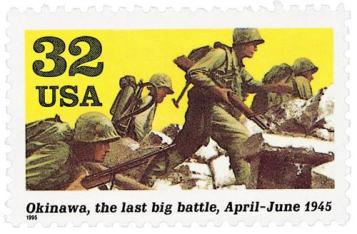
Established by act of Congress on July 9, 1918, the Silver Star is the third-highest decoration is the system of military honors awarded to members of US armed services for valor in combat, against an enemy of the United States. A search of public records reveals a long list of recipients of the Silver Star including the name “Ball, Harvey A. HQ, 45th Infantry Division, G.O. No. 281”.
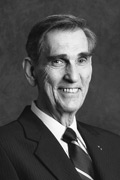
Harvey Ball earned the silver star medal “for Conspicuous Gallantry in Action” in the 1945 battle for Okinawa. He went on to serve most of his life in the United States Army Reserve and retired in 1979 with the rank, of Colonel.
A member of the greatest generation his was a name you may not know but I guarantee you will know the man, by his work.
Harvey Ross Ball worked for a sign painter in Massachusetts while attending Worcester South High School, and went on to study fine arts at the Worcester Art Museum School.
After the war, Ball came home to Worcester and worked for a local advertising firm later opening his own ad agency, Harvey Ball Advertising, in 1959.
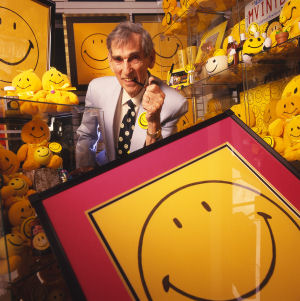
In 1963, the State Mutual Life Assurance Company of Worcester (now Hanover Insurance) bought out the Guarantee Mutual Company of Ohio. Employee morale tanked with the new acquisition. Director of Promotions Joy Young was tasked with solving the problem. Young hired Harvey Ball as a freelance artist to create a visual icon. A pin to be worn as part of the company’s ‘friendship campaign’.
First came that silly grin. That part was easy but the pair soon realized, the button could be inverted. Now we’ve got a “frowny” face and we can’t have that. Ball added eyes, the left drawn just a bit smaller than the right to “humanize” the image.
The work took ten minutes and the artist was paid $45, equivalent to $330 today. Neither Ball nor State Mutual Felt the need to copyright the graphic.

From Betty Boop to the hula hoop, popular culture is always primed and ready to dive into the latest fad. State Mutual ordered 100 buttons. It wasn’t long before manufacturers were taking orders for thousands at a time.

Seven years later the Philadelphia brothers Bernard and Murray Spain seized on the image producing coffee mugs, t-shirts, watches and bumper stickers by the millions, emblazoned with the happy face and the slogan “Have a happy day”. That was later revised to, “Have a nice day”.
The image was everywhere, second only to the ubiquitous “Peace Sign” of the era.
Frenchman Franklin Loufrani copyrighted the graphic in France in 1972, using the image in the “good news” section of the newspaper France Soir and developing a line of imprinted novelty items. Loufrani’s son Nicolas took over the family business and launched the Smiley Company, in 1996.
Unsurprisingly, the younger Loufrani is skeptical of Harvey Ball’s claim to have created such a simple design, pointing to cave paintings found in France dated to 2500BC and a similar graphic used in radio ad campaigns, of the early 1960s.
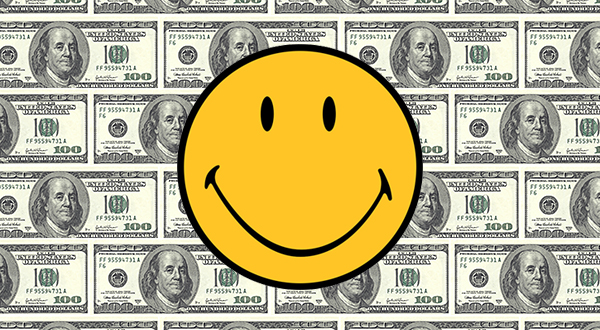
Of course, that didn’t prevent the company from seeking US trademark rights to the image and kicking off a years-long legal battle with retail giant WalMart, which had been using the happy face in its “Rolling Back Prices” campaign.
The 2007 film “Smiley” depicts the story of a lazy actress who eats marijuana laced brownies baked by a stoner roommate and embarks on a series of life-changing misadventures. If you don’t remember the film you’re in good company. The thing was delisted less than three months later on February 4, 2008.
The Smiley Company is one of the 100 largest licensing corporations in the world with revenues of $167 million in 2012, holding rights to the Smiley Face in over 100 countries. Notably, the United States is not one of them.
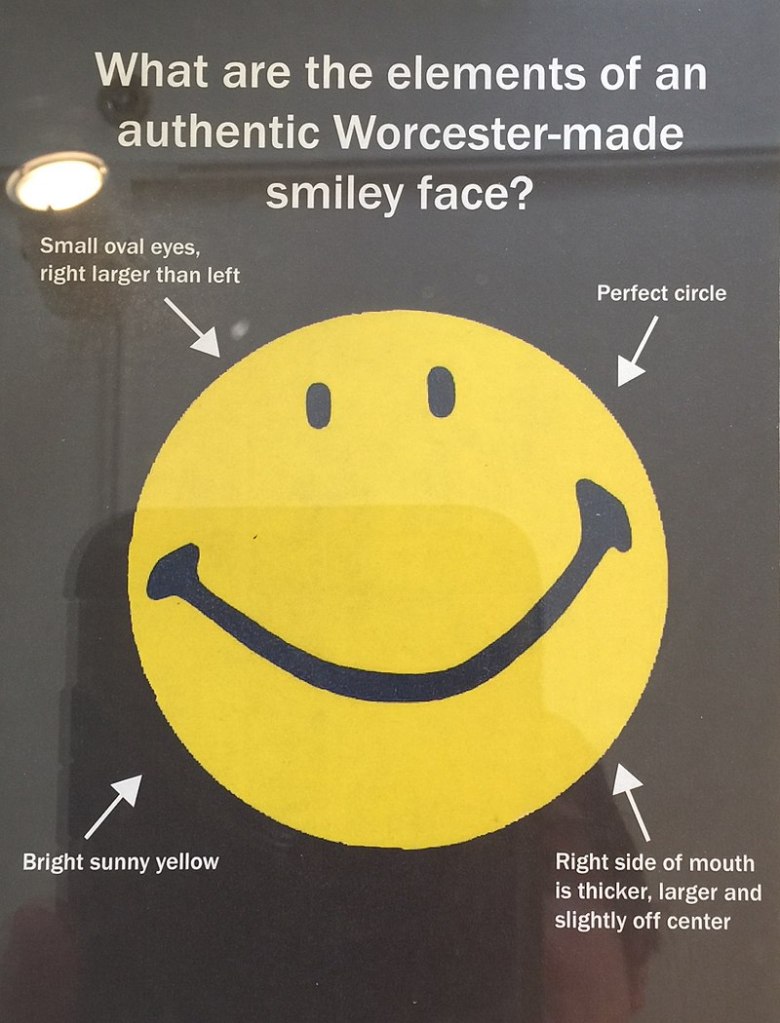
Harvey Ball wasn’t the first to draw a smiley face, or at least something similar. When archaeologists pieced together the broken shards of a Hittite jug there appeared looking back from some 3,700 years in the past a round circle with upturned mouth and two little dots, for eyes.
The Czech monk Bernard Hennet used something like very much like it in his signature, around 1741.
And yet it is one image we remember, the perfect yellow circle with the dots and lines that could only come, from Harvey Ross Ball.
Characters flew to Mars in the 2009 superhero film “Watchmen” , landing in a crater that looks very much, like Harvey Ball’s creation. The red planet’s own smiley face is very real I assure you. It’s an enormous impact basin located in the Argyre quadrangle in the southern highlands of Mars and named after the astronomer, Johann Gottfried Galle.
Would I kid you about something like that?

As for Ball himself, he didn’t seem to mind never copyrighting his creation. His son Charles says his father never was a money driven kind of guy. “Hey”, he would say, “I can only eat one steak at a time. Drive one car at a time”.
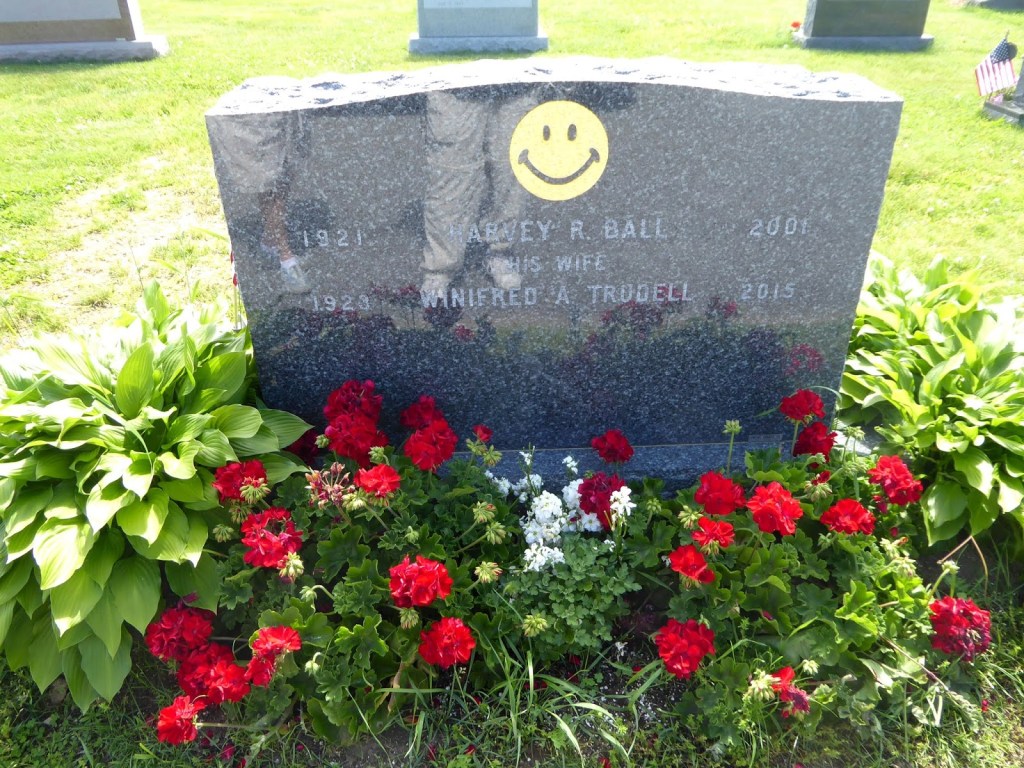
The artist is gone now but his work lives on in the popular imagination. And in the place where Harvey and his wife Winifred went to their eternal rest in the Notre Dame cemetery in Worcester, Massachusetts. If you’re ever in the area stop on by. It’s one of the happier places on earth as cemeteries go with Harvey Ball’s creation emblazoned on both sides and looking back at you as if to say, “Have a Nice Day”.



















 The age of Constantine saw enormous expansion of the city which bore his name, including enlargement of the Hippodrome to an impressive 1,476-feet long by 427-feet wide with a seating capacity of 100,000. By way of comparison, the Empire State Building is 1,454-feet from sidewalk to the very tip of the spire. Mercedes Benz Stadium in Atlanta, home of Super Bowl LIII, has a rated capacity of 71,000 spectators.
 A raised median called a spina ran down the center, adorned with stone statuary and obelisks. Ganging up to drive opposing handlers into the stone median or the stands, whipping opponents and even hauling them out of their chariots was not only permitted, but encouraged.
 Modern sport has seen its share of fan passion rising to violence, but the worst “futbol hooligan” pales to docility, compared with the crowd come to watch the chariot races. Imagine the worst fan violence of the modern era combined with aspects of street gangs and political organizations, each faction holding forth on the issues of the day and attempting to sway public policy by shouting slogans, between races.

 With spine thus restored, Justinian formulated a plan. The popular eunuch Narses was sent out with a bag of gold, into the lion’s den. Small and slight of build, unarmed but for those coins, Narses entered the Hippodrome and went directly to the Blue section. On this day in 532 Hypatios was in the very act of coronation when the eunuch spoke. Narses reminded the Blues that Hypatios was a Green while Justinian himself, supported their team.
 Thus ends one of the great “backfires” in political history. Senator Hypatius was put to the sword and those who had supported the pretender, sent into exile. Justinian I would rule another 33 years, rebuilding Constantinople, muzzling the Senatorial Class which had caused him such grief and reconquering lost territories, in Italy.









 Historical Easter Eggs - Today in History
You must be logged in to post a comment.