There would be no “Phoney War”, no “Sitzkreig”, as some wags were wont to call the early days of WWII. This would be a cataclysm that would change a century. Few realized it on this date, 103 years ago today. The collision was only days away.
On the eve of 1870, the German nation existed only as an agglomeration of 22 independent German states. On the eve of WWI, Germany was one of the five Great Powers of Europe.
Alarmed by the aggressive growth of its historic adversary, France had by that time increased its period of compulsory military service from two years to three, in an effort to offset the advantage which a population of 70 million conferred on Germany, compared with a French population of 40 million.
Joseph Caillaux was a left-wing politician, once Prime Minister of France and, by 1913, a cabinet minister under the more conservative administration of French President Raymond Poincare.
Never too discreet with his personal conduct, Caillaux paraded through his public life with a succession of mistresses. One of them was Henriette Raynouard. By 1911, both were divorced and Madame Raynouard had become Henriette Caillaux.
A relative pacifist, many on the French right considered Caillaux to be too “soft” on Germany. One of them was Gaston Calmette, editor of the leading right-wing newspaper Le Figaro, who regularly excoriated the politician.
On March 16, 1914, the now-second Mrs Caillaux took a taxi to the offices of Le Figaro. She waited for a full hour to see the newspaper’s editor, before walking into his office and shooting him at his desk. Four out of six rounds hit their mark. Gaston Calmette would be dead before the night was through.
It was the crime of the century. The OJ trial version 1.0. The French public was captivated as the trial began, 102 years ago, today.
The British public was similarly distracted, by the latest in a series of Irish Home Rule crises.
The Austro-Hungarian Empire, a sprawling amalgamation of 17 nations, 20 Parliamentary groups and 27 political parties, desperately needed to bring the Balkan peninsula into line after the June 28 assassinationof the heir-apparent to the dual monarchy.
That individual Serbians were complicit in the assassination is beyond doubt, but so many government records of the era have disappeared that it’s impossible to determine official Serbian complicity. Nevertheless, Serbia had to be brought into line.
Having given Austria his assurance of support in the event of war with Serbia, even if Russia entered in support of its Slavic ally, Kaiser Wilhelm of Germany left on a summer cruise in the Norwegian fjords. The Kaiser’s being out of touch for those critical days in July, has been called the most expensive maritime disaster, in naval history.
The Austro-Hungarian Empire delivered a deliberately unacceptable ultimatum to Serbia on the 23rd, a bald pretext for the war it declared on the 28th. The same day, Madame Caillaux was acquitted on the grounds that hers was a “crime passionnel”. A crime of passion.
In the days that followed, entangling alliances and mutual distrust reigned over the European continent. As expected, Russia mobilized in support of Serbia, as Germany began implementation of its long-standing strategy of a lightning defeat of France, before wheeling to face the much larger “Russian steamroller”.
Pre-planned timetables took over. France alone would have 3,781,000 military men under orders before the middle of August, arriving at the western front on 7,000 trains, arriving as often as one every eight minutes.
There would be no “Phoney War”, no “Sitzkreig”, as some wags were wont to call the early days of WWII. The coming storm would resemble the near-simultaneous detonation of a continent. A cataclysm which would destroy everything in its path and irrevocably alter the following century. Few realized it, as this warm summer day came and went, 103 years ago today. The four horsemen of the apocalypse, cometh. The collision was only days away.
Ernest Shackleton asked how the war had ended. The response left him without words. “The war isn’t over. Millions are dead. Europe is mad. The world is mad”.
In an alternate history, the June 1914 assassination of the heir-apparent to the Habsburg Empire could have led to nothing more than a regional squabble. Little more than a policing action in the Balkans. As it was, mutual distrust and entangling alliances drew the Great Powers of Europe into the vortex. On August 3, the “War to End Wars” broke out across the European continent.
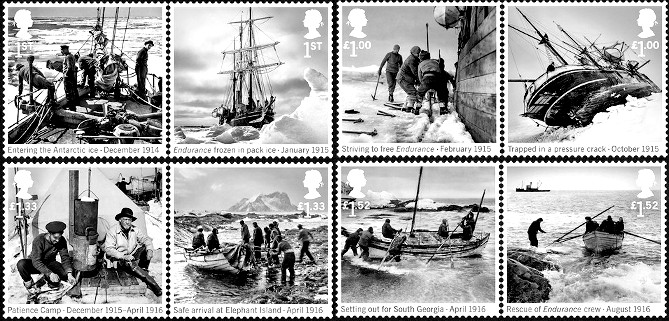
The early 20th century has been called the “Heroic Age of Antarctic Exploration”, and for good reason. As the diplomatic wranglings, the mobilizations and counter-mobilizations of the “period preparatory to war” unfolded, Sir Ernest Shackleton made the final arrangements for his third expedition into the Antarctic. Despite the outbreak of war, first Lord of the Admiralty Sir Winston Churchill ordered Shackleton to Proceed. The “Endurance” expedition” departed British waters on August 8.
The German invasion of France ground to a halt that September. The first entrenchments were being dug as Shackleton remained in England, departing on September 27 to meet up with the Endurance expedition in Buenos Aires.
As the unofficial Christmas Truce descended over the trenches of Europe, Shackleton’s expedition slowly picked their way through the ice floes of the Weddell Sea.
The disaster of WWI became “Total War” with the zeppelin raids of January, as Endurance met with disaster of its own. The ship was frozen fast, with no hope of escape. As the nine-month battle unfolded across the Gallipoli Peninsula, Shackleton’s men abandoned ship’s routine and converted to winter station. Finally, camps were set up across the drifting ice. On November 21, the wreck of the Endurance slipped below the surface.
In December, Allies began preparations for a summer offensive along the upper reaches of the river Somme. In February, Erich von Falkenhayn began the Verdun offensive that would “bleed France white”, as the Shackleton party camped on an ice pack, adrift in open ocean. The ice was breaking up in April, forcing Shackleton and his party into three small lifeboats. Five brutal days would come and go in open boats, the last of 457 days before reaching land at the desolate shores of Elephant Island.
The whaling stations at South Georgia Island, some 720 miles distant, were their only hope for survival. Shackleton and a party of five set out on April 24 in a 20′ lifeboat. They shouldn’t have made it, but somehow did. In hurricane-force winds, the cliffs of South Georgia Island came into view four weeks later.
They must have been a sight, with thick ice encrusted on long, filthy beards, saltwater-soaked sealskin clothing rotting from their bodies. The first people they came across were children, who ran in fright at the sight of them. At last, on May 20, 1916, the Shackleton expedition was saved.
Ernest Shackleton asked how the war had ended. The response left him without words. “The war isn’t over. Millions are dead. Europe is mad. The world is mad”.
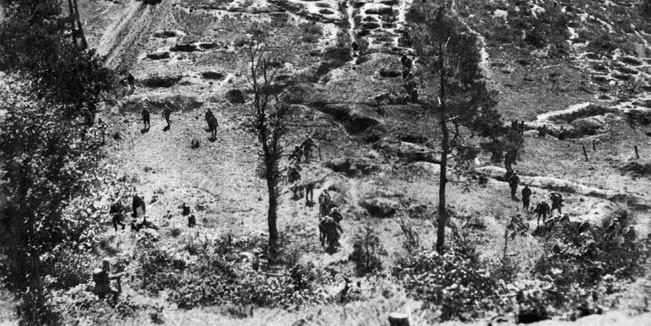
German trench from the Somme battlefield
Verdun battlefield, 2005
Preparatory bombardment for the Somme offensive began in June, 1,500 guns firing 1.7 million shells into a twelve-mile front. 27 shells for every foot of the front. Allies went “over the top” on July 1, the single worst day in British military history. 19,240 British soldiers were killed in that single day, along with 1,590 French. German losses numbered 10,000–12,000. By July 19 the Somme offensive was just getting started. The battle would last another 122 days.
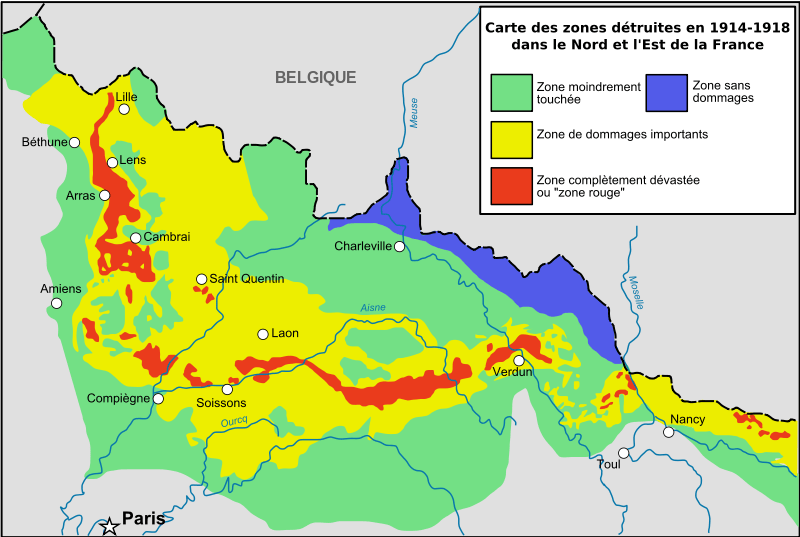
The toll exacted by the 1st World War was cataclysmic, in human, economic and environmental terms. After the war, hundreds of square miles along the north of France were identified as “Completely devastated. Damage to properties: 100%. Damage to Agriculture: 100%. Impossible to clean. Human life impossible”.
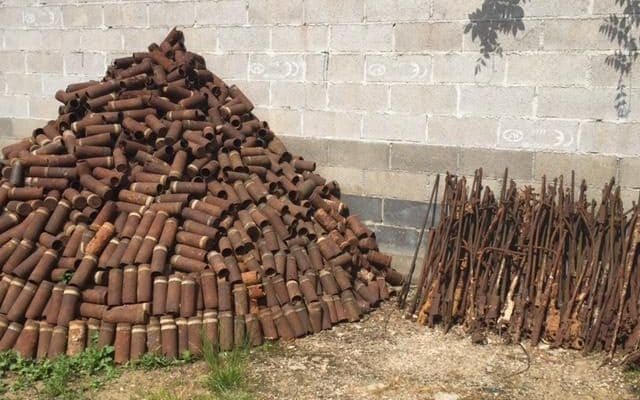
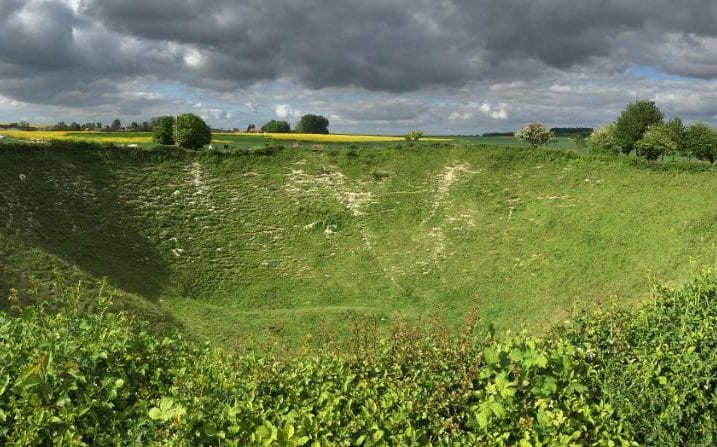
Vast quantities of human and animal remains permeate this “Zone Rouge”, an area saturated with unexploded shells and munitions of all sizes and types: gas, high explosive, anti-personnel. There are hand grenades and bombs, small arms and rusted ammunition, by the truckload.
Lochnagar bomb crater in the Somme Photo Credit Telegraph Newspaper: HENRY SAMUEL
Lead, mercury, chlorine, arsenic and other toxins permeate the soil. In two areas near Ypres and Woëvre, arsenic constitutes up to 17% of some soil samples. To this day, 99% of all plants still die in these places.
Eighty-seven years after the cessation of hostilities, one “Red Zone” survey uncovered up to 150 shells per 5,000 square meters in the top six inches of soil, alone. An area smaller than an American football field.
The rotor blades from farmers’ tractors often set them off. 76-year-old Claude Samain farms land near Serre, land that was once part of the British front line. As a farm kid in the 1930s, Samain still remembers turning up bodies in his fields. To this day, he is still finding unexploded ordnance. ‘We find shells every time we turn the earth over for potatoes or sugar beet.’
In June 2016, head of the bomb disposal unit at Amiens Michel Colling, said: “Since the start of the year we’ve been called out 300 times to dispose of 25 tons of bombs. As soon as you start turning the earth up”, Colling said, “you find them. At this rate, we have another 500 years to clear the area, so the work is far from over.”
For all his vaunted brilliance, Muenter seems to have been nuttier than a squirrel turd. His intention as explained to police, was to take Morgan’s wife and children hostage, until the financier cut off loans to Europe. He told police of his intention to assassinate J.P. Morgan, as well. How these two objectives squared with one another, remains unexplained.
The train left Boston in April, 1906. On board were the infant, the toddler, the nanny, and the children’s father, a German language instructor from Harvard University. The two little girls’ mother was onboard as well. She, and her casket, were going home to Chicago, to be buried in her home town. Leone (Krembs) Muenter had passed from some sort of stomach ailment, ten days after giving birth.
The story may have ended there, but for Dr. Herbert McIntyre. The circumstances of death didn’t seem right, and Dr. McIntyre ordered an autopsy. On April 27, Cambridge police issued a warrant for the arrest of Professor Erich Muenter, in the murder of his wife, by arsenic poisoning.
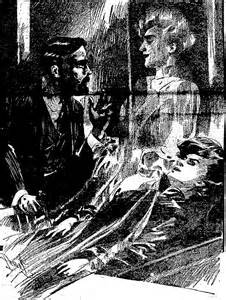
Apparently, this “man of science” wanted to test his theory that you could see the soul passing, at the moment of death. Now, Erich Muenter vanished.
Nine years later, the United States’ entry into WW1 was still two years in the future.
US policy at this time allowed arms sales to any and all belligerents in the European war. With British dominance of north Atlantic shipping routes, for all intents and purposes this meant France and Great Britain.
German language professor Frank Holt was teaching at Cornell University in 1915. A naturalized citizen and committed German nationalist, Holt had ties with the secret German spy intelligence unit Abteilung IIIb, which was conducting a campaign of sabotage against US ships carrying munitions ‘over there’.
Frank Holt might have described himself as a ‘peace activist’, obsessed with the idea that arms themselves were extending the war. If arms exports were brought to a halt, Holt believed, the war would come to an end.
On July 2, Holt gave up arguing the point, and took a train to Washington DC. In his hands he carried a bomb, three sticks of dynamite attached to a timing mechanism, ingeniously designed to go off when the acid ate through its cork stopper. In those days, you were apparently free to stroll about the United States Capitol, with a bomb in your hands. At least when Congress was in recess.
Finding the Senate chamber locked, Holt placed his package under a telephone switchboard in the Senate reception room, with the timer set to go off around midnight.
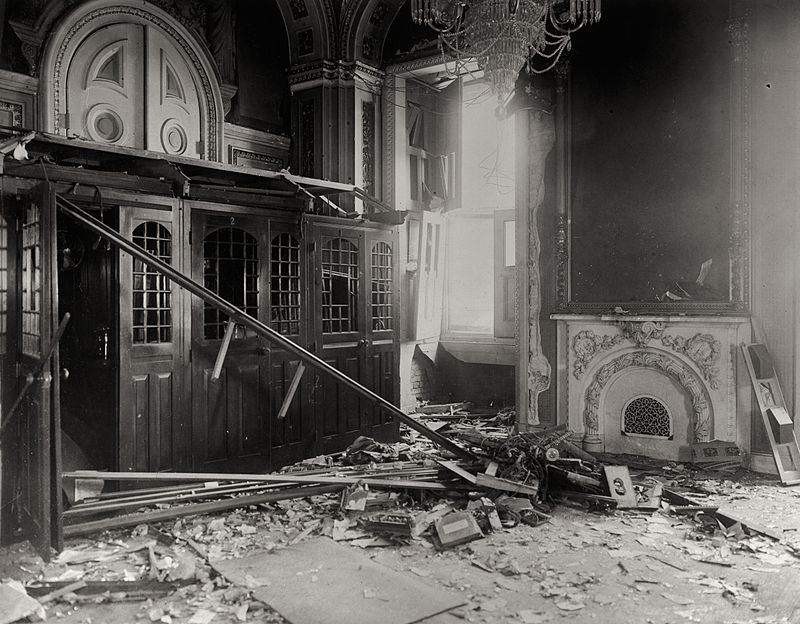
The explosion was enormous, tearing the room to pieces and blowing a night watchman out of his chair on the other side of the building. Writing to the Washington Star newspaper under the pseudonym R. Pearce, Holt explained his intentions to “make enough noise to be heard above the voices that clamor for war. This explosion is an exclamation point in my appeal for peace.”
Aftermath of the Senate bombing, July 2, 1915
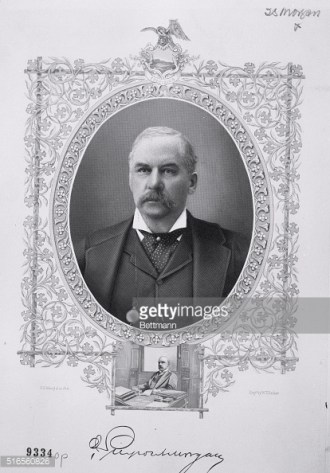
The following day, a tiny little box on the front page of the New York Times, attributed the explosion to ‘gasses’. As the paper was hitting news stands, Frank Holt was headed for Long Island, to the Glen Cove estate of “the Great Pierpont”, J. P. Morgan. Armed with two revolvers, a suitcase full of dynamite and a few anti-war newspaper clippings, Holt bulled his way through the butler who opened the door, and into the Morgan residence.
John Pierpont Morgan
Pandemonium broke out in the home, as Holt turned his weapons on the four Morgan children. Mrs. Morgan tried to block the path to her husband, but the millionaire financier lunged, tackling the much smaller man to the ground. Holt fired twice into Morgan’s thigh and groin, as the pair went down together. Pierpont twisted the gun from his grasp as Mrs. Morgan and a gaggle of household servants struggled for the other. All the while, the butler pounded the would-be assassin’s head with a lump of coal, as Holt shouted “Kill me! Kill me now! I don’t want to live any more. I have been in a perfect hell for the last six months on account of the European war!”
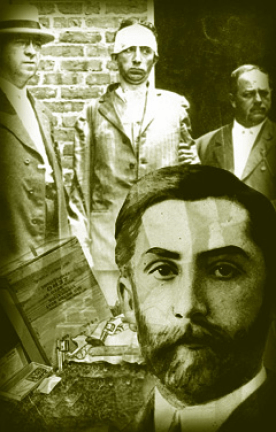
A copy of the R. Pearce letter quickly tied Holt to the Capitol bombing, as former colleagues identified the long-since vanished, accused killer of Leone Muenter. Frank Holt and Erich Muenter were the same man.
A colleague once described Muenter as “a brilliant man, a tireless worker, and a profound student. Night after night he would sit reading, studying and writing while his wife lay asleep in a room nearby.” The Harvard Crimson newspaper described him as ‘harmless on the surface…affect[ing] a scholarly stoop and a Van Dyke, and wore dingy, patched suits”. Fluent in seven languages, he was the pale, bearded model of the junior faculty intellectual, complete with elbow patches.
For all his vaunted brilliance, Muenter seems to have been nuttier than a squirrel turd. His intention as explained to police, was to take Morgan’s wife and children hostage, until the financier cut off loans to Europe. He told police of his intention to assassinate J.P. Morgan, as well. How these two objectives squared with one another, remains unexplained.
That Sunday morning, July 4, the J.P. Morgan shooting seems to have been front page on every newspaper in the world. On July 5, Erich Muenter took the brass ferrule from a pencil eraser, and slit his wrist. That suicide attempt was unsuccessful. The following day, Muenter scaled the bars in his prison and jumped, leaving his brains on the concrete floor, twenty feet below.
The day after his death, Police tracked down a trunk Muenter had left in a New York city storage facility. In it were 134 sticks of dynamite, blasting caps, fuse coils, batteries, nitric acid, windproof matches, mercury fulminate and smokeless explosive powder. Three tin can bombs had been recently completed, and were ready to go. Inspector of Combustibles Owen Egan declared it to be “the greatest equipment for bomb making ever brought to New York”.
That same day, the 2nd Mrs. Muenter received a letter from her dead husband. It said that an arms shipment headed for England would go to the bottom, that very day. Warned by wireless, the crew of SS Minnehaha frantically searched for the bomb, without success. Muenter’s bomb went off and touched off a fire, but it was far away from Minnehaha’s cargo of high explosives, and did little damage to the ship itself.
The Harland & Wolff liner SS Minnehaha was torpedoed and sunk off the Irish coast with the loss of 43, on September 7, 1917.
A correspondent to the New York Times wrote in 1918 “When I landed in France I didn’t think so much of the Salvation Army; after two weeks with the Americans at the front I take my hat off… [W]hen the memoirs of this war come to be written the doughnuts and apple pies of the Salvation Army are going to take their place in history”.
The United States entered the ‘War to end all Wars’ in April, 1917. The first 14,000 Americans arrived ‘over there’ in June, the American Expeditionary Forces (AEF) formed on July 5. American troops fought the military forces of Imperial Germany alongside their British and French allies, others joining Italian forces in the struggle against the Austro-Hungarian Empire.
For a variety of reasons, WW1 was a war of movement in the East. Not so on the Western front. As early as October 1914, combatants were forced to burrow into the ground like animals, sheltering from what Ernst Jünger called the ‘Storm of Steel’.
Conditions in the trenches and dugouts defy description. You must have smelled the trenches long before you could see them. The collective funk of a million men and more, out in the open. Little but verminous scars in the earth teaming with rats and lice and swarming with flies, time and again the shells churned up and pulverized the soil, the water and the shattered remnants of once-great forests, along with the bodies of the slain.
You couldn’t call the stuff these people lived in mud – it was more like a thick slime, a clinging, sucking ooze capable of claiming grown men, even horses and mules.
Captain Alexander Stewart wrote “Most of the night was spent digging men out of the mud. The only way was to put duck boards on each side of him and work at one leg: poking and pulling until the suction was relieved. Then a strong pull by three or four men would get one leg out, and work would begin on the other…He who had a corpse to stand or sit on, was lucky”.
On first seeing the horror of Paschendaele, Sir Launcelot Kiggell broke down in tears. “Good God”, he said. “Did we really send men to fight in that?”
Often unseen in times of such calamity, are the humanitarian workers. Those who tend to the physical and spiritual requirements, the countless small comforts, of those in need.
Within days of the American declaration of war, Evangeline Booth, National Commander of the Salvation Army, responded, saying “The Salvationist stands ready, trained in all necessary qualifications in every phase of humanitarian work, and the last man will stand by the President for execution of his orders”.
These people are so much more than that donation truck, and the bell ringers we see behind those red kettles, in December.
Lieutenant Colonel William S. Barker of the Salvation Army left New York with Adjutant Bertram Rodda on June 30, 1917, to survey the situation. It wasn’t long before his not-so surprising request came back in a cable from France. Send ‘Lassies’.
A small group of carefully selected female officers was sent to France on August 22. That first party comprised six men, three women and a married couple. Within fifteen months their number had expanded by a factor of 400.
In December 1917, a plea for a million dollars went out to support the humanitarian work of the Salvation Army, the YMCA, YWCA, War Camp Community Service, National Catholic War Council, Jewish Welfare Board, the American Library Association and others. This “United War Work Campaign” raised $170 million in private donations, equivalent to $27.6 billion, today.
‘Hutments’ were formed all over the front, many right out at the front lines. Religious services of all denominations were held in these facilities. Concert performances were given, clothing mended and words of kindness were offered in response to all manner of personal problems. There were canteen services. On one occasion, the Loyal Order of Moose conducted an initiation at one of them. Pies and cakes were baked in crude ovens and lemonade was served to hot and thirsty troops. Of all these corporal works of mercy, the ones best remembered by the ‘doughboys’ themselves, were the doughnuts.
Helen Purviance, sent to France in 1917 with the American 1st Division, seems to have been first with the idea. An ensign with the Salvation Army, Purviance and fellow ensign Margaret Sheldon first formed the dough by hand, later using a wine bottle in lieu of a rolling pin. Having no doughnut cutter at the time, dough was shaped and twisted into crullers, and fried seven at a time on a pot-bellied wood stove.
The work was grueling. The women worked well into the night that first day, serving all of 150 hand-made doughnuts. “I was literally on my knees,” Purviance recalled, but it was easier than bending down all day, on that tiny wood stove. It didn’t seem to matter. The men stood in line for hours, patiently waiting in the mud and the rain. Their own little piece of warm, home-cooked heaven, in a world full of misery.
Before long, the women got better at it. Soon they were turning out 2,500 to 9,000 doughnuts a day. An elderly French blacksmith made Purviance a doughnut cutter, out of a condensed milk can and a camphor-ice tube, attached to a wooden block.
It wasn’t long before the aroma of hot doughnuts could be found, wafting all over the dugouts and trenches of the western front. Volunteers with the Salvation Army and others made apple pies and all manner of other goodies, but the name that stuck, was “Doughnut Lassies”.
A correspondent to the New York Times wrote in 1918 “When I landed in France I didn’t think so much of the Salvation Army; after two weeks with the Americans at the front I take my hat off… [W]hen the memoirs of this war come to be written the doughnuts and apple pies of the Salvation Army are going to take their place in history”.
Years earlier, German Chancellor Otto von Bismarck had said the next European war would be started by “Some damn fool thing in the Balkans”. Bismarck got his damn fool thing on June 28, 1914, when future Emperor Franz Ferdinand came to Sarajevo, the capital of the Balkan province of Bosnia-Herzegovina.
In 1914, Austria-Hungary was a kaleidoscope of fifteen distinct ethnic groups speaking at least that many languages. Ostensibly a constitutional union between the Empire of Austria and the Kingdom of Hungary, the dual monarchy was in fact divided, sometimes sharply, along no fewer than six religious lines.
Since the 1889 suicide of his cousin Crown Prince Rudolf, the only son of Emperor Franz Josef, Franz Ferdinand, was the Heir Presumptive to the Austro-Hungarian throne.
Sophie Maria Josephine Albina Chotek von Chotkow und Wognin was a minor noble in the Kingdom of Bohemia, a small figure in a constellation of 19th century European royalty. It’s uncertain when Sophie and Franz first met and fell in love, but their relationship caused a royal scandal. The future Queen of the Habsburg Dynasty was expected to hold suitable rank. Only a Princess of one of Europe’s dynastic families would do, certainly no Bohemian Countess.
Ferdinand wrangled with the Royal Court in Vienna for a year before the couple was permitted to marry, but only under hard and humiliating conditions. Theirs was a “morganatic” marriage. A marriage of unequals.
Three days before the wedding, June 28, 1900, Franz was forced to sign and publicly declare Sophie to be his morganatic wife, never to bear the titles of Empress, Queen or Archduchess. Any children produced by the marriage would neither inherit nor be granted dynastic rights or privileges of any kind. The Imperial family didn’t even show up at the wedding.
In a world where rank was everything, Sophie was never permitted to appear beside her husband in public. She was humiliated at every court function, relegated to last place and made to stand in line behind every Archduchess, Princess and Countess from Vienna to Budapest.
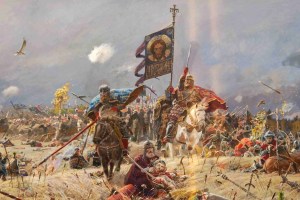
June 28 was significant for another reason. The invading army of Ottoman Sultan Murad I was wiped out on this date in the 1389 Battle of Kosovo, (June 15, ‘old style’), the “Field of Blackbirds”. It was a Pyrrhic victory, as the Balkan defenders were virtually wiped out as well. The Ottomans being far more numerous, the Balkan states soon became vassals of the Ottoman Turks.
The Encyclopedia Britannica describes “Balkanization” as “fragmentation of ethnic groups”. The Balkans form a geographic and political region, including 13 southeastern European nations from Slovenia to Greece. Located at the crossroads of east and west, the region has been subjugated and re-subjugated since the 6th century BC conquests of Persian King Darius the Great. The Balkan wars of 1912-1913 wrested some (but not all) of the area back from Ottoman control, as a newly enlarged Serbia pushed for greater independence and alliance among south Slavic peoples.
Years earlier, German Chancellor Otto von Bismarck had said the next European war would be started by “Some damn fool thing in the Balkans”. Bismarck got his damn fool thing on June 28, 1914, when future Emperor Franz Ferdinand came to Sarajevo, the capital of the Balkan province of Bosnia-Herzegovina.
Morganatic marriage was unknown in Hungarian law and custom. This trip was a rare opportunity for the couple to openly travel together. A “place in the sun” for Ferdinand’s wife, Sophie.
Ironically, Franz Ferdinand favored a more federalized model for the Empire, with greater autonomy for all its provinces. That wasn’t enough for the radical Serbian nationalists of the “Black Hand”, who inserted seven assassins along the route which the Archduke was scheduled to travel.
They were a carpenter, a printer, a teacher and four students. The oldest was 27. All suffered from tuberculosis, all armed with revolvers, crude bombs, or both, and a cyanide capsule with which to commit suicide if captured.
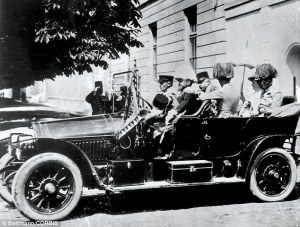
The six car motorcade drove by the first assassin, Muhamed Mehmedbašić, a little after 10am. He froze, allowing the cars to pass unmolested.
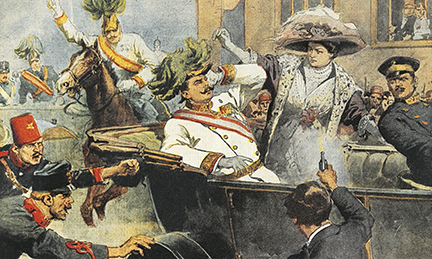
Riding along the Appel Quay, the motorcade passed the second assassin, Nedeljko Čabrinović, who threw his bomb at the open car. The driver sped away as the bomb went off under the wheel of the fourth car, wounding two occupants and a dozen spectators. Meanwhile, Čabrinović popped his cyanide pill and jumped into the Miljacka River, expecting to die. The cyanide just made him retch and the river was but a few inches deep, so the would-be assassin was soon in police custody.
The motorcade sped on to a planned reception at City Hall, passing three more assassins, Vasco Cubrilovic, Danilo Ilic and Cvijetko Popovic, none of whom did anything. There followed a sort of dark comedy, when Ferdinand jumped out of the car, incandescent with rage. Addressing Fehim Effendi Curcic, the mayor of Sarajevo, Ferdinand shouted “One comes here to visit and is received with bombs. Mr. Mayor, what do you say? It’s outrageous!” Unaware of what had happened, Mayor Curcic began to read his prepared remarks: “Our hearts are filled with happiness…”
Ferdinand later insisted on visiting the wounded at hospital, though he begged Sophie to stay behind. She wouldn’t have it. The Military Governor of the province, Oskar Potiorek, assured them of safe passage. Sophie would remain by her husband’s side.
Soon they were off, speeding by the sixth assassin, Trifko Grabez, before he could react. Taking a wrong turn onto Franz Josef Strasse, the chauffeur realized his error and came to a stop before turning around. They were 8’ from the seventh and last assassin, Gavrilo Princip. Princip was in point blank range in two steps, firing once into Sophie’s side and once into the neck of the Archduke.
Archduke Franz Ferdinand’s jugular had been severed by the bullet. “For heaven’s sake, what’s happened to you?” she cried, before slipping to the floor of the car. “Sophie dear, Sophie dear, don’t die. Stay alive for our children.” Asked if he was alright, Franz Ferdinand was already fading away. “Es ist nichts; Es ist nichts…” (It is nothing; it is nothing…). By 11:30, both were dead.
The mad act of a tubercular 19-year led to a series of diplomatic missteps and military mobilizations and counter-mobilizations called the “July Crisis of 1914″, culminating in the “War to End all Wars” that August. There is virtually no part of 20th century history, that would ever be the same.
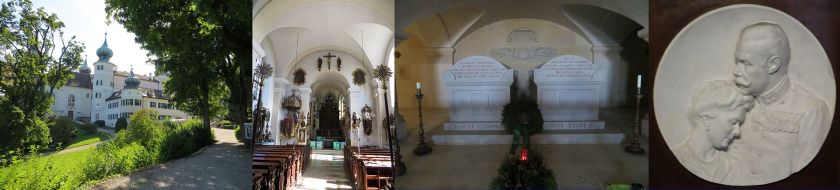
Knowing that he and his beloved wife could never be buried together in the Imperial Crypt, Ferdinand got the last word. In 1910, the Archduke set up a family crypt below the choir at the Artstetten Castle, in lower Austria. Neither had any idea that they’d need it, four years later. Now, Sophie and Ferdinand are at rest. At equal heights. Photo credit (2012) Marshmallowbunnywabbit at English Wikipedia, CC BY-SA 3.0, https://commons.wikimedia.org/w/index.php?curid=29775082
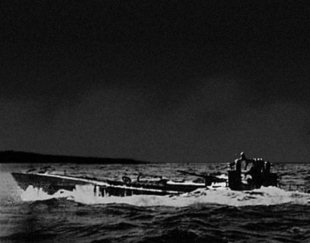
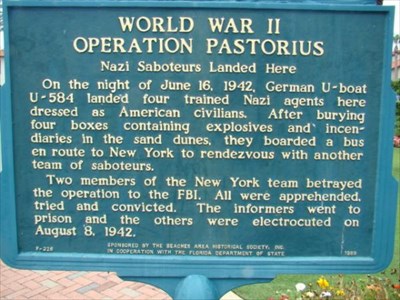
The German submarine U-202 came to the surface in the small hours of June 12 at Amagansett, NY, near Montauk Point. The inflatable that came out of its hatch was rowed to shore at what is today Atlantic Avenue beach, Long Island.
Much has been written about the eight central characters in this story. These individuals have been described in contemporary and subsequent sources alike, as Saboteurs, Nazis and Spies. Certainly to call them such, fed into the political expectations of the day. Yet their country had chosen them for this mission based on unique qualifications, separate and apart from whatever devotion they felt for the fatherland, or to the Nazi party. It may be that these guys deserve every evil name that’s been heaped upon them. Or maybe they were just eight guys who got caught up between two nations at war. It’s an interesting story. You decide.
The German submarine U-202 came to the surface in the small hours of June 12 at Amagansett, New York, near Montauk Point. The inflatable that came out of its hatch was rowed to shore at what is today Atlantic Avenue beach, Long Island. Four figures stepped onto the beach wearing German military uniforms. If they’d been captured at that point, they wanted to be treated as enemy combatants, rather than spies.
Their mission was to sabotage American economic targets and damage defense production. Their targets included hydroelectric plants, train bridges, and factories. They had almost $175,000 in cash, some good liquor, and enough explosives to last them through a two year campaign.
German plans began to unravel as they buried their uniforms and explosives in the sand. 21-year old Coast Guardsman John Cullen was a “sand pounder”. Armed only with a flashlight and a flare gun, Cullen had the unglamorous duty of patrolling the beaches, looking for suspicious activity.
It was “so foggy that I couldn’t see my shoes”, Cullen said, when a solitary figure came out of the dunes. He was George John Davis, he said, a fisherman run ashore. Something seemed wrong and Cullen’s suspicions were heightened, when another figure came out of the darkness. He was shouting something in German, when “Davis” spun around, yelling, “You damn fool! Go back to the others!”
With standing orders to kill anyone who confronted them during the landing, Davis hissed, “Do you have a mother? A father? Well, I wouldn’t want to have to kill you.”
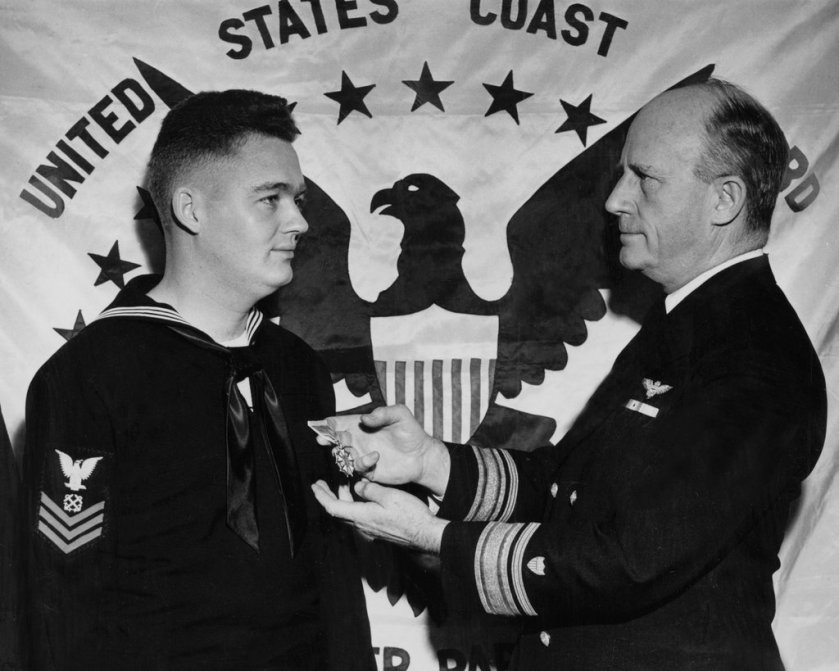
It was Cullen’s lucky day. “Davis'” real name was George John Dasch. He was no Nazi. He’d been a waiter and dishwasher before the war, who’d come to the attention of the German High Command because he’d lived for a time in America. “Forget about this, take this money, and go have a good time” he said, handing over a wad of bills. $260 richer, Cullen sprinted two miles to the Coast guard station.
Seaman John Cullen, left, received the Legion of Merit from Rear Adm. Stanley V. Parker for his service in WW2
Four days later, U-584 deposited a second team of four at Ponte Vedra Beach, Florida, south of Jacksonville. As with the first, this second group had lived and worked in the United States, and were fluent in English. Two of the eight were US citizens.
George Dasch had a secret. He had no intention of carrying out his mission. He summoned Ernst Peter Burger to an upper-level hotel room. Gesturing toward an open window, Dasch said “You and I are going to have a talk, and if we disagree, only one of us will walk out that door—the other will fly out this window.”
Burger turned out to be a naturalized citizen, who’d spent 17 months in a concentration camp. He hated the Nazis as much as Dasch, and the pair decided to defect.
Dasch tested the waters. Convinced the FBI was infiltrated with Nazi agents, he telephoned the New York field office. Put on hold with the call transferred several times, Dasch was horrified to have the agent who finally listened to him, quietly hang up the phone. Had he reached a German mole? Had the call been traced?
Dasch could not have known, he’d been transferred to the ‘nut desk’. The FBI thought he was a clown.
Finally, Dasch went to the FBI office in Washington DC, where he was treated like a nut job. Until he dumped $84,000 on Assistant Director D.M. Ladd’s desk, equivalent to about a million, today. Dasch was interrogated for hours, and happily gave up everything he knew. Targets, German war production, he spilled it all, even a handkerchief with the names of local contacts, written in invisible ink. He couldn’t have been a very good spy, though. He forgot how to reveal the names.
All eight were in custody within two weeks.
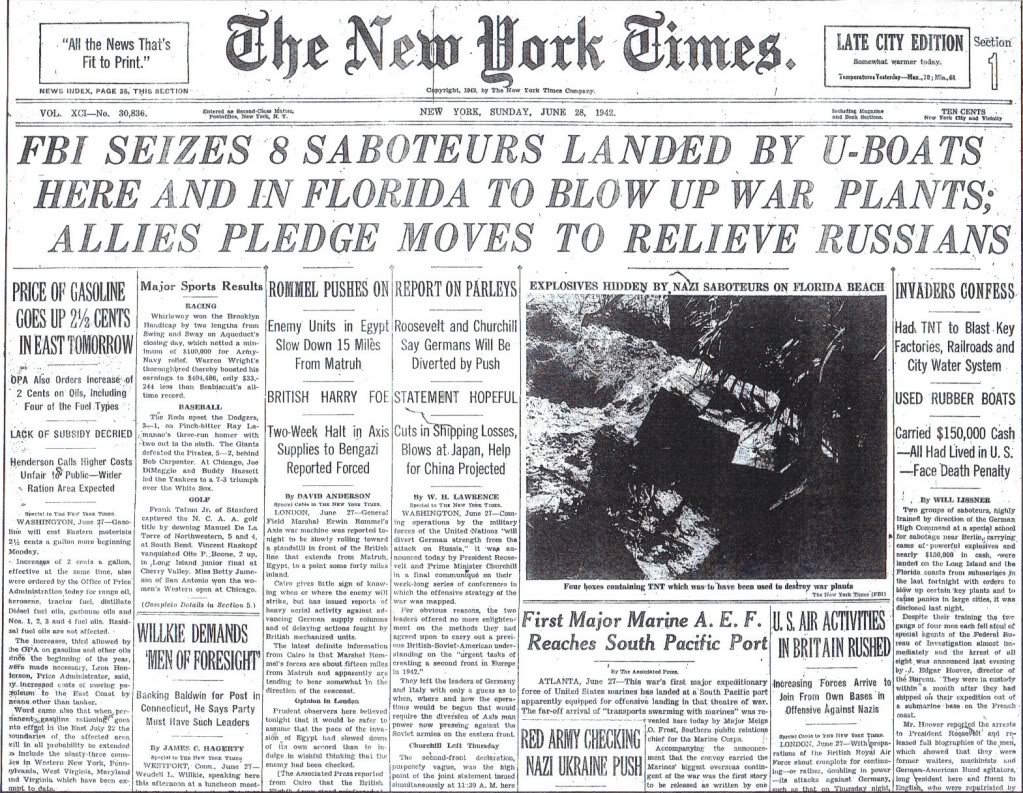
J. Edgar Hoover announced the German plot on June 27, but his version had little resemblance to that of Dasch and Burger. As with the brief he had given President Roosevelt, Hoover praised the magnificent work of FBI detectives, and the Sherlock Holmes-like powers of deduction which led Assistant Director Ladd to the $84,000. Dasch and Burger’s role in the investigation was conveniently left out, as was the fact that the money had basically bounced Ladd off the head.
Neither Dasch nor Burger expected to be thrown in a cell, but agents assured them it was a formality. Meanwhile, a credulous and adoring media speculated on how Hoover’s FBI had done it all. Did America have spies inside the Gestapo? German High Command? Were they seriously that good?
Attorneys for the defense wanted a civilian trial, but President Roosevelt wrote to Attorney General Francis Biddle: “Surely they are as guilty as it is possible to be and it seems to me that the death penalty is almost obligatory”. The case went all the way to the Supreme Court, where the decision “Ex parte Quirin” became precedent for the way unlawful combatants are tried, to this day. All eight would appear before a military tribunal.
It’s unclear whether any of the eight were the menace they were made out to be. German High Command had selected all eight based on a past connection with the United States, ordering them to attack what they may have regarded as their adopted country. Several were arrested in gambling establishments or houses of prostitution. One had resumed a relationship with an old girlfriend, and the pair was planning to marry. Not exactly the behavior patterns of “Nazi saboteurs”.
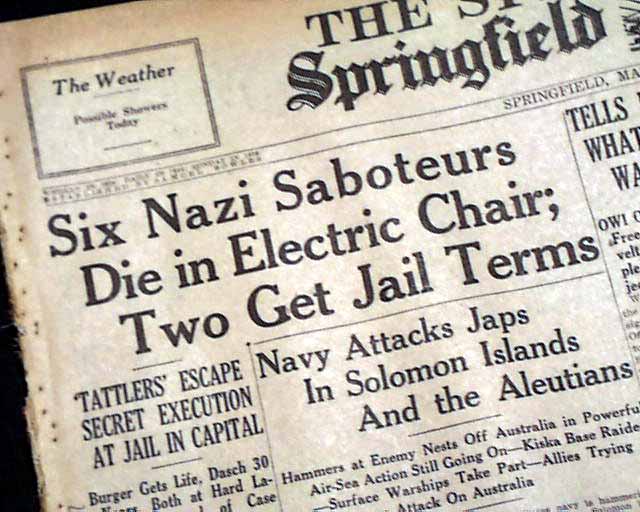
The trial was held before a closed-door military tribunal in the Department of Justice building in Washington, the first such trial since the Civil War. All eight defendants were found guilty and sentenced to death. It was only on reading trial transcripts, that Roosevelt learned the rest of the story. The President commuted Burger’s sentence to life and Dasch’s to 30 years, based on their cooperation with the prosecution. The other six were executed by electric chair on August 8, in alphabetical order.
After the war, Burger and Dasch’s trial transcripts were released to the public, over the strenuous objections of J. Edgar Hoover. In 1948, President Harry S. Truman bowed to political pressure, granting them executive clemency and deporting both to the American zone of occupied Germany. The pair found themselves men without a country, hated as spies in America, and traitors in Germany.
The reader may decide, whether Hoover and Roosevelt operated from base and venal political motives, or whether the pair was playing 4-D chess. Be that as it may, Hitler rebuked Admiral Canaris, and seems to have bought into Hoover’s version of FBI invincibility. There would be no further missions of this type, save for one in November 1944, when two spies were landed on the coast of Maine to gather information on the Manhattan project.
George Dasch campaigned for the rest of his life, to be allowed to return to what he described as his adopted country. Ernst Burger died in Germany in 1975, Dasch in 1992. The pardon Hoover promised both men a half-century earlier, never materialized
White crosses and Stars of David stand silent witness over the graves of fallen servicemen at the American cemetery, 2,289 of them. 250 mark the final resting place of the unknown. The names of another 1,060, missing for all time, appear on the wall of a memorial chapel. Visitors there may also stop at the nearby German cemetery, where 8,625 are buried.
After three years, the Great War could be likened to two evenly matched and exhausted fighters, each holding the other by the throat while attempting to beat the other to death.
Swaths of the European countryside were literally torn to pieces. Every economy on the continent tottered on the edge of destruction, or close to it. The Austro-Hungarian and Ottoman Empire were on the edge of extinction. The Russian Empire was dying.
No fewer than 1.7 million Russian troops lay dead at the dawn of 1917, and food shortages plagued the countryside. The Czar was forced to abdicate by February, as the largest belligerent of the war descended into civil war. By March, Imperial Russia was all but out of the war.
The United States entered WW1 relatively late, the first 14,000 Americans arriving ‘over there’ in June 1917. General John ‘Black Jack’ Pershing wanted his troops to be well trained and equipped before entering combat, and refused to disperse them, piecemeal. Desperately wanting the Americans to fill in gaps in his own lines, British Field Marshal Douglas Haig called Pershing ‘Obstinate and Stupid. Ridiculous’. French Marshall Ferdinand Foch was apoplectic, but Pershing refused to allow his people to be used as cannon fodder.
The first small-scale American action occurred that October, near the trenches of Nancy. Meanwhile, a mighty force was building at the French harbors of Bordeaux, La Pallice, Saint Nazaire and Brest. Passenger liners, seized German vessels and borrowed Allied ships poured out of New York, New Jersey, and Newport News, as American engineers built 82 new ship berths, nearly 1,000 miles of railroad track and 100,000 miles of telephone and telegraph lines across the french countryside.
By May 1918, those initial 14,000 had grown to over a million, ‘over there’.
It was imperative at this stage for the German war effort, to throw a knockout punch before the Americans entered in force. With close to 50 divisions freed up from duty in the east following the Russian surrender, Spring of 1918 was time for the ‘King’s Battle’. The Kaiserschlacht.
Operation Michael, the first of four German offensives, exploded against the British 3rd and 5th Armies at 4:40am on March 21. In the space of five hours, 1,100,000 shells were fired into an area 150 miles square. This “Storm of Steel” was followed by storm troopers: fast, elite German infantry armed with flame throwers and small arms, following a moving curtain of fire known as the ‘Feuerwalze’. Rupprecht, Crown Prince of Bavaria, was succinct. “We chop a hole. The rest follows.”
At first, Michael was so successful that German troops outran their own supply lines. The German advance began to falter as exhausted forces faced waves of fresh British and Australian troops. By April 5 the western front was returned to stalemate, at the cost of 255,000 British, British Empire and French troops. 239,000 were lost to the German side.
‘Operation Georgette‘, the Battle of Lys, opened after preliminary bombardment on April 9. The main attack all but destroyed the Portuguese Expeditionary Corps, the British 2nd Division and elements of the British 40th Division. In issuing his “Order of the Day” on April 11, Field Marshal Sir Douglas Haig stated, “With our backs to the wall and believing in the justice of our cause, each one of us must fight on to the end.”
Technically a German victory insofar as they held the ground when the shooting stopped, Georgette too was a pyrrhic victory. Killed, wounded and missing stood at roughly 220,000, split evenly between both sides.
Operation Blücher–Yorck, known to history as the Third Battle of the Aisne, began with a German attack on May 27, toward Rheims. The sector was nominally held by six British divisions, badly depleted and basically ‘resting’, following the mauling suffered in earlier fighting. Making matters worse, French General Denis Auguste Duchêne was openly contemptuous of Marshall Philippe Petain’s order to maintain defense in depth, insubordinately massing his troops in forward trenches.
The results of the Feuerwalze were devastating, if not predictable. Allied lines were smashed as German armies poured through, taking 19 kilometers in three days and reaching the Marne River, 50 miles from Paris. On May 31, a dogged defense by the US 3rd Infantry Division turned the German advance at Château-Thierry, and toward Belleau Wood.
This and the following week’s fighting earned for the 3rd I.D. the nickname “The Rock of the Marne”. To this day, the unit out of Ft. Stewart, Georgia, is known as the “Marne Division”.
On June 1, German Forces penetrated French lines to the left the US Reserve. The US Army 23rd Infantry Regiment, the 1st Battalion, 5th Marines, and an element of the Marine Corps 6th Machine Gun Battalion conducted a forced march overnight, covering over 6 miles to plug the gap and oppose the German line.
Arriving to find French forces retreating, Marines were urged to turn back. 2nd Battalion, 5th Marines Captain Lloyd Williams’ response would go down in Marine Corps History. “Retreat? Hell, we just got here”. Belleau Wood was one of the bloodiest battles US forces would fight in WW1. Six times over the following days, 5th & 6th Battalion Marines attacked the better part of five German divisions in Belleau Wood. The once-beautiful hunting preserve was reduced to a jungle of shattered timber.
An overwhelmingly superior German force threw everything they had at these two brigades of Marines, a few hundred soldiers and a handful of Navy corpsmen: mustard gas, interlocking and mutually supporting fields of machine gun fire. Fighting became hand to hand with rifle, bayonet and even fists. And still they came.
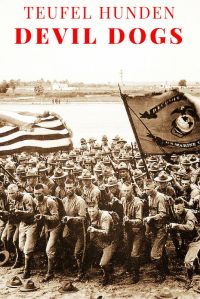
At Belleau Wood, Marines first heard the name “Höllenhunde” (“hellhound”), and the appellation that goes down in Marine Corps lore, to this day. “Teufelshunde”. “Devil Dogs.” In one attack on June 11, only 1 of the 10 Marine officers and 16 out of 250 enlisted men survived, or came out unscathed.
On June 26, Major Maurice Shearer was able to report, “Woods now U.S. Marine Corps entirely,” Belleau Wood was the first major engagement for American forces in WW1. They came out of it with nothing to prove.
On June 30, the French 6th Army Commanding General Jean Degoutte officially renamed Belleau Wood as “Bois de la Brigade de Marine” – Wood of the Marine Brigade.
A German private, one of only 30 men left out of 120, may have had the understatement of the war, when he wrote “We have Americans opposite us who are terribly reckless fellows.”
17,000 veterans and their families, 43,000 all told, gathered in and around Washington: men, women and children living in tents or in make-shift shelters built out of old lumber, packing boxes and scrap tin scavenged from nearby junkyards.
In 1924, Congress passed the “World War Adjusted Compensation Act”, awarding cash bonuses to veterans of the “Great War”, in which the United States had been involved from 1917 to 1918.
3,662,374 military service certificates were issued to qualifying veterans, bearing a face value equal to $1 per day of domestic service and $1.25 a day for overseas service, plus interest. Total face value of these certificates was $3.638 billion, equivalent to $43.7 billion in today’s dollars and coming to full maturity in 1945.
The Great Depression was two years old in 1932, and thousands of veterans had been out of work since the beginning. Certificate holders could borrow up to 50% of the face value of their service certificates, but direct funds remained unavailable for another 13 years.
WWI veterans began to arrive in Washington on May 29 to press their case for immediate cash redemption, setting up encampments between the Capitol and the Lincoln Memorial and around Washington DC. Former Army sergeant Walter W. Waters led the group, which called itself the “Bonus Expeditionary Force” after the American Expeditionary Force of WWI. The Media called them the “Bonus Army”.
This had happened before. Hundreds of Pennsylvania veterans of the Revolution had marched on Washington in 1783, after the Continental Army had been disbanded without pay.
The Congress fled to Princeton New Jersey on that occasion, and the Army was called up to expel these war veterans from the Capital. Washington, DC was later excluded from the restrictions of the Posse Comitatus Act, making it the only part of the United States where the military can be used for domestic police activity.
17,000 veterans and their families, 43,000 all told, gathered in and around Washington: men, women and children living in tents or in make-shift shelters built out of old lumber, packing boxes and scrap tin scavenged from nearby junkyards.
The House passed the bill which then went to the Senate for a vote on June 17, a day one newspaper described as “the tensest day in the capital since the war.” 10,000 marchers crowding the Capitol grounds responded with stunned silence when they got the news. The Senate had voted it down, 62 to 18. “Sing America and go back to your billets”, said Waters, and so they did. Marchers would hold a silent vigil in front of the Capitol, a “death march”, until July 17. The day that Congress adjourned.
Marchers were in their camps on July 28 when Attorney General William Mitchell ordered them evicted. Two policemen became trapped on the second floor of a building when they drew their revolvers and shot two veterans, William Hushka and Eric Carlson, both of whom died of their injuries.
President Hoover ordered the Army under General Douglas MacArthur to evict the Bonus Army from Washington. 500 Cavalry formed up on Pennsylvania Avenue at 4:45pm, supported by 500 Infantry, 800 police and six battle tanks under the command of then-Major George S. Patton. Civil Service employees came out to watch as bonus marchers cheered, thinking that the Army had gathered in their support. And then the Cavalry was ordered to charge. The infantry followed with tear gas and fixed bayonets, entering the camps and evicting men, women and children alike.
Bonus marchers fled to their largest encampment across the Anacostia River, when President Hoover ordered the assault stopped. Feeling that the Bonus March was an attempt to overthrow the government, General MacArthur ignored the President and ordered a new attack, the army routing 10,000 and leaving their camps in flames. 1,017 were injured and 135 arrested. The wife of one veteran miscarried. 12 week old Bernard Myers died after being caught in the gas attack. A government investigation later claimed he died of inflammation of the small intestine, but a hospital employee said the tear gas “didn’t do it any good.”
Then-Major Dwight D. Eisenhower was one of MacArthur’s aides at the time. Eisenhower believed that it was wrong for the Army’s highest ranking officer to lead an action against fellow war veterans. “I told that dumb son-of-a-bitch not to go down there”, he said.
The bonus march debacle doomed any chance that Hoover had of being re-elected. Franklin D. Roosevelt opposed the veterans’ bonus demands during the election, but he was able to negotiate a solution when veterans organized a second demonstration in 1933. Roosevelt’s wife Eleanor was instrumental in these negotiations, leading one veteran to comment: “Hoover sent the army, Roosevelt sent his wife”.
The Lafayette Escadrille is often confused with the much larger Lafayette Flying Corps, and the movie “Flyboys” adds to the confusion.
Norman Prince
Knowing that his father would not approve, Norman Prince of Beverly Massachusetts concealed his flight training. Using the name George Manor, Norman earned his wings in 1911 in the Quincy, Massachusetts neighborhood of Squantum. A fluent French speaker with a family estate in Pau, France, Norman sailed in January 1915, to join the French war effort.
The earliest vestiges of the American Hospital of Paris and what would become the American Ambulance Field Service can be found five years earlier, in 1906. Long before the American entry in 1917, individual sympathies brought Americans into the war to fight for Britain and France. They traveled to Europe to fight in the war against the Axis Powers, joining the Foreign Legion, the Flying Corps or, like Ernest Hemingway, the Ambulance Service.
Squadron Insignia pin
After 1915, American pilots volunteered for multiple “Escadrille” – flight squadrons of the French Air Service, the Aéronautique Militaire.
The March 7, 1918 Harvard Alumni Bulletin, would give Norman Prince full credit for persuading the French government to form all-American flying squadrons, though he would not live to see the article.
Sergeant Norman Prince caught a landing wheel on a telegraph wire after a bombing run on October 12, 1916, sustaining massive injuries when his plane flipped over and crashed. He was promoted to sous (2nd) lieutenant on his death bed and awarded the Legion of Honor. He died three days later, at the age of 29.
Lt. Col. William Thaw II with_lion cub mascots Whiskey and Soda
William Thaw II of Pittsburgh was the first pilot to fly up New York’s East River under all four bridges, the first American engaged in aerial combat in the war.
Thaw pooled his money with three other pilots to purchase a male lion cub, the first of two such mascots kept by the Escadrille. He bought the lion from a Brazilian dentist for 500 francs and bought a dog ticket, walking the lion onto the train on a leash. Explanations that this was an “African dog” were less than persuasive, and the pair was thrown off the train. “Whiskey” would have to ride to his new home in a cage, stuck in cargo.
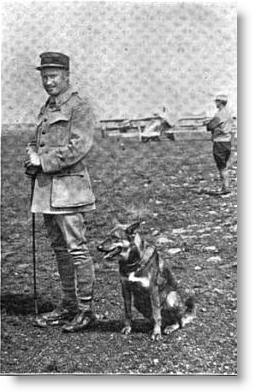
French Lieutenant Colonel Georges Thenault & Fram, 1917
French Lieutenant Colonel Georges Thenault owned a “splendid police dog” named Fram who was the best of friends with Whiskey, though he learned to keep to himself at dinner time.
A female lion, “Soda”, was purchased sometime later. The lions were destined to spend their adult years in a Paris zoo, but both remembered from whence they had come. Both animals recognized William Thaw on a later visit to the zoo, rolling onto their backs in expectation of a good belly rub.
Originally authorized on March 21, 1916 as the Escadrille Américaine (Escadrille N.124), American pilots wore French uniforms and flew French aircraft. Nevertheless, Germany was dismayed at the existence of such a unit, and complained that the neutral United States appeared to be aligning with France.
Escadrille N.124 changed its name in December 1916, adopting that of a French hero of the American Revolution. Marie-Joseph Paul Yves Roch Gilbert du Motier, Marquis de Lafayette. Five French officers commanded a core group of 38 American volunteers, supported by all-French mechanics and ground crew. Rounding out the Escadrille were the unit mascots, the African lions Whiskey and Soda.
This early in aviation history, flying duty was hazardous to say the least. Planes were flimsy and plagued with mechanical difficulties. Machine guns jammed and other parts failed when they were needed most. There were countless wounds in addition to fatal injuries. At least one man actually asked to be sent back to the trenches, where he felt safer.
Kiffin Rockwell
The first major action of the Escadrille Américaine took place at the Battle of Verdun on May 13, 1916. Kiffin Rockwell of Newport Tennessee became the first American to shoot down an enemy aircraft on May 18, later losing his own life when he was shot down by the gunner in a German Albatross observation plane on September 23. French born American citizen Raoul Lufbery became the squadron’s first Ace with 5 confirmed kills, and went on to be the highest scoring flying ace in the unit with 17 confirmed victories. He was killed on May 19, 1918, when his Nieuport 28 flipped over while he attempted to clear a jam in his machine gun.
The unit sustained its first fatality on June 24, 1916, when Victor Chapman was attacked by German flying ace Leutnant Kurt Wintgens, north of Douaumont. Chapman was carrying oranges at the time, intended for his buddy Clyde Balsley, who was in hospital recuperating from an earlier incident.
Edmond Genet
Ossining, New York native Edmond Genet was a bit of a celebrity among American expats, as the second-great grandson of Edmond-Charles Genêt, of the Founding-era Citizen Genêt Affair. Genet sailed for France at the end of January 1915, joining the French Foreign Legion, and finally the Lafayette Escadrille on January 22, 1917.
Genet had left while on leave from the US Navy, and was therefore classified as a deserter. The decision weighed heavily on him. Edmond Genet was shot down and killed by anti-aircraft artillery on April 17, eleven days after the American declaration of war, officially making him the first American fatality in the War to end all Wars. The war department sent his family a letter after his death, stating that his service was considered in all respects, honorable.
38 American pilots passed through the Lafayette Escadrille, “the Valiant 38”, eleven of whom were either killed in action or died later as the result of wounds received. The unit flew for the French Air Service until the US’ entry into the war, when it passed into the 103rd Aero Squadron, American Expeditionary Force.
Raoul Lufbery
The Lafayette Escadrille is often confused with the much larger Lafayette Flying Corps, and the movie “Flyboys” adds to the confusion. The Flying Corps was different from the Escadrille, the former coming about as the result of widespread interest in the exploits of the latter. American volunteers were assigned individually or in groups of two or three to fly in various French Aviation units, but, prior to US entry into the war. The Lafayette Escadrille was the only one to serve as a single organization.
All told, 267 American volunteers applied to serve in the Lafayette Flying Corps, credited with downing 199 German planes at the cost of 19 wounded, 15 captured, 11 dead of illness or accident, and 51 killed in action.
Lafayette Escadrille, July 1917. Standing (left to right) Soubiron, Doolittle, Campbell, Persons, Bridgman, Dugan, MacMonagle, Lowell, Willis, Jones, Peterson and de Maison-Rouge. Seated (left to right) Hill, Masson with “Soda,” Thaw, Thénault, Lufbery with “Whiskey,” Johnson, Bigelow and Rockwell. Georges Thenault’s dog “Fram” sits in the foreground.
The news was greeted with reserve in the United States, where the first thought was that there was still a lot of fighting to do in the Pacific
Reporters from AP, Life magazine, and others began sleeping on the floor of Eisenhower’s red brick schoolhouse headquarters on the 5th, for fear of stepping out and missing the surrender of Nazi Germany. Adolf Hitler had taken his own life on April 30, so it was General Alfred Jodl who came to Reims, France to sign the document, which included the phrase “All forces under German control to cease active operations at 2301 hours Central European time on 8 May 1945“. The signing of the instruments of surrender ending WWII in Europe took place on Monday, May 7, at 2:41am, local time. The war in Europe, was over.
The German government announced the end of hostilities to its people right away, but most of the Allied governments, remained silent. Field Marshal Wilhelm Keitel would not repeat the signing in Soviet General Georgy Zhukov’s Berlin headquarters until nearly midnight of the following day. Soviet Premier Josef Stalin had his own ideas about how he wanted to handle the matter, and so the rest of the world, waited.
In England, the 7th dragged on with no public statement. Large crowds gathered outside of Buckingham Palace shouting “We want the King”. Bell ringers throughout the British Isles remained on silent standby, waiting for the announcement. The British Home Office issued a circular, instructing Britons how they could celebrate: “Bonfires will be allowed, but the government trusts that only material with no salvage value will be used.” Still, the world waited.
Prime Minister Winston Churchill finally lost patience in the early evening, saying he wasn’t going to give Stalin the satisfaction of holding up what everyone already knew. The Ministry of Information made this short announcement at 7:40pm: “In accordance with arrangements between the three great powers, tomorrow, Tuesday, will be treated as Victory in Europe Day and will be regarded as a holiday”.
The news was greeted with reserve in the United States, where the first thought was that there was still a lot of fighting to do in the Pacific. President Harry Truman broadcast an address to the nation at 9:00am on May 8th, thanking President Roosevelt and wishing he’d been there to share the moment. Roosevelt had died on April 12, in Warm Springs, Georgia.
President Truman’s speech begins: “This is a solemn but a glorious hour. I only wish that Franklin D. Roosevelt had lived to witness this day. General Eisenhower informs me that the forces of Germany have surrendered to the United Nations. The flags of freedom fly over all Europe. For this victory, we join in offering our thanks to the Providence which has guided and sustained us through the dark days of adversity”.
VE Day wasn’t the end of WWII, only the end of the war in Europe. Fighting in the Pacific would continue until the Japanese surrender on the 15 August 1945, the date celebrated as VJ Day.
Today we don’t hear much about the Eastern Front, though it was the largest military confrontation in history. Fighting between Nazi Germany and the Soviet Union had long since taken on shades of a race war, Slav against Teuton, in a paroxysm of mutual extermination that is horrifying, even by the hellish standards of WWII. Nearly every extermination camp, death march, ghetto and pogrom which formed the Holocaust, occurred on the Eastern Front.
The loss of life was prodigious, through atrocity, massacre, disease, starvation and exposure. Civilians resorted to cannibalism, during the 900-day siege of Leningrad. Entire landscapes were destroyed while populations fled, never to return. Rape became a weapon of war.
An estimated 70 million people were killed all over the world, as the result of World War II. Over 30 million of them, many of those civilians, died on the Eastern Front. Pockets of fighting would continue through the surrender in Europe. Soviet forces lost over 600 in Silesia alone, on May 9. The day after their own signing. Moscow celebrated VE Day on the 9th, with a radio broadcast from Josef Stalin himself: “The age-long struggle of the Slav nations…has ended in victory. Your courage has defeated the Nazis. The war is over.”
7th May 1945: A wounded American serviceman during a ticker tape parade in New York following press reports of the unconditional surrender of Germany. (Photo by Fox Photos/Getty Images)


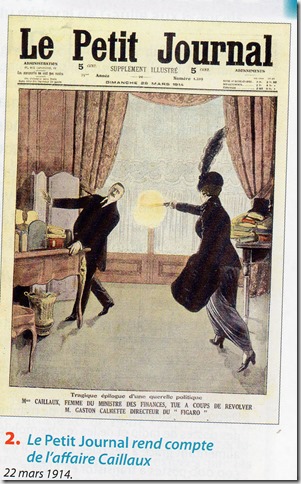 On March 16, 1914, the now-second Mrs Caillaux took a taxi to the offices of Le Figaro. She waited for a full hour to see the newspaper’s editor, before walking into his office and shooting him at his desk. Four out of six rounds hit their mark. Gaston Calmette would be dead before the night was through.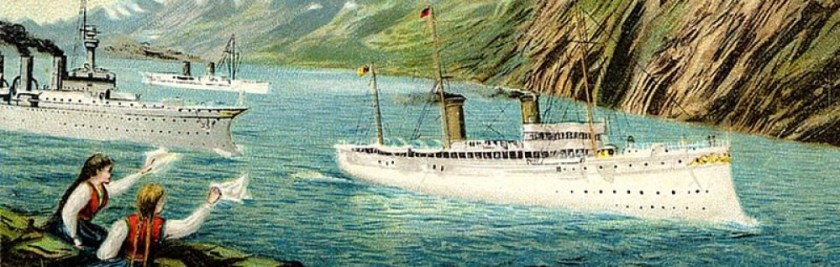




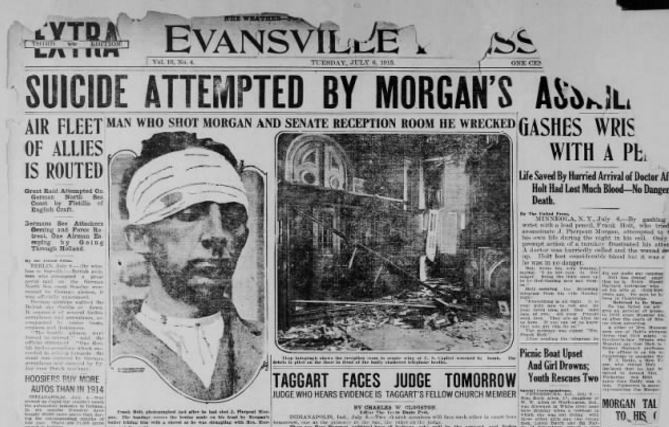
 That Sunday morning, July 4, the J.P. Morgan shooting seems to have been front page on every newspaper in the world. On July 5, Erich Muenter took the brass ferrule from a pencil eraser, and slit his wrist. That suicide attempt was unsuccessful. The following day, Muenter scaled the bars in his prison and jumped, leaving his brains on the concrete floor, twenty feet below.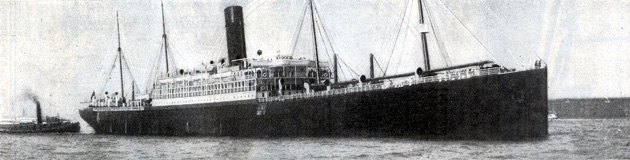


 Often unseen in times of such calamity, are the humanitarian workers. Those who tend to the physical and spiritual requirements, the countless small comforts, of those in need.




 June 28 was significant for another reason. The invading army of Ottoman Sultan Murad I was wiped out on this date in the 1389 Battle of Kosovo, (June 15, ‘old style’), the “Field of Blackbirds”. It was a Pyrrhic victory, as the Balkan defenders were virtually wiped out as well. The Ottomans being far more numerous, the Balkan states soon became vassals of the Ottoman Turks.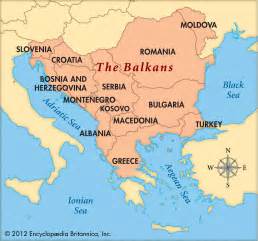
 The six car motorcade drove by the first assassin, Muhamed Mehmedbašić, a little after 10am. He froze, allowing the cars to pass unmolested.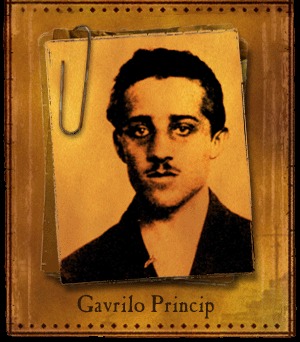




 The results of the Feuerwalze were devastating, if not predictable. Allied lines were smashed as German armies poured through, taking 19 kilometers in three days and reaching the Marne River, 50 miles from Paris. On May 31, a dogged defense by the US 3rd Infantry Division turned the German advance at Château-Thierry, and toward Belleau Wood.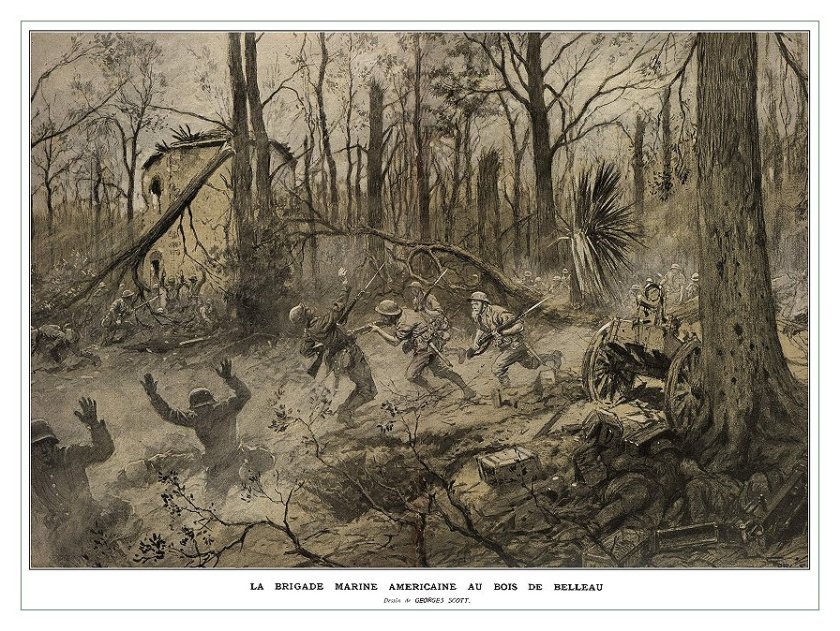


 3,662,374 military service certificates were issued to qualifying veterans, bearing a face value equal to $1 per day of domestic service and $1.25 a day for overseas service, plus interest. Total face value of these certificates was $3.638 billion, equivalent to $43.7 billion in today’s dollars and coming to full maturity in 1945.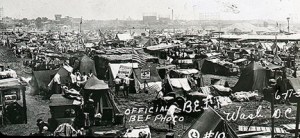
 This had happened before. Hundreds of Pennsylvania veterans of the Revolution had marched on Washington in 1783, after the Continental Army had been disbanded without pay.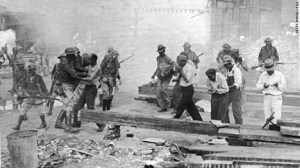
 Bonus marchers fled to their largest encampment across the Anacostia River, when President Hoover ordered the assault stopped. Feeling that the Bonus March was an attempt to overthrow the government, General MacArthur ignored the President and ordered a new attack, the army routing 10,000 and leaving their camps in flames. 1,017 were injured and 135 arrested. The wife of one veteran miscarried. 12 week old Bernard Myers died after being caught in the gas attack. A government investigation later claimed he died of inflammation of the small intestine, but a hospital employee said the tear gas “didn’t do it any good.”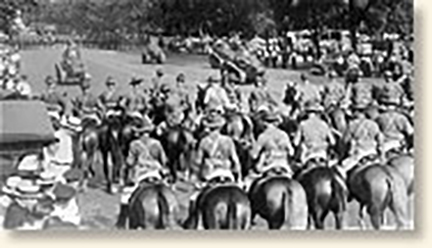


 Escadrille N.124 changed its name in December 1916, adopting that of a French hero of the American Revolution. Marie-Joseph Paul Yves Roch Gilbert du Motier, Marquis de Lafayette. Five French officers commanded a core group of 38 American volunteers, supported by all-French mechanics and ground crew. Rounding out the Escadrille were the unit mascots, the African lions Whiskey and Soda.


 VE Day wasn’t the end of WWII, only the end of the war in Europe. Fighting in the Pacific would continue until the Japanese surrender on the 15 August 1945, the date celebrated as VJ Day.

 Historical Easter Eggs - Today in History
You must be logged in to post a comment.