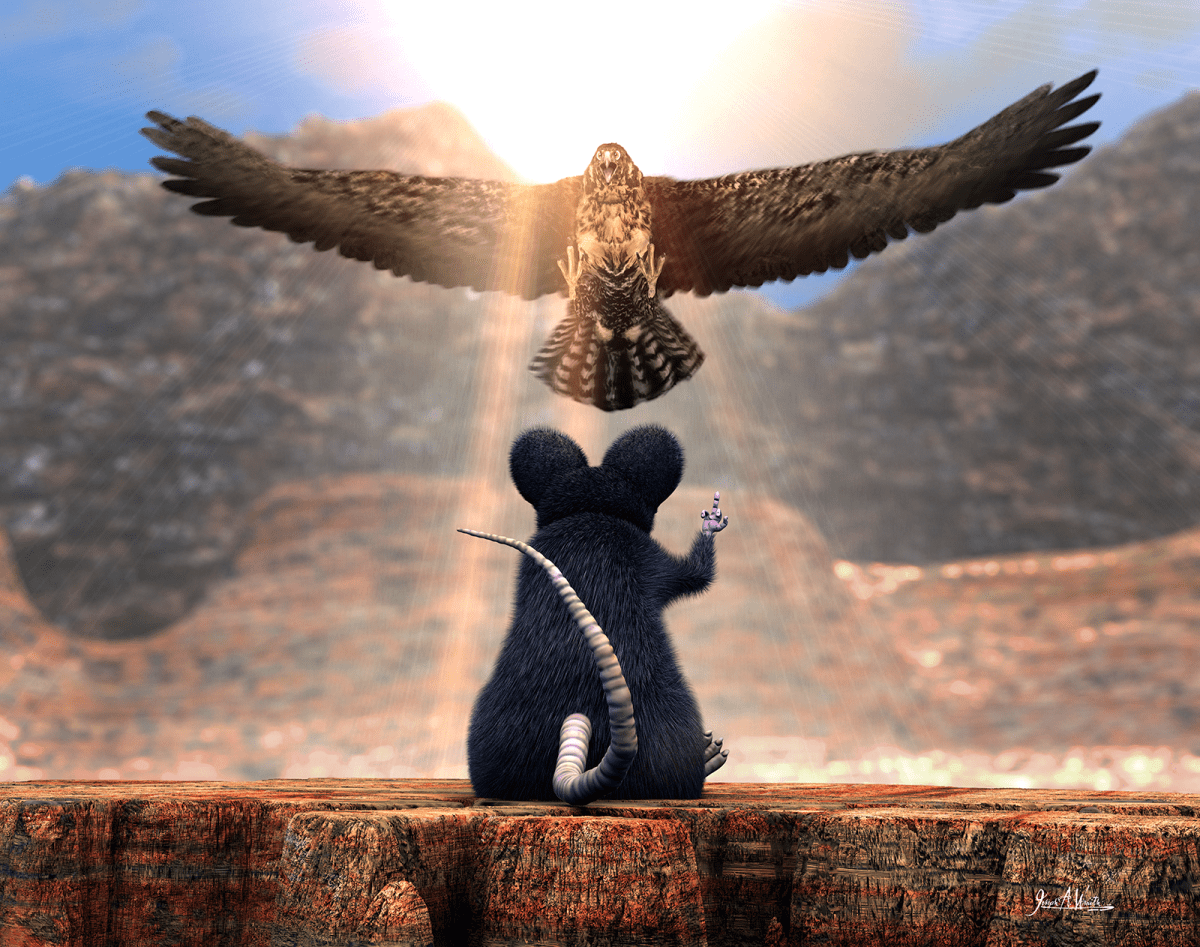
March 30, 1945 A Great Act of Defiance

“First they came for the socialists, and I did not speak out—because I was not a socialist. Then they came for the trade unionists, and I did not speak out— because I was not a trade unionist. Then they came for the Jews, and I did not speak out—because I was not a Jew. Then they came for me—and there was no one left to speak for me”. – Martin Niemöller

We shall go on to the end. We shall fight in France, we shall fight on the seas and oceans, we shall fight with growing confidence and growing strength in the air, we shall defend our island, whatever the cost may be. We shall fight on the beaches, we shall fight on the landing grounds, we shall fight in the fields and in the streets, we shall fight in the hills; we shall never surrender, and if, which I do not for a moment believe, this island or a large part of it were subjugated and starving, then our Empire beyond the seas, armed and guarded by the British Fleet, would carry on the struggle, until, in God’s good time, the New World, with all its power and might, steps forth to the rescue and the liberation of the old”.

Winston Churchill
last_great_act_of_defiance1

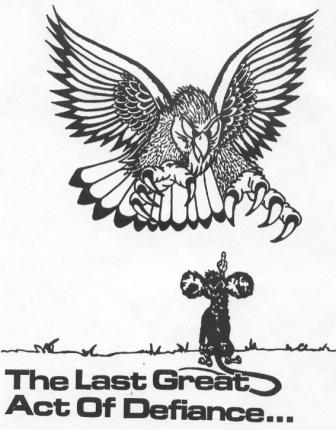
Before the age of the internet,  office jokes and bits of folk wisdom were passed around and copied, and copied again.  “The Last great of Defiance“ was one of those and shall live for all time, as my personal favorite. 

The image speaks for itself.  I had one on the wall, for years. This is one of those stories.

The last great effort of German arms burst out of the frozen Ardennes forest on December 16, 1944, aiming for the vital port at Antwerp.

Unternehmen Wacht am Rhein“, (“Operation Watch on the Rhine”) was a tactical surprise for the Wehrmacht, as allied forces were driven back through the densely forested regions of France, Belgium and Luxembourg. Wartime news maps showed a great inward “bulge” in the lines, and the name stuck. The Battle of the Bulge was the largest and bloodiest battle fought by American forces in World War 2, fought in the harshest winter conditions in recorded history and involving some 610,000 GIs.
malmed1

Prisoners were swept up by the thousands, to face an uncertain future.  In Malmedy, Belgium, seventy-five captured Americans were marched into an open field and machine gunned by members of the 1st SS Panzer Division (Leibstandarte Adolf Hitler), a part of 6th Panzer Army.

On December 16, the all-black 333rd Field Artillery Battalion of the racially segregated US Army put up an heroic defense outside the town of Wereth, Belgium. Using 155mm guns to delay the German advance they were desperately outnumbered. The 333rd was overrun the following day, groups of men scattering to escape as best they could. Eleven soldiers made their way to the home of Mathias Langer, the Mayor of Wereth.

To shelter allied troops under German occupation was to risk summary execution. Despite the obvious risk to their own lives, Matthias and his wife Maria took these men in and attempted to hide them, in their home. When German troops arrived, the eleven surrendered rather than risk the lives of their benefactors.
the-wereth-eleven-578359l
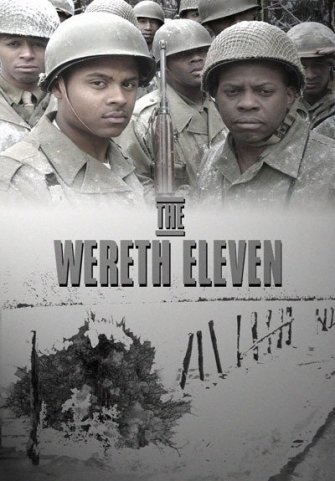
Movie poster for the 2011 film, “The Wereth Eleven”

The prisoners were marched out of sight and murdered by German troops. Every one of them. Lost in the confusion of the Bulge, the bodies of the Wereth 11 lay hidden under the snow, until the Spring melt. For the next fifty years their story was lost, to history.

Nazi atrocities were not limited to Allied troops.  By some accounts, more civilians were killed during the Battle of the Bulge than anytime. in the last four years.  When the fighting was over, more than 115 bodies were found in the towns of Ster and Parfondruy, alone.

For Master Sargent Roderick “Roddie” Edmonds, the war ended on December 19, swept up with hundreds of American troops and taken prisoner.  These were the lucky ones, escaping those first white-hot moments of capture to be sent to a German prisoner-of-war camp.  Edmonds was later transferred to another camp near Ziegenhain, Germany.  At 24, M/Sgt Roddie Edmonds was now the senior non-commissioned officer at Stalag IX-A, responsible for 1,275 American POWs.

The Wehrmacht had harsh anti-Jewish policies and kept Jewish POWs in strict segregation.  In the East, Russian Jews who became POWs were sent directly to extermination camps.  In the west the future was more uncertain, for Jewish POWs.  Many of them were worked to death, in slave labor camps.

Home_Slider_Image-1024x666

On January 27, the first day at Stalag IX-A, commandant Siegmann ordered Edmonds: All American Jews were to identify themselves at the following day’s assembly.  The word went out to all five barracks:  “We’re not doing that.  We’re all turning out“.

The following morning, 1,275 POWs presented themselves.  Every. Single. Man.

Siegmann was perplexed.  “They can’t all be Jews!”  As senior NCO, Edmonds spoke for the group.  “We’re all Jews here“.  The Nazi commandant was apoplectic, pressing a Luger into Edmonds’ forehead.  This is your last chance.

Imagine yourself in this situation and ponder, what would you do?

Edmonds gave his name, rank and serial number. :  ‘If you are going to shoot’, he said, ‘ you are going to have to shoot all of us because we know who you are and you’ll be tried for war crimes when we win this war.’”  Siegmann was incandescent, white with rage, but the moment had passed.  He was beaten.

The 1,275 American POWs held at Stalag IX-A were liberated on March 30, 1945, their number including some 200 Jews.

Years later the Army called once again and Roddie Edmonds was recruited, for the war in Korea.  He never told his family a word about what happened, at Stalag IX-A.

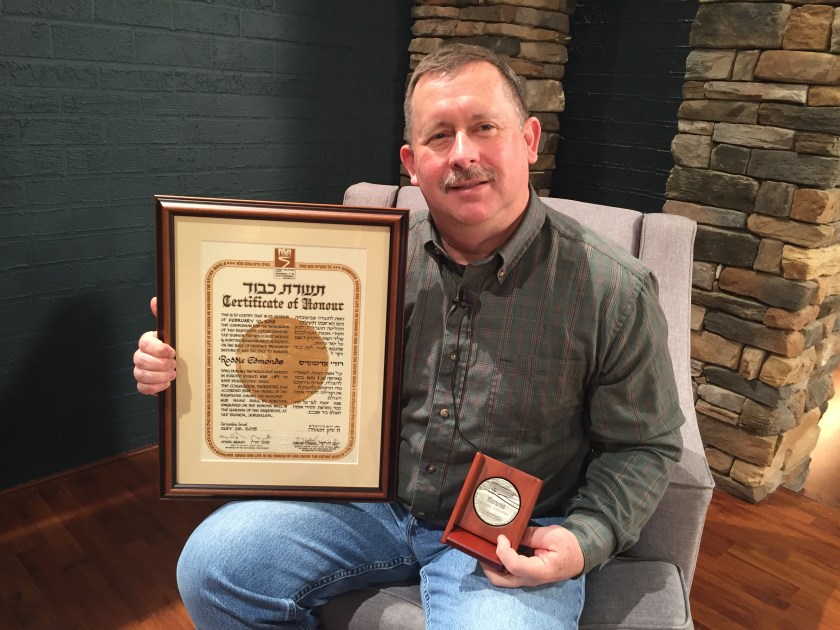
Chris Edmonds is the Pastor at Piney Grove Baptist Church in Maryville, Tennessee. Following his father’s death in 1985, Chris’ mother gave him his father’s  war diary, where he found a brief mention of this story.  Chris scoured the news for more information, around the time Richard Nixon was looking for his post-Presidential home.  As it happened, Nixon bought his posh, upper-east side home from Lester Tanner, a prominent New York Lawyer who mentioned in passing, he owed his life to Roddie Edmonds.

So it is, this story came to light.  In 2015, Edmonds was honored as “Righteous among the Nations”, the first American soldier, so honored.  It’s the highest honor bestowed by the state of Israel, on non-Jews who risked their lives to save Jews from the Nazi death machine.  President Barack Obama recognized Edmonds’ heroism in a 2016 speech before the Israeli embassy.  In 2017 Tennessee Senator Marsha Blackburn led a bipartisan effort to bestow the Congressional Gold Medal. 

Pastor Edmonds and the Jewish veterans saved by M/Sgt Edmonds continue to push for the Knoxville, Tennessee native to receive the Medal of Honor. Pastor Edmonds says he always looked up to his father, the man had always been, his hero.  “I just didn’t know he had a cape in his closet“.
Chris Edmonds_1455424082776_247114_ver1.0.JPG

Pastor Chris Edmonds
March 18, 1917 The Concrete Fleet

Steel was in critically short supply by the time the US entered the war with the need for new ships, greater than ever. Something had to be done. One answer, was concrete.

The last third of the nineteenth century was a period of unprecedented technological advancement, an industrial revolution of international proportion.

The war borne of the second industrial revolution, would be like none before.

From the earliest days of the “War to end all Wars”, the Triple Entente powers imposed a surface blockade on the Central Powers of Germany, Austria-Hungary and the Ottoman Empire, throttling the maritime supply of goods and crippling the capacity to make war. A 1928 academic study put the death toll by starvation at 424,000, in Germany alone.

The Kaiser responded with a blockade of his own, a submarine attack on the supply chain to the British home islands. It was a devastating incursion against an island adversary dependent on prodigious levels of imports.

barque
Joseph Louis Lambot’s first prototype, built 1848

1915 saw the first German attacks on civilian shipping. Total losses for that year alone came to 370 vessels against a loss of only 16 U-Boats.

The US was a late arrival to the “War to End All Wars”, as yet nominally neutral. On this day in 1917 President Woodrow Wilson’s request for a declaration of war and the Congress’ affirmative response, was a scant three weeks away.

Steel was in critically short supply by the time the US entered the war with the need for new ships, greater than ever. Something had to be done. One answer, was concrete.

The idea of concrete boats was nothing new.  In the south of France, Joseph Louis Lambot experimented with steel-reinforced “ferrocement”, building his first dinghy in 1848.

By the outbreak of WW1, Lambot’s creation had sunk to the bottom of a lake, where it remained for 100 years, buried deep in anaerobic mud. Today you can see the thing at the Museum of Brignoles, in the south of France.

Italian engineer Carlo Gabellini built barges and small ships of concrete in the 1890s.  British boat builders experimented with the stuff, in the first decade of the 20th century.  The Violette, built in Faversham in 1917, is now a mooring hulk in Kent, the oldest concrete vessel still afloat.

Violette 1
VIOLETTE 2
Violette 3

The Violette built in 1917, is the oldest concrete ship, still afloat.

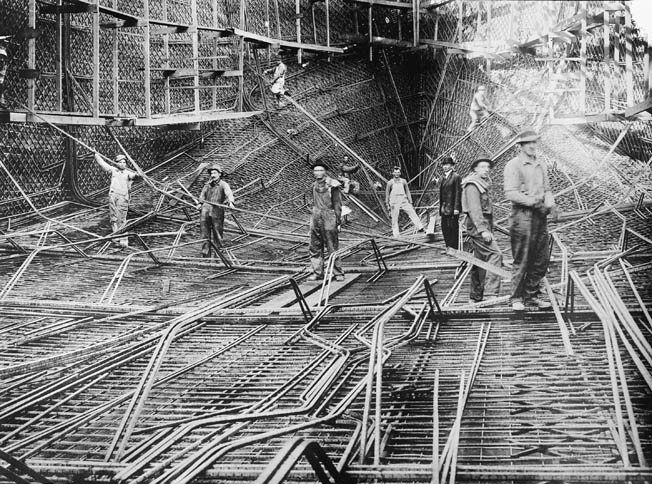
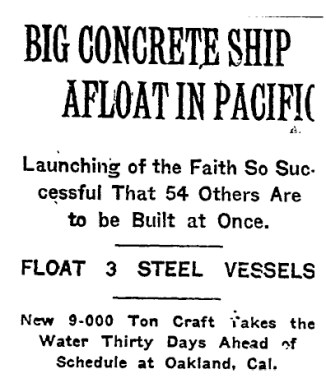
The American government contracted with Norwegian boat builder N.K. Fougner to create a prototype, the 84-foot Namsenfjord launched in August, 1917. The test was judged a success. President Wilson approved a twenty-four ship fleet consisting of steamers and tankers to aid the war effort. The first and largest of the concrete fleet, the SS Faith was launched on this day in 1918, thirty days ahead of schedule.

W-Ordnance-1-2
“Constructed by the San Francisco Shipbuilding Company in 1918, the SS Faith was the first concrete ship built in the United States”. – H/T warfarehistorynetwork.com

The New York Times was ecstatic:

98260463

‘”When the first steel vessels were built people said they would not float, or if they did they would be too heavy to be serviceable,” said W. Leslie Comyn, President of the concern which built the boat. “Now they say the same about concrete. But all the engineers we have taken over this boat, including many who said it was an impossible undertaking, now agree that it was a success”‘.

All that from a west coast meadow with two tool sheds, a production facility 1/20th the cost of a conventional steel shipyard.

The Great War ended eight months later with only half the concrete fleet, actually begun.  None were completed.  All were sold off to commercial shippers or for storage, or scrap.

For all its advantages as a building material, ferrocement has numerous drawbacks. Concrete is a porous material, and chunks tend to spall off from rusting steel reinforcements. We’ve all seen what that looks like, on bridge abutments. Worst of all, the stuff is brittle. On October 30, 1920, the SS Cape Fear collided with a cargo ship in Narragansett Bay Rhode Island and “shattered like a teacup”, killing 19 crewmen.

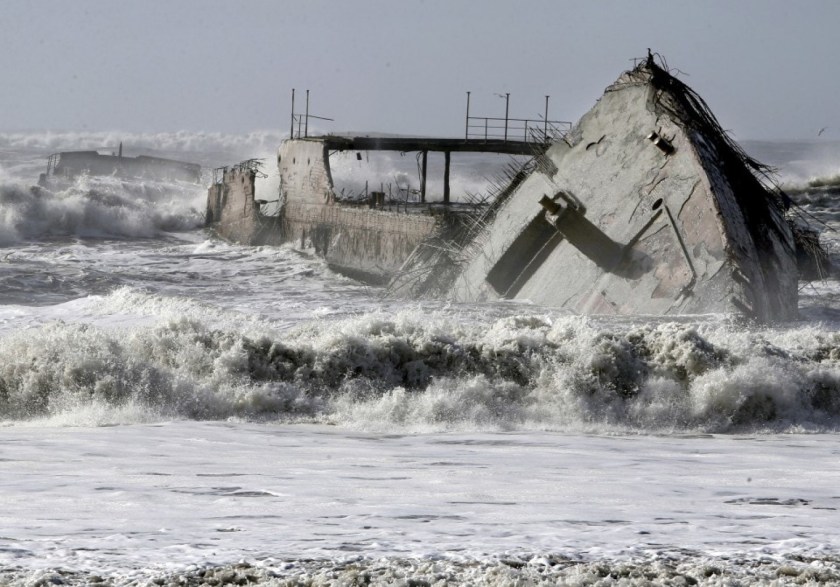
SS Palo Alto was a tanker-turned restaurant and dance club, before breaking up in heavy waves, in Monterey Bay.

imrs
SS Palo Alto

SS San Pasqual was damaged in a storm in 1921 and became a warehouse for the Old Times Molasses Company of Havana. She was converted to a coastal defense installation during WW2 and outfitted with machine guns and cannon, then becaming a prison, during the Cuban revolution. The wreck was later converted to a 10-room hotel before closing, for good.  That was some swanky joint, I’m sure.

ebf8e74d80a6015db77f3178ec937bf23bf8c407
SS San Pasquale

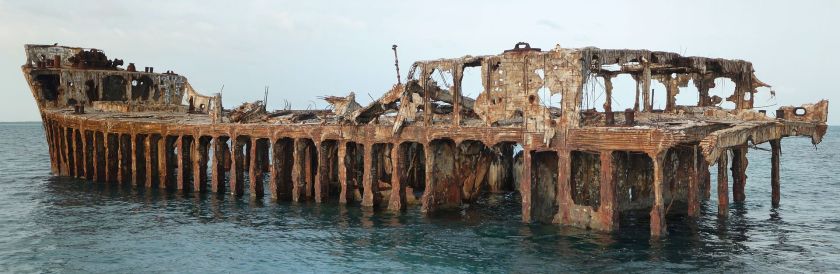
The steamer SS Sapona was sold for scrap and converted to a floating liquor warehouse during Prohibition, later grounding off the shore of Bimini during a hurricane.  All the liquor, was lost.

1920px-Sapona_Panoramic
SS Sapone as she looked, in 2009.  H/T Compsciscubadive

The SS Atlantus was destined to be sunk in place as a ferry dock in Cape May New Jersey in 1926, until she broke free in a hurricane and ran aground, 150-feet from the beach. Several attempts were made to free the hulk, but none successful. At one time, the wreck bore a billboard. Advertising a marine insurance outfit, no less. Kids used to swim out and dive off, until one drowned. The wreck began to split up in the late 1950s. If you visit sunset beach today, you might see something like the image, at the top of this page.

postcard_insurance
SS Atlantus, Insurance billboard

In 1942, the world once again descended into war.  With steel again in short supply, the Roosevelt administration contracted for another concrete fleet of 24 ships.  The decades had come and gone since that earlier fleet.  This time, the new vessels came off the production line at the astonishing rate of one a month featuring newer and stronger aggregates, lighter than those of years past. Like the earlier concrete fleet, most would be sold off after the war.  Two of the WW2 concrete fleet actually saw combat service, the SS David O. Saylor and the SS Vitruvius.  

In March 1944, an extraordinary naval convoy departed the port of Baltimore. including the concrete vessels, SS David O. Saylor and SS Vitruvius.  It was the most decrepit procession to depart an American city since Ma and Pa Joad left Oklahoma, for California.  A one-way voyage with Merchant Marines promised a return trip, aboard Queen Mary.

Merchant mariner Richard Powers , described the scene:

“We left Baltimore on March 5, and met our convoy just outside Charleston, South Carolina,” Powers recalled. “It wasn’t a pretty sight: 15 old ‘rustpots.’ There were World War I-era ‘Hog Islanders’ (named for the Hog Island shipyard in Philadelphia where these cargo and transport ships were built), damaged Liberty Ships.”

1,154 U-boats were commissioned into the German navy before and during WW2, some 245 of which were lost in 1944.  The majority of those, in the North Atlantic.  The allied crossing took a snail’s pace at 33 days and, despite the massive U-boat presence, passed unmolested into Liverpool.  Powers figured, “The U-Boats were not stupid enough to waste their torpedoes on us.”

Herr Hitler’s Kriegsmarine should have paid more attention.

55fda32fbd86ef15008bb8a3-750-433

On June 1, Seaman Powers’ parade of misfit ships joined a procession of 100 British and American vessels.  Old transports and battered warships, under tow or limping across the English channel at the stately pace of five knots.  These were the old and the infirm, the combat damaged and obsolete.  There were gaping holes from mine explosions, and the twisted and misshapen evidence of collisions at sea. Some had superstructures torn by some of the most vicious naval combat, of the European war.  Decrepit as they were, each was bristling with anti-aircraft batteries, Merchant Mariners joined by battle hardened combat troops.

Their services would not be required.  The allies had complete air supremacy over the English channel.

1122x900
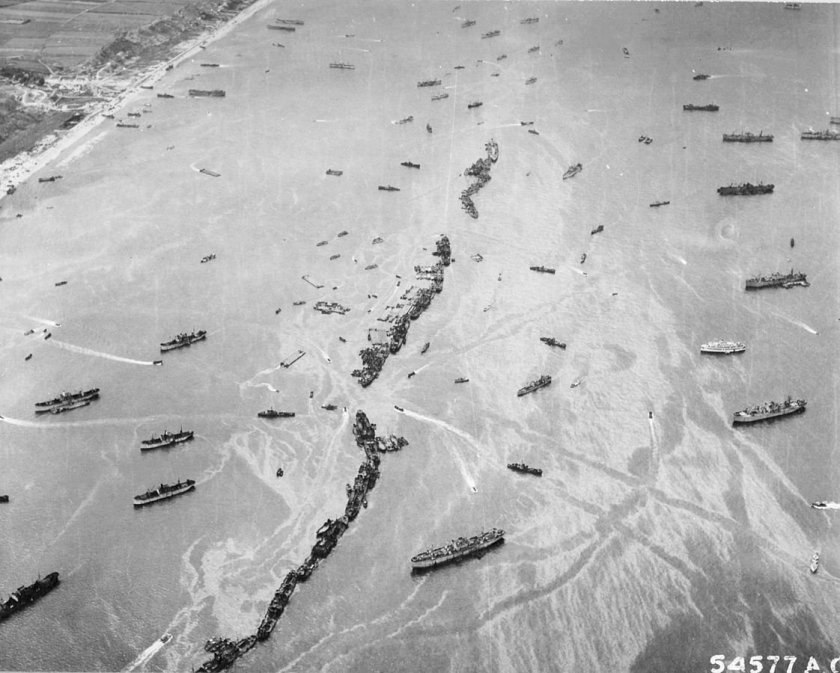
A line of U.S. Liberty ships deliberately sunk off the coast at Omaha beach to form a breakwater for the Mulberry harbor there.(U.S. Army) H/T wearethemighty.com

These were the “gooseberries” and “blockships”.   Part of the artificial “Mulberry” harbors intended to form breakwaters and landing piers in support of the D-Day landing, charged with the difficult and dangerous task of scuttling under fire at five points along the Norman coast.  Utah.  Omaha.  Gold.  Juneau.  Sword.

Later on, thousands more merchant vessels would arrive in support of the D-Day invasion.  None more important than those hundred or so destined to advance and die, the living breakwater without which the retaking of continental Europe, would not have been possible.
A Trivial Matter
The British Army lost 19,240 killed on the first Day of the WW1 Battle of the Somme. French and German forces suffered a whopping 975,000 casualties on one single day of the ten-month Battle of Verdun. Imperial Russia lost five million soldiers, in the first two years of WW1. Many single day’s fighting of the great battles of 1916 produced more casualties than every European war of the previous 100 years. Combined.

March 16, 2006 RPG

Channing Moss, standing with his upper body out of the Humvee, felt something and smelled smoke.  He looked down to see it was himself.  His body was smoking.

Paktika Province is a wild and lawless region in the east of Afghanistan, a border crossroads with the west of Pakistan and home to a number of Taliban and Al Qaeda units.
An article from Time magazine describes the U.S. base: “The U.S. firebase looks like a Wild West cavalry fort, ringed with coils of razor wire. A U.S. flag ripples above the 3-ft.-thick mud walls, and in the watchtower a guard scans the expanse of forested ridges, rising to 9,000 ft., that mark the border. When there’s trouble, it usually comes from that direction.”
article-1392699-0C581BE600000578-294_634x435
Channing Moss, second from right

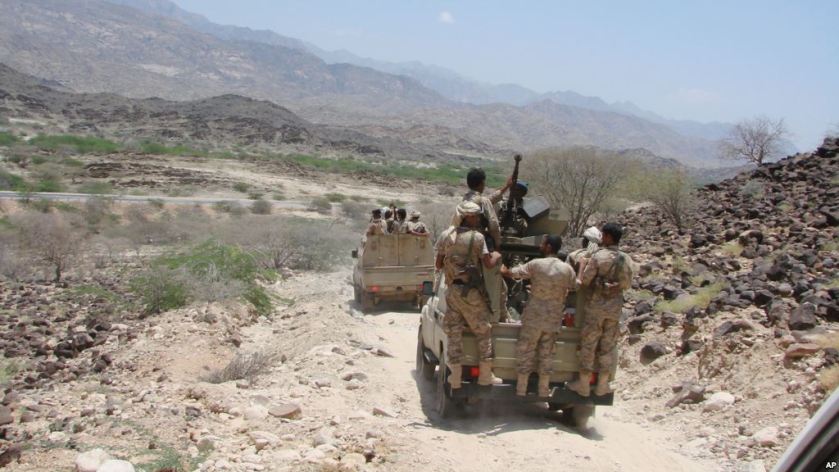
The morning of Thursday, March 16, 2006 dawned bright and clear as a force rode out from the 10th Mountain Division.  Their mission was to seek out a remote mountain village, and meet with village elders. They were twenty-four American soldiers in five Humvees and a handful of Afghan National troops, riding a pickup truck.

Paktika is a trackless wilderness of ragged hillsides and wadis, seasonal riverbeds flowing southwest from the mountains of Sar Hawza, to the north.  The land appears custom made for an ambush, with dangerous high spots in nearly every direction.

9A0AA69F-D000-4F20-BFA3-2A7E3B73EF60_cx0_cy19_cw0_mw1024_s_n_r1

Some four hours into the mission, gunfire broke out from above.   First small arms, then came the rocket-propelled grenades.  Twenty-three-year-old Private Channing Moss remembered, it sounded like rattling spoons.

RPGs were soon raining down.  The pickup exploded, killing two Afghan soldiers.  The rest scrambled to get out of the “kill zone” as three rocket propelled grenades struck Private Moss’ Humvee.  Staff Sergeant Eric Wynn, 33, felt one slice through his face.  Channing Moss, standing with his upper body out of the Humvee, felt something and smelled smoke.  He looked down to see it was himself.  His body was smoking.

article-1392699-0065C3F100000258-490_634x321
RPG ammunition, found on the outskirts of Basra

A rocket propelled grenade is exactly what it sounds like, a weapon roughly the size of a baseball bat, propelled at nearly the speed of a bullet.  Standing as he was, Channing Moss had taken one of these things in the hip, leaving nothing but the fins, sticking out of his body.  The weapon now inside of him was capable of turning everyone in the vehicle to a “pink mist”.

What happened next, is beyond belief. When every human instinct says “get the hell away from that thing” Moss had a whole team by his side, throughout the ordeal. Company medic Spc. Jared Angell, 23, working to stabilize that thing for transportation. Lieutenant Billy Mariani came over once the fighting had died down: “I grabbed his hand and I just said, ‘Hey, buddy, we’re gonna get you out of here.’” Badly wounded himself, Wynn literally held his own face together while reporting casualties over the radio, and holding Moss’ hand.

article-1392699-0C584A4E00000578-13_306x360
Private Channing Moss

The MEDEVAC crew arrived escorted by an Apache attack helicopter, they knew what they were dealing with. Army regulations say it’s too dangerous to carry such a human bomb. It could take out every man on the chopper and blow the bird out of the sky: four MEDEVAC crew members, and three wounded soldiers.

Pilot CW2 Jorge Correa spoke with his team: “I asked my crew, you know, ‘Are you guys comfortable with this?  Because I wasn’t gonna put my crew in jeopardy if they weren’t comfortable with it.”  Co-pilot Jeremy Smith recalled the moment:  “We all said, ‘Yeah, let’s get him on board and let’s get outta here.’”

It was the same thing, back at the aid station.  Explosives expert Staff Sgt. Dan Brown.  Two surgeons, Major John Oh and Major Kevin Kirk and the whole team at the aid station.  Three surgical staff.  All did their jobs knowing that, at any instant, the whole team could be vaporized.

article-1392699-0C581BFB00000578-84_634x437

Channing Moss was well beyond the “golden hour” with expectations of survival, growing dim.  The man’s heart actually stopped and the surgeons administered epinephrine, knowing that physical heart massage could detonate the ordnance still inside the man’s body.

Despite massive injury to his torso Private Moss, survived.  There would be four more surgeries back at Walter Reed and an endless hell of physical therapy as the man progressed from bed to wheel chair to crutches, to a cane.  Moss had a Purple Heart coming and then some but refused to receive it, until he could stand on his own two legs and walk to receive his medal.

article-1392699-0C581BEF00000578-877_634x446
Channing Moss and his wife Lorena, reunited with Majors Oh and Kirk

Explosives expert Dan Brown spoke for the whole team, I think, in explaining what they had done:  “He was American, he was a solider, he was a brother and he was one of us. And there was nothing gonna stop us from doing what we knew what we had to do … We knew we did right. In that screwed up world we did something right.

A Trivial Matter:

While rare, unexploded ordnance has been lodged inside of living human bodies on no fewer than thirty six occasions between WW2 and the modern era, requiring surgical removal.  All but four, survived.

February 20, 1942 Father and Son

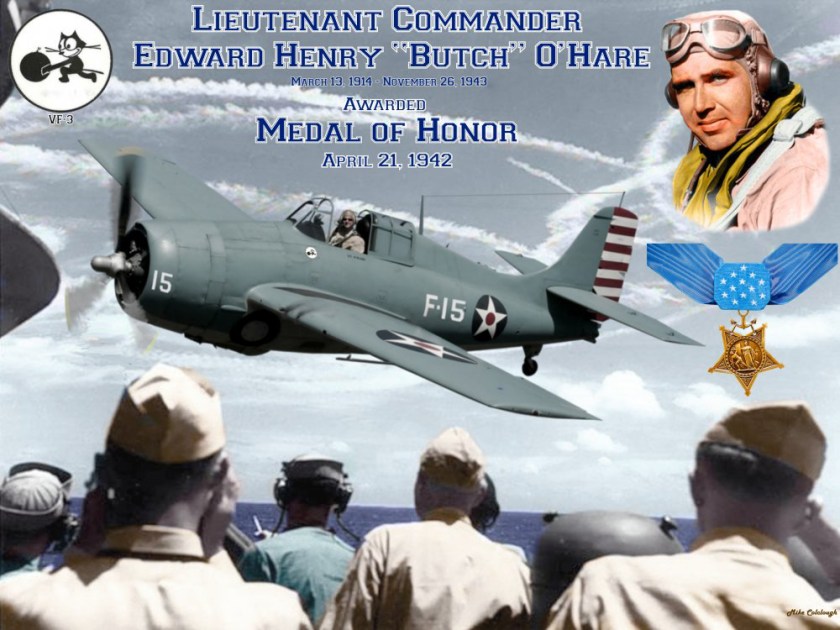
Eddie was a mob lawyer who testified against his boss and paid for it, with his life. Eddie’s son Butch went on to be the first Ace of WW2 and recipient, of the Medal of Honor.

We’ve all heard the story of the mob lawyer who had everything but a good name, and gave it all up to show his son. That personal integrity is more important than all the riches of the underworld. His name was “Easy Eddie”. Eddie went on to testify against Al Capone, the most notorious gangster in the history of the underworld. Eddie paid for it with his life. Eddie’s son “Butch” learned the lesson his father taught from beyond the grave and went on to become a world War 2 WWII flying ace, and recipient of the Medal of Honor.

easy-eddie
Eddie O’Hare

The story is true more or less, but it does lays on the morality, a little thick.

Edward Joseph O’Hare, “EJ” to friends and family, passed the Missouri bar exam in 1923 and joined a law firm.  Operating dog tracks in Chicago, Boston and Miami, O’Hare made a considerable fortune working for Owen Smith, the high commissioner for the International Greyhound Racing Association. He’s the guy who patented the mechanical rabbit used in dog racing.  EJ and Selma Anna (Lauth) O’Hare had three children together between 1914 and 1924, – Edward (“Butch”), Patricia, and Marilyn.

EJ developed an interest in flying in the 1920s, once even hitching a ride on Charles Lindbergh’s mail plane.  For a time he worked as pilot for Robertson Aircraft, occasionally giving his teenage son a turn at the controls.

Eddie and Butch O’Hare

One day, EJ came home to find 13-year -old Butch sprawled on the couch, munching on donuts and banana layer cake.  He enrolled the boy in the Western Military Academy in Alton, Illinois.  The kid was getting way too lazy.

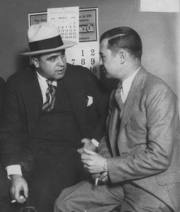
EJ and Selma divorced in 1927.  Eddie left St. Louis for good moving to Chicago while Butch stayed with his mother, attending WMA.  It was there the elder O’Hare met Al Capone and later earned his second fortune working as the gangster’s business manager and lawyer.

easy_eddie_with_capone

In 1930, O’Hare approached John Rogers, a reporter for the St. Louis Post-Dispatch, asking that he arrange a meeting with the Internal Revenue Service, then in pursuit of Capone on grounds of tax evasion. 

It all could have been to restore his good name, or maybe Eddie saw the writing on the wall.  Some will tell you he HAD to get right since no Congressman would nominate the son of a gangster, to the nation’s premier naval academy.

Who knows, maybe it’s all of the above.  None of them are mutually exclusive.  Whatever the motivation, IRS Agent Wilson later said of EJ “On the inside of the gang I had one of the best undercover men I have ever known: Eddie O’Hare.”

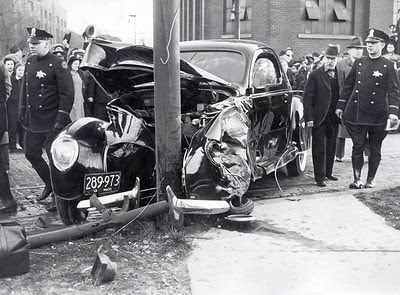
Al Capone was convicted of tax evasion in 1931 and sentenced to Alcatraz, becoming eligible for early release in 1939 due to syphilitic dementia. A week before the gangster’s release, EJ left his office at Sportsman’s Park racetrack in Cicero, driving his black ’39 Lincoln Zephyr. Two shotgun wielding gunmen pulled alongside, firing a volley of big game slugs and killing O’Hare, instantly. No arrest was ever made.

Butch had graduated from the Naval Academy at Annapolis by this time, receiving his duty assignment aboard the USS New Mexico.  Shortly after his father’s assassination, the younger O’Hare began flight training at Naval Air Station in Pensacola.

Assigned to the USS Saratoga’s Fighting Squadron, Butch O’Hare made his first carrier landing in 1940, describing the experience as “just about the most exciting thing a pilot can do in peacetime.”

butch-ohare

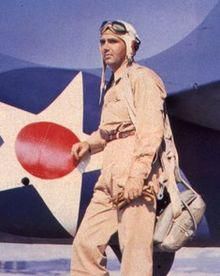
Butch O’Hare became the first American flying Ace of WWII on February 20, 1942.

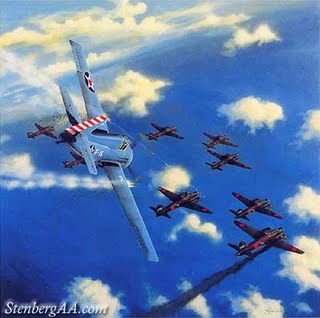
The carrier Lexington was discovered by Japanese reconnaissance aircraft, 450 miles outside of Rabaul.  Six Grumman F4F Wildcat fighters and Lexington’s anti-aircraft guns were engaged with an incoming formation of nine Japanese bombers when nine more bombers were reported incoming.

Six more Wildcats roared off the flight deck of the Lexington, one piloted by Butch O’Hare.  He and his wingman Marion William “Duff” Dufilho were the first to spot the V formation, diving to the intercept and leaving the other four fighters too far away to affect the outcome.  Dufilho’s guns jammed, leaving Butch O’Hare alone on the unprotected side of his flotilla.  One fighter against nine enemy bombers flying in tight V formation, mutually protecting one another with rear-facing machine guns.

hagel-butchohare

O’Hare’s Wildcat had four 50-caliber guns with 450 rounds apiece, enough to fire for about 34 seconds.  What followed was so close to the Lexington, that pilots could hear the carrier’s AA guns.  Full throttle and diving from the high side, O’Hare fired short, accurate bursts, the outermost bomber’s right-hand engine literally jumping from its mount.  Ducking to the other side and smashing the port engine on another “Betty”, O’Hare’s Wildcat attacked one bomber after another, single handedly taking out five bombers with an average of only 60 rounds apiece.

O’Hare’s Medal of Honor citation calls the performance “…one of the most daring, if not the most daring, single action in the history of combat aviation…”

In a confused night action in the darkness of November 26, 1943, Butch O’Hare stepped from the pages of history.  Some say he was cut down by friendly fire, mistakenly shot down by TBF Avenger gunner Alvin B. Kernan.  Others say it was a lucky shot by a gunner aboard his old adversary, a Rikko (Betty) bomber.  Yet another theory was that O’Hare’s Hellcat caught a wingtip on a wave and cartwheeled into the ocean.

butch-ohare

On September 19, 1949, the Orchard Depot Airport in Chicago was renamed in tribute to the fallen Ace. O’Hare International Airport.   Neither his body nor his aircraft were ever recovered. 

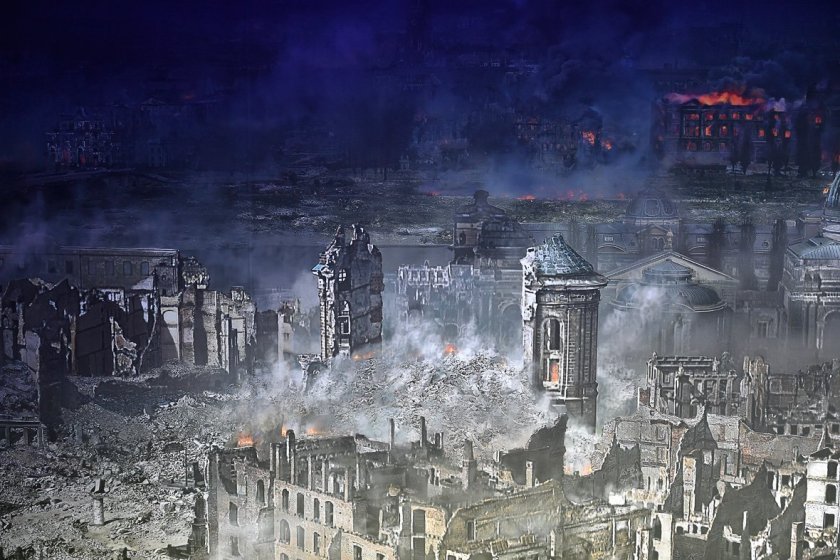
February 14, 1945 The Firebombing of Dresden

“We saw terrible things: cremated adults shrunk to the size of small children, pieces of arms and legs, dead people, whole families burnt to death, burning people ran to and fro, burnt coaches filled with civilian refugees, dead rescuers and soldiers, many were calling and looking for their children and families, and fire everywhere, everywhere fire, and all the time the hot wind of the firestorm threw people back into the burning houses they were trying to escape from”. Eyewitness to the firebombing at Dresden

The most destructive war in history entered its final, apocalyptic phase in January 1945, with another four months of hard fighting yet remaining before Allied forces could declare victory in Europe. In the west, the “Battle of the Bulge” was ended, the last great effort of German arms spent and driven back beyond original lines. In the east, the once mighty German military contracted in on itself, in the face of a massive Soviet advance.

Dozens of German divisions hurried east to meet the threat. Allied intelligence believed the war could be over in April if the major cities to the east, were destroyed. Dresden. Leipzig. Chemnitz. Letting these places stand to serve as bases for retreating German forces, could drag the war out until November.

destroyed-german-equipment-znoymo-czechoslovakia-1945-may
German military equipment lies broken in Czechoslovakia, 1945

Sir Charles Portal, British Chief of the Air Staff, put the problem succinctly: “We should use available effort in one big attack on Berlin and attacks on Dresden, Leipzig, and Chemnitz, or any other cities where a severe blitz will not only cause confusion in the evacuation from the East, but will also hamper the movement of troops from the West.”

With its baroque and rococo city center, the capital city of Dresden was long described as the “Jewel Box” of the Free State of Saxony, family seat to the Polish monarchs and royal residence to the Electors and Kings of Saxony. Dresden was the seventh-largest city in Germany in 1945, home to 127 medium-to-large sized factories supplying the German war machine, and the largest built-up area in the “thousand-year Reich”, yet to be bombed.

Dresden_montage
Long described as “Florence on the Elbe” Dresden was considered one of the world’s most beautiful cities, a treasure of art and architecture.

For Victor Klemperer, the 13th of February, 1945, was the most terrifying and depressing experience of a lifetime. Once home to well over 6,000 Jews, Dresden now contained a mere forty-one. Klemperer’s marriage to an “Aryan” wife had thus far protected him from the “final solution”, despite the yellow Juden star he was forced to wear on his coat.

Now, the man witnessed notices for final “deportation” being delivered even to those last few. There wasn’t one who received such a notice who didn’t understand what it meant. Terrified that he might be next the process was interrupted by the coming firestorm. Three nights later Klemperer removed the yellow star, an act punishable by death at the time.

Three hundred miles away, bad weather hampered operations for the United States Army Air Force (USAAF).  The first wave in the fire bombing of Dresden would be a Royal Air Force (RAF) operation.

dresden-bombing (2)

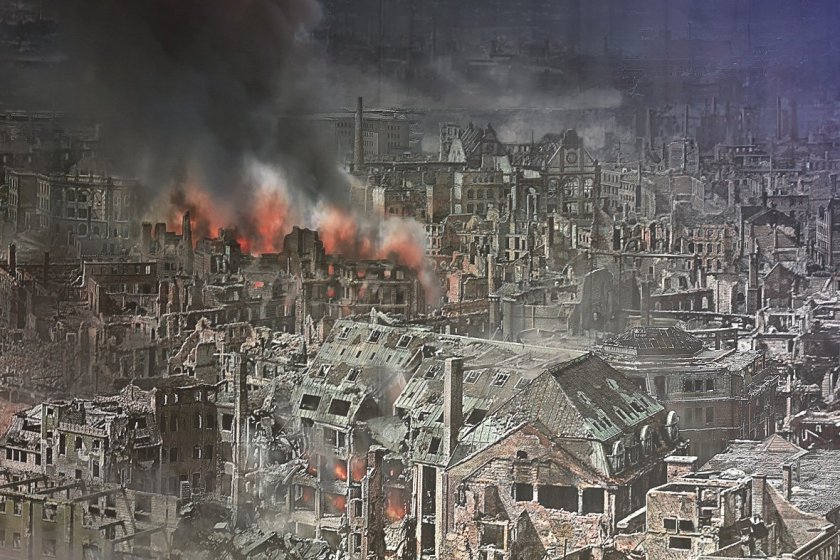
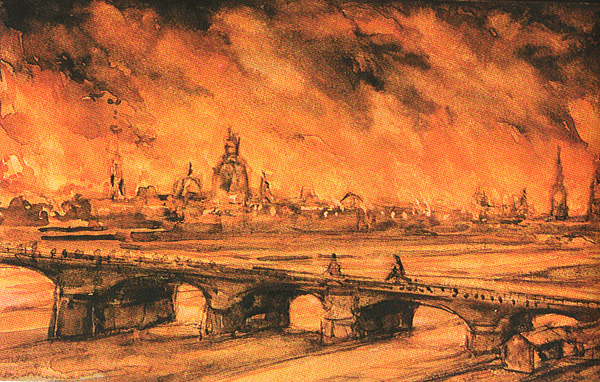
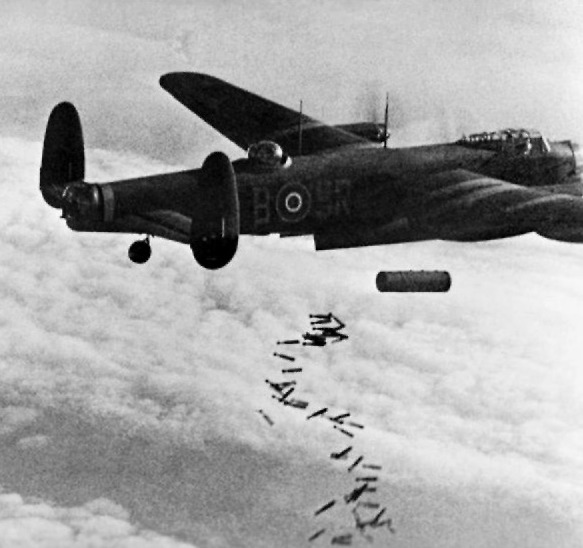
The first group of Lancaster bombers arrived in the skies over Dresden two hours before midnight, February 13. These were the pathfinders, their job to find the place and drop magnesium parachute flares, to light up the target. Then came the marker planes, Mosquito bombers whose job it was to drop 1,000-pound target indicators whose red glare provided something to aim at. Then came the first wave, 254 Lancaster bombers dropping 500 tons of high explosives ranging from 500-pounders to massive, 4,000-pound “blockbusters”. Next came the incendiaries. The “fire bombs”. 200,000 of them.

For those caught on the ground like scared rabbits in oncoming headlights, the horrors had only begun.

dresden

The second wave came in the small hours of February 14, just as rescue operations were getting underway. By now thousands of fires were burning, with smoke rising 15,000 feet into the air. You could see it from the air, from five hundred miles.

Then came another 529 Lancasters, dropping another 1,800 tons of bombs.

Lancaster_I_NG128_Dropping_Blockbuster_-_Duisburg_-_Oct_14,_1944
Lancaster bomber

The USAAF arrived over the target on the afternoon of February 14, the 317 B-17 “Flying Fortresses” of the “Mighty 8th” delivering another 771 tons of bombs.

Fires enveloped the city by the tens of thousands growing into a great, howling firestorm. A shrieking, seemingly living demon beast from the blackest pits of hell, devouring all in its path.

A firestorm of this size develops its own weather, fire tornadoes reaching into the sky as pyrocumulonimbus clouds hurl lightning bolts back to earth, starting new fires. Gale force winds scream into the vortex from all points of the compass, powerful enough to hurl grown adults opening doors in an effort to flee, off their feet and into the flames.

Lothar Metzger brings us one of the few eyewitness accounts of the fire bombing of Dresden, as seen from the ground:

“It is not possible to describe! Explosion after explosion. It was beyond belief, worse than the blackest nightmare. So many people were horribly burnt and injured. It became more and more difficult to breathe. It was dark and all of us tried to leave this cellar with inconceivable panic. Dead and dying people were trampled upon, luggage was left or snatched up out of our hands by rescuers. The basket with our twins covered with wet cloths was snatched up out of my mother’s hands and we were pushed upstairs by the people behind us. We saw the burning street, the falling ruins and the terrible firestorm. My mother covered us with wet blankets and coats she found in a water tub.

We saw terrible things: cremated adults shrunk to the size of small children, pieces of arms and legs, dead people, whole families burnt to death, burning people ran to and fro, burnt coaches filled with civilian refugees, dead rescuers and soldiers, many were calling and looking for their children and families, and fire everywhere, everywhere fire, and all the time the hot wind of the firestorm threw people back into the burning houses they were trying to escape from.

I cannot forget these terrible details. I can never forget them”.

He was ten years old at the time.

dresden-bombing (3)

For Victor Klemperer, the fire bombing of Dresden was a last minute reprieve. On the 19th he joined a refugee column fleeing the inferno, for American held territory. He would survive the attack, and live to see the end of the war.

Official death tolls from the burned out city are estimated at 18,500 to 25,000. The real number will never be known. At this point in the war refugees and military forces were streaming through the area by the tens of thousands. Estimates run as high as 200,000. That number if accurate, is more than death tolls resulting from the atomic bombings of Hiroshima and Nagasaki, combined.

February 13, 1945 Of Battles and Beignets

So what does Joan of Arc have in common with pancakes, pigs and potatoes? Why, I’m glad you asked.

We fancy ourselves a land of sand and fun here on Sunny Cape Cod™, not the kind of place for an epoch changing clash of arms. Truth be told the place really IS “Mayberry by the Sea” but even we, have had our moments.

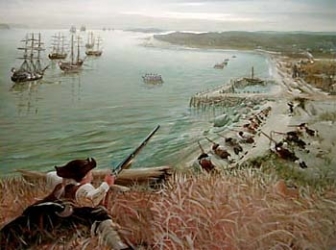
On April 3, 1779, local militia sallied forth to the beaches of Falmouth, to oppose a landing by some 220 of the King’s Regulars. The invaders were indeed repulsed but not before little Falmouth sustained a cannonade of ball and grape lasting from eleven in the morning, until well after dark.

falmouth1779_350

During the War of 1812, locals once again took up squirrel guns along the beaches and fired, on British warships. HMS Nimrod fired back holing no fewer than thirty buildings, with cannon shot. Until recently, three of those buildings yet stood, holes and all. Sadly, the Nimrod Restaurant is no more. Today there are but two cannonball holes but you can still see them still, one at the Elm Arch Inn and the other, at the former home of Captain Silas Bourne.

And who can forget that battle for the ages remembered far and wide, as the “Herring War”. “The Cape” has always been a sport fisherman’s paradise (and still is) but the earliest settlers were more focused on more important things. Like eating. The earliest mill was built in 1700. Others came into service over the next 100 years, mostly grist and woolen mills.

Before the age of internal combustion such enterprises harnessed the power of running water, and there came the rub. There were those who plied the waterways in search of a migratory and tasty little silver fish, called a Herring.

Long simmering animus between the two groups came to blows in 1800 when new mill construction threatened to block a herring run, in East Falmouth. Locals took to a cannon on the town green to express their ire. Packing the barrel with powder and herring they though to touch the thing off but, if some is good then more just has to be better. Right?

A herring left strictly to nature is an unlikely object to put in a cannon, but these guys figured it out. By the time they were done there must have been fish tails, hanging from the muzzle. Match was touched to to powder and the fuse was lit BOOM! The barrel exploded killing the gunner and raining down fish guts, for half a mile.

Thus ends another chapter of the never ending Herring Wars. And yet, this wasn’t the first conflict coming down to us with a funny sounding name. This wasn’t even the first Battle of the Herrings.

Today, the Siege of Orléans during the Hundred Years’ War marks the first appearance of Joan of Arc, at the head of a French Army. On February 12, 1459, Joan was making her final plea for support and safe conduct to enter the battle. The future saint prophesied that very day the King’s forces would suffer a dreadful defeat as indeed they did in an action remembered, as the Battle of the Herrings.

The city of Orléans was under siege for five months when an English supply train of 300 carts and wagons set out to provision the besieging force. Set upon by a vastly superior force of French and Scottish allies the English took refuge behind walls bristling with sharpened wooden stakes and wagons laden with – you guessed it – herring, in barrels. The tactic served them well at Agincourt and again, on February 12. Three to four thousand French forces attacked with gunpowder artillery, a new and poorly understood weapon, at that time. The Scots deplored such unmanly tactics and went to the attack, only to be cut down by a torrent of English arrows. The French cavalry then charged to the rescue while English longbowmen finished the job. The battle ended in a rout resulting in the loss of 500-600 French and Scots allies at the cost of a negligible number of English.

Word of the disaster reached the Dauphin, days later. Plunged into despair the young King-in-waiting and his ministers decided it couldn’t hurt to let this illiterate peasant girl take part. Thus we remember the Battle of the Herrings and the legend, of the Maid of Orléans.

In many Christian nations, Shrove Tuesday is the day before Ash Wednesday, the first day of lent and the last day (for now) to gorge on pancakes, beignets and other sweet treats. Also known as “Fat Tuesday”, “Mardi Gras” and “Pancake Tuesday”, Christians across the nation turn to pantries and supermarket shelves in the quest for some sweet confection. Many of those will see the face of Aunt Jemima smiling back. At least they once did, but then there was 2020.

Sigh.

Speaking of Aunt Jemima, Shrove Tuesday fell on February 13 in 1945, a day marking the continuing effort to evict the Japanese occupier from pre-communist China. In the US, OSS operatives, precursor to the modern CIA, devised an explosive compound with a color and consistency very much like, pancake flour. You could even cook with the stuff and eat it though it wasn’t recommended and probably not very tasty. As it was explosives were easily smuggled into occupied China in Aunt Jemima packages for the use of Chinese patriots, in the war against Imperial Japan.

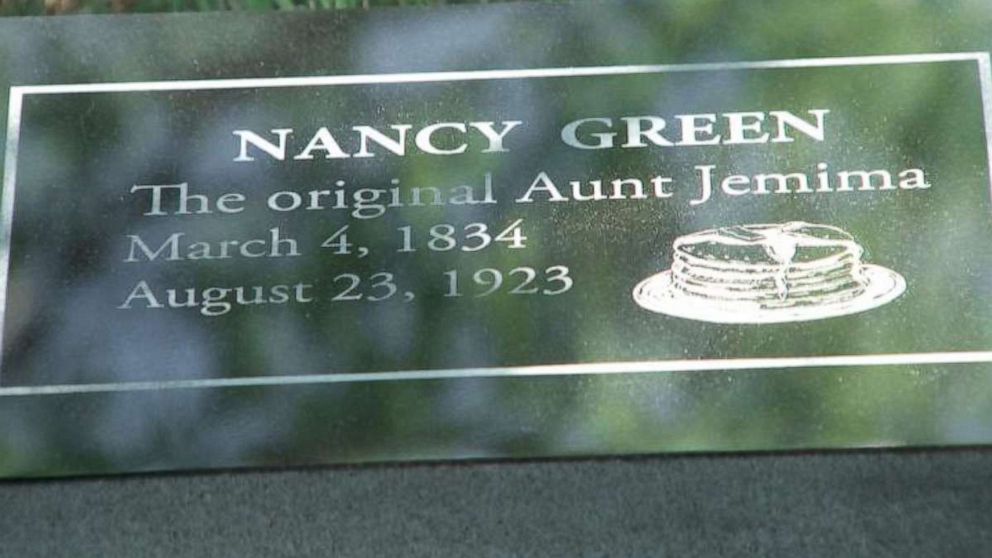
Today Nancy Green, the original (and very real) Aunt Jemima is once again relegated, to anonymity. Her descendants don’t understand and neither does anyone else, why her likeness was removed from grocery store shelves and replaced by the impersonal, “Pearl Milling Company Original”. But hey, who are we to stand in the way of the conspicuous display of meaningless virtue?

Today the United States and the United Kingdom enjoy a “Special Relationship” and may it ever be thus, but it wasn’t always that way. Three epoch changing clashes of arms were to unfold before we got to this place: the American Revolution, the War of 1812 and the Pig and Potato War.

Wait…What?

Yeah. The Oregon treaty of 1846 failed to make clear who governed the tiny but strategically important San Juan Island in the Gulf of Georgia, near Vancouver. Despite the diplomatic limbo British and American settlers alike lived in the place and got along perfectly well. Until June 15, 1859. A pig belonging to an Irishman named Charles Griffin was helping himself to potatoes belonging to the American farmer, Lyman Cutlar. Cutlar shot the pig. Scorning the farmer’s £10 peace offering Griffin insisted the farmer be arrested as indeed, he was. Anger boiled over on both sides and before long, a 461-man force of pissed off Americans armed with with 14 cannon faced over 2,000 British soldiers and five warships.

Very little ends well that begins with armed and angry men but sometimes, cooler heads prevail. British Admiral Robert Baynes had no intention of fighting with Americans over a dead pig. US President James Buchanan felt the same way and, before long, ruffled feathers were soothed. The island was handed over to US administration in 1872 following thirteen years, of mediation.

Now, wouldn’t I just love to talk about the Battle of the Cheeses, and how Mad Honey laid low the legions of Pompey the great? Yes I would, this is too much fun but, sadly, work awaits. That must remain a tale, for another day.

February 3, 1917 Sink the Housatonic

n the United States, the political tide was turning. Unrestricted submarine warfare…the Housatonic…the California and now the Zimmermann telegram…the events combined to become the last straw.  On April 2 the President who had won re-election on the slogan “He kept us out of war” addressed a joint session of the United States Congress, requesting a declaration of war.

The June 28, 1914 assassination of Archduke Franz Ferdinand  began a cascade of events which would change the course of the 20th century.  Entangling alliances and mutual suspicion combined with slavish dependence on timetables to effect the mobilization and counter-mobilization of armies.  

Remember the 1960s counterculture slogan “what if there was a war and nobody came”? In 1914, no one wanted to show up late in the event of war.  And so, there was war.  By October, the “War to End All Wars” had ground down to the trench-bound hell which would characterize the next four years.

Both the German and British economies were heavily dependent on imports to feed populations at home and to prosecute the war effort. By February 1915, the two powers were attempting to throttle the other through naval blockade.

Great Britain’s Royal Navy had superior numbers, while the Imperial German Naval surface fleet was restricted to an area of the North Sea called the German Bight. In other theaters, Germans augmented their small navy with commerce raiders and “unterseeboots”.  More than any other cause it was the German policy of unrestricted submarine warfare which would bring the United States into the war, two years later.

wwi-submarine

On February 4, 1915, Imperial Germany declared a naval blockade against shipping to Britain stating that “On and after February 18th every enemy merchant vessel found in this region will be destroyed, without its always being possible to warn the crews or passengers of the dangers threatening”. “Neutral ships” the statement continued, “will also incur danger in the war region”.

As the war unfolded, German U-boats sank nearly 5,000 ships, close to 13 million gross register ton including the Cunard Liner Lusitania, torpedoed and sunk off Kinsale, Ireland on May 7, 1915. 1,198 were drowned including 128 Americans. 100 of the dead, were children.

lusitania-sinking

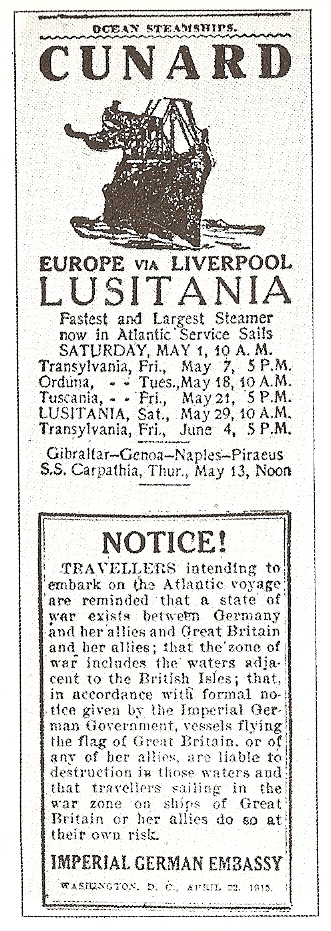
Reaction in the United States and the United Kingdom alike were immediate, and vehement. The sinking was portrayed as the act of barbarians and Huns. For their part the Imperial German government maintained that Lusitania was illegally transporting munitions intended to kill German boys on European battlefields. Furthermore, as the embassy pointed out ads were taken out in the New York Times and other newspapers specifically warning that the liner was subject to attack.

lusitania-warning

Warnings from the German embassy often ran directly opposite ads for the sailing itself. Many dismissed such warnings believing such an attack, was unlikely.

Unrestricted submarine warfare was suspended for a time, for fear of bringing the US into the war.  The policy was reinstated in January 1917 prompting then-Chancellor Theobald von Bethmann Hollweg to comment, “Germany is finished”.  He was right.

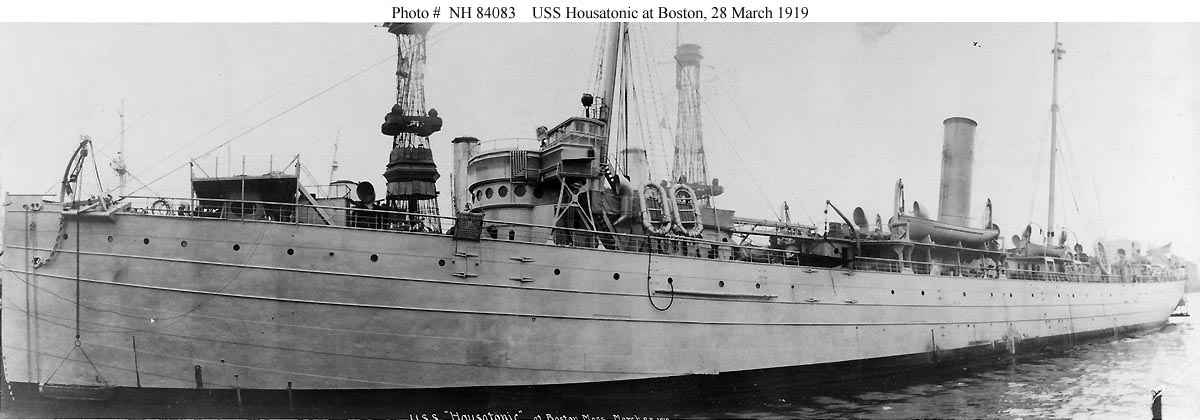
On February 3, 1917, SS Housatonic was enroute from Galveston Texas to Liverpool England bearing a cargo of flour, and grain. Passing the southwest coast of England the liner was stopped and boarded by the German submarine U-53.

American Captain Thomas Ensor was interviewed by Kapitänleutnant Hans Rose, who said he was sorry. Housatonic he said, was “carrying food supplies to the enemy of my country”, and would be destroyed. The American Captain and crew were allowed to launch lifeboats and abandon ship while German sailors raided the American vessel .

Based on what was taken, WWI vintage German subs were especially short on soap.

Abandoned and adrift Housatonic was sunk with a single torpedo, U-53 towing the now-stranded Americans toward the English coast. Sighting the trawler Salvator, Rose fired his deck guns to be sure they’d been seen, and then slipped away.

President Woodrow Wilson retaliated, breaking off diplomatic relations with Germany the same day. Four days later a German U-boat fired two torpedoes at the SS California, off the Irish coast. One missed but the second tore into the port side of the 470-foot, 9,000-ton steamer. California sank in nine minutes killing 43 of her 205 passengers and crew.

zimmerman-note

Two weeks later, British Intelligence divulged the Zimmermann note to Edward Bell, secretary to the United States Embassy in Britain.  It was a diplomatic overture from German Foreign Minister Arthur Zimmermann to the Mexican government, promising American territories in exchange for a Mexican declaration of war against the United States.

Zimmermann’s note read, in part:

“We intend to begin on the first of February unrestricted submarine warfare. We shall endeavor in spite of this to keep the United States of America neutral. In the event of this not succeeding, we make Mexico a proposal of alliance on the following basis: make war together, make peace together, generous financial support and an understanding on our part that Mexico is to reconquer the lost territory in Texas, New Mexico, and Arizona…”

In the United States, the political tide was turning. Unrestricted submarine warfare…the Housatonic…the California and now the Zimmermann telegram…the events combined to become the last straw.  On April 2 the President who had won re-election on the slogan “He kept us out of war” addressed a joint session of the United States Congress, requesting a declaration of war.

At the time, the German claim that Lusitania carried contraband munitions seemed to be supported by survivors’ reports of secondary explosions within the stricken liner’s hull. In 2008, the UK Daily Mail reported that dive teams had reached the wreck, lying at a depth of 300′. Divers reported finding tons of US manufactured Remington .303 ammunition, about 4 million rounds, stored in unrefrigerated cargo holds in cases marked “Cheese”, “Butter”, and “Oysters”.

January 31, 1918 The Battle of May Island

By 6:30pm, the fleet had formed a line some thirty miles long proceeding north at 20 knots, equivalent to 23MPH over the ground. It was full dark at this latitude with the Haar or “sea fog”, closing in. The fleet was effectively deaf and blind, and traveling fast. The table was set, for disaster.

ww1navybritish-shipbuildingmapbritishisles2

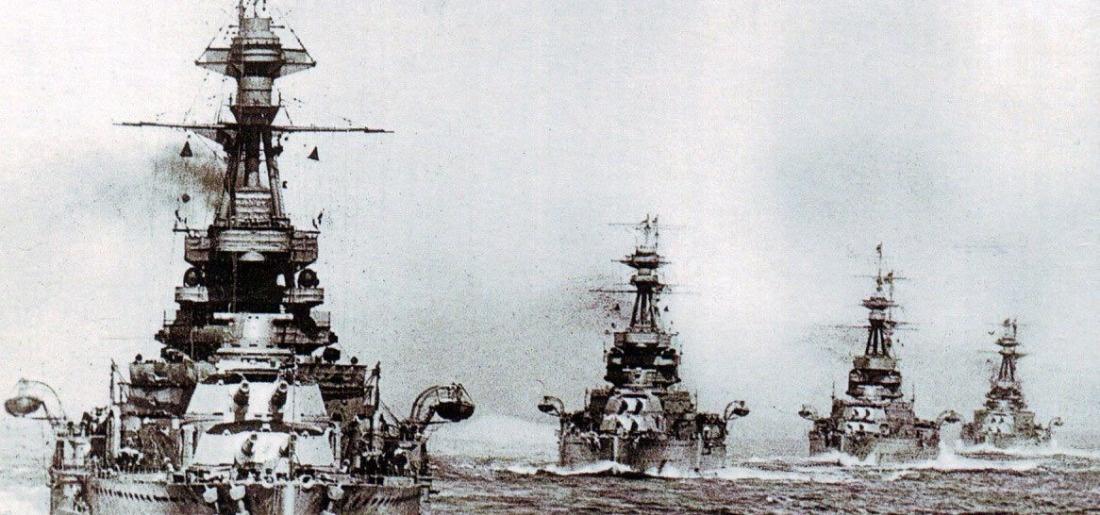
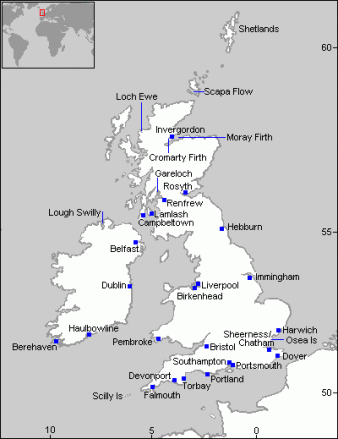
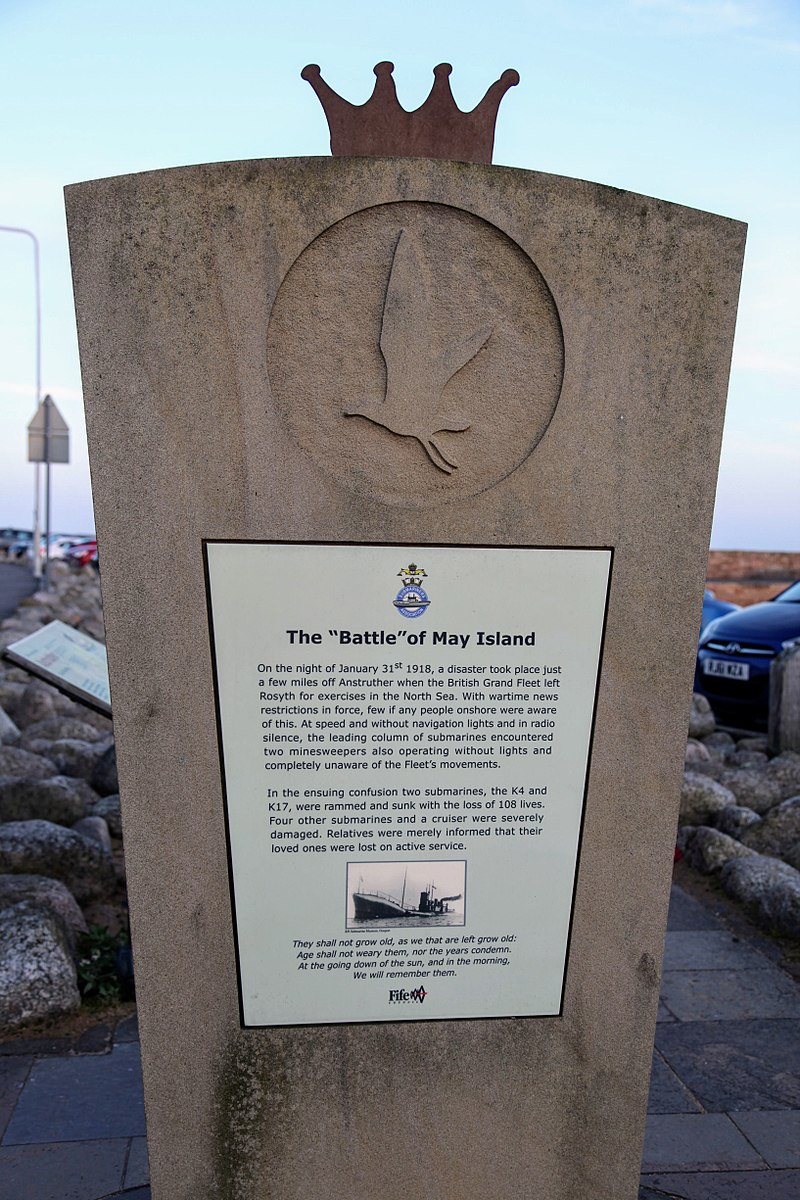
Operation E.C.1 was a planned exercise for the British Grand Fleet, scheduled for February 1, 1918 out of the naval anchorage at Scapa Flow in the North Sea Orkney Islands.

Forty vessels of the British Royal Navy departed Rosyth in the Scottish fjord at the Firth of Forth on January 31, bound for Scapa flow. They were the 5th Battle squadron with destroyer escort, the 2nd Battlecruiser squadron and their destroyers, two cruisers and two flotillas of K-class submarines, each led by a light cruiser.

By 6:30pm, the fleet had formed a line some thirty miles long proceeding north at 20 knots, equivalent to 23MPH over the ground. It was full dark at this latitude with the Haar or “sea fog”, closing in.  The fleet was effectively deaf and blind, and traveling fast.

While only an exercise, strict radio silence was observed, lest there be any Germans in the vicinity. Each vessel displayed a faint blue stern light, travelling 400-yards ahead of the next-in-line. Black-out shields restricted the lights’ visibility to one compass point left or right of the boats’ center line.   The table was set for disaster.

Though large for WW1-vintage submarines at over 300-feet, K-class subs were low to the water and slow, compared with the much larger surface vessels.  Compounding the problem, the unfortunately nicknamed”Kalamity Klass” was powered by steam, meaning that stacks had to be folded and closed, before the thing was ready to dive.  Only eighteen K-class submarines were ever built, only one of which ever caused damage to a German U-boat, and that was a ramming attack.

Seems the K-class was more dangerous to its own people, than anyone else.

A half-hour into the cruise, the flagship HMS Courageous passed a tiny speck on the map called May Island and picked up speed. A pair of lights appeared in the darkness as the 13th Submarine Flotilla passed, possibly a pair of mine sweeping trawlers. The flotilla turned hard to port to avoid collision when the helm of the third-in-line K-14 jammed, and veered out of line. Both K-14 and the boat behind her, K-12 turned on their navigation lights as K-22, the next submarine in line, lost sight of the flotilla and collided with K-14, severing the bow and killing two men. Two stricken submarines now struggled to pull themselves apart while an entire fleet sped through the darkness, unaware of what was about to happen.

The destroyer HMS Ithuriel received a coded signal and turned to lend aid, doubling back and followed by the remainder of the 13th submarine flotilla and thus putting themselves on collision course with the outgoing 12th flotilla.

Unaware of the mess lying in her path, 12th flotilla escort HMS Fearless was traveling way too fast to change the outcome. Fearless went “hard astern” on sighting K-17 but too late, her bow knifing through the smaller vessel, sinking the sub within minutes with the loss of 47 men. Meanwhile, outgoing submarine K-4 heard the siren and came to a stop but not the trailing K-3 which hit her sister sub broadside, nearly cutting the vessel in half.

battlemayisland_fearless1
HMS Fearless

K-4 sank in minutes, with the loss of 55 men.

The number of near misses that night, can never be known. 104 men were dead before it was over, with the total loss of two K-class submarines. Four more sustained severe damage along with the Scout Cruiser, HMS Fearless.

A hastily arranged Board of inquiry began on February 5 and sat for five days, resulting in several courts martial for negligence.  Those would be adjudicated, “unproved”.

800px-may_island_memorial_anstruther

The whole disaster and subsequent inquiry was kept quiet to avoid embarrassment, and to deprive the propaganda bonanza, to the Germans. Full details were released only in 1994, long after the participants in this story had passed on.

On January 31, 2002, a memorial cairn was erected in memory of the slain.  As it had been eighty four years before there wasn’t a German, in sight.  The “Battle of May Island” was no battle at all.  Just the black and forlorn humor, of men at war.

January 31, 1918 Battle of May Island

January 20, 2018 Rosie the Riveter

All told some six million women answered the call, expanding the female participation in the overall workforce from 27%, to 37%.


Following the German invasion of Poland in 1939 and the outbreak of general war in Europe, President Franklin Delano Roosevelt proclaimed a limited national emergency, authorizing an increase in Regular Army personnel to 227,000 and 235,000 for the National Guard. Strong isolationist sentiment kept the United States on the sidelines for the first two years, as victorious German armies swept across France.

That all changed on December 7, 1941, with the Japanese attack on the Pacific naval anchorage at Pearl Harbor. Seizing the opportunity, Nazi Germany declared war on the United States, four days later.

The Roosevelt administration had barely found the keys to the American war machine in February 1942, when disaster struck with the fall of Singapore, a calamity Prime Minister Winston Churchill called the “worst disaster” in British military history.

The mobilization of the American war machine was a prodigious undertaking. From that modest beginning in 1939, the Army alone had 5.4 million men under arms by the end of 1942. By the end of the war in 1945, American factories produced a staggering 296,000 warplanes, 86,000 tanks, 64,000 landing ships, 6,000 navy vessels, millions of guns, billions of bullets, and hundreds of thousands of trucks and jeeps. US war production exceeded that of the Axis powers of Germany, Italy, and Japan, combined.

As all that manpower mobilized to fight the war, women moved into the workforce in unprecedented numbers.  Nearly a third of a million women worked in the American aircraft industry alone in 1943:  65% of the industry’s workforce, up from just 1% in the interwar years.

All told some six million women answered the call, expanding the female participation in the overall workforce from 27%, to 37%.

rosie-the-riveter

The mythical “Rosie the Riveter” first appeared in a song written by Redd Evans and John Jacob Loeb and made famous by swing bandleader James Kern “Kay” Kyser, in 1943.  The song told of a munitions worker who “keeps a sharp lookout for sabotage / Sitting up there on the fuselage…Rosie’s got a boyfriend, Charlie.  Charlie, he’s a Marine / Rosie is protecting Charlie Working overtime on the riveting machine”.

Norman Rockwell had almost certainly heard the song when he gave Rosie form for the cover of that year’s Memorial Day Saturday Evening Post.  Posed like the Prophet Isaiah from Michelangelo’s Sistine Chapel, Rockwell’s “Rosie” is on lunch break, riveting gun on her lap, a beat-up copy of Mein Kampf ground happily under foot.

1035x1485-gettyimages-90017379

Vermont Dental Hygienist Mary Doyle Keefe was the model for Rockwell’s Rosie.  The propaganda value of such an iconic image was unmistakable, but copyright rules limited the use of Rockwell’s portrait.  The media wasted no time in casting a real-life Rosie the Riveter, one of whom was Rose Will Monroe, who worked as a riveter at the Willow Run aircraft factory, in Ypsilanti Michigan.  Rose Monroe would go on to appear in war-bond drives, but the “Real” Rosie the Riveter, was someone else.

The year before the Rosie song came out, Westinghouse commissioned graphic artist J. Howard Miller to produce a propaganda poster, to boost company morale.  The result was the now-familiar “We Can Do It” poster, depicting the iconic figure flexing her biceps, wearing the familiar red & white polka dot bandanna.

world-war-ii-women-at-work-in-color-8
Colorized image of railroad workers on break, 1943

Though she didn’t know it, Miller’s drawing was based on a photograph of California waitress Naomi Parker Fraley, who worked in a Navy machine shop in 1942.

While Norman Rockwell’s Rosie the Riveter was the first, it is Miller’s work we remember, today.  Rosie the Riveter was larger than any one woman.  She was symbolic of her age, one of the most memorable and long lasting images of the twentieth century.

merlin_132732191_22bab46e-396e-4056-809a-2e551095a7dc-superjumbo
Naomi Parker Fraley, real-life model for Rosie the Riveter

For many years, it was believed that a Michigan woman, Geraldine Hoff Doyle, was the “real” Rosie the Riveter.  Hoff Doyle had seen the uncaptioned image, and believed it to be herself.  It was an innocent mistake. The woman bears a striking resemblance to the real subject of the photograph.

Thirty years came and went before Parker-Fraley even knew about it.  She saw herself in a newspaper clipping, and wrote to the paper around 1972, trying to set the record straight.  Too late. Hoff Doyle’s place had been cemented into popular culture, and into history.

Parker-Fraley was devastated. “I just wanted my own identity,” she says. “I didn’t want fame or fortune, but I did want my own identity.”

kimble_research_rosie-320
Professor James Kimble, Ph. D.

Another thirty-eight years would come and go before Seton Hall Communications Professor James J. Kimble, Ph.D., took an interest in the identity of the famous female from the WW2 poster. Beginning in 2010 and lasting nearly six years, the search became an obsession. It was he who discovered the long lost original picture with photographer’s notes identifying Naomi Parker-Fraley. “She had been robbed of her part of history,” Kimble said. “It’s so hurtful to be misidentified like that. It’s like the train has left the station and you’re standing there and there’s nothing you can do because you’re 95 and no one listens to your story.

rosie-the-riveter (1)

Over the years there have been many Rosie the Riveters, the last of whom was Elinor Otto, who built aircraft for fifty years before being laid off at age ninety-five.  Naomi Parker-Fraley knew she was the “first”, but that battle was a long lost cause until Dr. Kimble showed up at her door, in 2015.  All those years, she had known.  Now the world knew.

Rosie the Riveter died on January 20, 2018.  She was ninety-six.

Hat tip “BoredPanda.com”, for a rare collection of colorized images from the WW2 era, of women at work.  It’s linked HERE.

January 14, 1967 The Cloud

“The Army disclosed yesterday that it secretly conducted 239 germ warfare tests in open air between 1949 and 1969, some tests releasing live but supposedly harmless microscope [SIC] “bugs” at Washington’s Greyhound bus terminal and National Airport as part of the experiment.” Washington Post, March 9, 1977

Hat tip Wall Street Journal

On October 11, 1950, Mr. Edward J. Nevin checked into Stanford hospital in San Francisco with a fever, respiratory and other symptoms. Doctors diagnosed the retired pipefitter, with pneumonia.

Ten other women and men checked into the same hospital at this time, all suffering with the same symptoms. Respiratory difficulty combined with kidney and/or urinary tract infections so rare as to prompt their publication in a prestigious medical journal.

The cause was believed to be exposure to the bacterium, Serratia marcescens. Mr. Nevin, 75, underwent prostate surgery causing S. marcescens to travel through his blood from the urinary tract, to his heart. Three weeks later, he was dead. The other ten recovered.

In 1981 the Nevin grandchildren sued the federal government for the death of their grandfather and the economic destruction wrought on their grandmother, the direct result of ruinously high medical expenses. The alleged cause of death was the deliberate poisoning of the entire city of San Francisco, by the United States Navy.

On January 14, 1967, the New York Times reported the United States Army was conducting secret germ warfare experiments, on its own citizens.

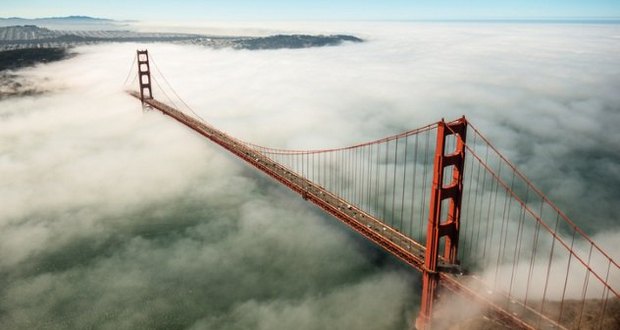
Turns out the San Francisco episode was part of a biowarfare experiment, called “Operation Sea-Spray”. Beginning on September 20, 1950 and continuing for seven days the US Navy sprayed massive amounts of two bacteria into the air believed to be harmless at the time, along with an iridescent agent, to aid with tracking. With cover and assistance from the famous San Francisco fog enough of this stuff was released into the atmosphere, that 43 tracking stations set up across the city determined that every one of the city’s 800,000 residents inhaled no fewer than 5,000 such particles.

Ten years later the U.S. Senate Subcommittee on Health and Scientific Research held a series of hearings, on the matter. On March 9, 1977, the Washington Post reported: “The Army disclosed yesterday that it secretly conducted 239 germ warfare tests in open air between 1949 and 1969, some tests releasing live but supposedly harmless microscope [SIC] “bugs” at Washington’s Greyhound bus terminal and National Airport as part of the experiment…Washingtin [SIC] was one of five cities where the Army released simulated lethal germs i [SIC] public places. Other cities where the public served as unknowing guinea pigs were New York, San Francisco, Key West and panama City, Fla”.

The Wall Street Journal reported on October 22, 2001, “In New York, military researchers in 1966 spread Bacillus subtilis variant Niger, also believed to be harmless, in the subway system by dropping lightbulbs filled with the bacteria onto tracks in stations in midtown Manhattan. The bacteria were carried for miles throughout the subway system, leading Army officials to conclude in a January 1968 report: “Similar covert attacks with a pathogenic [disease-causing] agent during peak traffic periods could be expected to expose large numbers of people to infection and subsequent illness or death.””

The Post reported 27 instances of simulated germ warfare attacks on two tunnels of the Pennsylvania Turnpike and a number of military installations including Fort Detrick, Maryland, Fort Belvoir, Virginia and the Marine training school at Quantico, Virginia.

The Post goes on to report that “Another 504 workers connected with biological warfare activities at Ft. Detrick, Dugway proving Ground and the Deseret test Center in Utah and the Pine Bluff Arsenal in Arkansas suffered infections, according to the Army’s count”. The Army went on to report that “three laboratorers at Fort Detrick died from diseases contracted in the 1950s and 1960s”.

I wasn’t aware that “laboratorers” is a word but the Washington Post seems to think it is.

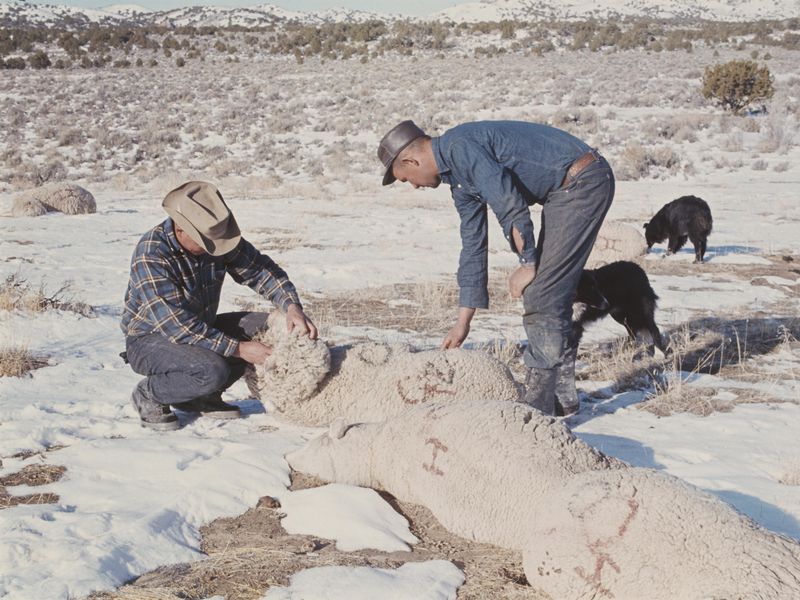
Utah’s Dugway Proving Ground alone conducted “hundreds, perhaps thousands of open-air tests using bacteria and viruses that cause disease in human, animals, and plants” according to a 1994 report, by the GAO (US General Accounting Office). One such experiment resulted in 3,843 dead animals in an episode known as, the “Skull Valley Sheep Kill“. In the end as many as 6,400 were killed or humanely euthanized as even the rumor of nerve agents renders both the wool and the meat of such an animal, less than worthless. A report which remained classified for thirty years blamed a faulty nozzle left open, as the test aircraft gained altitude.

Public backlash was vehement against the US Army Chemical Corps, and nearly lead to its disbanding.  President Richard Nixon ordered a halt to open air testing of “NBC” (Nuclear Biological and Chemical) agents, in 1969.

In the past, military spokesmen have argued that such tests are necessary. That NBC agents are readily available to state and non-state actors such as terrorist organizations and we must know how these agents behave, under real world conditions.

Perhaps they have a point. As does the ancient proverb of the Kikuyu people of Kenya, which tells us, “when elephants fight, it is the grass that suffers”.