July 8, 2002 Rocky

Rocky planned to become a Priest of the Roman Catholic faith, and return to the country to help the orphaned children of Vietnam. His was a bright and shining future. One never meant to be.

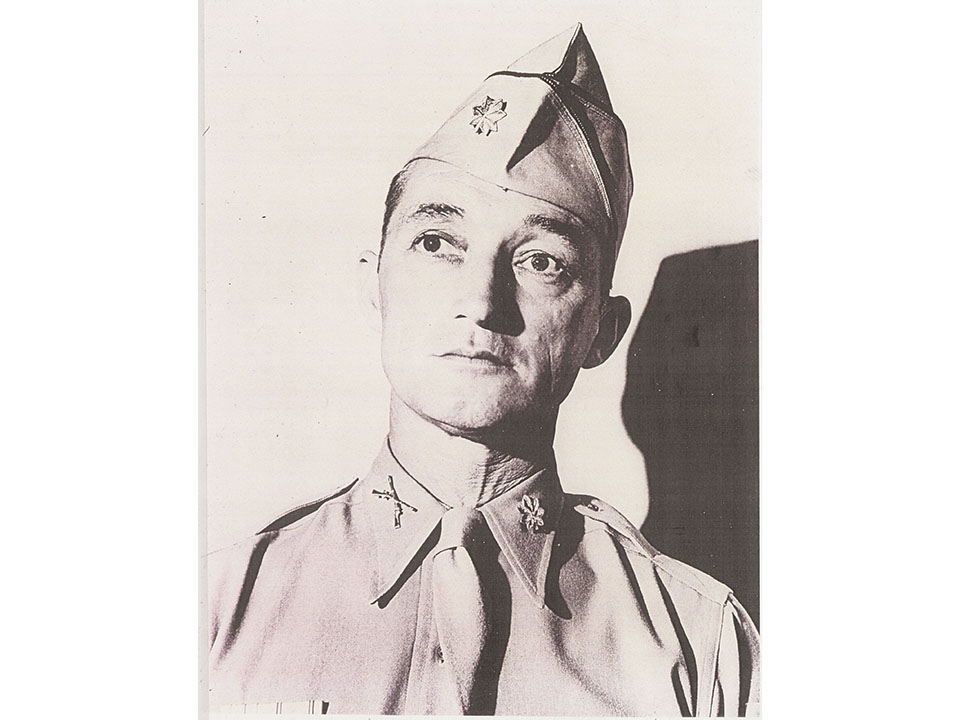
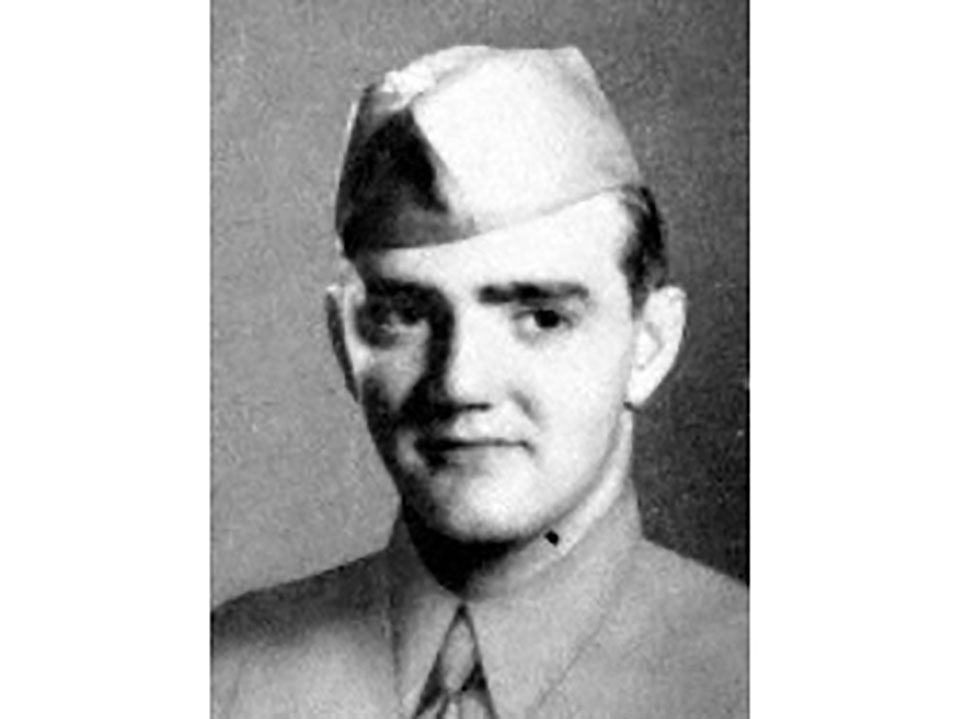
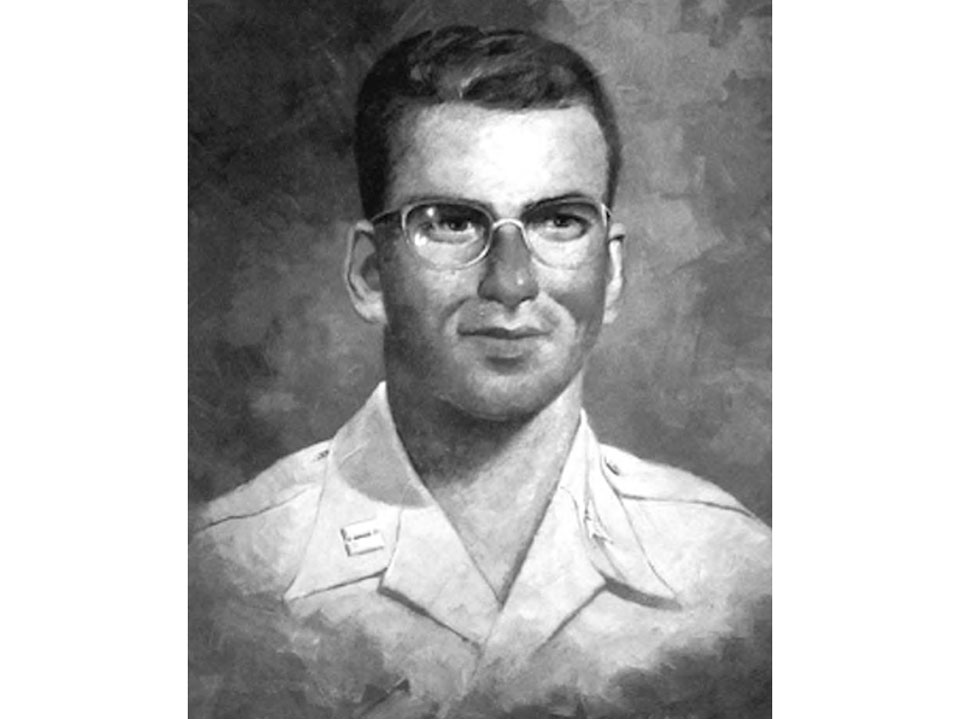
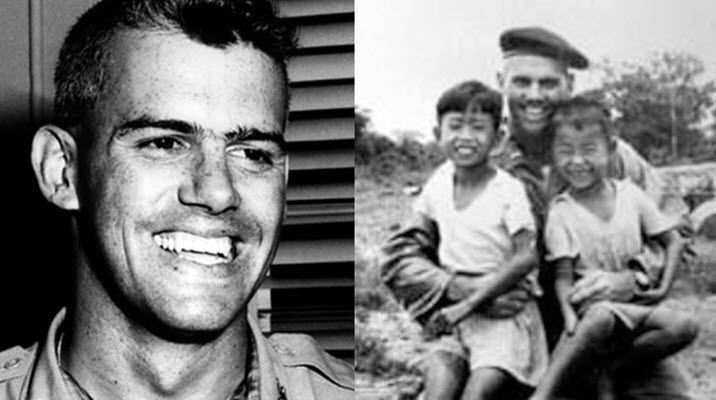
Humbert Roque Versace was born in Honolulu on July 2, 1937, the oldest of five sons born to Colonel Humbert Joseph Versace.  Writer Marie Teresa “Tere” Rios was his mother, author of the Fifteenth Pelican.  If you don’t recall the book, perhaps you remember the 1960s TV series, based on the story.  It was called The Flying Nun.

Like his father before him, Humbert, (“Rocky” to his friends), joined the armed services out of high school, graduating from the United States Military Academy at West Point, in 1959.

Rocky earned his Ranger tab and parachutist badge the same year, later serving as tank commander with the 1st Cavalry in South Korea, then with the 3rd US Infantry – the “Old Guard”.

Rocky attended the Military Assistance Institute, the Intelligence course at Fort Holabird Maryland, and the USACS Vietnamese language Course at the Presidio of Monterey, beginning his first tour of duty in Vietnam on May 12, 1962.
versace1

He did his tour, and voluntarily signed up for another six months.  By the end of October 1963, Rocky had fewer than two weeks to the end of his service.  He had served a year and one-half in the Republic of Vietnam.  Now he planned to go to seminary school.  He had already received his acceptance letter, from the Maryknoll order.

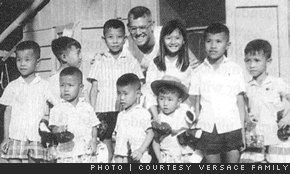
Rocky planned to become a Priest of the Roman Catholic faith, and return to the country to help the orphaned children of Vietnam.

His was a bright and shining future. One never meant to be.

Rocky was assisting a Civilian Irregular Defense (CIDG) force of South Vietnamese troops remove a Viet Cong (VC) command post in the Mekong Delta. It was unusual that anyone would volunteer for such a mission, particularly one with his “short-timer’s stick”. This was a daring mission in a very dangerous place.
Screen-Shot-2016-09-28-at-7.20.27-PM-466x315
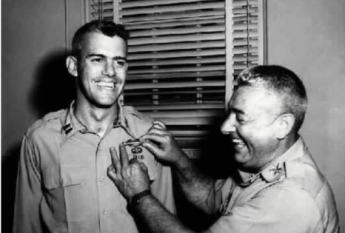
In happier times, Colonel Humbert Joseph Versace pins insignia on the uniform of his son, Captain Humbert Roque “Rocky” Versace

On October 29, an overwhelming force of Viet Cong ambushed and overran Rocky’s unit.  Under siege and suffering multiple bullet and shrapnel wounds, Versace put down suppressing fire, permitting his unit to withdraw from the kill zone.

Another force of some 200 South Vietnamese arrived, too late to alter the outcome.  Communist radio frequency jamming had knocked out both main and backup radio channels.

Their position overrun, Captain Versace, Lieutenant Nick Rowe and Sergeant Dan Pitzer were captured and taken to a North Vietnamese prison, deep in the jungle.
This image has an empty alt attribute; its file name is 7d4cb22a67972aeb9cbbc48b25414a38.jpg

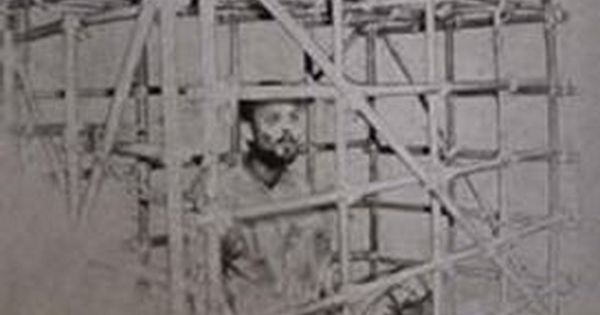
For most of the following two years, a 2’x3’x6’ bamboo cage would be their home.  On nights when their netting was taken away, the mosquitoes were so thick on their shackled feet, it looked like they were wearing socks.

Years later, President George W. Bush would tell a story, about how Steve Versace described his brother.   “If he thought he was right”,  Steve said to audience laughter, “he was a pain in the neck.  If he knew he was right, he was absolutely atrocious.

btkf-penthouse1-475

In 1964, Vietnamese interrogators were learning what Steve Versace could have told them, if only they’d asked.  His brother could not be broken.  Rocky attempted to escape four times, despite leg wounds which left him no option but to crawl on his belly.   Each such attempt earned him savage beatings, but that only made him try harder.

Fluent in French, Vietnamese and English, Rocky could quote chapter and verse from the Geneva Conventions and never quit doing so.  He would insult and ridicule his captors in three languages, even as they beat him to within an inch of his life.
d2876bed385752258d0ad3af863709e1

Incessant torture and repeated isolation in solitary confinement did nothing to shut him up.  Communist indoctrination sessions had to be brought to a halt in French and Vietnamese, because none of his interrogators could effectively argue with this guy.  They certainly didn’t want villagers to hear him blow up their Communist propaganda in their own language.

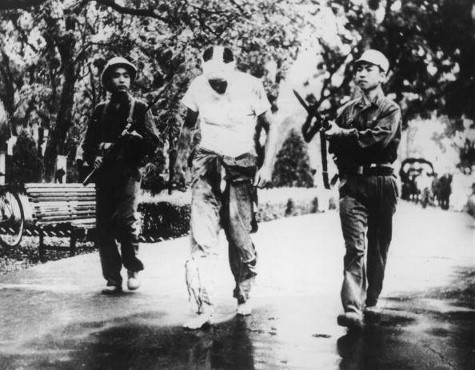
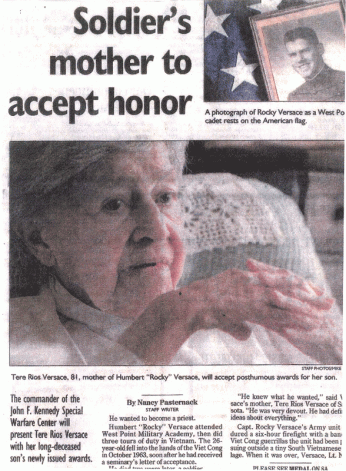
For five months in 1964, reports came back through intelligence circles, of one particular prisoner. Paraded in chains before local villagers, with hair turned snow white and face swollen and yellowed with jaundice. With hands tied behind his back and a rope around his neck, even then this man still spoke in three languages, of God, and Freedom, and American democracy.
pg1ver

The affect was unacceptable to his Communist tormentors. To the people of these villages, this man made sense.

In the end, Versace was isolated from the rest of the prison population, as a dangerous influence.  He responded by singing at the top of his lungs, the lyrics of popular songs of the day replaced by messages of inspiration to his fellow POWs.  Rocky was last heard belting out “God Bless America”, at the top of his lungs.

Humbert Roque Versace was murdered by his North Vietnamese captors, his “execution” announced on North Vietnamese “Liberation Radio” on September 26, 1965.  He was twenty-eight years old.

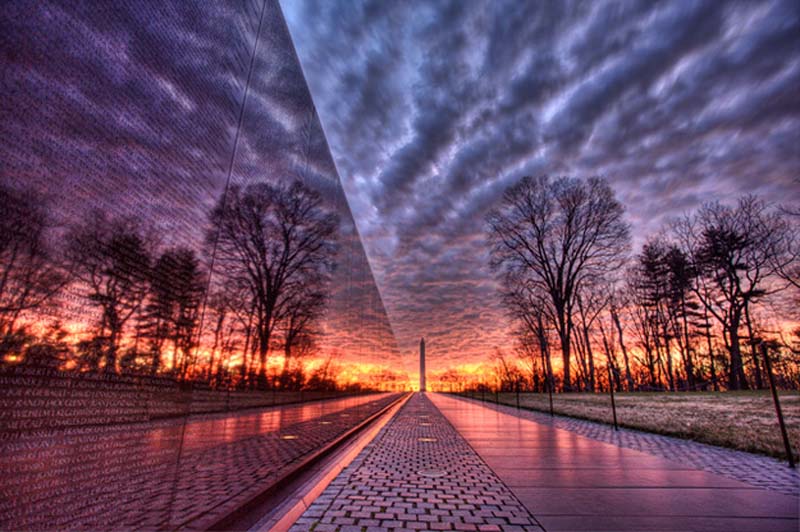
Rocky’s remains were never recovered.  The headstone bearing his name in the Memorial section MG-108 at Arlington National Cemetery, stands over an empty grave.  The memory of his name is inscribed on the Courts of the Missing in the Honolulu Memorial at the National Memorial Cemetery of the Pacific in Honolulu, and on Panel 1E, line 33, of the Vietnam Veterans Memorial.
vietnam-memorial

This American hero of Italian and Puerto Rican heritage was nominated for the medal of honor in 1969, an effort culminating in a posthumous Silver Star.  In 2002, the Defense Authorization Act approved by the United States Congress and signed into law by President George W. Bush, awarded Versace the Medal of Honor.

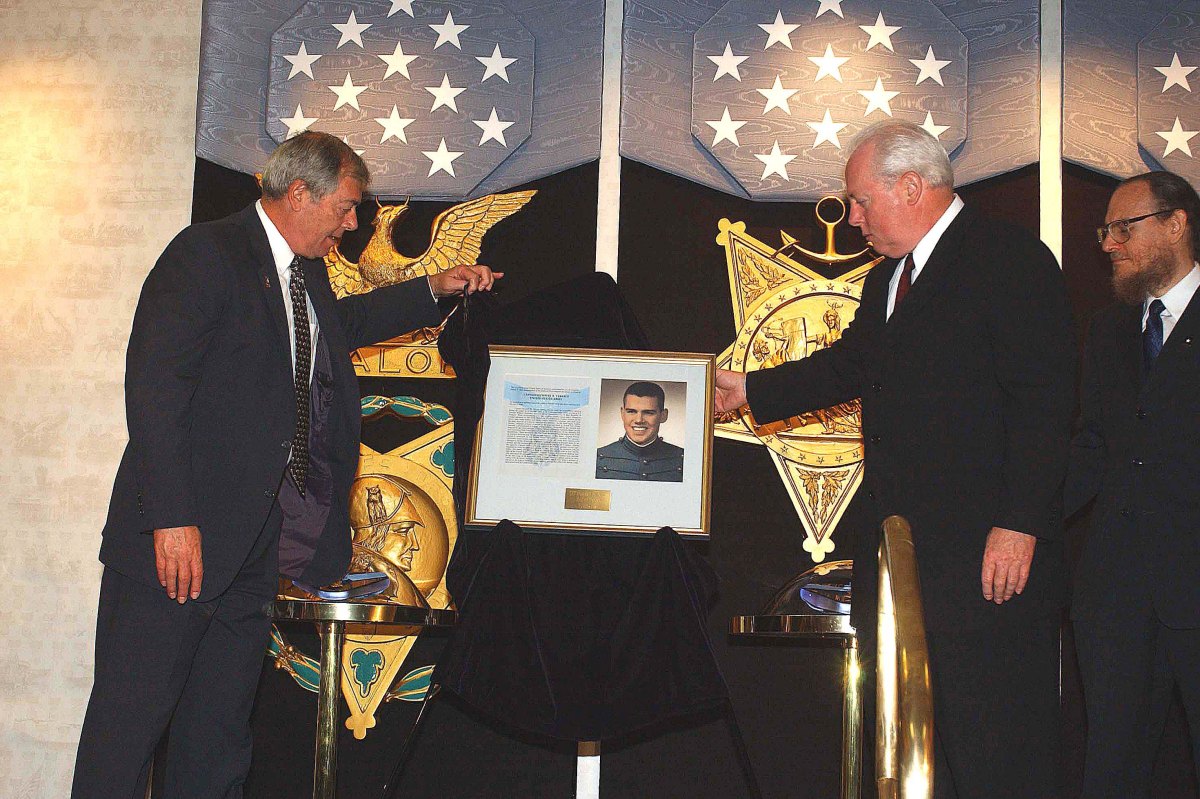
In a July 8, 2002 ceremony in the East Room of the White House, the President of the United States awarded the Medal of Honor to United States Army Captain Humbert Roque “Rocky” Versace.  Dr. Stephen Versace stood in to receive the award, on behalf of his brother.  Never before had the nation’s highest honor for military valor been bestowed on a POW, for courage in the face of captivity.
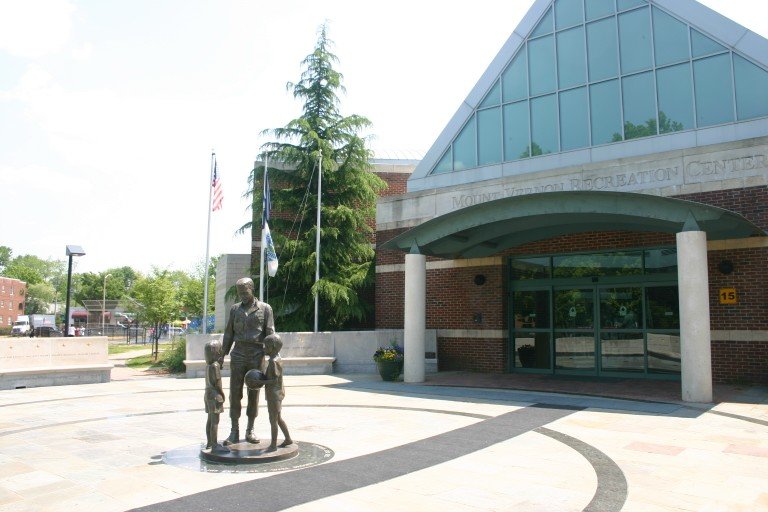
Rockys Statue_Plaza1
This statue of Medal of Honor recipient and Ranger Hall of Fame inductee Captain “Rocky” Versace stands in a plaza bearing his name in Alexandria, Virginia. With him are the likenesses of two Vietnamese children, along with sixty-seven gold stars, each representing one of the 67 soldiers, sailors and airmen from Alexandria who were KIA or MIA, in the war in Vietnam.

July 7, 1944 Banzai

Crowded into the north end of the island, lieutenant General Yoshitsugu Saito assembled everything he had, over 4,000 hardened troops, into the largest banzai charge of World War 2.

The largest amphibious assault in history began on June 6, 1944, on the northern coast of France.  By end of day, some 156,000 Allied troops had successfully stormed the beaches of Normandy.  Within a week that number had risen to a third of a million troops, over 50,000 vehicles and more than 100,000 tons of equipment.

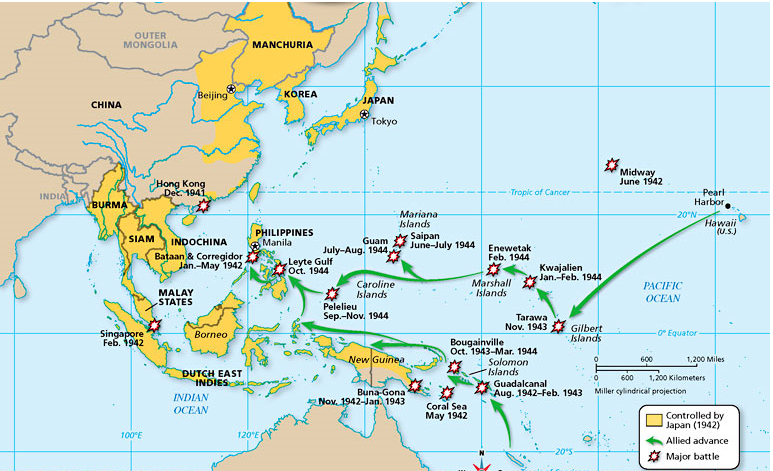
Half a world away the “D-Day of the Pacific” launched the day before and landed nearly two weeks later, to take the first of three islands in the Mariana group. Saipan.

The “leapfrog” strategy bringing US Marines onto the beaches of Saipan were nothing new. The earlier campaigns to recapture New Guinea and the Solomon Islands, clearing the way for the “island hopping” tactics of admiral Chester Nimitz, to move on the Japanese archipelago.  

The Solomon Islands of Tulagi, and Guadalcanal. The heavily fortified atolls of Tarawa and Makin, in the Gilbert islands. The Marshall islands group: Majuro, Kwajalein and Eniwetok. These and more were pried from the grasp of the Japanese occupier, retaken only by an effusion of blood and treasure unheard of, in previous conflicts.

Saipan was different. Captured in 1914, the League of Nations awarded Saipan to the Empire of Japan five years later, part of the South Seas Mandate of 1919. Saipan was Japanese territory, the first not retaken since the Japanese offensives of 1941 -’42. Not only that. Allied control of Saipan put the Japanese archipelago well within range of B29 long range bombers. Control of the Marianas and Saipan in particular spelled the beginning of the end of the war in the Pacific, and both sides knew it.

Prime Minister Hideki Tōjō publicly swore the place would never be taken. This was to be the most pivotal battle, of the war in the Pacific.

We’ve all seen that hideous footage from the closing days. The cataracts of human beings hurling themselves from the cliffs of Saipan to certain and violent death, on the rocks below. Destroying themselves to avoid who-knows-what kind of atrocities the propaganda ministers of their own government, had taught them to expect at the hands of the Americans.

And those were the civilians. The ferocity of Japanese military resistance can scarcely be imagined, by the modern mind. US Marines took 2,000 casualties on the first day alone, June 16, on the beaches of Saipan.

US Army joined in the following day and, for almost four weeks, battled dug-in and fanatical Japanese soldiers for control of Saipan. Fighting was especially intense around Mount Tapotchau, the highest peak on Saipan. Names such as “Death Valley” and “Purple Heart Ridge” etched themselves in blood, onto the histories of the 2nd and 4th divisions of the United States Marine Corps and the US Army’s 27th Infantry Division.

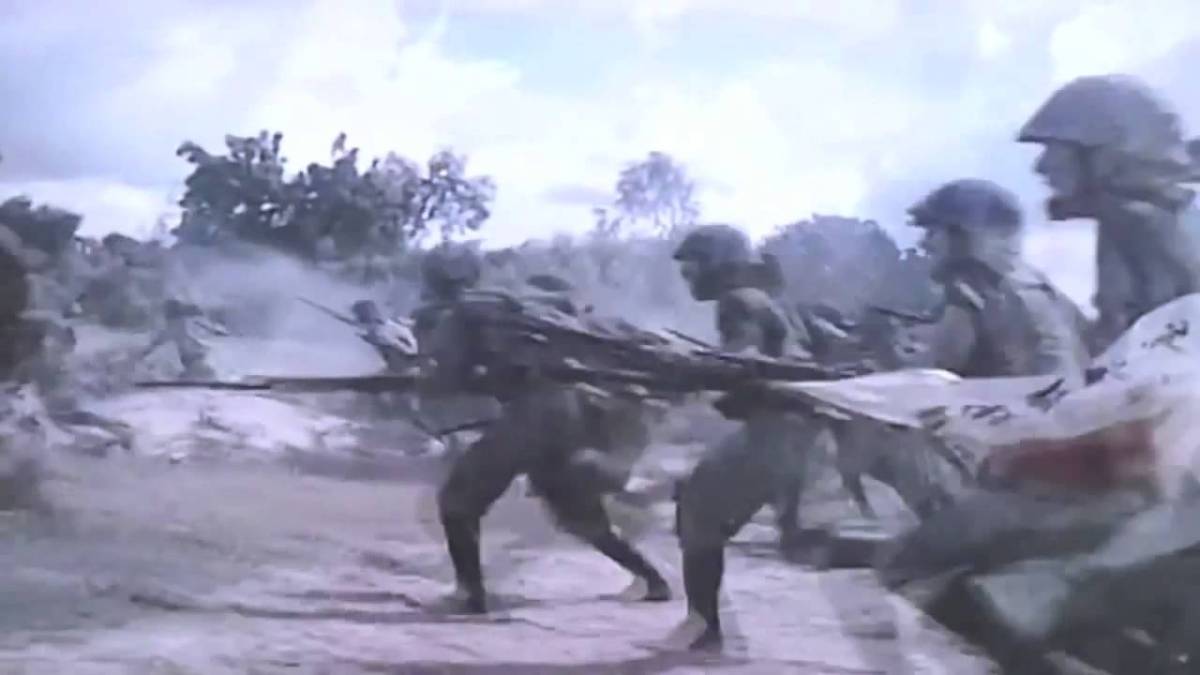
By July 6 what remained of the defenders had their backs to the sea. Crowded into the north end of the island, lieutenant General Yoshitsugu Saito assembled everything he had, over 4,000 hardened troops, into the largest banzai charge of World War 2.

Banzai as the allies called it after the battle cry “Tennōheika Banzai” (“Long live His Majesty the Emperor”) was a massed assault, one method of gyokusei (shattered jewel) whose purpose is honorable suicide, not unlike the hideous ritual of self-disembowelment known as seppuku.

Imagine if you will, an irresistible tide of shrieking warriors, thousands of them pouring down on you bent on destroying you and everyone around you, each seeking that honorable suicide only to be had, from death in battle.

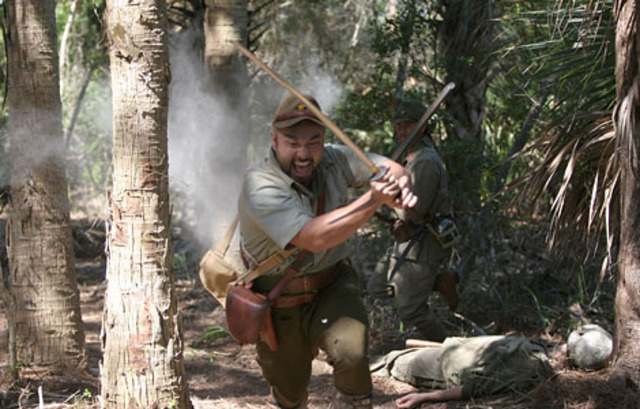
The evening of July 6 was spent immersed in beer and sake At 4:45am local time July 7, the largest banzai charge of World War 2 came screaming out of the dawn to envelop US forces. First came the officers, some 200 of them, waving their swords and screaming, at the top of their lungs. Then came the soldiers. Thousands of them, howling in the morning’s first light. Major Edward McCarthy said it was like stampeding cattle, only these, kept coming.

The tide was irresistible at first, sweeping all before it. The American perimeter was shattered leaving nothing but isolated pockets, fighting for their lives. Fighting was savage and hand to hand with everything from point-blank howitzers and anti-tank weapons to rifle butts, fists, and rocks.

The human tide advanced some 1,000 yards into the American interior before it was slowed, and then stopped. By six that evening, American armed forces had regained original positions in what was now a charnel house, of gore.

406 Americans were killed that July 7 and an another 512, maimed. 4,311 Japanese troops, lay dead. Three stories come down to us, from that day. Three stories among thousands who have earned the right, to be remembered.

Lt. Col. William O’Brien fired two pistols into the faces of his attackers until he was out, of bullets. Receiving a severe shoulder wound in the process O’Brien leaped onto a jeep and blazed away with its .50 caliber mounted machine gun, all while shouting encouragement to his retreating comrades.

At last even that was out of ammunition. Lt. Col O’Brien was overwhelmed by his attackers his body riddled with bullets, and bayonet wounds. On retaking the position that evening American observers credited 30 dead Japanese, to O’Brien’s .50-cal.

Private Tom Baker exhausted his rifle’s ammunition before turning it, as a club. His rifle butt shattered Baker began to pull back, before he was hit. A fellow soldier began to carry him when he himself, was shot down. Baker refused further aid asking instead to be propped up against a tree facing the enemy with a cigarette, and a pistol.

He was found that afternoon, dead, the eight bullets from that pistol, spent. He was still sitting up against that tree. At his feet, were eight dead Japanese.

Captain Benjamin Salomon was a rear-echelon guy, a dentist assigned to a medical unit. Captain Salomon was treating the wounded in an aid station, when the first attacker, crawled under the tent wall. Salomon hit the man with a medical tray before killing him with a wounded soldier’s carbine.

Ordering the aid station to be evacuated of all wounded, Dr. Salomon covered their retreat with a .30-caliber water-cooled machine gun. He too was found later his body riddled with bullets, and bayonet wounds.

Seven men were awarded Medals of Honor for their actions on Saipan, all of them, posthumous. Among those were Lieutenant Colonel O’Brien, and Private Baker. Dr. Salomon did not receive the medal of honor as his final actions, involved a machine gun. The Geneva Conventions prevent medical personnel from defending themselves with anything more, than a pistol.

July 6, 1916 Jersey Shore

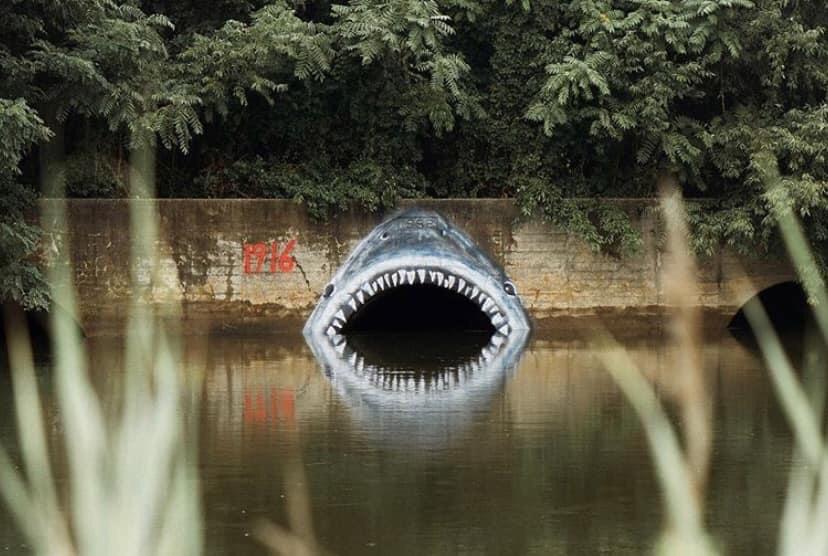
Today, some sharks are known to be capable of living for a time, in fresh water. Bull sharks have been known to travel as much as sixty miles up the Mississippi River. Researchers report that the Neuse River in North Carolina has been home to bull sharks, possibly arrived in pursuit of young dolphins. That information was unavailable in 1916.

As Spring gives way to Summer, kids of all ages exchange school bags for beach bags. Sports practices and homework are over, for now. We grown-ups can enjoy the last hours of the weekday, under the warmth of the sun.

Gone are the days when the warmth of summer brought with it, the horrors of polio.  We have no idea how fortunate we are.

health-polio-1916-c-swscan02773

In pre-1955 America and around much of the world, Summer was a time of dread. TIME Magazine offered what solace it could, in 1946: “for many a parent who had lived through the nightmare fear of polio, there was some statistical encouragement: in 1916, 25% of polio’s victims died. This year, thanks to early recognition of the disease and improved treatment (iron lungs, physical therapy, etc.) the death rate is down to 5%.”

Polio is as old as antiquity but major outbreaks are all but unknown, until the 20th century. The 1916 outbreak was particularly severe. Nationally, some 6,000 died of the disease that summer. New York City alone suffered 9,000 cases of polio, forcing a city-wide quarantine.

“Polio was a plague. One day you had a headache and an hour later you were paralyzed. How far the virus crept up your spine determined whether you could walk afterward or even breathe. Parents waited fearfully every summer to see if it would strike. One case turned up and then another. The count began to climb. The city closed the swimming pools and we all stayed home, cooped indoors, shunning other children. Summer seemed like winter then.”

Richard Rhodes, A Hole in the World

To make matters worse, the epidemic took place during one of the hottest Summers in memory, the twin threats of heat and disease driving millions to seek relief at nearby lakes, streams and beaches.

1920-woman-on-beach

On July 1, 1916, twenty-five-year-old Charles Epting Vansant of Philadelphia was vacationing with family, at the Engleside Hotel on the Jersey shore. Just before dinner, Vansant took a swim with a Chesapeake Bay Retriever, who was playing on the beach. Vansant began to shout and bathers thought he was calling to the dog, but shouts soon turned to screams. As lifeguard Alexander Ott and bystander Sheridan Taylor pulled the man to shore, they could see the shark, following.

5017802db4ff6102b80da58beb964440

Charles Vansant’s left thigh was stripped to the bone. He was brought to the Engleside hotel where he bled to death on the front desk.

Despite the incident, beaches remained open all along the Jersey Shore. Sea captains entering the ports of Newark and New York reported numbers of large sharks swarming off the Jersey shore but such reports received little attention.

The next major shark attack occurred five days later, on July 6. Forty-five miles north of Engleside, Essex & Sussex Hotel bell captain Charles Bruder was swimming near the resort town of Spring Lake. Hearing screams, one woman notified lifeguards that a red canoe had capsized, and lay just below the surface.  Lifeguards Chris Anderson and George White rowed out to the spot to discover Bruder, legless, with a shark bite to his abdomen. The twenty-seven year old Swiss army veteran bled to death before ever regaining the shore.

Njsharkattackmap

Authorities and the press downplayed the first incident. The New York Times reported that Vansant “was badly bitten in the surf … by a fish, presumably a shark.” Pennsylvania State Fish Commissioner and former director of the Philadelphia Aquarium James M. Meehan opined that “Vansant was in the surf playing with a dog and it may be that a small shark had drifted in at high water, and was marooned by the tide. Being unable to move quickly and without food, he had come in to bite the dog and snapped at the man in passing“.

Response to the second incident was altogether different.  Newspapers from the Boston Herald to the San Francisco Chronicle ran the story front page, above the fold. The New York Times went all-in: “Shark Kills Bather Off Jersey Beach“.

A trio of scientists from the American Museum of Natural History held a press conference on July 8, declaring a third such incident unlikely. Be that as it may, John Treadwell Nichols, the only ichthyologist among the three, warned swimmers to stay close to shore, and take advantage of netted bathing areas.

Rumors went into high gear, as an armed motorboat claimed to have chased a shark off Spring Creek Beach.  Asbury Park Beach was closed after lifeguard Benjamin Everingham claimed to have beaten a 12-footer back, with an oar.

Title

New Jersey resort owners suffered a blizzard of cancellations and a loss of revenue estimated at $5.6 million in 2017 dollars.  In some areas, bathing declined by as much as 75%.

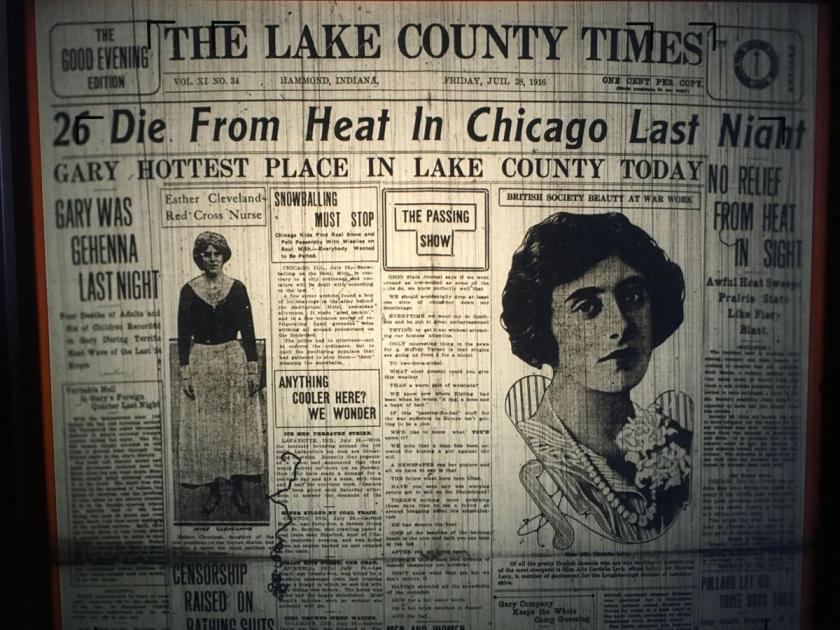
Scores of people died in the oppressive heat.  Newspapers reported twenty-six fatalities, in Chicago alone.  Air conditioning, invented in 1902, would not be widely available until the 1920s.  Rural areas had yet to be electrified.

57a25d377b0af.image

Today, some sharks are known to be capable of living for a time, in fresh water. Bull sharks have been known to travel as much as sixty miles up the Mississippi River. Researchers report that the Neuse River in North Carolina has been home to bull sharks, possibly arrived in pursuit of young dolphins.

That information wasn’t available in 1916.

As the heat wave dragged on, lakes and rivers crowded with bathers from Gary, Indiana to Manchester, New Hampshire.  In New Jersey, ocean beaches remained closed with the exception of the 4th Ave. Beach at Asbury Park, enclosed with a steel-wire-mesh fence and patrolled by armed motorboats.

Eleven miles from the ocean, Matawan New Jersey had little to fear, from sharks. Locals sought relief from the heat in Matawan Creek, a brackish water estuary in the Marlboro Township of Monmouth County.  With fresh waters flowing from Baker’s Brook down the salinity gradient to the full-salt waters of Keyport Harbor, Matawan Creek seemed more at risk for snapping turtles and snakes, than sharks.

Matawan_Creek_mouth
“Photo showing the Matawan Creek near its mouth in Keyport and Aberdeen Township, New Jersey. Photo taken from the Front Street / Amoby Road (County Route 6) bridge looking north”. H/T Wikipedia

On July 12, several boys including eleven-year-old epileptic Lester Stilwell were swimming near Wykoff Dock when the boys spotted an “old black weather-beaten board or a weathered log.” The boys scattered when that old log turned out to have a dorsal fin, but Lester Stilwell wasn’t fast enough.

004

Many dismissed the rantings of five naked, hysterical boys, believing that no shark could be this far inland.  Twenty-four year old tailor Stanley Fisher came running, knowing that the boy suffered from epilepsy.  Arthur Smith and George Burlew joined in the effort, by now clearly a recovery and no longer a rescue. The trio got in a boat and probed with an oar and some poles, but…nothing. They were about to give up the search when Fisher dove in the water.  He actually found the boy’s body, and began to swim to shore.

Matawan Creek
Matawan Creek

Townspeople lining the creek looked on in horror, as Fisher now came under attack.

Stanley Fisher made it to shore though his right thigh was severely injured, an eighteen-inch chunk of his thigh gone, and an artery severed. The man would bleed to death at Monmouth Hospital, before the day was over.

The Jersey Shore shark attacks of 1916 claimed a fifth and final victim thirty minutes later, when 12-year old Joseph Dunn of New York city was bitten a half-mile from the Stilwell and Fisher attacks. A savage tug-of war ensued between Dunn’s brother Michael and sixteen-year-old Jeremiah Hourihan, with local attorney Jacob Lefferts jumping into the water, to help. The boy survived but the damage to his left leg, was severe.  He wouldn’t be discharged from the hospital, until September 15.

shark-attack

Based on the style of the attacks and glimpses of the shark(s) themselves, the attacks may have been those of Bull sharks, or juvenile Great Whites.  Massive shark hunts were carried out all over the east coast, resulting in the death of hundreds of animals.  Whether all five attacks were carried out by a single animal or many, remains unclear.

635930279184222386-shark-2

At the time, the story resulted in international hysteria. Now, the tale is all but unknown, but for the people of Matawan. Stanley’s grave sits on a promontory at the Rose Hill Cemetery, overlooking Lester’s grave, below. People still stop from time to time, leaving flowers, toys and other objects. Perhaps they’re paying tribute. A small token of respect. Homage to the courage of those who would jump into the water, in the face of our most primordial fear.

July 5, 1915 A Man of Science

Fancy the irony that, today as I write this, a 7-foot “non-scalable fence” surrounds the Capitol building, in Washington DC. In those days, you were apparently free to stroll about, with a bomb in your hands. At least while Congress was in recess.

The train left Boston station in April 1906, headed for Chicago. On board were the infant, the toddler, the nanny and the children’s father, Professor Erich Muenter, a German language instructor from Harvard University.  The two little girls’ mother was onboard as well.  Leone (Krembs) Muenter was in her casket taking a one-way trip to her own funeral, and burial in her home town.  She had passed from some sort of stomach ailment, ten days after giving birth.

The story may have ended there, but for Dr. Herbert McIntyre.  The circumstances of Leone’s death didn’t add up. Dr. McIntyre ordered an autopsy.  On April 27, Cambridge police issued a warrant for the arrest of Professor Erich Muenter for the murder of his wife, by arsenic poisoning.

Man of science

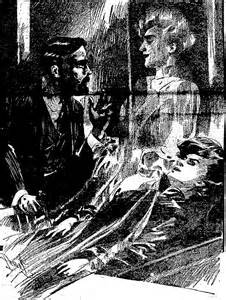
Apparently, this “man of science” wanted to test his theory that you could literally see the soul passing, at the moment of death.  Now, Erich Muenter vanished.

Eight years later, the European continent exploded in the ‘War to End Wars’.

US policy at this time allowed arms sales to any and all belligerents in the European war.  With British dominance of North Atlantic shipping routes, for all intents and purposes this meant France and Great Britain.

German language professor Frank Holt was teaching at Cornell University in 1915.  A naturalized citizen and committed German nationalist, Holt had ties with the secret German spy intelligence unit Abteilung IIIb, which was conducting a campaign of sabotage against US ships carrying munitions ‘over there’.

Frank Holt might have described himself as a ‘peace activist’, obsessed with the idea that arms themselves were extending the war.  If arms exports were brought to a halt he believed, the war would come to an end.

Holt gave up arguing the point on July 2 and took a train to Washington DC.  In his hands he carried a bomb, three sticks of dynamite attached to a timing mechanism, ingeniously designed to go off when the acid ate through the cork stopper. 

Fancy the irony that, today as I write this, a 7-foot “non-scalable fence” surrounds the Capitol building, in Washington DC. In those days, you were apparently free to stroll about, with a bomb in your hands. At least while Congress was in recess.

Finding the Senate chamber locked, Holt placed his package under a telephone switchboard in the Senate reception room, with the timer set to go off around midnight.

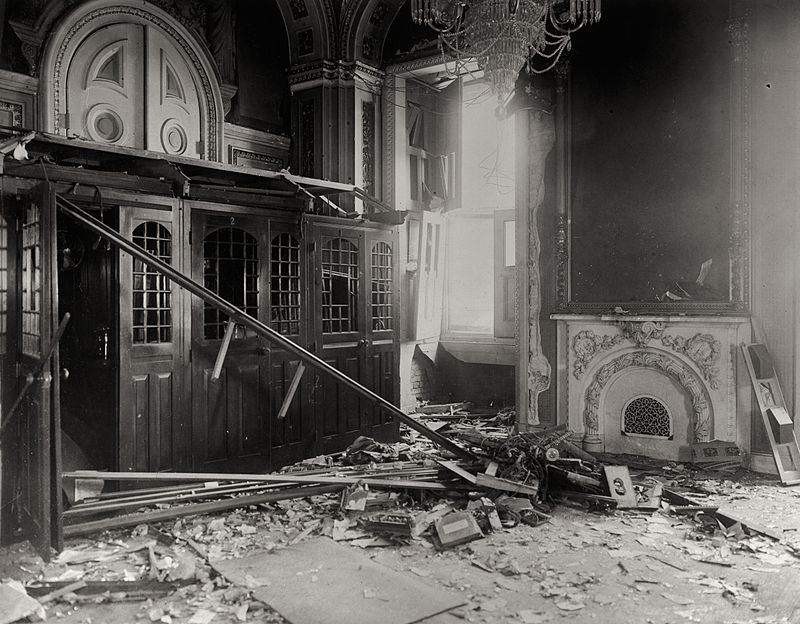
The explosion when it came, was enormous. The room was torn to pieces while, across the building, a night watchman was blown out of his chair.  Writing to the Washington Star newspaper under the pseudonym R. Pearce, Holt explained his intentions to “make enough noise to be heard above the voices that clamor for war. This explosion is an exclamation point in my appeal for peace.”

Senate_Bombing_July_2,_1915
Aftermath of the Senate bombing, July 2, 1915

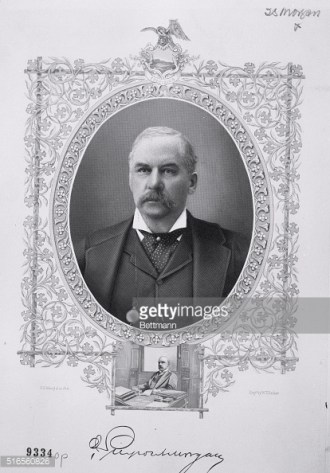
The following day, a tiny little box on the front page of the New York Times attributed the explosion to ‘gasses’.  The paper was hitting news stands as Frank Holt headed for Long Island, to the Glen Cove estate of “the Great Pierpont”, J. P. Morgan.  Armed with two revolvers, a suitcase full of dynamite and a few anti-war newspaper clippings, Holt bulled his way through the butler who opened the door, and into the Morgan residence.

JP Morgan
John Pierpont Morgan

Pandemonium broke out in the home, as Holt turned his weapons on the four Morgan children.  Mrs. Morgan tried to block the path to her husband but the millionaire financier lunged, tackling the much smaller man to the ground.  Holt fired twice into Morgan’s thigh and groin, as the pair went down together.  Pierpont twisted the gun from his grasp as Mrs. Morgan and a gaggle of household servants struggled for the other.  All the while, the butler pounded the would-be assassin’s head with a lump of coal as Holt shouted “Kill me! Kill me now! I don’t want to live any more. I have been in a perfect hell for the last six months on account of the European war!

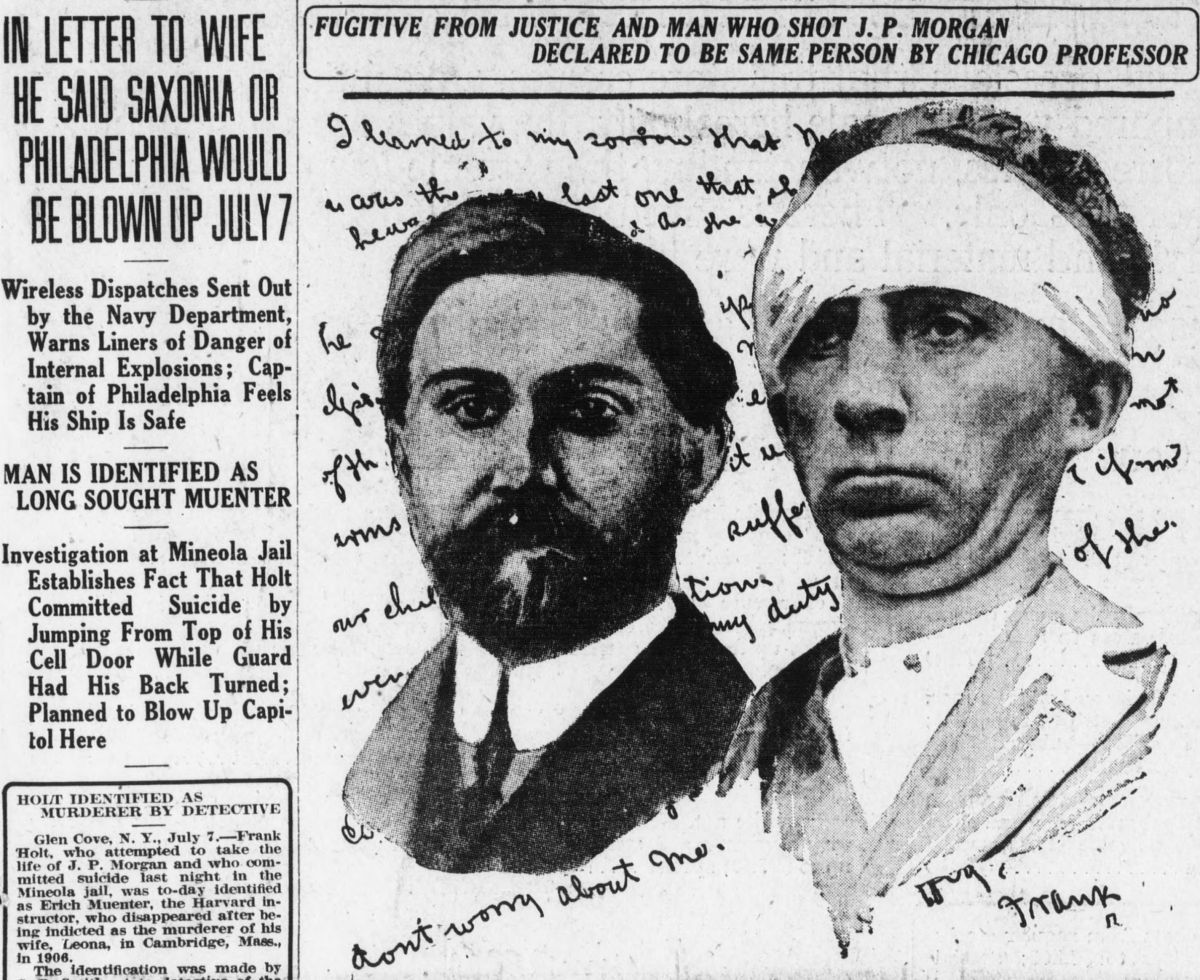
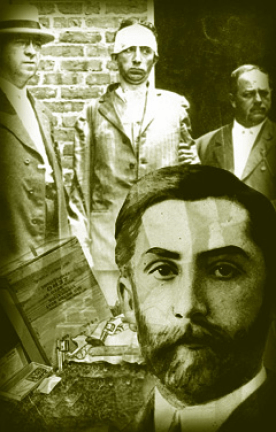
A copy of the R. Pearce letter quickly tied Holt to the Capitol bombing, as former colleagues identified the long-since vanished, alleged killer of Leone Muenter.  Frank Holt and Erich Muenter were the same man.

A colleague once described Muenter as “a brilliant man, a tireless worker, and a profound student.  Night after night he would sit reading, studying and writing while his wife lay asleep in a room nearby.” The Harvard Crimson newspaper described him as “harmless on the surface…affect[ing] a scholarly stoop and a Van Dyke, and wore dingy, patched suits”.  Fluent in seven languages he was the pale, bearded model of the junior faculty intellectual, complete with elbow patches.

For all his vaunted brilliance, Erich Muenter was nuttier than a squirrel turd.  His intention as explained to police, was to take Morgan’s wife and children hostage, until the financier cut off loans to Europe.  He told police of his intention to assassinate J.P. Morgan, as well.  How the two objectives squared with one another, remains to be explained.

Erich Muenter

That Sunday morning, July 4, the J.P. Morgan shooting seems to have been front page on every newspaper in the world.  On July 5, Erich Muenter took the brass ferrule from a pencil eraser, and slit his wrist.  That suicide attempt was unsuccessful.  The following day he scaled the bars of his prison cell and jumped, leaving his brains on the concrete floor, twenty feet below.

The day after his death, Police tracked down a trunk Muenter left in a New York city storage facility.  In it were 134 sticks of dynamite, blasting caps, fuse coils, batteries, nitric acid, windproof matches, mercury fulminate and smokeless explosive powder. Three tin can bombs had been recently completed, and were ready to go.  Inspector of Combustibles Owen Egan declared the find to be “the greatest equipment for bomb making ever brought to New York”.

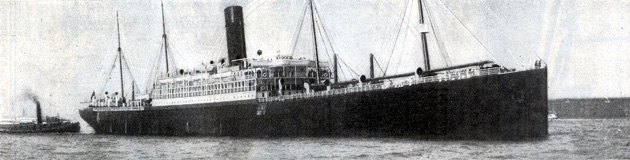
That same day, the 2nd Mrs. Muenter received a letter from her dead husband.  It said that an arms shipment headed for England would go to the bottom, that very day.    Warned by wireless, the crew of SS Minnehaha frantically searched for the bomb, without success.  Muenter’s bomb went off and touched off a fire, but it was far away from Minnehaha’s cargo of high explosives, and did little damage to the ship itself.
SS Minnehaha

The vessel sustained little damage at the time but, in the end, the ghost of Erich Muenter had his way. The Harland & Wolff liner SS Minnehaha was torpedoed and sunk off the Irish coast with the loss of 43, on September 7, 1917. There was one survivor.

July 4, 1826 Friendship Restored

For two years Dr. Benjamin Rush labored to restore the broken friendship, of two founding fathers.  In 1811, he succeeded.

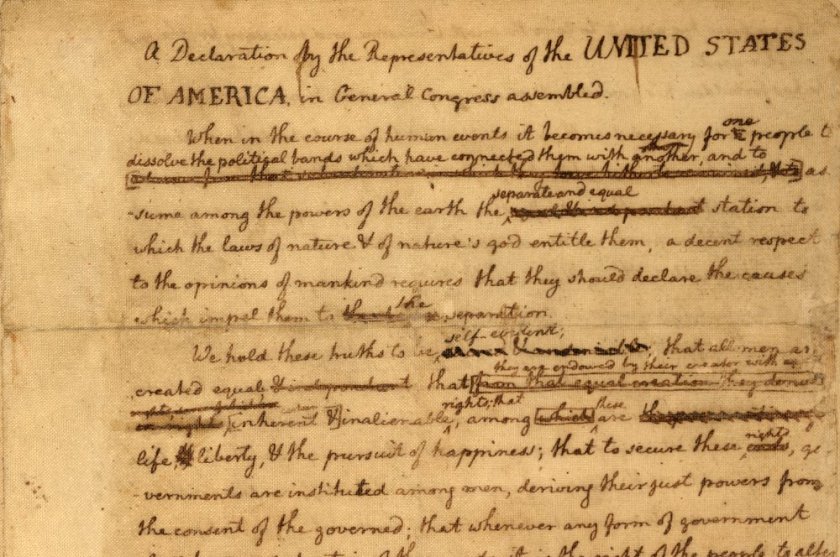
On June 7, 1776, Richard Henry Lee delivered the all-important resolution of the founding era, before the assembled delegates of the 2nd Continental Congress:  “Resolved, that these United Colonies are, and of right ought to be, free and independent States...”

committ

Congress appointed three overlapping committees to draft a formal declaration of independence, a model treaty for the conduct of international relations and a document by which this confederation of states, was to be governed. Already appointed to the Committee of Confederation, Lee was urged to join the Declaration committee, as well. Believing that two such committees were too much and burdened with the care of a critically ill wife, he demurred.

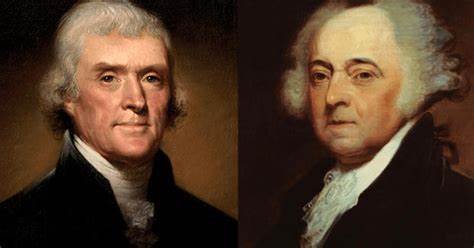
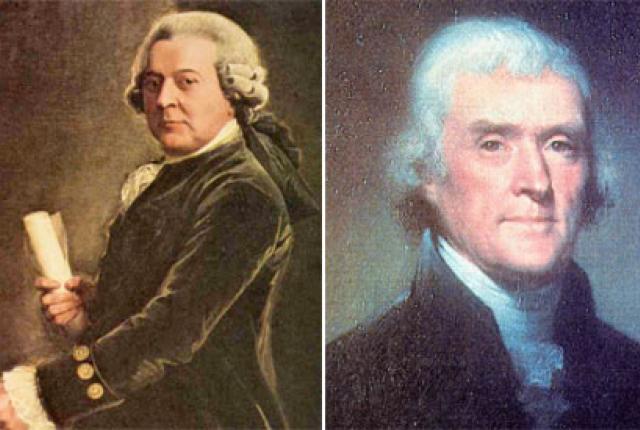
So it is a committee of five was appointed to write the Declaration of Independence, including Benjamin Franklin of Pennsylvania, Roger Sherman of Connecticut, Robert R. Livingston of New York, Massachusetts attorney John Adams and a young Virginia delegate named Thomas Jefferson.

Jefferson had no interest in writing the Declaration of Independence and suggested Adams pen the first draft. Adams declined, and described the following conversation, in a letter to Massachusetts politician Timothy Pickering:

“Jefferson proposed to me to make the draft. I said, ‘I will not,’ ‘You should do it.’ ‘Oh! no.’ ‘Why will you not? You ought to do it.’ ‘I will not.’ ‘Why?’ ‘Reasons enough.’ ‘What can be your reasons?’ ‘Reason first, you are a Virginian, and a Virginian ought to appear at the head of this business. Reason second, I am obnoxious, suspected, and unpopular. You are very much otherwise. Reason third, you can write ten times better than I can.’ ‘Well,’ said Jefferson, ‘if you are decided, I will do as well as I can.’ ‘Very well. When you have drawn it up, we will have a meeting.”

Fellow committee members agreed. Thomas Jefferson spent the following seventeen days, writing the first draft.  He and Adams had only just met during the Continental Congress in Philadelphia.  The two would develop a close personal friendship which would last for the rest of their lives.

6cadd6d5f50e0e581e4e0fb6f9db974a

To be more precise, the friendship between the two men would last, for much of their lives. That came to an ugly end during the Presidential election of 1800, in which mudslinging and personal attacks from both sides rose to levels never before witnessed in a national election.

Jefferson defeated one-term incumbent Adams and went on to serve two terms as President of the United States.  Upon Jefferson’s retirement in 1809, Dr. Benjamin Rush, one of the Declaration’s signers, took it upon himself to patch up the broken friendship between the two founding fathers.

For two years Dr. Rush worked on this personal diplomatic mission.  In 1811, he succeeded.

JeffersonSeal2
Jefferson Seal

There followed a series of letters between John Adams and Thomas Jefferson, which together constitute one of the most comprehensive historical and philosophical assessments ever written about the American founding.

The correspondence between the pair touched on a variety of topics, from the birth of a self-governing Constitutional Republic, to then-current political issues to matters of philosophy and religion and personal issues related to the advancement, of years.

Both men understood. They were writing not only to one another, but to generations yet unborn.  Each went to great lengths to explain the philosophical underpinnings of his views. Adams the firm believer in strong, centralized government, Jefferson advocating a small federal government, deferential to the states.

By 1826, Jefferson and Adams were among the last survivors among the founding generation.  Only a handful yet remained.

No fiction author, no Hollywood screenwriter would dare put to paper an ending so unlikely, so unbelievable, as that which then took place. These two men, central among the hundreds who gave us this self governing Republic, died on the same day. July 4, 1826. Fifty years to the day from the birth of the Republic, they had helped to create.

Adams was 90 as he lay on his deathbed, suffering from congestive heart failure. His last words were “Thomas Jefferson still survives”. He had no way to know. The author of the Declaration of Independence had died that morning, at his Monticello home. Jefferson was 82.

adams-jefferson_6

John Adams’ son John Quincy was himself President at the time of the two men’s passing, and remarked that the coincidence was among the “visible and palpable remarks of Divine Favor”.

A month after the two men passed, Daniel Webster spoke of these two men at Faneuil Hall, in Boston.

“No two men now live, (or) any two men have ever lived, in one age, who (have) given a more lasting direction to the current of human thought. No age will come, in which the American Revolution will appear less than it is, one of the greatest events in human history. No age will come, in which it will cease to be seen and felt, on either continent, that a mighty step, a great advance, not only in American affairs, but in human affairs, was made on the 4th of July 1776″.

A Blessed Independence Day, to you and yours. – Rick Long, the “ Cape Cod Curmudgeon”

June 30, 1917 A Bit of Comfort

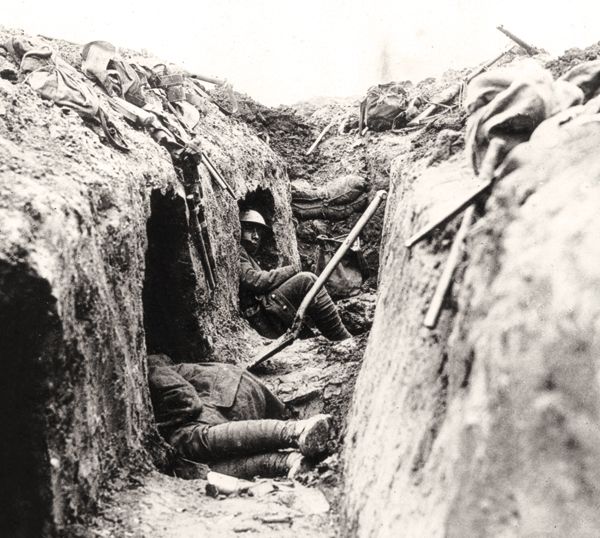
Imagine if you will a world of trench warfare. A world of mud and rats where instant and violent death is an ever-present possibility. A world of lice and disease and the stink of millions of men in the open, both dead and alive. A world capable of producing psychological trauma on an industrial scale. Now imagine just for a moment, a bit of home made comfort steps into that world.

For a variety of reasons, the eastern front of the “War to end all Wars” was a war of movement. Not so in the West.  As early as October 1914, combatants burrowed into the ground like animals sheltering from what Private Ernst Jünger would come to call, the ‘Storm of Steel’.

Conditions in the trenches and dugouts must have defied description. You would have smelled the trenches long before you could see them. The collective funk of a million men and more, enduring the troglodyte existence of men who live in holes. Little but verminous scars in the earth teaming with rats and lice and swarming with flies. Time and again the shells churned up and pulverized the soil, the water and the shattered remnants of once-great forests, along with the bodies of the slain.

7dbc338da7b95e8f133e78356ad14912

By the time the United States entered the ‘War to end all Wars’ in April, 1917, millions had endured three years of this existence. The first 14,000 Americans arrived ‘over there’ in June, the American Expeditionary Forces (AEF) forming on July 5. American troops fought the military forces of Imperial Germany alongside their British and French allies, others joining Italian forces in the struggle against the Austro-Hungarian Empire.

You couldn’t call the stuff these people lived in mud – it was more like a thick slime, a clinging, sucking ooze capable of swallowing grown men, even horses and mules, alive.

Captain Alexander Stewart wrote “Most of the night was spent digging men out of the mud. The only way was to put duck boards on each side of him and work at one leg: poking and pulling until the suction was relieved. Then a strong pull by three or four men would get one leg out, and work would begin on the other…He who had a corpse to stand or sit on, was lucky”.

Sir Launcelot Kiggell broke down in tears, on first seeing the horror of Paschendaele, . “Good God”, he said. “Did we really send men to fight in That?”

kalamazoo-gazette-newspaper-0518-1919-wwi-donuts-salvation-army

Unseen and unnoticed in times of such dread calamity, are the humanitarian workers. Those who tend to the physical and spiritual requirements and the countless small comforts, of those so afflicted.

Within days of the American declaration of war, Evangeline Booth, National Commander of the Salvation Army, responded, saying “The Salvationist stands ready, trained in all necessary qualifications in every phase of humanitarian work, and the last man will stand by the President for execution of his orders”.

These people are so much more than that donation truck, and the bell ringers we see behind the red kettles, every December.

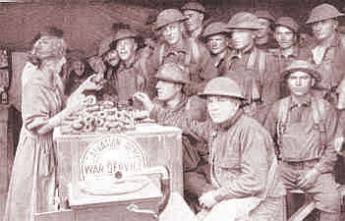
wwi-doughnut-girls-2

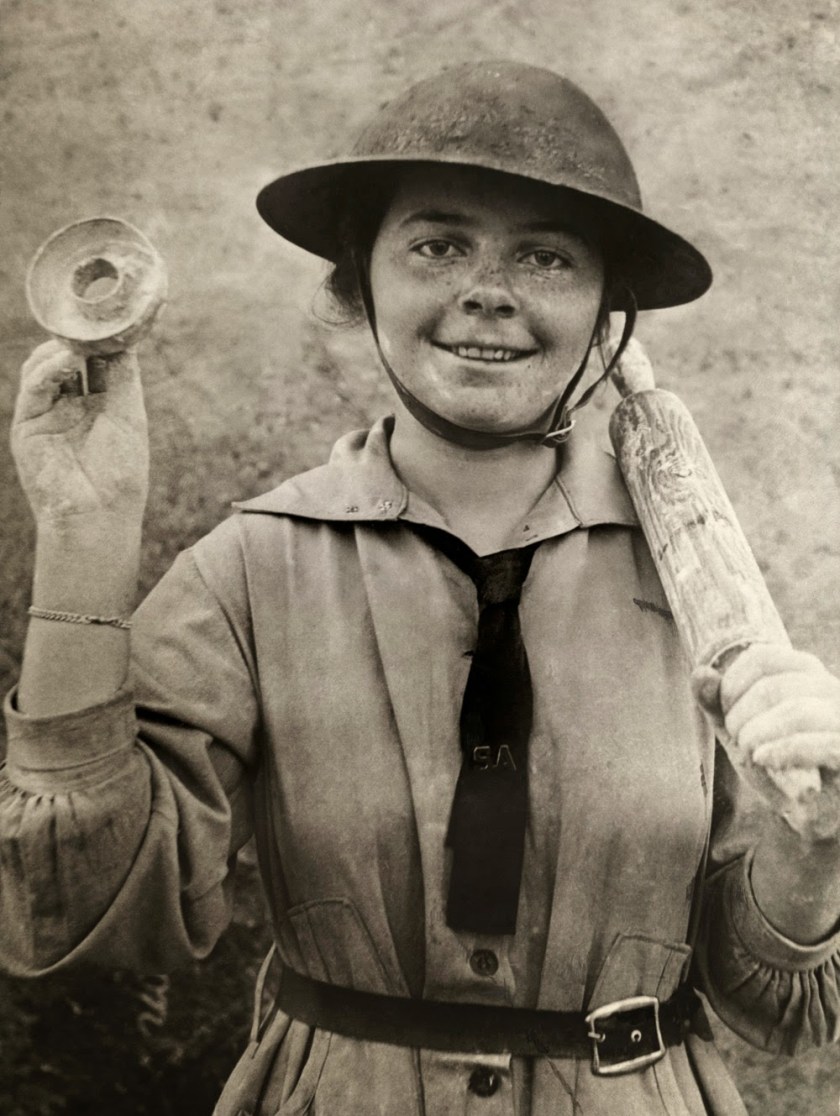
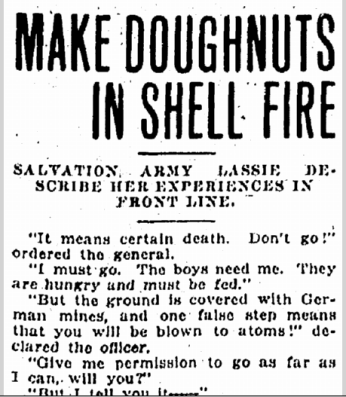
Lieutenant Colonel William S. Barker of the Salvation Army left New York with Adjutant Bertram Rodda on June 30, 1917, to survey the situation. It wasn’t long before his not-so surprising request came back in a cable from France. Send ‘Lassies’.

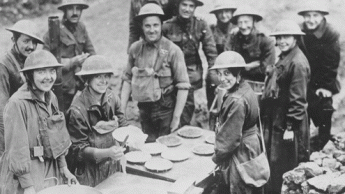
wwi-doughnut-girls-7

A small group of carefully selected female officers was sent to France on August 22. That first party comprised six men, three women and a married couple. Within fifteen months their number had expanded by a factor of 400.

In December 1917, a plea for a million dollars went out to support the humanitarian work of the Salvation Army, the YMCA, YWCA, War Camp Community Service, National Catholic War Council, Jewish Welfare Board, the American Library Association and others. This “United War Work Campaign” raised $170 million in private donations, equivalent to $27.6 billion, today.

roads_donutGirl2

‘Hutments’ were formed all over the front, many right out at the front lines.  There were canteen services.  Religious observances of all denominations were held in these facilities. Concert performances were given, clothing mended and words of kindness  offered in response to all manner of personal problems.  On one occasion, the Loyal Order of Moose conducted a member initiation. Pies and cakes were baked in crude ovens and lemonade served to hot and thirsty troops.

Of all these corporal works of mercy, the ones best remembered by the ‘doughboys’ themselves, were the doughnuts.

how-to-make-doughnuts

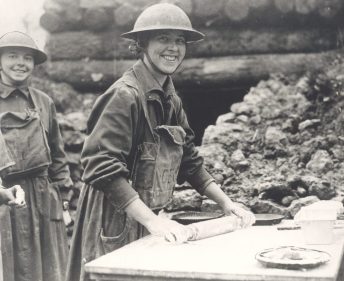
Helen Purviance, sent to France in 1917 with the American 1st Division, seems to have been first with the idea. An ensign with the Salvation Army, Purviance and fellow ensign Margaret Sheldon first formed the dough by hand, later using a wine bottle in lieu of a rolling pin. Having no doughnut cutter at the time, dough was shaped and twisted into crullers, fried seven at a time in a lard-filled helmet, on a pot-bellied wood stove.

1066cc6f-b94f-4d16-8d5d-add6c976e39c_World+War+I+-+Frying+Doughnuts

The work was grueling. The women worked well into the night that first day, serving all of 150 hand-made doughnuts. “I was literally on my knees,” Purviance recalled, but it was easier than bending down all day, on that tiny wood stove. It didn’t seem to matter. Men stood in line for hours, patiently waiting in the mud and the rain of that world of misery, for their own little piece of warm, home-cooked heaven.

doughnuts-top-slider

Techniques gradually improved and it certainly helped, when these there was a real pan to cook in. These ladies were soon turning out 2,500 to 9,000 doughnuts a day. An elderly French blacksmith made Purviance a doughnut cutter, out of a condensed milk can and a camphor-ice tube, attached to a wooden block.

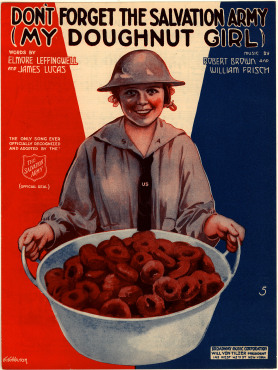
Before long the pleasant aroma of hot doughnuts could be detected, wafting all over the dugouts and trenches of the western front.  Salvation Army volunteers and others made apple pies and all manner of other goodies, but the name that stuck, was “Doughnut Lassies”.

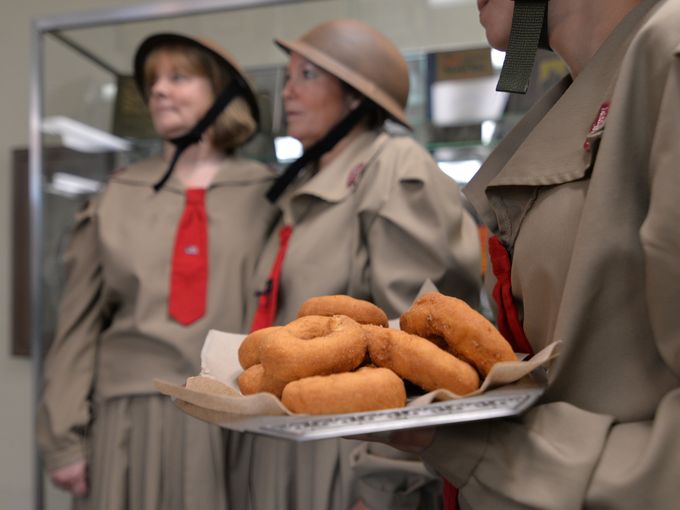
636320189957957314-20flvp-donut-girls
June 2, 2017 – Salvation Army employees Cheryl Freismuth (l) and Susan Klyk (c) celebrate the 100th anniversary of the “Doughnut Lassies” of WW1 with student Catie McDougall (r). H/T The Detroit News

One New York Times correspondent wrote in 1918 “When I landed in France I didn’t think so much of the Salvation Army; after two weeks with the Americans at the front I take my hat off… [W]hen the memoirs of this war come to be written the doughnuts and apple pies of the Salvation Army are going to take their place in history”.

Contrary to popular myth the doughnut was not invented in WW1. Neither was the name for soldiers of the Great War although millions of “doughboys” returned from ‘over there’ requesting wives, mothers sweethearts and local bakeries make their newfound favorite confection. Russian émigré Adolph Levitt invented the first doughnut machine in 1920. The round cake with the hole in the middle, has never looked back.

If you’re interested, the Doughnut Lassies’ original WW1 recipe may be found, HERE. Let me know how they come out.

June 22, 1918 Showmen’s Rest

127 were injured and an estimated 86 crushed or burned to death in the wreck.  The saddest thing you could ever imagine was the sight of a clown, his name was Joe Coyle, weeping inconsolably beside the dead and mangled bodies of his wife and two children.

In the world of the Big Top, the term “First of May” describes a new employee’s first season, with the circus.

There’s an oft-repeated but mistaken notion, that the circus goes back to Roman antiquity. The panem et circenses, “bread and circuses” of Juvenal (circa A.D. 100), refers more to the ancient precursor of the modern racetrack, than to the modern circus. The only common denominator is the word itself, as the Latin root ‘circus’, translates into English, as “circle”.

Astleys_royal_amphitheatre

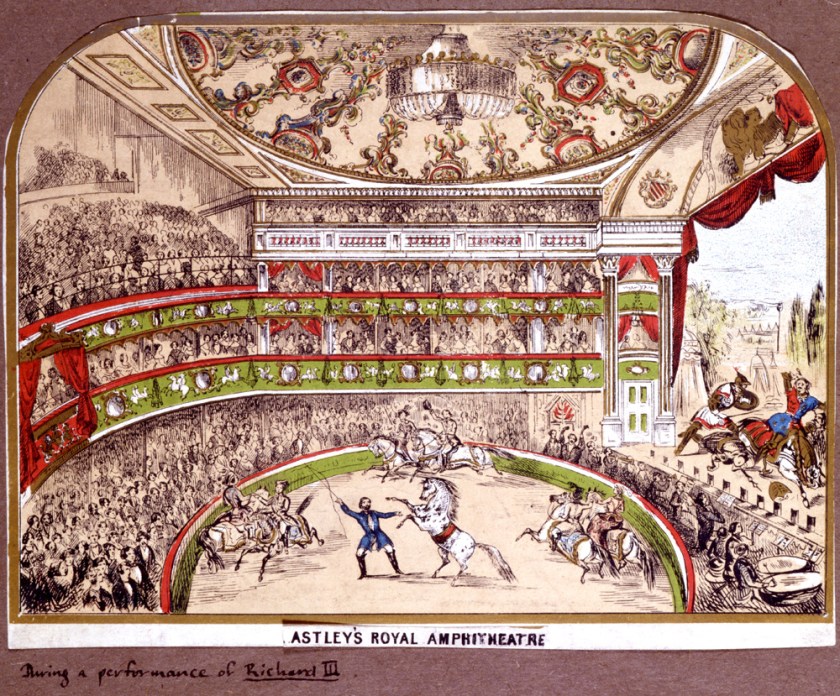
The father of the modern circus is the British Sergeant-Major turned showman, Philip Astley. A talented horseman, Astley opened a riding school near the River Thames in 1768, where he taught in the morning and performed ‘feats of horsemanship’ in the afternoon.

Astley’s afternoon shows gained overwhelming popularity by 1770, when he hired acrobats, rope-dancers and jugglers to fill the spaces between equestrian events. The modern circus, was born.

Equestrian and trick riding shows were gaining popularity all over Europe at this time, performers riding in circles to keep their balance while standing on the backs of galloping horses.  It didn’t hurt matters, that the “ring” made it easier for spectators to view the event.

In 1825, Joshuah Purdy Brown of Somers New York replaced the wooden structure common to European circuses with a canvas tent, around the time when a cattle dealer named Hachaliah Bailey bought a young African elephant, which he exhibited all over the country. The exotic animal angle was a great success. Other animals were added and soon farmers were leaving their fields, to get into the traveling menagerie business.

The unique character of the American traveling circus emerged in 1835, when 135 such farmers and menagerie owners combined with three affiliated circuses to form the American Zoological Institute.

Phineas Taylor Barnum and William Cameron Coup launched P.T. Barnum’s Museum, Menagerie & Circus in 1871, where the “museum” part was a separate exhibition of human and animal oddities.  It wouldn’t be long, before the ‘sideshow” became a standard feature of the American circus.

There have been no fewer than 81 major circuses in American history, and countless smaller ones. ‘The Greatest Show on Earth’ broke down its tent for the last time in 2017, when the Ringling Brothers Barnum & Bailey Circus ended a 146-year run. There was a time though, when the circus really WAS, the greatest show on earth.

hagenbeck-wallace-circus

The American war machine was spinning up to peak operational capacity in 1918, as the industrial might of the nation pursued the end to the war ‘over there’.

At 3:56 on the morning of June 22, 1918, an engineer with the Michigan Central Railroad was at the controls of an empty 21-car troop train. Automatic signals and flares should have warned him that there was a stalled train on the track ahead. A frantic flag man tried and failed to get him to stop. Alonzo Sargent had been fired before, for sleeping on the job. Tonight, Sargent was once again, asleep at the wheel.

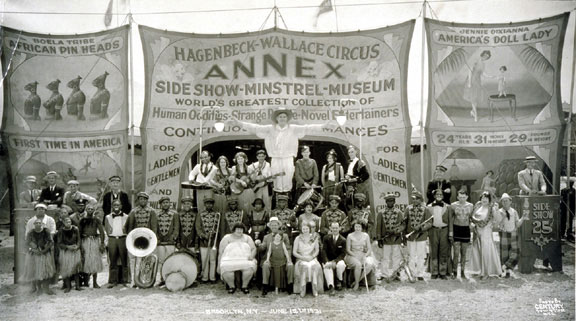
The Hagenbeck-Wallace circus was a big deal in those days. The famous lion tamer Clyde Beatty was a member, as was a young Red Skelton, on this night tagging along with his father, who worked as a clown.

The 26-car Hagenbeck-Wallace circus train was enroute from Hammond Indiana to Monroe Wisconsin, when an overheated axle box required an unscheduled stop.

Most of the 400 circus employees were asleep at that early hour, in one of four rear sleeping cars.

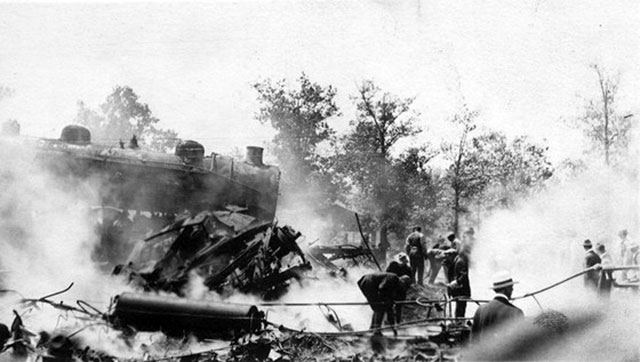
The Michigan Central locomotive smashed into the rear of the stalled train at 60mph. Strong men, bareback riders, trapeze performers and acrobats were killed instantly. Others were horribly maimed, as wooden sleeping cars telescoped into one another. Confused and bleeding survivors struggled to emerge from the wreckage as gas-fed lanterns began to set all that wood on fire.

hammond-circus-train-wreck

Those lucky enough to escape looked on in horror, as friends and family members were burned alive. Some had to be physically restrained from rushing back into the inferno.

127 were injured and an estimated 86 crushed or burned to death in the wreck. The saddest thing you could ever imagine was the sight of a clown, his name was Joe Coyle, weeping inconsolably beside the dead and mangled bodies of his wife and two children.

The rumor mill went berserk. Wild lions and tigers had escaped and were roaming the streets and back yards of Gary, Indiana. Elephants died in the heroic attempt to put out the flames, spraying water on the burning wreckage with their trunks. None of the stories were true. The animals had passed through hours before on one of two additional trains, and now awaited a train that would never come.

showmans-rest-circus-mass-grave

The Showmen’s League of America was formed in 1913, with Buffalo Bill Cody its first President. The group purchased a 750-plot parcel at the Woodlawn Cemetery in Forest Park, Illinois only a year earlier, calling it “Showmen’s Rest”. They had no idea their investment would be used so soon.

Only thirteen of the dead were ever identified. A mass grave was dug for the unidentified and unidentifiable. Most of the dead were roustabouts or temporary workers, hired just recently and known only by nicknames. Then there were the performers known only by stage names, their gravestones inscribed with names like “Baldy,” “4-Horse Driver”, “Smiley,” and “Unknown Female #43.

Only one show had to be canceled, as erstwhile ‘competitors’ Barnum & Bailey, Ringling brothers and others lent workers, performers and equipment. The show would go on.

Today, the International Circus Hall of Fame is located in the former Hagenbeck-Wallace Circus winter headquarters in Peru, Indiana.

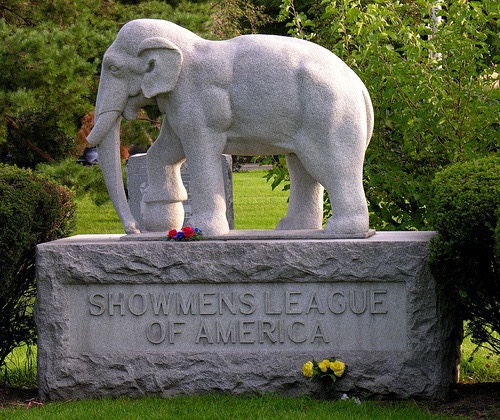
In the elephant world, an upraised trunk symbolizes joy. Five elephant statues circumscribe the Showmen’s Rest section of Woodlawn cemetery. Each has a foot raised with a ball underneath. Their trunks hang low, a symbol of mourning. The largest of the five bears the inscription, “Showmen’s League of America.” On the other four are inscribed the words: “Showmen’s Rest”.

June 15, 1904 Earth’s Purest Children, Young and Fair

The all but forgotten disaster of June 15 1904 stole the lives of 1,021 innocents, mostly women and children. No one could know it at the time but the flaming wreck of the General Slocum would kill their community, as well.

Kleindeutschland, or “Little Germany”, occupied some 400 blocks on the Lower East Side of Manhattan, in what is now  the East Village.  “Dutchtown”, as contemporary non-Germans called it, was home to New York’s German immigrant community since the 1840s, when they first began to arrive in significant numbers. By 1855, New York had the largest ethnically German community in the world save for Berlin, and Vienna.

General Slocum token

It was 9:30 on a beautiful late spring morning when the sidewheel passenger steamboat General Slocum left the dock and steamed into New York’s East River.

She was on a charter this day, carrying German American families on an outing from St. Mark’s Lutheran Church. Over a thousand tickets were sold for that day’s harbor cruise and picnic, not counting the 300 or so children on board who were sailing for free. There were 1,342 people on board, mostly women and children, including band, crew and catering staff.

The fire probably started when someone tossed a cigarette or match in the forward section lamp room. Fueled by lamp oil and oily rags on the floor, the flames spread quickly, being noticed for the first time at around 10:00am.  A 12-year old boy had reported the fire earlier, but the Captain did not believe him.

Slocum 3

The ships’ operators had been woefully lax in maintaining safety equipment.  Now it began to show. Fire hoses stored in the sun for years were uncoiled, only to break into rotten bits in the hands of the crew. Life preservers manufactured in 1891 had hung unprotected in the sun for 13 years, their canvas covers splitting apart pouring useless cork powder onto the floor.  Survivors reported inaccessible life boats, wired and painted into place.Slocum 4

Crew members reported to Captain William van Schaick that the blaze “could not be conquered.”  It was “like trying to put out hell itself.” The captain ran full steam into the wind trying to make it to the 134th Street Pier, but a tug boat waved them off, fearing the flames would spread to nearby buildings. Captain van Schaick changed course for North Brother Island just off the Bronx’ shore, as the wind and speed of the ship itself whipped the flames into a holocaust.

Many jumped overboard to escape the inferno, but the heavy women’s clothing of the era quickly pulled them under.  Desperate mothers put useless life jackets on children and threw them overboard, only to watch in horror as they sank. One man, fully engulfed in flames, jumped screaming over the side, only to be swallowed whole by the massive paddle wheel. One woman gave birth in the confusion and then jumped overboard with her newborn, to escape the flames. They both drowned.

A few small boats were successful in pulling alongside in the Hell’s Gate part of the harbor, but navigation was difficult due to the number of corpses already bobbing in the waves.

Slocum-ablaze

Holding his station despite the inferno, Captain van Schaick permanently lost sight in one eye. His feet were badly burned by the time he ran the Slocum aground at Brother Island.  Patients and staff at the local hospital formed a human chain to pull survivors to shore as they jumped into shallow water.

General Slocum Casualties

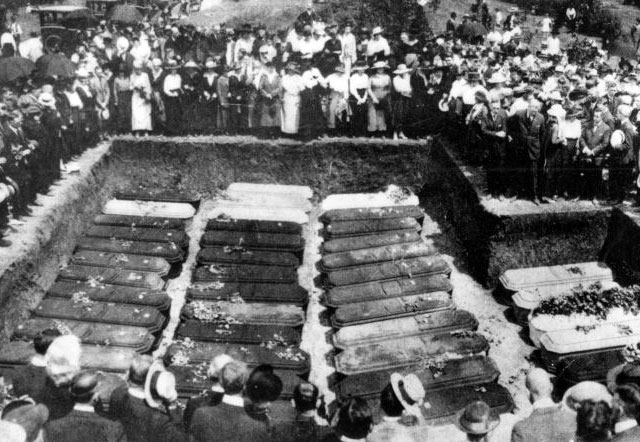
1,021 passengers and crew either burned to death or drowned this day in 1904.  It was the deadliest peacetime maritime disaster, in American history. Only 321 lived to tell the tale.

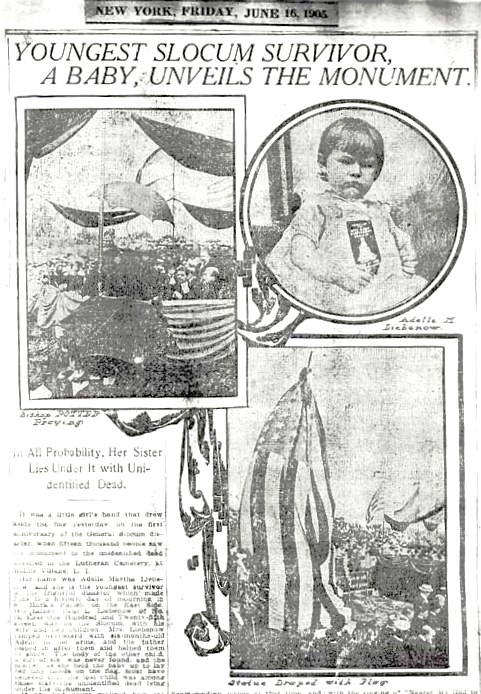
Six month old Adella Liebenow was the youngest survivor of the disaster. The following year at the age of one, Liebenow unveiled a memorial to the calamity which had killed her two sisters and permanently disfigured her mother. The New York Times reported “Ten thousand persons saw through their tears a baby with a doll tucked under her arm unveil the monument to the unidentified dead of the Slocum disaster yesterday afternoon in the Lutheran Cemetery, Middle Village, L.I.”

Both her sisters were among the unidentified dead.

Youngest_Slocum_Survivor

Less than one per cent of Little Germany’s population was killed in the disaster, yet these were the women and children of some of the community’s most established families.  There followed more than a few suicides.  Mutual recriminations devoured much of the once-close community as the men began to move away.  There was nothing for them anymore, in this place.   Anti-German sentiment engendered by WW1 finished what the Slocum disaster had begun. Soon, New York’s German-immigrant community, was no more.

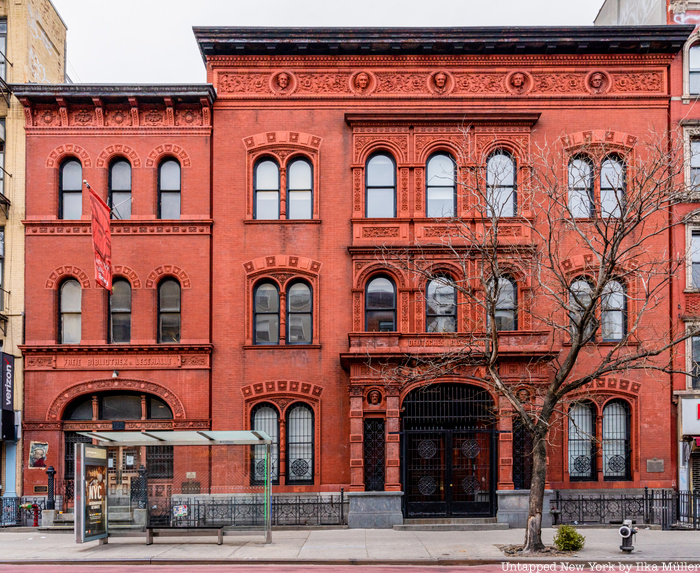
The East Village Ottendorfer branch of the New York Public Library was originally bilingual, with half its collection in German and the other half, in English.

In Tompkins Square Park in Manhattan, there is a 9-foot stele sculpted from pink Tennessee Marble.  The relief sculpture shows two children, beside these words:

“They were Earth’s purest children, young and fair.”

General_Slocum_Memorial

Once the youngest survivor of the disaster, Adella (Liebenow) Wotherspoon passed away in 2004, at the age of 100.  The oldest survivor of the deadliest disaster in New York history, until September 11, 2001.

June 11, 1775 Bad Little Falls

“Of balsam & blueberries, lobsters & lighthouses, puffins & whale watching, sunsets over the bay…”. Thus does its own website describe the tiny downeast town of Machias Maine. It’s not the kind of place where you’d expect the first naval combat, of the American Revolution.

Five hours and 15 minutes drive from Boston, the small town of Machias sports a campus for the University of Maine, a municipal airport and, even today, a year-round population barely exceeding 2,000. In the Passamaquoddy tongue, the name translates into “bad little falls”, a reference the river running through the place.

BAD LITTLE FALLS KC.JPG
Machias-area residents who discussed downtown revitalization Tuesday evening said the Bad Little falls was the town’s most distinctive element. (KATHERINE CASSIDY PHOTO)

It’s not a spot where you’d expect the first naval combat of the American Revolution.

In 1775, the modern state of Maine was still part of Massachusetts. Machias itself, a small fishing village on the “Downeast” New England coast was a thorn in the British side, since the earliest days of the Revolution.   That February, a local pilot intentionally grounded the coastal patrol schooner HMS Halifax, in Machias Bay.  The place also served as a base from which privateers preyed on British merchant shipping.

Machias by JFW des Barres

In April, a British foray from the occupied city of Boston culminated in the Battle at Lexington Green.  While the King’s troops held the ground in the wake of the early morning skirmish, the decision of the afternoon’s battle at nearby Concord was quite different.  The colonial’s response to this incursion of “Regulars” was that of a swarming beehive, resulting in a Patriot victory and a British retreat under fire, all the way back to Boston.

Siege-of-Boston-1-AB

Boston was all but an island in those days, connected to the mainland only by a narrow “neck” of land.  A Patriot force some 20,000 strong took positions in the days and weeks that followed, blocking the city and trapping four regiments of British troops, about 4,000 men, inside of the city.

For General Thomas Gage in charge of all those troops, the best hope for resupply was by water.

Concerned lest they fall into rebel hands, Royal Navy Admiral Samuel Graves wanted the guns from the wreck of the Halifax.  Gage needed lumber as well, with which to build barracks.  So it was the wealthy merchant and Tory loyalist Ichabod Jones was enlisted to help, blissfully unaware of the dim view in which his activities were held by fellow colonials.

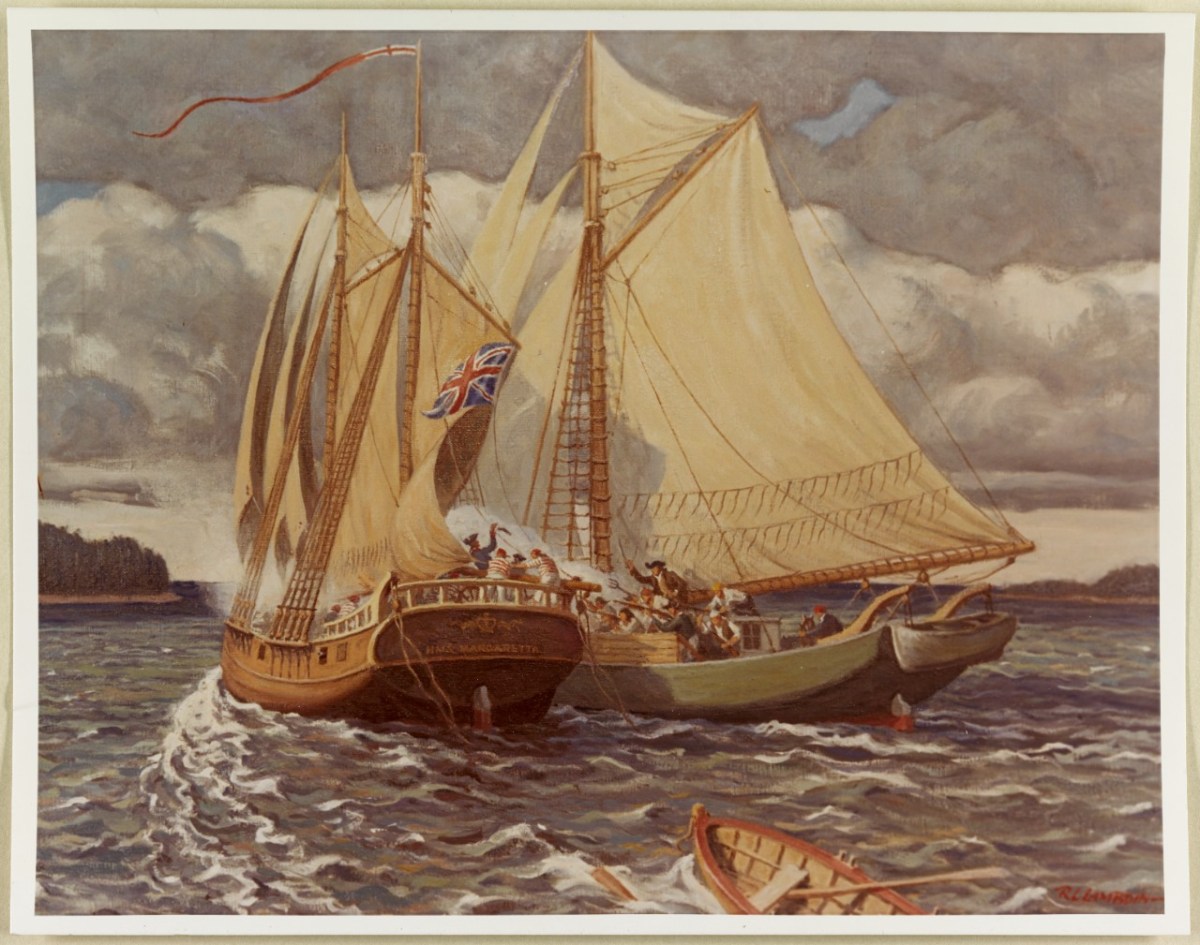
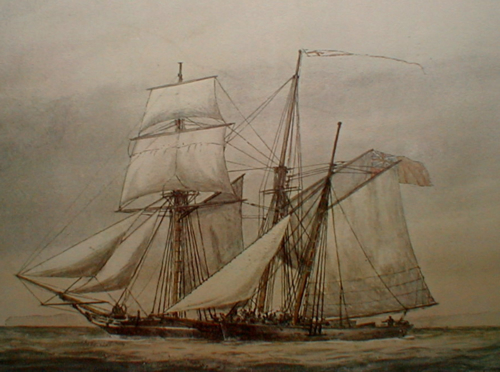
Jones arrived at Machias on June 2 aboard the merchant ships Unity and Polly, under guard of the armed schooner HMS Margaretta commanded by Midshipman James Moore.  They had come to trade food for lumber but the townspeople were split, and voted against doing business with Jones.  This provoked a threat from the Margaretta, which moved into range to bombard the town.  The action resulted in a second vote and the trade was approved, but Jones’ response was ham-fisted.   The merchant would only do business, with those who had voted with him in the first place.

margaretta
HMS Margaretta

Local militia leader Colonel Benjamin Foster conceived a plan to seize the merchant. He saw his opportunity on June 11, when Jones and Moore were in church.  They almost had the pair too, but Jones saw some twenty men approaching, and fled for the woods.  Moore was able to get back to the Margaretta, but events soon spun out of control.

The following day Colonel Foster and his brother, a man with the delightful name of Wooden Foster, seized the Unity.  A group of thirty began to construct breastworks to serve as protection, while others commandeered the coastal packet Falmouth.   There was about to be a fight.

machias_me

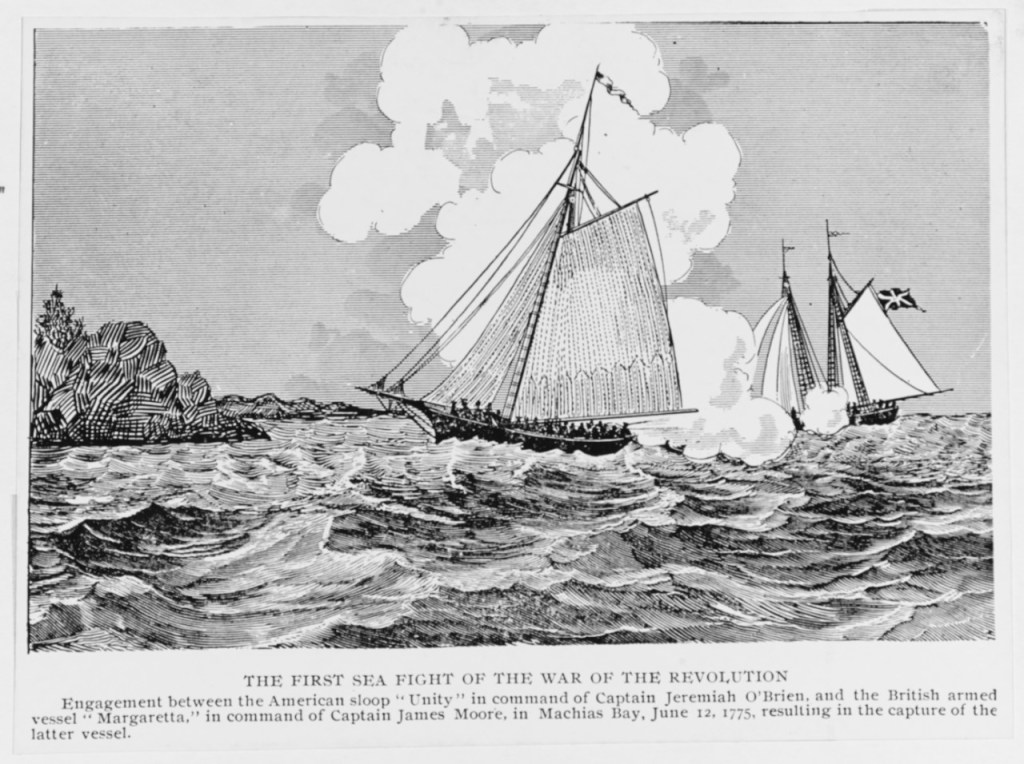
A group of Machias men approached Margaretta from the land and demanded her surrender, but Moore lifted anchor and sailed off in attempt to recover the Polly.  A turn of his stern through a brisk wind resulted in a boom and gaff breaking away from the mainsail, crippling the vessel’s navigability. Unity gave chase followed by Falmouth.

Musket fire was exchanged from both sides and hand grenades thrown onto the decks of the Unity.   Margaretta was soon boarded from both sides, the fighting hand to hand.

So began the “Lexington of the Sea”. The little-known episode was the first naval battle of the American Revolution, and ended in victory for the Patriot side.  Four Royal Navy seamen were killed outright and another ten wounded including Moore himself. He received a musket ball to the chest and died, the following day.

Patriot losses amounted to ten killed and another three wounded.

HMS Margaretta served the remainder of the Revolution as the renamed Machias Liberty.  British payback came on October 18 when Falmouth, the modern-site of Falmouth Maine and not to be confused with Falmouth Massachusetts, was burned to the ground.

British forces attempted a second assault on Machias, with an amphibious landing of 1,000 troops over the 13th – 14th of August, 1777.  The attempt was beaten back by local militia aided by Passamaquoddy and Penobscot allies, with both sides claiming victory.  The nearby village of Castine would be occupied in 1779 as would Machias itself during the War of 1812.  On both occasions, captured territories were re-dubbed the Crown Colony of “New Ireland”, a refuge for Loyalists and a base for future military operations.

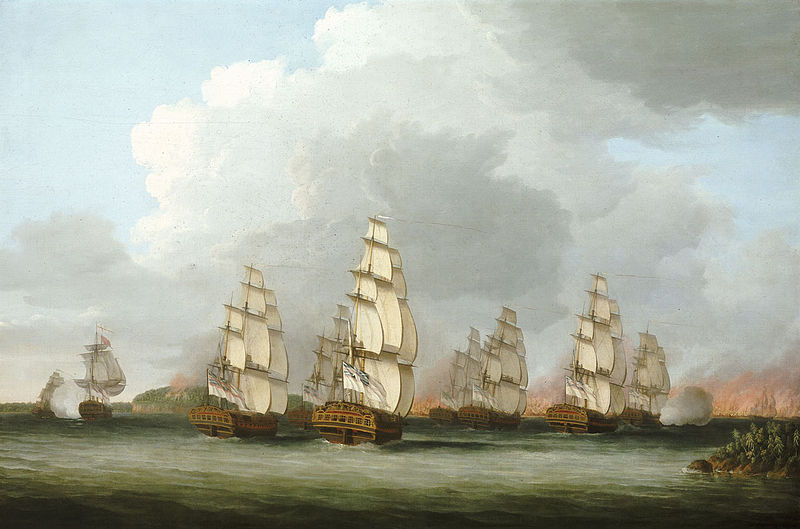
The Crown Colonies of New Ireland survived for four years in the first instance and eight months in the second.  The failed Penobscot expedition of 1779 to retake the colony would result in the most catastrophic defeat suffered by American Naval forces until the Japanese attack on Pearl Harbor 162 years later, but that must be a story for another day.

800px-PenobscotExpeditionBySerres
Britain defending New Ireland from the Penobscot Expedition by Dominic Serres

June 12, 1970 No-Hitter

“I really didn’t see the hitters, all I could tell is if they were on the right side or the left side. The catcher had tape on his fingers to help me see signals. But I was high as a Georgia pine.”

In the sport of baseball, a “no-hitter“ is a game in which nobatter is able to get on base, in the usual manner. Players may still get on base through a walk, an error or being hit by a pitch, but not by hitting the ball.

The talent to pitch 27 or more outs without surrendering a single hit is nearly as scarce, as hen’s teeth. Nearly a quarter-million Major League games have been played in this country between 1876 and 2021. Only 311 have ended, with no-hitters.

No fewer than six Major League ball clubs have recorded but a single no-hitter, in their entire existence. The number of pitchers to throw more than one, are precious few. Those who did it while tripping on acid number…precisely…one.

This is dated. Padres pitcher Joe Musgrove threw San Diego’s first no-hitter in April, this year

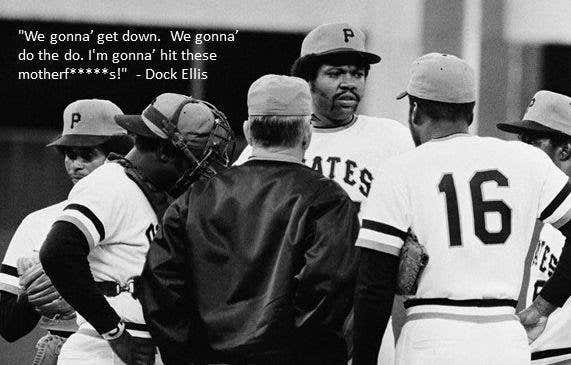
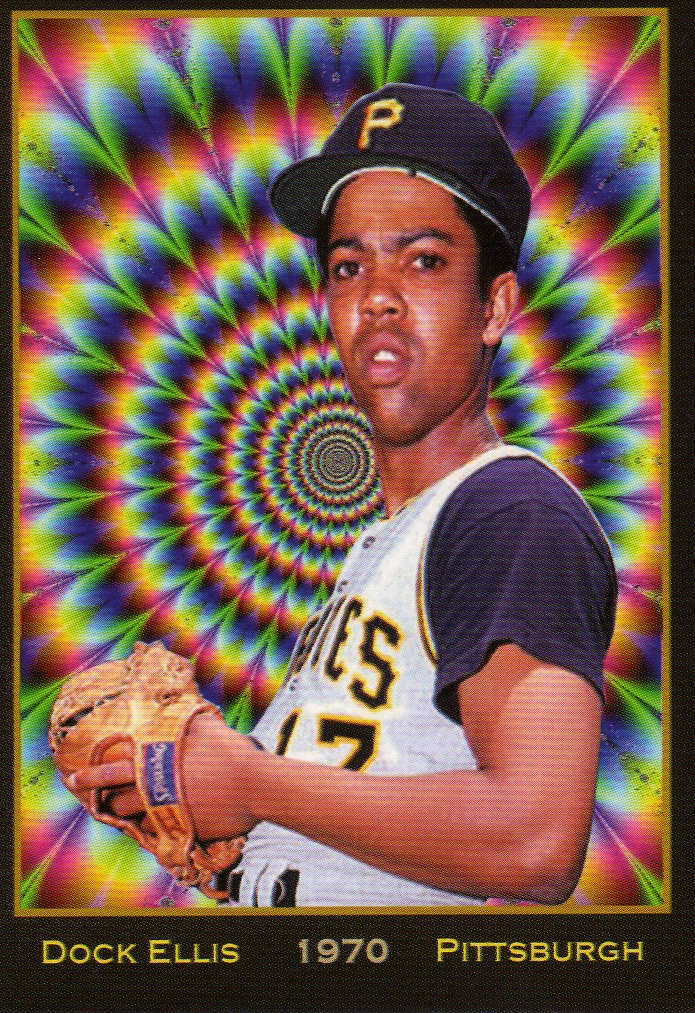
At his best, Pittsburg Pirates pitcher Dock Ellis was one of the best there was. Former ESPN announcer and San Diego Padres infielder, Dave “Soup” Campbell once said “I’ve always been asked who the toughest guy I ever faced was, and I always say Dock. His fastball had such great late movement, always seemed to be in one place when I’d start my swing and then move in another direction. It could sink, move in on my hands, or sail away like Mariano Rivera’s cutter.”

And then there were those times…

Baseball commissioner Bowie Kuhn repeatedly ordered the man to refrain from wearing curlers, on the field. He once burned a pre-game pitch list in the locker room and set off the sprinkler system. The man literally went ‘hunting’ Cincinnati batters one day in 1974, striking the first three men in the lineup: Pete Rose, Joe Morgan, and Dan Driessen. The next two were a little too quick dodging one head shot after another until Ellis was pulled, from the game.

Lest anyone think that was by accident, permit me to put the matter to rest. He said he’d do it, before the game. I believe Dock Ellis still holds the record for most consecutive batters, hit by a pitch.

Dock Ellis could be one of the best in the game, but never seemed to keep the focus to stay that way. Flamboyant, vocal and quick to anger, Jackie Robinson himself once praised Dock Ellis for advancing the rights of black players and criticized him, for talking too much.

And then there were the drugs. Ever mindful of his “can’t miss” status as a prospect, Ellis was never without a bit of chemical assistance. He later said he never pitched a major league game, without amphetamines.

And those were the days he was working.

June 11, 1970 was a Thursday, the day before a double header between the visiting Pirates, and the San Diego Padres. Ellis wasn’t pitching that day and drove to Los Angeles, to visit a friend.

Father Time moved on. The earth revolved on its axis and night followed day but Dock Ellis, knew none of it. “Two or three” LSD tabs took care of that. And then it was Friday. Game day. Ellis crushed another tablet and snorted the thing. Two hours later his host asked, aren’t you playing tonight? Ellis didn’t believe that it was Friday, asking “what happened to Thursday? She had to show him a sports page with the day’s date. June 12, 1970.

It was 2:00pm. He was scheduled to pitch at 6:08.

The rest of that day? Who knows. There was that frenzied trip to the airport, the flight and the pitcher’s arrival, just in time. Sometimes the ball seemed so big he later said, and sometimes, it was small. There was a plate up there or was it several, and why did it (they) keep moving? Years later he said he couldn’t see the batters, just which side of the plate they were on. Catcher Jerry May had to wear reflective tape on his fingers, so Ellis could see the signals.

At 8:18 it was over, the most unlikely no-hitter, in history. Pitching was so erratic the Padres had a man on base, in every inning.

“I started having a crazy idea in the fourth inning that Richard Nixon was the home plate umpire, and once I thought I was pitching a baseball to Jimi Hendrix, who to me was holding a guitar and swinging it over the plate. I remember diving out of the way of a ball I thought was a line drive. I jumped, but the ball wasn’t hit hard and never reached me.”

Dock Ellis

In 1993, San Francisco’s “proto-punk” singer songwriter Barbara Manning and the SF Seals, a group named after the city’s one-time minor league ball club, released what may be the first and only baseball themed EP in the history, of indie pop.

Manning’s trilogy included a cover of Les Brown’s “Joltin’ Joe DiMaggio,” the “Ballad of Denny McLain” and “Dock Ellis”, the psychedelic ballad of a Major League no-hitter, once pitched while tripping on acid.