September 14, 2004  Fake but Accurate

“Conservative” news sources like PJ Media rose in the aftermath, a tongue-in-cheek reference to the fact that a bunch of bloggers “in their jammies” uncovered in hours what the vaunted news gathering apparatus of CBS News failed to figure out in weeks.

It was September 8, 2004, less than two months before the 2004 Presidential election.  CBS News aired a 60 Minutes™ broadcast hosted by News Anchor Dan Rather, centered on four documents critical of President George W. Bush’s National Guard service in 1972-‘73.  The documents were supposed to have been written by Bush’s commander, Lieutenant Colonel Jerry B. Killian, who’d passed away in 1984.

GW-Bush-in-uniformThe documents came from Lt. Col. Bill Burkett, a former Texas Army National Guard officer who had received publicity back in 2000, when he claimed to have been transferred to Panama after refusing to falsify then-Governor Bush’s personnel records.  He later retracted the claim, but popped up again during the 2004 election cycle.  Many considered Burkett to be an “anti-Bush zealot”.

Within hours of the broadcast, the documents were criticized as forgeries.  Internet forums and blogs challenged the terminology and typography of the memos.  Within days it came out that the font used in the memos didn’t exist at the time the documents were supposed to have been written.

That didn’t stop the Boston Globe from running a story entitled “Authenticity Backed on Bush Documents”, a story they later had to retract.

Criticism of the 60 Minutes’ piece intensified, as CBS News and Dan Rather dug in and defended their story.   Within the week, Rather was talking to a Daily Kos contributor and former typewriter repairman who claimed that the documents could have been written in the 70s.  Meanwhile, the four “experts” used in the original story were publicly repudiating the 60 Minutes piece.

Other aspects of the documents were difficult to authenticate without access to the originals.  CBS had nothing but faxes and photocopies, and Burkett claimed to have burned the originals after faxing them to the network.

Fake but AccurateThe New York Times interviewed Marian Carr Knox who’d been secretary to the squadron in 1972, running a story dated September 14 under the bylines of Maureen Balleza and Kate Zernike.  The headline read “Memos on Bush Are Fake but Accurate, Typist Says“.

The story went on to describe the 86 year-old Carr’s recollections that she never typed the memos, but they accurately reflected the feelings of Lt. Col. Killian.  “I think he was writing the memos”, she said, “so there would be some record that he was aware of what was going on and what he (Bush) had done.”

Yet Killian’s wife and son had cleared out his office after his death, and they didn’t find anything even hinting at the existence of such documents.  Others who claimed to know Carr well described her as a “sweet old lady”, but said they had “no idea” where her statements had come from.

CBS News would ultimately retract the story, as it came out that Producer Mary Mapes collaborated on it with the Kerry campaign.  Several network news people lost their jobs, including Rather and Mapes.

dan-rather-cnnPublic confidence in the “Mainstream Media” plummeted.  Many saw the episode as a news network lying, and the “Newspaper of Record” swearing to it.

“Conservative” news sources like PJ Media rose in the aftermath, a tongue-in-cheek reference to the fact that a bunch of bloggers “in their jammies”, uncovered in hours what the vaunted news gathering apparatus of CBS News failed to figure out in weeks.

Such news media bias is nothing new.  In 1932-33, New York Times reporter Walter Duranty reported on Josef Stalin’s deliberate starvation of millions of Ukrainians, known as “Holodomor”.  “Extermination by hunger”.   With 25,000 starving to death every day, Duranty won a Pulitzer with such gems as:  “There is no famine or actual starvation nor is there likely to be.” – (Nov. 15, 1931), and,  “Any report of a famine in Russia is today an exaggeration or malignant propaganda.” – (Aug. 23, 1933).

Walter Duranty

The 1993 NBC Dateline “Exploding Truck” edition didn’t get the desired effect when they crash tested that pickup truck, so they rigged another one with a pyrotechnic device.  Sure enough, that one exploded on cue.  The “Exposé” was fiction masquerading as “News”, but hey.  The explosion made good television.

In a transparent attack on an administration with which it had political disagreements, the New York Times ran the Abu Ghraib story on the front page, above the fold, for 32 days straight.  Just in case anyone missed the first 31.

And who can forget that edited audio from George Zimmermann’s 911 call.  Thank you, NBC.

If the point requires further proof, watch ABC News Charlie Gibson’s 2008 interview with Sarah Palin, then read the transcript.  Whether you like or don’t like Ms. Palin is irrelevant to the point.  The transcript and the interview as broadcast, are two different things.

The political process is afflicted when news agencies act as advocates in the stories they cover.  Our system of self-government cannot long survive without an informed electorate.  That may be the worst part of this whole sorry story.

Bill Clintons Cat
Press photographers, in search of the perfect image. Of Bill Clinton’s cat.

August 29, 1854  The President’s Desk

The British government ordered at least three desks to be fashioned out of the ship’s timbers, the work being done by the skilled cabinet makers of the Chatham dockyards.  The British government presented a large partner’s desk to President Rutherford B. Hayes in 1880.  A token of gratitude for HMS Resolute’s return, 24 years earlier.

(AP Photo/Look Magazine, Stanley Tretick, File)
The desk, known as the Resolute Desk, has been used by almost every American President since, whether in a private study or the oval office. 

HMS ResoluteHMS Resolute was a Barque rigged merchant ship, purchased by the English government in 1850 as the Ptarmigan, and refitted for Arctic exploration.  Re-named Resolute, the vessel became part of a five ship squadron leaving England in April 1852, sailing into the Canadian arctic in search of the Franklin expedition, which had disappeared into the ice pack in 1845.
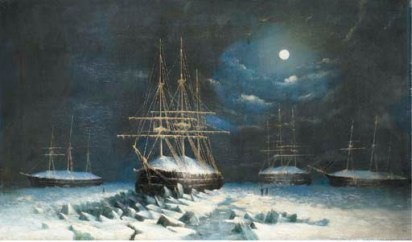
They never found Franklin, though they did find the long suffering crew of the HMS Investigator, hopelessly encased in ice where they had been stranded since 1850.

Three of the expedition’s ships themselves became trapped in floe ice in August 1853, including Resolute.  There was no choice but to abandon ship, striking out across the ice pack in search of their supply ships.  Most of them made it, despite egregious hardship, straggling into Beechey Island between May and August of the following year.resoluteice2

The expedition’s survivors left Beechey Island on August 29, 1854, never to return.

Meanwhile Resolute, alone and abandoned among the ice floes, continued to drift eastward at a rate of 1.5 nautical miles per day.

The American whale ship George Henry discovered the drifting Resolute on September 10, 1855, 1,200 miles from her last known position.  Captain James Buddington split his crew, half of them now manning the abandoned ship.  Fourteen of them sailed Resolute back to their base in Groton CT, arriving on Christmas eve.

Resolute hulk
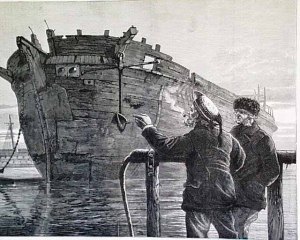
LLUSTRATED LONDON NEWS, England, October 4, 1879: “The Old Arctic Exploring Ship Resolute, Now Broken Up At Chatham Dockyard”

1856 was a difficult time for American-British relations.  Senator James Mason of Virginia presented a bill in Congress to fix up the Resolute, giving her back to her Majesty Queen Victoria’s government as a token of friendship between the two nations.

$40,000 were spent on the refit, and Resolute sailed for England later that year, Commander Henry J. Hartstene presenting her to Queen Victoria on December 13.

Resolute served in the British navy until being retired and broken up in 1879.  The British government ordered at least three desks to be fashioned out of the ship’s timbers, the work being done by the skilled cabinet makers of the Chatham dockyards.  The British government presented a large partner’s desk to President Rutherford B. Hayes in 1880.  A token of gratitude for HMS Resolute’s return, 24 years earlier.

KENNEDY
(AP Photo/Look Magazine, Stanley Tretick, File)

The desk, known as the Resolute Desk, has been used by almost every American President since, whether in a private study or the oval office.

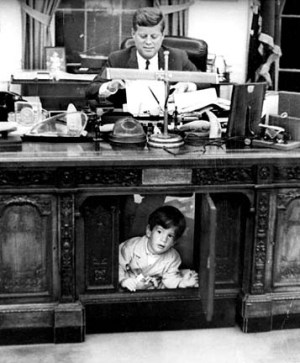
FDR had a panel installed in the opening, since he was self conscious about his leg braces.  It was Jackie Kennedy who brought the desk into the Oval Office.  There are pictures of JFK working at the desk, while his young son JFK, Jr., played under it.

Presidents Johnson, Nixon and Ford were the only ones not to use the Resolute desk, as LBJ allowed it to leave the White House after the Kennedy assassination.

The desk spent several years in the Kennedy Library and later the Smithsonian Institute, the only time the desk has been out of the White House.

Jimmy Carter returned the Resolute Desk to the Oval Office, where it has remained through the Presidencies of Ronald Reagan, George H.W. Bush, Bill Clinton, George W. Bush, Barack Obama and, so far, Donald Trump.

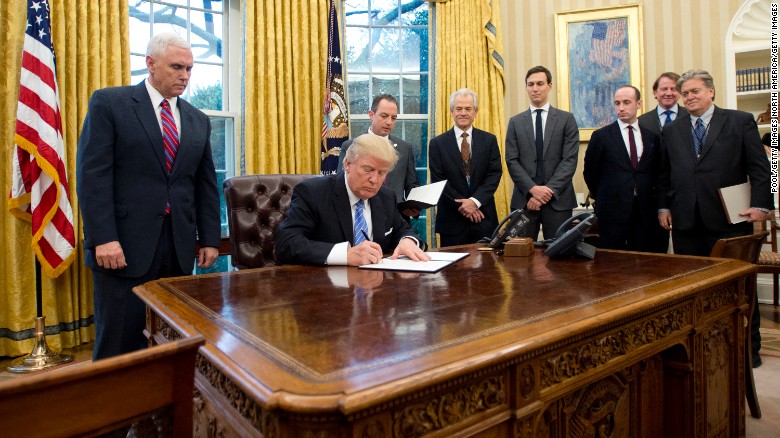
President Trump at Resoute Desk

August 28, 1948 Landslide Lyndon

‘People have been saying for 40 years, ‘No one knows what really happened in that election,’ and ‘Everybody does it.’ Neither of those statements is true. I don’t think that this is the only election that was ever stolen, but there was never such brazen thievery”.

In 1944, Texas political Boss George Berham Parr and Webb County Judge Manuel “Black Coke StevensonHawk” Raymond had a favor to ask of then-Governor Coke Robert Stevenson. They wanted the Governor to appoint a Raymond relative, E. James Kazen, as Laredo district attorney.

The Governor wasn’t playing ball. The United States was at war at that time, and the commander at the local Army Air Force Base opposed the appointment, saying that half his men were down with VD. A district attorney from the local political machine, he argued, would mean lax enforcement of prostitution laws, and his high sick rate was adversely effecting the war effort.

Stevenson was persuaded, and he appointed another man to the job. George Parr would not forget the slight.

Four years later, Coke Stevenson was running for the United States Senate. Parr had a debt to repay to Stevenson’s opponent, Congressman Lyndon Baynes Johnson, who had helped him obtain a Presidential Pardon back in 1946. He had some payback to do on Stevenson’s account as well, but that would be payback of a different sort.

Landslide LyndonTexas had only a weak Republican party in 1948.  The winner of the Democrat’s three-way primary was sure to be the next Senator.
When the votes were counted on August 28, Stevenson was the top vote getter with 37.3%, edging out Johnson at #2, by 112 votes out of 988,295 cast.

Texas state law requires an absolute majority to determine a primary winner, so a runoff was held between the top two finishers.

Stevenson held the lead at the end of counting.  Five days later, Jim Wells County amended its return. 202 additional votes had been “found”, hidden away in Box #13 from the town of Alice.

200 of the 202 had voted for Johnson.  By a miraculous coincidence, each had signed their names in alphabetical order, in the same penmanship, each apparently using the same pen.

An investigation was called, and the executive committee of the Texas Democratic Party upheld Johnson’s victory, 29-to-28.   Stevenson sued.

160221-updegrov-lbj-fortas-tease_xkflll
Fortas, Johnson

A Federal court ordered Johnson’s name off the ballot pending the results of an investigation, but the matter was settled in Johnson’s favor when Associate Supreme Court Justice Hugo Black voided the order on the urging of Johnson lawyer, Abe Fortas.

Purely coincidentally I’m sure, the very same Abe Fortas would himself be appointed to the Supreme Court by then-President Lyndon Johnson, in 1965.

Johnson went on to defeat the Republican candidate in the general election.  The primary ballots were “accidentally” burned some time later.

‘Means of Ascent’ author Robert A. Caro, the second volume of a projected four-volume Johnson study entitled ‘The Years of Lyndon Johnson’, told the New York Times in a 1990 interview: ‘People have been saying for 40 years, ‘No one knows what really happened in that election,’ and ‘Everybody does it.’ Neither of those statements is true. I don’t think that this is the only election that was ever stolen, but there was never such brazen thievery”.

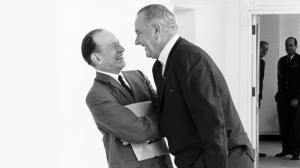
LBJ had “won” his primary by 87 votes, August 28 forever marking the day on which he would be known as “landslide Lyndon”. Johnson easily defeated Republican Jack Porter for the Senate seat, later becoming Vice President and then President after the texas-ballot-boxassassination of John F Kennedy, a man whom many believe stole his own election from Richard Nixon in 1960, with the help of Chicago’s Daley machine and a little creative vote counting in Cook County.

Johnson never acknowledged stealing the election, but Ronnie Dugger, editor of the Texas Observer, once visited him in the White House. Then-President Johnson pulled out a photo of five “ol’ boys” from Alice, grinning back at the camera with the infamous Box 13 between them. Dugger asked LBJ if he had stolen the election. President Johnson’s only response, was to laugh.


August 1, 1794 Whiskey Rebellion

A federalized militia force of 12,950 was raised to put down what President Washington saw as armed insurrection, marching on Western Pennsylvania in October 1794.  It was a larger force than General Washington normally had under his command, during the late Revolution.

On ratification of the modern constitution in 1789, the founding fathers gazed out at what they had wrought.  What they saw, was debt.Constitution

The Continental government had been unable to levy taxes under the Articles of Confederation, the only major income source being foreign import duties. The government had borrowed money to meet expenses during this period, accumulating $54 million in debt.  The states themselves another $25 million.

Compounding the problem was the matter of runaway inflation, which had plagued the Articles of Confederation period. The colonies had printed paper currency to pay debts, as did the national government. Silver coinage remained stable due to the inherent value of the metal itself, but there was nothing behind this paper money. At one point, you could buy a single sheep for $2 “hard currency”, or $150 in paper “Continental Dollars”. To this day, you might hear the expression “worthless as a continental”.

The first Secretary of the Treasury, Alexander Hamilton, reported in his Report on Public Credit, urging Congress to consolidate state and national debt into a single debt to be funded by the federal government. Hamilton felt that existing duties were as high as they could be without depressing imports, so he recommended the first excise tax on a domestically manufactured product – whiskey.  The more meddlesome of Hamilton’s contemporaries were enthusiastically in favor of a “sin tax”, just as they are today.  The “Whiskey Act” became law on March 3, 1791.

The whiskey tax was immediately unpopular, particularly in the west where it was, for all intents and purposes, an income tax.  At a flat rate of 7¢ per gallon, the tax weighed more heavily on the western frontiers, where whiskey was sold for 50¢ a gallon.  About half what it sold for in the more established regions of the east.

Furthermore, coinage wasn’t easy to come by on the frontiers.  In many areas the medium for exchange was whiskey itself.  The stuff was popular, it’s value was relatively stable, and it was easier to transport than the grain from which it was distilled.

Folks on the western fringes of the new nation already felt the federal government was doing too little to secure them against the predation of Indians.  This whiskey tax was the final straw.

Whiskey_Insurrection
Illustration of the Whiskey Rebellion from “Our First Century”, R.M. Devens 1882

Petitions were signed against the new law and there were hearings, none of which settled the matter satisfactorily. Events reached a boiling point in May 1794, when federal district attorney William Rawle issued subpoenas for more than 60 Western Pennsylvania distillers who had not paid their excise tax. All 60 were expected to appear in excise court in Philadelphia, an expensive, disruptive trip that these poor farmers were loathe to undertake.

The war of words became a shooting war as US Marshal David Lenox was delivering these writs in Allegheny County, south of Pittsburgh, on July 15.

Braddocks FieldMore shooting incidents occurred in the days that followed.  Objections to the whiskey tax gave way to a long list of economic grievances, as over 7,000 gathered in Braddock’s Field on August 1. They talked of secession and carried their own flag, each of its six stripes representing one of 6 Pennsylvania or eastern Ohio counties.

At last they marched on Pittsburg, burning the barns of Major Abraham Kirkpatrick, who had previously led soldiers against them.

A federalized militia force of 12,950 was raised to put down what President Washington saw as armed insurrection, marching on Western Pennsylvania in October 1794.  It was a larger force than General Washington normally had under his command during the late Revolution.

Washington himself rode out to check on the progress of his army, the first and only time in history that a sitting American President led an army in the field.

whiskey-rebellion-300x214The whiskey rebellion collapsed in the face of what was then an overwhelming army, with 10 of their leaders brought to Philadelphia to stand trial. Two were sentenced to hang for their role in the rebellion, but President Washington pardoned them both.  The whiskey rebellion was over.
All internal taxes were repealed in 1800, when President Thomas Jefferson returned US fiscal policy to a reliance on trade tariffs.  With the Napoleonic wars ongoing in Europe, business was good.  National debt was reduced from $83 million to $43 million, despite $11 million spent on the Louisiana Purchase.

President Andrew Jackson paid off the national debt in its entirety, in 1835.  The first and only President in United States history, ever to do so.  Since that time, the Federal government has saddled the American taxpayer with approximately $301 million in additional debt.  Per day.

July 23, 1796 Royal Gift

Today, we think of George Washington as the father of the country.  Revolutionary era General. first President of the United States.  It may surprise some to learn, that he’d have described himself as a farmer.

Today, we think of George Washington as the father of the country.  Revolution-era General, first President of the United States.  It may surprise some to learn, that he’d have described himself as a farmer.

mount-vernon-shenk-5200-2
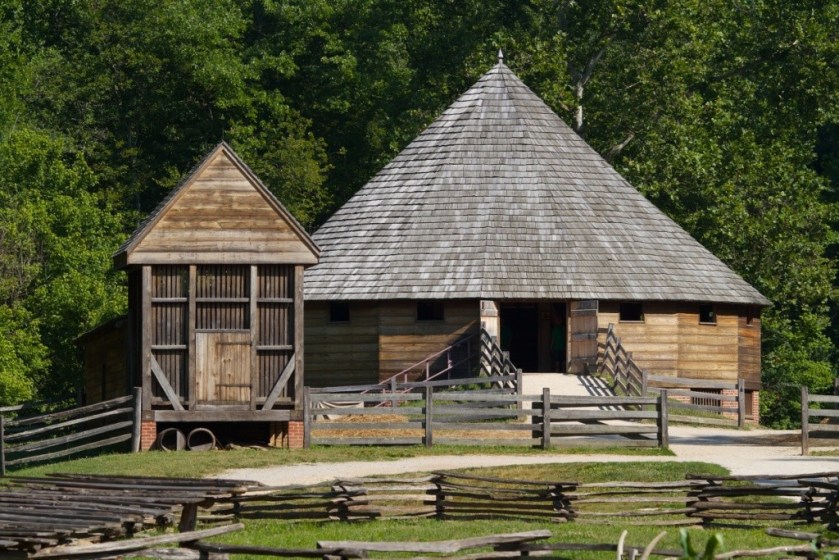
The Pioneer Farm and 16-Sided Barn at Mount Vernon

Washington’s early work in agriculture was driven by the need to make a living.  He would constantly study and experiment, always on the lookout for new and innovative methods and materials.  From his 16-sided treading barn at Dogue run to innovations in crop rotation, fertilization methods and animal husbandry, Washington’s innovations benefited not only the five farms of Mount Vernon, but much of American agriculture.

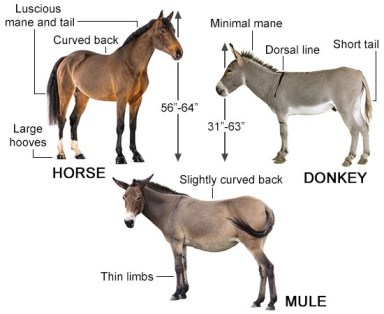
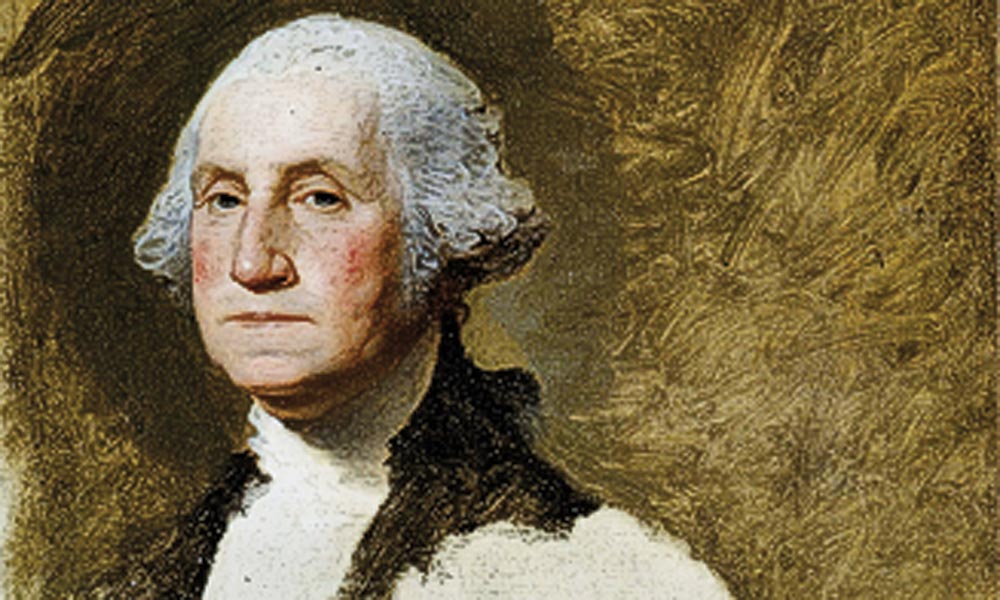
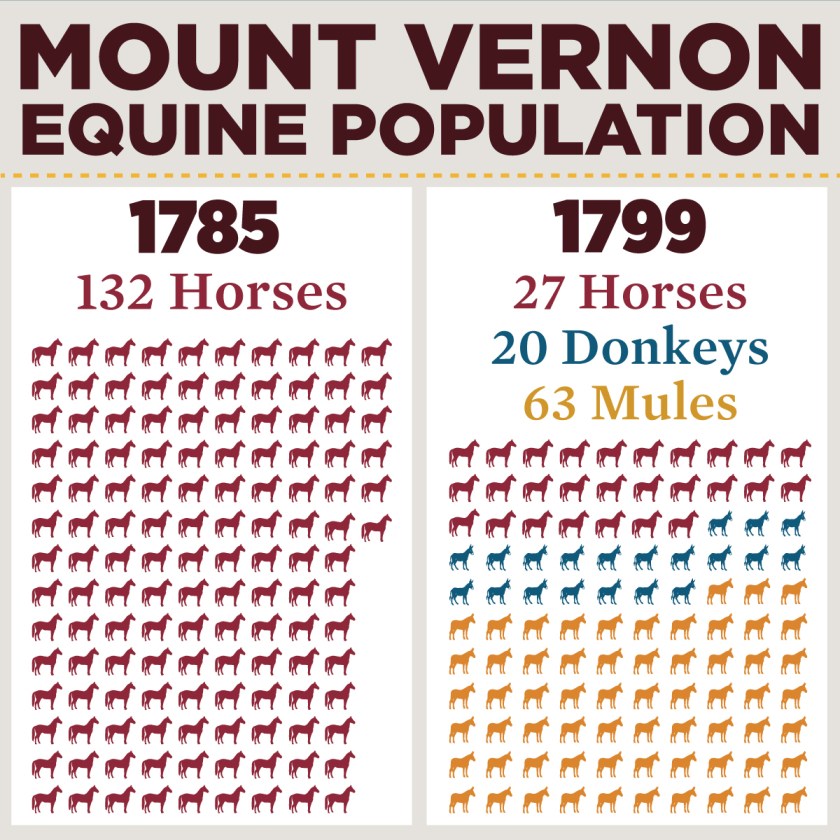
132 horses worked the Mount Vernon estate in 1785, when Washington became interested in mules.  A working mule has a productive life expectancy of 30 years, while a horse is generally played out in 20.  A mule is capable of more work with less feed than either horses or donkeys, and more intelligent than a horse.  A mule is capable of seeing its own back feet, making it less likely to “spook” at unseen hazards, and far more sure footed than a horse.

During the age of westward expansion, mules would stop along wagon trails, pointing their ears toward an approaching buffalo herd or Indian band, long before humans or other animals were aware of the threat.  This tendency to stop and assess leads to the perception that mules are stubborn, but the experienced mule handler understands.  There is a cognitive process at work in these animals.  It’s best to work with it.

Mules vs Donkeys vs HorsesMules are hybrid animals, the offspring of a male Equus Africanus Asinus, and a female Equus Caballus.  A jackass and a mare.  From the sire, the mule inherits intelligence, toughness and endurance, while the dam passes down her speed, conformation and agility.
Charles Darwin once wrote: “The mule always appears to me a most surprising animal. That a hybrid should possess more reason, memory, obstinacy, social affection, powers of muscular endurance, and length of life, than either of its parents, seems to indicate that art has here outdone nature.”

A “Hinny” results from crossing a female donkey and a male horse.  The result is a far less desirable animal, possessed of the lesser traits of both parent species.

Mules and hinnies have 63 chromosomes, resulting from the horse’s 64 and the donkey’s 62.  For this reason, there is no historical record of even a single fertile mule stallion.  Only a miniscule number of mule mares have bred successfully with purebred horses or donkeys.

Such an event is so rare that it was considered an ill omen in ancient days.  Herodotus describes such an event as an ill omen during Xerxes’ invasion of Greece in 480 BC, culminating in the Battle at Thermopylae.  “There happened also a portent of another kind while he (Xerxes the Great, 4th “King of Kings” of the Achaemenid dynasty of Persia), was still at Sardis, a mule brought forth young and gave birth to a mule”.Royal Gift

The English isles are for the most part blessed with flat farmlands, rarely having need of mules.  France and Spain possessed some of the finest breeding stock in the world in the Andalusian and Catalonian Jacks, though it was illegal to export them to the new world for fear of advantaging historic rivals.

Desiring a breeding Jack of his own, Washington reached out to Spanish King Charles III in 1780, through the Cuban merchant Don Juan de Miralles.  Miralles died unexpectedly and the transaction never took place, and Washington tried again in 1784. This time, American chargé d’affaires at the Spanish court William Carmichael reached out to the Spanish King, who was more than happy to provide two Spanish Jacks.  One died in transit, while the other arrived with its handler in Gloucester, Massachusetts, on October 7, 1785.  He was gray in color with a strong, stocky, build, standing just short of fifteen hands.

This original donkey stallion would come to be called “Royal Gift”.

John Fairfax, Washington’s overseer at Mount Vernon, was dispatched to Boston to meet Royal Gift and his handler, and escort them back to Virginia.  So solicitous was he of the animal’s health, that the donkey was provided with blankets, and never required to walk more than 15 miles in a day.  Royal Gift arrived at Mount Vernon on the evening of December 5.

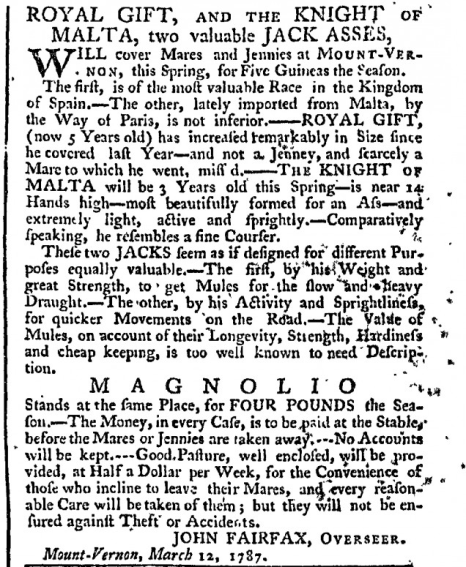
The Marquis de Lafayette sent Washington a black Maltese Jack called “Knight of Malta” the following year, probably illegally, along with several “Jennies”. An ad ran in the Maryland Journal in March 23, 1787, advertising Mount Vernon’s Jacks for stud at five Guineas for the season.

Royal Gift came up lame in 1793, after being driven far too hard by an ignorant handler.  He would live another three years, but his stud career was all but over.  On July 23, 1796, William Washington wrote to the President informing him of the passing of his prized Spanish Jackass.  Royal Gift had succumbed to “farcy”, a form of Cutaneous Glanders nearly always fatal in horses, donkeys and mules.

mule-infographic-2

By the time of George Washington’s death in 1799, there were 63 working mules at Mount Vernon, and an untold number working the farms of the young nation.  By 1808, there were 855,000 mules throughout the south, west of the Appalachian frontier, and at work in countless American farms.  Even today, many American donkeys and mules can trace their lineage back to Royal Gift.  And to George Washington.  The Father of the American Mule.

July 22, 1937 Packing the Court

Article III, Section 1 of the United States Constitution creates the highest court in the land. The relevant clause states that “The judicial power of the United States, shall be vested in one Supreme Court, and in such inferior courts as the Congress may from time to time ordain and establish”. Nowhere does the document specify the number of justices.

Article III, Section 1 of the United States Constitution creates the highest court in the land. The relevant clause states that “The judicial power of the United States, shall be vested in one Supreme Court, and in such inferior courts as the Congress may from time to time ordain and establish”. Nowhere does the document specify the number of justices.Constitution

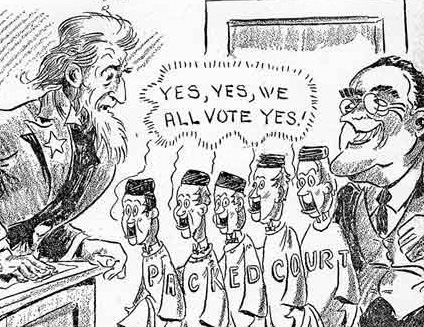
The United States was in the midst of the “Great Depression” when President Franklin Delano Roosevelt came to office in 1932. He had promised a “New Deal” for America, immediately beginning a series of sweeping legislative reforms designed to counter the devastating effects of the Depression. His initiatives faced many challenges in the courts, with the Supreme Court striking down as unconstitutional several New Deal provisions in his first term.

The Supreme Court was divided along ideological lines in 1937, as it is today. “Judicial Court Packing Scheme,1Realist” or “Liberal” legal scholars and judges argued that the constitution was a “living document”, allowing for judicial flexibility and legislative experimentation. Supreme Court justice Oliver Wendell Holmes, Jr., a leading proponent of the Realist philosophy, said of Missouri v. Holland that the “case before us must be considered in the light of our whole experience and not merely in that of what was said a hundred years ago”.
“Judicial Formalists”, today we call them “Conservatives” or “Originalists”, seek to discover the original meaning or intent of the constitution. Formalist legal scholars and judges argue that the judiciary is not supposed to create, amend or repeal law; that is for the legislative branch. The role of the court is to interpret and uphold law, or strike them down in light of the original intent of the framers, and the ratifiers, of the constitution.

In 1937, SCOTUS was divided along ideological lines, with three Liberals, four Conservatives, and two swing votes.

President Woodrow Wilson’s Attorney General, James Clark McReynolds, made a proposal in 1914 that: “(When) any judge of a federal court below the Supreme Court fails to avail himself of the privilege of retiring now granted by law (at age 70), that the President be required, with the advice and consent of the Senate, to appoint another judge, who would preside over the affairs of the court and have precedence over the older one. This will insure at all times the presence of a judge sufficiently active to discharge promptly and adequately the duties of the court”.

Court Packing SchemeTo Roosevelt, that was the answer. The age 70 provision allowed him 6 more handpicked justices, effectively ending Supreme Court opposition to his policies.
Roosevelt’s “Judiciary Reorganization Bill of 1937” immediately came under sharp criticism from legislators, bar associations, and the public. The Senate Judiciary Committee began hearings on the bill on March 10, 1937, reporting it “adversely” by a committee vote of 10 to 8. The full senate took up the matter on July 2, with the Roosevelt administration suffering a disastrous setback when Senate Majority Leader Joseph T. Robinson, a powerful supporter of the legislation, died of a heart attack.

The full Senate voted on July 22, 1937, to send the bill back to the Judiciary Committee, where provisions for additional justices were stripped from the bill. A modified version passed in August, but Roosevelt’s “court packing” scheme was dead.

In the end, the President had the last word. After an unprecedented four terms, Roosevelt would eventually appoint eight of nine justices to the Court.

July 7, 1798 XYZ

In the UK, the ruling class appeared to enjoy the chaos.  A British political cartoon of the time depicted the United States, represented by a woman being groped by five Frenchmen while John Bull, the fictional personification of all England, laughs from a nearby hilltop.

Imagine that you’ve always considered yourself to be somewhere in the political center, maybe a little to the left.  Now imagine that, in the space of two years, your country’s politics have shifted so radically that you find yourself on the “reactionary right”. So much so, that you are subject to execution by your government.  And all that time, your politics haven’t changed.

Our strongest ally in the American Revolution lost its collective mind in 1792, when France descended into its own revolution.    17,000 Frenchmen were officially tried and executed during the 1793-94 “Reign of Terror”, including King Louis XVI himself and his queen, Marie Antoinette.  Untold thousands died in prison or without benefit of trial.  The monarchical powers of Europe were quick to intervene and for the 32nd time since the Norman invasion of 1066, England and France found themselves at war.

Exécution_de_Marie_Antoinette_le_16_octobre_1793
Execution of Marie Antoinette

Both sides in the European conflict seized neutral ships which were trading with their adversary.  The “Treaty of Amity, Commerce, and Navigation” between Great Britain and its former colonies, better known as the “Jay Treaty”, all but destroyed relations with the French Republic.  France retaliated by stepping up attacks on American merchant shipping, seizing 316 vessels in one 11-month period, alone.

France had been the colonies’ strongest ally during the American Revolution, now the Jay treaty infuriated the French, who believed the agreement violated earlier arrangements between the two nations.  Making matters worse, America repudiated its war debt in 1794, arguing that it owed money to “L’ancien Régime”, not to the “First Republic” which had overthrown it and executed its King.

In 1796, France formally broke diplomatic relations with the United States, rejecting the credentials of President Washington’s Ambassador, Charles Cotesworth Pinckney.

The following year, President John Adams dispatched a delegation of two.  They were future Chief Justice of the Supreme Court John Marshall, and future Massachusetts Governor Elbridge Gerry, the man who later became the 5th Vice President, lending his name to the term “Gerrymander”.  Their instructions were to join with Pinckney in negotiating a treaty with France, with terms similar to those of the Jay treaty with Great Britain.

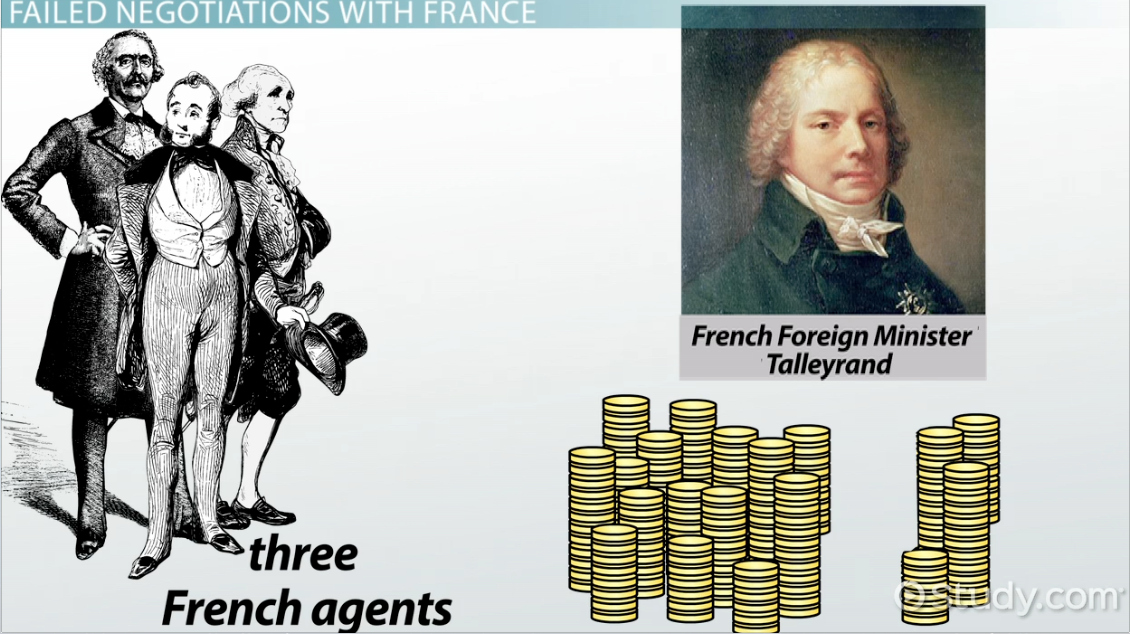
The American commission arrived in Paris in October 1797, requesting a meeting with the French Foreign Minister, Charles Maurice de Talleyrand.  Talleyrand, unkindly disposed toward the Adams administration to begin with, demanded a bribe for himself and substantial ‘loan’ to the French Republic, before so much as meeting with the American delegation.  The practice was not uncommon in European diplomacy of the time.  The Americans were appalled.

Believing that the Adams administration sought war by exaggerating the French position, Jeffersonian allies in Congress joined with more warlike Federalists in demanding the release of the commissioner’s communications. It was these dispatches, released in redacted form, which gave the name “X-Y-Z Affair” to the diplomatic and military crisis to follow.

Nicholas Hubbard, an English banker, was identified in the transcripts, only as “W”.  W introduced “X” (Baron Jean-Conrad Hottinguer) as a “man of honor”, who wished an informal meeting with Pinckney.  Pinckney agreed and Hottinguer reiterated Talleyrand’s demands, specifying the payment of a large loan to the French government, and a £50,000 bribe to Talleyrand himself.  Met with flat refusal by the American commission, X then introduced Pierre Bellamy (“Y”) to the Americans.  Lucien Hauteval (“Z”), Talleyrand’s personal emissary, was then sent to negotiate with Elbridge Gerry.  X, Y and Z, each in their turn, reiterated the Foreign Minister’s demand for a loan, and a bribe.

American politics were sharply divided over the European war.  President Adams and his Federalists, always the believers in strong, central government, took the side of the Monarchists.  Thomas Jefferson and his “Democratic-Republicans” found more in common with the ‘liberté, égalité and fraternité’ espoused by French revolutionaries.

In the UK, the ruling class appeared to enjoy the chaos.  A British political cartoon of the time depicted the United States, represented by a woman being groped by five Frenchmen while John Bull, the fictional personification of all England, laughs from a nearby hilltop.

John Bull cartoon

At this point, the United States had little means of defending itself.  The government had disbanded the Navy along with the Marine Corps at the end of the Revolution, selling the last warship in 1785 and retaining only a handful of “revenue cutters” doing customs enforcement.  The Naval Act of 1794 established a standing Navy for the first time in US history.  In October 1797, Congress authorized the construction of six frigates.  One of them, USS Constitution, saw its first combat in the Quasi-War with France, and remains in service to this day, the oldest commissioned ship in the United States Navy.

Quasi War

Adams’ commission left without entering formal negotiations, their failure leading to a political firestorm in the United States.  Congress rescinded all existing treaties with France on July 7, 1798, authorizing American privateers to attack French shipping. The undeclared “Quasi-War” with France, had begun.

Four days later, President John Adams signed “An Act for Establishing and Organizing a Marine Corps,” permanently establishing the United States Marine Corps as an independent service branch, in order to defend the American merchant fleet.

For the United States, military involvement proved decisive.  Before military intervention, the conflict with France resulted in 28 Americans killed, 42 wounded, and over 2,000 merchant ships captured.  Following intervention, the US suffered 54 killed and 43 wounded, with only a single ship lost, and that one was later recaptured.

The undeclared naval war with our former ally was settled with the Treaty of Mortefontaine, also known as the Convention of 1800, and ratified the following year.

July 4, 1826 Founding Fathers

The letters between Adams and Jefferson together constitute one of the most comprehensive historical and philosophical assessments ever written about the American founding.

Thomas Jefferson met John Adams at the 1775 Continental Congress in Philadelphia, the two forming a close personal friendship which would last for most of their lives.   They were two of the committee of five assigned to write the Declaration of Independence, and worked closely together throughout the era of our founding.

The friendship between the two men came to an end during the Presidential election of 1800.  Mudslinging on both sides rose to levels never before seen in a national election, an election in which both sides firmly believed the election of the other, would destroy the young nation.HamJeff

Jefferson defeated one term incumbent Adams and went on to serve two terms as President.

On Jefferson’s retirement in 1809, one of the signers of the Declaration of Independence, Dr. Benjamin Rush, took it upon himself to patch up the broken friendship between the two founding fathers. Dr. Rush worked on his personal diplomatic mission for two years.  In 1811, he finally succeeded.

There followed a series of letters between Adams and Jefferson, which together constitute one of the most comprehensive historical and philosophical assessments ever written about the American founding.

Their correspondence touched on a variety of topics, from the birth of this self-governing Republic, to then-current political issues, to matters of philosophy and religion and issues of aging. Both men understood that they were writing not only to one another, but to generations yet unborn.Letters

Each went to great lengths to explain the philosophical underpinnings of his views.  Adams the Federalist, the firm believer in strong, centralized government.  Jefferson was the Democratic-Republican, advocating for smaller federal government and more autonomy for the states.

In 1826, Jefferson and Adams were the last of the founding fathers.  In an ending no fiction writer would even dare to contemplate, both men died on this day in 1826, fifty years to the day from the birth of the Republic they had helped to create.

Adams was 90. His final words as he lay on his deathbed were “Thomas Jefferson still survives”.  Adams had no way of knowing that Jefferson had died five hours earlier, at Monticello.  He was 82.

Daniel Webster spoke of the pair a month later, at Faneuil Hall, in Boston. “No two men now live” he said”, (or) any two men have ever lived, in one age, who (have) given a more lasting direction to the current of human thought. No age will come, in which the American Revolution will appear less than it is, one of the greatest events in human history. No age will come, in which it will cease to be seen and felt, on either continent, that a mighty step, a great advance, not only in American affairs, but in human affairs, was made on the 4th of July, 1776″.

July 3, 1775, Washington’s Sword

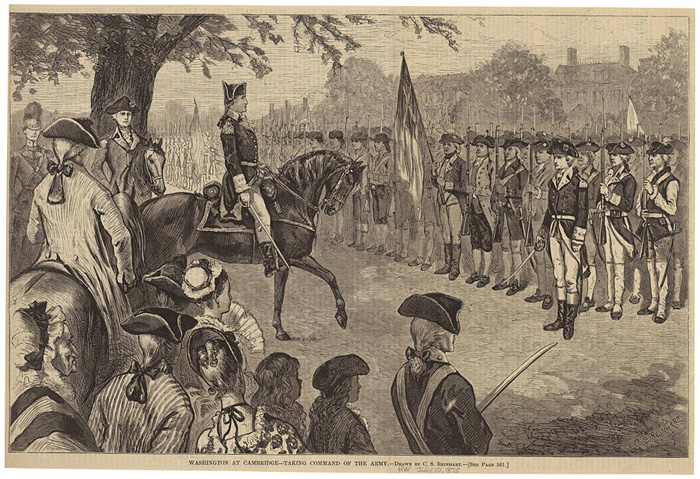
General Washington rode out in front of the troops gathered at Cambridge Common on July 3, 1775.  Washington drew his sword under the branches of an ancient elm, by that act formally taking command of the Continental Army.

The American Revolution began with the battles of Lexington and Concord on the 19th of April, 1775. Thousands of armed colonial militia followed the British columns as they withdrew, and there they remained, hemming the British occupiers up in the city of Boston.

Within days, more than 20,000 armed men from all over New England had gathered from Cambridge to Roxbury. Tories’ vacant homes, empty Churches, even the brick buildings of Harvard College served as barracks, officers’ quarters, and hospitals. Soldiers camped in tents and other makeshift shelters, while Harvard canceled classes on May 1. Classes would not resume at the Cambridge campus until June of the following year.

The Continental Congress created the Army on June 14, 1775, appointing George Washington to lead it. General Washington rode out in front of the troops gathered at Cambridge Common on July 3, 1775.  Washington drew his sword under the branches of an ancient elm, by that act formally taking command of the Continental Army.

Washington Elm marker

Interestingly, 150 years of de facto independence from Great Britain seems to have suited the American colonist.  If inheritance records are any indication, the average American enjoyed a better standard of living, than the average Brit.  Average heights of the time bear that out.

The average American colonist had a full three inches on his British counterpart. At a time when the average male stood 5’8′, Washington towered over the crowd at 6’2″.   George Washington was a hard man to miss.

For Washington to draw his sword against King George III, was itself an act of magnificent courage.  According to British law of the time, one of four definitions of High Treason was “If a man do levy war against our lord the King in his realm”.  By drawing that sword against the crown, Washington was clearly committing High Treason.  He surely understood that such a prominent person as himself would be dealt with harshly, if caught.

At that time, the centuries-old penalty for High Treason was as savage as it was gruesome. Even now the language of the death sentence is difficult to read.  You may consider that to be my warning if you don’t care to read what follows.

The full sentence as read to the condemned was: “That you be drawn on a hurdle (a sledge) to the place of execution where you shall be hanged by the neck and being alive cut down, your privy members shall be cut off and your bowels taken out and burned before you, your head severed from your body and your body divided into four quarters to be disposed of at the King’s pleasure”.

These were the terms of employment under which George Washington accepted his assignment.  He even declined to accept payment, beyond reimbursement for his personal expenses.

The 56 signers of the Declaration of Independence would show the same brand of courage, by signing that document a year later. It must have been a supreme in-your-face moment when John Hancock put his pen to that parchment, which ended: “And for the support of this Declaration, with a firm Reliance on the Protection of divine Providence, we mutually pledge to each other our Lives, our Fortunes, and our sacred Honor”.

Signers

At the signing, Ben Franklin famously said “We must all hang together, or assuredly we shall all hang separately”.  This was no empty philosophical statement they were signing.  Should circumstances turn against them, the founding fathers well understood. Each was signing his death warrant.