February 2, 1887 Groundhog Day

Midway between Winter Solstice and Spring Equinox and well before the first crocus of spring has peered out across the frozen tundra, there is a moment of insanity which helps those of us living in northern climes get through to that brief, blessed moment of warmth when the mosquitoes once again have their way with us.

Here on sunny Cape Cod, there is a joke about the four seasons. We have “Almost Winter”, “Winter”, “Still Winter” and “Bridge Construction”.

images (16)Midway between Winter Solstice and Spring Equinox and well before the first crocus of spring has peered out across the frozen tundra, there is a moment of insanity which helps those of us living in northern climes get through to that brief, blessed moment of warmth when the mosquitoes once again have their way with us.

The ancient Romans observed their mid-season festival on February 5, the pagan Irish on February 1. For Christians, it was February 2, Candlemas day, a Christian holiday celebrating the ritual purification of Mary. For reasons not entirely clear, early Christians believed that there would be six more weeks of winter if the sun came out on Candlemas Day.

Clergy would bless and distribute candles needed for winter, their length representing how long and cold the winter was expected to be. Germans expanded on the idea by selecting an animal, a hedgehog, as a means of predicting weather. Once a suitable number of Germans had come to America, they switched over to a more local rodent: Marmota monax.  The common Groundhog.

groundhogpuppetGroundhogs hibernate for the winter, an ability held in great envy by some people I know. During that time, their heart rate drops from 80 beats per minute to 5, and they live off their stored body fat.  Another ability some of us would appreciate, very much.
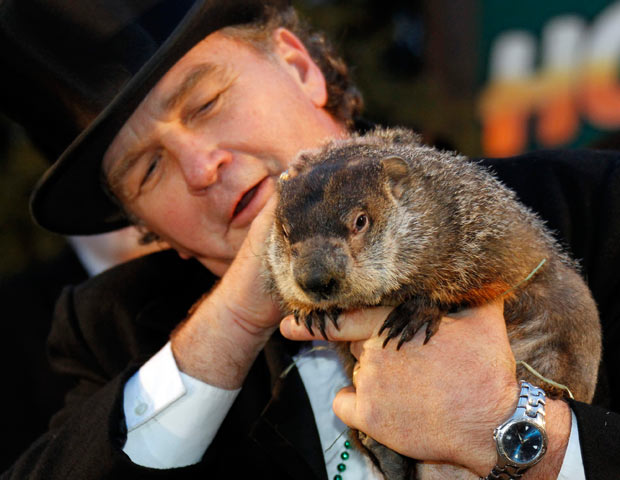

The male couldn’t care less about the weather.  He comes out of his burrow in February, in search of a date.  If uninterrupted, he will fulfill his groundhog mission of love and return to earth, not coming out for good until sometime in March.

But then there is the amorous woodchuck’s worst nightmare in a top hat.  The groundhog hunter.

In 1887, there was a group of groundhog hunters in Punxsutawney, Pennsylvania, imaginatively calling themselves the Punxsutawney Groundhog Club. One of them, a newspaper editor, declared on February 2, 1887, that their groundhog “Phil” was the only True weather forecasting rodent.

Groundhog-Day-1

There are those who would dispute the Gobbler’s Knob crowd and their claims to Punxsutawney Phil’s weather forecasting prowess. Alabama has “Birmingham Bill”, and Canada has Shubenacadie Sam. New York can’t seem to decide between Staten Island Chuck and New York City’s very own official groundhog, “Pothole Pete”.  North Carolinians look to “Queen Charlotte” and “Sir Walter Wally”, and Georgia folks can take their choice between “Gus”, and “General Beauregard Lee”.

Since the eponymously named Bill Murray film from 1993, nothing seems to rise to the appropriate level of insanity, more than Groundhog Day drinking games. For the seasoned Groundhog enthusiast, “beer breakfasts” welcome the end of winter, across the fruited plain. If you’re in the Quaker state, you can attend the Groundhog day “Hawaiian Shirt Beer Breakfast”, at Philadelphia’s own Grey Lodge Public House. If you’re in Des Moines, stop by the The High Life Lounge, where free Miller High Life beers will be served from 6am, to eleven. And for the late sleeper, there is the annual screening of the Bill Murray Masterpiece, at the Alamo Drafthouse Cinema Beer Dinner.

Fun fact: Bill Murray was bitten, not once but twice, by the groundhog used on the set.

groundhog-day-driving

It appears that there is no word for groundhog in Arabic, accounts of this day in the Arab press translate the word as جرذ الأرض.  “Ground Rat”.  I was pretty excited to learn that before al Jazeera gets carted off, toe tag first.

If anyone were to bend down and ask Mr. Ground Rat his considered opinion on the matter, he would probably cast a pox on all their houses. It’s been a long winter. Mr. Ground Rat’s all dressed up for a date.  He has other things on his mind.

If you enjoyed this “Today in History”, please feel free to re-blog, “like” & share on social media, so that others may find and enjoy it too. Please click the “follow” button on the right, to receive email updates on new articles.  Thank you for your interest, in the history we all share.

January 30, 1948 Madame, I Think You’re Missing a Monkey

The Confucian maxim may have crossed from China to Japan with a Tendai-Buddhist legend, sometime around the 8th century. At the time, the story had nothing to do with monkeys.

The Analects of Confucius is a written record of the sayings of the philosopher and his contemporaries, compiled between 475 and 221BC. In it, a follower named Yen Yüan asked the Master about perfect virtue. Confucius said, “To subdue one’s self and return to propriety, is perfect virtue. If a man can for one day subdue himself and return to propriety, all under heaven will ascribe perfect virtue to him”.

220px-Commentaries_of_the_Analects_of_Confucius“I beg to ask the steps of that process”, asked the student.  Confucius replied, “Look not at what is contrary to propriety. Listen not to what is contrary to propriety. Speak not what is contrary to propriety. Make no movement which is contrary to propriety”.

It was an ancient idea, even then. Zarathrusta, also known as Zoroaster, is in some respects the father of the world’s first monotheistic religion. It was sometime around 1200BC when Zoroaster taught his followers on the high Iranian Plateau “Humata, Hukhta, Hvarshta”.  “Good Thoughts, Good Words, Good Deeds”.

The Confucian maxim may have crossed from China to Japan with a Tendai-Buddhist legend, sometime around the 8th century. At the time, the story had nothing to do with monkeys.

3_wise_monkeys_by_yannickbouchard-d5mdz46
3 Wise Monkeys by Yannick Bouchard

In medieval Japanese, mi-zaru, kika-zaru, and iwa-zaru translate as “don’t see, don’t hear, and don’t speak”, -zaru being an archaic negative verb conjugation and pronounced similarly to “saru”, the word for monkey.

download (8)The visual play on words, then, depicts Iwazaru covering his mouth, Kikazaru covering his ears, and Mizaru covering his eyes.
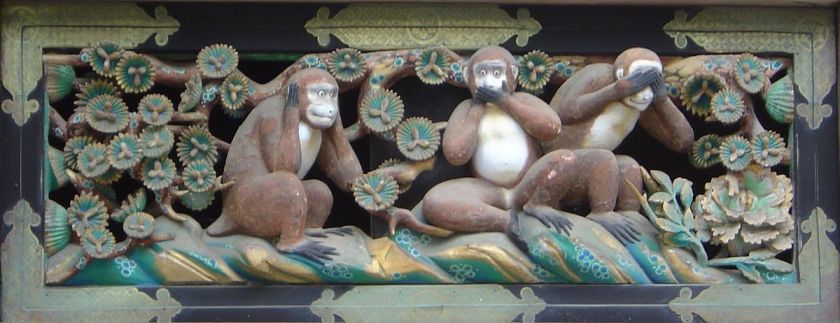

Though it’s unusual to see him anymore, there is a fourth monkey.  Shizaru is generally depicted with his arms crossed or covering his privates, his name variously translated as “do no evil”, or “know no evil”.

The first known depiction of the “Three Mystic Apes” appears over the doors of the Tōshō-gū shrine in Nikkō, Japan, carved sometime in the 17th century.

1200px-Hear_speak_see_no_evil_Toshogu

Mohandas Karamchand Gandhi was a Hindu lawyer, member of the merchant caste from coastal Gujarat, in western India. Today he is known by the honorific “Mahatma”, from Gandhithe Sanskrit “high-souled”, or “venerable”.

Ghandi is recognized as the Father of modern India, who brought Independence to his country through non-violent protest. Mohandas Gandhi lived a life of poverty and simplicity, owning almost no material possessions at the time of his assassination by Hindu nationalist Nathuram Vinayak Godse on January 30, 1948.

Beside the clothes on his back, Gandhi owned a tin cup and a spoon, a pair of sandals, his spectacles and a set of three carved monkeys, reminding him to hear no evil, see no evil and speak no evil.

maxresdefault (3)

If you enjoyed this “Today in History”, please feel free to re-blog, “like” & share on social media, so that others may find and enjoy it too. Please click the “follow” button on the right, to receive email updates on new articles.  Thank you for your interest, in the history we all share.

January 26, 1945 Underage, and Under Weight

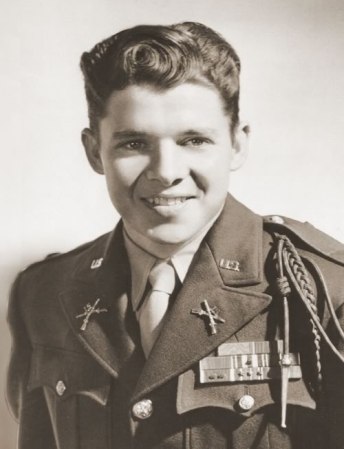
After the war, Audi Murphy was asked how he could have grabbed that machine gun, and taken on an entire company of German infantry.  “They were killing my friends”, he replied.

In the days following the Japanese sneak attack on Pearl Harbor, hundreds of thousands of Americans rushed to enlist in the United States’ armed services.  One of these was the son of a Hunt County Texas sharecropper family,  Audie Leon Murphy.

He went to the Marine Corps, Navy and the Army, and all turned him down, for being underweight and under age.  Murphy changed his diet to “fatten” up, and appeared at a Dallas recruiting station six months later, armed with a sworn affidavit from his sister, inflating his age by a year. It was 10 days past his 17th birthday when Audi Murphy, all 5’5½” and 112 lbs of him, enlisted in the United States Army.

f50b348dd608662fdfc1b4b1203ddf06Murphy’s company commander thought he wasn’t big enough for infantry service, and attempted to transfer him to cook and bakers’ school. Murphy refused.  He wanted to be a combat soldier.

Joining the 3rd Infantry Division of George S. Patton’s 7th Army, Murphy participated in amphibious landings in Sicily in July, fighting in nearly every aspect of the Italian campaign.

From Palermo to Messina and on to Naples, Anzio and Rome, the Germans were driven out of the Italian peninsula in savage and near continuous fighting that killed a member of my own family.

By mid-December, the 3rd ID suffered 683 dead, 170 missing, and 2,412 wounded. Now Sergeant Murphy was there for most of it, excepting two periods when he was down with malaria.

Two months after the “Overlord” landings in Normandy, elements of the 7th Army landed in southern France in an operation called “Dragoon”. By mid-September, only three of Company B’s original roster remained, the rest either killed or removed due to wounds or illness. It was around this time when Audi Murphy received his first Purple Heart.  A mortar blast resulted in a heel wound that wasn’t very serious, but a far more dangerous hip wound followed from a sniper, that December.  Murphy repaid the sniper, with a bullet between the German’s eyes.

Reduction of Colmar Pocket - January 20, 1945-February 9, 1944He was still in the hospital when his unit moved into the Vosges Mountains, in Eastern France.

The “Colmar Pocket” was an 850 square mile area held by German troops: Murphy described it as “a huge and dangerous bridgehead thrusting west of the Rhine like an iron fist. Fed with men and materiel from across the river, it is a constant threat to our right flank; and potentially it is a perfect springboard from which the enemy could start a powerful counterattack.”

Rejoining his unit in January, now Lieutenant Murphy became Company Commander, being the only officer remaining in the Company. Disease, wounds and casualties had reduced company B’s fighting strength by this time from an original 235, to 18.

What remained of the unit was awaiting reinforcements on January 26, 1945, as a combined force of German infantry and armor assembled itself outside of town. “I see the Germans lining up for an attack”, said Murphy. “Six tanks rumble to the outskirts of Holtzwihr, split into groups of threes, and fan out toward either side of the clearing. Then wave after wave of white dots, barely discernible against the background of snow, start across the field. They are enemy infantrymen”.

Let Lt. Murphy’s Medal of Honor Citation describe what happened next:

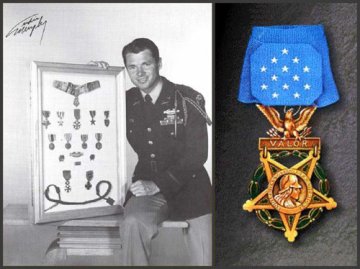
Audie-murphy-tank-scene-world-war-II-2“Second Lieutenant Audie L. Murphy, 01692509, 15th Infantry, Army of the United States, on 26 January 1945, near Holtzwihr, France, commanded Company B, which was attacked by six tanks and waves of infantry. Lieutenant Murphy ordered his men to withdraw to a prepared position in a woods while he remained forward at his command post and continued to give fire directions to the artillery by telephone. Behind him to his right one of our tank destroyers received a direct hit and began to burn. Its crew withdrew to the woods. Lieutenant Murphy continued to direct artillery fire which killed large numbers of the advancing enemy infantry. With the enemy tanks abreast of his position, Lieutenant Murphy climbed on the burning tank destroyer which was in danger of blowing up any instant and employed its .50 caliber machine gun against the enemy. He was alone and exposed to the German fire from three sides, but his deadly fire killed dozens of Germans and caused their infantry attack to waver. The enemy tanks, losing infantry support, began to fall back. For an hour the Germans tried every available weapon to eliminate Lieutenant Murphy, but he continued to hold his position and wiped out a squad which was trying to creep up unnoticed on his right flank. Germans reached as close as 10 yards only to be mowed down by his fire. He received a leg wound but ignored it and continued the single-handed fight until his ammunition was exhausted. He then made his way to his company, refused medical attention, and organized the company in a counterattack which forced the Germans to withdraw. His directing of artillery fire wiped out many of the enemy; he personally killed or wounded about 50. Lieutenant Murphy’s indomitable courage and his refusal to give an inch of ground saved his company from possible encirclement and destruction and enabled it to hold the woods which had been the enemy’s objective”.
After the war, Audi Murphy was asked how he could have grabbed that machine gun, and taken on an entire company of German infantry.  “They were killing my friends”, he replied.

MurphyMOHThe man who had once been judged too small to fight was one of the most decorated American combat soldiers of WW2, having received every military combat award for valor the United States Army has to give, plus additional awards for heroism, from France and from Belgium.
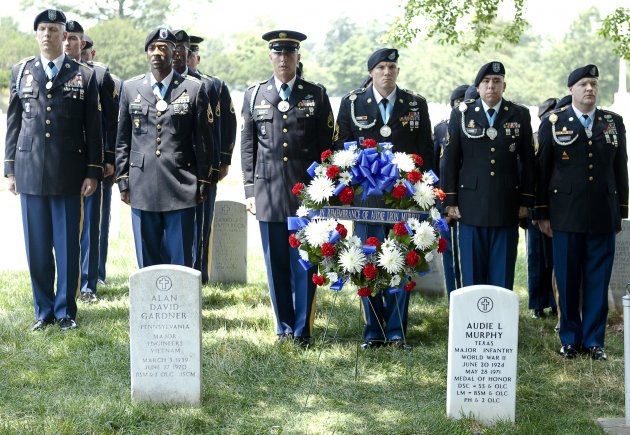
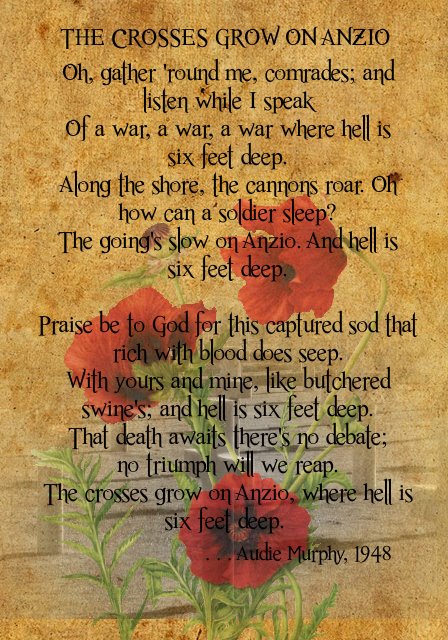
Audi Murphy returned to civil life and a 21-year career in Hollywood, starring in 40 feature films and a television series.  The transition was difficult  There were frequent bouts of depression and insomnia, and an addiction to sedatives.  He turned to poetry and songwriting for a creative outlet, but images of German war orphans could bring him to tears of guilt.  He slept with a loaded gun under his pillow, and there were episodes which professional colleagues and family members, found alarming.

In Murphy’s Day it was called “Battle Fatigue”, or “Shell Shock”.  He was candid about his own difficulties, and called on government to give increased consideration to the emotional toll inflicted on those whom it sent into combat.

Audi Murphy was killed in a plane crash near Catawba, Virginia, and buried with full military honors, in Arlington National Cemetery.  He was 45.

Audie Murphy Gravesite

Nine years later, the American Psychiatric Association recognized Post-Traumatic Stress Disorder (PTSD) in the 3rd edition of its Diagnostic and Statistical Manual of Mental Disorders.

Data from the National Vital Statistics System, a collaboration of the National Center for Health Statistics of the Department of Health and Human Services, reveals a suicide rate among veteran populations approximately twice that of comparable civilian populations.

I wonder about that term. “Disorder”.  The word makes it sound like there’s something wrong with these guys.

When a soldier experiences an event, so traumatic that the very memory of it causes pain, I don’t understand how that can be characterized as a “disorder”. To me it seems like the properly functioning conscience of a good man, recoiling in horror at what he’s seen in service to his country.

cc5083d1b7c62b153cd42c8f568de8f7

January 20, 1940  A People, an Empire, a Drink

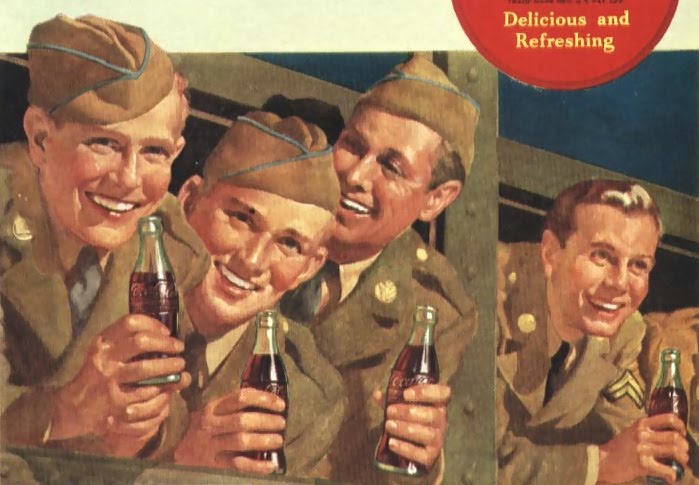
Coca-Cola GmbH had concocted a sweet, slightly cheesy tasting soft drink, and the German market responded. Sales rose steadily throughout the war, particularly as alternatives became increasingly scarce. People didn’t just drink the stuff, either.

In 1865, Confederate Cavalry officer John Stith Pemberton was wounded by a saber slash. Like many wounded veterans, Pemberton became addicted to the morphine given him to help ease the pain. Unlike most, “Dr.” Pemberton possessed the wherewithal to do something about it.

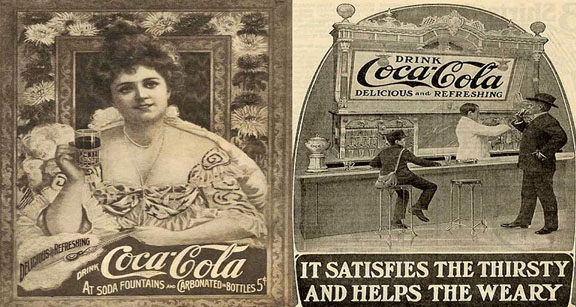
In civil life, Pemberton was a chemist.  After the war, the former cavalry officer experimented with non-opiate pain-killers, landing on a combination of the coca leaf and kola nut.  By 1886, he was bottling his concoction and selling it for 5¢ a bottle out of an Atlanta pharmacy.  Ten years later, Coca-Cola was available in every American state and territory.

Cocaine_CocaCola2

Europeans had long believed that natural mineral waters held medicinal qualities, and favored such beverages over often-polluted common drinking water.  In 1920, the company opened its first European bottling plant, in France. By the time of Hitler’s annexation of Austria, the “Anschluss” of 1938, Coca-Cola had been in Germany for ten years.

Around the time that Hitler and the Nazi party were coming to power in 1933, German-born Max Keith (pronounced “Kite”) took over Coca-Cola’s German subsidiary, Coca-Cola Deutschland, GmbH.  Mark Pendergrast, author of For God, Country, and Coca-Cola, writes that Keith “valued his allegiance to the drink and to the company more than his allegiance to his own country”.  He had no qualms about doing business with every aspect of German society, including Nazi party members.

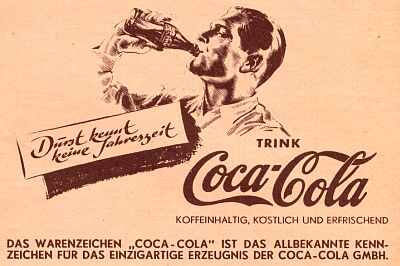
Ein Getrank

Bizarre though it may sound to the modern ear, a number of famous Americans and companies were involved with the European fascist regimes of the 1930s, including William Randolph Hearst, Joseph Kennedy (JFK’s father), Charles Lindbergh, John Rockefeller, Andrew Mellon (banker, head of Alcoa, and Secretary of the Treasury), DuPont, General Motors, Standard Oil (now Exxon), Ford, ITT, Allen Dulles (later head of the CIA), Prescott Bush, National City Bank, General Electric, and many in Hollywood.

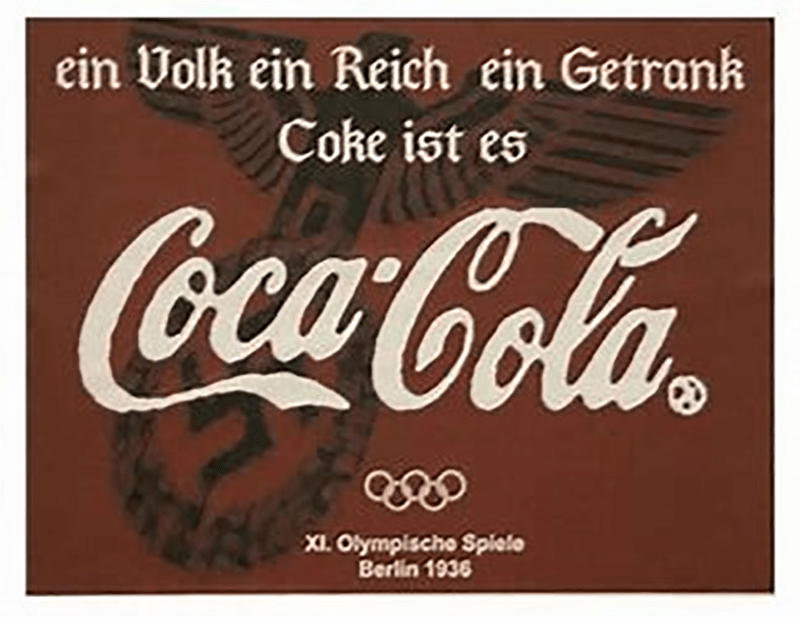
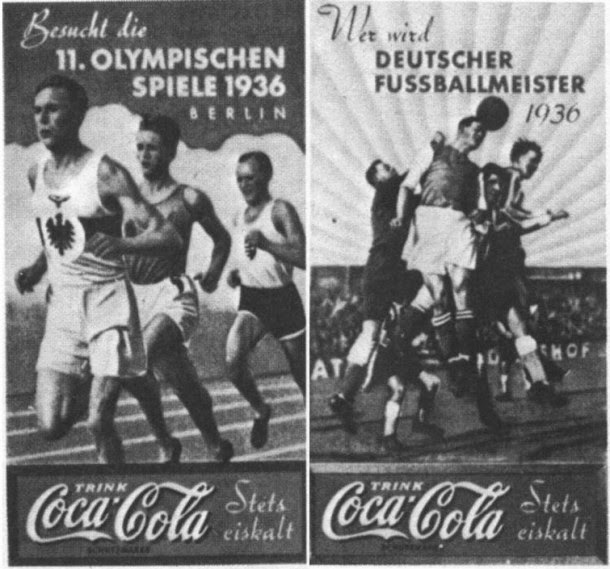
In Atlanta, Coca-Cola President Robert Woodruff was no exception.  Woodruff himself attended the 1936 Berlin Olympics, alongside banners depicting the company logo, with the slogan  “Ein Volk, ein Reich, ein Getrank – A People, an Empire, a Drink”.

Coca-Cola-Advertisements-in-Nazi-Germany-in-the-1930s-8

Woodruff used a 10th anniversary party for Coca-Cola GmbH to organize a mass Nazi salute in honor of Hitler’s 50th birthday, declaring that it was “to commemorate our deepest admiration for our Fuhrer.”

On January 20, 1940, Winston Churchill urged neutral nations to oppose the Nazi war machine, warning that, “Each one hopes that if he feeds the crocodile enough, the crocodile will eat him last.”  Meanwhile in Germany, Coca Cola was the undisputed king of the domestic soft drink market.

Memorial-Day-2010-From-Time-Mag-1942-OUT-12

That changed a year later, with the Japanese attack on Pearl Harbor, and the German declaration of war on the United States.

American entry into WW2 meant that American companies ceased business with axis powers, while the German government threatened to seize “enemy owned” businesses.  Max Keith was cut off from all communications with Coca-Cola headquarters in Atlanta, and in danger of the Nazi party nationalizing his beloved company.  As shipments of Coca-Cola’s mythical “7X’ syrup, dried up, Keith had to come up with a substitute for the domestic soft drink market.  Schnell.

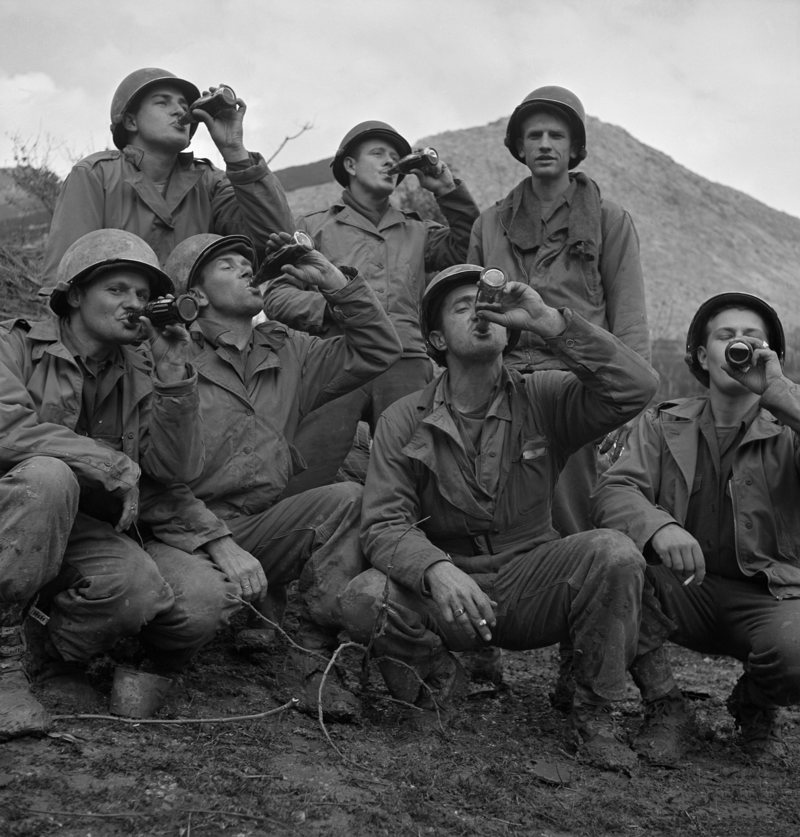
Soldiers Gulp Down Coca Cola
Coca-Cola worked with the U.S. government to ensure troops, including these men in Italy, had access to Coke throughout WW2. Bettmann/Getty Images

With wartime rationing already in effect, Keith and his chemists worked with what was available.  Leftovers from other food industries, apple fibers, fruit peelings, beet sugar  and whey, the liquid left over when milk was curdled and strained off to make cheese.

The result was “Fantasievoll”, “Fantastiche” (“Imaginative”, “Fantastic”).  So it is that the soft drink “Fanta”, was borne of the wartime necessities of Nazi Germany.

Coca-Cola GmbH had concocted a sweet, slightly cheesy tasting soft drink, and the German market responded. Sales rose steadily throughout the war, particularly as alternatives became increasingly scarce. People didn’t just drink the stuff, either. With sweeteners of all kinds strictly rationed, Fanta made its way into baked goods, soups and a variety of foodstuffs. By 1943, Fanta sales reached almost three million cases.

Fanta-3

Tristan Donovan, author of the book Fizz: How Soda Shook Up the World, writes “It was Fanta or nothing”. Pendergrast writes that there’s little doubt that Keith did business with Nazis, but he was more company guy than idealogue. “You could not do business inside of Nazi Germany unless you collaborated with them,” wrote Pendergrast. “There’s no question he was a Nazi collaborator. [But] he was not a member of the Nazi party. His allegiance was to Coca-Cola, not to Hitler.”

When American troops liberated Germany in the summer of 1945, legend has it that they found Keith in a half-bombed out factory, still bottling the stuff.

Fun fact: Hitler and his henchmen didn’t call themselves “Nazis”, in fact the term was frowned upon. They were the “NSDAP”, the Nazionale Socialistiche Deutsche Arbaits Partai, (National Socialist German Workers Party), the original abbreviation forwhich, was “Nasos”. The word “Nazi” derives from a Bavarian term meaning “simple minded” and was first used as a term of derision by journalist Konrad Heiden. The term was adopted by Anti-NSDAP’ers and Allied troops after war broke out, and the name stuck.

Despite being on the losing side, Keith was hailed as a hero back in Atlanta. The man who kept the company alive, in Germany. Vice President of Sales Harrison Jones called Keith a “great man”.  He was given control of Coca-Cola, in all of Europe.

coca-cola_ad_third_reich_1935

In April 1955, Coca-Cola reintroduced Fanta as an orange drink. Starting in Italy, the product made its way to the United States, in 1958. The name stuck, and why not. The company already owned the copyright.

In 2012, Fanta saw the strongest sales growth of the top 10 brands, the third Coke branded product to surpass 2 billion in case sales. Today, more than 100 flavors of Fanta are sold around the world, where customers from Latin America to Africa, to Europe, Brazil and China can say,  “Es ist die Reale Sache”.  It’s the Real Thing.


January 12, 1967 Frozen

“I should prefer to an ordinary death, being immersed with a few friends in a cask of Madeira, until that time, then to be recalled to life by the solar warmth of my dear country”. – Benjamin Franklin

The human brain is an awesome thing. Weighing in at about 3lbs, the organ is comprised of something like 86 billion neurons, each made up of a stoma or cell body, an axon to take information away from the cell, and anywhere between a handful and a hundred thousand dendrites bringing information in. Chemical signals transmit information over minute gaps between neurons called synapses, about 1/25,000th to 1/50,000th of the thickness of a sheet of paper.

Signal+Transmission+Dendrites+Cell+body+Nucleus+SynapseThere are roughly a quadrillion such synapses, meaning that any given thought could wend its way through more pathways than there are molecules in the known universe. This is roughly the case, whether you are Stephen J. Hawking, or Forrest Gump.

For all of this, the brain cannot store either oxygen or glucose (blood sugar), meaning that there’s about 6 minutes after the heart stops, before the brain itself begins to die.

Legally, brain death occurs at “that time when a physician(s) has determined that the brain and the brain stem have irreversibly lost all neurological function”. Brain death defines the legal end of life in every state except New York and New Jersey, where the law requires that a person’s lungs and heart must also have stopped, before that person is declared legally dead.

Clearly there is a gap, a small span of time, between the moment of legal death and a person’s permanent and irreversible passing. So, what if it were possible to get down to the molecular level and repair damaged brain tissue.  For that matter, when exactly does such damage become “irreversible”?

“Information-theoretic death” is defined as death which is final and irreversible by any technology, apart from what is currently possible given contemporary medical methodologies.  For some, the gap between current legal and clinical definitions of death and the truly irretrievable, is a source of hope for some future cure.

cryonicsThe Alcor Life Extension Foundation, the self-described “world leader in cryonics, cryonics research, and cryonics technology” explains “Cryonics is an effort to save lives by using temperatures so cold that a person beyond help by today’s medicine can be preserved for decades or centuries until a future medical technology can restore that person to full health”.

The practice is highly controversial, and not to be confused with Cryogenics, the study of extremely low temperatures, approaching the still-theoretical cessation of all molecular activity.  Absolute zero.

The Cryogenic Society of America, Inc. includes this statement on its home page: “We wish to clarify that cryogenics, which deals with extremely low temperatures, has no connection with cryonics, the belief that a person’s body or body parts can be frozen at death, stored in a cryogenic vessel, and later brought back to life. We do NOT endorse this belief, and indeed find it untenable”.

The modern era of cryonics began in 1962, when Michigan College physics professor Robert Ettinger proposed that freezing people may be a way to reach out to some future medical technology.

The Life Extension Society, founded by Evan Cooper in 1964 to promote cryonic suspension, offered to preserve one person free of charge in 1965. Dr. James Hiram Bedford was suffering from untreatable kidney cancer at that time, which had metastasized to his lungs.

James Bedford
Dr. James Hiram Bedford

Bedford became the first person to be cryonically preserved on January 12, 1967, frozen at the boiling point of liquid nitrogen, −321° Fahrenheit, and sealed up in a double-walled, vacuum cylinder called a “dewar”, named after Sir James Dewar, the 19th century Scottish chemist and physicist best known for inventing the vacuum flask, and for  research into the liquefaction of gases.

Fifty-one years later, cryonics societies around the world celebrate January 12 as “Bedford Day”.  Dr. Bedford has since received two new “suits”, and remains in cryonic suspension, to this day.

Advocates experienced a major breakthrough in the 1980s, when MIT engineer Eric Drexler began to publish on the subject of nanotechnology. Drexler’s work offered the hope that, theoretically, one day injured tissue may be repaired at the molecular level.

Cryonics1-640x353In 1988, television writer Dick Clair, best known for television sitcoms “It’s a Living”, “The Facts of Life”, and “Mama’s Family”, was dying of AIDS related complications. In his successful suit against the state of California, “Roe v. Mitchell” (Dick Clair was John Roe), Judge Aurelio Munoz “upheld the constitutional right to be cryonically suspended”, winning the “right” for everyone in California.

The decision failed to make clear who was going to pay for it.

As to cost, the Cryonics Institute (CI) website explains, “A person who wishes to become a Lifetime CI Member can make a single membership payment of $1,250 with no further payment required. If a new member would rather pay a smaller amount up front, in exchange for funding a slightly higher cryopreservation fee later on ($35,000), he or she can join with a $75 initiation fee, and pay annual dues of only $120, which are also payable in quarterly installments of $35”.

Ted Williams went into cryonic preservation in 2002, despite the bitter controversy that split the Williams first-born daughter Bobby-Jo Williams Ferrell, from her two half-siblings John-Henry and Claudia. The pair were adamant that the greatest hitter in baseball history wanted to be preserved to be brought back in the future, while Ferrell pointed out the will, which specified that Williams be cremated, his ashes scattered off the Florida coast.

teds_new_will_072502The court battle produced a “family pact” written on a cocktail napkin, which was ruled authentic and allowed into evidence. So it is that Ted Williams’ head went into cryonic preservation in one container, his body in another.

The younger Williams died of Leukemia two years later, despite a bone marrow donation from his sister. John-Henry joined his father, in 2004.

Walt Disney has long been rumored to be in frozen suspension, but the story isn’t true. After his death in 1966, Walt Disney was interred at Forest Lawn Memorial Park in Glendale, California.

FranklinIn April 1773, Benjamin Franklin wrote a letter to Jacques Dubourg. “I wish it were possible”, Franklin wrote, “to invent a method of embalming drowned persons, in such a manner that they might be recalled to life at any period, however distant; for having a very ardent desire to see and observe the state of America a hundred years hence, I should prefer to an ordinary death, being immersed with a few friends in a cask of Madeira, until that time, then to be recalled to life by the solar warmth of my dear country! But…in all probability, we live in a century too little advanced, and too near the infancy of science, to see such an art brought in our time to its perfection”.
Maybe so but, for the several hundred individuals who have plunked down $25,000 to upwards of $200,000 to follow Dr. Bedford into cryonic suspension, hope springs eternal.

January 9, 1493 Mermaid

Columbus seems not to have been impressed, describing these mermaids as “not half as beautiful as they are painted.”

“Pax Romana”, or “Roman Peace”, refers to a period between the 1st and 2nd century AD, when the force of Roman arms subdued most everyone standing against them.  The conquered peoples described the period differently.  Sometime in 83 or 84AD, Calgacus of the Caledonian Confederacy in Northern Scotland, said “They make a desert and call it peace”.

catalan-atlas-depicting-marco-polo-traveling-to-the-east-during-the-pax-mongolica (1)

The conquests of Genghis Khan and his successors accomplished much the same during the 13th and 14th century.  The “Pax Mongolica” effectively connected Europe with Asia, making it safe to travel the “Silk Road” from Britain in the west to China in the east.  Great caravans carrying Chinese silks and spices came to the west via transcontinental trade routes.  It was said of the era that “a maiden bearing a nugget of gold on her head could wander safely throughout the realm.”

Never mind the pyramids of skulls, over there.

The “Black Death” and the political fragmentation of the Mongol Empire brought that period to an end.  Muslim domination of Middle Eastern trade routes made overland travel to China and India increasingly difficult in the 15th century.  After Constantinople fell to the Ottoman Turks in 1453, such travel became next to impossible.   Europe began to look for a water route to the East.

flat-earth

It’s popular to believe that 15th century Europeans thought the world was flat, but that’s a myth.  Otherwise, the cats would have pushed everything over the edge, by now.

The fact that the world is round had been understood for over a thousand years, though 15th century mapmakers often got places and distances wrong.  In 1474, Paolo dal Pozzo Toscanelli detailed a scheme for sailing westward to China, India and the Spice Islands.  He believed that Japan, which he called “Cipangu”, was larger than it is, and farther to the east of “Cathay” (China).  Toscanelli vastly overestimated the size of the Eurasian landmass, and the Americas were left out altogether.

This is the map that Christopher Columbus took with him in 1492.

mermaidColumbus had taken his idea of a westward trade route to the Portuguese King, to Genoa and to Venice, before he came to Ferdinand and Isabella in 1486.  At that time the Spanish monarchs had a Reconquista to tend to, but they were ready in 1492.  The Nina, Pinta and the Santa Maria sailed that August.

By January 9, 1493, the expedition had been at sea for six months.  Sailing off the coast of Hispaniola, what we now call the Dominican Republic, Columbus spotted three “mermaids”.

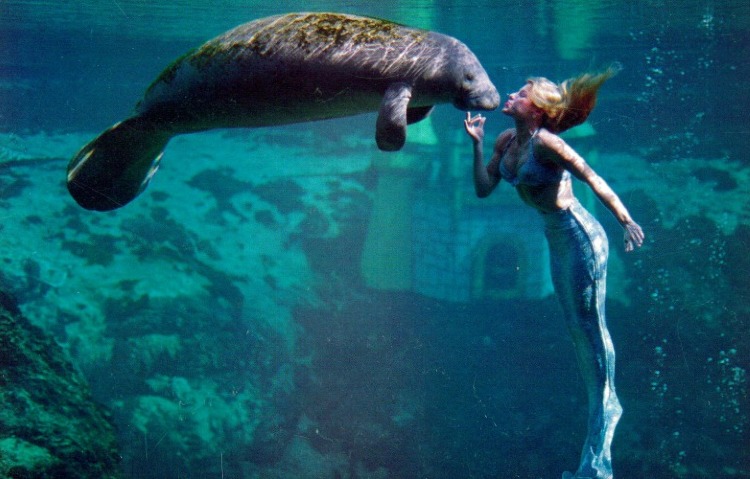
They were Manatee, part of the order “Sirenia”.  “Sirens” are the beautiful sisters, half birdlike creatures who live by the sea, according to ancient Greek mythology.  These girls, according to myth, sang a song so beautiful that sailors were hypnotized, crashing their ships into rocks in their efforts to reach them.

ManateeColumbus seems not to have been impressed, describing these mermaids as “not half as beautiful as they are painted.”

Small wonder.  These marine herbivores measure 10’ to 13′ from nose to tail, and weigh in at 800-1,200 lbs.

Not everyone was quite so dismissive.  A hundred years later, the English explorer John Smith reported seeing a mermaid, almost certainly a Manatee. It was “by no means unattractive”, he said, but I’m not so sure.  I think it’s possible that Mr. Smith needed to get out a little more.


If you enjoyed this “Today in History”, please feel free to re-blog, “like” & share on social media, so that others may find and enjoy it too. Please click the “follow” button on the right, to receive email updates on new articles.  Thank you for your interest, in the history we all share.

December 31, 1903 Happy New Year

In 1907, Times owner Adolph Ochs wanted a bigger spectacle to draw attention to the newly renamed Times Square. He asked the newspaper’s chief electrician, Walter F. Painer for an idea. Painer suggested a time ball.

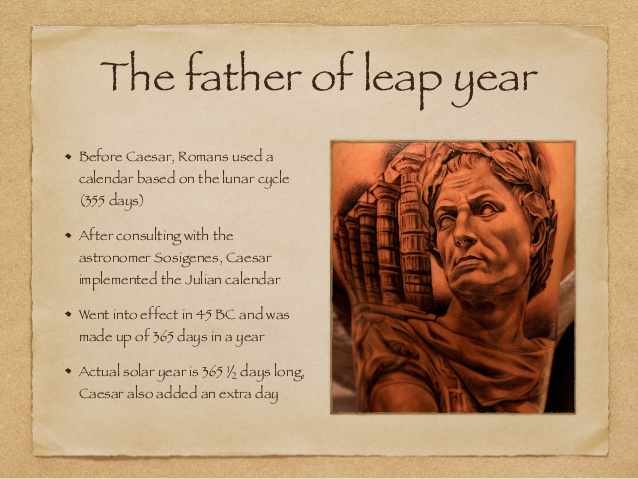
From the 7th century BC, the Roman calendar attempted to follow the cycles of the moon. The method frequently fell out of phase with the change of seasons, requiring the random addition of days. The Pontifices, the Roman body charged with overseeing the calendar, made matters worse. They were known to add days to extend political terms, and to interfere with elections. Military campaigns were won or lost due to confusion over dates. By the time of Julius Caesar, things needed to change.

julius-caesar-11-638

Caesar hired the Alexandrian astronomer Sosigenes to help straighten things out. The astronomer calculated that a proper year was 365¼ days, which more accurately tracked the solar, and not the lunar year. “Do like the Egyptians”, he might have said, the new “Julian” calendar went into effect in 46BC. Caesar decreed that 67 days be added that year, moving the New Year’s start from March to January 1. The first new year of the new calendar was January 1, 45BC.

Caesar synchronized his calendar with the sun by adding a day to every February, and changed the name of the seventh month from Quintilis to Julius, to honor himself. Rank hath its privileges.

Not to be outdone, Caesar’s successor changed the 8th month from Sextilis to Augustus. 2,062 years later, we still have July and August.

Julian_to_Gregorian_Date_ChangeSosigenes was close with his 365¼ day long year, but not quite there. The correct value of a solar year is 365.242199 days.  By the year 1000, that 11-minute error had added seven days. To fix the problem, Pope Gregory XIII commissioned Jesuit astronomer Christopher Clavius to come up with yet another calendar. The Gregorian calendar was implemented in 1582, omitting ten days and adding a day on every fourth February.

Most of the non-Catholic world took 170 years to adopt the Gregorian calendar. Britain and its American colonies “lost” 11 days synchronizing with it in 1752.  The last holdout, Greece, would formally adopt the Gregorian calendar in 1923. Since then, we’ve all gathered to celebrate New Year’s Day on the 1st of January.

For years, New Years’ eve celebrations were held at Trinity Church, where revelers would gather to “ring in the new”. The New York Times newspaper moved into “Longacre Square” just after the turn of the 20th century.   Times owner Adolph Ochs held his first fireworks celebration on December 31, 1903, with almost 200,000 people attending the event.  Four years later, Ochs wanted a bigger spectacle to draw attention to the newly renamed Times Square. He asked the newspaper’s chief electrician, Walter Painer, for an idea. Painer suggested a time ball.

Time Ball
Flamsteed house royal observatory time ball, Greenwich, England

A time ball is a marine time signaling device, a large painted ball which is dropped at a predetermined rate, enabling mariners to synchronize shipboard marine chronometers for purposes of navigation. The first one was built in 1829 in Portsmouth, England, by Robert Wauchope, a Captain in the Royal Navy.

Time balls were obsolete technology by the 20th century, but it fit the Times’ purposes, nicely.  A young immigrant metalworker named Jacob Starr designed a 5′ wide, 700-lb iron and wooden ball, decorated with 100 25-watt incandescent bulbs.  For most of the twentieth century the company he founded, sign maker Artkraft Strauss, was responsible for lowering the ball.

download (1)That first ball was hoist up a flagpole by five men on December 31, 1907. Once it hit the roof of the building, the ball completed an electric circuit, lighting up a sign and touching off a fireworks display.

The newspaper no longer occupies the building at 1 Times Square, but the tradition continues.  One of seven versions of the Times Square ball has marked the coming of the new year ever since, with the exceptions of 1942 and ’43, due to the wartime need to dim out the lights.

The version used the last few years is 12′ wide, weighing in at 11,875lbs; a great sphere of 2,688 Waterford Crystal triangles, illuminated by 32,256 Philips LED bulbs and producing more than 16 million colors.  It used to be that the ball only came out for New Year.  The last few years, you can see the thing, any time you like.

only-sailors-truly-understand-the-strange-tradition-of-the-new-years-eve-ball-drop

In most English-speaking countries, the singing of “Auld Lang Syne”, is the traditional end to the New Year’s celebration.  Written by the Scottish poet Robert Burns in 1788, the tune comes from an old pentatonic Scots folk melody. The original verse, phonetically spelled as a Scots-speaker would pronounce it, sounds like this:

“Shid ald akwentans bee firgot, an nivir brocht ti mynd?

Shid ald akwentans bee firgot, an ald lang syn?”

CHORUS

“Fir ald lang syn, ma jo, fir ald lang syn,

wil tak a cup o kyndnes yet, fir ald lang syn.

An sheerly yil bee yur pynt-staup! an sheerly al bee myn!

An will tak a cup o kyndnes yet, fir ald lang syn”.

CHORUS

“We twa hay rin aboot the braes, an pood the gowans fyn;

Bit weev wandert monae a weery fet, sin ald lang syn”.

CHORUS

“We twa hay pedilt in the burn, fray mornin sun til dyn;

But seas between us bred hay roard sin ald lang syn”.

CHORUS

“An thers a han, my trustee feer! an gees a han o thyn!

And we’ll tak a richt gude-willie-waucht, fir ald lang syn”.

December 27, 1865 Confederados

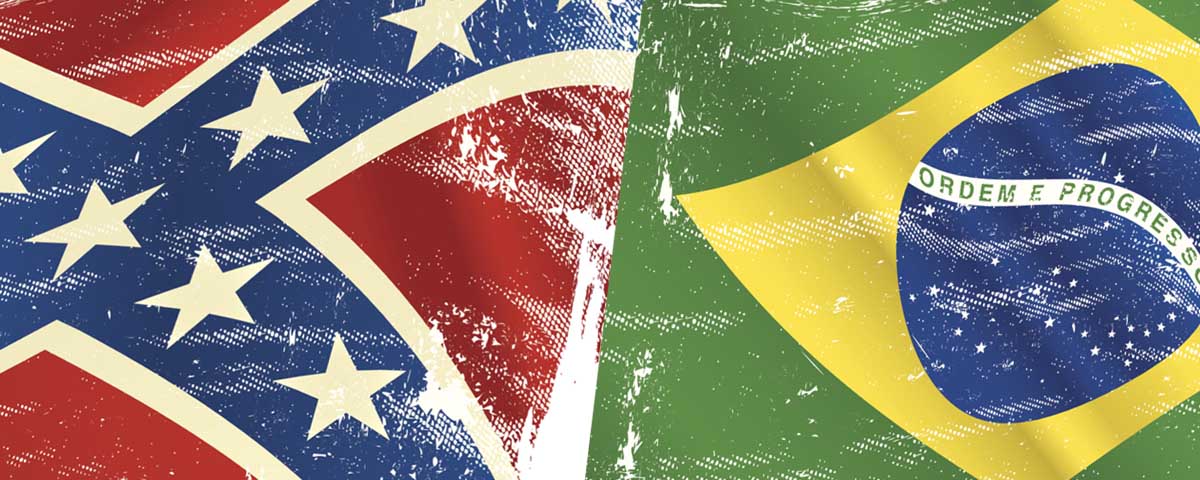
The numbers are hazy, but port records indicate that somewhere between ten and twenty thousand former Confederates moved to Brazil in the twenty years following the Civil War. A great uncle of former First Lady Rosalynn Carter, was one.

Most of us grew up learning that 600,000+ Americans were killed in the Civil War.  618,222 to be precise, more than the combined totals of every conflict in which the United States has been involved, from the Revolution to the War on Terror.  Recently, sophisticated data analysis techniques have been applied to newly digitized 19th century census figures, indicating that even that figure may be understated.

The actual number may lie somewhere between 650,000 and 850,000.

VIR_362561_27117_cuanto_sabes_sobre_los_estados_confederados_de_america

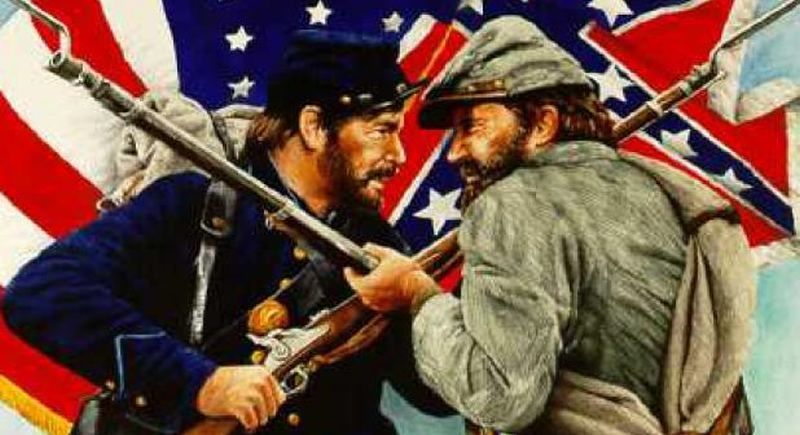
The cataclysm of the Civil War would leave in its wake animosities which would take generations to heal.  “Reconstruction” would be 12 years in the making, but some never did reconcile themselves to the war’s outcome. Vicksburg, Mississippi, which fell after a long siege on July 4, 1863, would not celebrate another Independence Day for 70 years.

In 1865, Emperor Dom Pedro II of Brazil wanted to encourage domestic cultivation of cotton.  Men like Jefferson Davis and Robert E. Lee advised southerners against emigration, but the Brazilian Emperor offered transportation subsidies, cheap land and tax breaks to those who would move.

Descendants of American Southerners wearing Confederate-era uniforms pose for a photograph during a party to celebrate the 150th anniversary of the end of the American Civil War in Santa Barbara D'Oeste, Brazil
Descendants of American Southerners wearing Confederate-era uniforms pose for a photograph during a party to celebrate the 150th anniversary of the end of the American Civil War in Santa Barbara D’Oeste, Brazil,

Colonel William Hutchinson Norris, veteran of the Mexican American War and former member of the Alabama House of Representatives and later State Senator, was the first to make the move.  Together with his son Robert and 30 families of the former Confederacy, Norris arrived in Rio de Janeiro on December 27, 1865, aboard the ship “South America”.

The numbers are hazy, but port records indicate that somewhere between ten and twenty thousand former Confederates moved to Brazil in the twenty years following the Civil War.  A great uncle of former First Lady Rosalynn Carter, was one.

Confederate flag rally at Stone Mountain Park

Some of these “Confederados” settled in the urban areas of São Paulo, most made their homes in the northern Amazon region around present-day Santa Bárbara d’Oeste and a place the locals called “Vila dos Americanos”, and the inhabitants called “Americana”.  Some would return to the newly re-united states.  Most would never return, and their ancestors, Portuguese speaking Brazilians all, remain there to this day.

Confederados earned a reputation for honesty and hard work, and Dom Pedro’s program was judged a success by immigrant and government alike.  The settlers brought modern cultivation techniques and new food crops, all of which were quickly adopted by native Brazilian farmers.

Small wonder.  Mark Twain once wrote “The true Southern watermelon is a boon apart, and not to be mentioned with common things. It is chief of this world’s luxuries, king by the grace of God over all the fruits of the earth. When one has tasted it, he knows what the angels eat. It was not a Southern watermelon that Eve took; we know it because she repented”.

That first generation kept to itself for the most part, building themselves Baptist churches and town squares, while traditional southern dishes like barbecue, buttermilk biscuits, vinegar pie and southern fried chicken did their own sort of culinary diplomacy with native populations.

Slavery remained legal in Brazil until 1888, but this nation of 51% African or mixed-race ancestry (according to the 2010 census), seems more interested in understanding and celebrating their past, than tearing their culture apart over it.

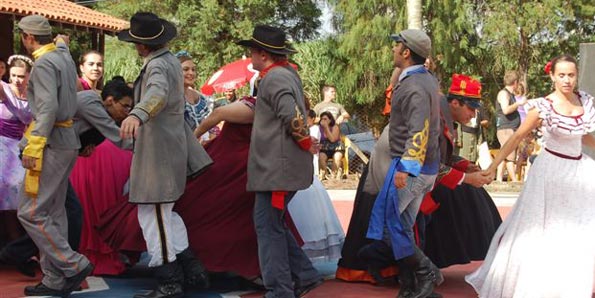
Today, descendants of those original Confederados preserve their cultural heritage through the Associação Descendência Americana (American Descendants Association), with an annual festival called the Festa Confederada.  There you’ll find hoop skirts and uniforms in gray and butternut, along with the food, the music and the dances of the antebellum South.

There you will find the Confederate battle flag, as well.  It seems that Brazilians have thus far resisted that peculiar urge which afflicts Isis and the American Left, to destroy the symbols of their own history.

descendentes-confederados-guerra-civil-eua

In 2016, the New York Times reported on the May celebration of the Festa Confederada, of Santa Bárbara d’Oeste:

‘“This is a joyful event,” said Carlos Copriva, 52, a security guard who described his ancestry as a mix of Hungarian and Italian. He was wearing a Confederate kepi cap that he had bought online as he and his wife, Raquel Copriva, who is Afro-Brazilian, strolled through the bougainvillea-shaded cemetery.  Smiling at her husband, Ms. Copriva, 43, who works as a maid, gazed at the graves around them. “We know there was slavery in both the United States and Brazil, but look at us now, white and black, together in this place,” she said while pointing to the tombstones. “Maybe we’re the future and they’re the past.”’

Brazil Confederates

09BRAZIL-master768-v3 (1)
“A woman in a traditional hoop skirt walked past graves adorned with Confederate battle flags in Santa Bárbara d’Oeste, Brazil. An annual celebration of the area’s many Confederate settlers was held in the cemetery last month”. Hat tip to Mario Tama/Getty Images, New York times, for this image

December 17, 1900 The Search for Extraterrestrial Intelligence

On December 17, 1900, the French Academy of Science offered a prize of 100,000 francs to the first person to make contact with an alien civilization.  Provided that it was anything but Martian.  That was considered too easy.

In the 5th century BC, the Greek philosopher Democritus taught that the world was made of atoms.  Physically indestructible and always in motion, these atoms are infinite in number, differing only in shape and size.  Democritus taught that everything around us is the result of physical laws without reason or purpose, asking only “what circumstances caused this event?”

Philosophers like Aristotle and Socrates took a less mechanistic approach, asking “What purpose did this event serve?” Plato disliked Democritus so much that he wanted to burn all his books.

The prevailing view throughout antiquity was that our planet is special, that we are alone in the cosmos.  Democritus believed there were infinite numbers of worlds such as our own, with inhabitants like ourselves.

In the time of Copernicus, it was widely believed that there is life on other planets.  Astronomers saw several features of the moon as evidence, if not of life, then at least that intelligent life had once paid a visit.

whatisthesta

Interest in Mars began to develop in the 1870s, when the Italian astronomer Giovanni Virginio Schiaparelli described physical features of the red planet as “canali”.  The word means “channels” in Italian, but it was mis-translated as “canals”.  The English speaking world was off to the races.

Speculation and folklore about intelligent life on Mars was soon replaced by a popular near-certainty that canals were excavated by Martians.

The idea was near universal by the turn of the century.  On this day, December 17, 1900, the French Academy of Science offered a prize of 100,000 francs to the first person to make contact with an alien civilization.  Provided that it was anything but Martian.  That was considered too easy.

6a00d83542d51e69e201b8d160dcaf970c-500wiEarly radio experiments by Nikola Tesla and Guglielmo Marconi left both inventors believing they had picked up, in Marconi’s words, “queer sounds and indications, which might come from somewhere outside the earth.”

In 1924, the idea was put to the test.  Believing that martians might attempt to communicate on the day the two bodies were in closest proximity, August 21, 1924 became “National Radio Silence Day”.  Americans were urged to observe “radio silence” for the first five minutes of every hour, while a radio receiver at the U.S. Naval Observatory, two miles aloft on board a dirigible, listened for the signal that never came.

20171023_wow-cc_f840The British author H. G. Wells wrote the War of the Worlds in 1897, telling the story of an alien earth invasion by Martians fleeing the desiccation of their own planet.  The story was adapted to a radio drama broadcast on Halloween, 1938, a production so realistic that many listeners sued the network for “mental anguish” and “personal injury”.

The idea of life on Mars persisted until the 1960s, when close observations of the Martian surface were made possible by the Mariner series of spacecraft.

While much of “mainstream” science seems to steer clear of the subject, the University of California at Berkeley is running a “distributed computing effort” to identify extraterrestrial life, called “SETI@home”.

setihome

The website explains the mission:  “SETI@home is a scientific experiment that uses Internet-connected computers in the Search for Extraterrestrial Intelligence (SETI). You can participate by running a free program that downloads and analyzes radio telescope data”.

With an original objective of 50,000-100,000 home computers, SETI@home had 1,525,050 users as of January 2015.  With the introduction of the Berkeley Open Infrastructure for Network Computing, or “BOINC” (I didn’t make that up), SETI@home users can even compete with one another, to see who can process the most “work units”.

You, too can participate at http://setiathome.berkeley.edu/, on your Windows, Apple or Network PC, or your Sony PlayStation 3.  Please let me know if you make contact.

December 16, 1884 River Horse

Short days from now, families across the nation will gather for the Christmas table.  There will be moist and savory stuffing, and green bean casserole.  Creamy mashed potatoes and orange cranberry sauce.  And there, the centerpiece of the feast.  Slow-roasted and steaming in its tray, golden brown and delicious, the roast hippopotamus.

Short days from now, families across the nation will gather for the Christmas table.  There will be moist and savory stuffing, and green bean casserole.  Creamy mashed potatoes and orange cranberry sauce.  And there, the centerpiece of the feast.  Slow-roasted and steaming in its tray, golden brown and delicious, the roast hippopotamus.

Wait…

What?

The story begins on December 16, 1884, the opening day for the World’s Fair, in New Orleans. Among the many wonders on display was the never-before seen, Eichornia crassipes, a gift of the Japanese delegation.  The Water Hyacinth.  Visitors marveled at this beautiful aquatic herb, its yellow spots accentuating the petals of beautiful delicate purple and blue flowers, floating across tranquil ponds on thick, dark green leaves.

Eichhornia_crassipes
Eichhornia crassipes

The seeds of Eichornia crassipes are spread by wind, flood, birds and humans, and remain viable for 30 years.  Beautiful as it is to look at, the Water Hyacinth is an “alpha plant”, the aquatic equivalent to the Japanese invasive perennial Kudzu, the “vine that ate the south”.  Impenetrable floating mats choke out native habitats and species, while thick roots impede the passage of vessels, large and small.  The stuff is toxic if ingested by humans and most animals, and costs a fortune to remove.

This plant native from the Amazon basin quickly broke the bounds of the 1884 World’s Fair, spreading across the bayous and waterways of Louisiana, and beyond.

Kenya_Kisumu_Harbour_Hyacinths_1997ke09b21-768x493
You can hardly find the water, in Lake Victoria’s Kisumu Harbor, Kenya

In the first decade of the 20th century, an exploding American population could barely keep up with its own need for food, especially, meat.  The problem reached crisis proportions in 1910, with over grazing and a severe cattle shortage.  Americans were seriously discussing the idea, of eating dogs.

Enter Louisiana member of the House of Representatives, New Iberia’s own Robert Foligny Broussard, with a solution to both problems.  “Lake Bacon”.

The attorney from Louisiana’s 3rd Congressional district proposed the “American Hippo” bill, H.R. 23621, in 1910, with enthusiastic support from Theodore Roosevelt and the New York Times.  One Agricultural official estimated that such a free-range hippo herd would produce up to a million tons of meat, per year.

Lippincott’s monthly magazine waxed rhapsodic about the idea:  “This animal, homely as a steamroller, is the embodiment of salvation.  Peace, plenty and contentment lie before us, and a new life with new experiences, new opportunities, new vigour, new romance, folded in that golden future, when the meadows and the bayous of our southern lands shall swarm with herds of hippopotami”.

p03dtkqg

With a name deriving from the Greek term “River Horse”, the common hippopotamus is the third largest land animal living today.  Despite a physical resemblance to hogs and other even-toed ungulates, Hippopotamidae’s closest living relatives are cetaceans such as whales, dolphins and porpoises.

The problem is, these things are dangerous.

Major_Frederick_Russell_Burnham
Major Frederick Russell Burnham

The adult bull hippopotamus is extremely aggressive, unpredictable and highly territorial.  Heaven help anyone caught between a cow and her young.  Hippos can gallop at short sprints of 19 mph, only a little slower than Sprinter Usain Bolt, “the fastest man who ever lived”.

Google the “10 most dangerous animals in Africa”.  You’ll be rewarded with the knowledge that hippos are #1, responsible for more human fatalities, than any other large animal, in Africa.

Be that at it as it may, the animal is a voracious herbivore, spending daylight hours at the bottom of rivers & lakes, happily munching on vegetation.

What could be better than taking care of two problems at once.  Otherwise unproductive swamps and bayous from Florida to Louisiana would become home to great hordes of free-range hippos.  The meat crisis would be solved, and America would become a nation of hippo ranchers.

As Broussard’s bill wended its way through Congress, the measure picked up steam with the enthusiastic support of two enemies who’d spent ten years in the African bush, trying to kill each other. No, really.

Captain Fritz Duquesne

Frederick Russell Burnham had argued for the introduction African wildlife into the American food stream, some four years earlier.  A freelance scout and American adventurer, Burnham was known for his service to the British South Africa company and to the British army in colonial Africa. The “King of Scouts’, commanding officers described Burnham as “half jackrabbit and half wolf”.  A “man totally without fear.”  One writer described Burnham’s life as “an endless chain of impossible achievements”, another “a man whose senses and abilities approached that of a wild predator”.  He was the inspiration for the Indiana Jones character and for the Boy Scouts.  Frederick Burnham was the “most complete human being who ever lived “.

Frederick “Fritz” Joubert Duquesne was a Boer of French Huguenot ancestry, descended from Dutch settlers to South Africa.  A smooth talking guerilla fighter, the self-styled “Black Panther” once described himself as every bit the wild African animal, as any creature of the veld.  An incandescent tower of hate for all things British, Duqesne was a liar, a chameleon, a man of 1,000 aliases who once spent seven months feigning paralysis, so he could fool his jailers long enough to cut through his prison bars.  Destined to be a German spy and saboteur through two world wars, Frederick Burnham described his mortal adversary, thus:  “He was one of the craftiest men I ever met. He had something of a genius of the Apache for avoiding a combat except in his own terms; yet he would be the last man I should choose to meet in a dark room for a finish fight armed only with knives“.

During the 2nd Boer war, the pair had sworn to kill each other.  In 1910, these two men became partners in a mission to bring hippos, to America’s dinner table.

Biologically, there seems little reason to believe that Hippo ranching couldn’t have worked along the Gulf coast.  Colombian officials estimate that, within a few years, the hippo descendants of drug kingpin Pablo Escobar’s exotic animal menagerie will number 100 or more individuals.

Broussard’s measure went down to defeat by one vote, but didn’t entirely go away.  Always the political calculator, Representative and later-Senator Broussard died with the bill on his legislative agenda, waiting for the right moment to reintroduce the thing.

General_Collection_deadzoneOver time, the solution to the meat question became a matter of doubling down on what we’re already doing, as factory farms and confinement operations took the place of free ranges, and massive use of antibiotics replaced the idea of balanced biological systems.

We may or may not have “traded up”.  Today, we contend with ever more antibiotic-resistant strains of “Superbug”. Louisiana spends $2 million per year on herbicidal control of the water hyacinth. The effluent of factory farms from Montana to Pennsylvania works its way into the nation’s rivers and streams, washing out to the Mississippi Delta to a biological dead zone, the size of New Jersey.

That golden future of Lippincott’s hippo herds roam only in the meadows and bayous of the imagination.  Who knows, it may be for the best.  I don’t know if any of us could see each other across the table.  Not with a roast hippopotamus.