February 13, 1542 Six Wives of Henry VIII

The science to prove or disprove the theory didn’t exist in the Tudor era, but it may not matter. Anyone attempting to bring that particularly bit of news to Henry VIII, very likely would have paid for it, with his head.

Catherine of Aragon, the youngest daughter of Ferdinand and Isabella, came to England to marry Arthur, the eldest son and heir to the throne of Henry VII, in 1501. Arthur died the following year and his younger brother took the throne, asking Catherine to marry him in 1509.

The Spanish princess-turned Queen Consort of England was by all accounts a devoted wife, but the marriage bore no sons. Henry came to believe, or said he believed, that it was punishment from God for marrying his brother’s wife. By this time the King had fallen hard for the daughter of Thomas Boleyn, 1st Earl of Wiltshire, Anne. Henry was in a pickle. His wife wouldn’t agree to a divorce, and Anne Boleyn was not about to give it up as a mere mistress. She was going to be the King’s wife, or nothing.

HenryVIII_wivesThe problem was, the Pope refused to grant the divorce. Henry launched the Reformation so that he could divorce his wife and marry this young girl from Kent, getting his divorce the following year and going on to become Supreme Head of the Church of England.

Catherine of Aragon died alone in a convent some three years later, the only Class Act in this whole, sorry story.

Catherine had been popular with the people, but this second wife was not. To many, she was ”the King’s whore”. Many believed Boleyn to be a witch who had cast a spell on the King. The marriage produced a daughter, Elizabeth, but again no sons.

On the day that Catherine of Aragon was buried at Peterborough Abbey, Anne miscarried a male child. The Savoyard ambassador Eustace Chapuys commented “She has miscarried of her saviour”.  There would be no divorce this time.  The King of England concocted a plot based on a rumor, and Anne was convicted of incest, adultery and treason. Anne Boleyn was executed by decapitation in 1536. She would not be the last.

Henry married Jane Seymour, 11 days later. Though she bore him a son, she died two weeks after the birth. Years later, Henry would request on his deathbed that he be buried next to her.

Henry+VIIIAnne of Cleaves would be wife #4, an arranged marriage with a German Princess intended to secure an alliance with the other major Protestant power on the continent, especially after England’s break with Rome over that first divorce. Henry was put off by her appearance however, apparently believing himself to be quite the prize. The marriage went unconsummated. They were amicably divorced after 6 months.

Catherine Howard was 19 and Henry 49 when she became wife #5. He was hugely fat by this time, with festering ulcers on his leg that never healed. Henry’s suits of armor reveal a waistline grown from 32″ to 54″. The man weighed 400lbs on his passing, five years later. Catherine was young and flirtatious, preferring the company of young courtiers to that of the fat old guy she was married to. She would be tried and convicted of adultery two years later. As with her predecessor, execution was by the headsman’s axe. Catherine Howard lost her head on, February 13, 1542.

Katherine Parr was the 6th and last wife of Henry VIII. Henry died in January 1547, Parr going on to marry Thomas Seymour, 1st Baron of Sudeley, six months later. Katherine died in September 1548, as the result of complications of childbirth.

Ironically, Henry himself may have been the problem, when it came to the inability to produce a male heir. Researchers revealed in 2011 that Henry’s blood group may have been “Kell positive”, a rare condition which would have initiated an auto-immune response in the mother’s body, targeting the body of the baby inside of her. It’s unlikely that first pregnancies would have been effected, but the mother’s antibodies would have attacked second and subsequent Kell-positive babies as foreign objects.

The science to prove or disprove the theory didn’t exist in the Tudor era, but it may not matter. Anyone attempting to bring that particularly bit of news to Henry VIII, very likely would have paid for it, with his head.

February 10, 1920  Lena Blackburne’s Famous Baseball Rubbing Mud

The age of one-ball-per-game died with Ray Chapman, the only player in the history of Major League Baseball, to die from injuries sustained during a game.. The lively ball era had begun. Batters loved it, but pitchers complained about having to handle all those shiny new balls.

Max_Surkont_1953
Max Surkont, 1953

The former Boston Braves pitcher Max Surkont, once said “Baseball was never meant to be taken seriously — if it were, we would play it with a javelin instead of a ball”.

I’m not sure about javelins, but this I know.  There’s nothing more fun at a baseball game, than watching a home run head for the bleachers.

Yet, as much as we all like to see a home run, that’s not always how the game was played. The “Hitless Wonders” of the Chicago White Sox won the 1906 World Series with a .230 club batting average. Manager Fielder Jones said “This should prove that leather is mightier than wood”.  Fielder Allison Jones, that’s the man’s real name.  If that’s not the greatest baseball name ever, it’s got to be one of the top five.

This was the “dead-ball” era, when an “inside baseball” style of play relied on stolen bases, hit-and-run plays and, more than anything else, speed.  Cumulative Major League batting averages stayed between .239 and .279 in the National League.  American League averages remained between .239 and .283.  In 1908, every team in Major League Baseball combined for an average of only 3.4 runs per game.

That’s not to say there were no power hitters. In some ways, a triple may be more difficult than a home run, requiring a runner to cover three bases in the face of a defense still in possession of the ball. Pittsburgh Pirates outfielder Owen “Chief” Wilson set a record of 36 triples in 1912. “Wahoo” Sam Crawford hit a career record 309 triples in his 18 years in Major League Baseball, playing for the Cincinnati Reds and Detroit tigers between 1899 and 1917. 100 years later, it’s unlikely that either record will ever be broken.

In a time when Barry Bonds holds the single season home record at 73, it’s hard to get your head around what a spectacular feat it was, when Babe Ruth hit 29 in 1919.

ty-cobb_shoeless-joe-jackson_only-400-hitters-in-1902-1919-dead-ball-era_b

In his 1994 television miniseries “Baseball”, Ken Burns explains “The moment a new ball was thrown onto the field, part of every pitchers job was to dirty it up. By turns they smeared it with mud, licorice, tobacco juice, it was deliberately scuffed, sandpapered, cut, even spiked. The result was a misshapen earth-colored ball that traveled through the air erratically, tended to soften in the later innings. And as it came over the plate, was very hard to see.”

8195979Spitballs lessened the natural friction with a pitcher’s fingers, reducing backspin and causing the ball to drop. Sandpapered, cut or scarred balls tended to “break” to the side of the scuff mark.

Balls were rarely replaced in those days.  By the end of a game, the ball was scarred, misshapen and entirely unpredictable.  Major League Baseball outlawed “doctored” pitches on February 10, 1920, though entire games continued to be played with the same ball.

The first-ever game to be played “under the lights” was forty years in the past in 1920, but it would be another 15 before the practice became widespread.

On the late afternoon of August 16, the Cleveland Indians were playing the New York Yankees at the Polo Grounds. Cleveland shortstop Ray Chapman took the plate in the top of the 5th, facing “submarine” pitcher Carl Mays.

15pitchers.spanSubmarine pitches are not to be confused with the windmill underhand pitches we see in softball.  Submarine pitchers throw side-arm to under-handed, their upper bodies so low that some of them scuff their knuckles on the ground, the ball rising as it approaches the strike zone.

Chapman may not have seen the pitch coming, because he never moved.  The crack of the ball as it hit his head was so loud that Mays thought he had hit the end of the bat, fielding the ball and throwing to first for the out. Wally Pipp, the first baseman best known for getting a headache and losing his starting position to Lou Gehrig, immediately knew something was wrong. The batter made no effort to run, collapsing slowly to the ground with blood streaming out of his ear.

YNBiMiB29-year-old Ray Chapman had said this was his last year playing ball.  He wanted to spend more time in the family business he had just married into. The man was right.  Raymond Johnson Chapman died 12 hours later, the only player in the history of Major League Baseball, to die from injuries sustained during a game.

The age of one-ball-per-game died with Ray Chapman, and with it the era of the dead ball. The lively ball era, had begun. Batters loved it, but pitchers complained about having to handle all those shiny new balls.

MLB rule #3.01(c) states that “Before the game begins the umpire shall…Receive from the home club a supply of regulation baseballs, the number and make to be certified to the home club by the league president. The umpire shall inspect the baseballs and ensure they are regulation baseballs and that they are properly rubbed so that the gloss is removed. The umpire shall be the sole judge of the fitness of the balls to be used in the game”.

Umpires would “prep” the ball using a mixture of water and dirt from the field, but this resulted in too-soft covers, vulnerable to tampering. Something had to take the shine off the ball without softening the cover.

Rubbing Mud

Philadelphia Athletics third base coach Russell Aubrey “Lena” Blackburne took up the challenge in 1938, scouring the riverbanks of New Jersey for just the right mud. Blackburne found his mud hole on the banks of the Delaware River, describing the stuff as “resembling a cross between chocolate pudding and whipped cold cream”. By the time of his death in the late 1950s, Blackburne was selling his “Baseball Rubbing Mud” to every major league ball club in the country, and most minor league teams.

Rubbing Mud 2In a world where classified government information is kept on personal email servers, there are still some secrets so pinky-swear-double-probation-secret that the truth may Never be known. Among them Facebook “Community Standards” algorithms, the formula for Coca Cola, and the secret fishing hole where Lena Blackburne’s Baseball Rubbing Mud comes from.

Nobody knows, but one thing is certain. The first pitchers will show up to the first spring training camp, a few short days from now. Every baseball thrown from pre-season to the last pitch of the 2018 World Series, will first have been de-glossed with Lena Blackburne’s famous, Baseball Rubbing Mud.

Go Sox.


If you enjoyed this “Today in History”, please feel free to re-blog, “like” & share on social media, so that others may find and enjoy it as well. Please click the “follow” button on the right, to receive email updates on new articles.  Thank you for your interest, in the history we all share.

February 4, 2012 Have a Nice Day

From Betty Boop to the hula hoop, popular culture is always primed and ready to dive into the latest fad.

medals_silver_star_100x200If you were to keyword search “United States Army”, “Silver Star” and “World War II”, you’ll find among a long list of recipients the name of “Ball, Harvey A. HQ, 45th Infantry Division, G.O. No. 281”.

Harvey Ball earned the silver star medal “for Conspicuous Gallantry in Action” in 1945, during the battle for Okinawa. He went on to serve most of his life in the United States Army Reserve, retiring with the rank of Colonel, in 1979.

Twenty years later, Colonel Ball was awarded the “Veteran of the Year” award from the Veterans Council of his home town of Worcester, Massachusetts. Yet, if we think of Harvey Ball, it is probably not for his military service.

Harvey Ross Ball worked for a sign painter while attending Worcester South High School, and went on to study fine arts at the Worcester Art Museum School.

After the war, Ball came home to Worcester and worked for a local advertising firm, later opening his own ad agency, Harvey Ball Advertising, in 1959.

In 1963, Worcester’s State Mutual Life Assurance Company (now Hanover Insurance) bought out the Guarantee Mutual Company of Ohio.  Employee morale had plummeted at the new acquisition, and Director of Promotions Joy Young was tasked with solving the problem.  She hired Harvey Ball as a freelance artist to create a visual icon. A pin to be worn as part of the company’s ‘friendship campaign’.

Harvey_Ball
Harvey Ball, surrounded by his own creation

First came that silly grin. The pair quickly realized that the button could be inverted, and we can’t have “frowny” faces walking about, can we. Ball added eyes, the left drawn slightly smaller than the right, to “humanize” the design.

The work took about ten minutes and the artist was paid $45, equivalent to $330 today.  Neither Ball nor State Mutual Felt it necessary to copyright the graphic.

From Betty Boop to the hula hoop, popular culture is always primed and ready to dive into the latest fad. State Mutual ordered 100 buttons.  Before  Long, manufacturers were taking orders for thousands at a time.

Philadelphia brothers Bernard and Murray Spain seized on the image seven years later, producing millions of coffee mugs, t-shirts, watches and bumper stickers, emblazoned with the happy face and the slogan “Have a happy day”, later revised to the ever present, “Have a nice day”.

The image was everywhere, second only to the ubiquitous “Peace Sign”.

Frenchman Franklin Loufrani copyrighted the image in France in 1972, using it to highlight the “good news” section of the newspaper France Soir.

WMCA_good_guys_sweatshirt_1962
WMCA “good guys” sweatshirt, 1962

Loufrani’s son Nicolas took over the family business, launching The Smiley Company in 1996.  The younger Loufrani is skeptical of Harvey Ball’s claim to have created such a simple design, pointing to cave paintings found in France dated to 2500BC, and a similar graphic used in radio ad campaigns, of the early ’60s.

Of course, that didn’t prevent the company from seeking US trademark rights to the image, kicking off a years-long legal battle with retail giant Wal-Mart, which had been using the happy face in its “Rolling Back Prices” campaign.

The Smiley Company is one of the 100 largest licensing corporations in the world with revenues of $167 million in 2012, the year that BBC Radio produced the documentary “Smiley’s People”, broadcast on February 4.

GalleMartianCrater
Martian Crater

The artist didn’t seem to mind, that he never copyrighted his Smiley Face. Harvey Ball is gone now, but his son Charles says his father never was a money driven kind of guy. “Hey”, he would say, “I can only eat one steak at a time. drive one car at a time”.

In the 2009 film “Watchmen” characters fly to Mars, landing in a crater that looks like a Smiley Face. The red planet really does have such a place. It’s called the Galle crater.

In June of 2010, Wal-Mart and the Smiley Company settled their 10-year-old legal dispute in Chicago federal court. The terms of the settlement are confidential, and the judges words as he lowered the gavel, are unknown to this writer.  I so want to believe he told all those lawyers, to “have a nice day”.

If you enjoyed this “Today in History”, please feel free to re-blog, “like” & share on social media, so that others may find and enjoy it too. Please click the “follow” button on the right, to receive email updates on new articles.  Thank you for your interest, in the history we all share.

February 2, 1887 Groundhog Day

Midway between Winter Solstice and Spring Equinox and well before the first crocus of spring has peered out across the frozen tundra, there is a moment of insanity which helps those of us living in northern climes get through to that brief, blessed moment of warmth when the mosquitoes once again have their way with us.

Here on sunny Cape Cod, there is a joke about the four seasons. We have “Almost Winter”, “Winter”, “Still Winter” and “Bridge Construction”.

images (16)Midway between Winter Solstice and Spring Equinox and well before the first crocus of spring has peered out across the frozen tundra, there is a moment of insanity which helps those of us living in northern climes get through to that brief, blessed moment of warmth when the mosquitoes once again have their way with us.

The ancient Romans observed their mid-season festival on February 5, the pagan Irish on February 1. For Christians, it was February 2, Candlemas day, a Christian holiday celebrating the ritual purification of Mary. For reasons not entirely clear, early Christians believed that there would be six more weeks of winter if the sun came out on Candlemas Day.

Clergy would bless and distribute candles needed for winter, their length representing how long and cold the winter was expected to be. Germans expanded on the idea by selecting an animal, a hedgehog, as a means of predicting weather. Once a suitable number of Germans had come to America, they switched over to a more local rodent: Marmota monax.  The common Groundhog.

groundhogpuppetGroundhogs hibernate for the winter, an ability held in great envy by some people I know. During that time, their heart rate drops from 80 beats per minute to 5, and they live off their stored body fat.  Another ability some of us would appreciate, very much.


The male couldn’t care less about the weather.  He comes out of his burrow in February, in search of a date.  If uninterrupted, he will fulfill his groundhog mission of love and return to earth, not coming out for good until sometime in March.

But then there is the amorous woodchuck’s worst nightmare in a top hat.  The groundhog hunter.

In 1887, there was a group of groundhog hunters in Punxsutawney, Pennsylvania, imaginatively calling themselves the Punxsutawney Groundhog Club. One of them, a newspaper editor, declared on February 2, 1887, that their groundhog “Phil” was the only True weather forecasting rodent.

Groundhog-Day-1

There are those who would dispute the Gobbler’s Knob crowd and their claims to Punxsutawney Phil’s weather forecasting prowess. Alabama has “Birmingham Bill”, and Canada has Shubenacadie Sam. New York can’t seem to decide between Staten Island Chuck and New York City’s very own official groundhog, “Pothole Pete”.  North Carolinians look to “Queen Charlotte” and “Sir Walter Wally”, and Georgia folks can take their choice between “Gus”, and “General Beauregard Lee”.

Since the eponymously named Bill Murray film from 1993, nothing seems to rise to the appropriate level of insanity, more than Groundhog Day drinking games. For the seasoned Groundhog enthusiast, “beer breakfasts” welcome the end of winter, across the fruited plain. If you’re in the Quaker state, you can attend the Groundhog day “Hawaiian Shirt Beer Breakfast”, at Philadelphia’s own Grey Lodge Public House. If you’re in Des Moines, stop by the The High Life Lounge, where free Miller High Life beers will be served from 6am, to eleven. And for the late sleeper, there is the annual screening of the Bill Murray Masterpiece, at the Alamo Drafthouse Cinema Beer Dinner.

Fun fact: Bill Murray was bitten, not once but twice, by the groundhog used on the set.

groundhog-day-driving

It appears that there is no word for groundhog in Arabic, accounts of this day in the Arab press translate the word as جرذ الأرض.  “Ground Rat”.  I was pretty excited to learn that before al Jazeera gets carted off, toe tag first.

If anyone were to bend down and ask Mr. Ground Rat his considered opinion on the matter, he would probably cast a pox on all their houses. It’s been a long winter. Mr. Ground Rat’s all dressed up for a date.  He has other things on his mind.

If you enjoyed this “Today in History”, please feel free to re-blog, “like” & share on social media, so that others may find and enjoy it too. Please click the “follow” button on the right, to receive email updates on new articles.  Thank you for your interest, in the history we all share.

January 22, 2000 Third Eye Open

According to Halvorson, “John Lennon once asked Huges to trepan him, but Bart told him he was a third-eyer, so he wouldn’t notice any difference.”

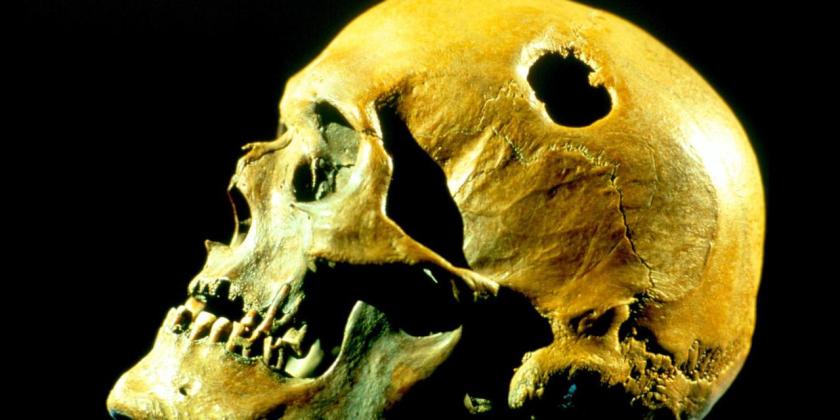
The procedure is called “trepanation”.  It may be the oldest surgical operation for which there is archaeological evidence.  Trepanation involves drilling or scraping a hole into the human head, and seems to have begun sometime in the Neolithic, or “New Stone Age” period.

One archaeological dig in France uncovered 120 skulls, 40 of which showed signs of trepanation. Another such skull was recovered from a 5th millennium BC dig in Azerbaijan. A number of 2nd millennium BC specimens have been unearthed in pre-Colombian Mesoamerica; the area now occupied by the central Mexican highlands through Belize, Guatemala, El Salvador, Honduras, Nicaragua, and northern Costa Rica.

p045xp4l

Hippocrates, the “Father of Western Medicine”, described the procedure in detail in his treatise “On Injuries of the Head,” written sometime around 400BC. The Roman physician Galen of Pergamon expanded on the procedure, some 500 years later.

Archaeologists discovered 1 in eight of all the skulls in pre-Christian era Magyar (Hungarian) graveyards, to have been trepanned.

Trepanation has obvious applications in the treatment of head trauma, though the procedure has been used to treat everything from seizures to migraines to mental disorders. During medieval times, the procedure was used to liberate demons from the heads of the possessed and to cure ailments ranging from meningitis to epilepsy.

1433709755287939

Trepanation took on airs of pseudo-science, many would say “quackery”, when the Dutch librarian Hugo Bart Hughes published “The Mechanism of Brain Blood Volume” in 1964. In it, Hughes contends that our brains drain of blood and cerebrospinal fluid when we begin to walk upright, and continues to do so, the older we get.

According to Hughes, young children are far more creative than adults due to a “natural trepanation effect”, as the fontanel or cranial “soft spot” allows for greater “elasticity” and “pulsation” of the brain.

18dys7vqhsmikjpgTo prove the value of his ‘third eye’ theory, to his own satisfaction if to no one else, Hughes drilled a hole in his own skull in 1965, using a Black & Decker electric drill. He must have thought it proved the point, because he expanded on his theory with “Trepanation: A Cure for Psychosis”, followed by an autobiography, “The Book with the Hole”, published in 1972.

Peter Halvorson, a Hughes follower and director of the International Trepanation Advocacy Group (ITAG), was at first skeptical of the idea.  “It was a time of my life when I felt a certain dullness. I was very much a sealed-skull adult, and I was struggling with that. After the trepanation I felt a positive lift. There’s no doubt trepanation is an enhancement.”

Halvorson trepanned himself with an electric drill in 1972. Today, he explains on his ITAG website (www.trepan.com) that “The hypothesis here at ITAG has been that making an opening in the skull favorably alters movement of blood through the brain and improves brain functions which are more important than ever before in history to adapt to an ever more rapidly changing world”.

According to Halvorson, “John Lennon once asked Hughes to trepan him, but Bart told him he was a third-eyer, so he wouldn’t notice any difference.”

vote-fieldingAt age 27, Amanda Feilding brought an electric dentist’s drill to her London apartment, and drilled a hole in her skull. After four unsuccessful years trying to find a surgeon to do it for her, “I thought, ‘Well, I’m a sculptor, I may as well do it myself'”.

Feilding is so convinced of the benefits of the procedure that she turned it into a political platform, running for the Parliament from Chelsea, on the slogan, “Vote Feilding – Trepanation for the National Health.”  In two separate runs, she garnered a total of 188 votes.

In 2000, British-born Heather Perry was living in Beryl, Utah.  Hearing that John Lennon had wanted a hole in his head, Perry set her heart on having one of her own.  On January 22, 2000, Peter Halvorson and Williams Lyons helped drill a hole in her head for producers of the ABC News program “20/20.” Thirty million viewers tuned in to the spectacle, resulting in $500 fines on the pair for practicing medicine without a license, and three years’ probation.  The two men were also ordered to undergo psychiatric evaluation.

18lpu4r7gdundjpgAt the time, the Iron County DA also considered charges against ABC News reporter Chris Cuomo, for aiding in the crime.

St. Louis neurologist Dr. William Landau wasn’t impressed with Hughes’ brain blood volume theory, explaining that “There is no scientific basis for this at all. It’s quackery.” Dr. Robert Daroff, Professor of Neurology at Case Western Reserve University School of Medicine, was a little more to the point. “Horseshit,” he said. “Absolute, unequivocal bullshit”.

144665

January 15, 1919 Slower than Cold Molasses

The Boston Post reported “Molasses, waist deep, covered the street and swirled and bubbled about the wreckage … Here and there struggled a form—whether it was animal or human being was impossible to tell. Only an upheaval, a thrashing about in the sticky mass, showed where any life was … Horses died like so many flies on sticky fly-paper. The more they struggled, the deeper in the mess they were ensnared. Human beings—men and women—suffered likewise”.

Roger Bannister became the first human to run a sub-four minute mile on May 6, 1954, with an official time of 3 minutes, 59.4 seconds.

The Jamaican sprinter Usain Bolt is recorded as the fastest man who ever lived. At the 2009 World Track and Field Championships, Bolt ran 100 meters at an average 23.35 mph from a standing start, and the 20 meters between the 60 & 80 markers, at an average 27.79 mph.

I suppose it would come as a rude shock to both of those guys, that they are literally slower than cold molasses, in January.

File photo of Bolt of Jamaica competing in the men's 100 metres semi-final heat event during the IAAF World Athletics Championships at the Luzhniki stadium in Moscow

In 1919, the Purity Distilling Company operated a large molasses storage tank at 529 Commercial Street, in the North End of Boston. Fifty feet tall and ninety feet wide, the tank held 2.32 million gallons, about 14,000 tons of the sweet stuff, awaiting transfer to the Purity plant in Cambridge.

It had been cold earlier in the month, but on January 15, it was a balmy 46°, up from the bitter low of 2° of the day before.

If you’d been there at about 12:30, the first sound you might have heard was a rumble, like the sound of a distant train. The next sound was like that of a machine gun, as rivets popped and the two sides of the metal tower split apart.

The collapse hurled a wall of molasses 40′ high down the street at 35 miles per hour, smashing the elevated train tracks on Atlantic Ave and hurling entire buildings from their foundations. Horses, wagons, and dogs were caught up with broken buildings and scores of people as the brown flood sped across the North End. Twenty municipal workers were eating lunch in a nearby city building when they were swept away, parts of the building thrown fifty yards. Part of the tank wall fell on a nearby fire house, crushing the building and burying three firemen alive.

2rd_pa-8637269-800x533

In the 17th century, Sir Isaac Newton described the physical properties of fluids. Water, a “Newtonian” fluid, retains a constant viscosity (flow) between 32° and 212°, Fahrenheit. We all know what it is to swim in water, but a “non-Newtonian” fluid such as molasses, acts very differently. Non Newtonian fluids change viscosity and “shear”, in response to pressure. You do not propel yourself through non-Newtonian fluid, the stuff will swallow you, whole. Not even Michael Phelps is swimming out of that gunk.

The Boston Post reported “Molasses, waist deep, covered the street and swirled and bubbled about the wreckage … Here and there struggled a form—whether it was animal or human being was impossible to tell. Only an upheaval, a thrashing about in the sticky mass, showed where any life was … Horses died like so many flies on sticky fly-paper. The more they struggled, the deeper in the mess they were ensnared. Human beings—men and women—suffered likewise”.

In 1983, a Smithsonian Magazine article described the experience of one child: “Anthony di Stasio, walking homeward with his sisters from the Michelangelo School, was picked up by the wave and carried, tumbling on its crest, almost as though he were surfing. Then he grounded and the molasses rolled him like a pebble as the wave diminished. He heard his mother call his name and couldn’t answer, his throat was so clogged with the smothering goo. He passed out, then opened his eyes to find three of his four sisters staring at him”.

All told, the molasses flood of 1919 killed 21 people, and injured another 150. 116 cadets from the Massachusetts Nautical School, now Mass Maritime Academy, were the first rescuers on-scene. They were soon followed by Boston Police, Red Cross, Army and Navy personnel. Some Red Cross nurses literally dove into the mess to rescue victims, while doctors and surgeons set up a makeshift hospital and worked around the clock.

boston-molasses-flood-ap-969731587817

It was four days before the search was called off for additional victims. The total cleanup was estimated at 87,000 man-hours.

It was probably a combination of factors that caused the tank to rupture. Construction was poor from the beginning. Locals knew they could come down and collect household molasses from the drippings down the outside of the thing, which was leaking so badly that it was painted brown to hide the leaks.

This was only the 6th or 7th time the tank had been filled to capacity, and the rising temperatures almost surely helped to build up gas pressure inside the structure. The Volstead Act, better known as Prohibition, was being passed in Washington the following day, to take effect the following year. I’m sure that distillers were producing as much hooch as they could while it was still legal.

With temperatures being so cold, the rapid spread of all that molasses made no sense.  The proverbial “cold molasses” had exploded it seemed, in January.  Newspapers speculated that there must be something more.  A bomb, perhaps.

Newspapers would more profitably have resorted to their physics books.  In fluid dynamics, a “gravity current” describes the horizontal flow in a gravitational field, of a dense fluid into a fluid of lesser density. Think about the way that cold air rushes through an open doorway into a warm room, even with no wind to drive it.

Molly Molasses

Today, the site of the Great Molasses Flood is occupied by a recreational complex called Langone Park, featuring a Little League ball field, a playground, and bocce courts. The Boston Duck Tours DUKW’s regularly visit the place with their amphibious vehicles, especially the dark brown one. The one with the name “Molly Molasses”, painted on its side.

December 17, 1900 The Search for Extraterrestrial Intelligence

On December 17, 1900, the French Academy of Science offered a prize of 100,000 francs to the first person to make contact with an alien civilization.  Provided that it was anything but Martian.  That was considered too easy.

In the 5th century BC, the Greek philosopher Democritus taught that the world was made of atoms.  Physically indestructible and always in motion, these atoms are infinite in number, differing only in shape and size.  Democritus taught that everything around us is the result of physical laws without reason or purpose, asking only “what circumstances caused this event?”

Philosophers like Aristotle and Socrates took a less mechanistic approach, asking “What purpose did this event serve?” Plato disliked Democritus so much that he wanted to burn all his books.

The prevailing view throughout antiquity was that our planet is special, that we are alone in the cosmos.  Democritus believed there were infinite numbers of worlds such as our own, with inhabitants like ourselves.

In the time of Copernicus, it was widely believed that there is life on other planets.  Astronomers saw several features of the moon as evidence, if not of life, then at least that intelligent life had once paid a visit.

whatisthesta

Interest in Mars began to develop in the 1870s, when the Italian astronomer Giovanni Virginio Schiaparelli described physical features of the red planet as “canali”.  The word means “channels” in Italian, but it was mis-translated as “canals”.  The English speaking world was off to the races.

Speculation and folklore about intelligent life on Mars was soon replaced by a popular near-certainty that canals were excavated by Martians.

The idea was near universal by the turn of the century.  On this day, December 17, 1900, the French Academy of Science offered a prize of 100,000 francs to the first person to make contact with an alien civilization.  Provided that it was anything but Martian.  That was considered too easy.

6a00d83542d51e69e201b8d160dcaf970c-500wiEarly radio experiments by Nikola Tesla and Guglielmo Marconi left both inventors believing they had picked up, in Marconi’s words, “queer sounds and indications, which might come from somewhere outside the earth.”

In 1924, the idea was put to the test.  Believing that martians might attempt to communicate on the day the two bodies were in closest proximity, August 21, 1924 became “National Radio Silence Day”.  Americans were urged to observe “radio silence” for the first five minutes of every hour, while a radio receiver at the U.S. Naval Observatory, two miles aloft on board a dirigible, listened for the signal that never came.

20171023_wow-cc_f840The British author H. G. Wells wrote the War of the Worlds in 1897, telling the story of an alien earth invasion by Martians fleeing the desiccation of their own planet.  The story was adapted to a radio drama broadcast on Halloween, 1938, a production so realistic that many listeners sued the network for “mental anguish” and “personal injury”.

The idea of life on Mars persisted until the 1960s, when close observations of the Martian surface were made possible by the Mariner series of spacecraft.

While much of “mainstream” science seems to steer clear of the subject, the University of California at Berkeley is running a “distributed computing effort” to identify extraterrestrial life, called “SETI@home”.

setihome

The website explains the mission:  “SETI@home is a scientific experiment that uses Internet-connected computers in the Search for Extraterrestrial Intelligence (SETI). You can participate by running a free program that downloads and analyzes radio telescope data”.

With an original objective of 50,000-100,000 home computers, SETI@home had 1,525,050 users as of January 2015.  With the introduction of the Berkeley Open Infrastructure for Network Computing, or “BOINC” (I didn’t make that up), SETI@home users can even compete with one another, to see who can process the most “work units”.

You, too can participate at http://setiathome.berkeley.edu/, on your Windows, Apple or Network PC, or your Sony PlayStation 3.  Please let me know if you make contact.

December 16, 1884 River Horse

Short days from now, families across the nation will gather for the Christmas table.  There will be moist and savory stuffing, and green bean casserole.  Creamy mashed potatoes and orange cranberry sauce.  And there, the centerpiece of the feast.  Slow-roasted and steaming in its tray, golden brown and delicious, the roast hippopotamus.

Short days from now, families across the nation will gather for the Christmas table.  There will be moist and savory stuffing, and green bean casserole.  Creamy mashed potatoes and orange cranberry sauce.  And there, the centerpiece of the feast.  Slow-roasted and steaming in its tray, golden brown and delicious, the roast hippopotamus.

Wait…

What?

The story begins on December 16, 1884, the opening day for the World’s Fair, in New Orleans. Among the many wonders on display was the never-before seen, Eichornia crassipes, a gift of the Japanese delegation.  The Water Hyacinth.  Visitors marveled at this beautiful aquatic herb, its yellow spots accentuating the petals of beautiful delicate purple and blue flowers, floating across tranquil ponds on thick, dark green leaves.

Eichhornia_crassipes
Eichhornia crassipes

The seeds of Eichornia crassipes are spread by wind, flood, birds and humans, and remain viable for 30 years.  Beautiful as it is to look at, the Water Hyacinth is an “alpha plant”, the aquatic equivalent to the Japanese invasive perennial Kudzu, the “vine that ate the south”.  Impenetrable floating mats choke out native habitats and species, while thick roots impede the passage of vessels, large and small.  The stuff is toxic if ingested by humans and most animals, and costs a fortune to remove.

This plant native from the Amazon basin quickly broke the bounds of the 1884 World’s Fair, spreading across the bayous and waterways of Louisiana, and beyond.

Kenya_Kisumu_Harbour_Hyacinths_1997ke09b21-768x493
You can hardly find the water, in Lake Victoria’s Kisumu Harbor, Kenya

In the first decade of the 20th century, an exploding American population could barely keep up with its own need for food, especially, meat.  The problem reached crisis proportions in 1910, with over grazing and a severe cattle shortage.  Americans were seriously discussing the idea, of eating dogs.

Enter Louisiana member of the House of Representatives, New Iberia’s own Robert Foligny Broussard, with a solution to both problems.  “Lake Bacon”.

The attorney from Louisiana’s 3rd Congressional district proposed the “American Hippo” bill, H.R. 23621, in 1910, with enthusiastic support from Theodore Roosevelt and the New York Times.  One Agricultural official estimated that such a free-range hippo herd would produce up to a million tons of meat, per year.

Lippincott’s monthly magazine waxed rhapsodic about the idea:  “This animal, homely as a steamroller, is the embodiment of salvation.  Peace, plenty and contentment lie before us, and a new life with new experiences, new opportunities, new vigour, new romance, folded in that golden future, when the meadows and the bayous of our southern lands shall swarm with herds of hippopotami”.

p03dtkqg

With a name deriving from the Greek term “River Horse”, the common hippopotamus is the third largest land animal living today.  Despite a physical resemblance to hogs and other even-toed ungulates, Hippopotamidae’s closest living relatives are cetaceans such as whales, dolphins and porpoises.

The problem is, these things are dangerous.

Major_Frederick_Russell_Burnham
Major Frederick Russell Burnham

The adult bull hippopotamus is extremely aggressive, unpredictable and highly territorial.  Heaven help anyone caught between a cow and her young.  Hippos can gallop at short sprints of 19 mph, only a little slower than Sprinter Usain Bolt, “the fastest man who ever lived”.

Google the “10 most dangerous animals in Africa”.  You’ll be rewarded with the knowledge that hippos are #1, responsible for more human fatalities, than any other large animal, in Africa.

Be that at it as it may, the animal is a voracious herbivore, spending daylight hours at the bottom of rivers & lakes, happily munching on vegetation.

What could be better than taking care of two problems at once.  Otherwise unproductive swamps and bayous from Florida to Louisiana would become home to great hordes of free-range hippos.  The meat crisis would be solved, and America would become a nation of hippo ranchers.

As Broussard’s bill wended its way through Congress, the measure picked up steam with the enthusiastic support of two enemies who’d spent ten years in the African bush, trying to kill each other. No, really.

Captain Fritz Duquesne

Frederick Russell Burnham had argued for the introduction African wildlife into the American food stream, some four years earlier.  A freelance scout and American adventurer, Burnham was known for his service to the British South Africa company and to the British army in colonial Africa. The “King of Scouts’, commanding officers described Burnham as “half jackrabbit and half wolf”.  A “man totally without fear.”  One writer described Burnham’s life as “an endless chain of impossible achievements”, another “a man whose senses and abilities approached that of a wild predator”.  He was the inspiration for the Indiana Jones character and for the Boy Scouts.  Frederick Burnham was the “most complete human being who ever lived “.

Frederick “Fritz” Joubert Duquesne was a Boer of French Huguenot ancestry, descended from Dutch settlers to South Africa.  A smooth talking guerilla fighter, the self-styled “Black Panther” once described himself as every bit the wild African animal, as any creature of the veld.  An incandescent tower of hate for all things British, Duqesne was a liar, a chameleon, a man of 1,000 aliases who once spent seven months feigning paralysis, so he could fool his jailers long enough to cut through his prison bars.  Destined to be a German spy and saboteur through two world wars, Frederick Burnham described his mortal adversary, thus:  “He was one of the craftiest men I ever met. He had something of a genius of the Apache for avoiding a combat except in his own terms; yet he would be the last man I should choose to meet in a dark room for a finish fight armed only with knives“.

During the 2nd Boer war, the pair had sworn to kill each other.  In 1910, these two men became partners in a mission to bring hippos, to America’s dinner table.

Biologically, there seems little reason to believe that Hippo ranching couldn’t have worked along the Gulf coast.  Colombian officials estimate that, within a few years, the hippo descendants of drug kingpin Pablo Escobar’s exotic animal menagerie will number 100 or more individuals.

Broussard’s measure went down to defeat by one vote, but didn’t entirely go away.  Always the political calculator, Representative and later-Senator Broussard died with the bill on his legislative agenda, waiting for the right moment to reintroduce the thing.

General_Collection_deadzoneOver time, the solution to the meat question became a matter of doubling down on what we’re already doing, as factory farms and confinement operations took the place of free ranges, and massive use of antibiotics replaced the idea of balanced biological systems.


We may or may not have “traded up”.  Today, we contend with ever more antibiotic-resistant strains of “Superbug”. Louisiana spends $2 million per year on herbicidal control of the water hyacinth. The effluent of factory farms from Montana to Pennsylvania works its way into the nation’s rivers and streams, washing out to the Mississippi Delta to a biological dead zone, the size of New Jersey.

That golden future of Lippincott’s hippo herds roam only in the meadows and bayous of the imagination.  Who knows, it may be for the best.  I don’t know if any of us could see each other across the table.  Not with a roast hippopotamus.

December 11, 1913  The Boll Weevil of Coffee County

ICYMI – “In profound appreciation of the Boll Weevil and what it has done as the herald of prosperity this monument was erected by the citizens of Enterprise, Coffee County, Alabama.”

Few machines have changed the course of history, like Eli Whitney’s cotton gin.

The long, hot summers of the southeastern United States have always been ideal for growing cotton, but there was a time when the stuff was extremely expensive to produce.  Cotton comes out wet from the boll, the protective capsule requiring about ten man hours just to remove the seeds to produce a pound of cotton.

By comparison, a cotton gin can process about a thousand pounds a day, at comparatively little expense.

slide_10

In 1792, the year that Whitney invented his machine, the southeastern United States exported 138,000 pounds a year to Europe and to the northern states.  Two years later, that number had risen to 1,600,000 pounds.  By the time of the Civil War, Britain alone was importing ¾ of the 800 million pounds it used each year, from the American south.

Enterprise, Alabama got its start when John Henry Carmichael first settled there in 1881.  Within a few years the Alabama Midland Railway came to Enterprise.  By the turn of the century the place was a major cotton growing hub.

bollweevil1Anthonomus grandis, the Boll Weevil, is a small beetle, about the size of the nail on your little finger. Indigenous to Mexico, the beetle crossed the Rio Grande near Brownsville, sometime around 1892.  The insect spread rapidly, producing eight to ten generations in a single growing season and preying mainly on the young cotton boll.

The insect is capable of destroying entire cotton crops, which it did in 1915, the year the insect reached Enterprise and most of Coffee County.  Facing economic ruin, local farmers were forced to diversify their crops, just to recoup some of the losses caused by that one wretched beetle.

Within two years, Enterprise became one of the leading peanut producers in the country.  Not only had farmers been able to stave of disaster, but they were already becoming prosperous as a result of the thriving new crop base.

Town fathers decided to build a monument, their “herald of prosperity”, to the boll weevil.  The bug that had almost ruined them.

Boll_weevil_monumentDesigned in Italy at a cost of $1,800, the monument depicts a female figure in a flowing gown, arms stretched high over her head, and holding in her hands a trophy.

The monument was dedicated on December 11, 1919 at the intersection of College and Main Street, in the heart of Enterprise’ business district.

You can’t have a Boll Weevil monument without a Boll Weevil.  Thirty years later, Luther Baker added a big bug on top of the trophy.  At the base of the monument appears this inscription:  “In profound appreciation of the Boll Weevil and what it has done as the herald of prosperity this monument was erected by the citizens of Enterprise, Coffee County, Alabama.”

The original has been vandalized so many times that it was moved it to a protected facility, and a replica put in its place.  So it is that you can drive down the Main Street of Enterprise Alabama today, in the footsteps of my own brother Dave, and there you will find a statue of…a bug.

December 8, 1941 Day of Infamy

Roosevelt probably learned that he was riding in Al Capone’s limo after he got in, on the way to Capitol Hill.  He didn’t seem to be bothered, the President’s only comment was “I hope Mr. Capone won’t mind.”

On Sunday morning, December 7th, 1941, the armed forces of Imperial Japan attacked the US Navy’s Pacific anchorage at Pearl Harbor.

The President of the United States, Franklin Delano Roosevelt, was notified almost immediately.  It had been an act of war, a deliberate attack on one sovereign nation by another.  Roosevelt intended to ask Congress for a declaration of war.

FDR-Truman__1226078961_4554
Presidential Limo “Sunshine Special”, used in both the FDR and Truman administrations

Work began almost immediately on what we now know as Roosevelt’s “Day of Infamy” speech, to be delivered to a joint session of Congress the following day.

There was no knowing if the attack on Pearl Harbor had been an isolated event, or whether there would be a continuation of such attacks, sabotage on facilities, or even assassination attempts.

The Willamette University football team, in Honolulu at this time to play the “Shrine Bowl”,  took up a defensive cordon around the Punahou school.

Roosevelt’s speech was scheduled for noon on the 8th, and the Secret Service knew they had a problem. Roosevelt was fond of his 1939 Lincoln V12 Convertible.  Roosevelt called it the “Sunshine Special,” but the car was anything but secure.  Armored Presidential cars would not come into regular use for another 20 years, after the assassination of President Kennedy.

Federal regulations of the time restricted the purchase of any vehicle costing $750 or higher, $10,455 in today’s dollars, and that wasn’t going to get them an armored limo. They probably couldn’t have gotten one that quickly anyway, even if there had been no restriction on spending.

Al Capones LimoIn 1928, Al Capone purchased a Cadillac 341A Town Sedan with 3,000 pounds of armor and inch-thick bulletproof windows.  It was green and black, matching the Chicago police cars of the era, and equipped with a siren and flashing lights hidden behind the grill.

Advanced syphilis had reduced Al Capone to a neurological wreck by this time.  By the time of FDR’s speech, Capone had been released from Alcatraz, and resided in Palm Island, Florida.   His limo had been sitting in a Treasury Department parking lot, ever since being seized in his IRS tax evasion suit from years earlier.

attachment-image-ce0008c9-491c-4988-a6d0-f5facdb1358a

Mechanics cleaned and checked Capone’s Caddy well into the night of December 7th, making sure that it would safely get the Commander in Chief the few short blocks to Capitol Hill.  It apparently did, because Roosevelt continued to use it until his old car could be fitted with the same features.  To this day, Presidential limousines have flashing police lights hidden behind their grilles.

Roosevelt probably learned that he was riding in Al Capone’s limo after he got in, on the way to Capitol Hill.  He didn’t seem to be bothered, the President’s only comment was “I hope Mr. Capone won’t mind.”

Afterward

Capone, FDR LimoThe internet can be a wonderful thing, if you don’t mind taking your water from a fire hose.  The reader of history quickly finds that some tales are true as written, some are not, and some stories are so good you want them to be true.

Napoleon once asked, ‘What is history, but a fable agreed upon?” Winston Churchill said “History will be kind to me, for I intend to write it”.

You can find on-line sources if you like, to tell you this story is a myth. Others will tell you it’s perfectly true.  CBS News reports: “After the attack on Pearl Harbor, President Roosevelt made use of a heavily armored Cadillac that was originally owned by gangster Al Capone until the Sunshine Special could be modified with armor plating, bulletproof glass, and sub-machine gun storage“.

As a piece of history, you may take this one as you like.  I confess, I am one who wants it to be true.


If you enjoyed this “Today in History”, please feel free to re-blog, “like” & share on social media, so that others may find and enjoy the same. Please click the “follow” button on the right, to receive email updates on new articles.  Thank you for your interest, in the history we all share.