

When he was little, his neighbors must have considered him a bad kid. His first arrest came at the age of 12, when he and some friends were caught stealing brass from a foundry. There were other episodes between 1932 and ’37: petty theft, breaking & entering, and disturbing the peace. In 1939 he was sent to prison, for stealing a car.
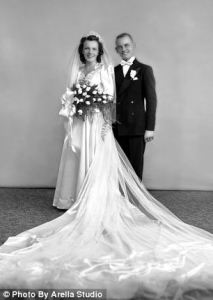 Edward Donald “Eddie” Slovik was paroled in 1942, his criminal record making him 4F. “Registrant not acceptable for military service”. He took a job at the Montella Plumbing and Heating company in Dearborn, Michigan, where he met bookkeeper Antoinette Wisniewski, the woman who would later become his wife.
There they might have ridden out WWII, but the war was consuming manpower at a rate unprecedented in history. Shortly after the couple’s first anniversary, Slovik was re-classified 1A, fit for service, and drafted into the Army. Arriving in France on August 20, 1944, he was part of a 12-man replacement detachment, assigned to Company G of the 109th Infantry Regiment, US 28th Infantry Division.
Slovik and a buddy from basic training, Private John Tankey, became separated from their detachment during an artillery attack, and spent the next six weeks with Canadian MPs. It was around this time that Private Slovik decided he “wasn’t cut out for combat”.
The rapid movement of the army during this period caused many replacements difficulty in finding their units. Edward Slovik and John Tankey finally caught up with the 109th on October 7. The following day, Slovik asked his company commander Captain Ralph Grotte for reassignment to a rear unit, saying he was “too scared” to be part of a rifle company. Grotte refused, confirming that, were he to run away, such an act would constitute desertion.
That, he did. Eddie Slovik deserted his unit on October 9, despite Private Tankey’s protestations that he should stay. “My mind is made up”, he said. Slovik walked several miles until he found an enlisted cook, to whom he presented the following note.
“I, Pvt. Eddie D. Slovik, 36896415, confess to the desertion of the United States Army. At the time 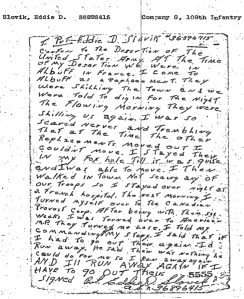 of my desertion we were in Albuff [Elbeuf] in France. I came to Albuff as a replacement. They were shelling the town and we were told to dig in for the night. The following morning they were shelling us again. I was so scared, nerves and trembling, that at the time the other replacements moved out, I couldn’t move. I stayed there in my fox hole till it was quiet and I was able to move. I then walked into town. Not seeing any of our troops, so I stayed over night at a French hospital. The next morning I turned myself over to the Canadian Provost Corp. After being with them six weeks I was turned over to American M.P. They turned me loose. I told my commanding officer my story. I said that if I had to go out there again I’d run away. He said there was nothing he could do for me so I ran away again AND I’LL RUN AWAY AGAIN IF I HAVE TO GO OUT THERE. — Signed Pvt. Eddie D. Slovik A.S.N. 36896415”.
Slovik was repeatedly ordered to tear up the note and rejoin his unit, and there would be no consequences. Each time, he refused. The stockade didn’t scare him. He’d been in prison before, and it was better than the front lines. Beside that, he was already an ex-con. A dishonorable discharge was hardly going to change anything, in a life he expected to be filled with manual labor. Finally, instructed to write a second note on the back of the first acknowledging the legal consequences of his actions, Eddie Slovik was taken into custody.
1.7 million courts-martial were held during WWII, 1/3rd of all the criminal cases tried in the United States during the same period. The death penalty was rarely imposed. When it was, it was almost always in cases of rape or murder.
2,864 US Army personnel were tried for desertion between January 1942 and June 1948. Courts-martial handed down death sentences to 49 of them, including Eddie Slovik. Division commander Major General Norman Cota approved the sentence. “Given the situation as I knew it in November, 1944,” he said, “I thought it was my duty to this country to approve that sentence. If I hadn’t approved it–if I had let Slovik accomplish his purpose–I don’t know how I could have gone up to the line and looked a good soldier in the face.”
On December 9, Slovik wrote to Supreme Allied Commander Dwight D. Eisenhower, pleading for clemency. Desertion was a systemic problem at this time. Particularly after the surprise German offensive coming out of the frozen Ardennes Forest on December 16, an action that went into history as the Battle of the Bulge. Eisenhower approved the execution order on December 23, believing it to be the only way to discourage further desertions.
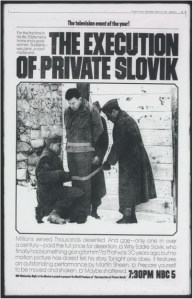
His uniform stripped of all insignia with an army blanket draped over his shoulders, Slovik was brought to the place of execution near the Vosges Mountains of France. “They’re not shooting me for deserting the United States Army”, he said, “thousands of guys have done that. They just need to make an example out of somebody and I’m it because I’m an ex-con. I used to steal things when I was a kid, and that’s what they are shooting me for. They’re shooting me for the bread and chewing gum I stole when I was 12 years old.”
Army Chaplain Father Carl Patrick Cummings said, “Eddie, when you get up there, say a little prayer for me.” Slovik said, “Okay, Father. I’ll pray that you don’t follow me too soon”. Those were his last words. A soldier placed the black hood over his head. The execution was carried out by firing squad. It was 10:04am local time, January 31, 1945.
Edward Donald Slovik was buried in Plot E of the Oise-Aisne American Cemetery, his marker bearing a number instead of his name. Antoinette Slovik received a telegram informing her that her husband had died in the European Theater of war, and a letter instructing her to return a $55 allotment check. She would not learn about the execution for nine years.
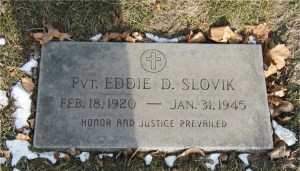 In 1987, President Ronald Reagan ordered the repatriation of Slovik’s remains. He was re-interred at Detroit’s Woodmere Cemetery next to Antoinette, who had gone to her final rest eight years earlier.
In all theaters of WWII, the United States military executed 102 of its own, almost always for the unprovoked rape and/or murder of civilians. From the Civil War to this day, Eddie Slovik’s death sentence remains the only one ever carried out for the crime of desertion. At least one member of the tribunal which condemned him to death, would come to see it as a miscarriage of justice.
Nick Gozik of Pittsburg passed away in 2015, at the age of 95. He was there in 1945, a fellow soldier called to witness the execution. “Justice or legal murder”, he said, “I don’t know, but I want you to know I think he was the bravest man in that courtyard that day…All I could see was a young soldier, blond-haired, walking as straight as a soldier ever walked. I thought he was the bravest soldier I ever saw.”

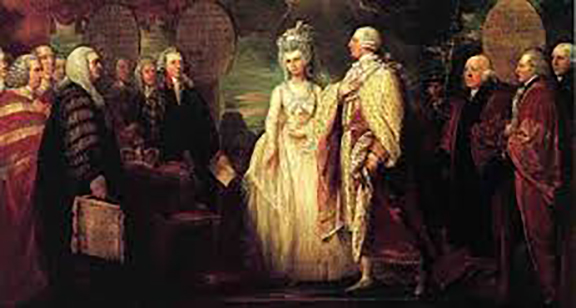
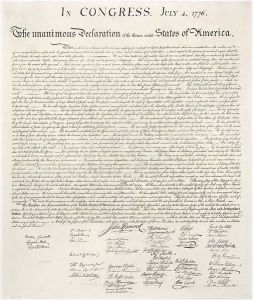 be self-evident, that all men are created equal, that they are endowed by their Creator with certain unalienable Rights, that among these are Life, Liberty and the pursuit of Happiness”.

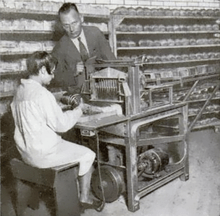 The project almost ended in a fire in 1917, when the prototype was destroyed along with the blueprints. Rohwedder soldiered on, by 1927 he had scraped up enough financing to rebuild his bread slicer.
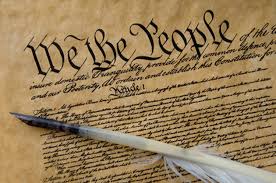 Article 1, Section 8 of the Constitution includes the “Commerce Clause”, permitting the Congress “To regulate Commerce with foreign Nations, and among the several States, and with the Indian Tribes”. That’s it. The Federal District Court sided with the farmer, but the Federal government appealed to the US Supreme Court, arguing that, by withholding his surplus from the interstate wheat market, Filburne was effecting that market, and therefore fell under federal government jurisdiction under the commerce clause.
 government had a billion bushels of wheat stockpiled at the time, about two years’ supply, and the amount of steel saved by not making bread slicers has got to be marginal, at best.

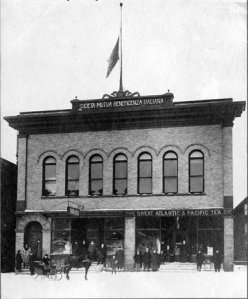 families gathered on Christmas Eve at the “Societa Mutua Beneficenza Italiana”, the Italian Hall in Calumet, Michigan, for a Christmas party sponsored by the Ladies Auxiliary of the WFM.
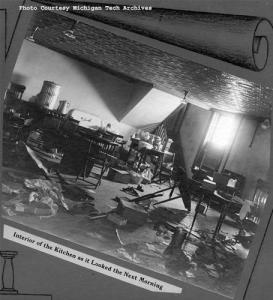 Miners Charles Moyer publicly accused members of the pro management “Citizens Alliance” of responsibility for the disaster. He was subsequently assaulted by members of the Alliance, who shot and kidnapped him, placing him on a train with instructions to leave Michigan and never return. Moyer would later receive medical attention in Chicago, holding a press conference where he displayed his gunshot wound before returning to Michigan and resuming his work with the WFM.
 1st amendment right to free speech. It’s a paraphrasing of Justice Oliver Wendell Holmes, Jr.’s opinion in the 1919 SCOTUS decision, Schenck v. United States, a case which turned, in part, on the Italian Hall disaster of seven years earlier.


 Historical Easter Eggs - Today in History
You must be logged in to post a comment.