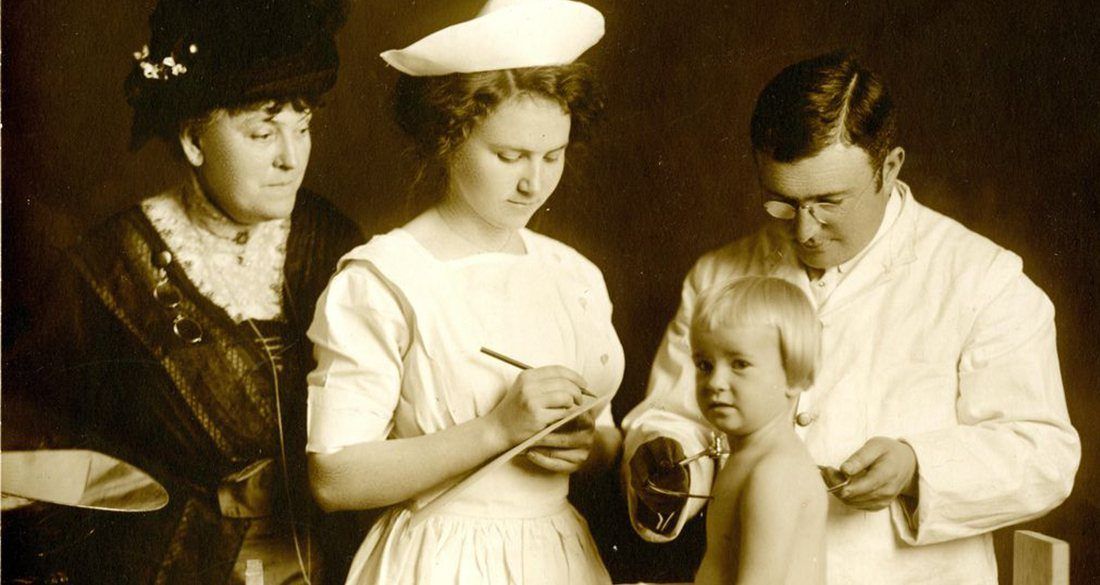
March 21, 1905 A Genetic Threat to Society

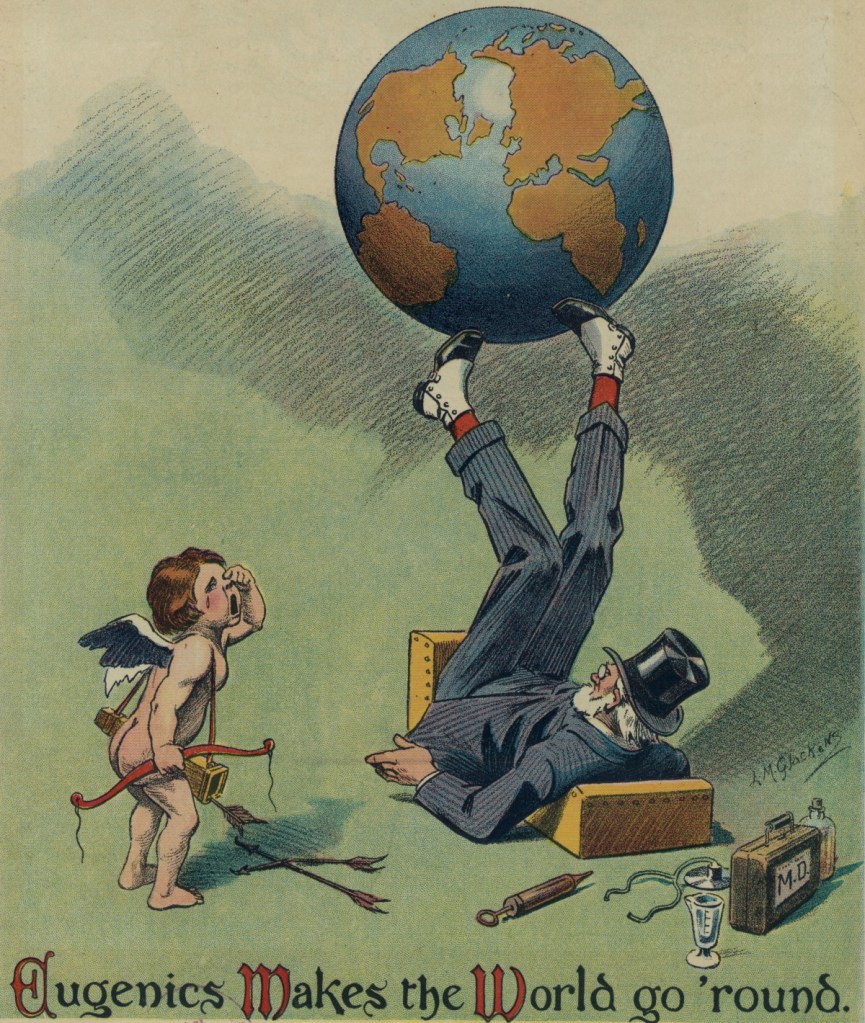
In the 19th century, Francis Galton studied the theories of his cousin Charles Darwin on the evolution of species, applying these ideas to a system of selective breeding intended to bring “better” human beings into the world.  He called it his theory of “Eugenics”.

In 380BC, Plato described a system of state-controlled human breeding. In the Socratic dialogue “The Republic” Plato introduced a “guardian class” to watch over over the ideal society.
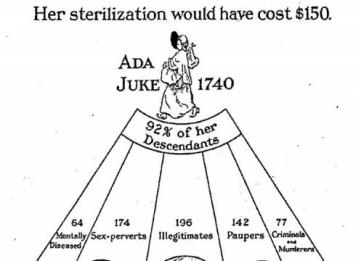
Ada Juke

In the 19th century, Francis Galton studied the theories of his cousin Charles Darwin on the evolution of species, applying these ideas to a system of selective breeding intended to bring “better” human beings into the world.  He called it his theory of “Eugenics”.

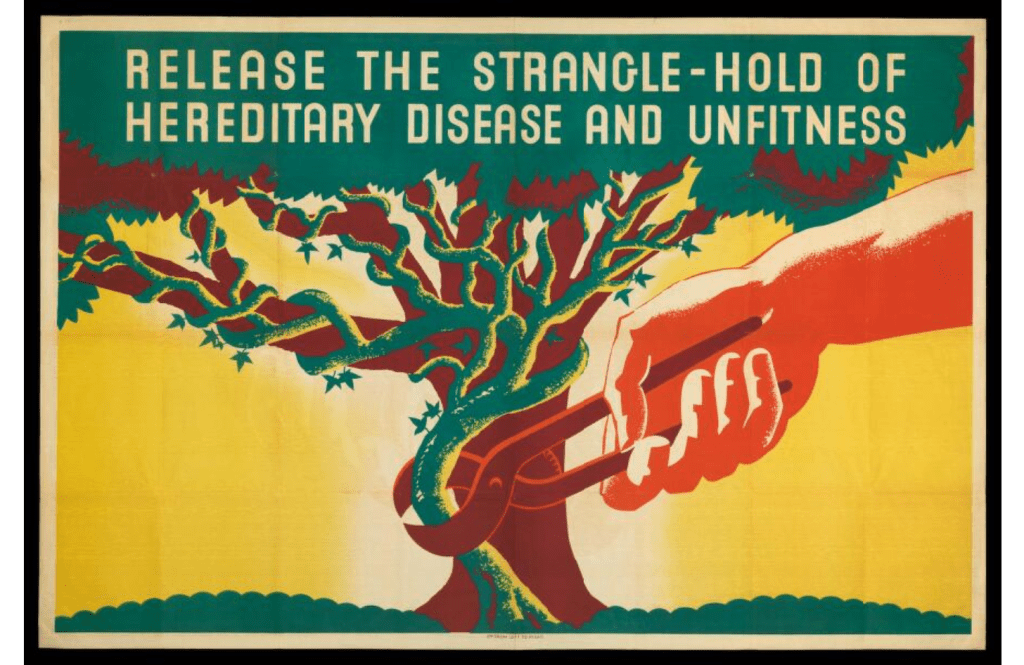
Eugenics gained worldwide respectability in the early 20th century, when countries from Brazil to Japan adopted policies regarding the involuntary sterilization of certain mental patients.

images (35)

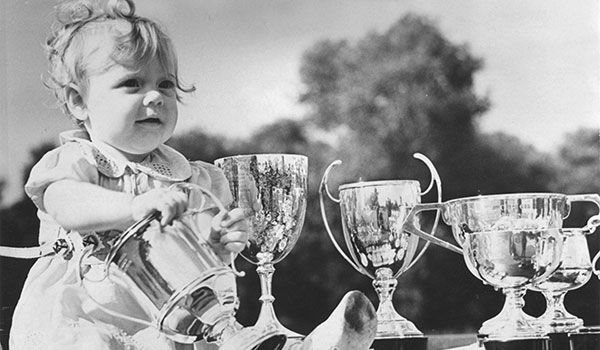
“Better Babies” competitions sprang up at state fairs across the United States. Babies were measured, weighed, and “judged”, like livestock.  By the 1920s, such events had evolved into “Fitter Family” competitions.

One of the leaders of the eugenics movement was the pacifist and Stanford University professor, David Starr Jordan.  After writing several books on the subject, Jordan became a founding member of the Eugenics Committee of the American Breeders Association.  The higher classes of American society were being eroded he argued, by the lower class.  Careful, selective breeding were required to preserve the nation’s “upper crust”.
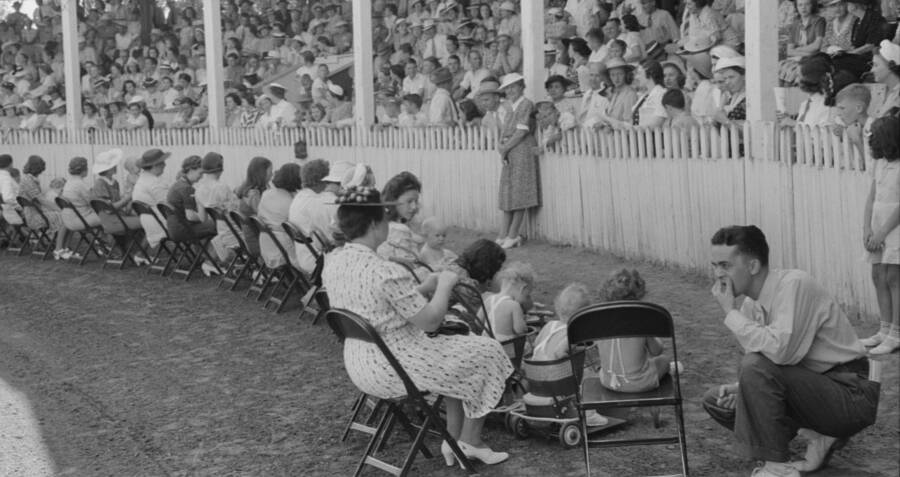
Judging babies at the state fair, in 1900

Margaret Higgins Sanger believed that birth control should be compulsory for “unfit” women. She claimed that these mothers “recklessly perpetuated their damaged genetic stock by irresponsibly breeding more children in an already overpopulated world.”

lrg_16330_233eugenictree

An early advocate for birth control, Sanger has her supporters to this day, including former Presidential candidate Hillary Rodham Clinton. “I admire Margaret Sanger enormously”, Clinton said.  “Her courage, her tenacity, her vision…”  Time Magazine points out that “Sanger opened the first birth-control clinic in the United States”, describing her as “An advocate for women’s reproductive rights who was also a vocal eugenics enthusiast…”
download (23)
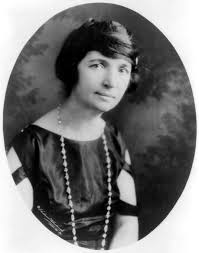
Margaret Samger

Detractors have described Sanger as a “thoroughgoing racist”, citing her own words in What Every Girl Should Know, published in 1910:  “In all fish and reptiles where there is no great brain development, there is also no conscious sexual control. The lower down in the scale of human development we go the less sexual control we find. It is said that the aboriginal Australian, the lowest known species of the human family, just a step higher than the chimpanzee in brain development, has so little sexual control that police authority alone prevents him from obtaining sexual satisfaction on the streets”.

Admire or detest the woman as you choose, Sanger’s work established organizations. These evolved into what we know today, the Planned Parenthood Federation of America.

Around the world, such ideas took the form of involuntarily terminated pregnancies, compulsory sterilization, euthanasia and, in the case of Nazi Germany, mass extermination.
Madison Grant, the New York lawyer best known for his work in developing the discipline of wildlife management, was a leader in the eugenics movement, once receiving an approving fan letter from none other than Adolf Hitler.

Public policy and academic types conducted three international eugenics conferences to discuss the application of programs to improve human bloodlines.  The first such symposium convened in London in 1912, discussing papers on “racial suicide” and similar topics.  Presiding over the conference was none other than Major Leonard Darwin, the son of Charles Darwin, with Harvard president emeritus Charles William Eliot serving as vice President.
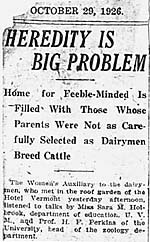
Vermont Eugenics: A Documentary History

The 1912 conference was followed by two more in 1921 and 1932, both held in New York City.  Colleges and universities delved into eugenics as academic discipline, with courses exploring the ethical and public policy considerations of eliminating the “degenerate” and “unfit”.

In Pennsylvania, 270 involuntary sterilizations were performed without benefit of law, between 1892 and 1931.  On March 21, 1905, the Pennsylvania legislature passed “An Act for the Prevention of Idiocy”, requiring that every institution in the state entrusted with the care of “ idiots and imbecile children”, be staffed by at least one skilled surgeon, whose duty it was to perform surgical sterilization.  The bill was vetoed by then-Governor Samuel Pennypacker, only to return in 1911, ’13, ’15, ’17, ’19, and again in 1921.

By the height of the eugenics movement, some 30 states had passed legislation, legalizing the involuntary sterilization of individuals considered “unfit” for reproduction. All told, some 60,000 individuals were forcibly sterilized in state-sanctioned procedures.

In 1945 the state of California required Charles Follett to undergo an involuntary vasectomy. His crime? Follett found himself abandoned by alcoholic parents. He was 15 years old.   Charlie Follett was but one of some 20,000 Californians forced to undergo such a procedure.
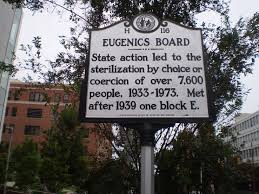
images (36)
Roadside Marker, Raleigh, NC

Vermont passed a sterilization law in 1931, aimed at what then-University of Vermont zoology professor Henry Perkins called the “rural degeneracy problem.”  An untold number of “defectives” were forced to undergo involuntary sterilization, including Abenaki Indians and French-Canadian immigrants.

Indiana passed the first eugenic sterilization law in 1907, but the measure was legally flawed.  To remedy the situation, the Eugenics Record Office (ERO), founded in 1910 by the the former Harvard University Zoology Professor Charles Benedict Davenport, Ph.D.  crafted a statute, later adopted by the Commonwealth of Virginia as state law in 1924.
That September, Superintendent of the ‘Virginia State Colony for Epileptics and Feebleminded’ Dr. Albert Sidney Priddy, filed a petition to sterilize one Carrie Elizabeth Buck, an 18-year-old patient at the institution whom Priddy claimed to be “incorrigible”.  A “genetic threat to society”.  Buck’s 52-year-old mother had a record of prostitution and immorality Priddy claimed. The child to whom Buck gave birth in the institution only proved the point.
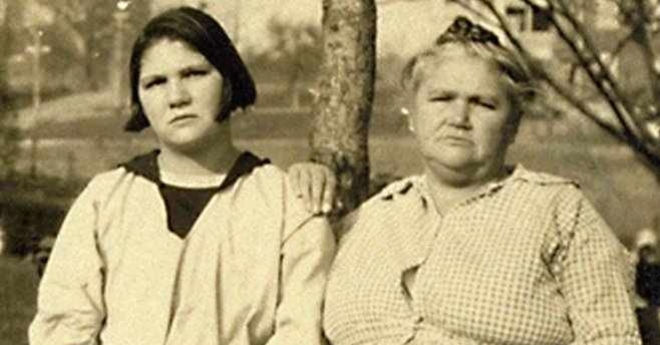
carriebuck2
Carrie Elizabeth Buck was born into poverty in Charlottesville, Virginia, the first of three children born to Emma Buck. Carrie’s father Frederick Buck abandoned the family, shortly after the marriage. Emma was committed to the “Virginia State Colony for Epileptics and Feebleminded” following accusations of immorality, prostitution, and having syphilis.

Buck’s guardian brought her case to court, arguing that compulsory sterilization violated the equal protection clause of the 14th amendment.  After losing in district court, the case was appealed to the Amherst County Circuit Court, the Virginia Supreme Court, and finally the United States Supreme Court.

Dr. Priddy died along the way, Dr. John Hendren Bell taking his place.  SCOTUS decided the “Buck vs Bell” case on May 2, 1927, ruling in an 8–1 decision that Carrie Buck, her mother, and her perfectly normal infant daughter, were all “feeble-minded” and “promiscuous.”
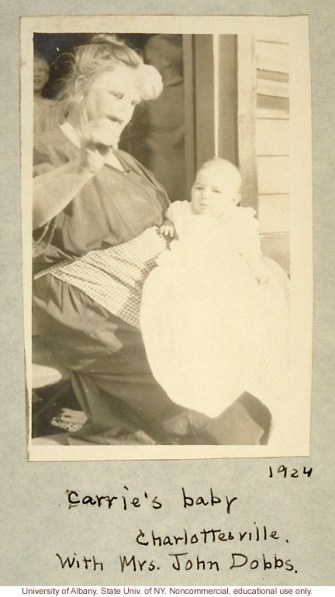
11255
“This photograph was taken on the eve of the initial trial of Buck v Bell in Virginia. Mrs. Dobbs appear to be holding a coin believed to be used as a test for alertness or mental acuity. Vivian appears to be looking elsewhere. It may have ben on the strength of this test that Arthur Estabrook concluded that she “showed backwardness.” H/T DNA Learning Center, dnalc.org

In the majority ruling, Justice Oliver Wendell Holmes, Jr. did more than just greenlight the Virginia statute.  He urged the nation as a whole to get serious about eugenics, and to prevent large numbers of “unfit” from breeding:  “”It is better for all the world“, Holmes wrote, “if instead of waiting to execute degenerate offspring for crime, or to let them starve for their imbecility, society can prevent those who are manifestly unfit from continuing their kind“. In writing about Carrie Buck herself, her mother and infant daughter Vivian, Holmes delivered one of the most brutal pronouncements in all American jurisprudence: “Three generations of imbeciles are enough.”

It was later revealed that Carrie Buck had been raped by a member of the Dobbs family, the foster family who had taken her in and later had her committed.  To save the family “honor”.  No matter.  Buck was compelled to undergo tubal ligation, later paroled from the institution to become a domestic worker with a family in Bland, Virginia.  Buck’s daughter Vivian was adopted by the Dobbs family.

In a later examination of Vivian Buck, ERO field worker Dr. Arthur Estabrook pronounced the child “feeble minded”, claiming that she “showed backwardness” supporting the “three generations” theory expressed in the SCOTUS opinion.
“Vivian Alice Elaine Dobbs” died from complications of measles at the age of 8, after only two years in school.  Dr. Estabrook’s report failed to explain how she seemed to do well for those two years with grades ranging from As and Bs in deportment and Cs in most academic subjects except mathematics, with which she always had problems. She actually made honor roll in April 1931, a fact which goes unexplained in Dr. Estabrook’s report.

In order to keep the family from reproducing, Carrie’s sister Doris was sterilized without her knowledge when she was hospitalized, with appendicitis. Doris later married. She and her husband tried for many years to have children, without success. It was only in 1980 she learned the true reason, for her inability to get pregnant.

Carrie Buck went on to marry. Twice. Both marriages ended only with the death of her husband. Later interviewers labeled her a woman of “normal intelligence”. In later life she said she always wanted more children but that, of course, was denied her. Carrie Buck died in a nursing home in 1983, 56 years after her sterilization. She was buried in a cemetery in Charlottesville. In a nearby gravesite lies the child the government took away from her, all those many years before.
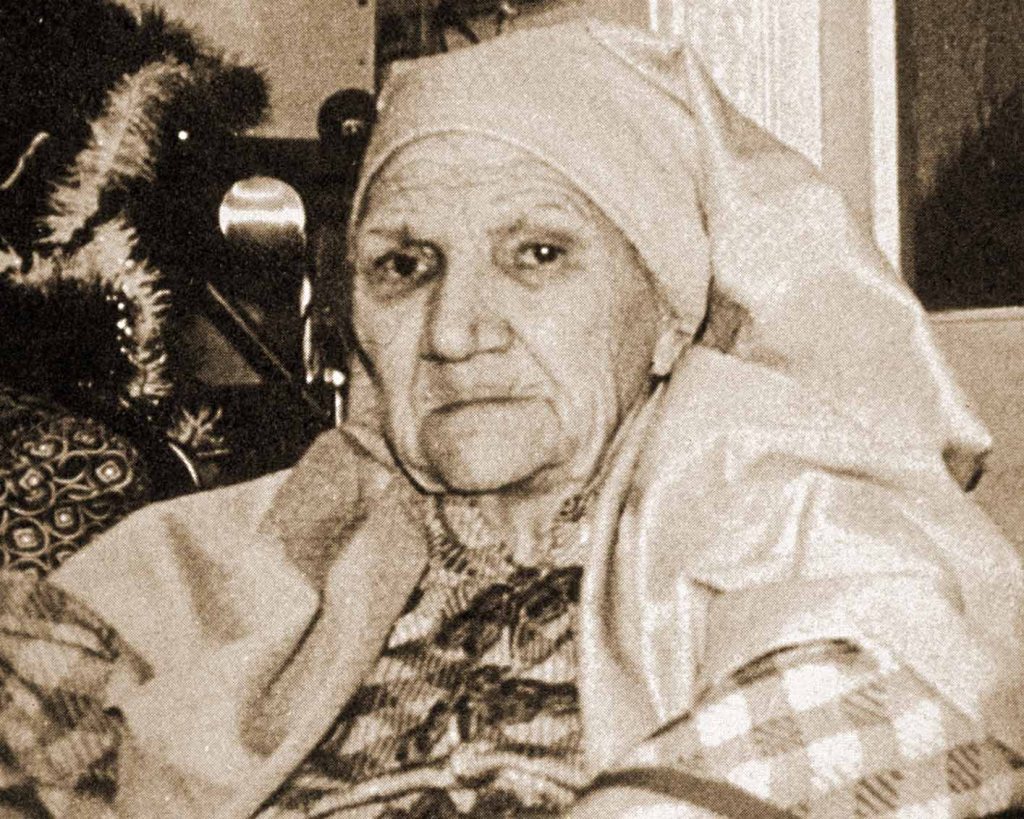
Carrie Buck in later life

March 17, 1968 Pandora’s Box

“The god Prometheus stole fire from heaven to give to the human race, which originally consisted only of men. To punish humanity, the other gods created the first woman, the beautiful Pandora. As a gift, Zeus gave her a box, which she was told never to open. However, as soon as he was out of sight she took off the lid, and out swarmed all the troubles of the world, never to be recaptured. Only Hope was left in the box, stuck under the lid. Anything that looks ordinary but may produce unpredictable harmful results can thus be called a Pandora’s box”. – Merriam-Webster.com

On March 4, 2018, a father and daughter enjoyed a meal at the Zizzi restaurant in the cathedral city of Salisbury, ninety miles southwest of London. Two hours before sunset, the two took ill.  A passing doctor and nurse found the couple unresponsive, on a park bench.

Skripal
Sergei and Yulia Skripal

Sergei Skripal, age 66, and his daughter Yulia (33) were slipping in and out of consciousness, foaming at the mouth with eyes wide open, but entirely white.  The Skripals were weeks in intensive care before regaining consciousness. In a May 23 interview with CBS News, Yulia said “I don’t want to describe the details, but the clinical treatment was invasive, painful and depressing.”

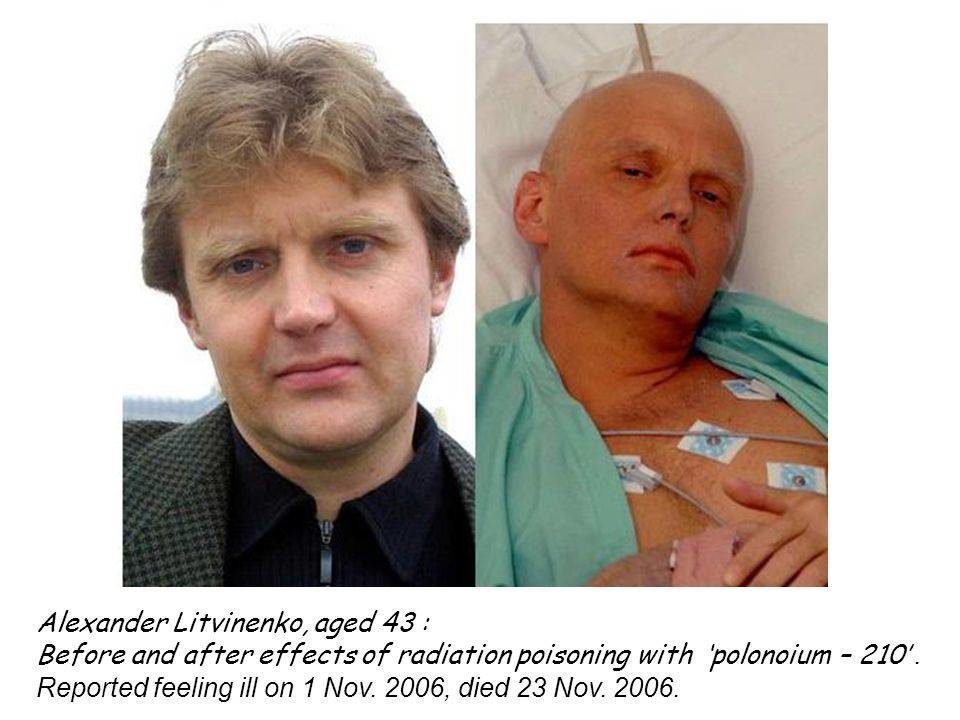
Like the Russian State Security operative turned defector Alexander Litvinenko before them, Sergei Skripal knew his former boss had a very long reach. In 2006, Litvinenko took ill on the streets of England, poisoned by the radioactive element Pollonium-210, slipped into his tea. Skripal it turns out was a former Russian military officer and double agent for British intelligence. Twelve years earlier Litvinenko suffered a long and terrible death. Skripal and his daughter recovered. The former spy is rumored to be living in New Zealand, under an assumed name.

British Prime Minister Theresa May expelled 23 Russian “diplomats” following the 2018 incident. While Vladimir Putin’s government vehemently denies the charge, the Skripal matter has been classified as an attempted assassination using the military grade nerve agent, Novichok.

The terrifying history of nerve agents began in 1936, when the German biochemist Dr. Gerhard Schrader was working on pesticides.  Dr. Schrader first experienced problems with his eyesight, and soon had difficulty breathing. Symptoms included involuntary muscular spasms. Within days the scientist’s arm was fully paralyzed.

Dr. Schrader had discovered a class of chemical compounds known as organo-phosphates.

Nerve agent final

Organo-phosphates are a class of organic chemical which block nerve signals to bodily organs. Nerve agents are generally clear to a golden amber in color, tasteless liquids which may be evaporated, into a gas. The Sarin gas used in the 1995 Aum Shinrikio attack on the Tokyo subway was odorless as was the VX used to assassinate the brother of Kim Jong-un, in 2017.

Symptoms of nerve agent poisoning begin with constriction of pupils and convulsions, leading to involuntary urination and defecation. Death follows within minutes caused by asphyxiation, or cardiac arrest.

In the 1950s, British chemist Dr. Ranajit Ghosh discovered the “V”series of organophosphate, sold as a pesticide in 1954 under the trade name Amiton. The stuff was soon judged too dangerous for safe use and taken off the market. British Armed Forces took control of the compound at Porton Downs and traded it to the United States in 1958, for information on thermo-nuclear weapons.

In 1961, the American military went into full-scale production of VX gas as a chemical weapon of war. The Soviet military developed an analog called VR in 1963 later developed into the Novichok group, including the most toxic molecules ever developed.

800px-Dugway_Proving_Ground
Dugway Proving Ground

The Dugway Proving Ground near Salt lake City Utah was established in 1941 and used for hundreds if not thousands of open-air tests of nuclear, biological and chemical (NBC) compounds.

A 1994 the US GAO (General Accounting Office) reported:

“From 1951 through 1969, hundreds, perhaps thousands of open-air tests using bacteria and viruses that cause disease in human, animals, and plants were conducted at Dugway … It is unknown how many people in the surrounding vicinity were also exposed to potentially harmful agents used in open-air tests at Dugway”.

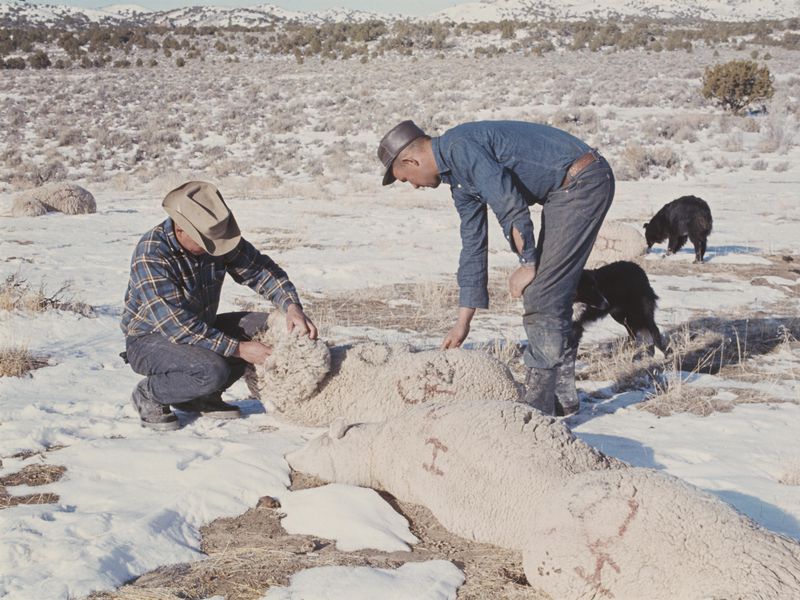
Skull Valley is a geologic formation bordering the Great Salt Lake Desert near Dugway, in the south of Utah. On March 17, 1968, the manager of a Skull Valley livestock company phoned the department of ecology and epidemiology at Dugway to report the unexplained death of 3,000 sheep.

The Dugway safety office compiled a count of 3,843 dead animals. Exact cause of death was at first difficult to determine, since “no other animals of any type, including cows, horses, dogs, rabbits, or birds, appeared to have suffered any ill effects, a circumstance that was hard to explain if VX had in fact caused the sheep deaths.”

gettyimages-595692841_master
View of two farmers checking the corpses of dead sheep on a farm ranch near the Dugway Proving Ground in Utah. (Rolls Press/Popperfoto/Getty Images) H/T Smithsonian.com

Necropsies revealed the presence of VX nerve agent, as did grass and snow samples taken, some three weeks after the incident.  Total sheep fatalities were counted at 6,000-6,400 including those humanely euthanized.  With even a suspicion of VX nerve agent, the animals had no market value whatsoever either for meat, or for wool.

Military Accidentally Ships Anthrax To Labs In Nine States

A report which remained classified for thirty years blamed a faulty nozzle left open as the test aircraft, gained altitude.

Public backlash was vehement against the US Army Chemical Corps, and nearly lead to its disbanding.  President Richard Nixon ordered a halt to open air testing of “NBC” agents, in 1969.

Few nations possess stockpiles of nerve agents, a hellish weapon of war which may, with a mere puff of wind, turn on those who would use it. The use of such an agent would almost certainly lead to nuclear retaliation should any nation so attacked, possess the capability.

Today on the morning news we hear of “scum” and “insects” who must be “purged” from the Russian nation. These are the pronouncements of the dictator Vladimir Putin, words we haven’t heard since the days of the Third Reich or the terrible monstrosity of Stalin’s USSR, words directed this time at Putin’s own countrymen, objectors to the war of aggression being carried out even now, against their neighbors in Ukraine.

The nations of the world release statements but stand at bay, fearful of the horrors as yet locked away in the darkness, of Pandora’s box. Like the hideous three-headed dog Cerberus standing guard at the gates of hell we shrink in horror at that terrible and yet benign sounding term, NBC. We hold a wolf by the ears, desperately afraid to hang on yet unable, to let go.

March 10, 1748 A Story of Redemption

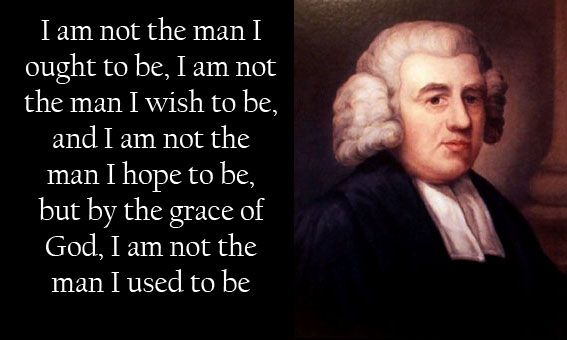
“I am not what I ought to be, I am not what I want to be, I am not what I hope to be in another world; but still I am not what I once used to be, and by the grace of God I am what I am” ― John Newton

It was the Golden Age of Greek history, a time when “[Men] lived like gods without sorrow of heart, remote and free from toil and grief…” according to the Greek poet, Hesiod. A time of Confucius and the Buddha in the east while the Olmec peoples ruled over much of South and Central America, a time when the Italian city-state of Rome overthrew a Monarch, to form a Republic.

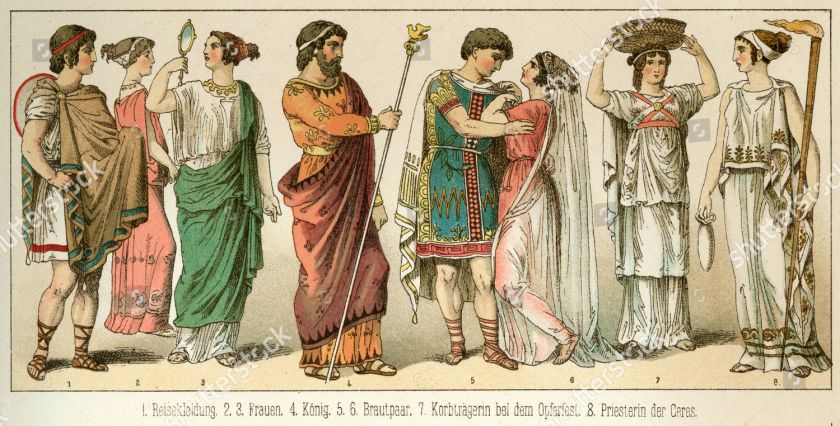
Ancient Greece Costume - circa 500 BC2,500 years ago, Bantu farmers on the African continent fanned out across the land as the first Africans penetrated the dense rain forests of the equator, to take up a new life on the west African coast.
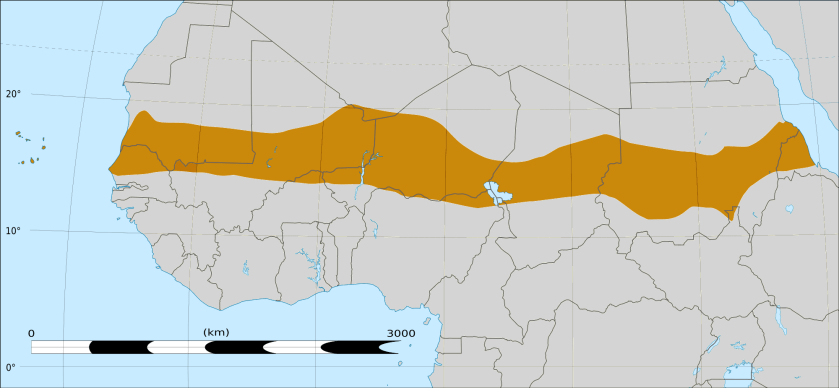
The Islamic crusades of the 7th and 8th centuries turned much of the Maghreb (northwest Africa) to Islam and displaced the Sahelian kingdoms of the sub-Saharan grasslands.   The hunters, farmers and traders of Coastal Africa remained free to make their own way, isolated by those same rain forests from the jihads and other violence of the interior.

Sahel_Map-Africa_rough
Sahelian Kingdoms of Sub-Saharan Africa

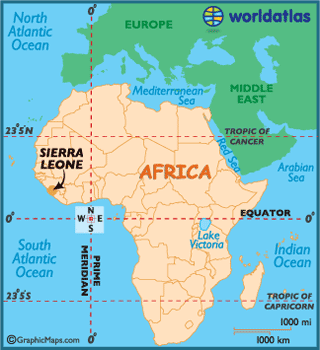
The first European contact came around 1462 when the Portuguese explorer Pedro de Sintra mapped the hills surrounding modern Freetown Harbour, naming an oddly shaped formation Serra Lyoa (Lioness Mountain).

ded91e87f93966f1ffcbc100d634a97d

Home to one of the few safe harbors on the surf-battered “windward coast”, Sierra Leone soon became a favorite of European mariners, some of whom remained for a time while others came to stay, intermarrying with local women.

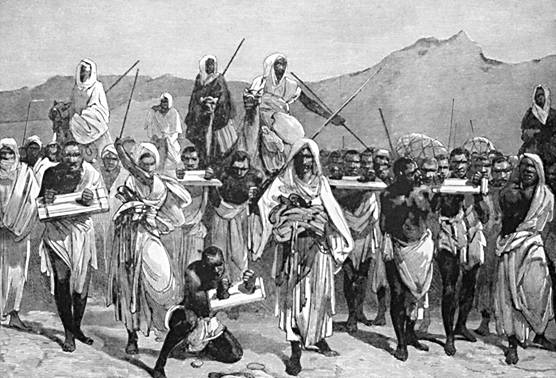
From the 6th century to a peak of around 1350, Arab slave traders conducted a rich trans-Saharan trade in human beings.

According to the Guyanese historian Walter Rodney, slavery among and between the African peoples of Sierra Leone appears to be rare at this time. Portuguese mariners kept detailed records and would have described such a thing though there was a particular kind of “slavery” in the region: “A person in trouble in one kingdom could go to another and place himself under the protection of its king, whereupon he became a “slave” of that king, obliged to provide free labour and liable for sale“.Arabslavers (1)While this type of “slave” retained rudimentary rights at this time, those unfortunate enough to be captured by Dutch, English and French slavers, did not.
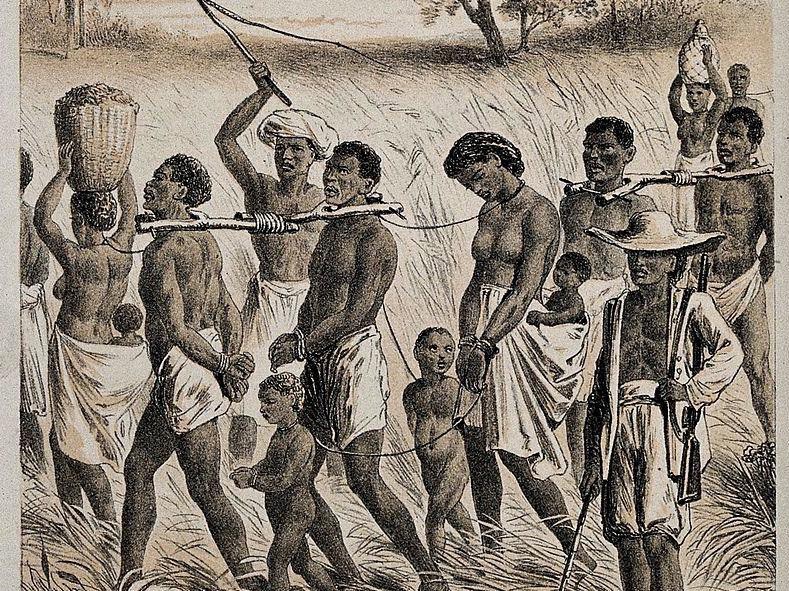
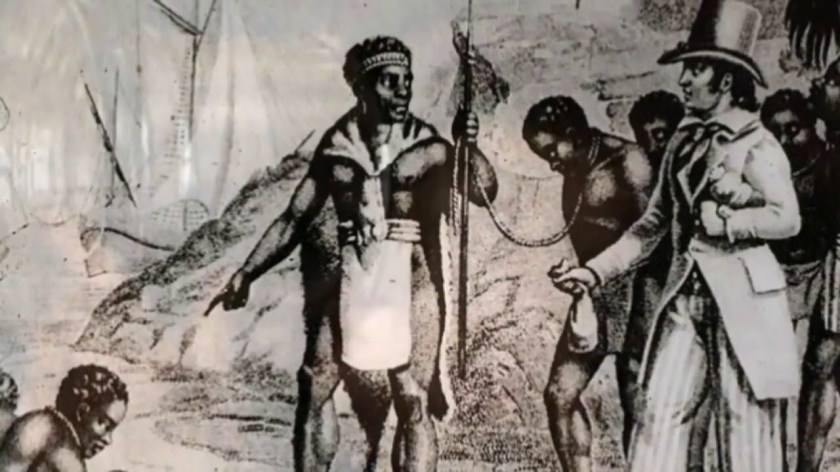
It wasn’t long before coastal kidnapping raids gave way to more lucrative opportunities.  Some chieftains were more than happy to “sell” the less desirable members of their own tribes while others made a business out of war, taking prisoners to be traded for a fortune in European goods, including muskets.

While slave “owners” were near-exclusively white and foreign at this time, the late 18th century was a time of rich and powerful African chieftains, many of whom owned large numbers of slaves, of their own.1_bUM2OMXstOAZukyNAc8oFgThis was the world of John Newton, born July 24 (old style) 1725 and destined for a life, in the slave trade.
The son of a London shipmaster in the Mediterranean service, Newton first went to sea with his father at age 11 and logged six such voyages before the elder Newton retired, in 1742.

His was a wild youth, the life of a sailor bent on drinking and raising hell. That was all brought up short in 1743, when Newton was captured and “pressed” into service with the 50-gun HMS Harwich and given the rank, of midshipman.

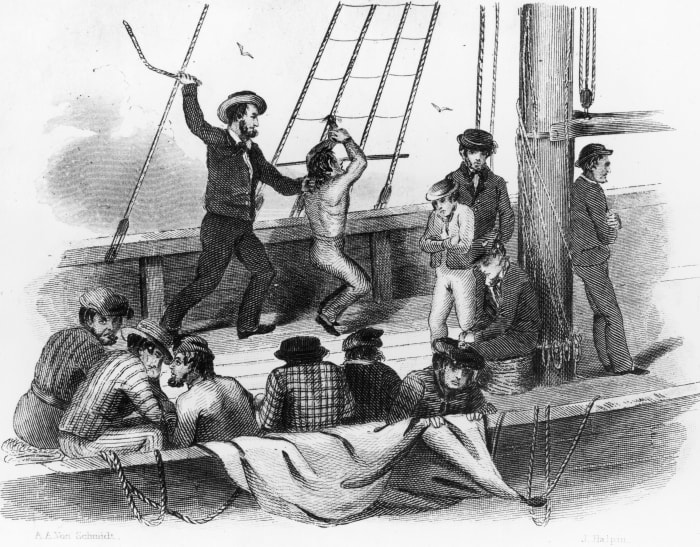
The teenager hated everything about the naval service and tried to desert, earning himself a flogging for his trouble.

Eight. Dozen. Lashes. Imagine for a moment, enduring something like that.

Reduced to the rank of common seaman Newton was disgraced, wounded and humiliated. He vowed to murder the captain and hurl himself overboard but it wasn’t meant to be. The wounds healed over in time and, with the Harwich enroute to India, Newton transferred to the slave ship Pegasus, bound for West Africa.

Pegasus would trade goods for slaves in Sierra Leone to be shipped to colonies in the Caribbean and North America.maxresdefault (28)Newton hated life on the Pegasus as much as his shipmates, hated him. In 1745 he was abandoned in West Africa with a slave trader, named Amos Clowe. Newton was now himself a slave, given by Clowe to his wife Princess Peye of the Sherbro tribe, of Sierra Leone.  Peye treated Newton as badly as she treated any of her other slaves, treatment as wretched as that meted out to the human beings who had fallen into his own hands, as a slave trader. Newton himself later described these three years as “once an infidel and a libertine, [now] a servant of slaves in West Africa”.

Rescued in 1748 by his father’s request, Newton was returning to England aboard the merchant ship Greyhound when he experienced a spiritual awakening. Caught in a dreadful storm off Donegal, Greyhound seemed doomed when a great hole opened in her hull. Newton prayed for the mercy of God when a load somehow shifted, party blocking the hole. With pumps operating around the clock, the storm died down. Greyhound made port in Lough Swilly, Ireland, four weeks later.

With this conversion, John Newton had come to accept the doctrines of Evangelical Christianity.  On March 10, 1748 he swore off liquor, gambling and profanity.  For the rest of this life he would regard this day, as a turning point.

March 10, 1748 Amazing Grace

There’s a popular story that Newton’s life was changed then and there but it didn’t work out that way. Those hours of despair on board the Greyhound were an awakening, yes, but Newton would return to the slave trade. Even after the 1754 stroke which ended his seafaring career, he still invested in slaving operations.

His was a gradual conversion.  “I cannot consider myself to have been a believer in the full sense of the word” he later said, “until a considerable time afterwards.”

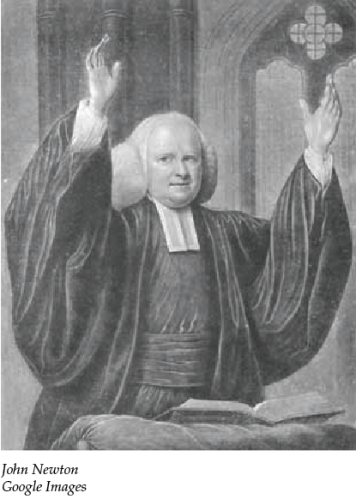
While working as tax collector in the Port of Liverpool, Newton studied Greek, Hebrew and Syriac, preparing himself for serious religious studies. In 1757 he applied to become an ordained minister, of the Anglican Church. Seven years would come and go when the lay minister applied with Methodists, Independents and Presbyterians.  He was ordained a priest of the Anglican church on April 29, 1764.

Screen shot 2013-11-21 at 11.02.31 PM

Moving to London in 1780 as the Rector of St. Mary Woolnoth church, Newton became involved with the Committee for the Abolition of the Slave Trade.

In 1788 he broke a long silence on the subject to take a forceful stand, against the “peculiar institution“. 

In his Thoughts Upon the African Slave Trade, Newton writes: “So much light has been thrown upon the subject…for the suppression of a traffic, which contradicts the feelings of humanity; that it is hoped, this stain of our National character will soon be wiped out.”

Newton apologized for his past in “a confession, which … comes too late … It will always be a subject of humiliating reflection to me, that I was once an active instrument in a business at which my heart now shudders.

The tract went on to two printings, describing the hideous conditions on board the slave ships and leading to an act of Parliament abolishing the slave trade, in 1807.67452William Cowper was an English poet and hymnist who came to worship in Newton’s church, in 1767.  The pair collaborated on a book of Newton’s hymns including “Glorious Things of Thee Are Spoken,” “How Sweet the Name of Jesus Sounds!,” “Come, My Soul, Thy Suit Prepare” and others.
“I am still in the land of the dying; I shall be in the land of the living soon”.  His last words

John Newton was a drunk, a carousing sailor and a slave trader who saw the light and left us one of the great hymns, of the last quarter-millennium.

Amazing grace, how sweet the sound,
that saved a wretch like me.
I once was lost, but now am found,
Was blind but now I see.

August 20, 1938 A Class Act

Gehrig briefly rejoined the Yankees in Washington, D.C., after the diagnosis. He was greeted by a group of Boy Scouts at Union Station, happily waving and wishing him luck. Gehrig waved back, but leaned forward to a reporter. “They’re wishing me luck”, he said, “and I’m dying.”


The Lane Tech High school baseball team was at home on June 26, 1920. 10,000 spectators assembled to watch the game at Cubs Park, now Wrigley Field. New York’s Commerce High was ahead 8–6 in the top of the 9th, when a left handed batter hit a grand slam out of the park. No 17-year-old had ever hit a baseball out of a major league park before, and I don’t believe it’s happened, since. The nation was about to know the name, of Lou Gehrig.

lou-gehrig-columbia

Gehrig was pitching for Columbia University against Williams College on April 18, 1923, the day Babe Ruth hit the first home run out of the brand new Yankee Stadium. Columbia would lose the game but Gehrig struck out seventeen batters that day, to set a team record.

The loss didn’t matter to Paul Krichell, the Yankee scout who’d been following Gehrig. Krichell didn’t care about the arm either, as much as he did that powerful, left-handed bat. He had seen Gehrig hit some of the longest home runs ever seen on several Eastern campuses, including a 450-foot home run at Columbia’s South Field that cleared the stands and landed at 116th Street & Broadway.

lou-gehrig-97280682
Lou Gehrig played Fullback for Columbia during the 1922 season

New York Giants manager John McGraw persuaded a young Gehrig to play pro ball under a false name, Henry Lewis, despite the fact that it could jeopardize his collegiate sports eligibility. He played only a dozen games for the Hartford Senators before being found out, and suspended for a time from college ball. This period, and a couple of brief stints in the minor leagues in the ’23 and ’24 seasons, were the only times Gehrig didn’t play for a New York team.

Gehrig started as a pinch hitter with the New York Yankees on June 15, 1923. He came into his own in the ‘26 season, in 1927 he batted fourth on “Murderers’ Row”; the first six hitters in the Yankee’s batting order: Earle Combs, Mark Koenig, Babe Ruth, Lou Gehrig, Bob Meusel and Tony Lazzeri.

He had one of the greatest seasons of any batter in history that year, hitting .373, with 218 hits: 52 doubles, 18 triples, 47 home runs, a then-record 175 RBIs, with a .765 slugging percentage. Gehrig’s bat helped the 1927 Yankees to a 110–44 record, the American League pennant, and a four game World Series sweep of the Pittsburgh Pirates.

00gehrig60-superJumbo
“Gehrig with his parents, Christina and Heinrich, in 1938. The three lived together in the house until Gehrig got married in 1933”. Hat tip, New York Daily News

Gehrig was the “Iron Horse”, playing in more consecutive games than any player in history. It was an “unbreakable” record, standing for 56 years, until surpassed in 1995 by Cal Ripken, Jr.

Gehrig hit his 23rd major league grand slam on August 20 1938, a record which would stand until fellow “Bronx Bomber” Alex Rodriquez tied it, in 2012.

This was the last one.

Gehrig collapsed in 1939 spring training, and went into an abrupt decline early in the season. Sports reporter James Kahn wrote: “I think there is something wrong with him. Physically wrong, I mean. I don’t know what it is, but I am satisfied that it goes far beyond his ball-playing”.

lou-gehrigThe Yankees were in Detroit on May 2 when Gehrig told manager Joe McCarthy “I’m benching myself, Joe”. It’s “for the good of the team”. McCarthy put Babe Dahlgren in at first and the Yankees won 22-2 but that was it. The Iron Horse’s streak of 2,130 consecutive games, had come to an end.

ny_50yankess_02Gehrig left the team in June, arriving at the Mayo Clinic on the 13th. The diagnosis of Amyotrophic Lateral Sclerosis (ALS) was confirmed six days later, on June 19. It was his 36th birthday. It was a cruel prognosis: rapidly increasing paralysis, difficulty in swallowing and speaking and a life expectancy, of fewer than three years.
Gehrig briefly rejoined the Yankees in Washington, D.C. He was greeted by a group of Boy Scouts at Union Station, happily waving and wishing him luck. Gehrig waved back, but leaned forward to a reporter. “They’re wishing me luck”, he said, “and I’m dying.”

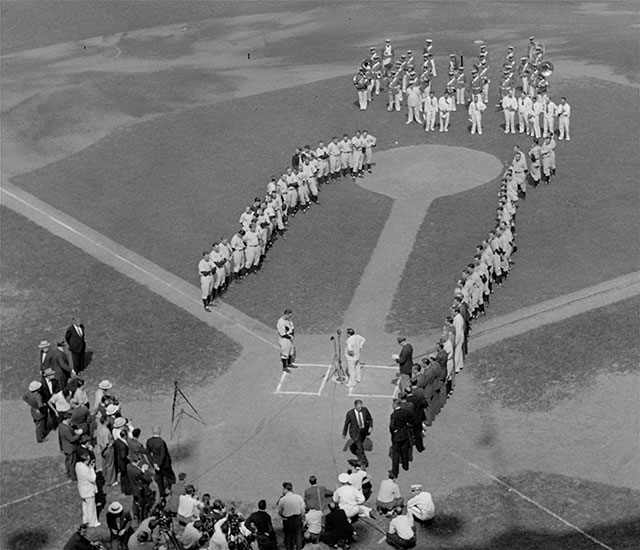
Gehrig appeared at Yankee Stadium on “Lou Gehrig Appreciation Day”, July 4, 1939, his once mighty body now so weakened, as to barely be able to stand upright.  Only two months earlier, manager Joe McCarthy had asked Babe Dahlgren to take the Iron Horse’s position.  Now he asked the 1st baseman to look out for his dying teammate.  “If Lou starts to fall, catch him.”

Gehrig was awarded a series of trophies and other tokens of affection by the New York sports media, fellow players and groundskeepers. He would place each one on the ground, already too weak to hold them.

2018_07_loug2

As the event drew to a close, Master of Ceremonies Sid Mercer asked for a few words.  Overwhelmed and struggling for control, Gehrig waved him off.  The New York Times later wrote, “He gulped and fought to keep back the tears as he kept his eyes fastened to the ground”.  62,000 fans would have none of it.  The chant went up.  “We want Lou!” We want Lou!”

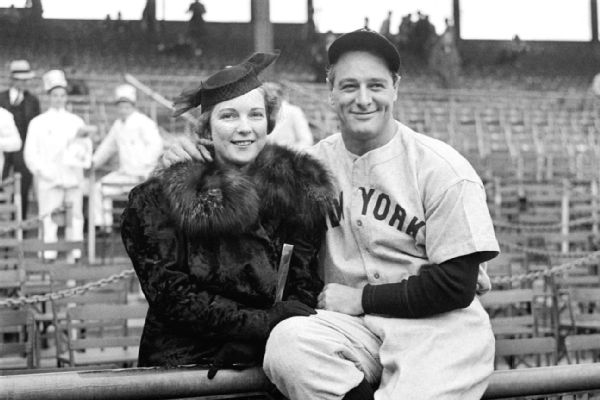
Eleanor Gehrig, a “tower of strength” throughout her husband’s ordeal, watched from a box seat.  New York Daily News reporter Rosaleen Doherty wrote that she did not cry, “although all around us, women and quite a few men, were openly sobbing.”

mlb_a_gehrig1x_600x400

At last, Lou Gehrig shuffled to the microphone, and began to speak. “For the past two weeks, you’ve been reading about a bad break.”  As if the neurodegenerative disease destroying his body, was merely a “bad break.” He looked down and paused, as if trying to remember what to say.  And then he delivered the most memorable line, of his life.

“Today, I consider myself the luckiest man on the face of the earth.”

Henry Louis Gehrig died on June 2, 1941.  He was 37.

I drove by Yankee Stadium a while back, and I thought of Lou Gehrig. It was right after the Boston Marathon bombing, in 2013. The sign out front said “United we Stand” and beside it, a giant Red Sox logo. That night, thousands of Yankees fans interrupted a game with the Arizona Diamondbacks, to belt out Neil Diamond’s “Sweet Caroline,” a staple of Red Sox home games, since 1997.

Copy-of-BostonBombingNYYankeesSign

I’ve always been a Boston guy myself. I think I’m required by Massachusetts law to hate the Yankees. But seriously.  What a class act…

June 30, 1917 A Bit of Comfort

Imagine if you will a world of trench warfare. A world of mud and rats where instant and violent death is an ever-present possibility. A world of lice and disease and the stink of millions of men in the open, both dead and alive. A world capable of producing psychological trauma on an industrial scale. Now imagine just for a moment, a bit of home made comfort steps into that world.

For a variety of reasons, the eastern front of the “War to end all Wars” was a war of movement. Not so in the West.  As early as October 1914, combatants burrowed into the ground like animals sheltering from what Private Ernst Jünger would come to call, the ‘Storm of Steel’.

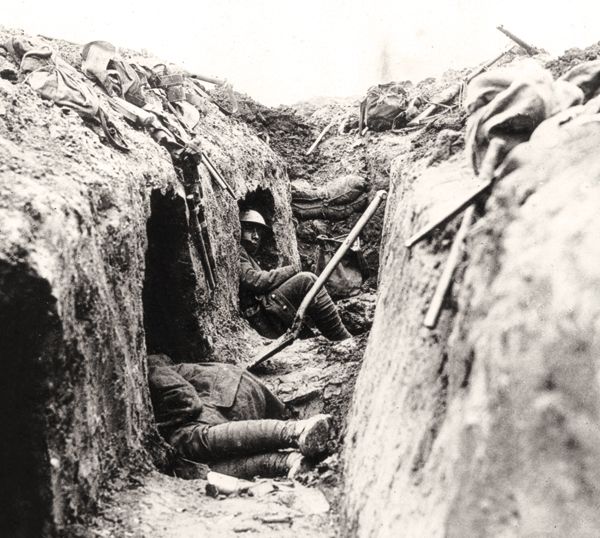
Conditions in the trenches and dugouts must have defied description. You would have smelled the trenches long before you could see them. The collective funk of a million men and more, enduring the troglodyte existence of men who live in holes. Little but verminous scars in the earth teaming with rats and lice and swarming with flies. Time and again the shells churned up and pulverized the soil, the water and the shattered remnants of once-great forests, along with the bodies of the slain.

7dbc338da7b95e8f133e78356ad14912

By the time the United States entered the ‘War to end all Wars’ in April, 1917, millions had endured three years of this existence. The first 14,000 Americans arrived ‘over there’ in June, the American Expeditionary Forces (AEF) forming on July 5. American troops fought the military forces of Imperial Germany alongside their British and French allies, others joining Italian forces in the struggle against the Austro-Hungarian Empire.

You couldn’t call the stuff these people lived in mud – it was more like a thick slime, a clinging, sucking ooze capable of swallowing grown men, even horses and mules, alive.

Captain Alexander Stewart wrote “Most of the night was spent digging men out of the mud. The only way was to put duck boards on each side of him and work at one leg: poking and pulling until the suction was relieved. Then a strong pull by three or four men would get one leg out, and work would begin on the other…He who had a corpse to stand or sit on, was lucky”.

Sir Launcelot Kiggell broke down in tears, on first seeing the horror of Paschendaele, . “Good God”, he said. “Did we really send men to fight in That?”

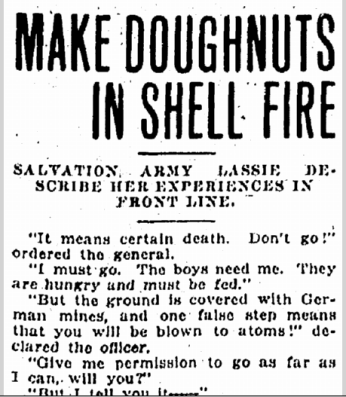
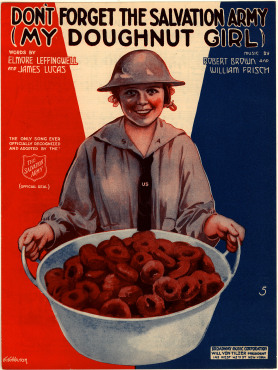
kalamazoo-gazette-newspaper-0518-1919-wwi-donuts-salvation-army

Unseen and unnoticed in times of such dread calamity, are the humanitarian workers. Those who tend to the physical and spiritual requirements and the countless small comforts, of those so afflicted.

Within days of the American declaration of war, Evangeline Booth, National Commander of the Salvation Army, responded, saying “The Salvationist stands ready, trained in all necessary qualifications in every phase of humanitarian work, and the last man will stand by the President for execution of his orders”.

These people are so much more than that donation truck, and the bell ringers we see behind the red kettles, every December.

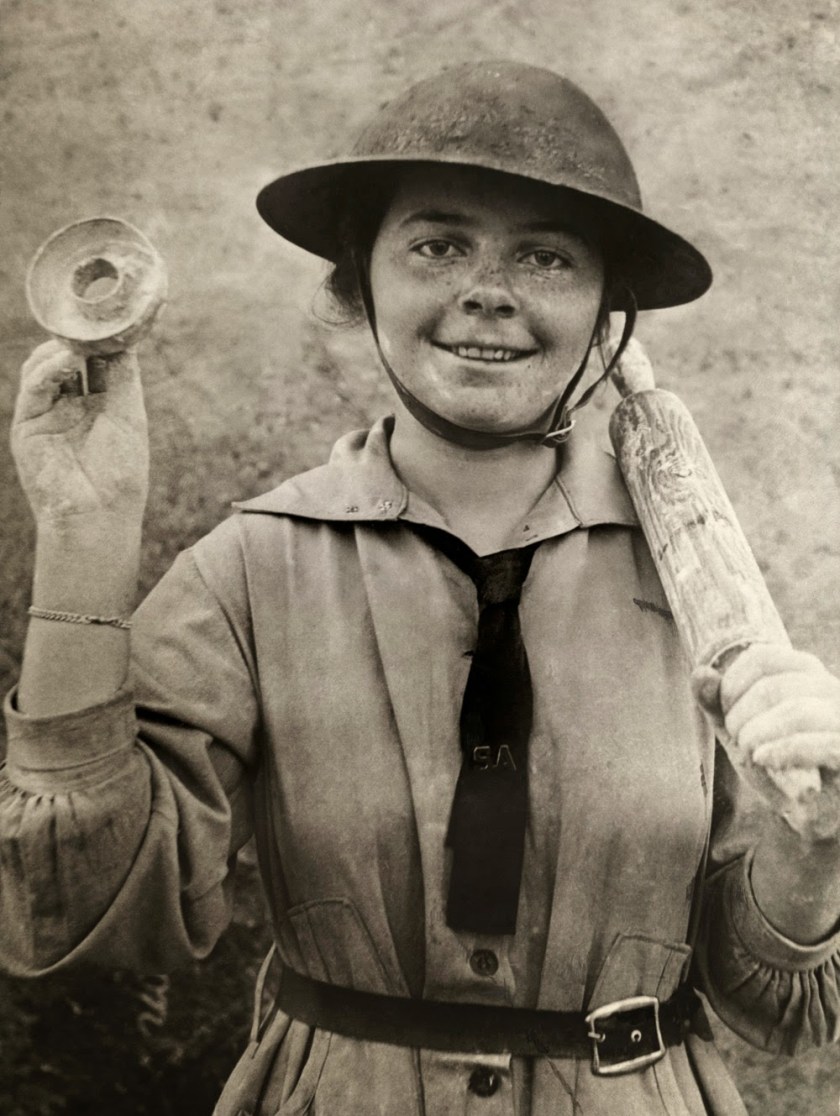
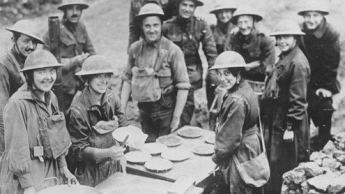
wwi-doughnut-girls-2

Lieutenant Colonel William S. Barker of the Salvation Army left New York with Adjutant Bertram Rodda on June 30, 1917, to survey the situation. It wasn’t long before his not-so surprising request came back in a cable from France. Send ‘Lassies’.

wwi-doughnut-girls-7

A small group of carefully selected female officers was sent to France on August 22. That first party comprised six men, three women and a married couple. Within fifteen months their number had expanded by a factor of 400.

In December 1917, a plea for a million dollars went out to support the humanitarian work of the Salvation Army, the YMCA, YWCA, War Camp Community Service, National Catholic War Council, Jewish Welfare Board, the American Library Association and others. This “United War Work Campaign” raised $170 million in private donations, equivalent to $27.6 billion, today.

roads_donutGirl2

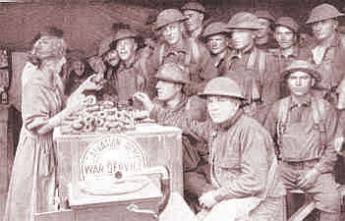
‘Hutments’ were formed all over the front, many right out at the front lines.  There were canteen services.  Religious observances of all denominations were held in these facilities. Concert performances were given, clothing mended and words of kindness  offered in response to all manner of personal problems.  On one occasion, the Loyal Order of Moose conducted a member initiation. Pies and cakes were baked in crude ovens and lemonade served to hot and thirsty troops.

Of all these corporal works of mercy, the ones best remembered by the ‘doughboys’ themselves, were the doughnuts.

how-to-make-doughnuts

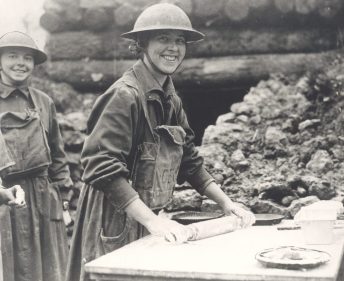
Helen Purviance, sent to France in 1917 with the American 1st Division, seems to have been first with the idea. An ensign with the Salvation Army, Purviance and fellow ensign Margaret Sheldon first formed the dough by hand, later using a wine bottle in lieu of a rolling pin. Having no doughnut cutter at the time, dough was shaped and twisted into crullers, fried seven at a time in a lard-filled helmet, on a pot-bellied wood stove.

1066cc6f-b94f-4d16-8d5d-add6c976e39c_World+War+I+-+Frying+Doughnuts

The work was grueling. The women worked well into the night that first day, serving all of 150 hand-made doughnuts. “I was literally on my knees,” Purviance recalled, but it was easier than bending down all day, on that tiny wood stove. It didn’t seem to matter. Men stood in line for hours, patiently waiting in the mud and the rain of that world of misery, for their own little piece of warm, home-cooked heaven.

doughnuts-top-slider

Techniques gradually improved and it certainly helped, when these there was a real pan to cook in. These ladies were soon turning out 2,500 to 9,000 doughnuts a day. An elderly French blacksmith made Purviance a doughnut cutter, out of a condensed milk can and a camphor-ice tube, attached to a wooden block.

Before long the pleasant aroma of hot doughnuts could be detected, wafting all over the dugouts and trenches of the western front.  Salvation Army volunteers and others made apple pies and all manner of other goodies, but the name that stuck, was “Doughnut Lassies”.

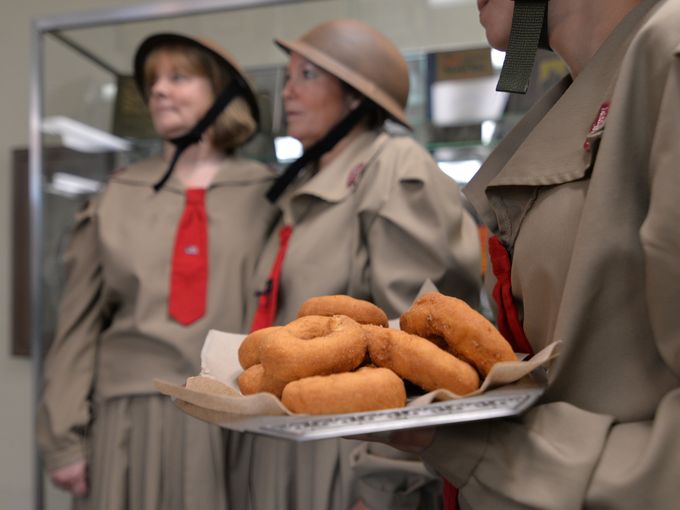
636320189957957314-20flvp-donut-girls
June 2, 2017 – Salvation Army employees Cheryl Freismuth (l) and Susan Klyk (c) celebrate the 100th anniversary of the “Doughnut Lassies” of WW1 with student Catie McDougall (r). H/T The Detroit News

One New York Times correspondent wrote in 1918 “When I landed in France I didn’t think so much of the Salvation Army; after two weeks with the Americans at the front I take my hat off… [W]hen the memoirs of this war come to be written the doughnuts and apple pies of the Salvation Army are going to take their place in history”.

Contrary to popular myth the doughnut was not invented in WW1. Neither was the name for soldiers of the Great War although millions of “doughboys” returned from ‘over there’ requesting wives, mothers sweethearts and local bakeries make their newfound favorite confection. Russian émigré Adolph Levitt invented the first doughnut machine in 1920. The round cake with the hole in the middle, has never looked back.

If you’re interested, the Doughnut Lassies’ original WW1 recipe may be found, HERE. Let me know how they come out.

May 10, 1940 And What of the Mouse?

Throughout history and across cultures, having a child with a member of a hostile force is looked upon as a grave betrayal of social values.

Throughout history and across cultures, having a child with a member of a hostile force is looked upon as a grave betrayal of social values.  Often such parents, usually women, are shunned by neighbors and even family.  “War children” may experience even worse subjected to ostracism, bullying, and more.

Much is written of what takes place, when politicians send nations to war. Few take note of the innocents. The proverbial mice wishing only to go about their business while all about them, is chaos.

“When elephants fight, it is the grass that suffers”.

African Proverb

On the Eastern Front of World War 2, combat between Nazi Germany and the Soviet Union rose to proportions of apocalyptic race war, Slav against Teuton, in a paroxysm of mutual extermination that is horrifying, even by the hellish standards of that war.  Four out of every five German soldiers who died in all World War 2, died on the ‘Ostfront’.

While precise numbers are impossible to ascertain, an estimated several hundred thousand to as many as 2 million German females from 8 to 80 were raped by Red Army soldiers. Some, as many as 60 or 70 times according to historian, William Hitchcock.. Austrian women were no different nor even Soviet women, released from work camps. 

“The front-line Russian troops who did the fighting – as a woman, you didn’t have to be afraid of them. They shot every man they saw, even old men and young boys, but they left the women alone. It was the ones who came afterwards, the second echelon, who were the worst. They did all the raping and plundering. They stripped homes of every single possession, right down to the toilets”.

Anonymous German woman, living in Berlin

British military historian Antony Beevor concludes that 1.4 million women were raped in East Prussia, Pomerania and Silesia, alone. Female deaths in connection with such rapes in Germany and the butchered abortion attempts which followed, are estimated at 240,000. 4,148 Red Army soldiers were punished for such atrocities.

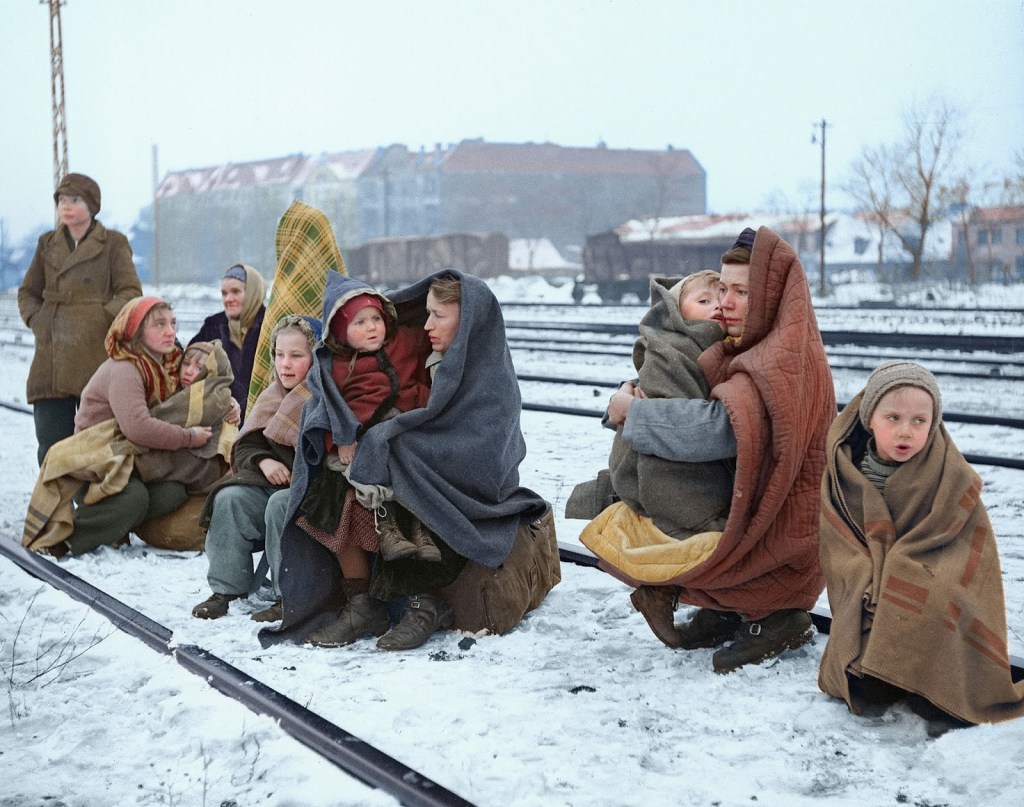
The only survivors of 150 Polish people who walked from Lodz, Poland to Berlin Huddle in blankets, on December 14, 1945. They are waiting by a railway track hoping to be picked up by a British army train and given help. (Fred Ramage—Keystone/Getty Images / Photo colorization by Sanna Dullaway for TIME)

When Yugoslav politician Milovan Djilas complained about rapes in Yugoslavia, Stalin replied that he should “understand it if a soldier who has crossed thousands of kilometres through blood and fire and death has fun with a woman or takes some trifle.”

Small surprise when Stalin’s own Chief of the Secret Police Lavrentiy Beria, was a serial rapist.

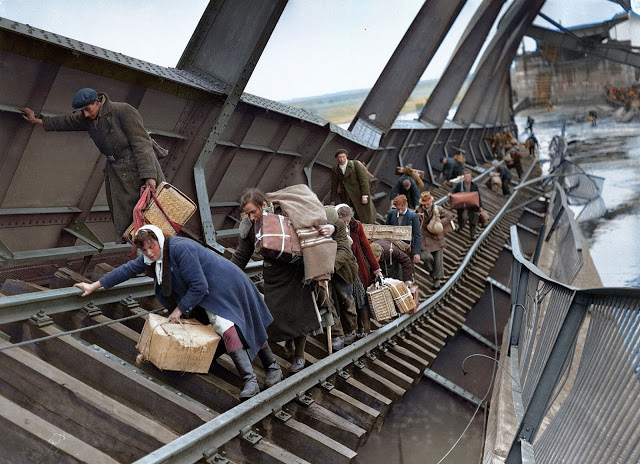
Displaced persons cross a bridge on the River Elbe at Tangermunde, which was blown up by the Germans, to escape the chaos behind German lines caused by the approach of the advancing Russians on May 1, 1945. (Fred Ramage—Keystone/Getty Images / Photo colorization by Sanna Dullaway for TIME)

In his 2007 book Taken by Force: Rape and American GIs in Europe in World War II, Northern Kentucky University sociology and criminology professor J. Robert Lilly reports that 11,040 rapes were carried out by US servicemen.

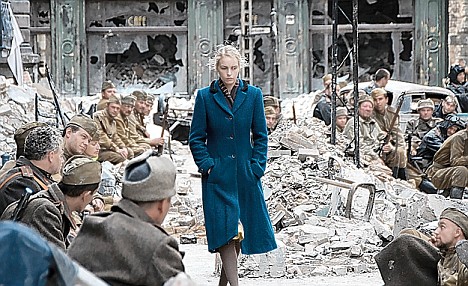
In 1959, journalist Marta Hillers wrote what was then an anonymous memoir of the weeks between April 22 and June, 1945. In it, Hillers describes being gang raped by Red Army soldiers before forming a relationship with a Soviet officer, for her own protection. Marta Hillers died in 2001. Seven years later, her account was retold in the German feature film, Eine Frau in Berlin. (A Woman in Berlin).

German woman walks by Soviet troops in a scene from the 2008 film, A Woman in Berlin

Propaganda banners and posters appeared all over the Soviet-occupation zone and later East Germany, proclaiming the heroism of those who had smashed the Nazi war machine and paved the way to Soviet-German friendship. The plight of tens of thousands of “Russian children”, mostly fatherless, was taboo.

All these decades later, former East German Jan Gregor can still remember the day his mother told him that she was “made pregnant by force”.

An estimated 100,000 “Amerasian” children were born to Asian mothers and U.S. servicemen during WWII, the Korean War, and war in Vietnam. 

Some 37,000 children were fathered by American soldiers with German and Austrian women in the 10 years following the German surrender. Locals disapproved of such relations, not only because these Americans had recently been their enemies, but also because such children often became “wards of the state” in local economies already impoverished, by war.  The “brown children” of black GIs and German mothers were particularly difficult to adopt out in what was heretofore a racially homogeneous culture.  Many were adopted by American couples and families of African ancestry, back in the States.

Military forces of Nazi Germany invaded the neutral Scandinavian Kingdoms of Denmark and Norway on April 9, 1940.  Denmark fell in a day. Norwegian armed resistance ceased within two months, when civil rule passed to the Reichskommissariat Norwegen (Reich Commissariat of Norway).  The neutral Scandinavian countries remained under Wehrmacht occupation, for the next five years.

Sometimes, relationships formed between German occupying troops and native women.  The racially obsessed Nazi regime was happy to encourage such relations, particularly in Norway, where local women were considered to be of pure, “Aryan” ancestry.  Some such relationships were consensual.  Many were anything but.  Some 10,000 to 12,000 children were born to Norwegian women and German fathers, the most famous being Anni-Frid Synni Lyngstad of the Swedish pop group ABBA, who fled Norway after the war for fear of reprisals.

For nearly a thousand years, the administration of Iceland was all but indistinguishable from that of Denmark and Norway.  The Act of Union established Iceland as a fully sovereign state in 1918, an independent country in a personal union through a common monarch, with the Kingdom of Denmark. 

Following the allied withdrawal from Dunkirk, every nation on the European mainland was either neutral, or under Nazi occupation. Alarmed at the possibility of German military presence to their north, British authorities invited the neutral nation Iceland to join the war as “as a belligerent and an ally,” following the collapse of Denmark. That invitation, was rejected.

On this day in 1940, the United Kingdom invaded Iceland, an initial force of 746 British Royal Marines disembarking at the Icelandic capital of Reykjavík. 

The British invasion of Iceland never resembled the “shooting war” in Europe.  The government complained that its neutrality had been “flagrantly violated” and demanded compensation, but principle opposition took the form of hordes of civilians, who crowded in to see what was happening.  Icelandic public opinion was sharply divided at the invasion and subsequent occupation.  Many described it all as the “blessað stríðið“, the “Lovely War”, the building of a roads, hospitals, harbors, airfields and bridges across the nation a boon to the Icelandic economy.  Others resented the occupation, which rose to half the native male population.

Sexual relationships between foreign troops and local women were severely frowned upon. Such women often accused of being traitors, even prostitutes. 

In 1941, the Icelandic Minister of the Judiciary investigated “The Situation”.  Upset that foreign troops were “taking away” women from friends and family, police investigated over 500 women for sexual with soldiers and determined, most had been consensual.  Two facilities opened to house such women in 1942 but both closed, within a year. Two-hundred fifty-five ástandsbörn (‘children of the situation’) were born of such relationships.  332 Icelandic women married foreign soldiers.

It has been said that, when governments make war, it’s the everyday Joe and the Nigel, the Fritz, Pierre and the Ivan down the street, who must do the fighting, the bleeding, and the dying.  It may well be added. It’s usually left to the mice, to pick up the pieces.

May 9, 1914 Mother’s Day

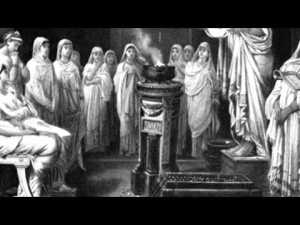
In ancient Rome, women partook of a festival, strictly forbidden to Roman men. So strict was this line of demarcation that only women were permitted even to know the name of the deity.  For everyone else she was simply the “Good Goddess”. The Bona Dea.

The earliest discernible Mother’s day comes down to us from 1200-700BC, descending from the Phrygian rituals of modern day Turkey and Armenia. “Cybele” was the great Phrygian goddess of nature, mother of the Gods, of humanity, and of all the beasts of the natural world, her cult spreading throughout Eastern Greece with colonists from Asia Minor.

Much of ancient Greece looked to the Minoan Goddess Rhea, daughter of the Earth Goddess Gaia and the Sky God Uranus, mother of the Gods of Olympus. Over time the two became closely associated with the Roman Magna Mater, each developing her own cult following and worshipped through the period of the Roman Empire.

Women in Rome

In ancient Rome, women partook of a festival, strictly forbidden to Roman men. So inflexible was this line of demarcation that only women were permitted even to know the name of the deity.  For everyone else she was simply the “Good Goddess”. The Bona Dea.

In the sixteenth century, it became popular for Protestants and Catholics alike to return to their “mother church” whether that be the church in which they were baptized, the local parish church, or the nearest cathedral. Anyone who did so was said to have gone “a-mothering”. Domestic servants were given the day off and this “Mothering Sunday”, the 4th Sunday in Lent, was often the only time when whole families could get together. Children would gather wild flowers along the way, to give to their own mothers or to leave in the church. Over time the day became more secular but the tradition of gift giving continued.

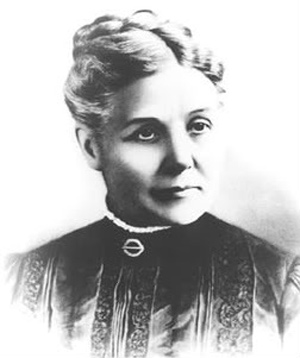
Ann Maria Reeves Jarvis

Ann Maria Reeves Jarvis was a social activist in mid-19th century western Virginia.  Pregnant with her sixth child in 1858, she and other women formed “Mothers’ Day Work Clubs”, to combat the health and sanitary conditions which were leading at that time to catastrophic levels of infant mortality.  Jarvis herself gave birth between eleven and thirteen times in a seventeen year period.  Only four would live to adulthood.

Jarvis had no patience for the sectional differences that led the nation to Civil War, or which led her own locality to secede and form the state of West Virginia in order to rejoin the Union.  Jarvis refused to support a measure to divide the Methodist church into northern and southern branches.  She would help Union and Confederate soldier alike if she could.  It was she alone who offered a prayer when others refused for Thornsbury Bailey Brown, the first Union soldier killed in the vicinity.

Anna Jarvis
Anna Jarvis

Following Jarvis’ death in 1905, her daughter Anna conceived of Mother’s Day as a way to honor her legacy, and to pay respect for the sacrifices all mothers make on behalf of their children.

Obtaining financial backing from Philadelphia department store owner John Wanamaker, Anna Jarvis organized the first official Mother’s Day celebration at a Methodist church in Grafton, West Virginia. That same day, thousands attended the first Mother’s Day event at Wanamaker’s store in Philadelphia.

Anna Jarvis resolved that Mother’s Day be added to the national calendar, and a massive letter writing campaign ensued. On May 9, 1914, President Woodrow Wilson signed a measure declaring the second Sunday of May, to be Mother’s Day.

Mothers-Day-1919

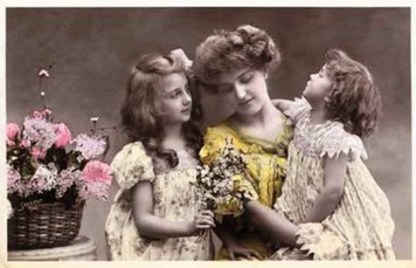
Anna Jarvis believed Mother’s Day to be a time of personal celebration, a time when families would gather to love and honor their mother.

In the early days she had worked with the floral industry to help raise the profile of Mother’s Day. By 1920 she had come to resent what she saw as the commercialization of the day.  Greeting cards seemed a pale substitute for the hand written personal notes she envisioned. Jarvis protested a Philadelphia candy maker’s convention in 1923, deriding confectioners, florists and even charities as “profiteers”. Carnations had by this time become symbolic of Mother’s Day. Jarvis resented that they were being sold at fundraisers.  She protested at a meeting of the American War Mothers in 1925 where women were selling carnations, and got herself arrested for disturbing the peace.

Anna-House1

Soon she was launching an endless series of lawsuits against those she felt had used the name of “Mother’s Day”, in vain.

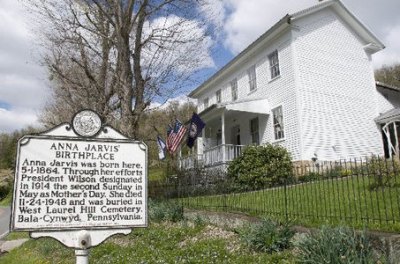
During the last years of her life, Anna Jarvis lobbied the government to take her creation off the calendar, gathering signatures door-to-door to get the holiday rescinded. The effort was obviously unsuccessful.  The mother of mother’s day died childless in a sanitarium in 1948, her personal fortune squandered on legal fees.

Today, some variation of Mother’s Day is observed from the Arab world to the United Kingdom. In the United States, Mother’s Day is one of the most commercially successful days of the year for flower and greeting card sales, and the biggest day of the year for long-distance phone calls. Church attendance is the third highest of the year behind only Christmas and Easter. Many churchgoers celebrate the day with carnations:  colored if the mother is still living and white, if she has passed on.

Happy Mother’s Day, Mom.

April 15, 1889 Damien of Moloka’i

“I would not be cured if the price of the cure was that I must leave the island and give up my work I am perfectly resigned to my lot”. Saint Damien of Molokai

It’s one of the oldest diseases in recorded history, the first written reference coming down to us, from 600BC. Ancient Greeks, Chinese, Indians and Middle Eastern sources wrote about the condition as did the Roman naturalist Pliny the elder, in the first century.

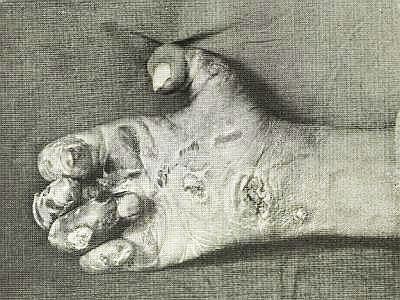
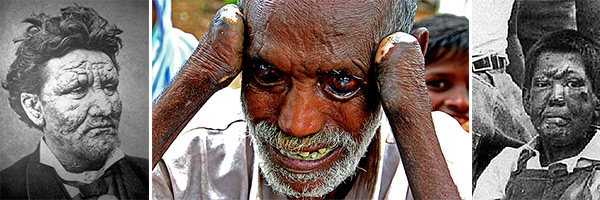
Leprosy is a chronic disease caused by the bacterium Mycobacterium leprae. Left untreated the condition produces skin ulcers, damage to peripheral nerves & upper respiratory tract, and muscular weakness. Everyday injuries go unnoticed due to numbness and lead to infection. Advanced cases result in severe disfigurement, crippling and/or the physical loss of hands, feet & facial features, and, finally, blindness.

The World Health Organization (WHO) reports a death rate among leprosy sufferers four times that of the general population.

First discovered by Norwegian physician G.H. Armauer Hansen in 1873, M. leprae is the first bacterium identified as the causative agent of disease, in humans. Today, Leprosy is curable with multidrug therapy (MDT). The world saw 208,619 new cases in 2018, 185 of which occurred, in the United States.

The horrors of the condition and resulting social stigmas, are plain for anyone to see. Today, sufferers fear loss of jobs, separation of familial and other connections and social isolation. Though not as widespread as commonly believed, victims of “Hansen’s disease” were historically sent off to quarantine in asylums and “leper colonies” from which few, ever returned.

In the 19th century, Mycobacterium leprae came to the Hawaiian islands.

According to research, long-distance explorers first came to the Hawaiian islands around the year 300. For the next 500 years, settlers arrived from French Polynesia, Tahiti, Tuamotus and the Samoan Islands. Other research indicates a shorter timeframe, settlement occurring between 1219 and 1266. Be that as it may the Hawaiian islands were first unified in 1810 to become the Kingdom of Hawai’i, under King Kamehameha the Great. Captain James Cook made the first known European contact in 1778 followed by waves of others both European, and American.

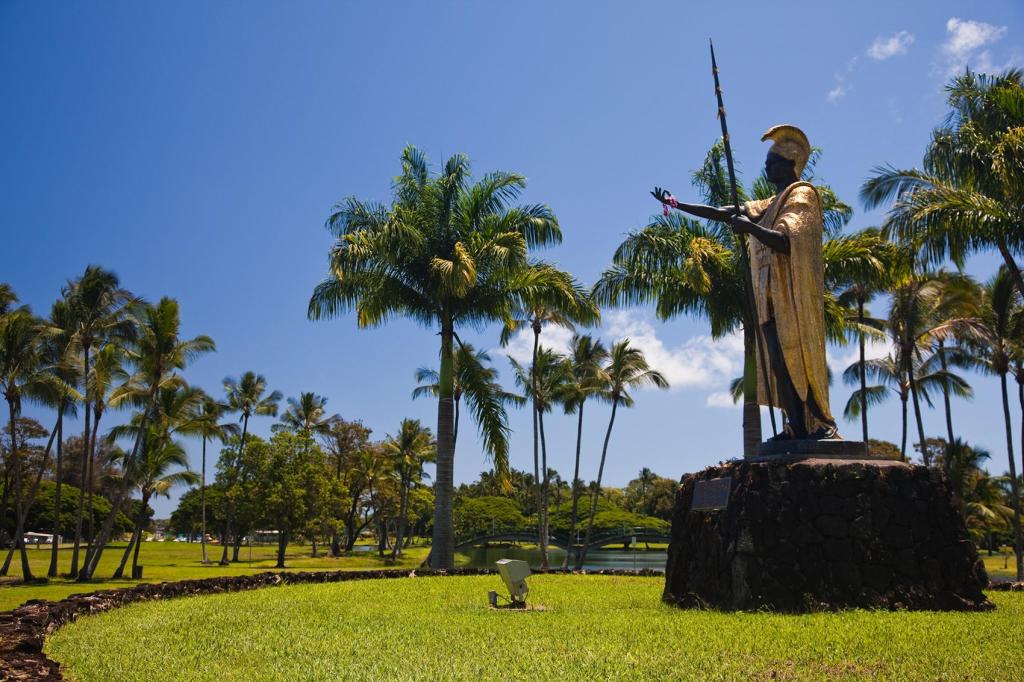
King Kamehameha statue, stands in front of Aliiolani Hale (the judiciary building), Honolulu, Oahu

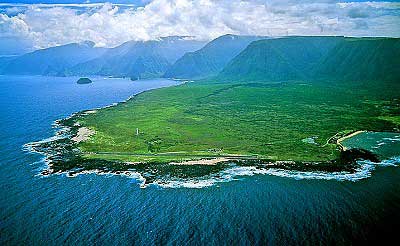
According to archaeological evidence, indigenous peoples occupied the Kalaupapa peninsula on the Hawaiian island of Moloka’i, for more than 900 years. Before first contact with Europeans their numbers are estimated, between 1,000 and 2,700, . Following the arrival of Captain Cook and others, Eurasian diseases decimated native populations. By 1853 only were 140 natives were left on the Kalaupapa peninsula.

Overhead view of the Kalaupapa peninsula

Leprosy first arrived on the Hawaiian islands around 1830, believed to be carried by Chinese laborers. The disease was incurable at that time, the first effective treatment didn’t come around, until the1940s.

By 1865, sugar planters were concerned about the labor supply. The Kingdom passed a measure to remove the Kānaka Maoli, Native Hawaiian inhabitants occupying the peninsula, in preparation for a leper colony.

The first such isolation settlement was established at Kalawao on the windward side of the peninsula and then on Kalaupapa, itself.

Even after a year of family disruption brought about by government response to Covid-19 the catastrophe of such a policy, is hard to process. In native Hawaiian tradition, Aloha ʻĀina means not only “Love of the Land” but a deep sense of connection, to all living things. For the descendants of those forcibly removed from the ʻĀina as well as those “lost” to Kalaupapa the wounds remain open, to this day.

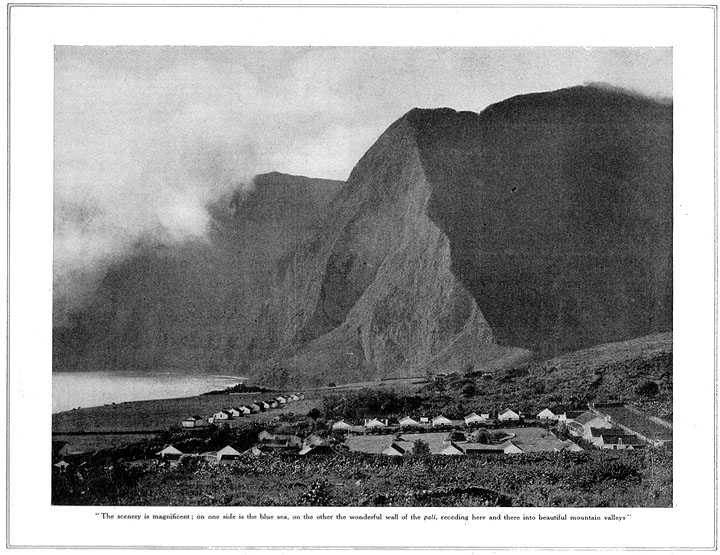
By 1890, 1,100 ‘lepers’ lived in this remote, inhospitable place, prisoners of their own deteriorating bodies and a greater culture who loathed, and feared them.

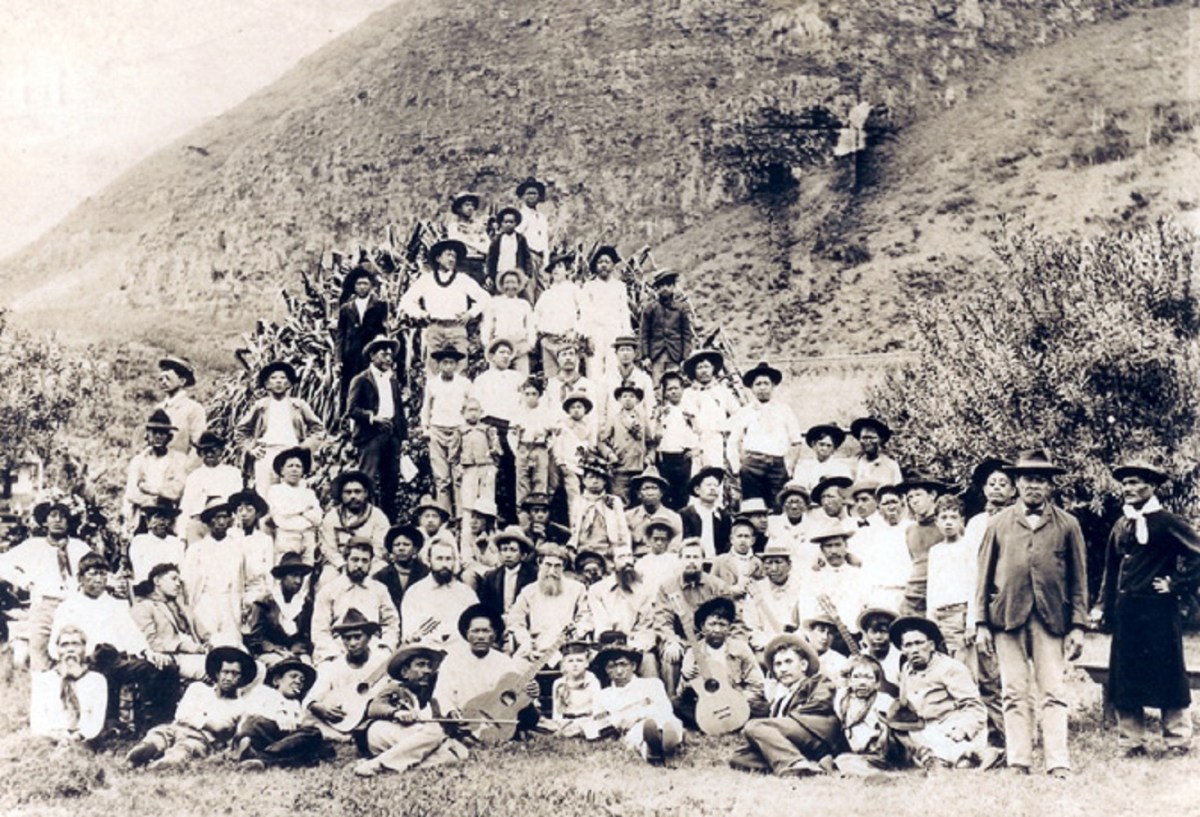
Over the years some 8,500 unfortunates would come to live in this place, the last one, in 1969.

Rudolph Wilhelm Meyer set out from his native Germany in search of the California gold rush. He made it as far as Molokaʻi. By 1866, Meyer was a father and husband to Kalama Waha, settled on the steep cliffs above Kalaupapa. As the peninsula became a leper colony, Meyer became supply agent to the colony and liaison to those few healthy individuals, willing to work there.

Mostly, those were Belgian missionary priests from the Congregation of the Sacred Hearts of Jesus and Mary, the first of whom was Father Damien, who served there from 1873 until his death, in 1889.

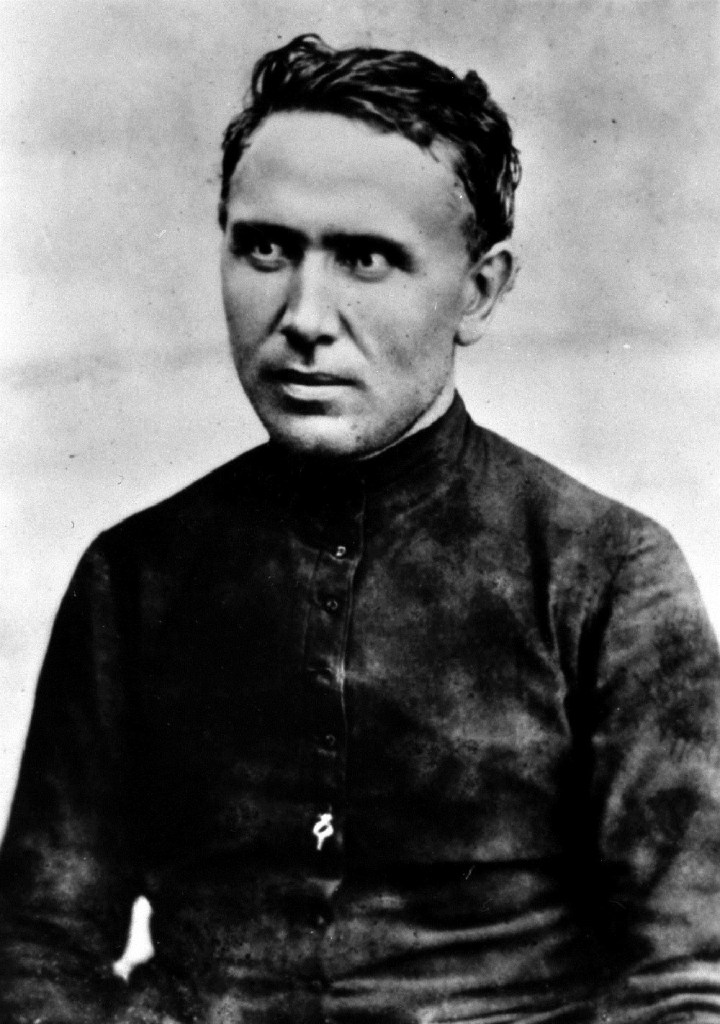
Fr. Damien in 1873 before sailing, for Hawai’i

Father Damien arrived at the isolated settlement at Kalaupapa on May 10, 1873. At that time there were 600 lepers. He spoke to the assembled unfortunates as “one who will be a father to you, and who loves you so much that he does not hesitate to become one of you; to live and die with you.”

After the Fr. Damien’s death of leprosy, commentators complained of contemporary accounts diminishing the work of native Hawaiians, some of whom served prominent roles on the island. While such are accounts are likely true enough there is no diminishing what the man did there.

For 16 years, father Damien lived and worked among the lepers of Molokaʻi. He ate with them, from the same bowls. He smoked with them, from the same pipe.

While the government had no desire to make this place a penal colony, outside support was slim to none. And this was no isolated population of yeoman farmers, these people were sickened and made weak by this most dreadful of medical conditions, many barely able to care for themselves.

Damien was not only a priest and teacher, he pitched in painting houses, organizing farms and building roads, hospitals and churches. He dressed the wounds of the stricken, built their coffins, dug graves and lived with the lepers, as equals. Six months after his arrival at Kalawao he wrote to his brother, Pamphile, in Europe: “…I make myself a leper with the lepers to gain all to Jesus Christ.”

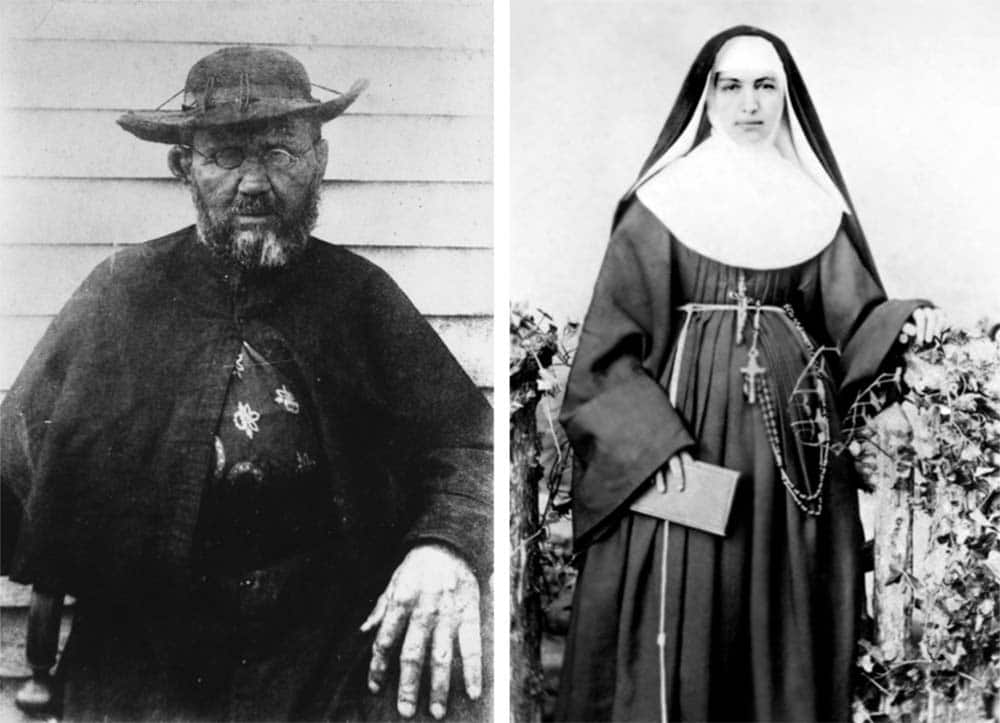
Father Damien and sister Marianne Cope have both received Roman Catholic Sainthood, for their actins on Molokaʻi

One day, it happened. In December 1884, he accidentally put his foot in scalding water. It was so hot that his skin blistered and peeled but he didn’t feel a thing. Father Damien was now himself, a leper.

Despite the illness destroying his body, Damien worked even harder in the last years of his life. He completed several building projects and improved orphanages, all while aiding his fellow lepers in their treatments and medical baths and spreading the Catholic faith. King David Kalākaua bestowed on the priest the honor of “Knight Commander of the Royal Order of Kalākaua.” When Crown Princess Lydia Liliʻuokalani arrived to present the medal she was said to be too distraught and heartbroken at the sight of those poor people, to even speak.

Princess Liliʻuokalani spoke of her experience bringing the plight of Father Damien and his flock, to the eyes of the world. European and American protestants sent money to help with the work. The Church of England sent food, medicine and supplies. It is believed that Fr. Damien never wore his medal but he went to his grave, with it by his side.

Japanese leprologist Masanao Goto arrived to treat the lepers of Molokaʻi with medical baths, moderate exercise and friction applied to parts, benumbed by disease. Goto’s treatments were popular with his patients but, in the end, there was little hope. Four volunteers arrived in the end to aid the ailing missionary including sister Marianne Cope, a woman who would one day join Father Damien, in Roman Catholic sainthood.

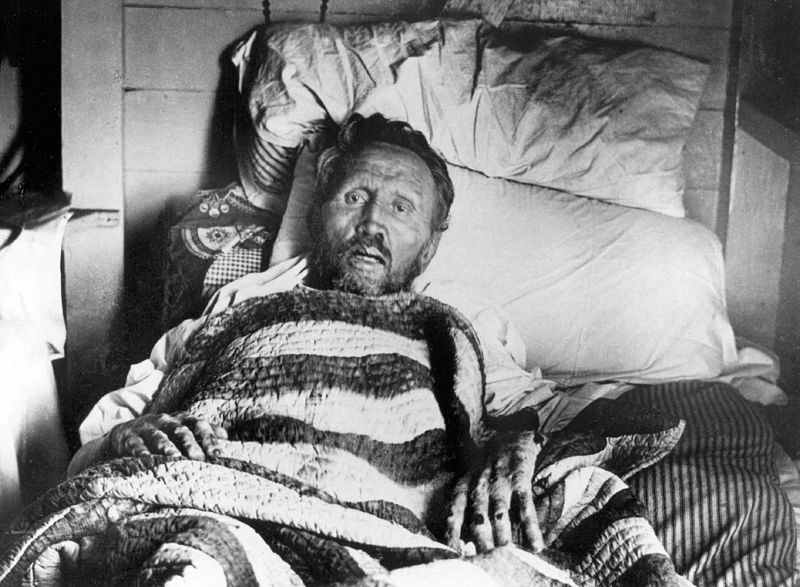
Father Damien on his deathbed, 1889

By February 1889, the end was near. With his foot in bandages and an arm in a sling, his other leg dragging uselessly behind, Damien went to his death bed on March 23. Father Damien died of leprosy at 8:00am on April 15, 1889. He was 49. The entire colony turned out the following day as the Belgian missionary was laid to rest beside the same pandamus tree under which he had slept those sixteen years earlier, on his first night in Molokaʻi.

In John 15:13, the King James Bible teaches that “Greater love hath no man than this, that a man lay down his life for his friends.” Today, I wonder how many know the name of Father Damien, of Molokaʻi . Or the faith which would bring a person to willingly submit to the literal rot, of such a hideous condition.

Let Mahatma Ghandi, himself no stranger to the horrors of leprosy, have the last word on that subject: “The political and journalistic world can boast of very few heroes who compare with Father Damien of Molokai. The Catholic Church, on the contrary, counts by the thousands those who, after the example of Fr. Damien, have devoted themselves to the victims of leprosy. It is worthwhile to look for the sources of such heroism“.

Feature image, top of page: Kalaupapa leper colony in 1905

March 17, 1901 Vincent

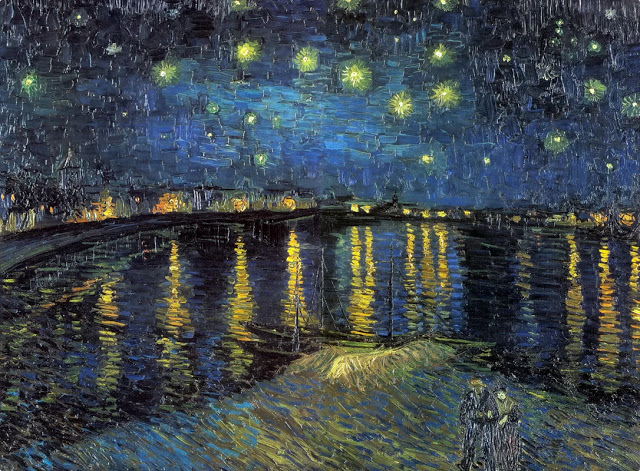
Artists who became famous only in death read like a who’s who of painters including Monet, Gaugin, Cezanne and more but none so tragic, as Vincent van Gogh.

Herman Melville wrote more than 90 books and short stories in his 72 years. He was no stranger to some small fame but it was only after death that the man’s magnum opus Moby Dick, came to be seen as one of the finest works of literature, ever written. Edgar Allen Poe struggled as a writer. The Raven was sold for only $9 during his lifetime. Now a towering figure in the literary world his fame too, would only come after death. Shy and introverted in life, Emily Dickinson published only 8 poems during her lifetime. Her remaining body of work she hid carefully away, some 1,800 poems coming only to light, after she was gone.
Such a list could be long and includes the likes of Franz Kafka, Henry David Thoreau and Jane Austen. Artists who became famous only in death contain a who’s who of painters including Monet, Gaugin, Cezanne and more but none so tragic, as Vincent van Gogh.

Vincent Willem Van Gogh was born and died on March 30, 1852, a stillbirth. The artist with the same name was born one year later, to the day. Confusingly, the church register even assigned the infant the same number, as his dead brother. Vincent van Gogh, #29. It wasn’t unusual in those days for grieving parents to give the same name, as a child who had died. What it’s like to grow up a replacement, to visit a grave marked with your own name and birthdate minus a year, is something the rest of us can only guess at.

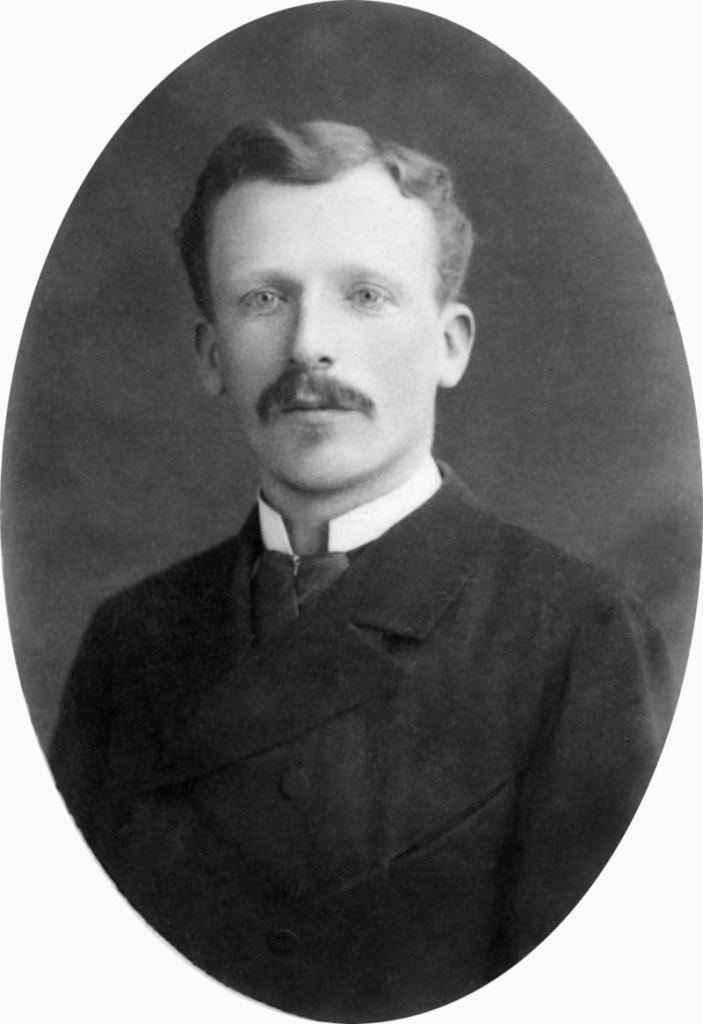
Vincent was close with his brother Theodorus, all but inseparable.

A successful Dutch art dealer, “Theo” had an important impact on the world of French and Dutch art. It is thanks to Theo van Gogh and his financial and emotional support of his older brother, that we’re able to enjoy much of the artist’s work.

Four years his junior it was Theo who encouraged his brother to paint, in the first place. Vincent could always draw but he didn’t pick up a brush, until he was 27.

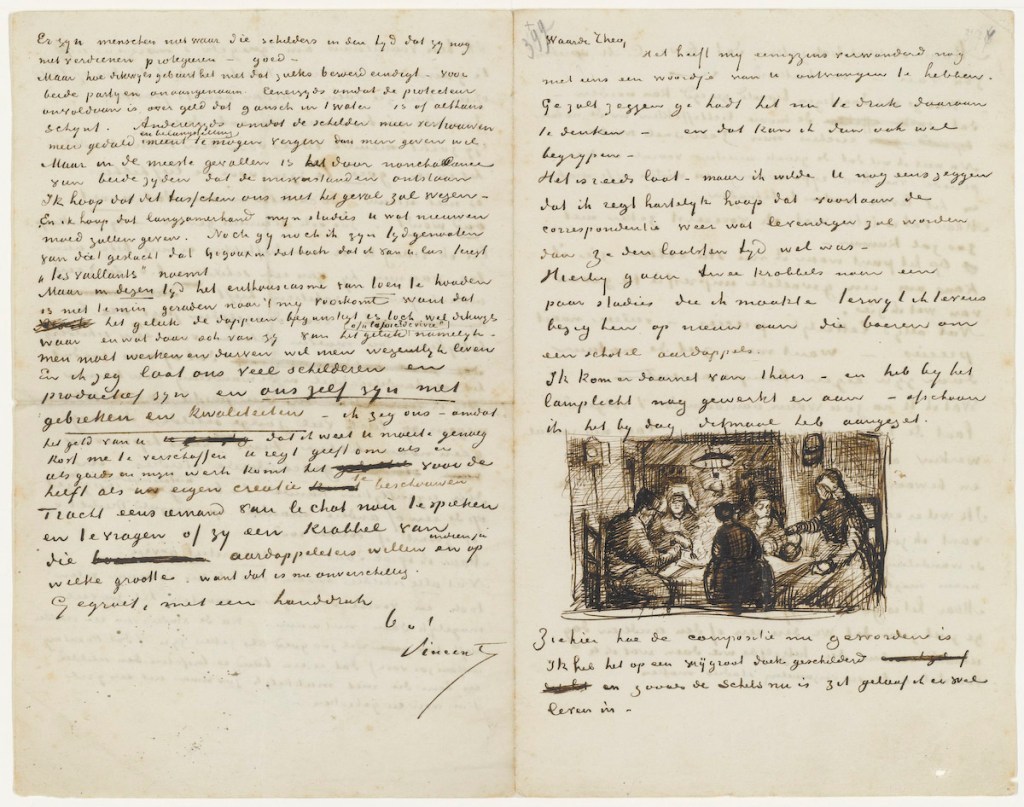
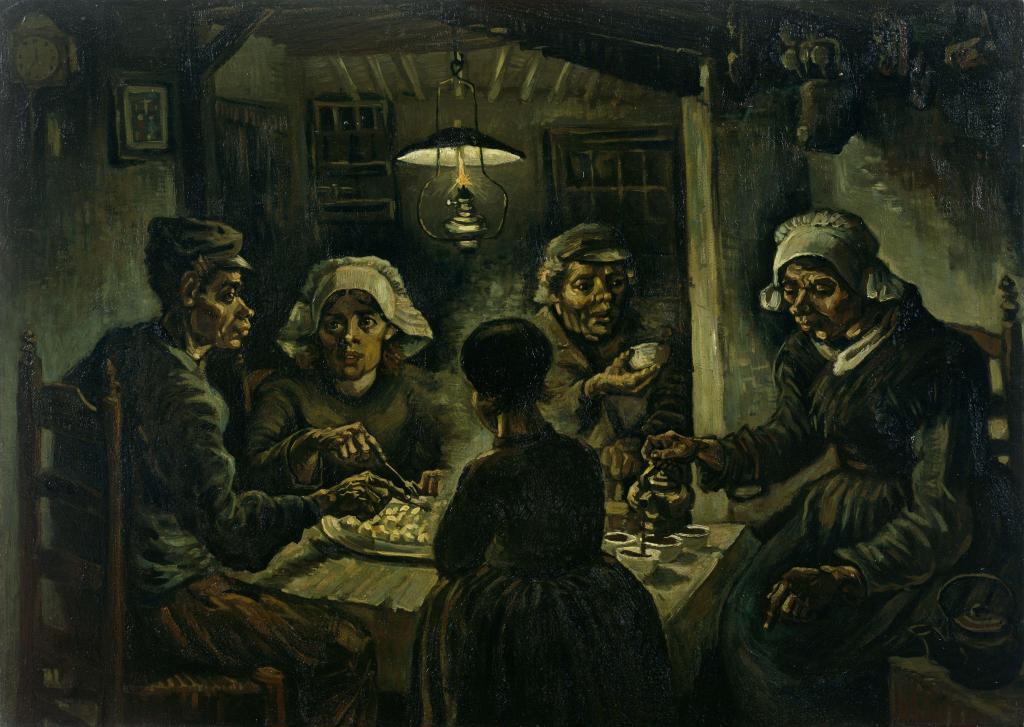
Van Gogh began to write letters in 1872, an average of one every ten days. Vincent would continue this practice for the rest of his life, some 903 in all. His sister Wil was a frequent recipient as were the artists Paul Gauguin, Anthon van Rappard and Émile Bernard, but none so much as his brother Theo. 663 of these letters are known to survive including this 1885 note describing the artist’s first masterpiece, “The Potato Eaters”. It is through these letters we know much of the life, of Vincent van Gogh.

2,300 years ago, Aristotle spoke of the confluence of Greatness, and mental illness. Even now that place where genius meets darkness, is imperfectly understood. Definitive diagnoses of historical figures are elusive and yet, history abounds with stories pointing toward mental illness in some of the great figures of the past. Michelangelo displayed signs of autism, as did Isaac Newton. The famous “scream” painting by Edvard Munch may be autobiographical of a man prone, to panic attacks. Ludwig von Beethoven suffered mood swings likely amounting to bipolar disorder as did Winston Churchill, Abraham Lincoln, and Vincent van Gogh.

Vincent tried his hand at dealing art but suffered depression during visits to London. There followed a period as Christian missionary in the south of Belgium before, feeling ill and depressed, van Gogh moved in with his parents. Theo, always the source of encouragement and support both financial and emotional convinced his brother, to take up the brush.

Vincent van Gogh had but ten years to live when he started to paint. In that time the man produced 2,100 artworks including 860 oil paintings, most of those, in the last two years of his life. First there were the dark colors of the “Dutch period” seen in peasant scenes, portraits and still life.

The Potato Eaters painted in April 1885 in Nuenen, Netherlands

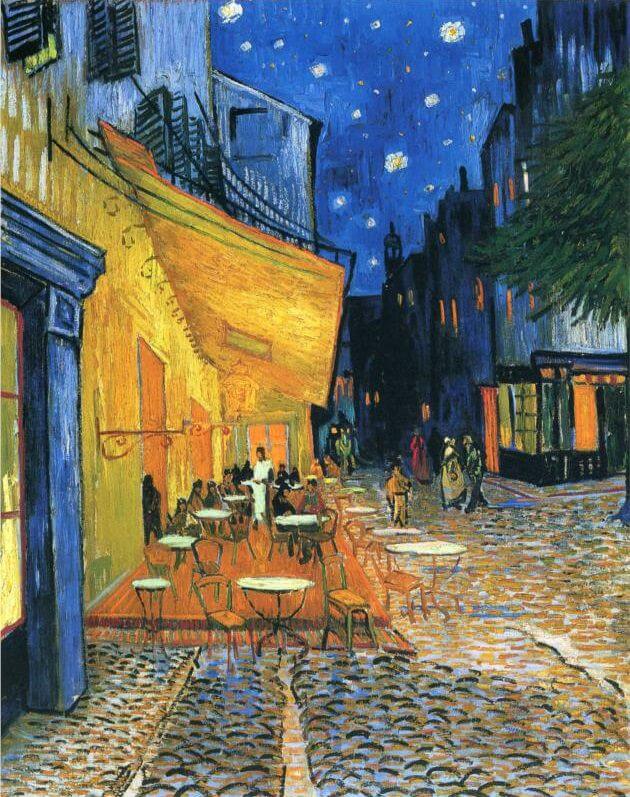
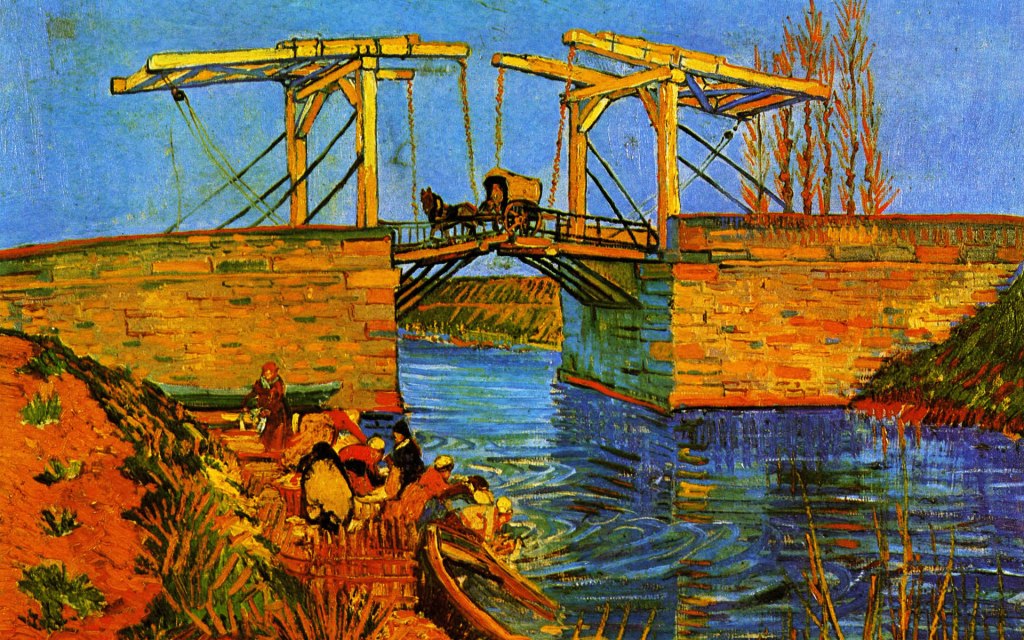
Vincent moved to Paris in 1886 where he met members of the avant-garde art world, including Émile Bernard and Paul Gauguin. These were the iconoclasts, the radicals, the unorthodox who opened a whole new vision. Here we see the burst of bright colors and bold brush strokes for which Vincent is now known.

This too was a period of depression, of mental instability and psychotic episodes. The confrontation ending Vincent’s friendship with Paul Gaugin culminated in van Gogh cutting off his own ear, with a razor.

Thus began a period of mental decline, ending in Vincent’s suicide. A period spent in and out of psychiatric hospitals, of heavy drinking, poor diet and declining health. One day, this tortured soul would be recognized as one of the finest artists who ever lived. For now he was just another madman, a failure in work, and in life.

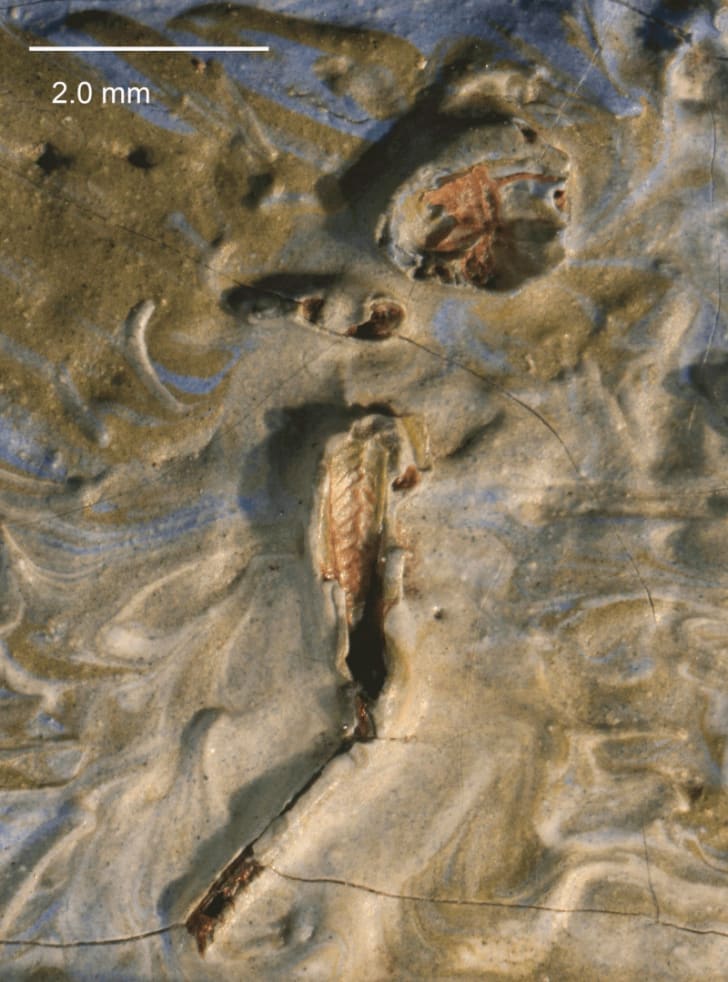
Fun Fact: Following the self-mutilation episode in which Vincent removed his own ear, van Gogh spent time in an asylum outside Saint-Rémy-de-Provence, in France. There he was fond of painting outdoors where he painted olive groves, and other pastoral scenes. If you look very closely just to the right of this 1889 portrait you will find the remains of a dead grasshopper, blown by the wind and trapped in wet paint. There no signs of struggle, indicating the insect was deceased before hitting the canvas. As for the Master he either didn’t notice, or did not care.

Olive Trees, 1889

For the man, the last two years were a downward spiral from which there would be no return. For Vincent’s art this was the most productive, the most brilliant period of a short career.

Theo alone understood his brother. His talent. His madness. For Vincent, Theo was the only person he could open up to. Vincent received a never-ending stream of letters from his brother, words of love, of encouragement, and always the painting supplies, and the money. Theo received a stream of letters in return with day-to-day news, plans for upcoming works but all the while, it wasn’t enough.

Around this time, Vincent set out on foot to visit the French naturalist Jules Breton, a walk of some 80 kilometers. Unlike van Gogh, Breton achieved considerable success, in his lifetime. Perhaps Vincent was intimidated by the high walls. The large estates. Nobody knows. After all that he turned and walked home. The man he intended to visit never knew he was there.

In Paris, Theo fell in love with one Johanna Bonger. The couple was married on April 17, 1889. Ten months later came a son, Vincent Willem van Gogh. The name was intended to honor his brother but, to Vincent, who knows? Perhaps in his madness the replacement felt that he himself, was now replaced. Theo had always been there with money, with painting materials and words of encouragement but to Vincent, he himself was nothing but a burden on a brother, now responsible for a family of three.

Visit allwallpapersfree.blogspot.com

In May of 1890, Vincent moved to a small attic room in the village of Ouvers-sur-Oisne. To be closer to Theo, and to Dr Paul Gachet, the quack homeopathic doctor Vincent himself described as “iller than I am, it seemed to me, or let’s say just as much.” On July 27, 1890, Vincent left his small apartment for the countryside. This time he carried no paints or brushes. Sick in body and mind and bereft of the Christian faith which had once bouyed his thoughts, Vincent had nothing to believe in anymore but his paintings and those, he couldn’t sell. No one knows where Vincent shot himself. The 7mm Lefaucheux à broche revolver. One bullet. In the stomach or the chest, depending on which version you happen to read. He managed to stagger back to his lodgings, lit up his pipe and lay down in his bed, to die. Gachet was called but the bullet, was too deep.

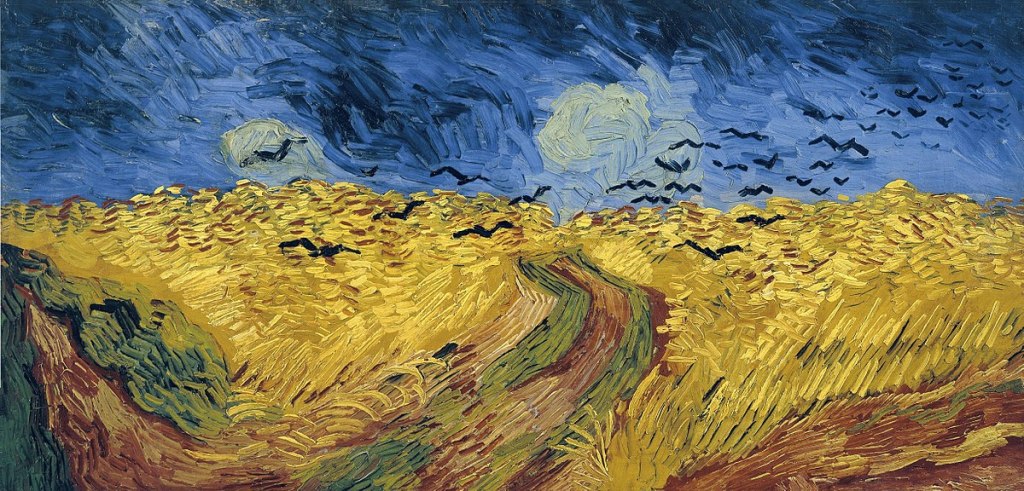
Wheatfield, with crows.

Infection began to set in as Theo was called and rushed to catch a train, to be there. Vincent van Gogh died in the arms of the brother to whom a last, unposted letter was found in his pocket. In it, Vincent describes a recently finished painting, called Wheatfield with crows. The letter said it depicted “vast fields of wheat beneath troubled skies,” adding “I did not have to go out of my way to express sadness and extreme loneliness.”

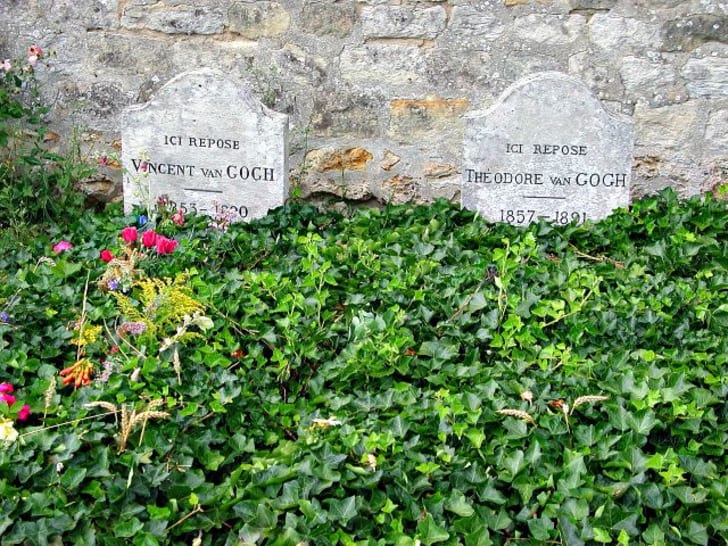
Theo van Gogh was destroyed over his brother’s death both physically, and mentally. A sharp decline ended six months later with his own death, at the age of 33. The cause of death was dementia paralytica caused by “heredity, chronic disease, overwork, sadness.” He was buried in Utrecht and later exhumed at the request of his widow to be re-interred, next to his brother

As for Johanna herself, she inherited the vast bulk of her brother-in-law’s paintings and drawings and spent the rest of her life, promoting his work.

On March 17, 1901, eleven years after his death, 71 van Gogh paintings were shown at the Bernheim-Jeune gallery, in Paris. A failure in life, Vincent’s work now hit the art world, like an electric shock. Today some of the artist’s works number among the most expensive paintings, ever sold.

Post script: Theo’s great-grandson, also called Theo van Gogh, was a Dutch film and television director, producer, actor and author. Working from a script provided by Somali-born Dutch-American activist, feminist and former politician Ayaan Hirsi Ali, van Gogh produced a ten-minute short film called Submission, concerning the plight of women in Islam. Both van Gogh and Hirsi Ali received death threats to which Theo responded “nobody kills the village idiot”. He often used that term in describing himself. On November 2, 2004, Islamist Mohammed Bouyeri shot and stabbed the director while bicycling to work, leaving a note pinned with a knife to his dead chest, containing threats against Jews, the west, and Ayaan Hirsi Ali.

February 18, 1977 Plain of Jars

A map of the world is dotted with ancient stone megaliths, from Easter Island in the South Pacific to the Carnac Stones of France, and the stone spheres of Costa Rica. Among all of them, there is no story more mysterious, or more tragic, than the Plain of Jars.


Yonaguni Island, the westernmost inhabited island of the Japanese archipelago, lies about 60 miles across the straits of Taiwan.  The place is a popular dive destination, due to (or possibly despite) a large population of hammerhead sharks.

Yonaguni

In 1987, divers discovered an enormous stone formation, with angles and straight lines seemingly too perfect to have been formed by nature.   If this “Yonaguni Monument” is in fact a prehistoric stone megalith, it would have to have been carved 8,000 to 10,000 years ago when the area was last dry,  radically changing current ideas about prehistoric construction.

A map of the world is dotted with such ancient stone megaliths, from Easter Island in the South Pacific to the Carnac Stones of France, and the stone spheres of Costa Rica.  Among all of them, there is no story more mysterious, or more tragic, than the Plain of Jars.

V94NuPT

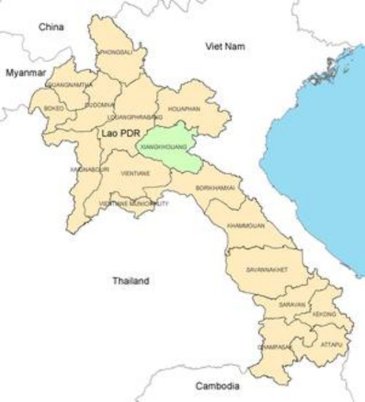
Deep in the heart of the Indochinese peninsula of mainland Southeast Asia lies the Lao People’s Democratic Republic, (LPDR), informally known as Muang Lao or just Laos.  To the north of the country lies the Xiangkhouang Plateau, known in French as Plateau du Tran-Ninh, situated between the Luang Prabang mountain range separating Laos from Thailand, and the Annamite Range along the Vietnamese border.

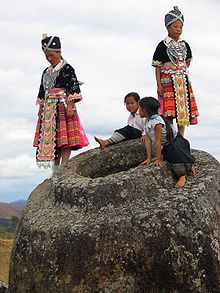
Fifteen-hundred to twenty-five hundred years ago, a now-vanished race of bronze and iron age craftsmen carved stone jars out of solid rock, ranging in size from 3 to 9-feet or more.  There are thousands of these jars, located at 90 separate sites containing just a single to four hundred apiece.

GettyImages-543867296-57eb5c1c3df78c690f639463

Most of these jars have carved rims but few have lids, leading researchers to speculate that lids were formed from organic material such as wood or leather.

Lao legend has it that the jars belonged to a race of giants, who chiseled them out of sandstone, granite, conglomerate, limestone and breccia to hold “lau hai”, or rice beer.  More likely they were part of some ancient funerary rite, where the dead and the about-to-die were inserted along with personal goods and ornaments such as beads made of glass and carnelian, cowrie shells and bronze bracelets and bells.  There the deceased were “distilled” in a sitting position, later to be removed and cremated with remains then going through a secondary burial.

laosmap
Map of Laos showing Xieng Khouang province, location of the Plain of Jars

These “Plain of Jars” sites might be some of the oldest burial grounds in the world, but be careful if you go there.  It’s the most dangerous archaeological site on earth.

With the final French stand at Dien Bien Phu a short five months in the future, France signed the Franco–Lao Treaty of Amity and Association in 1953, establishing Laos as an independent member of the French Union. The Laotian Civil War broke out that same year between the Communist Pathet Lao and the Royal Lao Government, becoming a “proxy war” where both sides received heavy support from the global Cold War superpowers.

Concerned about a “domino effect” in Southeast Asia, US direct foreign aid to Laos began as early as 1950.  Five years later the country suffered a catastrophic failure of the rice crop.  The CIA-operated Civil Air Transport (CAT) flew over 200 missions to 25 drop zones, delivering 1,000 tons of emergency food.  By 1959, the CIA “air proprietary” was operating fixed and rotary wing aircraft in Laos, under the renamed “Air America”.

220px-Plainofjars_1

The Geneva Convention of 1954 partitioned Vietnam at the 17th parallel, and guaranteed Laotian neutrality.  North Vietnamese communists had no intention of withdrawing from the country or abandoning Laotian communist allies, any more than they were going to abandon the drive for military reunification, with the south.

Chief of Naval Operations Admiral Arleigh Burke warned the Joint Chiefs of Staff, “If we lose Laos, we will probably lose Thailand and the rest of Southeast Asia. We will have demonstrated to the world that we cannot or will not stand when challenged”.

As the American war ramped up in Vietnam, the CIA fought a “Secret War” in Laos, in support of a growing force of Laotian highland tribesmen called the Hmong, fighting the leftist Pathet Lao and North Vietnamese communists.

Primitive footpaths had existed for centuries along the Laotian border with Vietnam, facilitating trade and travel.  In 1959, Hanoi established the 559th Transportation Group under Colonel Võ Bẩm, improving these trails into a logistical system connecting the Democratic Republic of Vietnam in the north, to the Republic of Vietnam in the south.  At first just a means of infiltrating manpower, this “Hồ Chí Minh trail” through Laos and Cambodia soon morphed into a major logistical supply line.

In the last months of his life, President John F. Kennedy authorized the CIA to increase the size of the Hmong army.  As many as 20,000 Highlanders took arms against far larger communist forces, acting as guerrillas, blowing up NVA supply depots, ambushing trucks and mining roads.  The response was genocidal.  As many as 18,000 – 20,000 Hmong tribesman were hunted down and murdered by Vietnamese and Laotian communists.

Air America helicopter pilot Dick Casterlin wrote to his parents that November, “The war is going great guns now. Don’t be misled [by reports] that I am only carrying rice on my missions as wars aren’t won by rice.”

laos

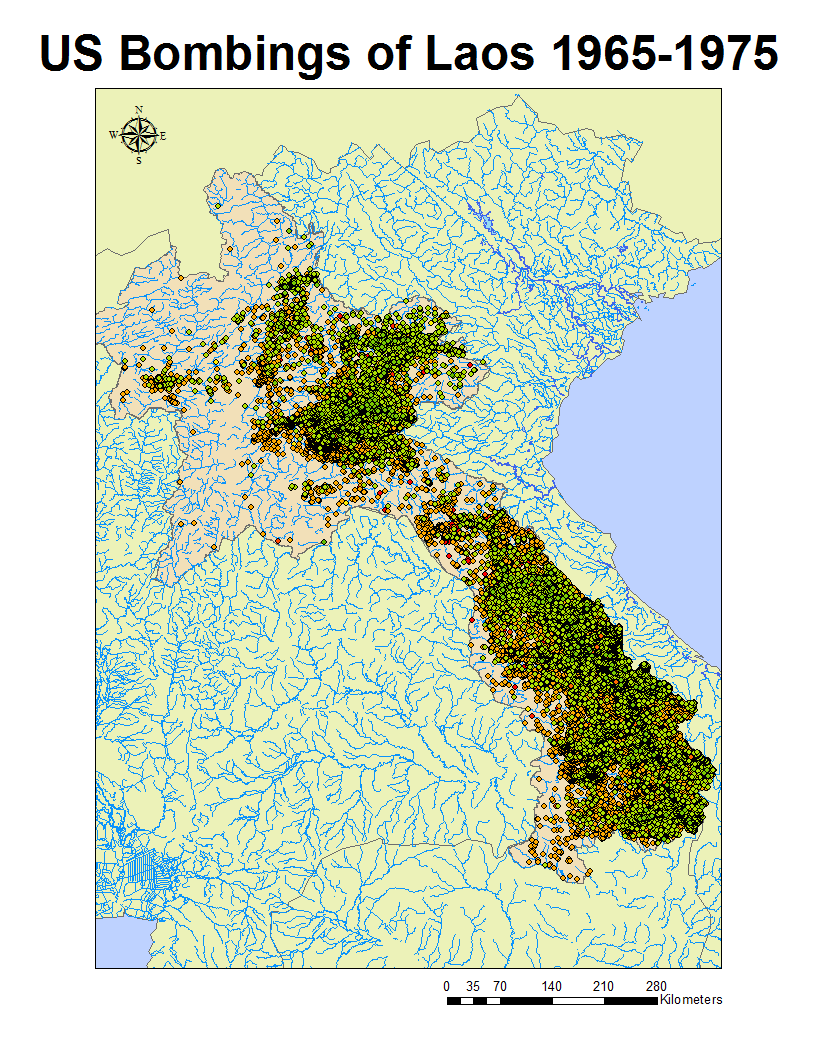
The proxy war in Laos reached a new high in 1964, in what the agency itself calls “the largest paramilitary operations ever undertaken by the CIA.”  In the period 1964-’73, the US flew some 580,344 bombing missions over the Hồ Chí Minh trail and Plain of Jars, dropping an estimated 262 million bomb.  Two million tons, equivalent to a B-52 bomber full of bombs every eight minutes, 24 hours a day, for nine years.  More bombs than US Army Air Forces dropped in all of WW2, making Laos the most heavily bombed country, per capita, in history.

Most were “cluster munitions”, bomb shells designed to open in flight, showering the earth with hundreds of “bomblets” intended to kill people and destroy vehicles.  It’s been estimated that 30% of these munitions failed to explode, 80 million of them, (the locals call them “bombies”), set to go off with the weight of a foot, or a wheel, or the touch of a garden hoe.

1024px-BLU-26_cluster_sub-munition
Unexploded cluster sub-munition, probably a BLU-26 type. Plain of Jars, Laos

Since the end of the war, some 20,000 civilians have been killed or maimed by unexploded ordnance, called “UXO”.  Four in ten of those, are children.

Removal of such vast quantities of UXO is an effort requiring considerable time and money and no small amount of personal risk.  The American Mennonite community became pioneers in the effort in the years following the war, one of the few international Non-Governmental Organizations (NGO’s) trusted by the habitually suspicious communist leadership of the LPDR.

urn

On February 18, 1977, Murray Hiebert, now senior associate of the Southeast Asia Program at the Center for Strategic and International Studies (CSIS) in Washington, D.C.  summed up the situation in a letter to the Mennonite Central Committee, US:  “…a formerly prosperous people still stunned and demoralized by the destruction of their villages, the annihilation of their livestock, the cratering of their fields, and the realization that every stroke of their hoes is potentially fatal.

Years later, Unesco archaeologists worked to unlock the secrets of the Plain of Jars, working side by side with ordnance removal teams.

In 1996, United States Special Forces began a “train the trainer” program in UXO removal, at the invitation of the LPDR government. Even so, Western Embassy officials in the Laotian capitol of Vientiane believed that, at the current pace, total removal will take “several hundred years”.

In 2004, bomb metal fetched 7.5 Pence Sterling, per kilogram.  That’s eleven cents, for just over two pounds.  Unexploded ordnance brought in 50 Pence per kilogram in the communist state, inviting young and old alike to attempt the dismantling of an endless supply of BLU-26 cluster bomblets.  For seventy cents apiece.