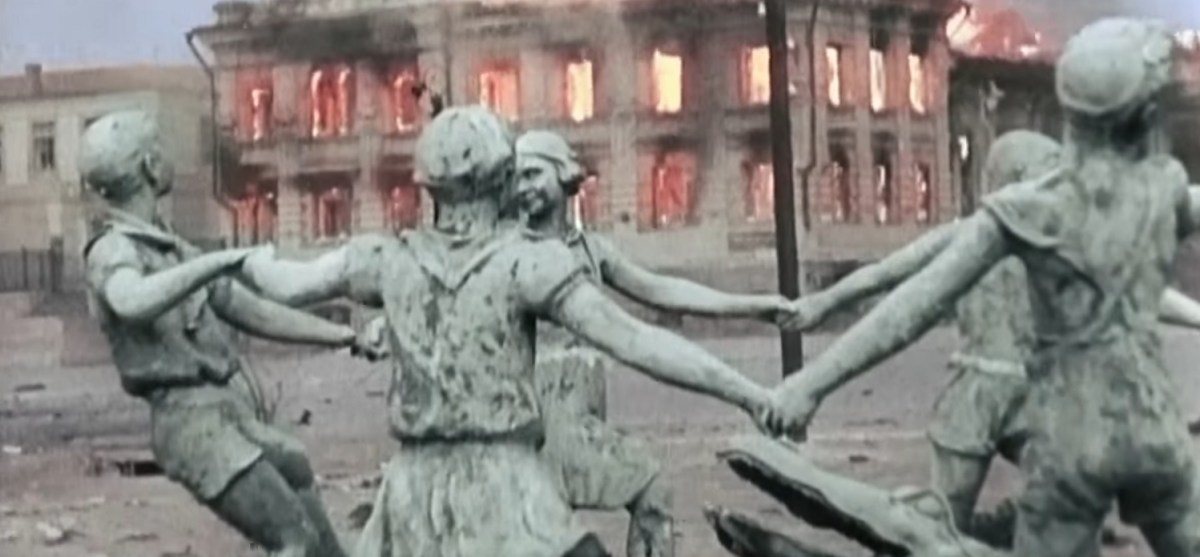
August 23, 1942 War of the Rats

A German infantryman wrote to his family, “Animals flee this burning hell of a city. The hardest stones do not last for long. Only men endure”.

WWII could have ended differently, had two of the most homicidal dictators in history become allies. It actually started out that way, when the Soviet Union and Nazi Germany signed the Molotov-Ribbentrop non-aggression pact, in August, 1939. That would end two years later with “Operation Barbarossa”, the German surprise invasion of the Soviet Union, beginning on June 22, 1941.

We’re accustomed to thinking of World War II in terms of the European and the Pacific “Theaters”, but the most horrific casualties of the most destructive war in history, took place on the “Ostfront”, (Eastern Front).  95% of all German Army casualties between 1941 and 1944, and 65% of all Allied military casualties from the entire war, took place on the Eastern Front. The bloodiest battle of the Eastern Front, probably the bloodiest battle in all of history, began this day in 1942, in the city of Stalingrad.
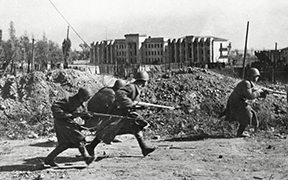
stalingrad. Red Army
Photo by Nara Archives / Rex Features (2093505a) October 1942, Stalingrad – Soviet Guardsmen Fighting In The Streets Of The Stalingrad Outskirts

Soviet propagandists called it a “harvest victory”, when most of the cattle, grain and rail cars were shipped out of the city in advance of the German assault.

Most of Stalingrad’s civilian residents remained however, leaving the city short of food, even before the commencement of German attacks. Making things worse, the Luftwaffe bombed Volga River shipping, sinking 32 ships and crippling another 9 in the narrow waterway, cutting off this vital link in the city’s supply chain.

Wilfred von Richtofen, cousin of the famous “Red Baron” of WWI, opened up with his heavy bombers on August 23rd, dropping over 1,000 tons of high explosive on Stalingrad.

The Soviets suffered from extreme manpower shortages in the beginning.  The burden of the early defense of the city fell to the 1077th Anti-Aircraft Regiment, a primarily female unit of young volunteers who had no training and the wrong weapons to engage ground targets. These women were all alone at this point with no support from other units, but they traded shot for shot with the German 16th Panzer Division until all 37 AA guns had been wiped out or overrun. When it was over, 16th Panzer soldiers were shocked to learn they’d been fighting women.
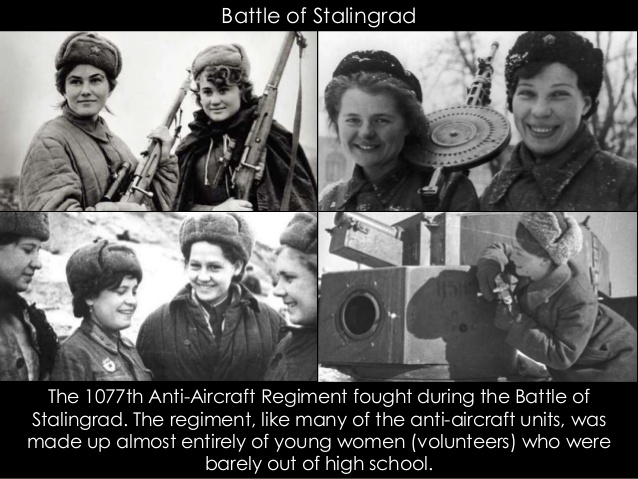
1077th

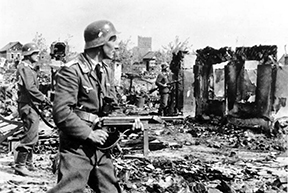
Stalingrad was quickly reduced to rubble, with the German 6th Army controlling 90% of the city.  Still, Lt. Gen. Vasily Ivanovich Chuikov’s army held on.  With backs to the Volga, they fought for the very sewers of the city, men and women alike reduced to a primitive level of existence. The Germans called it “Rattenkrieg”. “War of the Rats”. A German infantryman wrote to his family, “Animals flee this burning hell of a city. The hardest stones do not last for long. Only men endure”.

As many as 80,000 Red Army soldiers lay dead by the middle of October, 1942. Counting German losses and civilian deaths, the battle cost a quarter of a million lives up to this point, and the fighting still had months to go.Stalingrad
Ice floes in the Volga river further cut off the defender’s supplies, reducing them to cannibalism as a massive Soviet counter-attack was building on the German’s exposed left flank.

By November, General Georgy Zhukov had assembled over a million fresh troops, 1,500 tanks, 2,500 heavy guns, and three Air Armies for the assault on Stalingrad. The rumble of artillery, the “Great Soviet God of War” could be heard across the steppe as the Soviet counter-attack commenced in a blinding snowstorm on November 19th, 1942. It was now the Germans who were trapped.

German General Friedrich von Paulus asked Hitler’s permission to withdraw before they became surrounded.  The response was that he should fight “to the last soldier and the last bullet.”stalingrad1
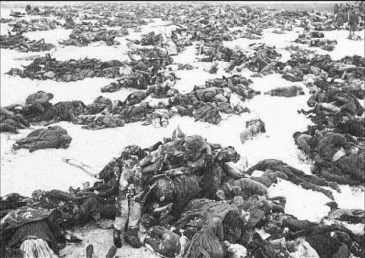
German forward movement on the Eastern Front came to an end in February, 1943, when 91,000 freezing, wounded, sick and starving Germans were surrendered to the Red Army.

Even then, as many as 11,000 Germans refused to lay down their arms and continued to fight from the cellars and the sewers of Stalingrad, holding on until early March.

Disease, death marches, cold, overwork, mistreatment, and malnutrition would all take their toll on the prisoners.  Of the nearly 110,000 who went into captivity after the Battle of Stalingrad, fewer than 6,000 lived to return to Germany, after the war.

July 20, 1914 The Coming Crisis

There would be no “Phoney War”, no “Sitzkreig”, as some wags were wont to call the early days of WWII. This would be a cataclysm that would change a century.  Few realized it on this date, 103 years ago today. The collision was only days away.

On the eve of 1870, the German nation existed only as an agglomeration of 22 independent German states. On the eve of WWI, Germany was one of the five Great Powers of Europe.

Alarmed by the aggressive growth of its historic adversary, France had by that time increased its period of compulsory military service from two years to three, in an effort to offset the advantage which a population of 70 million conferred on Germany, compared with a French population of 40 million.

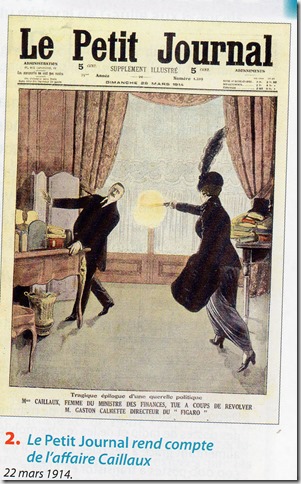
Joseph Caillaux was a left-wing politician, once Prime Minister of France and, by 1913, a cabinet minister under the more conservative administration of French President Raymond Poincare.

Never too discreet with his personal conduct, Caillaux paraded through his public life with a succession of mistresses. One of them was Henriette Raynouard.  By 1911, both were divorced and Madame Raynouard had become Henriette Caillaux.

A relative pacifist, many on the French right considered Caillaux to be too “soft” on Germany. One of them was Gaston Calmette, editor of the leading right-wing newspaper Le Figaro, who regularly excoriated the politician.

affairecaillaux_thumbOn March 16, 1914, the now-second Mrs Caillaux took a taxi to the offices of Le Figaro. She waited for a full hour to see the newspaper’s editor, before walking into his office and shooting him at his desk. Four out of six rounds hit their mark. Gaston Calmette would be dead before the night was through.
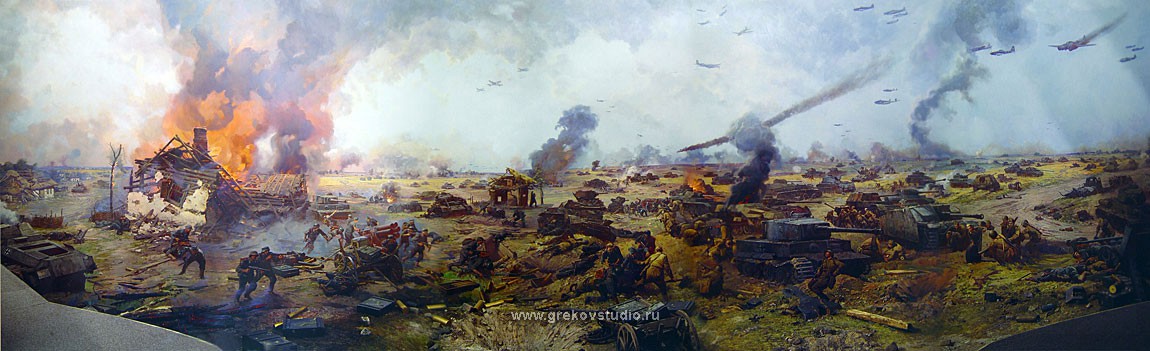
It was the crime of the century.  The OJ trial version 1.0.  The French public was captivated as the trial began, 102 years ago, today.

The British public was similarly distracted, by the latest in a series of Irish Home Rule crises.

The Austro-Hungarian Empire, a sprawling amalgamation of 17 nations, 20 Parliamentary groups and 27 political parties, desperately needed to bring the Balkan peninsula into line after the June 28 assassination of the heir-apparent to the dual monarchy.

That individual Serbians were complicit in the assassination is beyond doubt, but so many government records of the era have disappeared that it’s impossible to determine official Serbian complicity. Nevertheless, Serbia had to be brought into line.

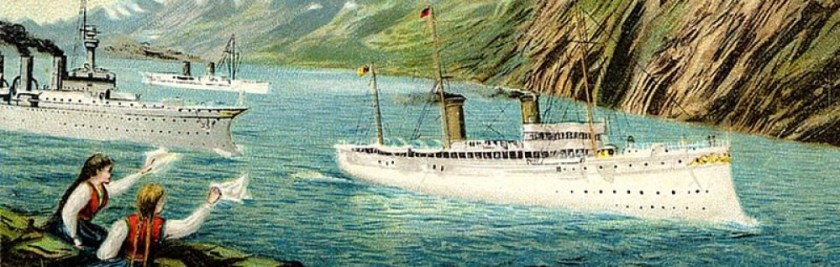
Having given Austria his assurance of support in the event of war with Serbia, even if Russia entered in support of its Slavic ally, Kaiser Wilhelm of Germany left on a summer cruise in the Norwegian fjords. The Kaiser’s being out of touch for those critical days in July, has been called the most expensive maritime disaster, in naval history.

Yacht_Hohenzollern_1906

The Austro-Hungarian Empire delivered a deliberately unacceptable ultimatum to Serbia on the 23rd, a bald pretext for the war it declared on the 28th. The same day, Madame Caillaux was acquitted on the grounds that hers was a “crime passionnel”.  A crime of passion.

In the days that followed, entangling alliances and mutual distrust reigned over the European continent. As expected, Russia mobilized in support of Serbia, as Germany began implementation of its long-standing strategy of a lightning defeat of France, before wheeling to face the much larger “Russian steamroller”.

Pre-planned timetables took over.  France alone would have 3,781,000 military men under orders before the middle of August, arriving at the western front on 7,000 trains, arriving as often as one every eight minutes.

There would be no “Phoney War”, no “Sitzkreig”, as some wags were wont to call the early days of WWII. The coming storm would resemble the near-simultaneous detonation of a continent.  A cataclysm which would destroy everything in its path and irrevocably alter the following century.  Few realized it, as this warm summer day came and went, 103 years ago today.   The four horsemen of the apocalypse, cometh.  The collision was only days away.

July 13, 1943 Kursk

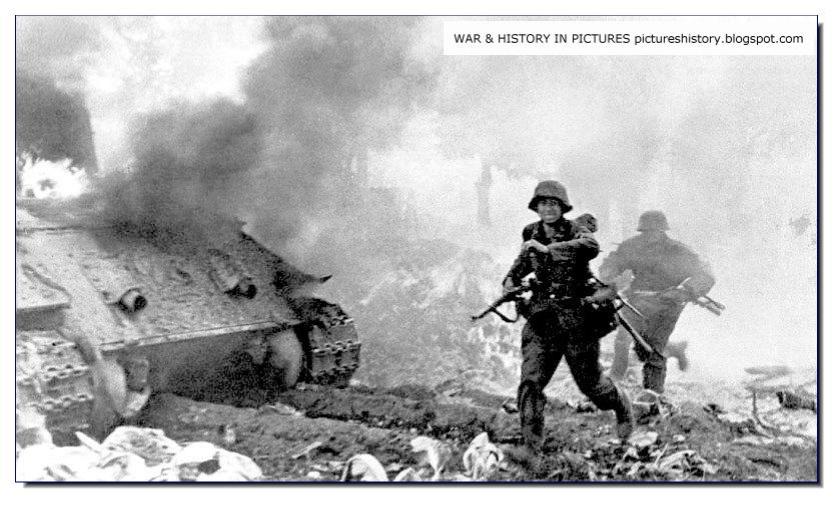
Fighting between Nazi Germany and the Soviet Union had long since taken on shades of a race war, Slav against Teuton, in a paroxysm of mutual extermination that is horrifying, even by the hellish standards of WWII.

WWII has been rightly described as the deadliest conflict in human history. Yet to the extent that WWII history is taught at all, it is largely based on the Western and Pacific theaters of the war. The “Ostfront” is less well understood, at least in the West:  the war as it was fought between the Soviet Union and Germany, on the Eastern theater of the war.

It may have been governments who started the war.  It was the every-day “Fritz” and the “Ivan” down the street, who did the fighting and the dying.totenkopf-SS-division-nazi-germany-elite-classic-fiercest-warriors-006

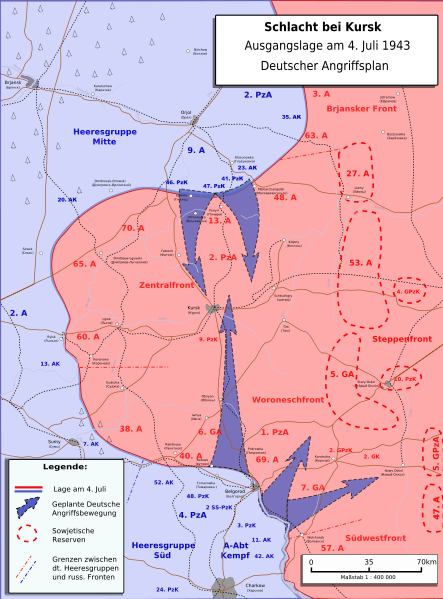
The greatest tank battle in history started this day on the Eastern Front. It began as a “Battle of a Bulge”, six months before the last German offensive began in the snow-covered forests of the Ardennes. The five-months long Battle for Stalingrad had ended with a decisive Soviet victory in February of that year, resulting in a “Bulge”, or salient in the Soviet lines, near the city of Kursk.

The Germans planned to shorten their battle lines by eliminating the Kursk salient, and commenced a series of strategic attacks in March, retaking Kharkov and Belgorod. Offensive operations ceased by the end of March due to the onset of the spring “rasputitsa” (mud season) and the exhaustion of both the Wehrmacht and the Red Army.

Field Marshal Erich von Manstein sent to Germany for massive reinforcements of Panther medium and Tiger heavy tanks, while Soviet forces prepared the “Defense in Depth” strategy which would prove decisive in July.

Kursk-1943-Plan-GE.svgThe Kursk salient was of little or no strategic value to the German war effort.  Both Manstein and General Walter Model argued for a tactical defense. Even Heinz Guderian, arguably the father of modern armored tactics, argued against the offensive, but Hitler would not hear of it. Der Fuhrer was going to have his offensive.
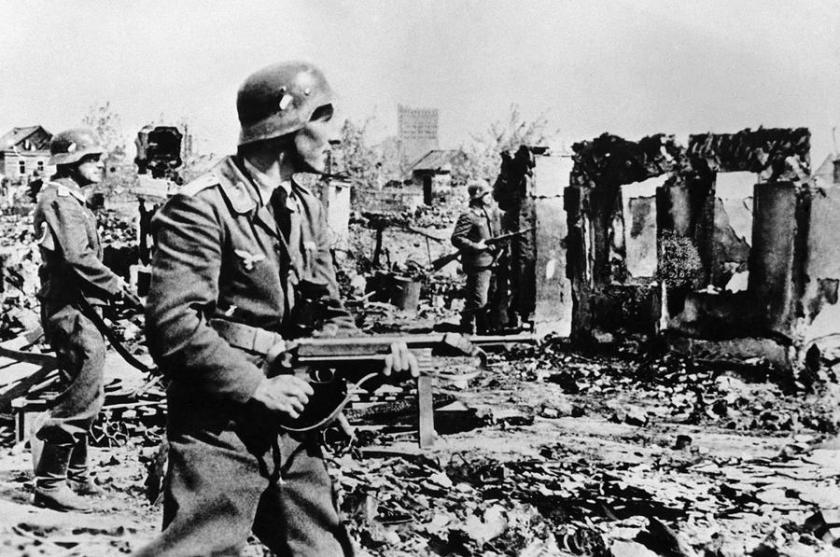
“Operation Citadel” started with a series of two offensives beginning on July 5. The Soviet’s defensive preparations began to take their toll almost immediately.

Minefields, fortifications, pre-sighted artillery fire zones and anti-tank strong points extended over 190 miles into the Soviet perimeter. By July 13, the Red Army had regained the offensive. Accounts of the battle vary wildly, with most estimates around 6,000 tanks, 2,000,000 troops, and 4,000 aircraft being involved in the fight.

Estimated losses are difficult to learn, due to the obsessive secrecy of both Nazis and Communists. Sources indicate over a quarter of a million German casualties and four times that number on the Soviet side.  1,083 tanks & assault guns were lost to the German side, over 8 times that number for the Russians.

The battle is considered to be a decisive victory for the Soviet union, representing the final German initiative of the Eastern Front. Though Soviet losses were far higher than those of Germany, the vast resources of the Soviet Union were far better positioned to replace those losses than that of the 3rd Reich.

main_900

Fighting between Nazi Germany and the Soviet Union had long since taken on shades of a race war.  Slav against Teuton, in a paroxysm of mutual extermination that is horrifying, even by the hellish standards of WWII.  The war on the Ostfront, was yet to grind out another year.

June 28, 1914 The Spark

Years earlier, German Chancellor Otto von Bismarck had said the next European war would be started by “Some damn fool thing in the Balkans”. Bismarck got his damn fool thing on June 28, 1914, when future Emperor Franz Ferdinand came to Sarajevo, the capital of the Balkan province of Bosnia-Herzegovina.

In 1914, Austria-Hungary was a kaleidoscope of fifteen distinct ethnic groups speaking at least that many languages.  Ostensibly a constitutional union between the Empire of Austria and the Kingdom of Hungary, the dual monarchy was in fact divided, sometimes sharply, along no fewer than six religious lines.

Since the 1889 suicide of his cousin Crown Prince Rudolf, the only son of Emperor Franz Josef, Franz Ferdinand, was the Heir Presumptive to the Austro-Hungarian throne.

Sophie Maria Josephine Albina Chotek von Chotkow und Wognin was a minor noble in the Kingdom of Bohemia, a small figure in a constellation of 19th century European royalty.  It’s uncertain when Sophie and Franz first met and fell in love, but their relationship caused a royal scandal. The future Queen of the Habsburg Dynasty was expected to hold suitable rank. Only a Princess of one of Europe’s dynastic families would do, certainly no Bohemian Countess.


Ferdinand wrangled with the Royal Court in Vienna for a year before the couple was permitted to marry, but only under hard and humiliating conditions. Theirs was a “morganatic” marriage.  A marriage of unequals.

Three days before the wedding, June 28, 1900, Franz was forced to sign and publicly declare Sophie to be his morganatic wife, never to bear the titles of Empress, Queen or Archduchess. Any children produced by the marriage would neither inherit nor be granted dynastic rights or privileges of any kind. The Imperial family didn’t even show up at the wedding.

In a world where rank was everything, Sophie was never permitted to appear beside her husband in public.  She was humiliated at every court function, relegated to last place and made to stand in line behind every Archduchess, Princess and Countess from Vienna to Budapest.

Battle of KosovoJune 28 was significant for another reason. The invading army of Ottoman Sultan Murad I was wiped out on this date in the 1389 Battle of Kosovo, (June 15, ‘old style’), the “Field of Blackbirds”. It was a Pyrrhic victory, as the Balkan defenders were virtually wiped out as well. The Ottomans being far more numerous, the Balkan states soon became vassals of the Ottoman Turks.
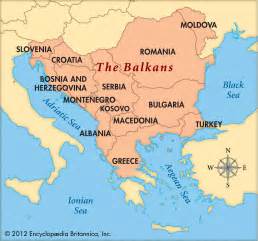
The Encyclopedia Britannica describes “Balkanization” as “fragmentation of ethnic groups”.  The Balkans form a geographic and political region, including 13 southeastern European nations from Slovenia to Greece. Located at the crossroads of east and west, the region has been subjugated and re-subjugated since the 6th century BC conquests of Persian King Darius the Great. The Balkan wars of 1912-1913 wrested some (but not all) of the area back from Ottoman control, as a newly enlarged Serbia pushed for greater independence and alliance among south Slavic peoples.Balkans

Years earlier, German Chancellor Otto von Bismarck had said the next European war would be started by “Some damn fool thing in the Balkans”. Bismarck got his damn fool thing on June 28, 1914, when future Emperor Franz Ferdinand came to Sarajevo, the capital of the Balkan province of Bosnia-Herzegovina.

Morganatic marriage was unknown in Hungarian law and custom.  This trip was a rare opportunity for the couple to openly travel together.  A “place in the sun” for Ferdinand’s wife, Sophie.

Ironically, Franz Ferdinand favored a more federalized model for the Empire, with greater autonomy for all its provinces. That wasn’t enough for the radical Serbian nationalists of the “Black Hand”, who inserted seven assassins along the route which the Archduke was scheduled to travel.

They were a carpenter, a printer, a teacher and four students. The oldest was 27. All suffered from tuberculosis, all armed with revolvers, crude bombs, or both, and a cyanide capsule with which to commit suicide if captured.

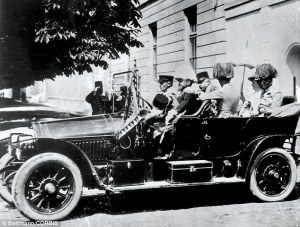
Ferdinand and SophieThe six car motorcade drove by the first assassin, Muhamed Mehmedbašić, a little after 10am. He froze, allowing the cars to pass unmolested.
Riding along the Appel Quay, the motorcade passed the second assassin, Nedeljko Čabrinović, who threw his bomb at the open car. The driver sped away as the bomb went off under the wheel of the fourth car, wounding two occupants and a dozen spectators. Meanwhile, Čabrinović popped his cyanide pill and jumped into the Miljacka River, expecting to die. The cyanide just made him retch and the river was but a few inches deep, so the would-be assassin was soon in police custody.

The motorcade sped on to a planned reception at City Hall, passing three more assassins, Vasco Cubrilovic, Danilo Ilic and Cvijetko Popovic, none of whom did anything. There followed a sort of dark comedy, when Ferdinand jumped out of the car, incandescent with rage. Addressing Fehim Effendi Curcic, the mayor of Sarajevo, Ferdinand shouted “One comes here to visit and is received with bombs. Mr. Mayor, what do you say? It’s outrageous!” Unaware of what had happened, Mayor Curcic began to read his prepared remarks: “Our hearts are filled with happiness…”

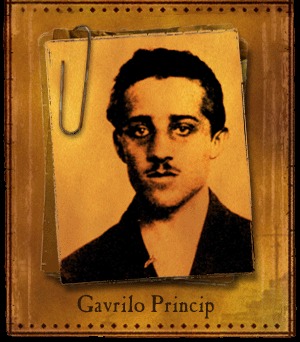
Ferdinand later insisted on visiting the wounded at hospital, though he begged Sophie to stay behind. She wouldn’t have it. The Military Governor of the province, Oskar Potiorek, assured them of safe passage. Sophie would remain by her husband’s side.Gavrilo Princip

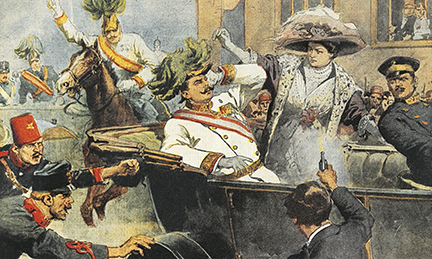
Soon they were off, speeding by the sixth assassin, Trifko Grabez, before he could react. Taking a wrong turn onto Franz Josef Strasse, the chauffeur realized his error and came to a stop before turning around. They were 8’ from the seventh and last assassin, Gavrilo Princip. Princip was in point blank range in two steps, firing once into Sophie’s side and once into the neck of the Archduke.

Archduke Franz Ferdinand’s jugular had been severed by the bullet. “For heaven’s sake, what’s happened to you?” she cried, before slipping to the floor of the car. “Sophie dear, Sophie dear, don’t die. Stay alive for our children.”  Asked if he was alright, Franz Ferdinand was already fading away. “Es ist nichts; Es ist nichts…” (It is nothing; it is nothing…). By 11:30, both were dead.

The mad act of a tubercular 19-year led to a series of diplomatic missteps and military mobilizations and counter-mobilizations called the “July Crisis of 1914″, culminating in the “War to End all Wars” that August.  There is virtually no part of 20th century history, that would ever be the same.

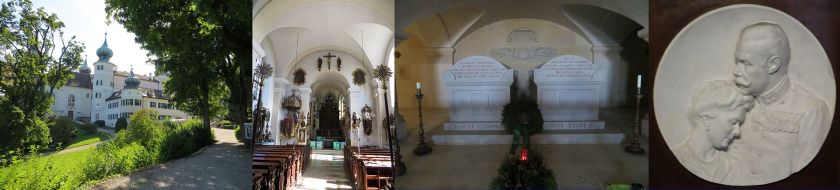
The_castle_The_chapel_The_crypt_The_couple
Knowing that he and his beloved wife could never be buried together in the Imperial Crypt, Ferdinand got the last word. In 1910, the Archduke set up a family crypt below the choir at the Artstetten Castle, in lower Austria. Neither had any idea that they’d need it, four years later. Now, Sophie and Ferdinand are at rest. At equal heights. Photo credit (2012) Marshmallowbunnywabbit at English Wikipedia, CC BY-SA 3.0, https://commons.wikimedia.org/w/index.php?curid=29775082