March 26, 1881 Old Abe

It wasn’t long before the entire Regiment adopted the bald eagle, calling themselves the “Eagle Regiment”, in honor of their new mascot. Much deliberation followed as to what to name him, before it was decided. He would be called “Old Abe”.

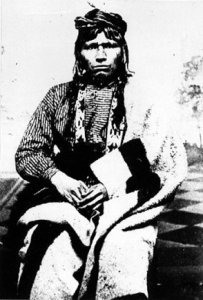
Ahgamahwegezhig
Ahgamahwegezhig

In 1861, leader of the Lac du Flambeau Ojibwe band Ahgamahwegezhig, or “Chief Big Sky”, captured an eaglet, and sold it for a bushel of corn to the McCann family of Chippewa County, Wisconsin. Captain John Perkins, Commanding Officer of the Eau Claire “Badgers”, bought the young bald eagle from Daniel McCann.

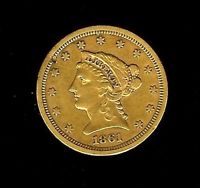
The asking price was $2.50.  Militia members were asked to pitch in twenty-five cents, as was one civilian:  tavern-keeper S.M. Jeffers.  Jeffers’ refusal earned him “three lusty groans”, causing him to laugh and tell them to keep their quarters.  Jeffers threw in a single quarter-eagle, a gold coin valued at 250¢, and that was that.   From that moment onward, the militia unit called itself the Eau Claire “Eagles”.1861 quarter eagle
Perkins’ Eagles entered Federal Service as Company C of the 8th Wisconsin Volunteer Infantry Regiment.  It wasn’t long before the entire Regiment adopted the bald eagle, calling themselves the “Eagle Regiment”, in honor of their new mascot.  Much deliberation followed as to what to name him, before it was decided.  He would be called “Old Abe”.

Old Abe accompanied the regiment as it headed south, travelling all over the western theater and witness to 37 battles. David McLain wrote “I have frequently seen Generals Grant, Sherman, McPherson, Rosecrans, Blair, Logan, and others, when they were passing our regiment, raise their hats as they passed Old Abe, which always brought a cheer from the regiment and then the eagle would spread his wings”.
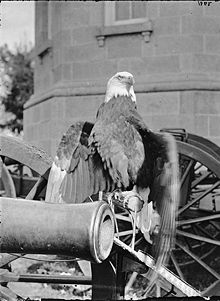
Old AbeAbe became an inspirational symbol to the troops, like the battle flag carried with each regiment. Colonel Rufus Dawes of the Iron Brigade recalled, “Our eagle usually accompanied us on the bloody field, and I heard [Confederate] prisoners say they would have given more to capture the eagle of the Eighth Wisconsin, than to take a whole brigade of men.”

Confederate General Sterling Price spotted Old Abe on his perch during the battle of Corinth, Mississippi.  “That bird must be captured or killed at all hazards”, Price remarked. “I would rather get that eagle than capture a whole brigade or a dozen battle flags”.OldAbe
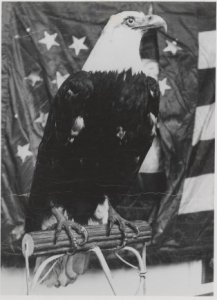
Old Abe was presented to the state of Wisconsin at the end of the war. He lived 15 years in the “Eagle Department”, a two-room apartment in the basement of the Capitol, complete with custom bathtub, and a caretaker.  Photographs of Old Abe were sold to help veteran’s organizations. He was a national celebrity, traveling across the country and appearing at the 1876 Centennial Exposition in Philadelphia, the 1880 Grand Army of the Republic National Convention, and dozens of fundraising events.

OLD_ABE_AND_GEORGE_GILLES
Old Abe & caretaker George Gilles

A small fire broke out in a Capitol basement workshop, fed by cleaning solvents and shop rags.  The fire was quickly extinguished thanks to the bald eagle’s cries of alarm, but not before Old Abe inhaled a whole lot of that thick, black smoke.  Abe’s health began to decline, almost immediately.  Veterinarians and doctors were called, but to no avail.  Bald eagles have been known to live as long as 50 years in captivity. Old Abe died in the arms of caretaker George Gilles on March 26, 1881.  He was 20.

His remains were stuffed and mounted.  For the next 20 years his body remained on display in the Capitol building rotunda. On the night of February 26, 1904, a gas jet ignited a newly varnished ceiling, burning the Capitol building to the ground.

Since 1915, Old Abe’s replica has watched over the Wisconsin State Assembly Chamber of the new capitol building.Old_abe_capitol

In 1921, the 101st infantry division was reconstituted in the Organized Reserves with headquarters in Milwaukee.  It was here that the 101st first became associated with the “Screaming Eagle”.  The Screaming Eagles of the 101st Airborne participated in the D-Day invasion, the Battle of the Bulge, Operation Market Garden, and Bastogne, becoming the basis of the HBO series “A Band of Brothers”.
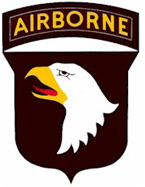
101st_Airborne_Division_patchAfter WWII, elements of the 101st Airborne were mobilized to Little Rock by President Eisenhower to protect the civil rights of the “Little Rock Nine”, a group of black students enrolled in Little Rock Central High School in September 1957, as the result of the US Supreme Court’s landmark ruling in the historic Brown v. Board of Education case.

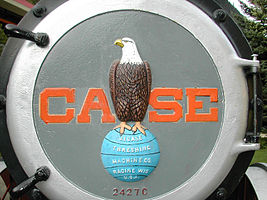
For 104 years, Old Abe appeared in the trademark of the J.I. Case farm equipment company of Racine, Wisconsin.Old_Abe_Case_mascot
Winston Churchill once said “A lie gets halfway around the world before the truth has a chance to get its pants on.”  We all know how stories change with the retelling.  Some stories take on a life of their own.  Ambrose Armitage, serving with Company D of the 8th Wisconsin Infantry, wrote in his diary on September 14, 1861, that Company C had a “four month old female eagle with them”.   Two years later, Armitage wrote, “The passing troops have been running in as they always do to see our eagle. She is a great wonder”.

Ten years after his death, a national controversy sprang up and lasted for decades, as to whether Old Abe was, in fact, a “she”.  Suffragettes claimed that “he” had laid eggs in the Wisconsin capitol.  Newspapers weighed in, including the Washington Post, Detroit Free Press, St. Louis Post Dispatch, Oakland Tribune, and others.Abe Feathers
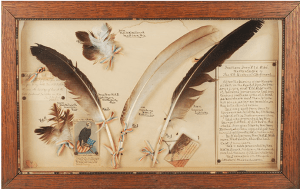
Bald eagles are not easily sex-differentiated, there are few clues available to the non-expert, outside of the contrasts of a mated pair.  It’s unlikely that even those closest to Old Abe, had a clue as to the eagle’s sex.

University of Wisconsin Biotechnology Center Sequencing Facility researchers had access to four feathers, collected during the early days at the Grand Army of the Republic Memorial Hall.  In March of 2016, samples were taken from the hollow quill portion (calamus) of each feather, and examined for the the presence of two male sex chromosomes (ZZ) or both a male and female chromosome (ZW). After three months, the results were conclusive.  All four samples showed the Z chromosome, none having a matching W.  After 155 years, Old Abe could keep his name.


March 10, 1864  Who’s Buried in Grant’s Tomb?

Grant was in constant pain in his last year, as the cancer literally throttled the life from his body. He wrote at a furious pace despite his suffering, often finishing 25 to 50 pages a day. No re-writes, no edits. there was no time for that.

Hiram Grant was born in Point Pleasant, Ohio on April 27, 1822. His family called him by his middle name Ulysses, or sometimes just “Lyss”, for short.

A clerical error changed the name of the future Commander-in-Chief during his first days at the United States Military Academy at West Point. He didn’t seem to mind, though, probably thinking that “US Grant” was preferable to “H.U.G.”. Predictably, Grant became known as “Uncle Sam” or simply “Sam.”  It was as good a name as any, though, as with future President Harry S. Truman, the “S” doesn’t actually stand for anything.

Grant at WarThe 1862 Civil War Battle of Fort Donelson secured the name, when then-Brigadier General Ulysses S. Grant received a request for terms from the fort’s commanding officer, Confederate Brigadier General Simon Bolivar Buckner. Grant’s reply was that “no terms except an unconditional and immediate surrender can be accepted. I propose to move immediately, upon your works.” The legend of “Unconditional Surrender” Grant, was born.

Grant had been a light smoker before Donelson, generally preferring a pipe, if anything. A reporter spotted him holding an unlit cigar during the battle, a gift from Admiral Foote.  Soon, ten thousand cigars were sent to him in camp. He gave away as many as he could, but it started the habit of smoking cigars that became one of his trademarks, and probably led to his death of throat cancer, in 1885.

On this day in 1864, President Abraham Lincoln signed a document promoting Ulysses S. Grant to the rank of Lieutenant General of the United States Army, officially putting then-Major General Grant in charge of all Union armies.  Lincoln preferred Henry Wagner Halleck for the promotion, at the time fearing that Grant would challenge him for the 1864 Republican Presidential nomination.  Lincoln submitted to the will of Congress only after Grant publicly dismissed the idea of running for President.

46 year old U.S. Grant would be elected the 18th President of the United States four yearsulysses_s_grant_18th_president_of_the_u_s_postcard later, going on to serve two terms after becoming, at that time, the youngest man ever so elected.
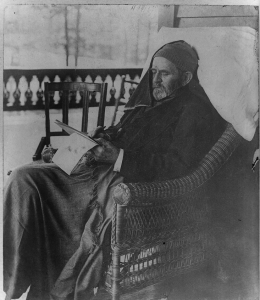
Grant was a gifted writer.  The penning of his autobiography is a story in itself. Gravely ill at the time and financially destitute, Grant knew with certainty that he was dying of throat cancer.  The proceeds from his unwritten memoirs were his only means of supporting his family after his death.

Grant was in constant pain in his last year, as the cancer literally throttled the life from his body. He wrote at a furious pace despite his suffering, often finishing 25 to 50 pages a day. No re-writes, no edits. There was no time for that. The writing of Grant’s two volume memoir was literally a race with death. Many of his wartime contemporaries felt that they received too little credit in Grant’s retelling of events, but that may be understood under the circumstances.

grantlastdaysIn June 1885, as the cancer spread through his body, the family moved to Mount MacGregor, New York, to make him more comfortable. Propped up on chairs and too weak to walk, Grant worked to finish the book as friends, admirers and even former Confederate adversaries, made their way to Mount MacGregor to pay their respects.

He finished the manuscript on July 18, 1885.  Five days later, he was gone. On release, the book received universal critical praise. Mark Twain, who published the memoir, compared them to the Commentaries of Julius Caesar. Gertrude Stein admired the book, saying she could not think of Grant without weeping. Ulysses Grant’s memoirs quickly became a best seller, his family receiving 75% of the net royalties after expenses.  The book would earn $450,000, over $10 million in today’s dollars, comfortably re-establishing the Grant family fortune.

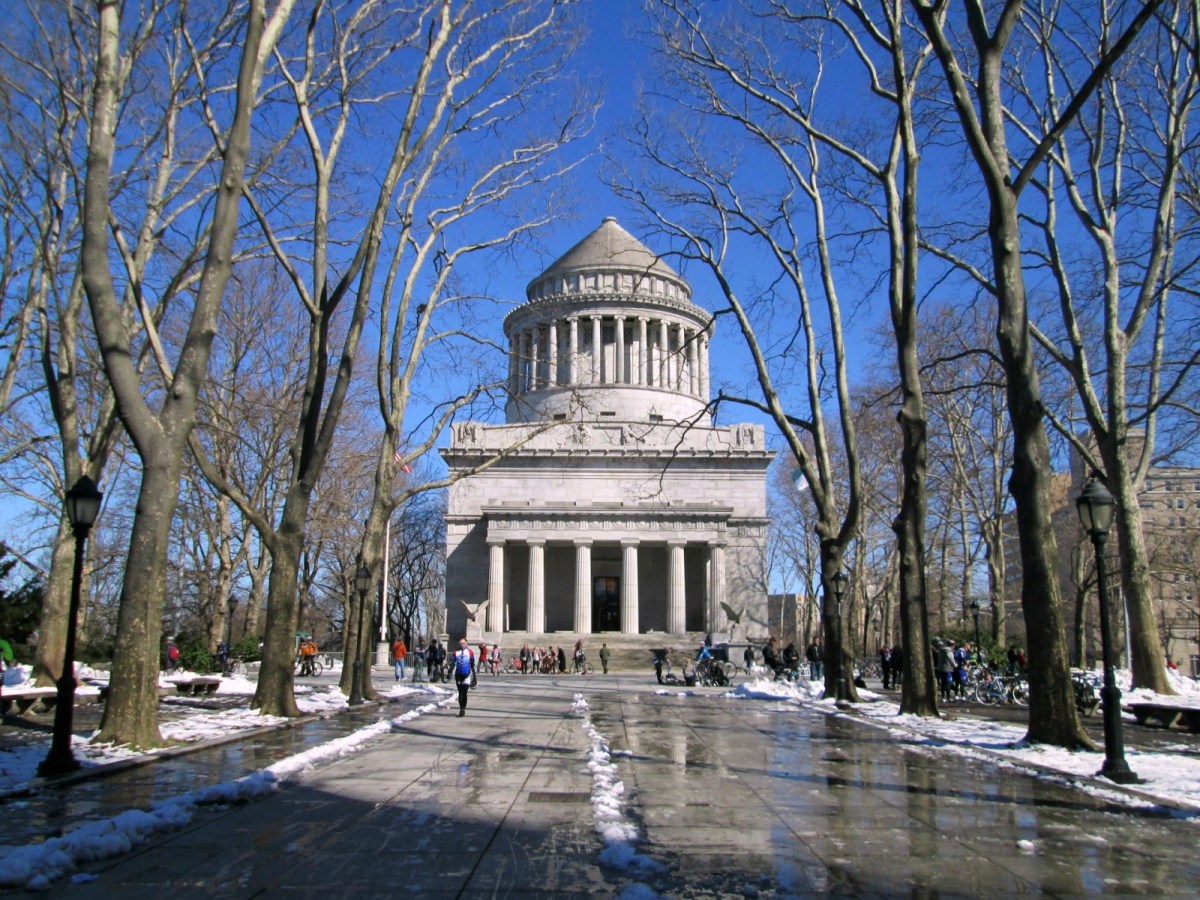
Grant’s wife Julia died on March 4, 1877, and was buried with her husband in Grant’s monumental tomb overlooking the Hudson River, in New York City.

Next time someone asks you who’s buried in Grant’s tomb, you can tell them that it’s Hiram Ulysses Grant.  If you really want to show off, don’t forget to include his wife, Julia.

March 8, 1863 The Gray Ghost

Entering the chamber where the General slept, Mosby lifted his nightshirt and slapped his bare backside with a sword

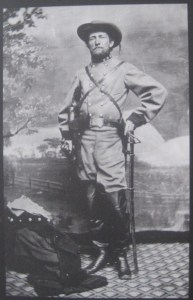
John Singleton Mosby was a Virginia lawyer, when Civil War broke out in 1861.  Like fellow Virginian Robert E. Lee, Mosby opposed secession. When it came, he left the Union along with his home state of Virginia. Small and frail as a boy, Mosby was often the target of much larger bullies. He’d write in his memoirs that he never won a fight. It seems that he never backed down from one, either.

MosbyMosby participated in the 1st Battle of Manassas (1st Bull Run) as a member of the Virginia Volunteers Mounted Rifles, later joining James Ewell Brown “Jeb” Stuart as a Cavalry Scout. A natural horseman and gifted tactician, information gathered by Mosby aided Stuart in his humiliating ride around McLellan’s Army of the Potomac in June, 1862.
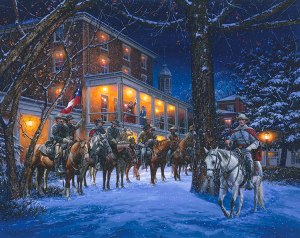
In 1863, Stuart authorized Mosby to form and take command of the 43rd Battalion of the Virginia Cavalry, a regiment sized unit operating out of north central Virginia. These “Partisan Rangers”, 1,900 of whom served between January 1863 and April 1865, were under the authority of Stuart and Lee and subject to their commands, but they were not a traditional army unit. Mosby’s Rangers shared in the spoils of war, they had no camp duties, and lived scattered among civilian populations.

Mosby himself would often reconnoiter a target himself, in disguise.  Known for lightning raids of the Virginia countryside, Mosby’s 43rd Cavalry would be called together to strike a specific target, dispersing afterward and making themselves next to impossible to run to ground.  He was the “Gray Ghost”, so successful were his Rangers, that parts of Virginia’s Piedmont region are known as “Mosby’s Confederacy”, to this day.

Late on the night of March 8, 1863, Mosby’s Rangers formed up for a raid on Fairfax Mosbys-Rangers750Courthouse, Virginia. Union Brigadier General Edwin H. Stoughton was sleeping in his headquarters there, some sources say he was “sleeping it off”. The Gray Ghost entered the Union General’s headquarters in the small hours of March 9, his rangers quickly overpowering a handful of sleepy guards.

Entering the chamber where the General slept, Mosby lifted his nightshirt and slapped his bare backside with a sword. The general sputtered awake, demanding “What is the meaning of this”. “General, did you ever hear of Mosby”, came the question. Stoughton replied, “Yes, have you caught him?” “I AM Mosby,” said the Gray Ghost, “and I have caught you. Stuart’s cavalry has possession of the Courthouse; be quick and dress.”

John Singleton Mosby and 29 Rangers had captured a Union General, two Captains, 30 enlisted men and 58 horses, without firing a shot. On hearing the story the next day, Lincoln lamented. “I can make another Brigadier in 5 minutes, but I can’t replace those horses”.

Mosby 3rd Reunion 7-1-1896
Mosby’s Rangers, Third Reunion, 1896


February 23, 1862 Floating Cathouse of the Cumberland

Certain that Nashville’s prostitutes were the source of the venereal plague, Union officials decided it was easier to get rid of them, than it was to keep their men from paying for sex

The Federal invasion of Tennessee began in early 1862, when Union forces under Ulysses S. Grant moved against Fort Henry on the Tennessee River and Fort Donelson on the Cumberland.  Both fortifications fell in February.  Another Federal army under Don Carlos Buell captured Nashville on the 25th.
Confederate presence in Tennessee essentially ceased to exist by June.  West Tennessee would remain in Union hands for the remainder of the war.
Robert E. Lee wrote to his wife on February 23, “The news from Tennessee and North Carolina is not cheering and disasters seem to be thickening around us”.
Union commanders declared martial law, posting garrisons in major towns including Chattanooga, Memphis, and Murfreesboro. Nashville in particular became a major military center, permanently occupied by thousands of Federal troops and support personnel.
According to the 1860 Census, Nashville had 198 white prostitutes and 9 described as “mulatto”, plying their trade in the two block red-light district known as “Smoky Row”. By 1862, the number of these “public women” had grown to 1,500.  It was barely enough to go around.

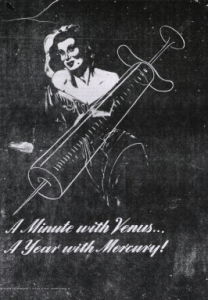
Major General William Rosecrans saw this sex trade as an issue and ordered Georgesyphilis_slogan Spalding, Provost Marshal of Nashville, to get rid of them. Though a Catholic, “Old Rosy’s” objection wasn’t based on moral grounds.  He was afraid of disease. 8.2% of all Union soldiers were afflicted with syphilis or gonorrhea in 1862, over half the battle casualty rate of 17.5%  Venereal disease was a major problem, and the only available treatments at the time involved mercury.  Without getting into details, that could take a man out for weeks.  Advanced cases were nothing short of grotesque.
tertiary-syphilis
Tertiary Syphilis Victim
Certain that Nashville’s prostitutes were the source of the plague, Union officials decided it was easier to get rid of them, than it was to keep their men from paying for sex.  Spalding had all the prostitutes in Nashville gathered up by July, (I wonder what that sounded like).    The Nashville Daily Press reported  “A variety of ruses were adopted to avoid being exiled; among them, the marriage of one of the most notorious of the cyprians to some scamp. The artful daughter of sin was still compelled to take a berth with her suffering companions, and she is on her way to banishment”.
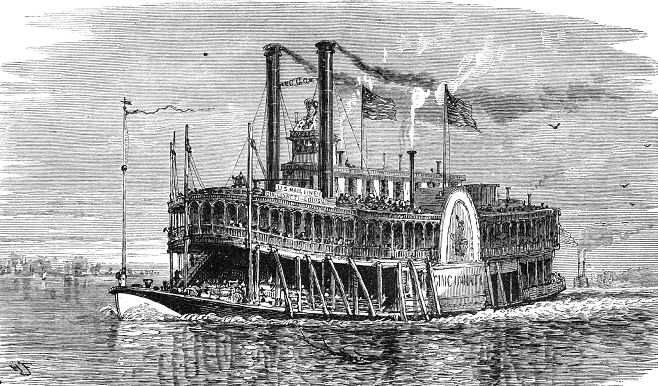
John Newcomb was the owner of a brand new steam powered riverboat, the “Idahoe”. (I swear I didn’t make that up). To Newcomb’s horror, Spalding ordered him to take 111 of Nashville’s most infamous hookers out of town, on Idahoe’s maiden voyage. Giving him three days’ rations, authorities didn’t care where he took them, so long as he got them out of Nashville.
It took a week for Idahoe to reach Louisville, by which time news of the unusual passenger list had already reached that city’s law enforcement. Newcomb was forbidden from docking there, and ordered to continue on to Cincinnati. Ohio didn’t want Nashville’s hookers any more than Louisville, so the steamboat was ordered to dock across the river in Kentucky.
Some of the women swam ashore but nobody was permitted to leave. Holcomb was desperate, finally returning to Louisville once more, only to be turned away again. Defeated, John Newcomb returned to Nashville 28 days later, with 98 of his original passengers and six children.
With Idahoe’s owner demanding to be compensated, a staffer inspected the vessel on August 8, finding the ship’s staterooms “badly damaged, the mattresses badly soiled,” and recommending that Newcomb be paid $1,000 in damages + $4,300 for food and for the “medicine peculiar to the diseased of women in this class”.
hospital_nashville
Civil War Nashville Hospital

In the end, it proved easier to manage the world’s oldest profession, than it was to eliminate it. A scheme was devised, by which each prostitute in Nashville would register and pay a $5 license fee, entitling her to ply her trade. A doctor would examine these women once a week, a service for which she would pay another 50¢. Women found to have venereal diseases were sent to a hospital, paid for in part by the weekly fees. The result of the program, according to one doctor, was a “marked improvement” in licensed prostitutes’ physical and mental health.

Altogether, the program cost about $6,000, on revenues of $5,900. Venereal disease was cut to one or two cases among the soldiers, compared to 3,000 or more without it. Today, the system practiced in Lyon County Nevada, closely resembles this system established in 1863.
As for John Newcomb, he waited almost two years for his money, finally writing directly to Secretary of War Edward Stanton before receiving any reimbursement. The Idahoe never again cruised in Southern rivers. “I told them it would forever ruin her reputation as a passenger boat”, he said. “It was done, so she is now & since known as the floating whore house.”

February 17, 1864 Hunley

Despite two disastrous test runs, there was no shortage of volunteers.  Once again, the Hunley was fished up from the bottom

In the 1850s, the economy of the southern United States was mostly agrarian.  When civil war broke out in 1861, the Confederacy depended to a greater degree on imported manufactured goods than the more industrialized states to the north.  For the Union, there was strategic advantage in cutting off this flow of manufactured goods, and so the “Anaconda Plan” was created, to choke off traffic to southern ports and harbors.
Few in the Confederacy understood the need to keep southern ports open as well as the planter, legislator, and southern Patriot Horace Lawson Hunley.
In 1861, Hunley joined forces with James McClintock and Baxter Watson to design and hunley-interiorbuild a secret Super Weapon for the Confederacy.  A submarine.  They completed construction on their first effort, the “Pioneer”, that same year in New Orleans.  The trio went on to build two more submarines in Mobile, Alabama, the “American Diver”, and their last and most successful creation, the “Fishboat”, later renamed HL Hunley.
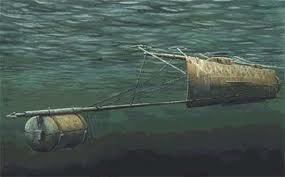
After a short sea trial in Mobile, the Hunley was put on a train and shipped up to Charleston, South Carolina, to help break the blockade.  Arriving on August 12, 1863, she was 40′ long by 4′ wide, displacing about 7½ tons.  She was designed for a crew of 8, with 7 operating a hand crank and the 8th steering the boat.
A test run on August 29 ended in disaster, when Skipper John A. Payne accidentally stepped on the lever controlling the diving planes with the hatches open.  Payne and two others escaped, but the other five crew members went to the bottom.
A second crew tested the submarine on October 15, this one including Horace Hunley himself.  The submarine conducted a mock attack but failed to surface afterward, this time drowning all 8 crew members.
Despite those two disastrous test runs, there was no shortage of volunteers.  Once again, the Hunley was fished up from the bottom.
hunley-warheadThe original plan was to tow a floating mine called a “torpedo”, with a contact fuse.  They would dive beneath their victim and surface on the other side, pulling the torpedo into the side of the target.
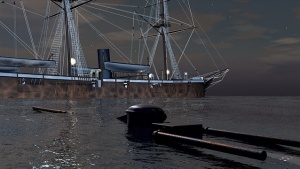
Tide and current conditions in Charleston proved to be very different from those in Mobile.  On several test runs, they found the torpedo floating out ahead of the sub.  That wouldn’t do, so they fashioned a spar and mounted it to the bow.  At the end of the spar was a 137lb waterproof cask of powder, attached to a harpoon-like device with which Hunley would ram its target.hunley-housatonic
Hunley made her first live attack run four miles outside of Charleston Harbor, on the night of February 17, 1864. Lieutenant George Dixon and a crew of seven attacked USS Housatonic, a 1,240 ton steam powered sloop of war, embedding the spar torpedo into Housatonic’s hull.  It must have been a sight to see.  The torpedo ignited a 4,000 lb store of black powder in the hull of the ship, exploding with a deafening roar and a towering column of flame that lit up the night.
hunley
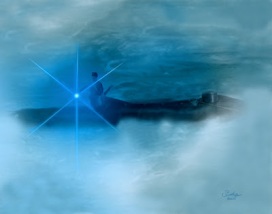
Housatonic was gone in three minutes, killing five sailors.  What happened next, is a mystery.  The first successful attack sub in history showed the signal for success, a blue lantern, to their comrades on shore.  And then it vanished.
Hunley would not be seen again for 131 years.
Author and adventurer Clive Cussler found the sub in 1995, buried in silt under 32′ of water.  A painstaking, five year effort was launched to bring Hunley to the surface, and on August 8, 2000, HL Hunley returned to the light of day.  The sub was moved to the Warren Lasch Conservation Center in thehunley-in-the-lab Charleston Navy Yard, and submerged in 55,000 gallons of chilled, fresh water, where scientists and historians worked on unlocking its secrets.
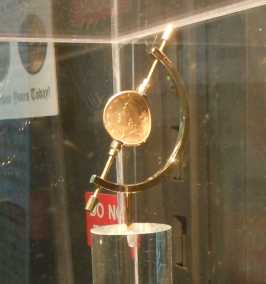
There was an old rumor that Lt. Dixon left a girlfriend in Mobile, Alabama, named Queenie Bennett.  She had given him a $20 gold piece, a good luck charm and token of her affection.  Dixon was shot in the hip at Shiloh, the story goes, a wound that should have killed him.  If the bullet hadn’t struck the gold piece in his pocket. dixon-gold-coin
No one knew if the story was true, until excavation started inside the sub.  Senior Archaeologist Maria Jacobsen found the coin, next to the remains of George E. Dixon.  “Some people may think this is a stroke of luck,” she said, “but perhaps it’s something else. They tell me that Lt. Dixon was a lady’s man, perhaps he winked at us yesterday to remind us that he still is”.
On the coin, clearly showing signs of having been struck by a bullet, are inscribed these words:

Shiloh
April 6, 1862
My life Preserver
G. E. D.


hunley-crew
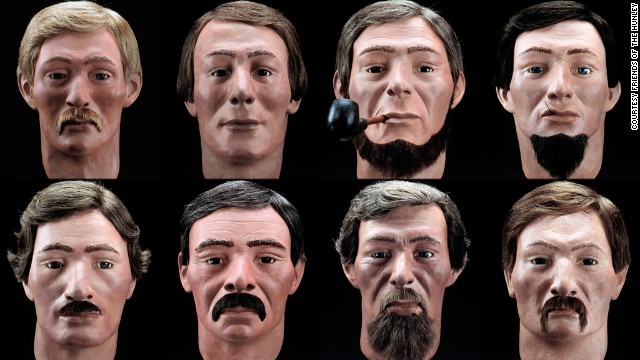
Facial reconstruction techniques reveal the faces of the HL Hunley commander Lt. George Dixon and crewmembers Arnold Becker, Lumkin (first name unknown), Joseph Ridgaway, Frank Collins, Miller (first name unknown), Cpl. J.F. Carlsen and James A Wicks.


December 30, 1863 The Confederate States of…Bermuda

“There are a great many Southern people here”, wrote the American Consul in Bermuda, in 1862, “14 came in the steamer ‘Bermuda’. They & their friends are down on me & have threatened to whip me”.

When South Carolina seceded from the Union in December 1860, it was the first of 11 states to do so. War broke out in April, and the Confederacy desperately needed ships for its fledgling Navy. They needed manufactured goods as well, which could no longer be obtained from the industrialized North. The answer, in both cases, was Great Britain. While remaining officially neutral, England soon became primary ship builders and trade partners for the Confederacy.

For the British military, Bermuda had already demonstrated its value. Bermuda based privateers captured 298 American ships during the war of 1812. The place served as a base for amphibious operations as well, such as the 1815 sack of Washington, DC. British Commander Sir Alexander Milne, said “If Bermuda were in the hands of any other nation, the base of our operations would be removed to the two extremes, Halifax and Jamaica, and the loss of this island as a Naval Establishment would be a National misfortune”.

President Lincoln issued a proclamation soon after taking office, threatening to blockade southern coastlines. It wasn’t long before the “Anaconda Plan” went into effect, a naval blockade extending 3,500 miles along the Atlantic and the Gulf of Mexico coastlines and up into the lower Mississippi River.

runnerbritanniawilm
Blockade runner Britannia in Wilmington harbor

Running the blockade was no small or occasional enterprise. The number of attempts to run the Federal stranglehold have been estimated at 2,500 to 2,800, of which about 2/3rds were successful. Over the course of the war, the Union Navy captured over 1,100 blockade runners. Another 355 vessels were destroyed or run aground.

Cotton would ship out of Mobile, Charleston and Wilmington as well as other ports, while weapons and other manufactured goods would come back in. Sometimes, these goods would make the whole trans-Atlantic voyage.  Often, they would stop at neutral ports in Cuba or the Bahamas.  North Carolina and Virginia had long-established trade relations with Bermuda, 600 nautical miles to the east.1blockadeusnavyhandout

The most successful blockade runners were the fast, paddle wheeled steamers, though surprisingly little is known of the ships themselves. They were usually built in secrecy, and operated at night. One notable exception is the “Nola”, a 236-foot paddle steamer that ran aground on December 30, 1863, en route from London to North Carolina. Nola ran aground on her maiden voyage, attempting to enter Bermuda to take on coal. She was wrecked near Western Blue Cut on Bermuda’s reefs, and remains a popular dive destination to this day.

President Lincoln appointed Massachusetts native Charles Maxwell Allen Consul to Bermuda in 1861, where he remained until his death in 1888. There were times when it was a great job, I’m sure, but not in the early days. “There are a great many Southern people here”, Allen wrote in 1862, “14 came in the steamer ‘Bermuda’. They & their friends are down on me & have threatened to whip me”. People were getting rich running the blockade, Allen estimated that one blockade runner alone, which sank after three voyages, generated a profit of more than £173,000.

Today, the capital of Bermuda is Hamilton, moved across the island in 1815 from the old port of St. George and leaving the former capital in a kind of time warp, where you can walk down streets that look like they did 150 years ago. Portraits of Robert E. Lee and Confederate battle flags can still be found on the walls of the old port, beside paintings showing the harbor filled with blockade runners, lying quietly at anchor.

st-george-harbor
Confederate blockade runners at anchor in St George Harbor, Bermuda

Sheryl and I traveled to Bermuda a while back, visiting the old port at St. George. At some point we learned about the maritime history of the island, as well. Making a living at sea in the 19th century was a dangerous business, so much so that one in ten of the married women living in Bermuda at that time, were widows.

It occurred to me that all those Confederate officers and enlisted men were spending a lot of time in Bermuda, and the possibility that followed soon morphed into a probability and then a certainty. At this point I can only wonder how many English citizens there are, residents of Bermuda and loyal subjects of the Queen, who can trace their paternity back to the Confederate States of America.

December 27, 1913 My Favorite Curmudgeon

Today, any writer who wants to be the least bit controversial had better keep his lawyer’s number on speed dial. In Bierce’s day, he’d better carry a gun.

bierceAmbrose Bierce was born in Horse Cave Creek, Ohio, to Marcus Aurelius and Laura Sherwood Bierce, the 10th of 13 children, all with names beginning with the letter “A”.

Marcus and Laura never had much money, but they were inveterate readers and imparted a love of books that would last young Ambrose all his life. At 15, Bierce left home to become a “printer’s devil”, fetching type and mixing ink, following in the footsteps of Benjamin Franklin, Thomas Jefferson, and his contemporary, Mark Twain.

He enlisted with the 9th Indiana Regiment at the outbreak of the Civil War, where he developed map making skills.  Bierce would frequently find himself in the hottest part of the front lines, while he drew out and mapped some difficult terrain feature.  He would later say of the experience that “War is God’s way of teaching Americans geography”.

For Ambrose Bierce, the Civil War ended at Kennesaw Mountain, Georgia, when a severe head wound took him out of the war for good. He later headed west, making the first usable maps of the Black Hills, before winding up in San Francisco.

Long hours spent in a boring job at the San Francisco mint, gave him plenty of time to read the classics and brush up on his writing skills. He soon found himself in the newspaper business, one of the top columnists in the city.

Today, any writer who wants to be the least bit controversial had better keep his lawyer’sambrosebierceoncabbage number on speed dial. In Bierce’s day, he’d better carry a gun. Ambrose Bierce didn’t shy away from politics, he jumped right in, frequently using a mock dictionary definition to lampoon his targets. One example and my personal favorite, is “Politics: A strife of interests masquerading as a contest of principles. The conduct of public affairs for private advantage”.
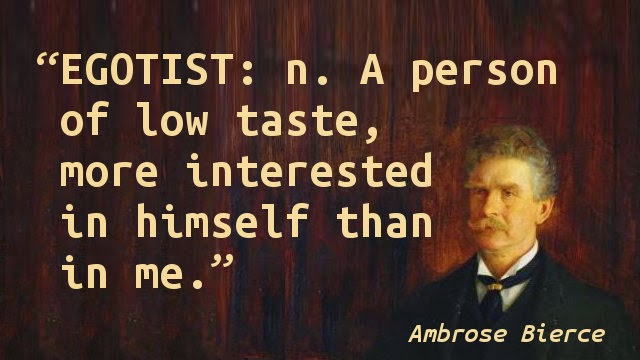
Bierce worked for the Hearst Newspaper The San Francisco Examiner in 1896, when he was sent to Washington to cover a railroad bill that was working its way through Congress. The Union and Pacific Railroad received $130 million taxpayer dollars (about $3 billion in today’s money) laundered through the Federal Government and lent to them on extremely favorable terms. One of the railroad’s builders, Collis P. Huntington, had persuaded a malleable congressman to forgive the loan altogether, if only they could keep the measure quiet.ambrosebierceonego

Bierce lampooned the crony capitalist and the politician alike.  The offending bill was anything but quiet when an infuriated Huntington confronted Bierce on the Capital steps. When asked his “price”, Bierce answered “My price is $130 million dollars.  If, when you are ready to pay, I happen to be out of town, you may hand it over to my friend, the Treasurer of the United States”. The bill went on to defeat.  We can only wonder how things would be today, if such a man were to replace the partisan lapdogs who pass themselves off as the national press corps.

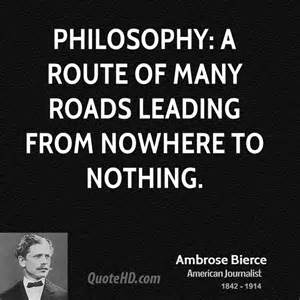
Bierce’s biting satire would often get Hearst and his newspaper in trouble.  Nothing wasambrosebierceonphilosophy off limits. Politics was a favorite target of his columns, such as: “CONSERVATIVE, n: A statesman who is enamored of existing evils, as distinguished from the Liberal who wishes to replace them with others”, or “POLITICIAN, n. An eel in the fundamental mud upon which the superstructure of organized society is reared. When he wriggles he mistakes the agitation of his tail for the trembling of the edifice. As compared with the statesman, he suffers the disadvantage of being alive”.

These mocking definitions became so numerous that they were published in 1906 as “The Cynic’s Word Book”.  It is still in print today as the “Devil’s Dictionary”. The topics are seemingly endless. On Motherhood: “SWEATER, n.: garment worn by child when its mother is feeling chilly”. On the Arts: PAINTING, n.: The art of protecting flat surfaces from the weather, and exposing them to the critic”. Or “MARRIAGE, n: the state or condition of a community consisting of a master, a mistress, and two slaves, making in all, two”. And then there’s education, “ACADEME, n.: An ancient school where morality and philosophy were taught. Academy, n.: A modern school where football is taught”.

Bierce left San Francisco in October 1913 at the age of 71, to revisit some of his Civil War battlefields. He then headed south into Mexico, which was at that time a whirlpool of revolution. He joined Pancho Villa’s army as an observer in Ciudad Juárez, arriving in Chihuahua some time in December. Bierce’ last letter was written to a close friend, Blanche Partington, on December 26, 1913. He closed the letter saying, “As to me, I leave here tomorrow for an unknown destination.”

And then, he vanished.

If you visit Sierra Mojada, in Coahuila, Mexico, they’ll tell you that Ambrose biercemarkerGwinnett Bierce was executed by firing squad in the town cemetery. It’s as good an ending to this story as any, as one hundred and three years ago today is as good a day as any on which to end it. The fact is that in that 103 years, there’s never been a trace of what became of him, and probably never will be.

He would have had a good laugh, reading the monument that Meigs County, Ohio erected in his honor in 2003. So many words to commemorate a life, when his own words would have done so well. “MONUMENT, n:  A structure intended to commemorate something which either needs no commemoration or cannot be commemorated.”ambrosebierceonplan

December 14, 1862 Angel of Marye’s Heights

No one will ever know how many lives were saved by his courage, and his kindness, this day in 1862

One of the bloodiest battles of the Civil War began on the 11th of December, 1862, when nearly 200,000 combatants collided in the town of Fredericksburg, Virginia.

The Union crossing of the Rappahannock was intended to be a surprise, depending on pontoons coming down from Washington to meet up with General Ambrose Burnside’s Union army in Falmouth, across the river from Fredericksburg.  The army of the Potomac arrived on November 19, with no sign of pontoons.  When they finally arrived, heavy snows slowed military operations for an additional week.  Lt. General James Longstreet and Lt. General Thomas “Stonewall” Jackson had more than enough time to prepare their defenses.

Burnside’s crossing began on the morning of December 11, as engineer battalions constructed bridges in the face of determined Confederate fire. Several groups of soldiers had to row across the river, the battle moving through the streets and buildings of Fredericksburg, as Union and Confederate troops fought the first urban combat of the Civil War.

On the morning of the 13th, Robert E. Lee’s Confederate forces occupied a seven mile long curving line, with the five divisions of Longstreet’s Corps on the left along Marye’s Heights, west of town.  Fighting began on both ends of the Confederate position, more or less simultaneously.  George Meade had some early successes against Stonewall Jackson’s dug-in positions on the right, but requested reinforcements never arrived.  By the end of the day, the old farmer’s expression “slaughter pen”, had taken on a whole new meaning.

In contrast to the swampy approaches on the Confederate right, 5,000 soldiers under James Longstreet looked out from behind the stone wall on Marye’s Heights to an open plain, crossed from left to right by a mill run, 5′ deep, 15′ wide and filled with 3′ of freezing water.

Confederate artillery commander Edward Porter Alexander looked out on that field, and said “a chicken could not live on that field when we open on it”.  He was right.  For six hours, the Union army threw one attack after another against the rebels behind the wall.  Fourteen assaults, in all.  As the sun went down on the evening of December 13, the ground before Marye’s Heights was carpeted with the mangled, dead and dying bodies of Union soldiers.

The Army of the Potomac suffered over 13,000 casualties, about two-thirds of them in front of that wall.  Lee’s army, by comparison, had suffered around 4,500 losses.  Watching the great Confederate victory unfold from his hilltop command post, Robert E. Lee said “It is well that war is so terrible, or we should grow too fond of it.”

Union ambulance corps had all they could do to remove their wounded from the plains, but dared not enter within the Confederate’s range of fire in front of that wall.  All through the night of the 13-14th, the moans of mangled and dying Union soldiers could be heard along the heights.

I don’t doubt that some Confederate soldiers reveled in all this carnage, but I’m sure that the moans and cries of agony were difficult for most to hear.  There wasn’t a man among them who didn’t understand that, but for the grace of God, that could be himself.  For Sergeant Richard Kirkland, Company G, Second South Carolina Infantry, it wasn’t good enough to sit and listen.  He could no longer stand to hear “those poor people crying for water”.  Kirkland left his position and made his way to General Joseph Kershaw’s headquarters, asking permission to help.

On the morning of December 14, 1862, Richard Kirkland took as many canteens as he could carry, and stepped into the no man’s land between two watching armies.  No one fired, nor even moved.  Sgt. Kirkland worked his way alone from one wounded man to the next, straightening out a shattered leg here, there spreading out an overcoat, always with a quiet word of encouragement and a drink of water.

Kirkland was out there for no less than 1½ hours.  Alone in no man’s land, he never left until he had helped every fallen soldier, Federal and Confederate, on that part of the battlefield.

moment_of_mercy
Moment of Mercy, by Felix de Weldon. 1965, Fredericksburg, VA. Photo credit Claire H. New York

General Kershaw later gave this account:  “Unharmed he reached the nearest sufferer. He knelt beside him, tenderly raised the drooping head, rested it gently upon his own noble breast, and poured the precious life-giving fluid down the fever scorched throat. This done, he laid him tenderly down, placed his knapsack under his head, straightened out his broken limb, spread his overcoat over him, replaced his empty canteen with a full one, and turned to another sufferer.”

Kirkland would not survive the war.  He met his end while leading an infantry charge the following September, at a place called Chickamauga. No one will ever know how many lives were saved by his courage, and his kindness,  this day in 1862.  Richard Rowland Kirkland will forever remain, the Angel of Marye’s Heights.

November 27, 1868 George Armstrong Custer

Like many of his fellow “goats”, George Armstrong Custer would make a greater contribution to history than his academic standing might indicate.

Like Edgar Allen Poe and James Whistler (“Whistler’s Mother”) before him, George Armstrong Custer was a ‘Goat’. Dead last in his class, West Point, class of 1861. Like many of his fellow goats, he would make a greater contribution to history than his academic standing might indicate.

At 25, Custer was one of the youngest Major Generals in the Union army, when Robert E. Lee met George Gordon Meade at the Pennsylvania town of Gettysburg.
He wasn’t the youngest. That honor goes to Brigadier General Galusha Pennypacker, who at 20 was the only General Officer in history too young to vote for the President who appointed him.

As with another goat, George Pickett, Custer’s contribution at Gettysburg came on the third day. In fact, it was in opposition to Pickett’s Charge that Custer makes his biggest contribution to the Union war effort, though I believe his role is overlooked.
The Battle of Gettysburg is usually described as a contest of men on foot, that cavalry did not play much of a role. On the third day, that would change.

For 19th century armies, the cavalry acted as the eyes and ears of battlefield commanders. Their superior mobility allowed them to report information back on enemy troop strength and movements in a way that otherwise would have been impossible.

For his first two days at Gettysburg, “Marse’ Robert” was out of touch with cavalry commander James Ewell Brown (JEB) Stuart, leaving him effectively blind. Stuart reappeared at the end of the second day.

On the third came Longstreet’s assault, better known as “Pickett’s charge”. 13,000 Confederate soldiers came out of the tree line at Seminary Ridge, 1¼ mile distant from the Federal line. Prior to pushing off, Lee ordered upwards of 3,400 Confederate horsemen and 13 guns around the Union right, in support of the infantry assault against the Union center.

The “High tide of the Confederacy” is marked at a point on Cemetery Ridge, between the corner of a stone wall and a copse of trees. The farthest that the remnants of Pickett’s charge made it, before being broken and driven back. But, what if Stuart’s cavalry had come crashing into the rear of the Union line?  The battle and possibly the Civil War may have ended differently, if not for Custer and his “Wolverines” of the 7th Michigan Cavalry.
Historians write of the 13,000 crossing that field, bayonets flashing and pennants snapping in the breeze. Of equal importance and yet off the main stage, is the drama which played out earlier, at the “east cavalry field”. 700 horsemen collided in furious, point-blank fighting with pistol and cutlass, just as the first Confederate artillery opened against the Union line.

Let the battle be described by one of its participants: “As the two columns approached each other the pace of each increased, when suddenly a crash, like the falling of timber, betokened the crisis. So sudden and violent was the collision that many of the horses were turned end over end and crushed their riders beneath them”.

east-cavalry-fieldStuart sent in reinforcements from all three of his brigades: the 9th and 13th Virginia, the 1st North Carolina, and squadrons of the 2nd Virginia. Custer himself had two horses shot out from under him, before his far smaller force was driven back. The wolverines of the 7th Michigan weren’t alone that day, but of the 254 Union casualties sustained on that part of the battlefield, 219 of them were from Custer’s brigade.

Custer’s later career as Indian fighter would be what he is best known for. On November 27, 1868, then Lieutenant Colonel George A. Custer led the 7th U.S. Cavalry on a surprise dawn attack against the Southern Cheyenne village of Peace Chief Black Kettle, in one of a series of battles that would end, for him, eight years later on a hill in the eastern Montana territory.

“What if” counterfactual scenarios can be dangerous. We can never know how a story which never happened might have played itself out. Yet I have often wondered how Gettysburg would have ended, had 3,000 Confederate horsemen crashed into Union lines from the rear, at the same time as Pickett’s, Pettigrew’s and Trimble’s men hit it from the front.

The Pennsylvania campaign had been Robert E. Lee’s gamble that he could make it hurt enough, that the Federals would allow the Confederate States of America to go its own way. On that third day at Gettysburg, the Civil War could have come to a very different ending.