April 29, 1915 The Wipers Times

My favorite among the classified ads has to be the “Flammenwerfer” – Flame Thrower. “Guaranteed absolutely harmless.” “Instructive – Amusing”.

Second YpresAs chief of the Imperial German general staff from 1891-1905, German Field Marshal Alfred von Schlieffen devised the strategic roadmap by which Germany prosecuted the first world war. The “Schlieffen Plan” could be likened to a bar fight, where a fighter (Germany) had to take out one guy fast (France), before turning and facing his buddy (Imperial Russia). Of infinite importance to Schlieffen’s plan was the westward sweep through France, rolling the country into a ball on a timetable before his armies could turn east to face the “Russian Steamroller”. “When you march into France”, Schlieffen had said, “let the last man on the right brush the Channel with his sleeve.”Ypres
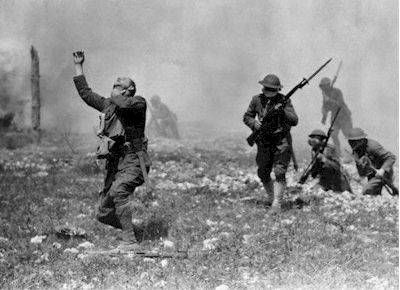
Field Marshall Helmuth von Moltke once said “No battle plan ever survives contact with the enemy”.  So it was in the tiny Belgian city where German plans were broken, on the road to Dunkirk. Native Dutch speakers called it Leper, today we know it as Ypres (Ee-press), since the battle maps of the time were drawn up in French. The Tommys of the British Expeditionary Force (BEF), called the place “Wipers”.

What had hitherto been a war of movement ground to a halt in the apocalyptic fighting around Ypres, in October-November, 1914. 104,920 on all sides were killed, wounded or missing, around a city roughly the size of my little town of Falmouth, on Cape Cod.

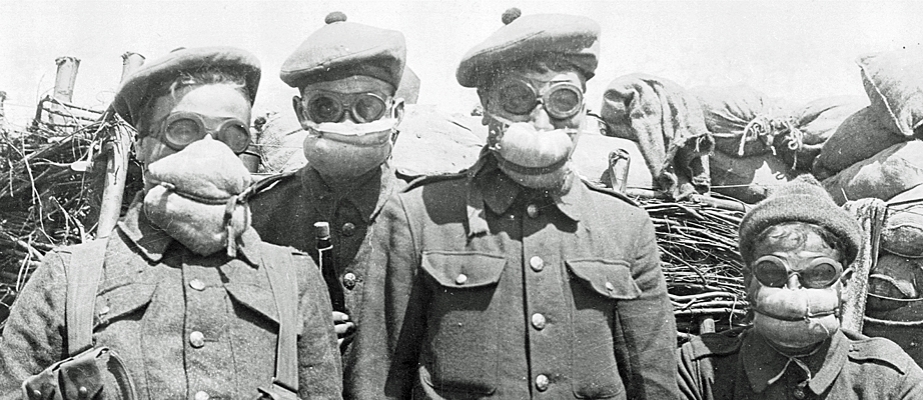
The-Wipers-Times-300x400The second Battle of Ypres began with a new and terrifying weapon, on April 22, 1915. German troops placed 5,730 gas cylinders weighing 90 pounds apiece, along a four mile front. Allied troops must have looked on in wonder, as that vast yellow-green carpet crept toward their lines. Chlorine gas forms hypochlorous acid when combined with water, destroying the moist tissues of the lungs and eyes. Heavier than air, the stuff crept along the ground and poured into the trenches, forcing troops out into heavy German fire. 6,000 casualties were sustained in the gas attack alone, opening a four mile gap in the allied line. Thousands retched and coughed out their last breath, as others tossed their equipment and ran in terror.

After the war, German losses were estimated at 34,933 between April 21 and May 30, BEF casualties numbered 59,275. The French recorded about 18,000 on April 22 alone, with another 3,973 by the 29th of April. All told, 2nd Ypres cost allied forces 87,223 killed, wounded or missing.

The third Battle of Ypres would begin in July of 1917, lasting almost until the end of the war. 3rd Ypres would result in 570,000 losses on all sides, but in early 1916, that was all part of some unknown and terrible future.Offensive as I might be

It’s hard to imagine anything remotely humorous coming out of the horrors of Ypres, but such a thing became possible in the early months of 1916.

The “Sherwood Foresters” were line infantry Regiments of the British Army, stationed at the front lines of the Ypres salient. Coming across a printing press, a sergeant who had been a printer in peacetime got the thing going. They began to print a trench magazine, the first published on February 12. The paper included poems and reflections, “adverts” and plenty of dark humor.  Written for fellow soldiers, not civilians, some in-jokes are so obscure that their meaning is lost to the modern reader. Others are clearly understandable, even 101 years into their future.
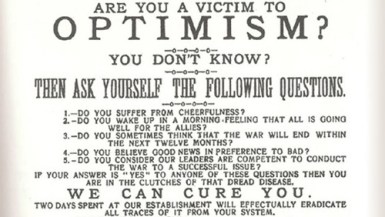
OptimismRichly typeset advertisements for “Music Hall Extravaganzas” include “Tickling Fritz” by the P.B.I. (Poor Bloody Infantry) Film Co. of the United Kingdom and Canada, advising the enthusiast to “Book Early”. There were Real Estate ads for property in no-man’s land. “BUILD THAT HOUSE ON HILL 60. BRIGHT-BREEZY-&-INVIGORATING. COMMANDS AN EXCELLENT VIEW OF HISTORIC TOWN OF YPRES”. Another one read “FOR SALE, THE SALIENT ESTATE – COMPLETE IN EVERY DETAIL! UNDERGROUND RESIDENCES READY FOR HABITATION. Splendid Motoring Estate! Shooting Perfect !! Fishing Good!!!”

There were news features, this one of a bungled trench raid: “”…They climbed into the trench and surprised the sentry, but unfortunately the revolver which was held to his head missed fire. Attempts were made to throttle him quietly, but he succeeded in raising the alarm, and had to be killed.” editor’s note, “This we consider real bad luck for the sentry after the previous heroic efforts to keep him alive””.Flammenwerfer

There were weather reports, laying odds on the forecast. “5 to 1 Mist, 11 to 2 East Wind or Frost, 8 to 1 Chlorine”. My favorite among the classified ads has to be the “Flammenwerfer” – Flame Thrower. “Guaranteed absolutely harmless.”  “Instructive – Amusing”.

It turns out that units of all sizes, from individual companies to army corps, lightened their load with some kind of unit journal in WWI.

The Wipers Times ran through the end of the war, with the exception of the “Operation Michael” period, the last gasp German Western Front offensive of 1918. The final edition, titled “The Better Times”, was published in December 1918, just short of two months after the armistice.   The banner read “Xmas, Peace and Final Number.”

Better Times


April 19, 1775  Shot Heard ‘Round the World

Taking positions across the village green to block the soldiers’ line of march, 80 “minutemen” turned and faced 700 of the most powerful military, on the planet.

The column of British soldiers moved out from Boston late on the 18th, their mission to confiscate the American arsenal at Concord and to capture the Patriot leaders Sam Adams and John Hancock, known to be hiding in Lexington.

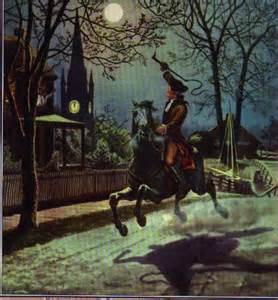
Midnight RideBoston Patriots had been preparing for such an event.  Sexton Robert John Newman and Captain John Pulling carried two lanterns to the steeple of the Old North church, signaling that the Regulars were crossing the Charles River to Cambridge. Dr. Joseph Warren ordered Paul Revere and Samuel Dawes to ride out and warn surrounding villages and towns, the two soon joined by a third rider, Samuel Prescott. It was Prescott alone who would make it as far as Concord, though hundreds of riders would fan out across the countryside before the night was through.

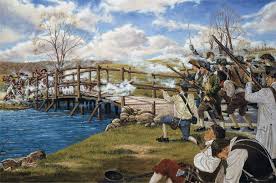
The column entered Lexington at sunrise on April 19, bayonets gleaming in the early morning light.  Armed with a sorry assortment of weapons, colonial militia poured out of Buckman Tavern, and fanned out across the town square.   Some weapons were hand made by village gunsmiths and blacksmiths, some decades old, but all were in good working order.   Taking positions across the village green to block the soldiers’ line of march, 80 “minutemen” turned and faced 700 of the most powerful military, on the planet.Lexington Green

Words were exchanged and no one knows who fired the first shot.  When it was over, eight Lexington men lay dead or dying, another ten wounded. One British soldier was wounded.

Vastly outnumbered, the militia soon gave way, as word spread and militia gathered from Concord to Cambridge.   The King’s Regulars never did find the weapons for which they had come, nor did they find Adams or Hancock.  There had been too much warning for that.

Regulars would clash with colonial subjects two more times that day, first at Concord Bridge and then in a running fight at a point in the road called “The Bloody Angle”.  Finally, hearing that militia was coming from as far away as Worcester, the column turned to the east and began their return march to Boston.

Concord BridgeSome British soldiers marched 35 miles over those two days, their final retreat coming under increasing attack from militia members firing from behind stone walls, buildings and trees. One taking up such a firing position was Samuel Whittemore of Menotomy Village, now Arlington Massachusetts. At 80 he was the oldest known combatant of the Revolution.

Whittemore took his position by the road, armed with his ancient musket, two dueling pistols and the old French cutlass captured years earlier from a French officer whom he explained had “died suddenly”.

three-men-from-action-header

Waiting until the last possible moment, Whittemore rose and fired his musket at the oncoming Redcoats, one shot, one kill. Several charged him from only feet away as he drew his pistols.  Two more shots, one dead and one mortally wounded. He had barely drawn his sword when they were on him, a .69 caliber ball fired almost point blank tearing part of his face off, as the butt of a rifle smashed into his head. Whittemore tried to fend off the bayonet strokes with his sword but he didn’t have a chance.  He was run through thirteen times before he lay still, one for each colony.

The people who came out of their homes to clean up the mess afterward found Whittemore, up on one knee and trying to reload his old musket.

Doctor Nathaniel Tufts treated the old man’s wounds as best he could, but felt that there was nothing anyone could do. Sam Whittemore was taken home to die in the company of his loved ones, which he did. Eighteen years later, at the age of ninety-eight.samuel_whittemore

April 15, 1912 Unsinkable

The elderly owner of Macy’s Department Stores Isidor Straus was offered a seat with his wife Ida, on account of his age. Strauss refused any special consideration and Ida refused to leave his side. The couple went down with the ship.

Titanic_stern_and_rudder
For Scale, Note the Man Standing Next to Titanic’s Stern and Rudder

The maiden voyage of the largest ship afloat left the port of Southampton, England On April 10, 1912, carrying 2,224 passengers and crew.  An accident was narrowly averted only minutes later, as Titanic passed the moored liners SS City of New York and Oceanic.

Both smaller ships lifted in the bow wave formed by Titanic’s passing, then dropped into the trough. New York’s mooring cables snapped, swinging her around stern-first.  Collision was averted by a bare 4 feet as the panicked crew of the tugboat Vulcan struggled to bring New York under tow.

The Southampton-to-New York run made stops at Cherbourg, France and Queenstown Ireland, to pick up passengers before the Atlantic crossing.  Titanic stoker John Coffey jumped ship in Ireland, hiding under a pile of mail bags.  The Queenstown native may have had a premonition as he claimed, or maybe he just wanted to go home.  Be that as it may, subsequent events may have made him the luckiest man on the cruise.

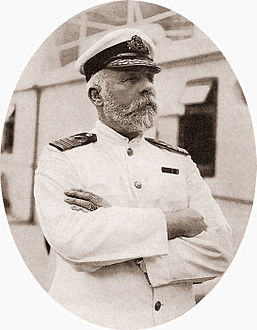
Edward Smith
Edward Smith, 1911

By the evening of the 14th, Titanic was 400 miles off the coast of Newfoundland, conditions clear, calm and cold.  There were warnings of drifting ice from other ships in the area, but the ship continued to steam at full speed.  It was generally believed that ice posed little danger to large vessels at this time, Captain Edward Smith opined that he “[couldn’t] imagine any condition which would cause a ship to founder.  Modern shipbuilding has gone beyond that.”

Lookout Frederick Fleet alerted the bridge of an iceberg dead ahead at 11:40pm. First Officer William Murdoch ordered the engines put in reverse, veering the ship to the left.  Lookouts were relieved, thinking that collision had been averted.  Below the surface, the starboard side of Titanic ground into the iceberg, opening a gash the length of a football field.  The ship had been designed to withstand the flooding of four watertight compartments.  The iceberg had opened five.  As Titanic began to lower at the bow, it soon became clear that the ship was doomed.

last-image-of-the-titanic
Last known image of titanic

Those aboard were poorly prepared for such an emergency. The ship was built for 64 wooden lifeboats, enough for 4,000, however the White Star Liner carried only 16 wooden lifeboats and four collapsibles. Regulations then in effect required enough room for 990 people. Titanic carried enough to accommodate 1,178.

As it was there was room for over half of those on board, provided that each boat was filled to capacity. The crew, however, hadn’t been adequately trained in evacuation.

The “women and children first” protocol was generally followed, sometimes to the exclusion of all others.  Ship’s officers didn’t know how many could safely board the lifeboats, and many were launched barely half-full. The first lifeboat in the water, rated at 65 passengers, launched with only 28 aboard.

3rd class passenger Bertram Dean and his wife Georgette had decided to leave the UK and emigrate to the United States.  Mr. Dean planned to become a partner in a tobacco store, owned by a cousin in Wichita.   Down below, Bert Dean was among the first to hear the collision.  After inspecting the damage, Dean told his wife to dress the children, two-year old Bertram and two-month old Millvina, the youngest passenger on board.     Georgette and the two kids were placed on lifeboat #10, the first to escape.  Most of the male passengers and crew were left aboard, even as lifeboats launched half empty.Carpathia Iceberg

J. Bruce Ismay, CEO of White Star Lines, helped to load some of the boats. Looking about and seeing no women or children in the vicinity, only then did he step onto a lowering collapsible, but he never lived down having survived a disaster in which so many others perished.

Titanic chief architect Thomas Andrews was last seen in the First Class smoking room, staring blankly at a painting of the ship.  John Jacob Astor IV, the wealthiest passenger onboard, was traveling with his young wife Madeleine Talmadge Force, 29 years his junior.  Placing her on a lifeboat, Astor asked if he could join her, explaining that she was pregnant.  All that money didn’t help him, Astor was refused.  All he could do was kiss his young wife goodbye as the boat lowered out of sight.

The elderly owner of Macy’s Department Stores Isidor Straus was offered a seat with his wife Ida, on account of his age.  Strauss refused any special consideration and Ida refused to leave his side.  The couple went down with the ship, as did Benjamin Guggenheim and his valet, who returned to their rooms and changed into Tuxedos.  Emerging on deck, the wealthy industrialist declared, “We are dressed in our best and are prepared to go down like gentlemen”.

The stories that will never be told, are those of the 700 or so 3rd class passengers below decks.  Disoriented, terrified and trapped below decks, one by one they spent their last moments gasping in shrinking pockets of air, as frigid water swirled like class V rapids through the pitch black interior of the ship.Titanic last moments

Distress signals were sent by wireless and lamp, but none of the ships responding were close enough to effect the outcome. The Californian, six miles to the north, was close enough to see distress rockets, but crew members thought the liner was having a party.

Two hours and 40 minutes after striking the iceberg, Titanic went up by the stern.  The forward deck dipped underwater as seawater poured in through open hatches and grates.  The immense strain on the keel split the ship in two between the third and fourth funnels, as the unsupported stern rose out of the water.  Propellers exposed, the stern remained afloat for a few minutes longer, rising to a nearly vertical angle with hundreds of people still clinging to it. The last piece sank out of sight at 2:20am, plunging passengers and crew into 28°F water.  Most of them died within minutes of hypothermia, cardiac arrest, or drowning. Lifeboats had room for almost 500 more, but only 13 were pulled from the water. Titanic_wreck_bow

RMS Carpathia arrived on the scene around 4am, in response to Titanic’s distress calls.  Originally bound for Austria-Hungary, Carpathia diverted to New York with survivors.  A crowd of 40,000 awaited the arrival of 705 survivors on the 18th, despite a cold, driving rain.  It would take four full days to compile and release the full list of casualties.

Millvina Dean, once the youngest survivor of the Titanic disaster, died 97 years later, the last survivor of the sinking.  The remains of her father lie with the ship on which he perished, 12,415 feet beneath the surface of the north Atlantic.

April 8, 1740, War of Jenkin’s Ear

In the smoke and confusion, the Spanish never did figure out how puny the forces were who opposed them

A series of escalating trade disputes had already taken place between British and Spanish forces, when the Spanish patrol boat La Isabela drew alongside the British brig Rebecca in 1731. After boarding, Commander Juan de León Fandiño accused the British commander of smuggling.  The discussion became heated, when Fandiño drew his sword and cut the left ear off of Captain Robert Jenkins.  “Go, and tell your King that I will do the same”, he said, “if he dares to do the same.”jenkins-ear-1

Seven years later, Jenkins was ordered to testify before Parliament where, according to some accounts, he produced the severed ear in a pickling jar, as part of his presentation. This and other incidents of “Spanish Depredations upon the British Subjects” were considered insults to the honor of the British nation and a provocation to war.

A squadron of three 70-gun British third-rates was patrolling off the coast of Cornwall on April 8, 1740, when a mast was sighted to the north.  What at first appeared to be a French vessel was revealed to be the 70 gun ship-of-the-line Princesa, when she struck her French colors and hoist the Spanish flag.  Outnumbered 3-to-1, Princesa put up a good fight, but the issue was never in doubt.  She was brought into Portsmouth for repairs, entering British service as HMS Princess in 1742.  What had once been described as “the finest ship in the Spanish Navy”, would serve Her Britannic Majesty for another 42 years.Princesa

For the future Georgia colony, the War of Jenkins Ear was an existential threat.  Spain had laid claim to Florida, when Ponce de Leon first mapped the territory in 1513.  The territory which later became North & South Carolina joined the British Colonies to the north in 1663, leaving the areas in-between in dispute.  James Oglethorpe founded the 13th colony of Georgia as a buffer to Spanish incursion, two years after Mr. Jenkins lost his ear. Battle of Bloody Marsh (Model)

By 1736, Oglethorpe established Fort Frederica on the barrier island of St. Simon, off the Savannah coast.  The Spanish landing force of 4,500 to 5,000 men arrived on St. Simon’s Island in July of 1742, opposed by only 950 British Rangers, Colonial Militia and Indian Allies.

Oglethorpe’s forces attacked a Spanish reconnaissance in force at the Battle of Gully Hole Creek in the early morning hours of July 7, followed by the ambush of a much larger force that afternoon, in what would be known as the Battle of Bloody Marsh.  In the smoke and confusion, the Spanish never did figure out how puny the forces were who opposed them.  These two victories were as big a boost to British morale as they were a blow to that of their adversary.  The last major Spanish offensive into Georgia ended with a complete withdrawal, a week later.

GullyHoleCreekSign

The conflict which began in 1739 ended in 1748, though major operations ceased in 1742 when the War of Jenkins Ear was subsumed by the greater War of Austrian Succession, involving most of the major powers of Europe at that time. Peace arrived with the Treaty of Aix-la-Chapelle in 1748.

April 5, 1761 Midnight Ride

The Dutchess County Militia had to be called up. The Colonel had one night to prepare for battle, and this rider was done. The job would have to go to Colonel Ludington’s first-born. His daughter, Sybil.

“Listen my children and you shall hear,
Of the midnight ride of”…Sybil Ludington.

Wait…What?

Midnight RidePaul Revere’s famous “midnight ride” began on the night of April 18, 1775.  Revere was one of two riders, soon joined by a third, fanning out from Boston to warn of an oncoming column of “regulars”, come to destroy the stockpile of gunpowder, ammunition, and cannon in Concord.

Revere himself covered barely 12 miles before being captured, his horse confiscated to replace the tired mount of a British sergeant.  Revere would finish his “ride” on foot, arriving at sunrise on the 19th to witness the last moments of the battle on Lexington Green.

Two years later, Patriot forces maintained a similar supply depot, in the southwest Connecticut town of Danbury.

William Tryon was the Royal Governor of New York, and long-standing advocate for attacks on civilian targets.  In 1777, he was also a major-general of the provincial army.  On April 25th, Tryon set sail for the Connecticut coast of Long Island Sound with a force of 1,800, intending to destroy Danbury.

Burning of DanburyPatriot Colonel Joseph Cooke’s small Danbury garrison was caught and quickly overpowered on the 26th, trying to remove food supplies, uniforms, and equipment.  Facing little if any opposition, Tryon’s forces went on a bender, burning homes, farms and storehouses.  Thousands of barrels of pork, beef, and flour were destroyed, along with 5,000 pairs of shoes, 2,000 bushels of grain, and 1,600 tents.

Colonel Henry Ludington was a farmer and father of 12, with a long military career.  A long-standing and loyal subject of the British crown, Ludington switched sides in 1773, joining the rebel cause and rising to command the 7th Regiment of the Dutchess County Militia, in New York’s Hudson Valley.

In April 1777, Ludington’s militia was disbanded for planting season, and spread across the countryside.  An exhausted rider arrived at the Ludington farm on a blown horse, on the evening of the 26th, asking for help.  15 miles away, British regulars and a force of loyalists were burning Danbury to the ground. Sybil Ludington

The Dutchess County Militia had to be called up.  The Colonel had one night to prepare for battle, and this rider was done.  The job would have to go to Colonel Ludington’s first-born, his daughter, Sybil.

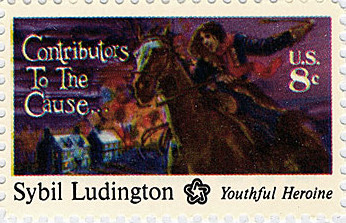
Born April 5, 1761, Sybil Ludington was barely sixteen at the time of her ride.  From Poughkeepsie to what is now Putnam County and back, the “Female Paul Revere” rode across the lower Hudson River Valley, covering 40 miles in the pitch dark of night, alerting her father’s militia to the danger and urging them to come out and fight.  She’d use a stick to knock on doors, even using it once, to fight off a highway bandit.

By the time Sybil returned the next morning, cold, rain-soaked, and exhausted, most of 400 militia were ready to march.

BattleOfRidgefield
Battle of Ridgefield, from Wikipedia A: British movement to the coast B: American movements to pursue and harass the British C: Arnold’s position attempting to block the British return to the beach D: British return to New York

35 miles to the east of Danbury, General Benedict Arnold was gathering a force of 500 regular and irregular Connecticut militia, with Generals David Wooster and Gold Selleck Silliman.

Arnold’s forces arrived too late to save Danbury, but inflicted a nasty surprise on the British rearguard as the column approached nearby Ridgefield.  Never outnumbered by less than three-to-one, Connecticut militia was able to slow the British advance until Ludington’s New York Militia arrived on the following day.  The last phase of the action saw the same type of swarming harassment, as seen on the British retreat from Concord to Boston, early in the war.

Though the British operation was a tactical success, the mauling inflicted by these colonials ensured that this was the last hostile British landing on the Connecticut coast.

The British raid on Danbury destroyed at least 19 houses and 22 stores and barns.  Town officials submitted £16,000 in claims to Congress, for which town selectmen received £500 reimbursement.  Further claims were made to the General Assembly of Connecticut in 1787, for which Danbury was awarded land.  In Ohio.

Keeler_tavern_ridgefield_cannonball_2006
Keeler Tavern

The Keeler Tavern in Ridgefield is now a museum.  The British cannonball fired into the side of the building, remains there to this day.

At the time, Benedict Arnold planned to travel to Philadelphia, to protest the promotion of officers junior to himself, to Major General.  Arnold, who’d had two horses shot out from under him at Ridgefield, was promoted to Major General in recognition for his role in the battle.  Along with that promotion came a horse, “properly caparisoned as a token of … approbation of his gallant conduct … in the late enterprize to Danbury.”  For now, the pride which would one day be his undoing, was assuaged.

Henry Ludington would become Aide-de-Camp to General George Washington, and grandfather to Harrison Ludington, mayor of Milwaukee and 12th Governor of Wisconsin.

Gold Silliman was kidnapped with his son by a first marriage by Tory neighbors, and held for Nearly seven months at a New York farmhouse.  Having no hostage of equal rank with whom to exchange for the General, Patriot forces went out and kidnapped one of their own, in the person of Chief Justice Judge Thomas Jones, of Long Island.

Wooster Square
Archway at Wooster Square

Mary Silliman was left to run the farm, including caring for her own midwife, who was brutally raped by English forces for denying them the use of her home.  The 1993 made-for-TV movie “Mary Silliman’s War” tells the story of non-combatants, pregnant mothers and farm wives during the Revolution, as well as Mary’s own negotiations for her husband’s release from his Loyalist captors.

General David Wooster was mortally wounded at the Battle of Ridgefield, moments after shouting “Come on my boys! Never mind such random shots!”  Today, an archway marks the entrance to Wooster Square, in the East Rock Neighborhood of New Haven.  Sybil_Ludington_stamp

Sybil Ludington received the thanks of family and friends, even George Washington, and then stepped off the pages of history.

Paul Revere’s famous ride would likewise have faded into obscurity, but for the poetry of Henry Wadsworth Longfellow.  86 years later.

April 1, 1698 Washing the Lions

Pandemonium broke out when hundreds showed up, only to realize they’d been pranked.

Festival of FoolsApril Fools.  The ancient Roman festival of Hilaria, held on March 25, may be a precursor.  The Medieval Feast of Fools, held December 28, is still a day on which pranks are played in Spanish-speaking countries.
In one translation of Chaucer’s Canterbury Tales, “March 32” of 1392 is the day the vain cock Chauntecleer was tricked by a fox. The fox appealed to the rooster’s vanity by insisting he would love to hear Chauntecleer crow, just as his amazing father did.  Standing on tiptoe with neck outstretched and eyes closed. The rooster obliged, with unfortunate, if not unpredictable results.

In 1582, France switched from the Julian calendar to the Gregorian moving New Year to January 1 as specified by the Council of Trent of 1563. Those who didn’t get the news and continued to celebrate New Year in late March/April 1, quickly became the butt of jokes and hoaxes. Paper fish were placed on their backs, as these “poisson d’avril” (April fish) were said to symbolize the young, naive, easily caught fish of Spring.poisson-davril

The Flemish children of Belgium lock their parents or teachers out, letting them in only if they promise to bring treats that evening or the next day.

In 1539, Flemish poet Eduard de Dene wrote of a nobleman who sent his servants on fool’s errands on April 1.

In Scotland, April Fools’ Day is traditionally called Hunt-the-Gowk Day. Although it’s fallen into disuse, a “gowk” is a cuckoo or a foolish person. The prank consists of asking someone to deliver a sealed message requesting some sort of help. The message reads “Dinna laugh, dinna smile. Hunt the gowk another mile”. On reading the message, the recipient will explain that to help, he’ll first need to contact another person, sending the victim to another person with the same message.

In Poland, “Prima Aprilis” is so strong that the anti-Turkish alliance with Leopold I, signed on April 1, 1683, was backdated to March 31.

LeoAnimals were kept at the Tower of London since the 13th century, when Emperor Frederic II sent three leopards to King Henry III. In later years, elephants, lions, even a polar bear were added to the collection, the polar bear trained to catch fish in the Thames.

In 1686, John Aubrey referred to the holiday as “Fooles holy day”, the first British reference.

On April 1, 1698, citizens were invited to the Tower of London to see the “Washing of the Lions” in the tower moat. Quite a few were sucked in.  The April 2 edition of Dawks’ News-Letter reported that “Yesterday being the first of April, several persons were sent to the Tower Ditch to see the Lions washed.” The “annual ceremony of washing the lions,” lasted throughout the 18th & 19th centuries, always held on April 1st.

tower-of-london
Tower of London

The prank became quite elaborate by the mid-nineteenth century. Tickets were printed and distributed for the event, specifying that attendees be “Admitted only at the White Gate”, and that “It is requested that no Gratuities will be given to the Wardens on any account.”

In his “Reminiscences of an Old Bohemian”, Gustave Strauss laments his complicity in the hoax in 1848. “These wretched conspirators”, as Straus called his accomplices, “had a great number of order-cards printed, admitting “bearer and friends” to the White Tower, on the 1st day of April, to witness…the famous grand annual ceremony of washing the lions”. Pandemonium broke out when hundreds showed up, only to realize they’d been pranked. “In the midst of the turmoil” Strauss wrote, “some one spotted me to whom I had given an order of admission, and he would have set the whole mob upon me. Knowing of old that discretion is, as a rule, the better part of valour…I had to skedaddle, and keep dark for a time, until the affair had blown over a little”.

spagtreeIn 1957, (you can guess the date), the BBC reported the delightful news that mild winter weather had virtually eradicated the dread spaghetti weevil of Switzerland, and that Swiss farmers were now happily anticipating a bumper crop of spaghetti.  Footage showed smiling Swiss peasants, pulling strands of spaghetti down from trees.  Apparently, an embarrassingly large number of viewers were fooled.  Many called BBC offices, asking how to grow their own spaghetti tree. “Place a piece of spaghetti in a tin of tomato sauce”, callers were told, “and hope for the best.”

The Warby Parker Company website describes a company mission of “offer[ing] designerWarby Barker eyewear at a revolutionary price, while leading the way for socially conscious businesses”.  On April 1, 2012, the company released its new line of eyeglasses for dogs, appropriately called “Warby Barker”.  For only $95, your hipster pooch could be sporting the latest styles in canine eyeware, in irresistible dog treat shades like “Gravy Burst” and “Dusty Bacon.”  There was a monocle option too, for those partial to that Prussian Field Marshall look.  Anyone falling for the gag, got an “April Fools!” message on their on-line shopping cart.

Two days ago, Burger King announced the introduction of their new, Whopper flavored mouthwash, for those who just can’t get enough.  I’m sure it’s true because I read it on-line, but it should be mentioned here. There is no “White Gate” at the Tower of London.  Never was.

Left-Handed Whopper

March 28, 1915 Thrasher Incident

That March, the 31-year-old Hardwick, Massachusetts native was leaving Liverpool, returning to a job on the Gold Coast of British West Africa aboard the cargo-passenger ship RMS Falaba

102 years ago, the Great War was in its 8th month.  The war of mobility of the early months was long gone, replaced by the lines of trench works which would characterize the rest of the war. Off the battlefield, the German and British governments each sought to choke the life out of the other’s economy. Great Britain held the upper hand, with the superior deep-water surface fleet.  To the Kaiser’s way of thinking, parity would come in the form of a submarine.

Picture_of_Leon_Chester_Thrasher_who_died_on_the_RMS_Falaba
Leon Chester Thrasher 1st American killed in WW!

Leon Chester Thrasher was an American mining engineer. That March, the 31-year-old Hardwick, Massachusetts native was leaving Liverpool, returning to a job on the Gold Coast of British West Africa aboard the cargo-passenger ship RMS Falaba.

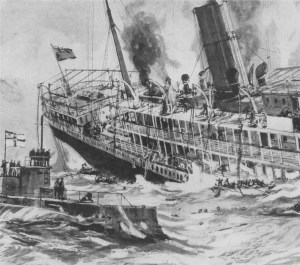
The German submarine U-28 stopped Falaba on this day in 1915, sinking the ship to the bottom with a single torpedo and killing 104, including Leon Thrasher.  The first American killed in the “War to End all Wars”.

German policy varied over the course of the war, from unrestrained submarine warfare, to strict adherence with international law. U-28 Commander Freiherr Georg-Günther von Forstner claimed to have given Falaba 23 minutes to evacuate, cutting that short and firing his torpedo only in response to Falaba’s distress rockets and wireless messages for help. British authorities claim to have been given only 7 minutes’ warning.

The death of the first American in the European war set off a diplomatic row which threatened for a time to bring the Americans into the war. American newspapers called it the “Thrasher Incident”, denouncing the sinking as a “massacre”.   An act of “piracy”.falaba

The Germans claimed that subsequent explosions proved Falaba to be carrying contraband ammunition, intended to kill German boys on European battlefields.  Eyewitness accounts failed to settle the matter, some even tended to support the German view.

President Woodrow Wilson stayed his hand, winning re-election the following year with the slogan, “He Kept Us Out of War”.

What remained of Leon Thrasher washed ashore on the coast of Ireland on July 11, 1915, after 106 days in the water.  Authorities mistakenly believed him to be a victim of the RMS Lusitania sinking, designating him Body No. 248.

The U-boat U-20 had torpedoed the Cunard liner RMS Lusitania off the coast of Ireland 40 days earlier, killing 1,198, 124 of whom were Americans. The US came close to the brink of war that time too, but the last and final straw wouldn’t come for another two years.  In the form of a German telegram, to the government of Mexico.

March 7, 1912 The Heroic Age of Polar Exploration

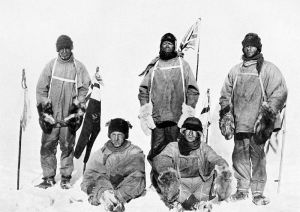
The final camp became their tomb, a high cairn of snow erected over it. Ship’s carpenters built a wooden cross, inscribed with a line from Alfred Lord Tennyson’s poem Ulysses: “To strive, to seek, to find, and not to yield”.

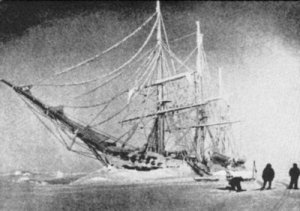
Belgica_schiff
RV Belgica frozen in the ice, 1898

The fourth son of a family of Norwegian shipowners and captains, Roald Amundsen always wanted to go to sea. His mother wanted no such thing and made him promise he’d go to school to become a doctor. Amundsen was 21 when his mother died. He kept his promise until that day.  There would be no more school after that.

Amundsen wanted to become an explorer, taking inspiration from the doomed Franklin Arctic Expedition of 1848, and Fridtjof Nansen’s crossing of Greenland in 1888.

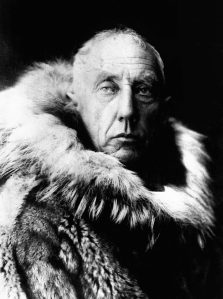
Roald Amundsen
Roald Amundsen

It’s been called the “Heroic Age” of polar exploration. Amundsen was drawn to it as much as he helped create it. He was part of the Antarctic expedition of 1897-99 aboard the RV Belgica, the first to winter in Antarctica. He led the first expedition to successfully navigate Canada’s Northwest Passage between the Atlantic and Pacific Oceans, in 1903–06.

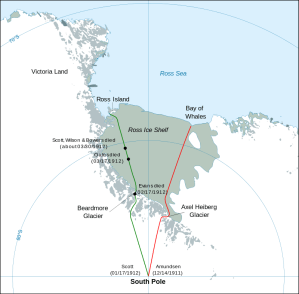
Amundsen’s attempt to reach the South Pole set out on September 8, 1911. Using skis and dog sleds, Amundsen and his men created supply depots at 80°, 81° and 82° south, along a direct line to the Pole. The effort proved to be premature and had to be abandoned due to extreme cold. A second attempt departed on October 19 with four sledges and 52 dogs, along the previously unknown Axel Heiberg Glacier.  The team of five men and 16 dogs arrived at 90° 0′ S on December 14, 1911,  the first team in history to reach the South Pole.

Aan_de_Zuidpool
Amundsen expedition plants the Norwegian flag on the South Pole, December 14, 1911.

English explorer Robert Falcon Scott had attempted the South Pole in 1901–04, and was doing so once again in 1911. Though he’d had to turn back, the earlier expedition had established the southernmost record for that time, at 88° 23′ S. 97 miles short of the pole.

Unlike Amundsen who adopted the lighter fur-skins of the Inuit, the Scott expedition wore heavy wool clothing, depending on motorized and horse-drawn transport, and man-hauling sledges for the final drive across the polar plateau. Dog teams were expected to meet them only on the way out, on March 1.

amundsen_-_scott_antarctic_expedition_map-svg
Routes taken by Scott (green) and Amundsen (red) expeditions to the South Pole.

Weak, unacclimatized ponies slowed the depot-laying part of the Scott expedition, four horses dying of cold or having to be shot because they slowed the team. When Scott decided to locate “One-Ton Depot” 35 miles short of its planned location at 80°, expedition member Lawrence Oates warned “Sir, I’m afraid you’ll come to regret not taking my advice.”

Unlike the previous attempt, Scott made it this time, only to find that Amundsen’s Norwegian expedition had beat him by five weeks. The anguish in Scott’s diary entry for January 17, 1912, is clear: “The worst has happened”; “All the day dreams must go”; “Great God! This is an awful place”.

Roald Amundsen returned safely and publicly announced his attainment of the South Pole on March 7, 1912.

scotts_party_at_the_south_pole
The doomed Scott party used a string to take this “selfie”, the day after becoming 2nd to reach the South Pole

Defeated, the five-man Scott party began the 800-mile, frozen slog back from the Pole on January 19. Team member Edgar Evans’ condition was visibly deteriorating as early as the 23rd. A bad fall on Beardmore Glacier on February 4 left him “dull and incapable”. Another fall on the 17th left him dead at the foot of the glacier.

Dog teams failed to materialize at the appointed time.  By March 16, Lawrence Oates was severely frostbitten. He left his tent for the last time, saying “I am just going outside and may be some time”.  He never returned.

The last three made their final camp on March 19, with 400 miles to go.   A howling blizzard descended on camp the following day and lasted for days, as Scott and his companions wrote good-bye letters to mothers, wives, and others. The last words in his diary, were: “Last entry.  For God’s sake look after our people”.

robert-falcon-scott
Robert Falcon Scott

The frozen corpses of Scott and his comrades were found 8 months later, the last diary entry dated March 29, 1912.  A high cairn of snow was erected over it all, that final camp becoming their tomb. Ship’s carpenters built a wooden cross, inscribing on it the names of those lost: Scott, Edward Wilson, Henry Bowers, Lawrence Oates and Edgar Evans. A line from Alfred Lord Tennyson’s poem, Ulysses, appears on the cross: “To strive, to seek, to find, and not to yield”.

They were eleven miles from their next supply depot.

Satellites measured the coldest temperature in recorded history on August 10, 2010 at −93.2 °C (−135.8 °F), in East Antarctica.   The Amundsen-Scott weather station at the South Pole reports the average daily temperature for March, at -50.3°C (-58.54°F).    A century of ice and snow have covered bodies, camp and the cross alike. Now encased 75′ down in the Ross Ice Shelf and inching their way outward, the bodies are expected to reach the Ross Sea sometime around 2276, perhaps to float away in an iceberg.

In 1926, Amundsen and a team of 15 reached the North Pole in the airship Norge. Three previous claims to have attained the North Pole: Frederick Cook (1908), Robert Peary (1909), and Richard E. Byrd (1926), have all been disputed as being of dubious accuracy or downright frauds, leaving Amundsen the undisputed first to have reached both poles.

cross_on_observation_hill_mcmurdo_station
The Observation Hill cross memorial to the Scott expedition, erected 1913.

On hearing the details of Scott’s end, Roald Engelbregt Gravning Amundsen is quoted as saying “I would gladly forgo any honour or money if thereby I could have saved Scott his terrible death”.

He and a crew of five disappeared into the Arctic on June 18, 1928, lost in the search for survivors following the crash of the Airship Italia. Despite efforts to find them as late as August 2009, neither aircraft nor bodies were ever found.

Peter Markham Scott, the only child produced by the marriage of Robert Falcon and Kathleen Bruce Scott, went on to found the World Wide Fund for Nature, which operates to this day as the World Wildlife Fund (WWF).

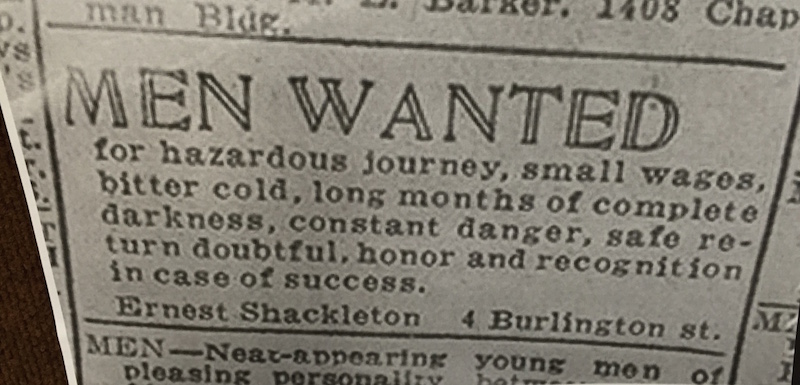
Shackleton advert

“I may say that this is the greatest factor—the way in which the expedition is equipped—the way in which every difficulty is foreseen, and precautions taken for meeting or avoiding it. Victory awaits him who has everything in order—luck, people call it. Defeat is certain for him who has neglected to take the necessary precautions in time; this is called bad luck”. —  The South Pole, by Roald Amundsen

February 13, 1542 The Six Wives of Henry VIII

Catherine of Aragon was destined to die alone in a convent, possibly the only class act in this whole, sorry story.

Catherine of Aragon, the youngest daughter of Ferdinand and Isabella, came to England to marry Arthur, the eldest son and heir to the throne of Henry VII, in 1501. Arthur died the following year and his younger brother took the throne, asking Catherine to marry him in 1509.

She was by all accounts a devoted wife, but the marriage bore no sons. Henry came to believe, or said he believed, that it was punishment from God for marrying his brother’s wife. By this time he had fallen hard for Thomas Boleyn’s daughter, Anne. The king was in a pickle. His wife wouldn’t agree to a divorce, and Anne Boleyn was not about to give it up as a mere mistress.  She was going to be the King’s wife, or nothing.

The problem was, the Pope refused to grant the divorce.  Henry launched the Reformation so that he could divorce his wife and marry this young French girl, getting his divorce the following year and going on to become Supreme Head of the Church of England.  Catherine of Aragon died alone in a convent three years later, possibly the only Class Act in this whole, sorry story.henryviii_wives

Catherine was popular with the people, but this second wife was not. To many, she was ”the King’s whore”.  Many believed she was a witch who had cast a spell on the king. The marriage produced one daughter, Elizabeth, but again no sons. Anne miscarried a male child on the day that Catherine of Aragon was buried at Peterborough Abbey.  The Savoyard ambassador Eustace Chapuys commented that “She has miscarried of her saviour.”  There would be no divorce this time, the king concocted a plot based on a story, and Anne was convicted of incest, adultery and treason.  Anne Boleyn was executed by decapitation in 1536.  She would not be the last.

Henry married Jane Seymour 11 days later.  Though she bore him a son, she died two weeks after the birth. Years later, Henry would request on his deathbed that he be buried next to her.

Anne of Cleaves would be wife #4, an arranged marriage with a German Princess intended to secure an alliance with the other major Protestant power on the continent, especially after England’s break with Rome over that first divorce. Henry was put off by her appearance however, as if Henry himself were a prize.  The marriage went unconsummated. They were amicably divorced after 6 months.henryviii

Catherine Howard was 19 and Henry 49 when she became wife #5. He was hugely fat by this time, with festering ulcers on his leg that never healed. Henry’s suits of armor reveal a waistline that had grown from 32″ to 54″.  The man weighed 400lbs on his passing, five years later.  Catherine was young and flirtatious, preferring the company of young courtiers to that of the fat old guy she was married to.  She would be tried and convicted of adultery two years later.  As with her predecessor, execution was by the headsman’s axe.  Catherine Howard lost her head on, February 13, 1542.

Katherine Parr was the 6th and last wife of Henry VIII. Henry died in January 1547, Parr going on to marry Thomas Seymour, 1st Baron of Sudeley, six months later. Katherine died in September 1548, as the result of complications of childbirth.

kell-positiveIronically, Henry himself may have been the problem, when it came to the inability to produce a male heir.  Researchers revealed in 2011 that Henry’s blood group may have been “Kell positive”, a rare condition which would have initiated an auto-immune response in the mother’s body, targeting the body of the baby inside of her.  It’s unlikely that first pregnancies would have been effected, but the mother’s antibodies would have attacked second and subsequent Kell-positive babies as foreign objects.
The science to prove or disprove the theory didn’t exist in the Tudor era, but it may not matter.  Anyone who tried to bring that bit of news to Henry VIII, very likely would have paid for it, with his head.

January 20, 1829 An Ass for a Lion

“The history of the present King of Great Britain is a history of repeated injuries and usurpations, all having in direct object the establishment of an absolute Tyranny over these States. To prove this, let Facts be submitted to a candid world”

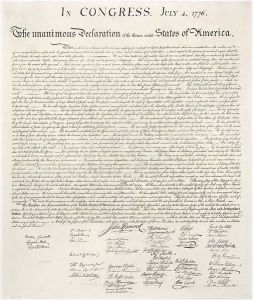
The Declaration of Independence, the birth certificate of the nation, begins with this preamble: “When in the Course of human events, it becomes necessary for one people to dissolve the political bands which have connected them with another…”.

The next paragraph leads with the phrase most commonly cited: “We hold these truths todeclaration-of-independence be self-evident, that all men are created equal, that they are endowed by their Creator with certain unalienable Rights, that among these are Life, Liberty and the pursuit of Happiness”.

The paragraph ends with a personal indictment of one man, followed by a 27 item bill of particulars against him. “The history of the present King of Great Britain is a history of repeated injuries and usurpations, all having in direct object the establishment of an absolute Tyranny over these States. To prove this, let Facts be submitted to a candid world”.

The overall tenor of the document is a personal indictment of one man, George III, King of England. The word “He” appears in the document 19 times, “tyrant” is used twice and “ruler” only once, as in: “A Prince whose character is thus marked by every act which may define a Tyrant, is unfit to be the ruler of a free people”.

Thomas Paine wrote of George III in “Common Sense”, the pamphlet which inspired a people to rise up in the summer of 1776: “One of the strongest natural proofs of the folly of hereditary right in kings, is, that nature disapproves it, otherwise she would not so frequently turn it into ridicule by giving mankind an ass for a lion”.

To be sure, the King had little or nothing to do with the policies which brought the two countries to war. The Stamp Act of 1765, the Townshend duties on tea, paper and other products in 1767; these came from Parliament, as did the “Coercive Acts” of 1774, referred to by the Patriots of Massachusetts and others as “The Intolerable Acts”.

These policies were a result of the financial burdens of garrisoning and administering the huge territories of the American colonies, the never ending wars with France and Spain, and the loans given to the East India Company, which was then responsible for administering India.

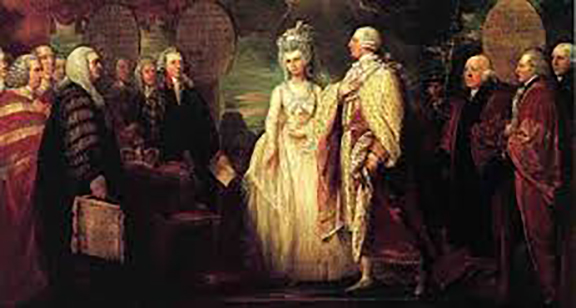
The third King of the House of Hanover was himself a creature of Parliament, his lineage having been invited to rule over Great Britain in 1714, after the fall of the House of Stuart. What Parliament gives, Parliament may take away. Yet today, George III is remembered for two things; losing the American colonies, and for losing his mind.

He is the longest reigning of any English King, ruling from 1760 until his death on January 29, 1820. Medical historians have long said that George III suffered from a genetic blood disorder called Porphyria, a term from the Greek meaning “purple pigment”. This refers to a blue discoloration in the urine of those suffering from the condition, along with symptoms primarily involving the central nervous system, and accompanied by severe abdominal pain, vomiting and mental disturbances.

The illness seems to have afflicted George III alone however, casting doubt on an hereditary condition. George III’s medical records cast further doubt on the porphyria diagnosis, showing that he was prescribed medicine based on gentian, a plant with deep blue flowers which may turn the urine blue. He seems to have been afflicted with some kind of mental illness, suffering bouts which occurred with increasing severity and longevity. At times the King of England would talk until he foamed at the mouth or go into convulsions where pages had to sit on him to keep him from injuring himself.

An ongoing research project at St George’s, University of London, has looked at thousands of King George III’s handwritten letters, and concluded that the King suffered from mental illness. His writing was erratic at times coinciding with his “spells”, with run-on sentences of 400 words or more and as many as 8 verbs with no punctuation. These are features of the writing and speech of patients as they experience the manic phase of bipolar disorder. This manic phase stands at one end of a spectrum of mood disorders, with an overwhelming sadness or depression at the other. Research is ongoing, but these types of mood swings are consistent with contemporary witnesses to George’s behavior, as well as the written record.

The last ten years of George’s reign were spent in complete seclusion, mentally unfit to rule.  His eldest son, the Prince of Wales and future King George IV, acted as Prince Regent from 1811 on.

There is an historic lesson in this story. If the country ruled by a King (or Queen) wins the lottery and gets a good and fair monarch, then that country can experience a period of peace and prosperity. If that country draws the cosmic short straw and gets a bad one, the results can be catastrophic. In the end, it’s the most powerful argument I can think of for a governmental system of diffuse power with checks and balances.