February 1, 1901 The Last Doughboy

The people the author sought were over 101. One was 113. The search could not have been easy, beginning with the phone call to next of kin. There is no delicate way to ask the question. “Is he still with us?” Most times, the answer was “no”.

In 2003, author Richard Rubin set out to interview the last surviving veterans of the Great War, the “War to End All Wars”.  World War One.

The people the author sought were all over 101. One was 113. It could not have been easy, beginning with the phone call to next of kin. There is no delicate way to ask the question. “Is he still with us?” Most times the answer was “no”.

Sometimes it was “yes”, and Rubin would ask for an interview. The memories his subjects sought to bring back were 80 years old and more.  Some spoke haltingly, and with difficulty.  Others were fountains of information, as clear and lucid as if the memories of which they spoke were made only  yesterday.

Rubin writes “Quite a few of them told me that they were telling me things that they hadn’t talked about in 50, 60, 70 years. I asked a few of them why not, and the surprising response often was that nobody had asked.”

Anthony Pierro of Swampscott, Massachusetts, served in Battery E of the 320th Field Artillery and fought in several of the major battles of 1918, including Oise-Aisne, St. Mihiel, and Meuse-Argonne.

Pierro recalled his time in Bordeaux as the best time of the war. “The girls used to say, ‘upstairs, two dollars.’” Pierro’s nephew Rick interrupted the interview. “But you didn’t go upstairs.”  Although possibly unexpected, Uncle Anthony’s response was a classic.  “I didn’t have the two dollars”.

Reuben Law of Carson City, Nevada remembered a troop convoy broken up by a German U-Boat while his own transport was swept up in the murderous Flu pandemic of 1918.

The people Rubin spoke with weren’t all men. 107-year-old Hildegarde Schan of Plymouth, Massachusetts spoke of caring for the wounded.
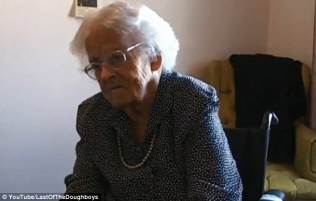
Howard Ramsey helped start an American burial ground in France, 150 miles north of Paris. Today, the 130½ acres of the Meuse-Argonne American Cemetery serves as the final resting place for the largest number of US military dead in Europe.

“So I remember one night”, Ramsey said, “It was cold, and we had no blankets, or nothing like that. We had to sleep, we slept in the cemetery, because we could sleep between the two graves, and keep the wind off of us, see?”

Arthur Fiala of Kewaunee, Wisconsin remembered traveling across France in a boxcar marked “40-8″. Room enough for 40 men, or eight horses.
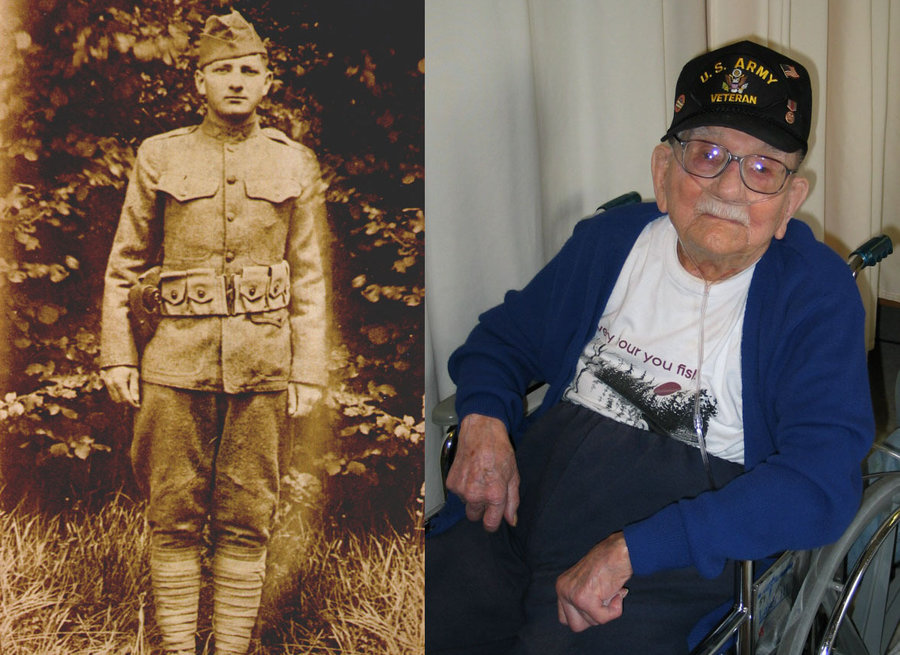
Arthur Fiala

There was J. Laurence Moffitt of Orleans, Massachusetts. Today, we see the “Yankee Division” only on highway signs. At 106, this man was the last surviving member of his outfit, with a memory so clear he could recall every number from every fighting unit of the 26th Division.

George Briant was caught in an open field with his battery, as German planes dropped bombs from the sky.  Briant felt as if he was hit by every one of them, spending several months in the hospital. When it was through, he begged to go back to the front.  
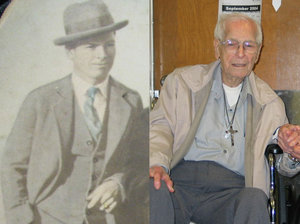
On the last night of the war, November 10, 1918, Briant came upon the bodies of several men who had just been shelled.

“Such fine, handsome, healthy young men”, he said, “to be killed on the last night of the war.  I cried for their parents. I mean it’s a terrible, terrible thing to lose anyone you love in a war, but imagine knowing precisely when that war ends, and then knowing that your loved one died just hours before that moment.

Rubin interviewed dozens of men and a handful of women, a tiny and ever diminishing living repository for memory of the War to End All Wars. Their stories are told in their own words and linked HERE, if you care to learn more.  I highly recommend it.  The words of these women and men are far more powerful than anything I can offer.

Frank Woodruff Buckles, born Wood Buckles, is one. Born on February 1, 1901, Buckles enlisted with the First Fort Riley Casualty Detachment at the age of sixteen, training for trench casualty retrieval and ambulance operations.
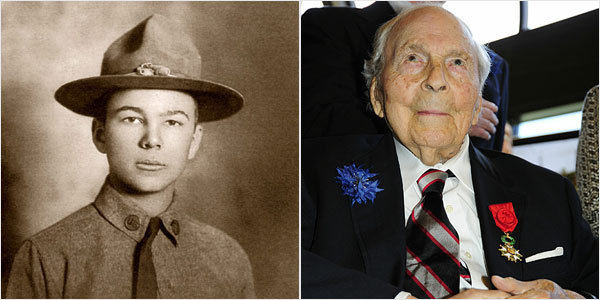
Frank Woodruff Buckles, S/N 15577

Buckles’ unit set sail from Hoboken New jersey in December 1917 aboard HMS Carpathia, a vessel made famous by the Titanic rescue, five years earlier.

Frank never saw combat but he did see a lot of Germans, with a Prisoner-of War escort company.  Returning home in January 1920 aboard USS Pocahontas, Buckles was paid $143.90, including a $60 bonus.

Buckles was a civilian in 1940, working for the White Star Lines and WR Grace shipping companies. His work took him to the Philippines, where he remained after the outbreak of WWII. He was helping to resupply U.S. troops when captured by Japanese forces in January 1942, imprisoned for thirty-nine months as a civilian prisoner in the Santo Tomas and Los Baños prison camps. 

He was rescued by the 11th Airborne Division on February 23, 1945. The day he was scheduled to be executed.
Buckles married Audrey Mayo of Pleasanton, California in 1946, and returned from whence he had come.  Back to the land, back to the Gap View Farm near Charles Town, West Virginia in January 1954, to farm the land his ancestors worked back in 1732.

Audrey Mayo Buckles lived to ninety-eight and passed away on June 7, 1999.  Frank continued to work the farm until 106, and still drove his tractor.  For the last four years of his life he lived with his daughter Susannah near Charles Town, West Virginia.

Once asked his secret to a long life, Buckles responded, “When you start to die, don’t”.

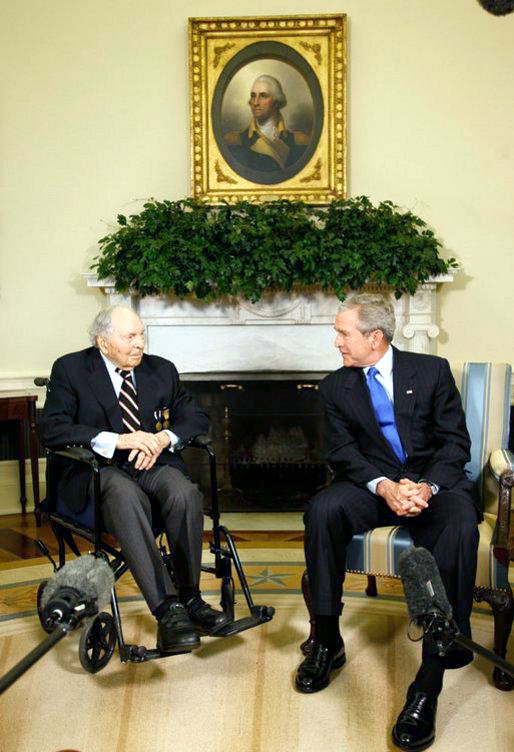
On December 3, 2009, Frank Buckles became the oldest person ever to testify before the United States Congress, where he campaigned for a memorial to honor the 4.7 million Americans who served in World War 1.

“We still do not have a national memorial in Washington, D.C. to honor the Americans who sacrificed with their lives during World War I. On this eve of Veterans Day, I call upon the American people and the world to help me in asking our elected officials to pass the law for a memorial to World War I in our nation’s capital. These are difficult times, and we are not asking for anything elaborate. What is fitting and right is a memorial that can take its place among those commemorating the other great conflicts of the past century. On this 92nd anniversary of the armistice, it is time to move forward with honor, gratitude, and resolve”.

The United States came late to the Great War, not fully trained, equipped or mobilized until well into the last year.  Even so, fully 204,000 Americans were wounded in those last few months.  116,516 never came home from a war in which, for all intents and purposes, the US fought for a bare five months.

Frank Woodruff Buckles passed away on February 27, 2011 at the age of 110, and went to his rest in Arlington National Cemetery.  The last of the Doughboys, the only remaining American veteran of WWI, the last living memory of the war to end all wars, was gone.

The United States House of Representatives and Senate proposed concurrent resolutions for Buckles to lie in state, in the Capitol rotunda. For reasons still unclear, the plan was blocked by Speaker John Boehner and Senate Majority Leader Harry Reid.  Neither Boehner nor Reid would elaborate, proposing instead a ceremony in the Amphitheater at Arlington National Cemetery.  The President of the United States personally attended the funeral.

Washington Post reporter Reporter Paul Duggan described the occasion:

“The hallowed ritual at grave No. 34-581 was not a farewell to one man alone. A reverent crowd of the powerful and the ordinary—President Obama and Vice President Biden, laborers and store clerks, heads bowed—came to salute Buckles’s deceased generation, the vanished millions of soldiers and sailors he came to symbolize in the end”.
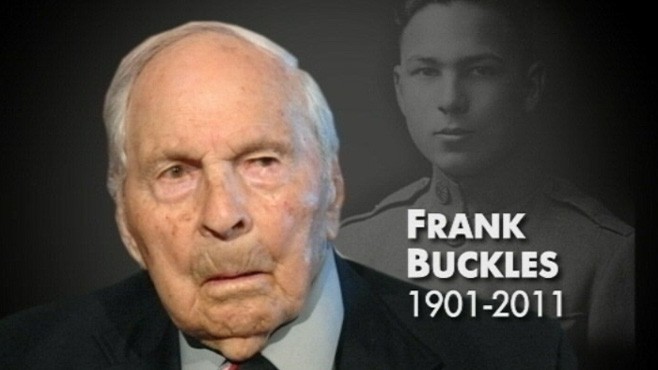
Frank Woodruff Buckles, the last living American veteran of WW1 was survived by the British Women’s Royal Air Force (WRAF) servicewoman Florence Beatrice (Patterson) Green who died on February 4, 2012, at the age of 110.

Afterward

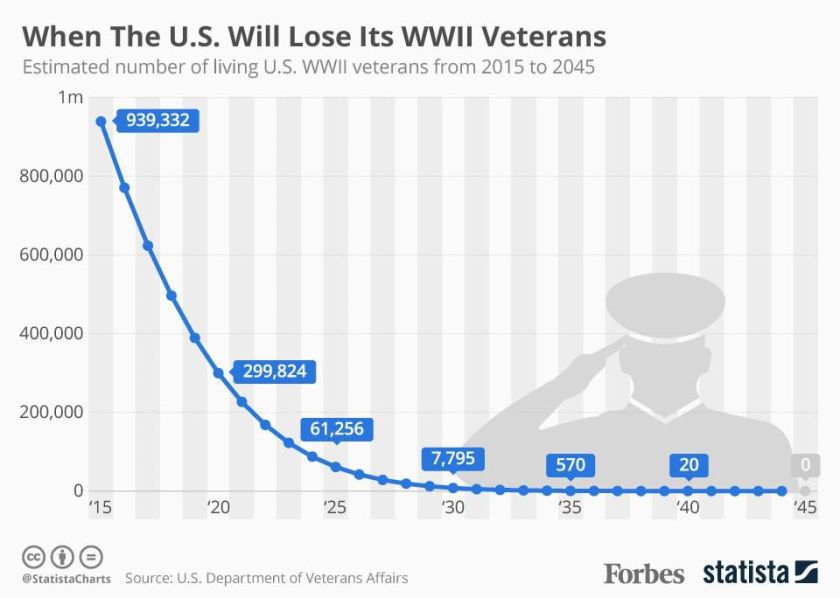
Sixteen million Americans joined with allies the world over to defeat the Axis Powers of World War 2.  They were the children of Frank Buckles’ and Florence Green’s generation, sent to complete what their parents had begun.  According to the Department of Veterans Affairs some 66,000 remained alive in 2024.

If actuarial projections are any indication, the Frank Buckles of his generation, the last living veteran of WW2, can be expected to pass from among us sometime around 2044.

That such an event should pass from living memory is a loss beyond measure.
June 6, 1944 A Fatal Rehearsal

In 1676, Isaac Newton wrote to rival Robert Hooke:  “…If I have seen a little further, it is by standing on the shoulders of Giants.”

On June 6, 2019, CNN reported  on the alarming number of US Military service deaths in training accidents, and other “circumstances unrelated to war.  “Since 2006” they wrote, “a total of 16,652 active-duty personnel and mobilized reservists have died while serving in the US armed forces. Seventy-three percent of these casualties occurred under circumstances unrelated to war”.

We would hope that those to whom we entrust the lives of our best and brightest would learn and adjust in response, that those lives not be lost in vain. War is, after all, a dangerous business.

Be that as it may no service member’s life lost in ‘circumstances unrelated to war’ is any less valuable, any less heroic, than those who died facing the adversary.

Permit me to speak then, of “Exercise Tiger.” A dress rehearsal for the largest seaborne invasion in history, gone terribly wrong. Their sacrifice taught important lessons and saved the lives of unknown legions of heroes. They, too, have earned the right to be remembered.

The largest amphibious attack in history began on June 6, 1944, on the northern coast of France.  British and Canadian forces came ashore at beaches codenamed Gold, Juno and Sword.  Americans faced light opposition at Utah Beach while heavy resistance at Omaha Beach resulted in over 2,000 American casualties.

By the end of day, some 156,000 Allied troops had stormed the beaches of Normandy.  Within a week that number would rise to 326,000 troops, more than 50,000 vehicles and over 100,000 tons of equipment.

Overlord’s success resulted from lessons learned from the largest amphibious training exercise of the war, the six phases of “Operation Fabius”, itself following the unmitigated disaster of a training exercise that killed more Americans than the actual landing at Utah beach.

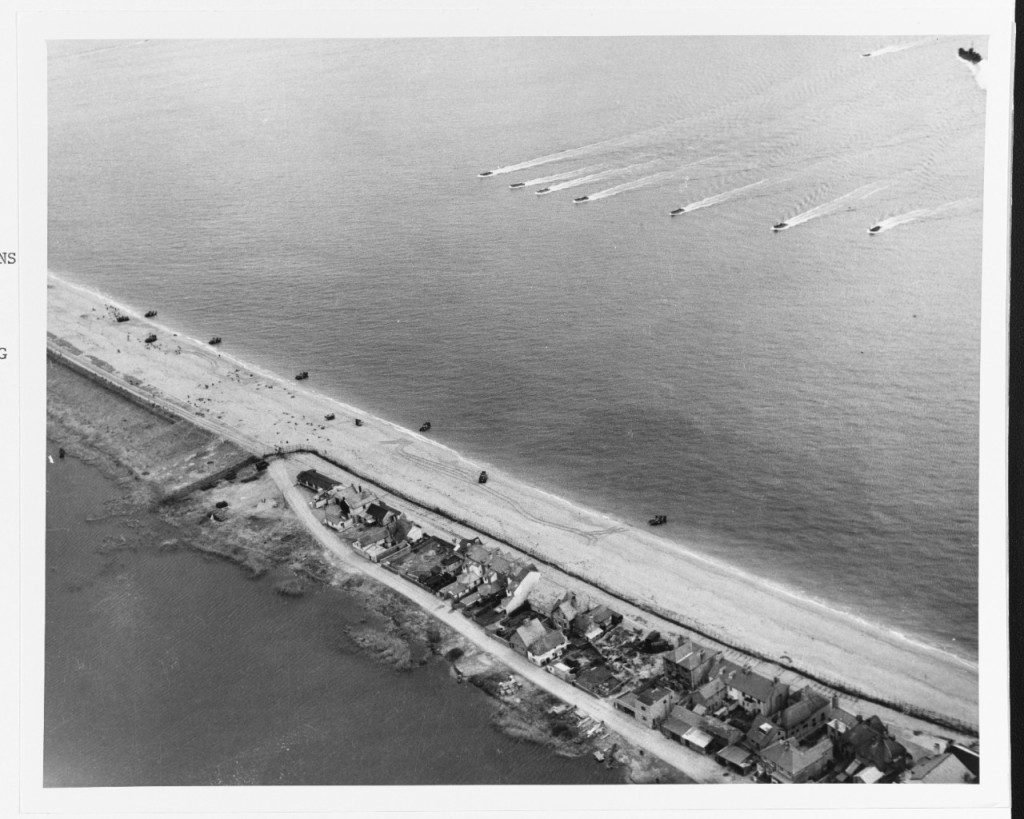
Slapton is a village and civil parish in the River Meadows of Devon County, where the southwest coast of England meets the English Channel.  Archaeological evidence suggests human habitation from at least the bronze age.  The “Domesday Book”, the recorded manuscript of the “Great Survey” of England and Wales completed in 1086 by order of William the Conqueror, names the place as “Sladone”, with a population of 200.

In late 1943, 750 families, some 3,000 locals, were evacuated with their livestock to make way for “Operation Tiger”, a D-Day landing rehearsal scheduled for the following spring.   Some had never so much as left their home village.

Thousands of US military personnel were moved into the region during the winter of 1943-44. The area was mined and bounded with barbed wire and patrolled by sentries.  Secrecy was so tight that even those in surrounding villages had no idea of what was happening.

Exercise Tiger was scheduled to begin on April 22, covering all aspects of the “Force U” landing on Utah beach and culminating in a live-fire beach landing at Slapton Sands at first light, on April 27. 

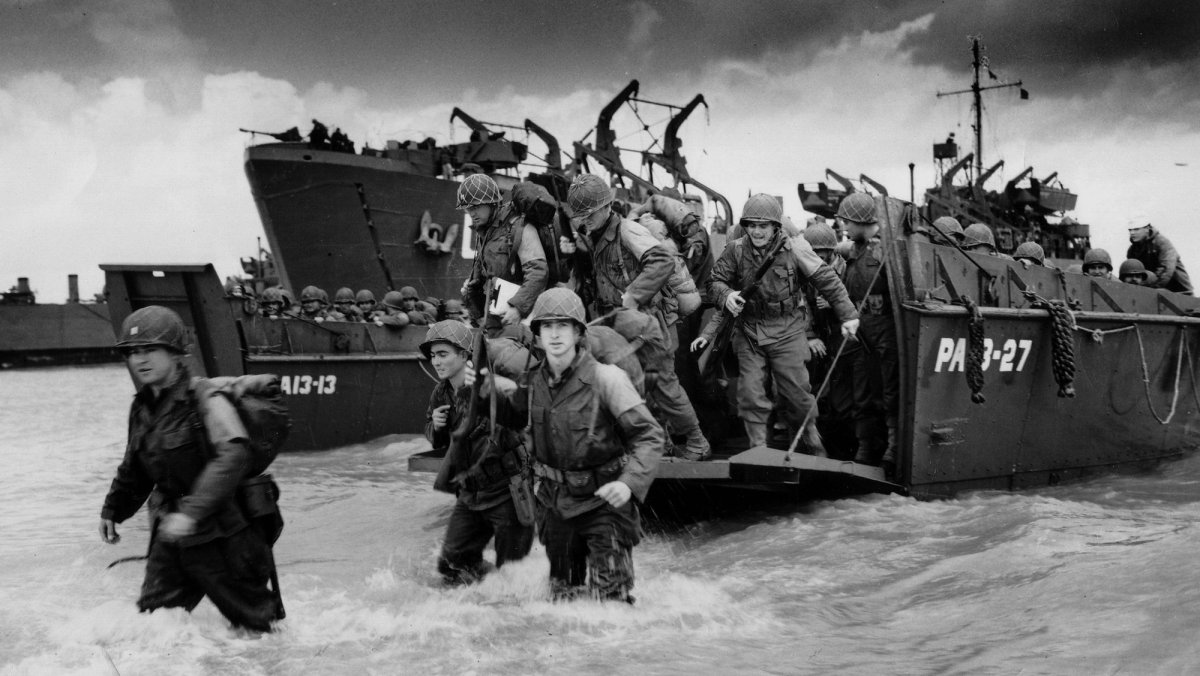
Nine large tank landing ships (LSTs) shoved off with 30,000 troops on the evening of the 26th, simulating the overnight channel crossing. Live ammunition was used in the exercise, to harden troops off to the sights, sounds and smells of actual battle. Naval bombardment was to commence 50 minutes before H-Hour, however delays resulted in landing forces coming under direct naval bombardment. An unknown number were killed in this “friendly fire” incident. Fleet rumors put the number as high as 450.

Two Royal Navy Corvettes, HMS Azalea and Scimitar, were to guard the exercise from German “Schnellboots” (“S-Boots”), the fast attack craft based out of Cherbourg.

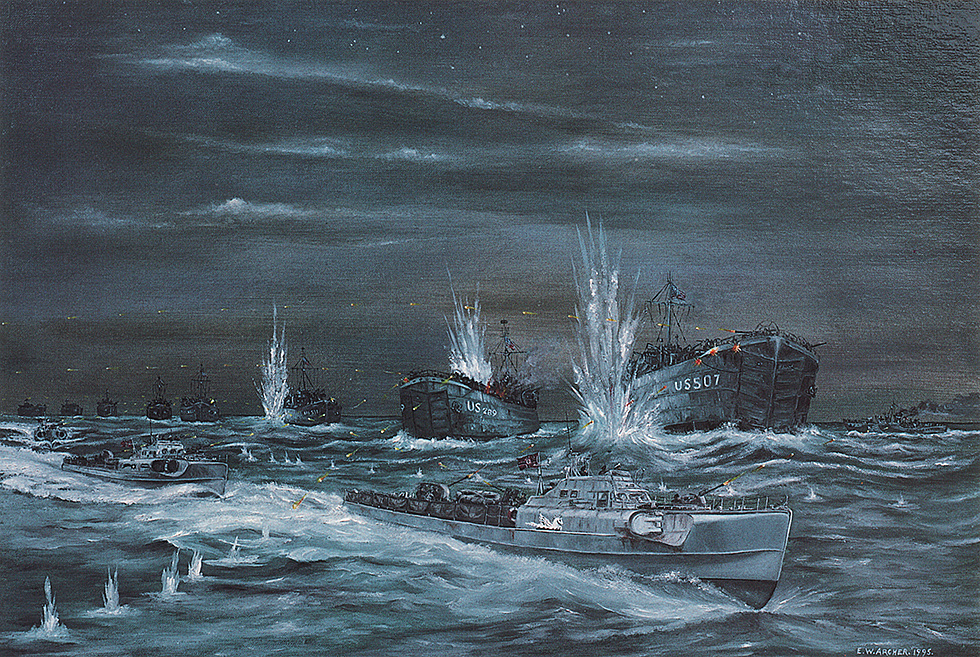
Scimitar withdrew for repairs following a collision with an LST on the 27th. In the early morning darkness of the following day, the single corvette was leading 8 LSTs carrying vehicles and combat engineers of the 1st Engineer Special Brigade through Lyme Bay, when the convoy was spotted by a nine vessel S-Boat patrol.

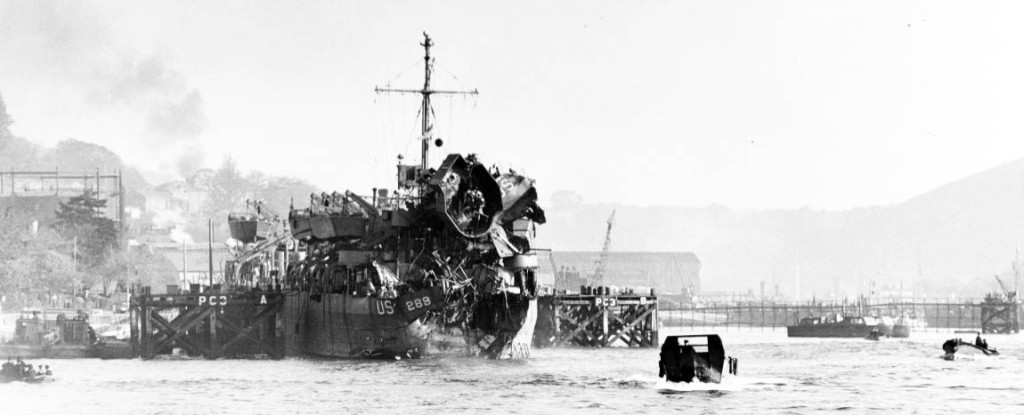
8 landing craft in single-file didn’t have a chance against fast-attack craft capable of 55mph.  LST-531 was torpedoed and sunk in minutes, killing 424 Army and Navy personnel. LST-507 suffered the same fate, with the loss of 202. LST-289 made it to shore in flames, with the loss of 123. LST-511 was damaged in yet another friendly fire incident. Unable to wear their lifebelts correctly due to the large backpacks they wore, many men placed them around their waists. That only turned them upside down. That is how they died, thrashing in the water with their legs above the waves. Dale Rodman, who survived the sinking of LST-507, said, “The worst memory I have is setting off in the lifeboat away from the sinking ship and watching bodies float by.”

Survivors were sworn to secrecy due to official embarrassment, and the possibility of revealing the real invasion, scheduled for June.  Ten officers with high level clearance were killed in the incident, but no one knew that for sure until their bodies were recovered.  The D-Day invasion was nearly called off, because any of them could have been captured alive, revealing secrets during German interrogation and torture. 

There’s a surprising amount of confusion about the final death toll.  Estimates range from 639 to 946, nearly five times the number killed in the actual Utah Beach landing.  Some or all the personnel from that damaged LST may have been aboard the other 8 on the 28th, and log books went down along with everything else.  Many of the remains have never been found.

That number would surely have been higher, had not Captain John Doyle disobeyed orders and turned his LST-515 around, plucking 134 men from the frigid water.

Today, the Exercise Tiger disaster is all but forgotten.  Some have charged official cover-ups, though information from SHAEF press releases appeared in the August edition of Stars & Stripes.  At least three books contain the information.  It seems more likely that the immediate need for secrecy and subsequent D-Day invasion swallowed the Tiger disaster, whole.  History has a way of doing that.  

Some of Slapton’s residents came home to rebuild their lives after the war, but many never returned.  In the early 1970s, Devon resident and civilian Ken Small discovered an artifact of the Tiger exercise, while beachcombing on Slapton Sands.  With little or no help from either the American or British governments, Small purchased rights from the U.S. Government to a submerged Sherman tank from the 70th Tank Battalion. The tank was raised in 1984 with the help of local residents and dive shops, and now stands as a memorial to Exercise Tiger. Not far away is a memorial to the villagers who never came home.

A plaque was erected at Arlington National Cemetery in 1995, inscribed with the words “Exercise Tiger Memorial”. A 5,000-pound stern anchor bears silent witness to Exercise Tiger in Mexico, Missouri, as does an M4 Sherman tank at Fort Rodman Park in New Bedford, Massachusetts.

In 1676, Isaac Newton wrote to rival Robert Hooke:  “…If I have seen a little further, it is by standing on the shoulders of Giants.”

Today, we celebrate ‘The Boys of Pointe du Hoc’ and all the heroes of D-Day, for it is they who broke down the door to Fortress Europe.  It is well that we should do this, and to remember. They, too, have stood on the shoulders of giants.

December 13, 1942 Ship’s Cook

Historical Easter Eggs

World War II was cut short on this day in 1942, by as much as a year. Untold lives spared by the actions of two courageous sailors. And a 16-year-old ship’s cook.

Similar to the Base Exchange system serving American military personnel, the British Navy, Army and Air Force Institutes (NAAFI) is the UK-government organization operating clubs, bars, shops and supermarkets in service to British armed forces, as well as naval canteen services (NCS) onboard Royal Navy ships.

NAAFI personnel serving on such vessels are assigned to duty stations and wear uniforms, while technically remaining civilians.

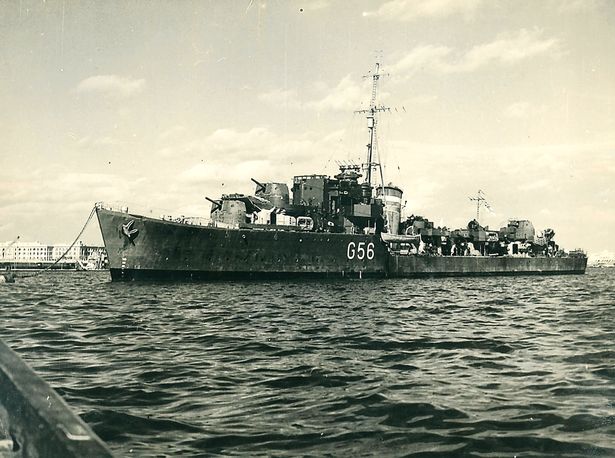
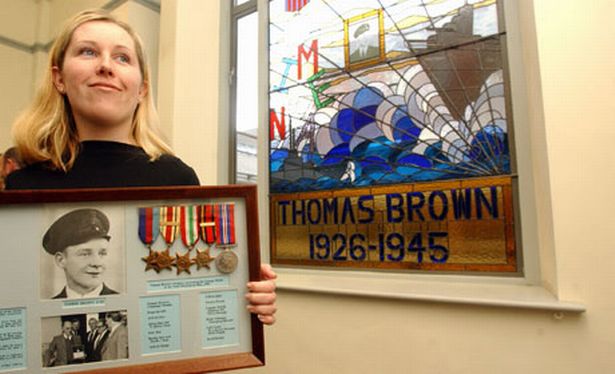
Tommy Brown was fifteen that day, lying about his age and enlisting in the NAAFI. He was assigned as canteen assistant to the “P-class” destroyer, HMS Petard.

HMSPETARD
HMS Petard

On October 30, 1942, Petard joined three other destroyers and a squadron of Vickers Wellesley light bombers off the coast of Port Said Egypt, in a 16-hour hunt for the German “Unterseeboot”, U–559.

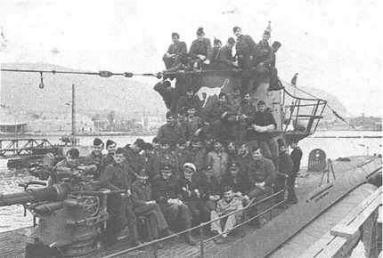
Hours of depth charge attacks were finally rewarded when the crippled U-559 came to the surface, the 4-inch guns of HMS Petard permanently ending the career of the German submarine.

U-559
U-559

The crew abandoned ship, but not before opening the boat’s seacocks.   Water was pouring into the submarine, even as Lieutenant Francis Anthony Blair Fasson and Able Seaman Colin Grazier dived into the water and swam to the stricken sub, with junior canteen assistant Tommy Brown close behind.

With U-559 sinking fast, Fasson and Grazier made their way into the captain’s cabin.   Finding a set of keys, Fasson opened a drawer and discovered a number of documents, including two sets of code books.

With one hand on the conning ladder and the other clutching those documents, Brown made three trips up and down through the hatch, to Petard’s whaler.

300px-U-185
U-185 sinking, after American depth charging

In the final moments, the ship’s cook called for his shipmates to get out of the boat. Brown himself was dragged under, but managed to kick free and come to the surface.  Colin Grazier and Francis Fasson went down with the German sub.

The episode brought Tommy Brown to the attention of the authorities, ending his posting aboard Petard when his true age was revealed.  Even so he was never discharged from the NAAFI, and later returned to sea on board the light cruiser, HMS Belfast.

In 1945, now-Leading Seaman Tommy Brown was home on shore leave, when fire broke out at the family home in South Shields.  He died while trying to rescue his 4-year-old sister Maureen, and was buried with full military honors in Tynemouth cemetery.

Fasson and Grazier were awarded the George Cross, the second-highest award in the United Kingdom system of honors.  Since he was a civilian due to his NAAFI employment, Brown was awarded the George Medal.

355b2-442_doenitz_paukenschlag

For German U-boat commanders, the period between the fall of France and the American entry into WW2 was known as “Die Glückliche Zeit” – “The Happy Time” – in the North Sea and North Atlantic.  From July through October 1940 alone, 282 Allied ships were sunk on the approaches to Ireland, for a combined loss of 1.5 million tons of merchant shipping.

Tommy Brown’s Mediterranean episode took place in 1942, in the midst of the “Second Happy Time”, a period known among German submarine commanders as the “American shooting season”. U-boats inflicted massive damage during this period, sinking 609 ships totaling 3.1 million tons with the loss of thousands of lives, against a cost of only 22 U-boats.

USMM.org reports that the United States Merchant Marine service suffered a higher percentage of fatalities at 3.9%, than any American service branch in WW2.

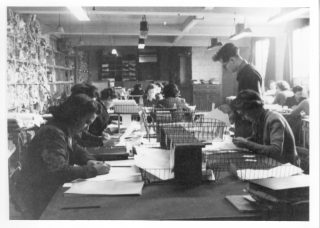
Bletchley Park

Early versions of the German “Enigma” code were broken as early as 1932, thanks to cryptanalysts of the Polish Cipher Bureau, and French spy Hans Thilo Schmidt.  French and British military intelligence were read into Polish decryption techniques in 1939, these methods later improved upon by the British code breakers of Bletchley Park.

Vast numbers of messages were intercepted and decoded from Wehrmacht and Luftwaffe sources through the Allied intelligence project “Ultra”, shortening the war by at least a year, and possibly two.

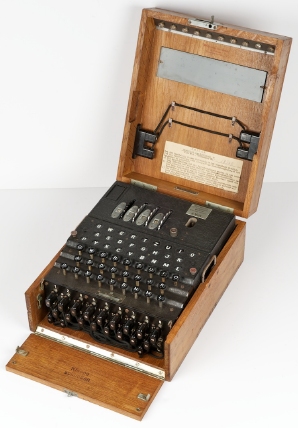
The Kriegsmarine was a different story.  Fanatically jealous of security, Admiral Karl Dönitz introduced a third-generation enigma machine (M4) into the submarine service around May 1941, a system so secret that even the Wehrmacht and the Luftwaffe, were ignorant of its existence.

The system requires identical cipher machines at both ends of the transmission and took a while to put into place, with German subs being spread around the world.

M4

All M4 machines were distributed by early 1942.  On February 2, German submarine communications went dark.  For code breakers at Bletchley Park, the blackout was sudden and complete.  For a period of nine months, Allies had not the slightest idea of what the German submarine service was up to.  The result was catastrophic.

U-559 documents were rushed back to England, arriving at Bletchley Park on November 24, allowing cryptanalysts to attack the “Triton” key used within the U-boat service.  It would not be long, before the U-boats themselves were under attack.

The M4 code was broken by December 13, when the first of a steady stream of intercepts arrived at the Admiralty Operational Intelligence Office, giving the positions of 12 U-boats.

The UK Guardian newspaper wrote: “The naval historian Ralph Erskine thinks that, without the (M4) breakthrough, the Normandy invasion would have been delayed by at least a year, and that between 500,000 and 750,000 tons of allied shipping were saved in December 1942 and January 1943 alone”.

Tommy Brown never knew what was in those documents.  The entire enterprise remained top secret, until decades after his death.

Winston Churchill later described the actions of the crew of HMS Petard as “crucial to the outcome of the war”. Untold numbers of lives that could have been lost.  But for the actions of two courageous sailors. And a sixteen-year-old ship’s cook.

thomas-brown-sharon-carley-462946894
Tommy’s grand niece Sharon Carley stands next to commemorative stained glass window of late war hero“. Hat Tip mirror.co.uk

December 17, 1843 A Christmas Card

Henry was astounded to see the volume of personal mail, particularly around the Christmas season. But there was a problem. Failure to reply to a handwritten letter was considered impolite, but this was more than he could handle.

With Christmas fast approaching, families all over are decorating trees, hanging lights and wrapping gifts. Short days from now children will scan the skies for a glimpse of Santa and his sleigh full of toys.

Americans alone are expected to mail some 1.6 Billion Christmas cards this year, but cards weren’t always so popular. There was a time in fact, when there were none at all. So let’s grab a hot chocolate & go back for a little fun history. To 1843 and the guy responsible, for the first Christmas card.

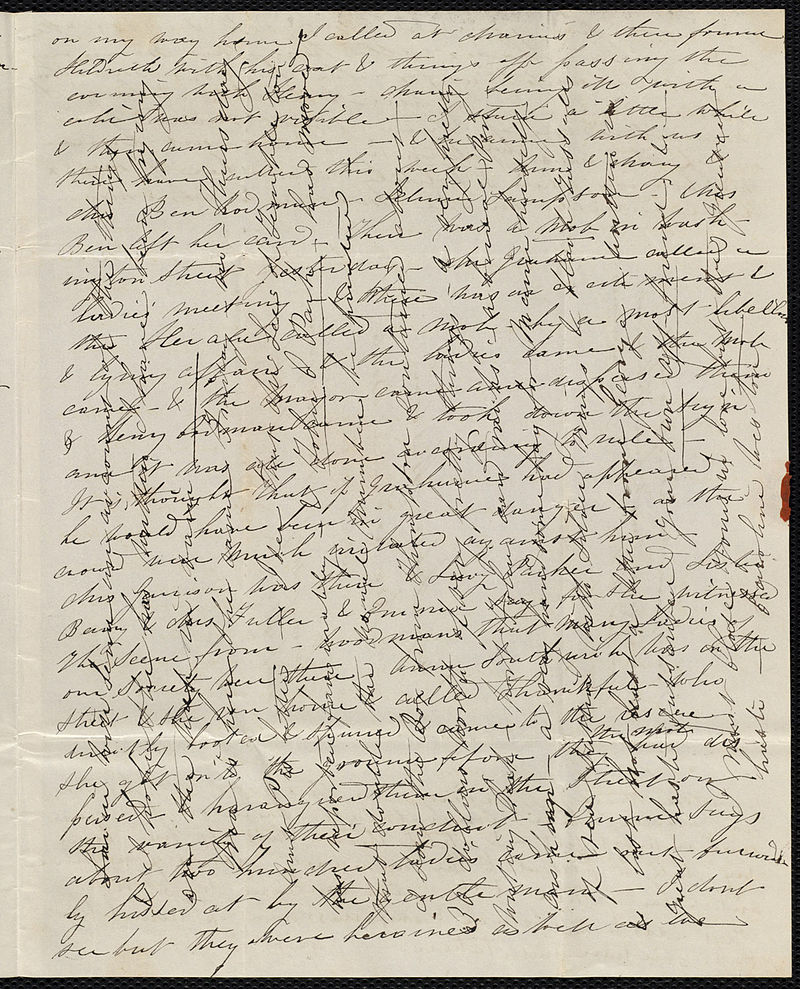
In 1812 England, mailing a letter was complicated. One sheet of paper mailed from London to Edinburgh cost 1 shilling, 1 penny. Two pages were twice that and so on. Simple you say and fair enough, but that was pricey. Adding to the complication, postage changed based on distance traveled. Not only that but the cost might be paid by the sender, or the recipient. People would write two sets of letters on one sheet to save money, two or more “crossed letters” written perpendicularly, to save money. Something had to change.

Crossed letter from Caroline Weston to Deborah Weston; Friday, March 3, 1837

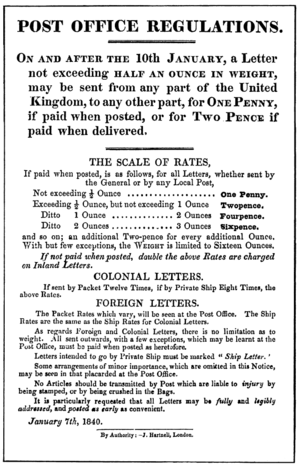
Discussions of a uniform postage based on weight began as early as 1837. Sir Rowland Hill argued in favor of a one penny rate, asserting that vastly higher mail volume resulting would more than offset offset any reduction in revenues.

With the ultimate goal of a single penny’s postage per half-ounce letter, the first change occurred on December 5, 1839. Postage could be paid by sender or recipient without penalty, at a standardized rate of four pennies. Letters were hand stamped (usually) in black if paid by the sender, or red if paid by the recipient. The age of the four penny post, had come.

The new system proved overwhelmingly popular. The penny post came to be on January 10, 1840.

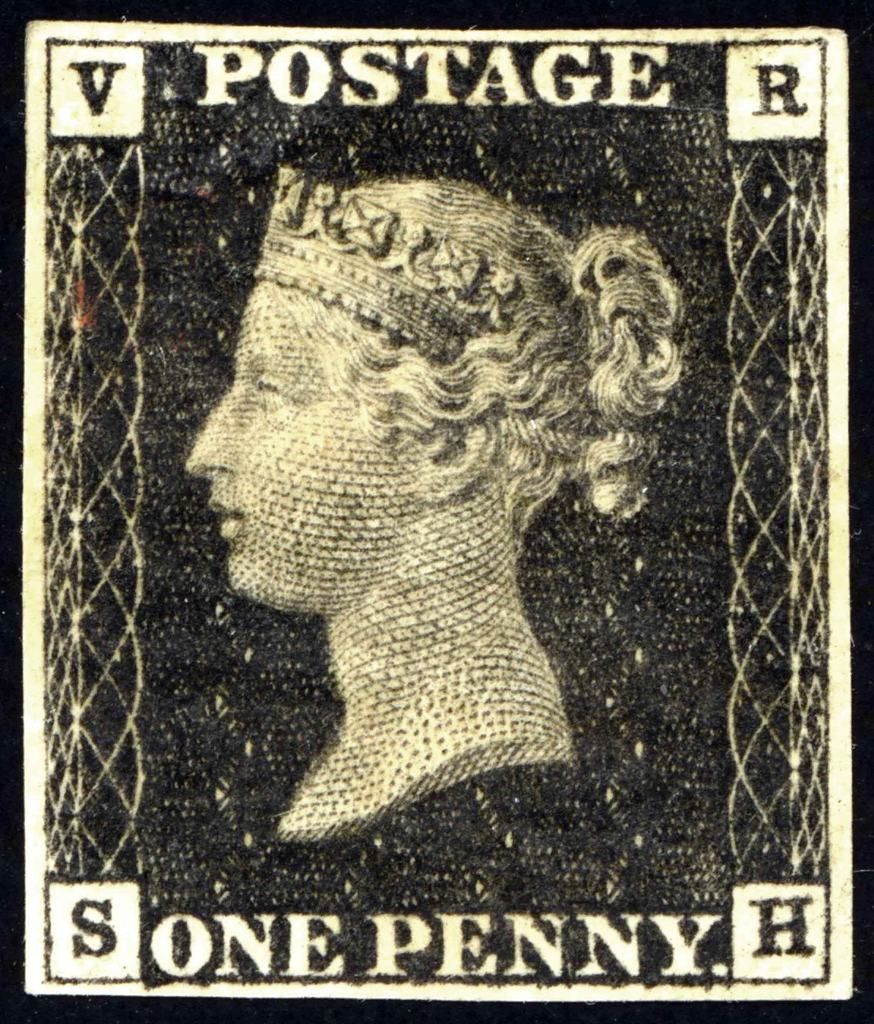
The first adhesive postage stamp in history came to be on May 1. The envy of philatelists from that day to this day, the “Penny Black” featured the profile of Queen Victoria and cost 240 pence per sheet of 240, a shilling per row and – you guessed it – a penny apiece.

Fun fact: the image used was one of Queen Victoria, at age 15. The stamp remained in use throughout the Victorian age, Britain’s longest reigning monarch save only, for Queen Elizabeth II.

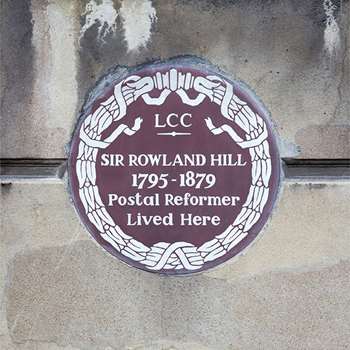
Rowland hill had argued that, if mailing a letter was cheaper, then more people would do it. He was right. So it is the one-time home of Sir Rowland Hill, K.C.B bears a Blue plaque, in recognition.

Sir Henry Cole now comes into this story, as the man who founded the Victoria and Albert Museum in London, and a man instrumental in assisting Rowland Hill’s efforts to reform the British postal system.

Sir Henry was astounded to see the volume of personal mail, particularly around the Christmas season. But there was a problem. Failure to reply to a handwritten letter was considered impolite, but this was more than he could handle.

Cole had an idea. An easily reproduced Christmas message, one that could be easily personalized. He asked artist friend John Callcott Horsley to come up with an idea.

Horsley came back with a triptych (a three panel illustration). The center panel depicted three generations of the Cole family in Christmas celebration. The side two showed charitable acts on behalf of the poor, one dispensing food and the other, clothing. The banner beneath it all read “Merry Christmas and a Happy New Year to you”.

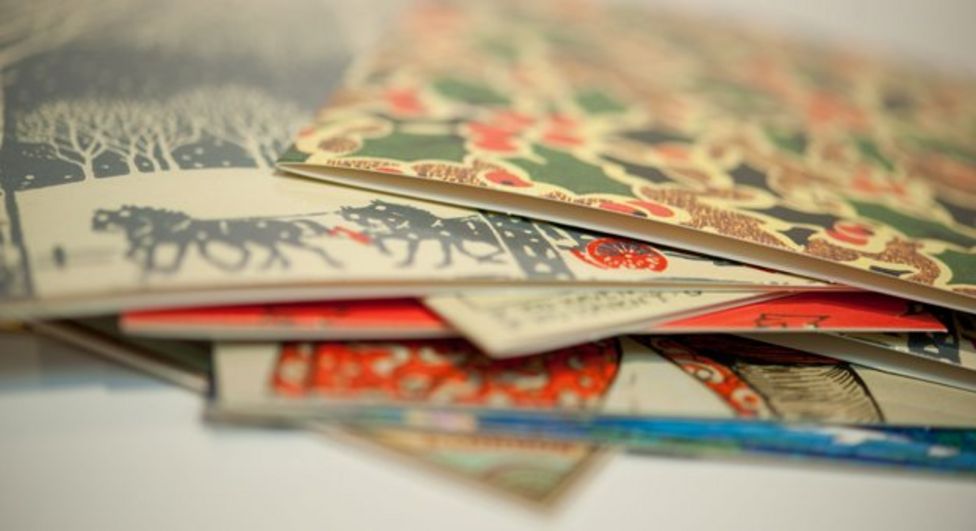
Today, news aggregator Globalnewswire.com forecasts global greeting card sales to reach $13.4 Billion US with the Christmas segment accounting for a third. All of it started on this day in 1843 when Henry Cole, founder of London’s V&A Museum, commissioned printing of the 1st Christmas card.

September 16, 1906 One of a Kind

A child was born on this day in 1906.  He was John Malcolm Thorpe Fleming Churchill, the first son and grandson of British employees of the Ceylon Civil Service.  The family lived in Hong Kong at the time and returned to England in 1917.  “Jack” graduated from the Royal Military College at Sandhurst, serving in Burma with the Manchester Regiment before leaving the military, ten years later.

Churchill worked as a newspaper editor for a time in Nairobi Kenya, along with an occasional career as male model, and a couple appearances in motion pictures.  From there he may have faded into obscurity (unlike his fellow Englishman of no relation), with the same last name.  Then came World War II, when John Churchill earned the name, “Mad Jack”.

It was around this time that Churchill learned to play bagpipes, a bit of an eccentricity for an Englishman of his era, but Mad Jack was nothing if not eccentric.  He taught himself to shoot a bow and arrow, becoming quite good at it.  Good enough to represent his country in the world archery championship in Oslo, in 1939.

Jack-Churchill

Churchill resumed his military commission and rejoined the Manchester Regiment later that year, when Germany invaded Poland.  Part of the British Expeditionary Force to France in 1940, Churchill signaled an ambush on a German unit, by taking out its sergeant with a broadhead arrow.  No one could have been more surprised than that German himself: How the hell did I get an ARROW in my chest?

Such were the dying thoughts of the only combatant in all World War 2 to be felled, by an English longbow.

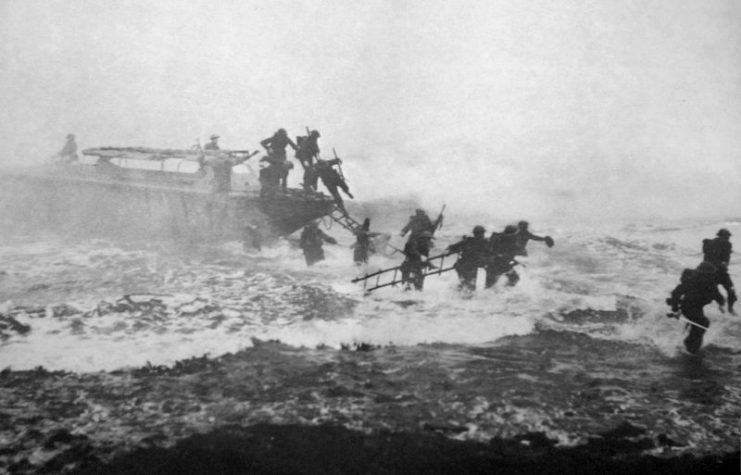
Jack Churchill (far right) leads a training exercise, sword in hand, from a Eureka boat in Inveraray. H/T warhistoryonline.com

Soon thereafter, allied military forces were hurled from the beaches of Europe.  The only way back in was via those same beaches. 

We’ve all seen the D-Day style waterborne assault:  invading forces pouring out of Higgins Boats and charging up the beaches.  Amphibious landings were carried out from the earliest days of WWII, from Norway to North Africa, from the Indian Ocean to Italy.  In all that time there’s likely no other soldier who stepped off a Higgins Boat, armed with bow and arrows.

On December 27, 1941, #3 Commando raided the German garrison at Vågsøy, Norway. As the ramp dropped on the first landing craft, out jumped Mad Jack Churchill playing “March of the Cameron Men” on the bagpipes, before throwing a grenade and charging into battle.  Mad Jack made several such landings, usually while playing his bagpipes, that Scottish broadsword at his side .

Jack-Churchill-Speaks-During-a-Landing-Exercise
“Mad Jack” Churchill, speaking at a landing exercise

Churchill was attached to that sword, a basket hilted “Claybeg”, a slightly smaller version of the Scottish Claymore.  He said “Any officer who goes into action without his sword is improperly dressed.” Mad Jack could be seen at the Catania (Sicily) and Salerno landings of 1943, trademark broadsword at his belt, bagpipes under an arm and an English longbow and arrows, around his neck.

Churchill lost his sword one time in confused hand to hand fighting around the town of Piegoletti, for which he received the Distinguished Service Order.  Almost single-handed but for a corporal named Ruffell, Churchill captured 42 Germans including a mortar squad.   “I always bring my prisoners back with their weapons”, he explained.  “It weighs them down. I just took their rifle bolts out and put them in a sack, which one of the prisoners carried. [They] also carried the mortar and all the bombs they could carry and also pulled a farm cart with five wounded in it….I maintain that, as long as you tell a German loudly and clearly what to do, if you are senior to him he will cry ‘Jawohl’ and get on with it enthusiastically and efficiently whatever the … situation. That’s why they make such marvelous soldiers…”  It looked, he said, like “an image from the Napoleonic Wars.

He later trudged back to town, to collect his sword.  Encountering a lost American squad Churchill informed the NCO they were headed, toward German lines. The soldier refused to change direction so Churchill took his leave, saying, he “wouldn’t come back for a bloody third time”.

07_Hugh-4-bows-1
Archery historian Hugh Soar pictured with four of “Mad Jack’s” English longbows

Mad Jack’s luck ran out in 1944 on the German held, Yugoslavian island of Brac.  He was leading a Commando raid at the time, coordinating with a unit of Josip Broz Tito’s Partisans.  Churchill and six others managed to reach the top of hill 622 when a mortar shell killed or wounded everyone but Churchill himself.  He was knocked unconscious by a grenade and captured.

He’d been playing “Will Ye No Come Back Again?” on his pipes.

Hitler’s infamous ‘Commando Order” had long since taken effect, requiring the instant execution of captured commandos. Churchill and his men escaped execution at the hands of the Gestapo, thanks only to the human decency of one Wehrmacht Captain named Thuener. “You are a soldier“, he said, “as I am. I refuse to allow these civilian butchers to deal with you. I shall say nothing of having received this order.”

After the war Churchill paid back Thuener’s act of kindness, keeping him out of the clutches of the merciless Red Army. But I digress.

Churchill was flown to Berlin and interrogated on suspicion that he might be related to the more famous Churchill, and later sent off to Sachsenhausen concentration camp in Oranienburg, Germany.  There, Mad Jack and Royal Air Force officer Bertram James escaped in September, slipping under the wire and crawling through an abandoned drain before walking all the way to the Baltic coast. They almost made it, too, but the pair was captured near the coastal city of Rostock, just a few miles from the coast.

churchill2

following the defeat of Nazi Germany, Mad Jack was sent off to Burma. He was bitterly disappointed by the swift end of the war in the Pacific, brought about by the American bombings at Hiroshima and Nagasaki. “If it wasn’t for those damn Yanks” he complained, “we could have kept the war going another 10 years!”

As a Seaforth Highlander, Mad Jack was posted to the British Mandate in Palestine, in 1948. He was one of the first to the scene of the ambush and massacre of the Haddassah medical convoy that April, banging on a bus and offering evacuation in an armored personnel carrier. His offer was refused in the mistaken belief that Hadassah was mounting an organized rescue.

No such rescue ever arrived. Churchill and a team of 12 British Light Infantry were left to shoot it out with some 250 Arab insurgents, armed with everything from blunderbusses and old flintlocks, to Sten and Bren guns. Seventy-eight Jewish doctors, nurses, students, patients, faculty members and Haganah fighters were killed along with one British soldier. Dozens were burned beyond recognition and buried in mass graves. Churchill later coordinated the evacuation of 700 Jewish patients and medical personnel from the Hadassah hospital at Hebrew University, in Jerusalem.
Churchill served as an instructor at the land-air warfare school in Australia, where he became passionately devoted to surfing.  Returning to England upon his retirement, he became the first to surf the 5-foot tidal surge up the River Severn, on a board of his own design.

Tidal Bore
Surfing the Tidal Bore, up the Severn River

Mad Jack Churchill remained an eccentric, even in his later years.   He loved sailing radio controlled model warships on the Thames. Little brought him more apparent joy than to horrify fellow train passengers, opening the window and hurling his briefcase into the darkness.

No one ever suspected that he threw it into the garden of his own back yard.  It saved him the trouble of carrying the thing home from the station.

He scribbled a couplet once on a postcard bearing regimental colors, and mailed it to a friend.

On the back o, Mad Jack Churchill had written fifteen words:

“No Prince or Lord has tomb so proud / As he whose flag becomes his shroud.”

He may have been talking about himself.

August 16, 1346 A Feudal State

Few understood at the time that the whole system was about to come crashing down, near a place called Crécy.

From the time of Charlemagne, the social and political structure of Middle Ages European society revolved around a set of reciprocal obligations between a warrior nobility supporting and in turn being supported by, a hierarchy of vassals and fiefs.

This was Feudalism, a system in which the King granted portions of land called “fiefs” to Lords and Barons in exchange for loyalty, and to Knights (vassals) in exchange for military service.

Knights were a professional warrior class,  dependent upon the nobility for lodging, food, armor, weapons, horses and money.

The entire edifice was borne up and supported by peasants, serfs who farmed the land and provided vassal and lord alike with material wealth in the form of food, and other products.

None of this is to be confused with the notion, of chivalry. The 18th century historian and political economist Jean Charles Léonard de Sismondi wrote “We must not confound chivalry with the feudal system. The feudal system may be called the real life of the period of which we are treating, possessing its advantages and inconveniences, its virtues and its vices. Chivalry, on the contrary, is the ideal world, such as it existed in the imaginations of the Romance writers. Its essential character is devotion to woman and to honour”.

Few understood at the time that the whole system was about to come crashing down, near a place called Crécy.

Crecy-en-Ponthieu_champ-de-bataille
Crécy Battlefield

The Battle of Crécy is memorable for several reasons. Crude cannon had appeared in siege operations during the Muslim conquest of Spain, (al Andalus), but this was the first time artillery was used in open battle. Perhaps more important though less evident at the time, was that Crécy spelled the end of feudalism.

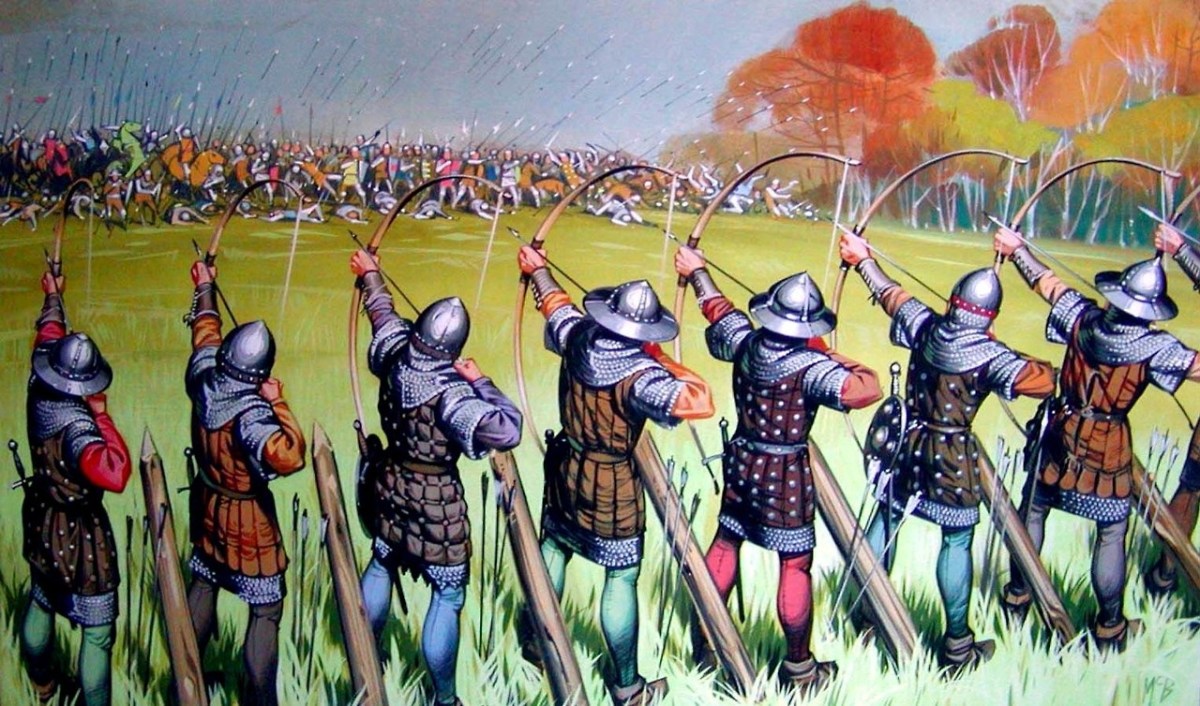
The Battle of Crécy was the first major combat of the hundred years’ war, a series of conflicts fought over a 116-year period for control of the French throne.  King Edward III invaded the Normandy region of France on July 12, 1346. Estimates vary concerning the size of his army, but not of its composition. This was not an army of mounted knights, though there were a few of those. This was a yeoman army of spearmen and foot archers, ravaging the French countryside as they went and pursued by a far larger army of French knights, and mercenary allies.

crecy-map

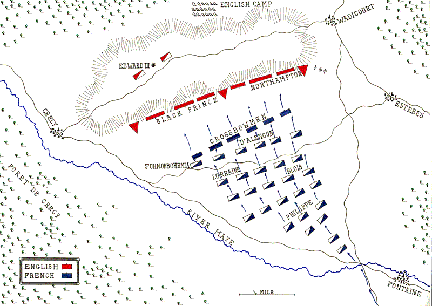
A fortunate tidal crossing of the Somme River gave the English a day’s lead, allowing Edward’s forces time to rest and prepare for battle as they stopped near the village of Crécy.

Edward’s forces took a strong defensive position overlooking flat agricultural land, natural obstacles to either side effectively nullifying the French numerical advantage. The French army under King Philip VI was wet and exhausted when they arrived on the 26th but launched themselves nevertheless, directly at the English lines.

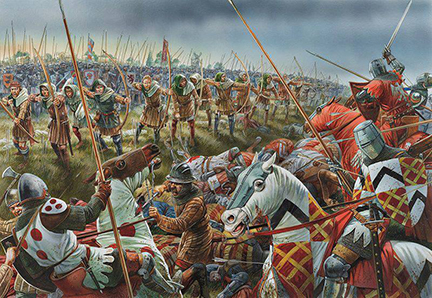
Genoese crossbowmen opened the battle on the French side, but wet strings hampered the weapon’s effectiveness. English archers had unstrung longbows during the previous night’s rain, and now showered thousands of arrows down on the heads of the adversary. The French first line broke and ran, only to be accused of cowardice and hacked to pieces by knights to the rear.

French mounted knights now entered the fray, but orderly lines soon dissolved into confusion. The muddy field combined with English obstacles and that constant barrage of arrows unhorsed French knights and confused their lines.

Riderless horses and unmounted knights alike were run down by successive waves of horsemen, each impatient to win his share of the “glory”. Those who made it to the English side faced a tough, disciplined line of spearmen and foot soldiers who held their position. Once unhorsed, heavily armored knights were easy prey to the quick and merciless knives of the English.

Crecy, Bowmen

In the midst of battle a messenger sought out the English King beseeching aid for the King’s son, the 16-year-old Edward of Woodstock, known as the Black Prince. Edward responded “Do not send to me so long as my son lives; let the boy win his spurs; let the day be his.”

Philip’s ally, the blind King John of Bohemia, heard that the battle was going badly for the French. He ordered his companions to tie his horse’s bridle to theirs, and lead him into the fight. It was the last time he was seen alive.

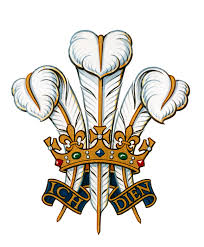
Ich Dien

The Black Prince did indeed earn his spurs that day and, according to legend retrieved the helmet from the dead king and adopted as his own the triple ostrich plume with the words “Ich Dien”. I serve.  To this day that heraldic badge symbolizes the the Prince of Wales and heir apparent, to the British throne.

When it was over, the mythical age of chivalry lay dead in the mud and the blood of Crécy, alongside the feudal system.  2,200 Heraldic coats were taken as trophies. The English side suffered 1/10th the number of casualties, as the French.  

In the words of A Short History of the English People, by John Richard Green, “The churl had struck down the noble; the bondsman proved more than a match in sheer hard fighting, for the knight”.  After Crécy, the world’s land battles would be fought not by armored knights fighting toe-to-toe with battle-axe and lance but by common foot soldiers with bow, spear and gun.

August 18, 1587 Lost Colony of Roanoke

What happened to the lost colonists of Roanoke, remains a mystery. They may have died of disease or starvation, or they may have been killed by hostile natives.


The 16th century was drawing to a close when Queen Elizabeth set out to establish a permanent English settlement in the New World. The charter went to Walter Raleigh, who sent explorers Philip Amadas and Arthur Barlowe to scout out locations for a settlement.

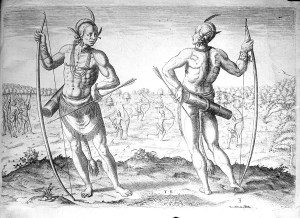
The pair landed on Roanoke Island on July 4, 1584, establishing friendly relations with local natives, the Secotans and Croatans. They returned a year later with glowing reports of what we now call the Outer Banks of North Carolina. Two Native Croatans, Manteo and Wanchese, accompanied the pair back to England. All of London was abuzz with the wonders of the New World.

Sir Walter Raleigh (?)
Explorer Sir Walter Raleigh

Queen Elizabeth was so pleased she knighted Raleigh.  The new land was called “Virginia” in honor of the Virgin Queen.

Raleigh sent a party of 100 soldiers, miners and scientists to Roanoke Island, under the leadership of Captain Ralph Lane. The attempt was doomed from the start. They arrived too late in the season for planting, and Lane alienated the neighboring tribe when misunderstanding led to the murder of their chief, Wingina. By 1586 the new arrivals had had enough, and left the island.

Ironically, their supply ship arrived about a week later. Finding the island deserted, the vessel left 15 men behind to “hold the fort” before they too, departed.

The now knighted “Sir” Walter Raleigh was not to be deterred. He recruited 90 men, 17 women and 9 children for a more permanent “Cittie of Raleigh”, appointing John White governor. Among the colonists were White’s pregnant daughter, Eleanor, her husband Ananias Dare, and the Croatans Wanchese and Manteo.

Wanchese, Manteo
Wanchese, Manteo

The caravan stopped at Roanoke Island in July, 1587, to check on the 15 men left behind a year earlier.  Raleigh believed that the Chesapeake afforded better opportunities for his new settlement, but his Portuguese pilot Simon Fernandes had other ideas.

Fernandes was a Privateer, impatient to resume his hunt for Spanish shipping.  He ordered the colonists ashore on Roanoke Island. It could not have lifted the spirits of the small group to learn that the 15 left by the earlier expedition, had disappeared.

Eleanor Dare gave birth to a daughter on August 18, 1587, and called her Virginia.  She was the first English child born to the new world.

Fernandez departed for England ten days later, taking along an anxious John White, who wanted to return to England for supplies. It was the last time Governor White would see his family.

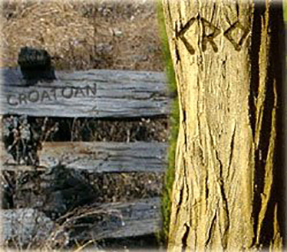
croatoan(2)White found himself trapped in England by the invasion of the Spanish Armada, and the Anglo-Spanish war.  It would be three years before he could return to Roanoke. He arrived on August 18, 1590, three years to the day from the birth of his granddaughter. White found the place deserted, save for the word “CROATOAN”, carved into a fence post.  The letters “CRO” appeared on a nearby tree.

croatoan(1)

White had hopes of finding his family at Croatoan, the home of Chief Manteo’s people to the south, on modern day Hatteras Island.

A hurricane came up before he could explore further, his ships so damaged that he had return to England. Despite several attempts he never raised the resources to return.

What happened to the lost colonists of Roanoke, remains a mystery. They may have died of disease or starvation, or they may have been killed by hostile natives.

Perhaps they went to live with Chief Manteo’s people, after all. One of the wilder legends has Virginia Dare, now a young woman, transformed into a snow white doe by the evil medicine man Chico, but that must be a story for another day.  The fate of the first English child born on American soil may never be known.

white-deer

Seventeen years later another group of colonists would apply the lessons learned in Roanoke, founding their own colony a few miles up the coast at a place called Jamestown.

One personal anecdote involves a conversation I had with a woman in High Point, North Carolina, a few years back. She described herself as having Croatan ancestry, her family going back many generations on the outer banks. She described her Great Grandmother, a full blooded Croatan. The woman looked like it, too, except for those crystal blue eyes. She used to smile at the idea of the lost colony of Roanoke. “They’re not lost”, she would say. “They are us”.

July 31, 1917 Passchendaele

“My wound was slight,
And I was hobbling back; and then a shell
Burst slick upon the duck-boards: so I fell
Into the bottomless mud, and lost the light”
Siegfried Sassoon, Memorial Tablet

The “War to end all Wars” exploded across the European continent in the summer of 1914, devolving into the stalemate of trench warfare, by October.

The ‘Great War’ became Total War, the following year.  1915 saw the first use of asphyxiating gas, first at Bolimow in Poland, and later (and more famously) near the Belgian village of Ypres.  Ottoman deportation of its Armenian minority led to the systematic extermination of an ethnic minority, resulting in the death of ¾ of an estimated 2 million Armenians living in the Empire at that time. For the first time and far from the last an unsuspecting world heard the term, genocide‘.

Battle-of-Passchendaele
Battle of Passchendaele

Kaiser Wilhelm responded to the Royal Navy’s near-stranglehold on surface shipping with a policy of unrestricted submarine warfare, as the first zeppelin raids were carried out against the British mainland.  German forces adopted a defensive strategy on the western front, developing the most sophisticated defensive capabilities of the war and determined to “bleed France white”, while concentrating on defeating Czarist Russia.

Russian Czar Nicholas II took personal command that September, following catastrophic losses in Galicia and Poland.  Austro-German offensives resulted in 1.4 million Russian casualties by September with another 750,000 captured, spurring a “Great Retreat” of Russian forces in the east and resulting in political and social unrest which would topple the Imperial government, fewer than two years later.   In December 1915, British and ANZAC forces broke off a meaningless stalemate on the Gallipoli peninsula, beginning the evacuation of some 83,000 survivors.  The disastrous offensive produced some 250,000 casualties.  The Gallipoli campaign was remembered as a great Ottoman victory, a defining moment in Turkish history.  For now, Turkish troops held their fire in the face of the allied withdrawal, happy to see them leave.

The-third-battle-of-Ypres-1917-9
Passchendaele, 1917

A single day’s fighting in the great battles of 1916 could produce more casualties than every European war of the preceding 100 years, civilian and military, combined. Over 16 million were killed and another 20 million wounded while vast stretches of the Western European countryside were literally torn to pieces.

1917 saw the resumption of unrestricted submarine warfare, and a German invitation to bring Mexico into the war, against the United States.  As expected, these policies brought America into the war on the allied side.  The President who won re-election for being ‘too proud to fight’ asked for a congressional declaration of war, that April.

Sealed Train

Massive French losses stemming from the failed Nivelle offensive of that same month (French casualties were fully ten times what was expected) combined with irrational expectations that American forces would materialize on the western front led to massive unrest in the French lines.  Fully one-half of all French forces on the western front mutinied.  It’s one of the great miracles of WW1 that the German side never knew, else the conflict may have ended, very differently.

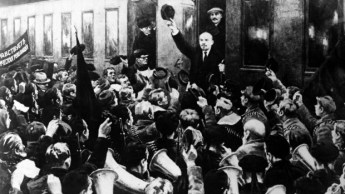
The sealed train carrying the plague bacillus of communism had already entered the Russian body politic.  Nicholas II, Emperor of all Russia, was overthrown and murdered that July, along with his wife, children, servants and a few loyal friends, and their dogs.

This was the situation in July 1917.

third-battle-of-ypres-passchendaele-ww1-007For eighteen months, British miners worked to dig tunnels under Messines Ridge, the German defensive works laid out around the Belgian town of Ypres.  Nearly a million pounds of high explosive were placed in some 2,000′ of tunnels, dug 100′ deep.  10,000 German soldiers ceased to exist at 3:10am local time on June 7, in a blast that could be heard as far away, as London.
Buoyed by this success and eager to destroy the German submarine bases on the Belgian coast, General Sir Douglas Haig planned an assault from the British-held Ypres salient, near the village of Passchendaele.

general

British Prime Minister David Lloyd George opposed the offensive, as did the French Chief of the General Staff, General Ferdinand Foch, both preferring to await the arrival of the American Expeditionary Force (AEF).  Historians have argued the wisdom of the move, ever since.

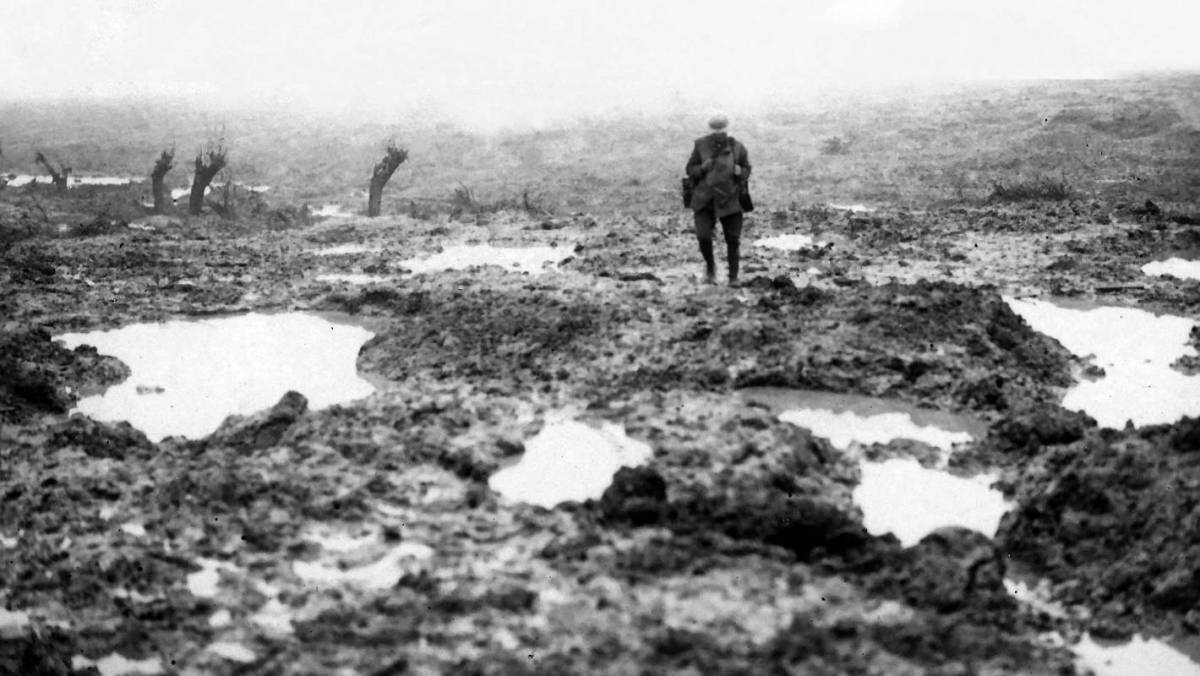
The third Battle of Ypres, also known as the Battle of Passchendaele, began in the early morning hours of July 31, 1917. The next 105 days would be fought under some of the most hideous conditions, of the entire war.

In the ten days leading up to the attack, some 3,000 guns fired an estimated 4½ million shells into German lines, pulverizing whole forests and smashing water control structures in the lowland plains.  Several days into the attack, Ypres suffered the heaviest rainfall, in thirty years.

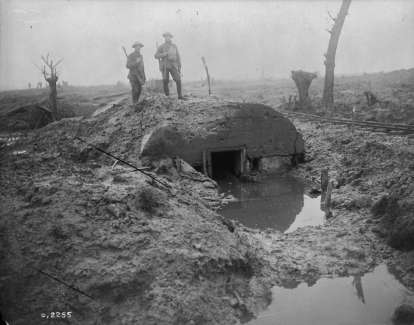
pillbox
German pillbox, following capture by Canadian soldiers.

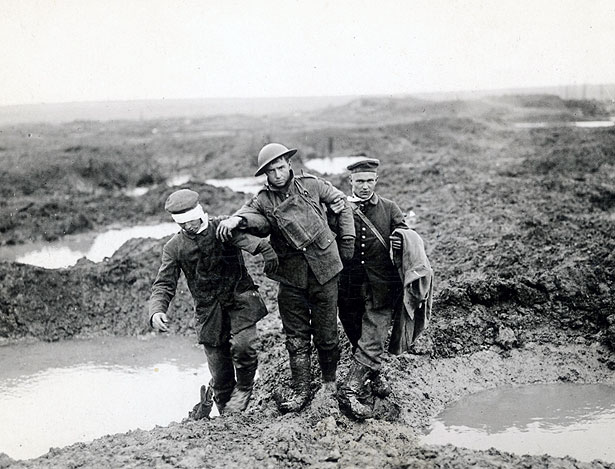
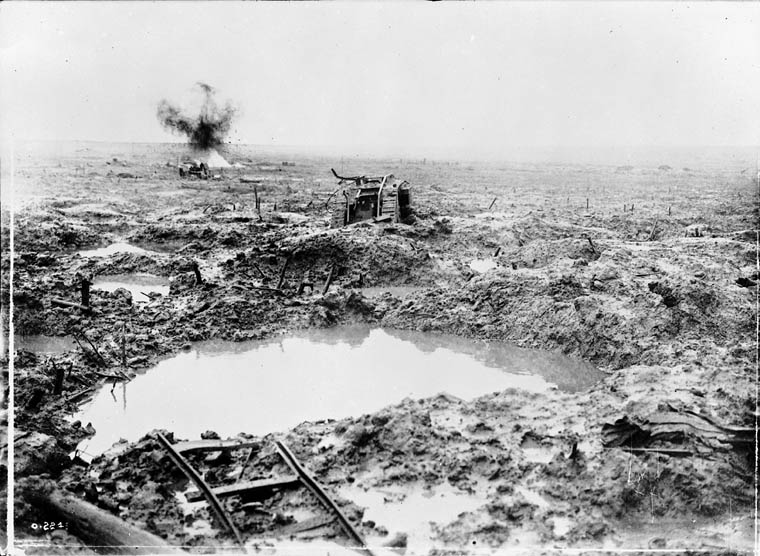
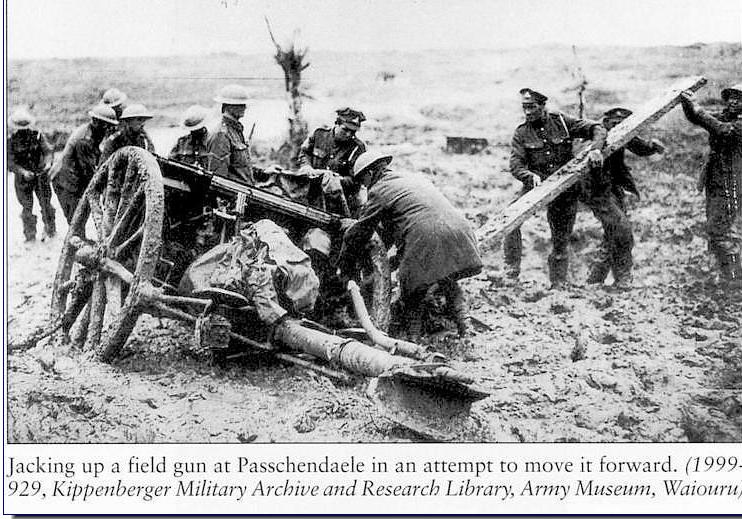
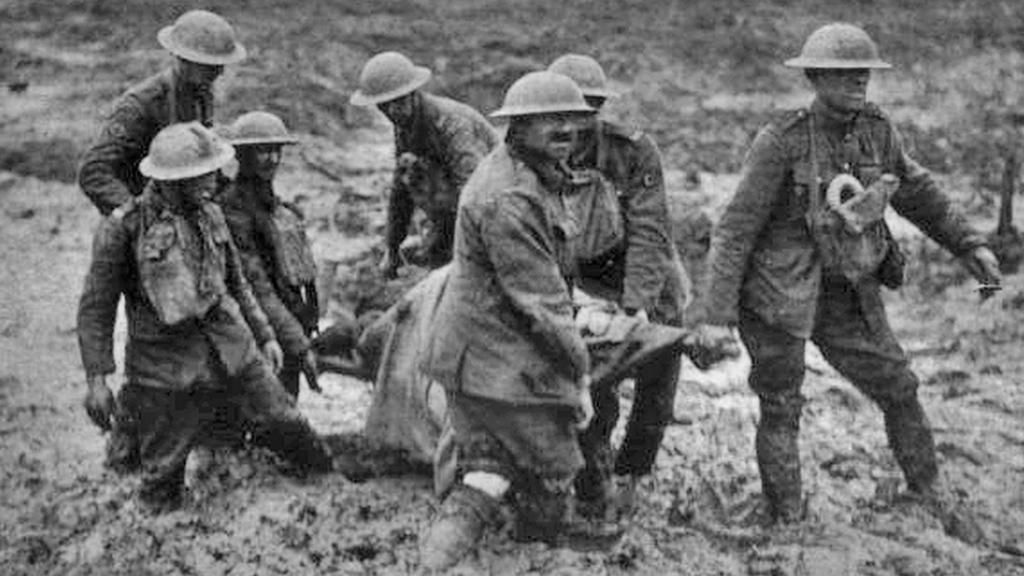
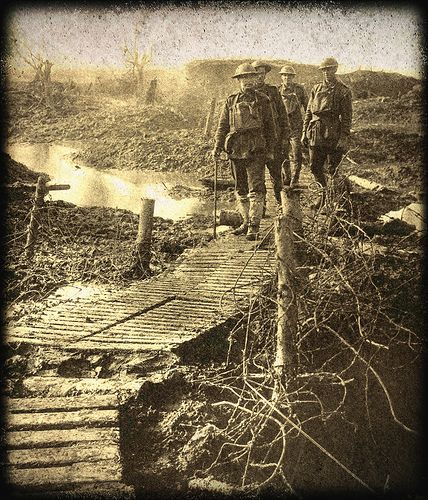
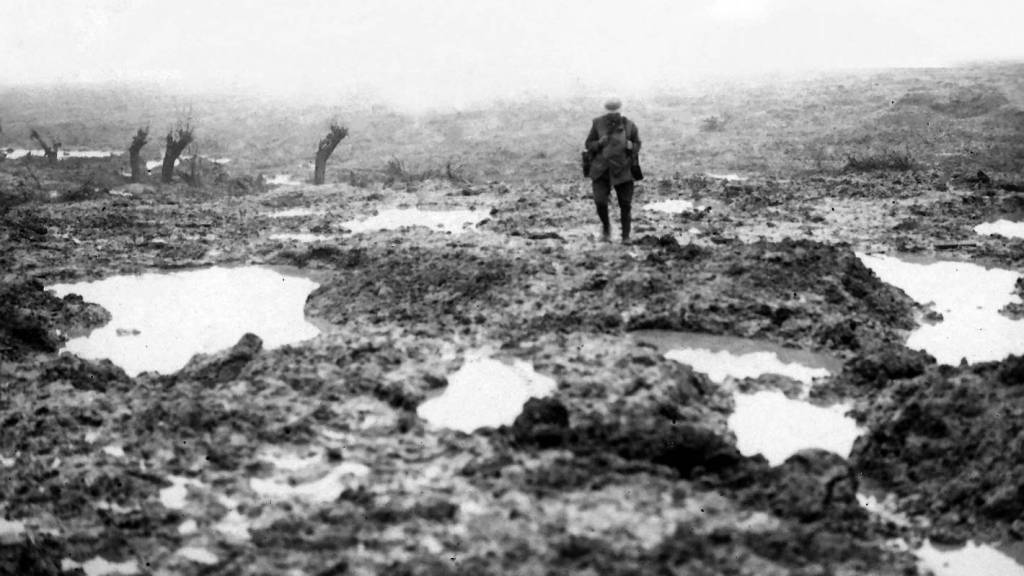
Conditions defy description. Time and again the clay soil, the water, the shattered remnants of once-great forests and the bodies of the slain were churned up and pulverized by shellfire.  You couldn’t call the stuff these people lived and fought in mud – it was more like a thick slime, a clinging, sucking ooze, capable of swallowing grown men, even horses and mules.  Most of the offensive took place across a broad plain formerly crisscrossed with canals, but now a great, sucking mire in which the only solid ground seemed to be German positions, from which machine guns cut down sodden commonwealth soldiers, as with a scythe.

Soldiers begged for their friends to shoot them, rather than being left to sink in that muck. One sank up to his neck and slowly went stark raving mad, as he died of thirst. British soldier Charles Miles wrote “It was worse when the mud didn’t suck you down; when it yielded under your feet you knew that it was a body you were treading on.”

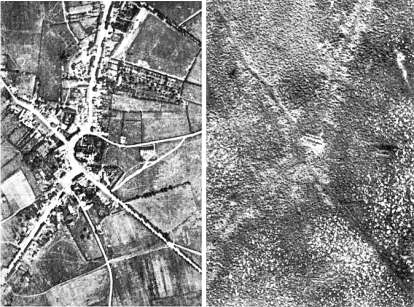
Passchendaele, aerial
Passchendaele, before and after the offensive. H/T Imperial War Museums/Wikimedia Commons

In 105 days of this hell, Commonwealth forces lost 275,000 killed, wounded and missing.  The German side another 200,000.  90,000 bodies were never identified.  42,000 were never recovered and remain there, to this day.  All for five miles of mud and a village barely recognizable, following capture.

Following the battle of Passchendaele, staff officer Sir Launcelot Kiggell is said to have broken down in tears.  “Good God”, he said, “Did we really send men to fight in That”?! 

The soldier-turned war poet Siegfried Sassoon reveals the bitterness of the average “Joe Squaddy”, sent by his government to fight and die, at Passchendaele.  The story is told in the first person by a dead man, in all the bitterness of which a poet decorated for bravery and later shot in the head by his own side, is capable.  It’s called:

Memorial Tablet

Squire nagged and bullied till I went to fight,  
(Under Lord Derby’s Scheme). I died in hell—  
(They called it Passchendaele). My wound was slight,  
And I was hobbling back; and then a shell  
Burst slick upon the duck-boards: so I fell
Into the bottomless mud, and lost the light.  

At sermon-time, while Squire is in his pew,  
He gives my gilded name a thoughtful stare:  
For, though low down upon the list, I’m there;  
‘In proud and glorious memory’… that’s my due.
Two bleeding years I fought in France, for Squire:  
I suffered anguish that he’s never guessed.  
Once I came home on leave: and then went west…  
What greater glory could a man desire?

July 25, 1944 Doodlebug

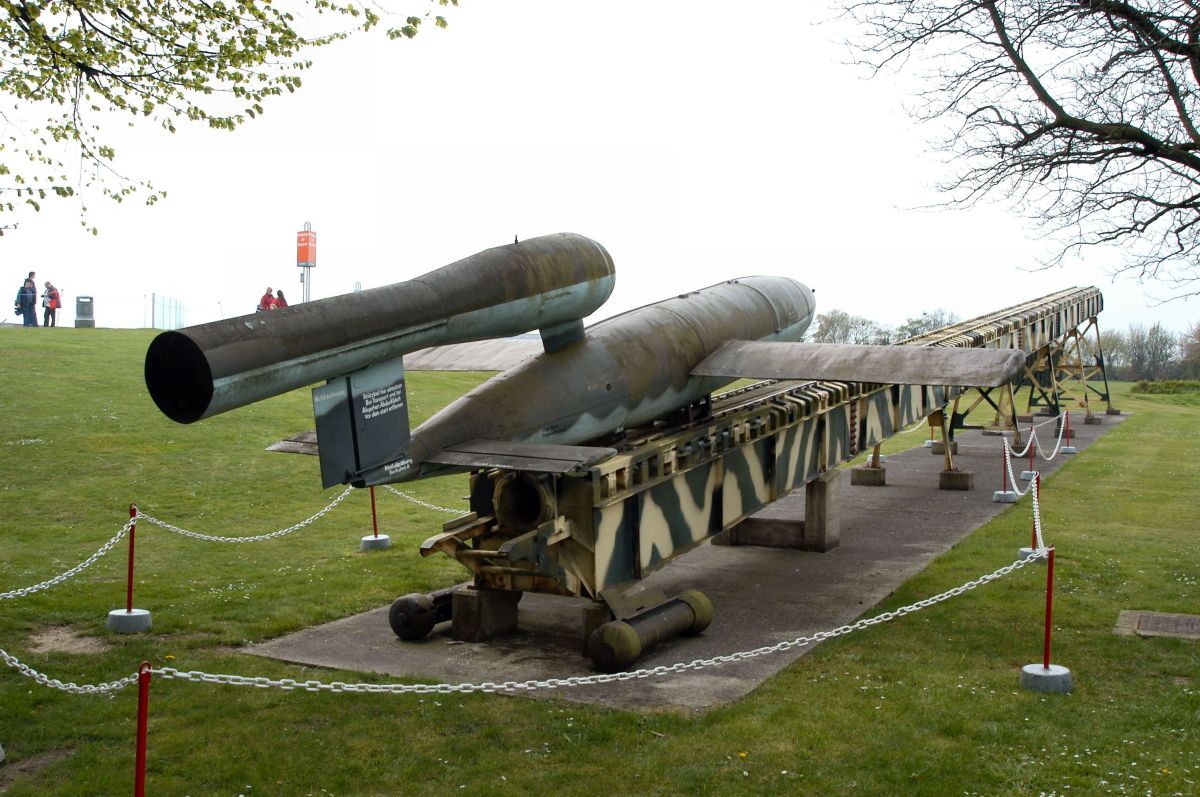
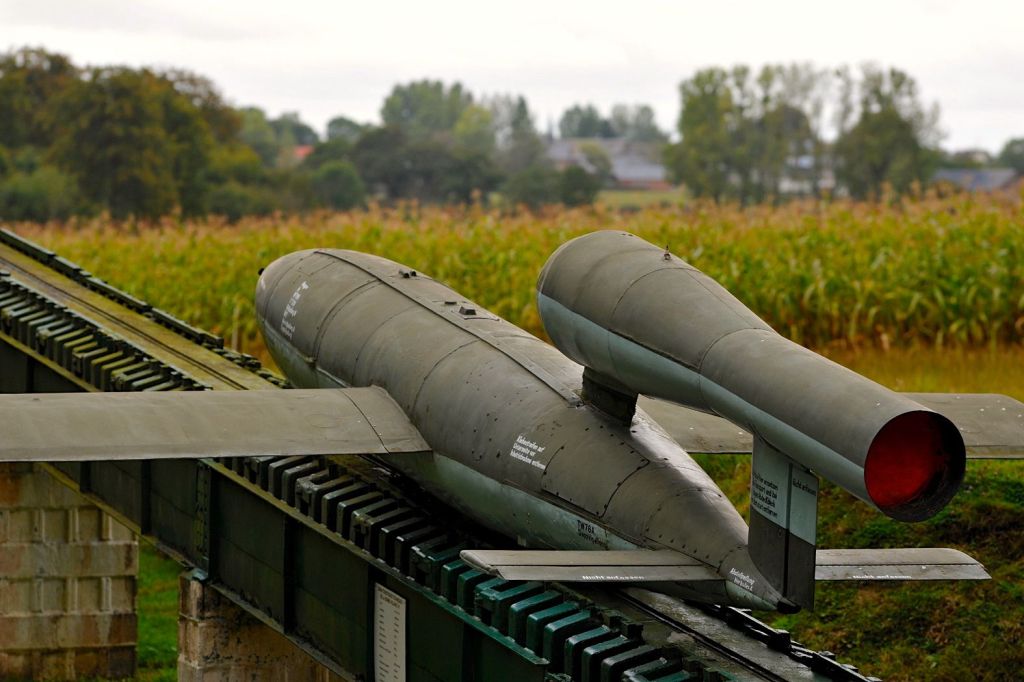
The Nazis called this new and terrifying weapon, “Vergeltungswaffe”, or “Vengeance weapon”. Finnish soldiers called the thing a flying torpedo. At over 27-feet long it was a flying bomb with a payload of nearly a ton of high explosive. Allies called this Nazi superweapon the “Buzz Bomb” or simply, “Doodlebug”.


In the early morning hours of June 13, 1944, a member of the Royal Observer Corps (ROC) spotted a bright yellow glow in the early morning darkness. The sentry was on the lookout for such a sight and immediately informed his superiors. The code word, “diver”.

The yellow glow went out within moments and plummeted to the earth, landing in the village of Swanscombe, some 20 miles east of the Tower of London. Other such devices were soon falling from the sky with terrible exclusive force. Cuckfield, West Sussex, London and Sevenoaks, in Kent. This time only six people died in a place called Bethnal Green. There would be more.

Most V1 rockets were launched from a simple rail system, others taken aloft attached to host aircraft

The Nazis called this new and terrifying weapon, “Vergeltungswaffe”, or “Vengeance weapon”. Finnish soldiers called the thing a flying torpedo. At over 27-feet long it was a flying bomb with a payload of nearly a ton of high explosive. Allies called this Nazi superweapon the “Buzz Bomb” or simply, “Doodlebug”.

Nazi Germany aimed as many as 10,492 of these Doodlebug rockets against England. Some 6,000 were killed in London alone, with another 18,000 serious injuries. The subsonic Doodlebug was an effective terror weapon but, bad as it was to be the target of one of these things, the “low and slow” trajectory and the weapon’s short range lacked the strategic punch Nazi Germany needed to win the war.

The next generation V2 missile was a different story.  The V2 ushered in the era of the ballistic missile and Nazi Germany was the first off the starting line.

The Peenemünde Aggregat A4 V2 was an early predecessor of the Cruise Missile, delivering a 2,148 pound payload at 5 times the speed of sound over a 236-mile range. While you could hear the V1 coming and seek shelter, victims of the V2 didn’t know they were under attack, until the weapon had exploded.

When Wernher von Braun showed Adolf Hitler the launch of the V2 on color film, Hitler jumped from his seat and shook Braun’s hand with excitement. “This is the decisive weapon of the war. Humanity will never be able to endure it,” Hitler said, “If I had this weapon in 1939 we would not be at war now.”

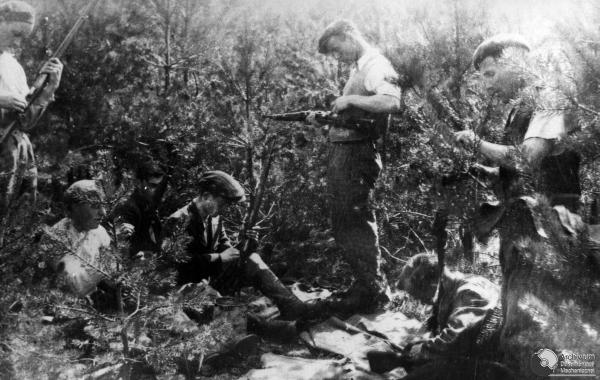
Allies were anxious to get their hands on this new secret weapon. In early 1944 they had their chance when a V2 crashed into a muddy bank of the Bug River in Nazi-occupied Poland, without exploding. The Polish underground was waiting for such an opportunity and quickly descended on the rocket, disguising it with brush. Desperate to retrieve the weapon, Germans conducted a week long aerial and ground search for the V2, but failed find it under all that camouflage.

Polish Partisans preparing for battle_WW2
Polish Partisans preparing for battle, WW2

The search came to an end after what must have seemed an eternity, when partisans returned to the site. This time they brought four Polish scientists who carefully disassembled the weapon, packing the pieces in barrels. The parts were then shipped to a barn in Holowczyce, just a few miles away.

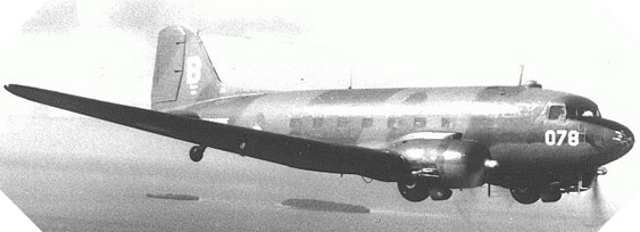
The allied effort to retrieve the stolen missile, code named “Most III”, got underway on this day in 1944, when Royal New Zealand Air Force 1st Lt Stanley George Culliford landed his Dakota C47 in the early morning darkness at a secret air strip near Tarnow.

1920px-Home_Army_intelligence_on_V1_and_V2
Home Army intelligence on V1 & V2

The V2 chassis and several technical experts were loaded on board, but it was all too much.  The overloaded C47 couldn’t move on the wet, muddy field – the port wheel stuck fast in the mud.  Everything had to be offloaded, Polish partisans working desperately to free the aircraft as dawn approached. They stuffed the wheel track with straw, and then laid boards in the trench.  Nothing worked.

Co-pilot Kazimierz “Paddy” Szrajer thought the parking brake must be stuck, so the hydraulic leads supplying the brake, were cut. That didn’t work, either. In the end, partisans were frantically digging trenches under the aircraft’s main wheel. Two attempts failed to get the aircraft off the ground, and Culliford was thinking about blowing up the plane and burning all the evidence.  There could only be one more attempt.

The aircraft lumbered off the ground on the third try.  The last of the partisans scattered into the night, even as the headlights of Nazi vehicles could be seen, approaching in the early morning darkness.

18lfbi20zpunyjpgThere would be 5 hours of unarmed, unescorted flight through Nazi-controlled air space and an emergency landing with no brakes, before those V2 rocket components finally made it to England.
Today, few remember the names of these heroes, struggling in the dark to defeat the forces of Tyranny.  We are left only to imagine a world in which Nazis remained in sole possession of the game changing super weapons, of WWII

June 22, 1807 The Chesapeake-Leopard affair

American public opinion was outraged over the humiliation, as the four men were transported to Halifax for trial.   Federalists and Democratic-Republicans alike were united as never before.  President Thomas Jefferson remarked “Never since the Battle of Lexington have I seen this country in such a state of exasperation as at present, and even that did not produce such unanimity.”


The Napoleonic Wars took place between 1799 and 1815, pitting a series of seven international coalitions against the forces of Napoleon Bonaparte and his Grande Armée.  The former American colonies benefited from the European conflict, remaining on the sidelines and doing business with both sides.  Within a ten-year period, the fledgling United States had become one of the world’s largest neutral shippers.

In 1807, two third-rate French warships were penned up in Maryland’s Chesapeake Bay, blockaded by a number of English warships outside of the harbor.

4467229436_5635b36a0a
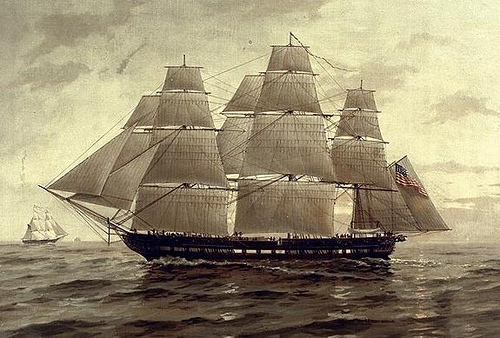
The American frigate, USS Chesapeake

London born Jenkin Ratford was an English sailor who deserted the British Navy and defected to the neutral United States.  This story might have ended better for him had he not run his mouth, but that wasn’t this guy.  Ratford couldn’t resist taunting British officers, boasting of his escape to the “land of liberty”

The USS Chesapeake was preparing for a Mediterranean cruise with Ratford aboard when she emerged from Norfolk, Virginia.  Her decks were laden with supplies and stores of every kind and her guns, unwisely stored.  Chesapeake was nowhere near combat ready when she was approached by the HMS Leopard on June 22.

The Chesapeake’s commander, Commodore James Barron, was unconcerned when Leopard, under the command of Captain Salusbury Pryce Humphreys, asked permission to board.  Lieutenant John Meade of Her Majesty’s Navy presented Barron with a search warrant.  Barron declined to submit, and the officer returned to the Leopard.

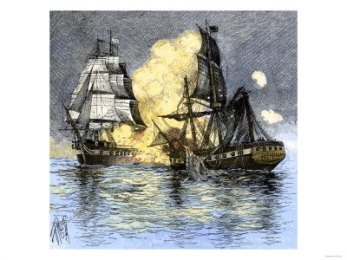
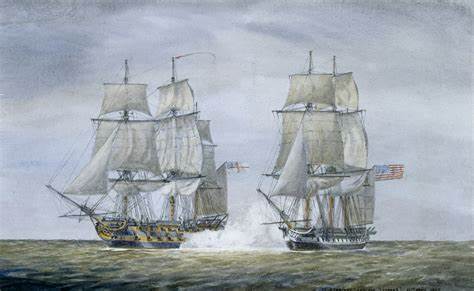
Chesapeake_Leopard

Humphreys then used a hailing trumpet and ordered the American ship to comply, to which Barron responded “I don’t hear what you say”. Humphreys then fired two rounds across Chesapeake’s bow, followed immediately by four broadsides.

Chesapeake fired only a single shot before striking colors and surrendering.  Humphreys refused the surrender and boarded, taking Ratford and three American born sailors with them when they left.

There was but token resistance, and yet the “Chesapeake-Leopard Affair” left three American crewmembers dead, and 18 wounded.

American public opinion was outraged over the humiliation, as the four men were transported to Halifax for trial.   Federalists and Democratic-Republicans alike were united as never before.  President Thomas Jefferson remarked “Never since the Battle of Lexington have I seen this country in such a state of exasperation as at present, and even that did not produce such unanimity.”

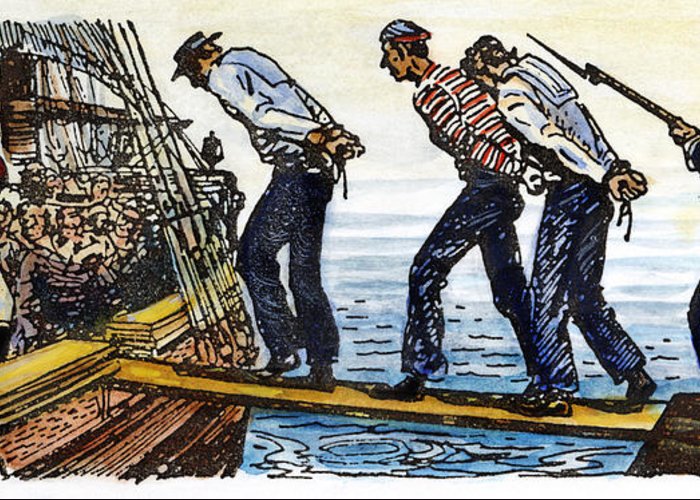
The English court found all four guilty of desertion and hanged Ratford by the fore yardarm of his former vessel, HMS Halifax.  The three Americans, David Martin, John Strachan, and William Ware, were sentenced to 500 lashes.

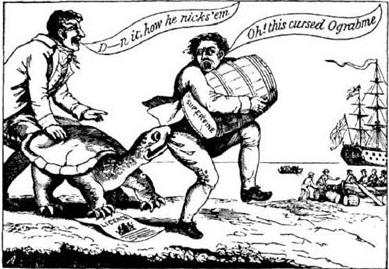
With the puny American navy deployed to the Mediterranean to check the Barbary pirates, President Jefferson’s options were limited to economic retaliation.  The Embargo Act of 1807 intended to extract concessions from France and Great Britain, instead had the effect of imposing crippling setbacks on some industries, while others railed against government interference in the private economy.  Many conclude that the only solution, lay in violence.

2661E817-FD9D-331B-F65F29408EE37509
Political cartoon depicting merchants harassed cursing the “Ograbme”—“embargo” spelled backwards.

British envoys delivered proclamations reaffirming the practice of impressment,  amounting to the kidnapping of sailors and forcing their labor aboard British ships.  In total, the Royal Navy impressed over 9,000 sailors claiming to be American citizens, becoming the driving force behind the United States going to war with England, in 1812.

Despite being wounded, Barron was blamed for the “Chesapeake-Leopard Affair”.  A court-martial suspended him from service for five years, without pay.   Commodore Stephen Decatur was one of the presiding officers at the court-martial. In 1820, Barron challenged Decatur to a duel, killing his fellow Commodore over his comments concerning the 1807 incident.

Undergoing a refit in Boston Harbor in 1813, USS Chesapeake was challenged to single combat by Captain Philip Broke, commanding the British frigate HMS Shannon.

Chesapeake_Mill

United States Naval Captain James Lawrence was eager to comply, confident in the wake of a number of American victories in single-ship actions.

It was a Big mistake.

All of Boston turned out that June day, to watch the fight.  Cheers went out across the docks and from scores of private vessels across Boston Harbor, as Chesapeake slipped her moorings and glided out of the harbor.

Boston authorities reserved dock space in expectation of a prize.  The arrival of a captured British frigate, was a foregone conclusion. Rooftops, hills and trees from Lynn to Malden and Cohasset to Scituate were crowded with spectators, come to watch the show.

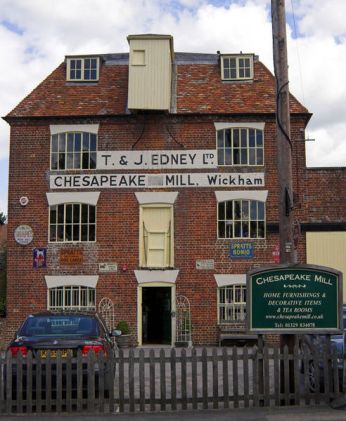
The tale of the Battle of Boston Harbor must be a story for another day.  Suffice it to say that USS Chesapeake ended her career as the British frigate HMS Chesapeake, before being sold for scrap, in 1819.  Two-hundred years later, the ship’s timbers live on.  Part of the Chesapeake Mill in the historic village of Wickham, in Hampshire, England.

A Trivial Matter: British manpower needs expanded exponentially following defeat at the battle of Saratoga and impending hostilities with Napoleonic France. Regular army enlistment swelled from 48,000 to 110,000. The Recruiting Acts of 1778 and 1779 alike reaffirmed the necessity of impressment. Some recruits went so far as to chop off their own thumb and forefinger of the right hand making it impossible to handle musket or sword, to avoid impressment.