May 8, 1877 Westminster

“Westminster pre-dates the invention of the light bulb, the automobile, and the zipper; the building of the Brooklyn Bridge and the Washington Monument; and manned air flight and the establishment of the World Series. Since Westminster held its first show 127 years ago, there have been 26 men elected president and 12 states have joined the union”.

The most famous dog show in the world was first held on May 8, 1877, called the “First Annual NY Bench Show of Dogs.”  The event began as a show for hunting dogs, mostly Setters and Pointers with a few Terriers.

That first show featured two Staghounds belonging to the late General George Armstrong Custer. Victoria, Queen of the United Kingdom of Great Britain and Ireland, entered two Deerhounds.  Two years later, Russian Czar Alexander III entered a Siberian Wolfhound. German Emperor Wilhelm II entered his own Wolfhound, a year later.

The event was held at Gilmore’s Garden at the corner of Madison Avenue and 26th Street, a location which would one day be known as Madison Square Garden.  In those days, another popular Gilmore Garden event was competitive boxing, a sport which was illegal in New York at that time.  Events were billed as “exhibitions” or, better yet, “Illustrated Lectures.”  (I love that one).

westmisterhotelA group of hunters used to meet at the Westminster Hotel at Irving Place & 16th Street, “to drink and lie about their shooting accomplishments”. The Westminster Kennel Club was formed when the group first decided to hold a dog show.

According to Westminsterkennelclub.org, “Westminster pre-dates the invention of the light bulb, the automobile, and the zipper; the building of the Brooklyn Bridge and the Washington Monument; and manned air flight and the establishment of the World Series. Since Westminster held its first show 127 years ago, there have been 26 men elected president and 12 states have joined the union…The dog show has outlasted three previous versions of Madison Square Garden, and is currently being staged in MSG IV. It is one of only four events to be held in all four “Gardens.”. 

Prizes for that original show included pearl handled revolvers.  Amusing when you think of the 2nd amendment purgatory that is Warren Wilhelm’s (Bill DiBlasio’s) New York.

51bMmhjei7L1,201 dogs arrived for that first show, in an event so popular that the originally planned three days morphed into four. The Westminster Kennel Club donated all proceeds from the fourth day to the ASPCA, for the creation of a home for stray and disabled dogs. The organization remains supportive of animal charities, to this day.

The Westminster dog show is the longest continuously held sporting event in the United States, with the sole exception of the Kentucky Derby, which began only a year earlier.

Not even two World Wars would stop the Westminster Dog Show, though a tugboat strike cut two days down to one in 1946. Even so, “Best in Show” was awarded fifteen minutes earlier than the year before.  I wonder how many puppies were named “Tug” that year.

The Westminster dog show was first televised in 1948, three years before college football was first broadcast on national television.
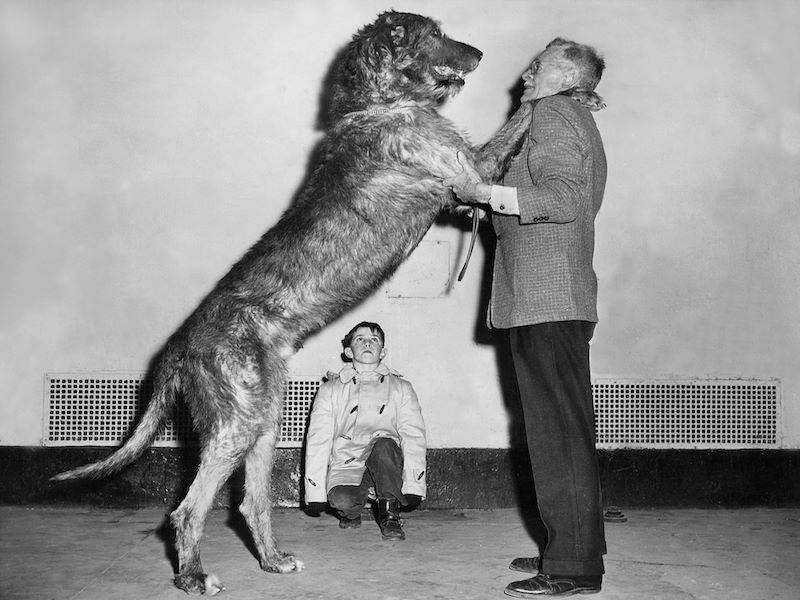
cdn.akc_.org3_Wolfhound-6af867ef287c29fa96c29ff94dbef73382882d48

When the American Kennel Club (AKC) was founded in 1884, Westminster was the first club to be admitted. Breed parent clubs such as the German Shepherd Dog Club of America developed breed standards, extensive written descriptions of what the perfect specimen looks like for any given breed. Some of the traits which distinguished the original working dogs of 1877 are still apparent, while other elements are seemingly arbitrary, such as tail carriage, eye shape and color.

SBT_Breed_Standard1
Breed standard for the American Staffordshire Bull Terrier

Dogs are judged first against others of their own breed.  The best of each goes forward into one of seven groups: Sporting, Hound, Working, Terrier, Toy, Non-Sporting, and Herding. In the final round, the winners from each group competes for “Best in Show”.  In the end, there can be only one.

Mixed breeds have been permitted since 2014, to compete in an agility event.
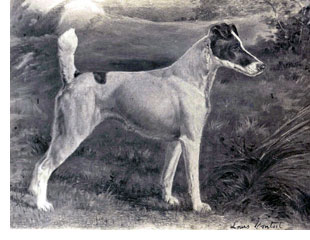
warrenremedy
Warren Remedy

A Smooth Fox Terrier named Ch.(Championship) Warren Remedy won the top award in 1907, 1908 and 1909, the only dog to ever win three Best in Shows at Westminster. Seven dogs have twice taken the top award.  Five owners have won Best in Show with more than one dog. A Sussex Spaniel named Stump became the oldest winner in dog show history in 2009, at the age of 10. Judge Sari Tietjen said she had no idea the winning dog was a senior citizen. “He showed his heart out,” she said. “I didn’t know who he was or how old … I just couldn’t say no to him”.

Today, the Westminster dog show runs two days and nights in February. Entry is limited to 2,800 dogs and fills up on the first day of registration. Breed judging takes place during the day at Piers 92 and 94. Group and Best in Show competition takes place in the evening at Madison Square Garden. Since 1992, Westminster has invited the top five dogs from each breed to pre-enter, based on dog show performances of the preceding year.
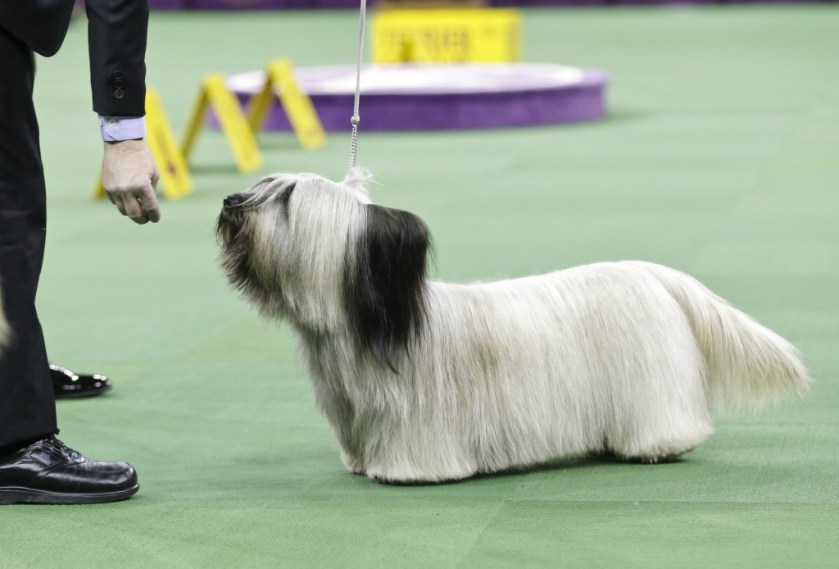
Charlie

Madison Square Garden generally sells out for the event, the WKC issuing up to 700 press credentials for media attending from no fewer than 20 countries. The Westminster website http://www.westminsterkennelclub.org receives about 20 million page views from 170 countries.
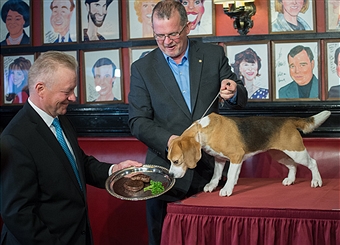
463811398Since the late 1960s, winner of the Westminster Best in Show has celebrated at Sardi’s, a popular mid-town eatery in the theater district and birthplace of the Tony award.

And then the Nanny State descended, pronouncing that 2012 would be the last. There shalt be no dogs dining in New York restaurants.  Not while Mayor Bloomberg is in charge.

Suddenly, Westminster found itself in good company.  The Algonquin, the historic hotel at the corners of 59th Street West & 44th, had taken in a stray cat, sometime back in the 1930s.  Ever since, one of a succession of felines have had the run of the place. The males have all been called “Hamlet”, the females, “Matilda”.
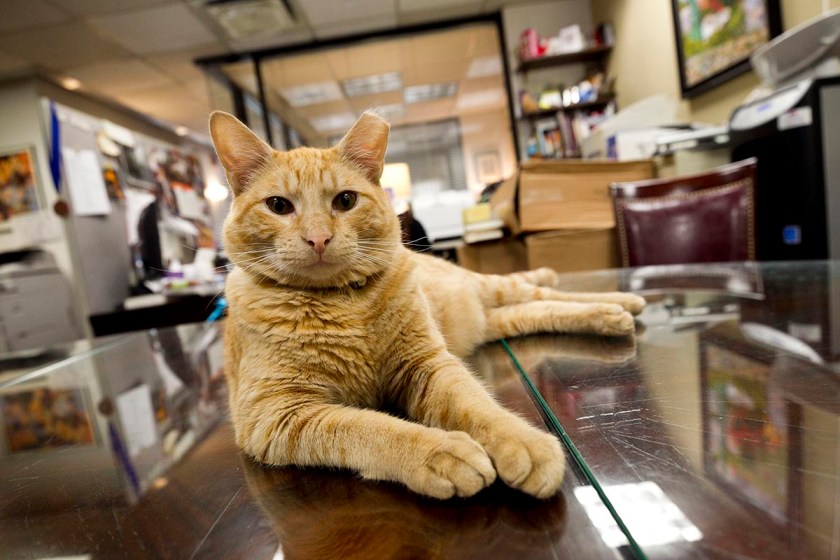
072417algonquinAW07.jpg
Meet “Hamlet”, the Algonquin Hotel’s official Cat in Residence

And then his Lordship Mayor Yourslurpeeistoobig’s Board of Health descended on the Algonquin, requiring that the cat be kept on a leash. There ensued a tempest in a cat box, until a compromise was reached, later that year. An electronic pet fence was installed confining the cat to non-food areas of the hotel, in return for which city bureaucrats returned to whatever it is they do.

Back to the dog show.  Not wanting another such drama, Nanny Bloomberg pulled his health commissioner, Dr. Thomas Farley, aside. By the end of the week, the health department had found a loophole to defuse the standoff:  Dr. Farley would issue a waiver. Since then, the winner at Westminster is free to enjoy the traditional celebratory luncheon of diced chicken and rice from a silver platter. Provided that it’s eaten in the back room.

Feature Image, top of page:  “Rumor”, Best in Show winner, 2017
Ho Lee Schitt
This one slays me.  I couldn’t resist.
If you enjoyed this “Today in History”, please feel free to re-blog, “like” & share on social media, so that others may find and enjoy it as well. Please click the “follow” button on the right, to receive email updates on new articles.  Thank you for your interest, in the history we all share.

April 28, 1933 Sacred Cod

So important was the Cod to the regional economy, that a carved likeness of the fish hung in the Massachusetts State House, fifty years or more before the Revolution.

The American Revolution was barely 15 years in the rear-view mirror, when the new State House opened in the Beacon Hill neighborhood of Boston.  The building has expanded a couple of times since then, and remains the home of Massachusetts’ state government, to this day.

download (71)

On January 11, 1798, a procession of legislators and other dignitaries worked its way from the old statehouse at the intersection of Washington and State Streets to the new one on Beacon Hill, a symbolic transfer of the seat of government.  The procession carried with it, a bundle.  Measuring 4’11” and wrapped in an American flag, it was a life-size wooden carving.  Of a fish.

For the former Massachusetts colony, the Codfish had once been a key to survival.  Now, this “Sacred Cod” was destined for a new home in the legislative chamber of the House of Representatives.

download (72)Mark Kurlansky, author of “Cod: A Biography of the Fish That Changed the World”, laments the 1990s collapse of the Cod fishery, saying the species finds itself “at the wrong end of a 1,000-year fishing spree.”

Records exist from as early as AD985, of Eirik the Red, Leif Eirikson’s father, preserving Codfish by hanging them in the cold winter air.  Medieval Spaniards of the Basque region improved on the process, by the use of salt.  By A.D. 1,000, Basque traders were supplying a vast international market, in Codfish.

By 1550, Cod accounted for half the fish consumed in all Europe.  When the Puritans set sail for the new world it was to Cape Cod, to pursue the wealth of the New England fishery.

download (100)

Without Codfish, Plymouth Rock would likely have remained just another boulder. William Bradford, first signer of the Mayflower Compact in 1620 and 5-term governor of the Plymouth Colony (he called it “Plimoth”), reported that, but for the Cod fishery, there was talk of going to Manhattan or even Guiana:  “[T]he major part inclined to go to Plymouth, chiefly for the hope of present profit to be made by the fish that was found in that country“.

There are tales of sailors scooping Codfish out of the water, in baskets.  So important was the Cod to the regional economy, that a carved likeness of the creature hung in the old State House, fifty years or more before the Revolution.

01_11.1_1798-c1f3d5a8
Massachusetts’ old Statehouse

The old State House burned in 1747, leaving nothing but the brick exterior you see today, not far from Faneuil Hall.  It took a year to rebuild the place, including a brand new wooden Codfish.  This one lasted until the British occupation of Boston, disappearing sometime between April 1775 and March 1776.

The fish which accompanied that procession in 1798 was the third, and so far the last such carving to hang in the Massachusetts State House, where it’s remains to this day.  Sort of.

With the country plunged into the Great Depression, someone looked up in Massachusetts’ legislative chamber, and spied – to his dismay – nothing but bare wires.  The Commonwealth had suffered “The Great Cod-napping”, of 1933.

Newspapers went wild with speculation about what happened to The Sacred Cod.

Suspects were questioned and police chased down one lead after another, but they all turned out to be red herring (sorry, I couldn’t help myself).  State police dredged the Charles River, (Love that dirty water).  Lawmakers refused D’Bait (pardon), preferring instead to discuss what they would do with the Cod-napper(s), if and when the evildoers were apprehended.

Soon, an anonymous tip revealed the culprits to be college pranksters, three editors of the Harvard Lampoon newspaper pretending to be tourists.  It was a two-part plan, the trio entering the building with wire cutters and a flower box, as other Lampoon members created a diversion by kidnapping an editor from the arch-rival newspaper, the Harvard Crimson.  The caper worked, flawlessly.  Everyone was busy looking for the missing victim, as two snips from a wire cutter brought down the Sacred Cod.

04_26_1933-da89b1f1

Two days later, it was April 28.  A tip led University Police to a car with no license plate, cruising up the West Roxbury Parkway. After a 20-minute low speed chase, (I wonder if it was a white Bronco), the sedan pulled over.  Two men Carp’d the Diem (or something like that), and handed over the Sacred Cod, before driving away.

The Sacred Cod  resumed its rightful place, and once again, there was happiness upon the Land.  The Cod was stolen one more time in 1968, this time by UMASS students protesting some thing or other, but the fish never made it out of the State House.

Holy-Mackerel
The “Holy Mackerel” of the Massachusetts State Senate

Years later, future Speaker of the House Tip O’Neill faced the Cod in the direction of the majority party.  It will come as no surprise to anyone familiar with Bay State politics, that the thing has faced Left, from that day to this.  For Massachusetts’ minuscule Republican delegation, hope springs eternal that the Sacred Cod will one day, face Right.

Not to be outdone, the State Senate has its own fish, hanging in the legislative chambers.  There in the chandelier, above the round table where sits the Massachusetts upper house, is the copper likeness of the “Holy Mackerel”.  No kidding.  I wouldn’t fool around about a thing like that.

Legend has it that, when you see those highway signs saying X miles to Boston, they’re really giving you the distance to the Holy Mackerel.

A tip of my hat to my friend and Representative to the Great & General Court David T. Vieira, without whom I’d have remained entirely ignorant of this fishy tale.

FOT2DE
Beacon Hill, seat of Massachusetts state government, where the author addresses an empty chamber.  Maybe The Sacred Cod™ was listening.
If you enjoyed this “Today in History”, please feel free to re-blog, “like” & share on social media, so that others may find and enjoy it as well. Please click the “follow” button on the right, to receive email updates on new articles.  Thank you for your interest, in the history we all share.

April 4, 1926 Sergeant Stubby

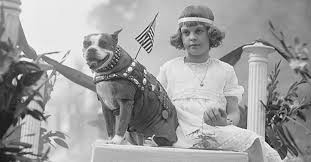
America’s first war dog, “Stubby”, got there by accident, and served 18 months ‘over there’, participating in seventeen battles on the Western Front.
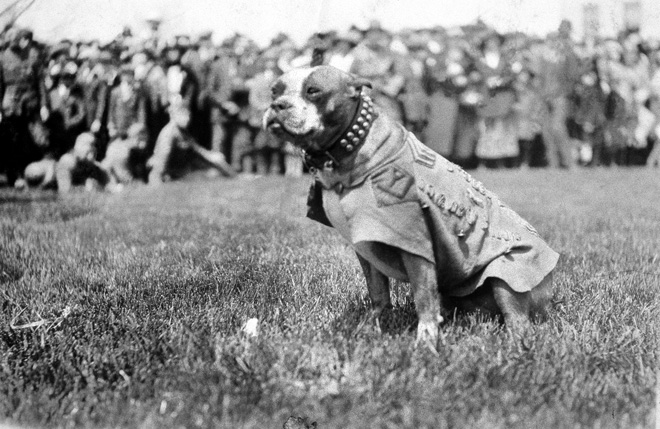
By the last year of WW1, the French, British and Belgians had at least 20,000 dogs on the battlefield, the Germans 30,000. General Headquarters of the American Expeditionary Forces recommended the use of dogs as sentries, messengers and draft animals in the spring of 1918. However, with the exception of a few sled dogs in Alaska, the US was the only country to take part in World War I with virtually no service dogs in its military.

sgt_stubby_7America’s first war dog, “Stubby”, got there by accident, and served 18 months ‘over there’, participating in seventeen battles on the Western Front.

Stubby looked like a terrier of some kind, similar to a pit bull.  Nobody knows anything more about him.  He showed up a stray one day, at Yale Field in New Haven Connecticut, where a group of soldiers were training. The dog hung around as the men drilled.  One soldier, Corporal Robert Conroy, began to take care of him. when Conroy’s outfit shipped out in 1917, Stubby was hidden on board.

Stubby saved his regiment from surprise mustard gas attacks, located and comforted the wounded, and even once caught a German spy by the seat of his pants. The Hun, who’d been sneaking around behind allied lines at the time, was mapping trenches for artillery bombardment.  The Bosch was found spinning in circles with a large, muscular terrier affixed to his behind.   He was easily disarmed, but it took a considerable amount of coaxing before Stubby could be persuaded to let go of that German’s rear end.

sgt_stubby_5Stubby saw his first action at Chemin des Dames. Since the boom of artillery fire didn’t faze him, he learned to follow the example of ducking when the big ones came close. It became a great game to see who could hit the dugout, first.  After a few days, the guys were watching him for a signal. Stubby was always the first to hear incoming fire.  We can only guess how many lives were spared by his early warning.
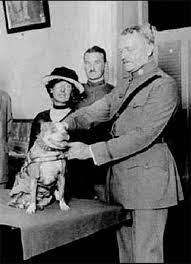
images (47)After the Armistice, Stubby returned home a nationally acclaimed hero, eventually received by both Presidents Harding and Coolidge. Even General John “Black Jack” Pershing, who commanded the AEF during the war, presented Stubby with a gold medal made by the Humane Society, declaring him to be a “hero of the highest caliber.”

Stubby toured the country by invitation and probably led more parades than any dog in American history:  he was promoted to honorary Sergeant by the Legion, becoming the highest ranking dog to ever serve in the Army.

Old age finally caught up with the small warrior on April 4th, 1926, as he took ill and died in his master’s arms.

Sergeant Stubby and a few of his contemporaries were instrumental in inspiring the creation of the US K-9 Corps, just in time for World War ll.


If you enjoyed this “Today in History”, please feel free to re-blog, “like” & share on social media, so that others may find and enjoy it as well. Please click the “follow” button on the right, to receive email updates on new articles.  Thank you for your interest, in the history we all share.

March 9, 1910 Brown Dog

In the five years I’ve been writing “Today in History”, I’ve written about 450 of these stories.  A father isn’t supposed to have favorites among his “children”, but I have to confess.  I do.  This is not one of those.  This one, I detest.

In the five years I’ve been writing “Today in History”, I’ve written about 450 of these stories.  A father isn’t supposed to have favorites among his “children”, but I have to confess.  I do.  This is not one of those.  This one, I detest.

The Oxford on-line Dictionary defines vivisection as: “noun – the practice of performing operations on live animals for the purpose of experimentation or scientific research”.

During the reign of Queen Victoria, British monarch from June 20, 1837 to January 22, 1901, a powerful opposition arose in Great Britain to the dissection of live animals. Labeled as “vivisection” by opponents of the practice, experiments were often performed in front of audiences of medical students, with or without anesthesia.

Ernest_Starling
Ernest Starling

The Cruelty to Animals Act of 1876 stipulated that subject animals must be anesthetized, unless anesthesia would interfere with the point of the experiment. The measure further required that each animal could only be used once, though multiple procedures were permitted so long as each was part of the same experiment.

In the end, the subject animal had to be killed when the study was over.

In 1902, about the time when Russian physiologist Ivan Petrovich Pavlov was doing his conditioning experiments om dogs, Ernest Starling performed his first “experiment” on a small brown terrier.  Whether a stray or someone’s pet, is unclear.  A further “demonstration” was performed on the same animal by William Bayliss on February 2, 1903, at the end of which the dog was killed with a knife to the heart.

William_Bayliss_1918b
William Bayliss

I don’t care to linger on the details of what was done to this dog.  It was difficult enough, to read about it.  Suffice it to say that Bayliss and Starling’s classes were infiltrated by two Swedish anti-vivisection activists, Lizzy Lind and Leisa Katherine Schartau.

The two women had attended 50 such classes at University College, keeping a diary throughout and later publishing observations in “The Shambles of Science: Extracts from the Diary of Two Students of Physiology”. In it, the pair disputed that the brown dog had been anesthetized, reporting that “The dog struggled forcibly during the whole experiment and seemed to suffer extremely during the stimulation. No anesthetic had been administered in my presence, and the lecturer said nothing about any attempts to anesthetize the animal having previously been made”.

Stephen_Coleridge,_Vanity_Fair,_July_1910_(cropped)
Stephen Coleridge,, Vanity Fair,, July 1910

Stephen Coleridge, secretary of the National Anti-Vivisection Society heard the two women’s story, and spoke angrily on behalf of the terrier.  “If this is not torture”, the barrister asked, “let Mr. Bayliss and his friends … tell us in Heaven’s name what torture is“.

There was little doubt that either professor if not both, would sue for libel.  Bayliss did and the jury retired for 25 minutes, returning with a unanimous verdict.  Bayliss was awarded £2,000 with £3,000 in court costs, equivalent to about £250,000 today, the verdict read to the applause of physicians in the public gallery.

On September 15, 1906, the World League against Vivisection unveiled a statue in Battersea’s Latchmere Recreation Ground, bearing the inscription “In Memory of the Brown Terrier Dog Done to Death in the Laboratories of University College in February 1903 after having endured Vivisection extending over more than Two Months and having been handed over from one Vivisector to Another Till Death came to his Release. Also in Memory of the 232 dogs Vivisected at the same place during the year 1902. Men and Women of England how long shall these Things be?”

Irish playwright George Bernard Shaw and Anglo-Irish suffragist Charlotte Despard spoke at the event, but medical students were outraged.

Brown_Dog_statue,_Battersea,_London(2)London’s teaching hospitals at first explored quiet means of taking down what they regarded as an insult to the profession.  By November, medical students were crossing the Thames with sledge hammers and crow bars, intending to take matters into their own hands.

Riots ensued, the worst nights occurring in London on December 10, 1907, when 1,000 medical students tried to pull the statue down, battling over the memorial with suffragettes, trade unionists and over 400 police officers.

More riots and brawls broke out in the weeks that followed.  Before long, the authorities were looking for a quiet way to make the statue go away.  Four workmen and 120 police officers quietly removed the Brown Dog Memorial over the night of March 9-10, 1910, hiding it in a bicycle shed. 3,000 anti-vivisectionists gathered in Trafalgar Square to demand its return, but to no avail.  The statue never reappeared, later to be broken up and melted down.

dsc04730Seventy-five years would come and go, before a new Brown Dog memorial was commissioned by the National Anti-Vivisection Society and the British Union for the Abolition of Vivisection.

For all the fuss, it hardly made a difference. There were something like 300 experiments on live animals, in the year 1875.  By the time of the brown terrier’s live dissection, the number was 19,084.  In 2005 the figure had increased to 2.81 million, and that’s just the vertebrates. 7,306 of those, were dogs.

Image – top ofpage.  Original brown dog statue, from 1906

December 4, 1966  War Dogs of Vietnam

A Military Working Dog (MWD) is anything but a “disposable” asset.  It is a highly trained, specialized soldier who complements and adds to the abilities of his human partner, as that two legged soldier complements those of the dog.

There are times when two highly trained individuals are able to function at a level higher than the sum of their parts.  Professional athletes like NFL linemen and NHL forwards are two examples.  Another is often the partnership formed between law enforcement officers.

On the battlefield, few assets are more powerful than a well equipped and highly trained soldier. Unless we’re pairing that soldier with a Military Working Dog.

A Military Working Dog (MWD) is anything but a “disposable” asset.  It is a highly trained, specialized soldier who complements and adds to the abilities of his human partner, as that two legged soldier complements those of the dog.

nemo-official-photo

“Nemo”, born in October 1962, entered the United States Air Force as a sentry dog in 1964, at the age of 1½ years.  After an 8-week training course at Lackland AFB Sentry Dog Training School in San Antonio, Texas, the 85-pound German Shepard was assigned to Airman Leonard Bryant Jr., and sent to Fairchild Air Base in Washington for duty with Strategic Air Command.

The pair was transferred to the Republic of South Vietnam with a group of other dog teams, and assigned to the 377th Security Police Squadron, stationed at Tan Son Nhut Air Base.  Six months later, Bryant rotated back to the States, and Nemo was paired with 22-year-old Airman 2nd Class Robert Thorneburg.

Early on the morning of December 4, 60 Vietcong guerrillas emerged from the jungle, setting off a near-simultaneous alarm from several sentry dogs on perimeter patrol.

Nemo3-vi

Three dogs, Rebel, Cubby and Toby, were killed with their handlers in a hail of bullets.  Several other handlers were wounded, including one who was able to maintain contact with the enemy, notifying Central Security Control of their location and direction of travel.

Thanks to the early warning, a machine gun team was ready and waiting when 13 infiltrators approached the main aircraft parking ramp.  None of them lived to tell the story.  Security forces quickly deployed around the perimeter, driving some infiltrators off and others into hiding.  Daylight patrols reported that all VC infiltrators were gone, either killed or captured, but they had made a big mistake.  They should have brought the dogs with them.

nemo-house

That night, Thorneburg and Nemo were out on patrol near an old Vietnamese graveyard, about ¼ mile from the air base’ runways.  Nemo alerted on something.  Before Thorneburg could radio for backup, that something started shooting.  Thorneburg released the dog and charged in shooting, killing one Vietcong before being shot in the shoulder.  Nemo was badly wounded, shot in the face, the bullet entering below his eye and exiting his mouth.  Ignoring the injury, Nemo attacked the four enemy soldiers hiding in the brush, giving his partner time to call for reinforcements.

Reichenbach, Major, 2Four additional Vietcong were discovered hiding underground, as quick reaction teams scoured the area.  They found Nemo and Thornburg, both seriously wounded, together on the ground.  Both would survive, though Thorneburg was shot a second time, while returning to base.

I’m sure that individual dog handlers were as good to their dogs as they knew how to be, during the Vietnam era.  That’s a guess, but having an MWD handler in the family, I think it’s a good one.  The Department of Defense bureaucracy was another matter.

Roughly 4,000 dogs served in Vietnam, leading patrols through the dense jungle terrain.  Overall, these animals are credited with saving close to 10,000 lives.

When Marine Corps handler Steve Reichenbach arrived in country in 1966, he was paired with a cream colored Great Dane-German Shepherd mix.  “Major”, whose previous handler had been killed only weeks before, was an excellent match for Reichenbach, both being “mellow, relaxed, even-keeled types” who bonded, almost immediately.

Reichenbach, Major
Marine dog handler Steve Reichenbach with his dog, Major, on a patrol north of Danang in late 1966. PHOTOGRAPH COURTESY OF STEPHEN K. REICHENBACH, with a tip of the hat to National Geographic

At 90 pounds, Major’s size alone seemed to intimidate the enemy, often leading VC to trip off ambushes, too early.

A land mine exploded on the Marine’s last day in country, killing four and wounding six.  Though badly wounded, Reichenbach would survive the war.  Major was unhurt, but he wasn’t so lucky.  The last the pair saw of one another, was in the medevac chopper.  Major still had Reichenbach’s blood on his fur, when he was paired with his next handler.  The marine never saw his “battle buddy” after that, but later heard the dog had succumbed to some tropical disease.

Nemo on the PlaneThe vast majority of MWDs who served in Vietnam, were left behind as “surplus equipment”.  Left to succumb to tropical disease, to be euthanized by the South Vietnamese Army, or worse.  Nemo was one of the few lucky ones.  He came home.

MWD Nemo was officially recognized for having saved the life of his handler, and preventing further destruction of life and property.   He was given the best of veterinary care and, on June 23, 1967, USAF Headquarters directed that he be returned to the United States.  The first sentry dog officially retired from active service.

The C124 Globemaster touched down at Kelly Air Force Base, Texas, on July 22, 1967.  Nemo lived out the seven years remaining to him in a permanent retirement kennel at the DoD Dog Center at Lackland Air Force Base.


If you enjoyed this “Today in History”, please feel free to re-blog, “like” & share on social media, so that others may find and enjoy the same. Please click the “follow” button on the right, to receive email updates on new articles.  Thank you for your interest, in the history we all share.

October 3, 1944 The Littlest War Dog

The decks around them were shaking from anti-aircraft and machine gun fire, when Smoky guided Wynne to duck at the moment an incoming shell struck, killing 8 men standing next to them. She was his “angel from a foxhole.”

The first dog may have approached some campfire, long before recorded history.  It may have been hurt or it maybe it was looking for a morsel.  Dogs have been by our side ever since.

Over history, the unique attributes of Canis Familiaris have often served in times of war.  Ancient Egyptian artwork depicts dogs at work in multiple capacities.  The ancient Greeks used dogs against Persian invaders at the Battle of Marathon.

sgt_stubby_6
Sergeant Stubby

The European allies and Imperial Germany had about 20,000 dogs working a variety of jobs in WWI. Though the United States didn’t have an official “War Dog” program in those days, a Staffordshire Terrier mix called “Sgt. Stubby” was smuggled “over there” with an AEF unit training out of New Haven, Connecticut. Stubby is credited with saving an unknown number of lives, his keen sense of hearing giving his companions early warning of incoming artillery rounds. Once, he even caught a German spy who had been creeping around, mapping allied trenches. It must have been a bad day at the office for that particular Bosch, when he was discovered with a 50lb terrier hanging from his behind.

The US War Dogs program was developed between the World Wars, and dogs have served in every conflict since. My son in law Nate served in Afghanistan with a five-year old German Shepherd named Zino, a Tactical Explosives Detection Dog (TEDD), trained to detect as many as 64 explosive compounds.

The littlest War Dog first appeared in the jungles of New Guinea, when an American soldier spotted a “golden head” poking out of an abandoned foxhole.  It was a 4lb, 7″ tall Yorkshire Terrier.  At the time, nobody had any idea how she had gotten there. The soldier brought her back to camp and sold her for $6.44 to Corporal William Wynne, who named her “Smoky”.  For the next two years, Smoky lived a soldier’s life.

They first thought she might have belonged to the Japanese, but they brought her to a POW camp and quickly learned that she understood neither Japanese nor English commands.

The little dog flew 12 air/sea rescue and photo reconnaissance missions, secured in Wynne’s backpack. She survived 150 air raids and a typhoon, often giving him early warning of incoming fire. Wynne credited Smoky with saving his life one time, on an LST transport ship. The decks around them were shaking from anti-aircraft and machine gun fire, when Smoky guided Wynne to duck at the moment an incoming shell struck, killing 8 men standing next to them. She was his “angel from a foxhole.”

Smoky-CulvertOnce, the small dog was able to perform a task in minutes that otherwise would have taken an airstrip out of service for three days, and exposed an entire construction battalion to enemy fire. The air field at Lingayen Gulf, Luzon, was crucial to the Allied war effort, and the signal corps needed to run a telegraph wire across the field. A 70′ long, 8” pipe crossed underneath the air strip, half filled with dirt.

Wynne recalled the story: “I tied a string to Smoky’s collar and ran to the other end of the culvert . . . (Smoky) made a few steps in and then ran back. `Come, Smoky,’ I said sharply, and she started through again. When she was about 10 feet in, the string caught up and she looked over her shoulder as much as to say `what’s holding us up there?’ The string loosened from the snag and she came on again. By now the dust was rising from the shuffle of her paws as she crawled through the dirt and mold and I could no longer see her. I called and pleaded, not knowing for certain whether she was coming or not. At last, about 20 feet away, I saw two little amber eyes and heard a faint whimpering sound . . . at 15 feet away, she broke into a run. We were so happy at Smoky’s success that we patted and praised her for a full five minutes”.

Smoky-Therapy DogSmoky toured all over the world after the war, appearing in over 42 television programs and entertaining thousands at veteran’s hospitals. In June 1945, Smoky toured the 120th General Hospital in Manila, visiting with wounded GIs from the Battle of Luzon.  She’s considered to be the first therapy dog, and credited with expanding interest in what had hitherto been an obscure breed.

Smoky died in her sleep in February 1957, at about 14, and was buried in a .30 caliber ammunition box. A bronze life-size sculpture of Smoky sitting in a GI helmet was installed over her final resting place almost fifty years later, where it sits atop a two-ton blue granite base.

Smoky-MemorialBill Wynne was 90 years old in 2012, when he was “flabbergasted” to be approached by Australian authorities. They explained that an Australian army nurse had purchased the dog from a Queen Street pet store, becoming separated in the jungles of New Guinea. 68 years later, the Australians had come to award his dog a medal.
 

As a personal aside, Nate and Zino were separated after their tour in Afghanistan.  They were reunited in 2014, when the dog came to live with Nate and our daughter Carolyn in their home in Savannah.  Last fall, Sheryl and I went with a friend to Houston, to celebrate our anniversary at the “Redneck Country Club”.  2,000 miles from home and completely by chance, who do we meet but the trainer who taught Zino to be a TEDD in the first place.  Small world.

October 2, 1918 1st Division Rags

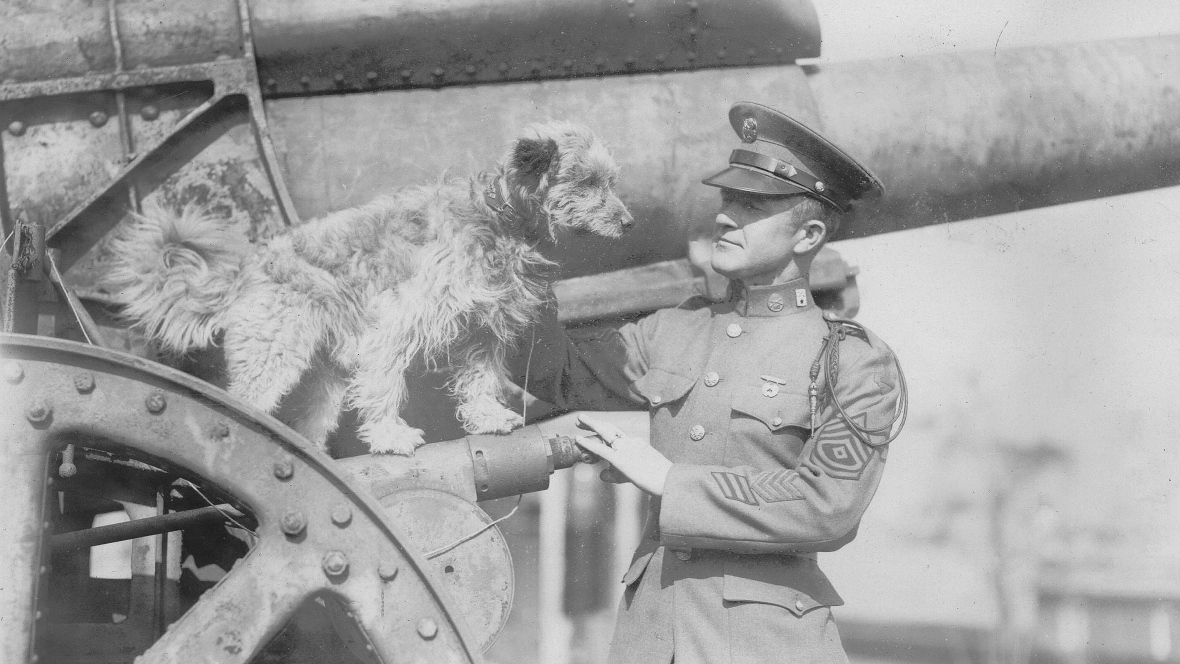
Rags survived our nation’s deadliest battle with the loss of an eye, but Donovan wasn’t so lucky. He was severely gassed and the two were brought to the rear. If anyone asked about expending medical care on a dog, they were told that it was “orders from headquarters”.

Private James Donovan was AWOL.  He had overstayed his leave in the French town of Montremere, and the ‘Great War’, awaited.

When the two MPs found him, Donovan knew he had to think fast. He reached down and grabbed a stray dog, explaining to the two policemen that he was part of a search party, sent out to find the Division Mascot.

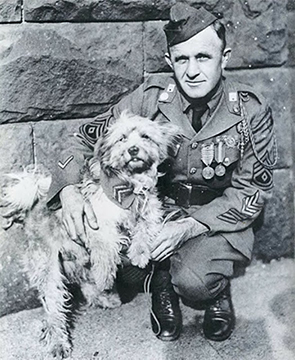
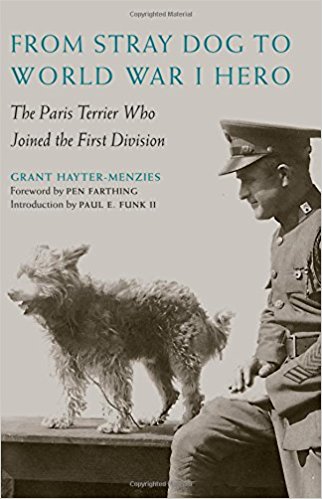
RagsIt was a small dog, possibly a Cairn Terrier mix. He looked like a pile of rags, and that’s what they called him.  The dog had gotten Donovan out of a jam, now he would become the division mascot for real. Rags was now part of the US 1st Infantry Division, the Big Red One.
Instead of “shaking hands”, Donovan taught him a sort of doggie “salute”.  Rags would appear at the flag pole for Retreat for years after the war, lifting his paw and holding it by his head.  Every time the flag was lowered and the bugle played, there was that small terrier, saluting with the assembled troops.

Donovan’s job was hazardous. He was on the front lines, stringing communications wire between advancing infantry and supporting field artillery. Runners were used to carry messages until the wire was laid, but they were frequently wounded, killed or they couldn’t get through the shell holes and barbed wire.

The dog learned to imitate the men around him, who would drop to the ground and hug it tightly during artillery barrages. He would hug the ground with his paws spread out, soon the doughboys noticed him doing it before any of them knew they were under fire. Rags’ acute and sensitive hearing became an early warning system, telling them that shells were incoming well before anyone heard them.

Rags-3
A great book, if you want to learn more.

Donovan trained Rags to carry messages attached to his collar.  On October 2, 1918, Rags carried a message from the 26th Infantry Regiment to the 7th Field Artillery.  The small dog’s successful mission resulted in an artillery barrage, leading to the capture of the Very-Epinonville Road.

An important objective had been taken, with minimal loss of life to the American side.

Rags was small and fast, and often ran messages across open battlefield. The terrier’s greatest trial came a week later, during the Meuse-Argonne Campaign. The small dog ran through falling bombs and poison gas to deliver his message. Mildly gassed and partially blinded, shell splinters damaged his right paw, eye and ear. Rags survived and, as far as I know, got his message where it needed to be.

Rags survived our nation’s deadliest battle with the loss of an eye, but Donovan wasn’t so lucky. He was severely gassed and the two were brought to the rear. If anyone asked about expending medical care on a dog, they were told that it was “orders from headquarters”.

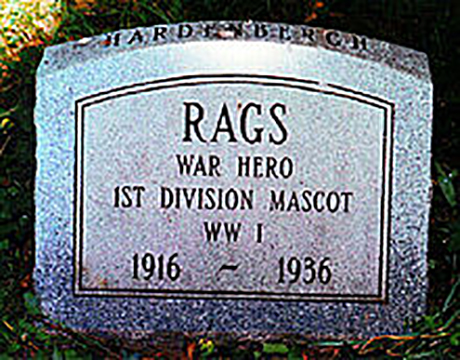
Rags recovered quickly, but Donovan did not.  Donovan was transferred to the United States, and brought to the Fort Sheridan base hospital near Chicago, where medical staff specialized in gas cases.  It was here that the dog was given a collar and tag, identifying him as 1st Division Rags.  Donovan died of his injuries, in early 1919.  Rags moved into the base fire house becoming “post dog”, until being adopted by Major Raymond W. Hardenbergh, his wife and two daughters, in 1920.Rags Grave

The 1st Division marched down Broadway in 1928, part of the division’s 10th anniversary WW1 reunion, a small terrier-mix in the vanguard.

Rags lived out the last of his years in Maryland.  A long life it was, too, the dog lived until 1934, remaining the 1st Infantry Division for all his 20 years.

On March 22, 1934, the 16-paragraph obituary in the New York Times began: “Rags, Dog Veteran of War, Is Dead at 20; Terrier That Lost Eye in Service is Honored.”

September 19, 1862 Douglas, the Confederate Camel

In the 1850s, then-Secretary of War Jefferson Davis persuaded President Franklin Pierce that the military super weapons of the future, were camels. Able to carry greater loads over longer distances than any pack animal, Davis saw camels as the high tech weapon of the age.

If you happen to visit www.visitvicksburg.com, you will learn that the Cedar Hill Cemetery, established by the United Daughters of the Confederacy, contains the graves of some 5,000 Confederate Soldiers who died in the 1863 Siege of Vicksburg, Mississippi.  Each one stands in memory of a soldier killed in the line of duty.  Even the one with the camel on it.

Camel_from_Harpers_WeeklyThe story begins with Jefferson Davis, in the 1840s. Now we remember him as the President of the Confederate States of America.  Then, he was a United States Senator from Mississippi, with a pet project of introducing camels into the United States.
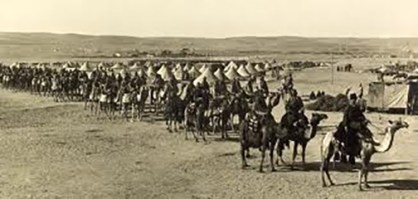
Re-introducing them might be more like it.  Today, the distribution of these animals is almost the inverse of their area of origin.  According to the fossil record, the earliest camelids first appeared on the North American continent, these even-toed ungulates ancestor to the Alpaca, Llama, Guanaco and Vicuña of today.

Jefferson Davis’ experiment was to be the first large-scale re-introduction of these animals on the North American continent, in geologic history.

Davis envisioned the day when every southern planter would have a stable full of camels.  In the kind of pork barrel tit-for-tat spending deal beloved of Congressmen to this day, the Senator slid $30,000 into a highway appropriations bill, to get the support of a colleague from Illinois.

Camel CorpsThe measure failed, but in the 1850s, then-Secretary of War Davis persuaded President Franklin Pierce that camels were the military super weapons of the future. Able to carry greater loads over longer distances than any other pack animal, Davis saw camels as the high tech weapon of the age. Hundreds of horses and mules were dying in the hot, dry conditions of Southwestern Cavalry outposts, when the government purchased 75 camels from Algeria, Tunisia and Egypt. Several camel handlers came along in the bargain, one of them a Syrian named Haji Ali, who successfully implemented a camel breeding program.  Haji Ali became quite the celebrity within the West Texas outpost.  The soldiers called him “Hi Jolly”.
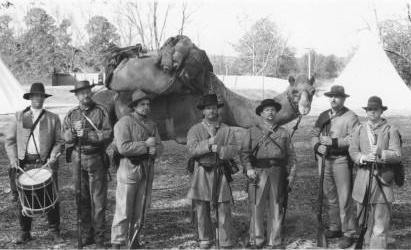
When the Civil War broke out, Camp Verde, Texas had about 60 camels. The King of Siam, (now Thailand), saw the military advantage to the Confederacy, and wrote to President Abraham Lincoln. “Here”, he wrote, “we use elephants”.  The King went on to propose bringing elephants into the Northwest, to help the Union war effort. This “animal arms race” appears to have gotten no further than the King’s letter to the President, but the imagination runs wild at the idea of War Elephants at Gettysburg….

Hi Jolly Cemetery

The horse lobby did a lot to kill the camel project, and the animal’s unpleasant personality traits didn’t help. A camel will not passively accept a riding crop or a whip. They are vengeful, and can spit stinking wads of phlegm with great accuracy over considerable distances. If they’re close enough, they will rake the skin off your face with their front teeth.  Camels have been known to trample people to death.

Douglas, the Confederate Camel, 1
Douglas, the Confederate Camel

Cut loose, one of those Texas camels somehow made its way to Mississippi, where he was taken into service with the 43rd Infantry Regiment, who named him “Douglas”.

Douglas wouldn’t permit himself to be tethered, but he always stuck around so he was allowed to graze on his own. Southern soldiers became accustomed to the sight of “Old Douglas”.  The 43rd Mississippi became known as the “Camel Regiment,” but the horses never did get used to their new companion.   On this day in 1862, Major General Sterling Price was preparing to face two Union armies at Iuka, when the sight of Old Douglas spooked the regimental horses. One horse’s panic turned into a stampede, injuring several of them and possibly killing one or two.

The 43rd Infantry was ordered to Vicksburg during General Ulysses S. Grant’s siege of the city, when Douglas was shot and killed by a Union sharpshooter. Enraged by the murder of their prized camel, the 5th Missouri’s commander Lieutenant Colonel Robert S. Bevier enlisted six of his best snipers, who stalked the killer until one of them had his revenge. Bevier later said of Douglas’ killer, “I refused to hear his name, and was rejoiced to learn that he had been severely wounded.”

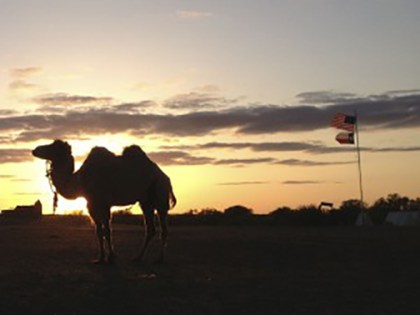
Camel-sunset-flags-300x225

So it is that there is a camel at the Cedar Hill Cemetery in Vicksburg, Mississippi.  He is not forgotten. Douglas and other camels of the era are remembered by the Texas Camel Corps, a cross between a zoo and a living history exhibit.

The organizations website begins with: “Texas Camel Corps was established to educate the public about the historic use of camels in America in the 19th century”.  I might have to check those boys out.


Tip of the hat to www.texascamelcorps.com for the sunset image, above.

August 31, 1959 Sergeant Reckless

Life Magazine published a collector’s edition in 1997, listing 100 heroes from American history.  Alongside the names of George Washington and Thomas Jefferson, Sally Ride and Abraham Lincoln, was that of a small Mongolian horse.  Sergeant Reckless.

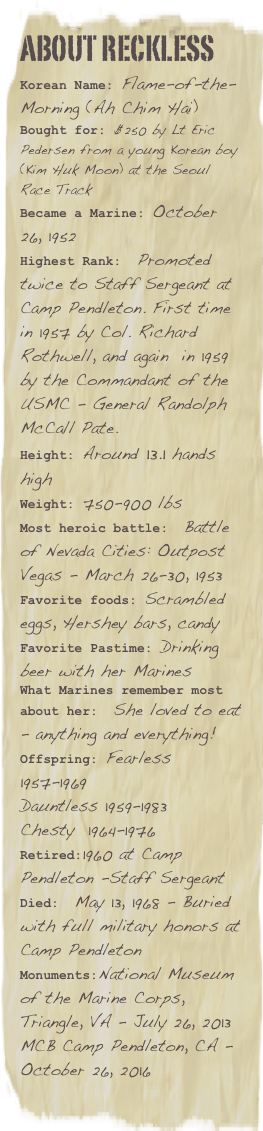
About RecklessA Recoilless Rifle is a type of lightweight tube artillery.  Think of a portable cannon.  Kind of a bazooka, really, only the Recoilless fires modified shells rather than rockets.   The back blast of these shells compensates for the mule’s kick to be expected from such a weapon, making the rifle “recoilless”.
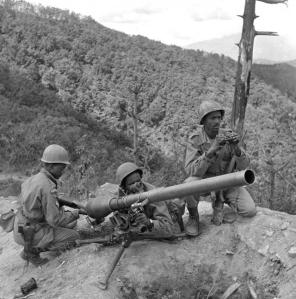
While that reduces projectile range, reduced gas pressures permit a thinner-walled barrel, resulting in a weapon light enough to be served by a 2 to 3-man crew, and shoulder fired by a single infantryman.

The “RCLR” weapon system has provided the punch of artillery to mobile troop formations since the early days of WWII, including Airborne, Special Forces and Mountain units.

The problem arises when combat operations consume ammunition faster than the supply chain can replace it.  Mountainous terrain makes the situation worse.  Even today in the more mountainous regions of Afghanistan, there are times when the best solution for the problem, is horsepower.

Ah Chim-hai was a chestnut mare of mixed Mongolian and Thoroughbred lineage, a race horse at the track in Seoul, South Korea.  Her name translated as “Flame of the Morning”.

Lieutenant Eric Pedersen of the recoilless rifle platoon, anti-tank company, needed a pack animal to carry the weapon’s 24-lb shells up Korean mountain passes.  In October 1952, Pederson received permission to buy a horse for his platoon.  Pederson and stable boy Kim Huk-moon agreed on a price of $250.  Kim cried on watching his “Flame” leave the stable, but the boy’s sister had stepped on a land mine, and needed a prosthetic leg.

The Marines called her “Reckless” – a nod to the weapon system she was meant to serve, and to the fighting spirit of the 5th Marines.

Recoilless Rifle, Korea
Recoilless Rifle team on a Korean Ridge

Pederson wrote to his wife in California to send a pack saddle, while Gunnery Sergeant Joseph Latham and Private First Class Monroe Coleman provided for her care and training.

Navy Hospitalman First Class George “Doc” Mitchell provided most of Reckless’ medical care, Latham taught her battlefield skills:  how to step over communication wires, when to lie down under fire, how to avoid becoming entangled in barbed wire.  She learned to run for cover, at the cry “Incoming!”

The platoon built her a bunker and fenced off a pasture, but soon Reckless was allowedSergeant Reckless ejoys a beer to roam freely throughout the camp.  She’d enter tents at will, sometimes spending the night if it was cold.

She’d eat anything:   bacon, mashed potatoes, scrambled eggs, shredded wheat.  Just about anything else that a Marine wasn’t watching closely enough, as well.  Reckless even ate her horse blanket once, and she loved a beer.  Mitchell had to warn his fellow Marines against giving her more than two Cokes a day, which she’d drink out of a helmet.  Once, she ate $30 worth of winning poker chips.  Reckless was a Marine.

Sergeant Reckless, 2She “went straight up” the first time she heard an RCLR go off, despite being loaded down with six shells.  All four feet left the ground and she came down trembling with fear, but Coleman was able to soothe her.  The second time she snorted.  By the fourth she didn’t bother to look up. She was happily munching on a discarded helmet liner.

Recoilless rifle tactics call for fire teams to fire four or five rounds, and then relocate before the enemy can return fire.  Reckless usually learned the route after one or two trips, often traveling alone to deliver supplies on the way up, and evacuate wounded on the way down.

Sergeant RecklessIn February 1953, Captain Dick Kurth and his Fox Company were fighting for a hill called “Detroit”.  Reckless made 24 trips by herself, carrying a total 3,500lbs of ammunition over 20 miles.  She made 51 solo trips that March, during the battle for Outpost Vegas.  Reckless carried 9,000lbs of ammunition in a single day, over 35 miles of open rice paddies and steep hills.  At times, artillery exploded around her at the rate of 500 rounds per minute.  She was wounded twice during the battle.  That night, she was too exhausted to do anything but hang her head while they rubbed her down.

Sergeant Reckless, arrivingReckless was the first horse in Marine Corps history to participate in an amphibious landing.  She was wounded twice, and later awarded two Purple Hearts and a Marine Corps Good Conduct Medal.  Her name appears on Presidential Unit citations from the United States and the Republic of Korea.
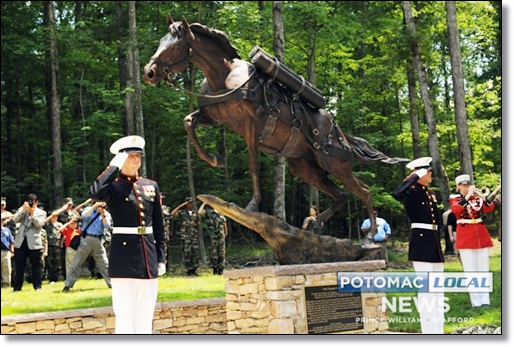
On August 31, 1959, Reckless was promoted to Staff Sergeant in a ceremony at Camp Pendleton.  1,900 of her 5th Marine comrades attended, as did two of her sons, “Fearless” and “Dauntless”.  A third, “Chesty”, was unavailable to attend.

General Randolph McCall Pate, a veteran of Guadalcanal, Iwo Jima and Korea, served as the 21st Commandant of the Marine Corps, from 1956-1959.  General Pate once wrote “In my career I have seen many animals that have been adopted by Marines, but never in all my experience have I seen one which won the hearts of so many as did. . .Reckless.”

Life Magazine published a collector’s edition in 1997, listing 100 heroes from American history.  Alongside the names of George Washington and Thomas Jefferson, Sally Ride and Abraham Lincoln, was that of a small Mongolian horse.  Sergeant Reckless.

Sergeant Reckless statue

August 22, 565 Loch Ness Monster

An entire study called “Cryptozoology” (literally, the study of hidden animals) has sprung up around Nessie and other beasts whose existence is never quite proven, and never completely debunked. There is Big Foot, who seems to have made it to stardom with his own series of beef jerky commercials. You have the Chupacabra, the Yeti, Ogopogo and Vermont’s own Lake Champlain monster, “Champ”.

As the story goes, an Irish priest named Columba was traveling the Scottish Highlands, teaching Christianity to the Picts. He was walking along the shores of Loch Ness one day, when he came upon some local villagers burying one of their number. The poor unfortunate had swum out to retrieve a boat that was loose from its moorings, when he was bitten by a water creature of some sort. The priest sent one of his followers swimming across the loch to get the boat. The monster rose from the depths once again and was just about to eat the man, when Columba commanded it away.

There’s no telling how it actually happened, because the story was written down 100 years later. The events described took place on August 22nd, 565, meaning that people have been talking about the Loch Ness monster for close to 1,500 years, at a minimum.

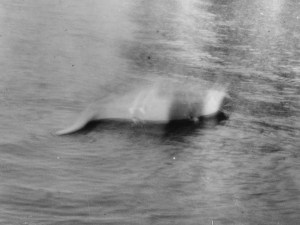
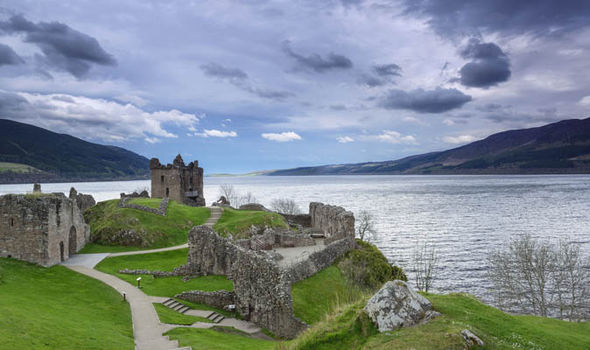
Heron-Allen ImageLoch Ness is formed by a 60 mile, active tectonic fault, where the hills are still rising at a rate of 1mm per year. It’s made up of 3 lochs; Loch Lochy, Loch Oich and Loch Ness, with Loch Ness being by far the largest. There is more water in Loch Ness than all the other lakes in England, Scotland and Wales, combined. It is 22½ miles long and varies from a mile to 1½ miles wide, with a depth of 754′ and a bottom “as flat as a bowling green”.
Loch Ness never freezes. There is a thermocline at 100′, below which the water remains a uniform 44° Fahrenheit. As the surface water cools in winter, it’s replaced by warmer water rising up from below, causing the loch to steam on cold days. The heat energy generated has been compared to burning 2 million tons of coal. With the steam rising off the water and the occasional seismic tremor, it must be a very eerie place at times.

The first photographic “evidence” of the Loch Ness monster was taken on the 12th of November 1933, by Hugh Gray. Some said the picture showed an otter, while others believed it was “some kind of giant marine worm”. The UK Daily Mail sent a team to look for evidence, headed by the famous big game hunter Marmaduke Wetherell. There was great media excitement when Wetherell discovered enormous footprints along the shore in December. Researchers from the Natural History Museum examined the tracks, which they determined to have come from a dried hippo’s foot; probably one of the umbrella stands popular at the time. That was the end of that.

Nessie, Robert Wilson
Surgeon’s Photo

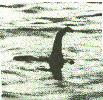
A British surgeon, Colonel Robert Wilson, took what might be the most famous picture of “Nessie” the following year. He didn’t want his name associated with it, so it became “The Surgeon’s Photo”, showing what appears to be a head and neck rising above the waters of the loch.

In one of history’s more interesting death bed confessions, Christian Spurling claimed in 1994 at the age of 93, that the surgeon’s photo had been a hoax.  According to Spurling, his step-father Marmaduke Wetherell, was smarting over his hippo-foot humiliation.  Spurling remembers Wetherell saying “We’ll give them their monster”, and asking his stepson to build a credible model of a marine creature.  And so he did, the photo was taken, and Dr. Wilson became the respectable front man for the hoax.

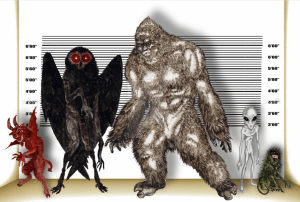
CryptoAn entire study called “Cryptozoology” (literally, the study of hidden animals) has sprung up around Nessie and other beasts whose existence is never quite proven, and never completely debunked. There is Big Foot, who seems to have made it to stardom with his own series of beef jerky commercials. You have the Chupacabra, the Yeti, Ogopogo, Vermont’s own Lake Champlain monster, “Champ”, and more.

Hundreds of images have been taken over the years, purporting to demonstrate that these critters really exist. Some have been transparent hoaxes, for others there is less certainty. In the end, people will believe what they want to believe. The existence of these mythical creatures may never be proven, short of one of them washing up on shore somewhere. Even then, there will be those who argue otherwise.