December 19, 1843 A Christmas Carol

The 29-year-old Charles Dickens was already a well-known and popular author when he stepped onto the shores of Boston Harbor on January 22, 1842

It’s hard not to love the traditions of the Christmas season.  Getting together with loved ones, good food, the exchange of gifts, and our favorite Christmas specials on TV.  I always liked a Charlie Brown’s Christmas, and of course there’s the Charles Dickens classic, “A Christmas Carol”, set against the vast brick factory buildings of Lowell, Massachusetts, along the Merrimack River.

Wait … What?

The 29-year-old Charles Dickens was already a well-known and popular author when he stepped onto the shores of Boston Harbor on January 22, 1842.

“The Pickwick Papers,” “Oliver Twist,” “Nicholas Nickleby”; all were behind the young author when he came to America, perhaps to write a travelogue, or maybe looking for material for a new novel.

Dickens traveled to Watertown, to the Perkins School for the Blind, where Helen Keller and her teacher Anne Sullivan underwent their mutual education, a half-century later.  He also visited a school for neglected boys in Boylston.  He must have thought the charitable institutions in his native England suffered by comparison, he later wrote that “I sincerely believe that the public institutions and charities of this capital of Massachusetts are as nearly perfect as the most considerate wisdom, benevolence, and humanity, can make them.”

In February, Dickens took a train north to the factory town of Lowell, visiting the textile mills and speaking with the “mill girls”, the women who worked in those mills.  Once again, he seemed to believe that his native England suffered in the comparison.  Dickens spoke of the new buildings and the well dressed, healthy young women who worked in them, no doubt comparing them with the teeming slums and degraded conditions in London.

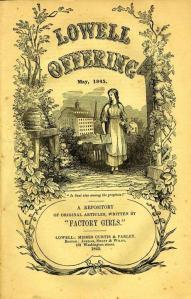
lowell-offering-coverHe left with a copy of “The Lowell Offering”, a literary magazine written by those same mill girls, which he later described as “four hundred good solid pages, which I have read from beginning to end.”


Over a century and a half later, Natalie McKnight, professor of English and dean at Boston University, read the same 400 pages that Dickens read.  She couldn’t help but notice similarities between the work of the mill girls, and “A Christmas Carol,” published about a year and a half after Dickens’ visit.  Chelsea Bray was a senior English major at the time.  Professor McKnight asked her to read those same pages.

The research that followed was published in the form of a thesis, later fleshed out to a full-length book:

“Dickens and Massachusetts

The Lasting Legacy of the Commonwealth Visits

How Massachusetts shaped Dickens’s view of America”

Edited by Diana C. Archibald and Joel J. Brattin

Published May 1, 2015.

The book describes a number of similarities between the two works, making the argument that Dickens familiar story draws much from his experience in Lowell.

Charles Dickens’ masterpiece, A Christmas Carol, was published for the first time 173 years ago on this day, December 19, 1843.

December 17, 1900 The Search for Extraterrestrial Intelligence

On December 17, 1900, the French Academy of Science offered a prize of 100,000 francs to the first person to make contact with an alien civilization, provided that it was anything but Martian. That was considered too easy

In the 5th century BC, the Greek philosopher Democritus taught that the world was made of atoms.  Physically indestructible and always in motion, these atoms are infinite in number, differing only in shape and size.  Democritus taught that everything around us is the result of physical laws without reasoning or purpose.  He asked only “what earlier circumstances caused this event?” Philosophers like Aristotle and Socrates took a less mechanistic approach, asking “What purpose did this event serve?”, while Plato disliked him so much he wanted to burn all his books.

Democritus also taught that there are an infinite number of worlds with inhabitants like us, though the prevailing view in antiquity was that the Earth was special, that we are alone.

In the time of Copernicus in the 1600s, it became widely believed that there is life on other planets.  Astronomers saw several features of the moon as evidence, if not of life, then at least that intelligence had at one time paid a visit.

Interest in Mars began to develop in the 1870s, when the Italian astronomer Giovanni Virginio Schiaparelli described physical features of the red planet as “canali”.  The word means “channels” in Italian, but it was mis-translated as “canals”.  The English speaking world was off to the races.extraterrestrial-life

Speculation and folklore about intelligent life on Mars was soon replaced by the popular concept that canals had been excavated by intelligent Martians.

The idea was near universal by the turn of the century.  On this day, December 17, 1900, the French Academy of Science offered a prize of 100,000 francs to the first person to make contact with an alien civilization, provided that it was anything but Martian.  That was considered too easy.

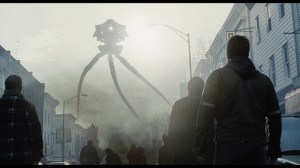
war-of-the-worlds-alien-tripod-attackingThe British author H. G. Wells wrote The War of the Worlds in 1897, telling the story of an alien invasion of earth by Martians fleeing from the desiccation of their planet.  The story was adapted to a radio drama broadcast on Halloween, 1938, so realistic that many listeners sued the network for “mental anguish” and “personal injury”.

The idea of life on Mars persisted until the 1960s, when close observations of the Martian surface were made possible by the Mariner series of spacecraft.

While much of “mainstream” science seems to steer clear of the subject, the University ofis-anybody-out-there California at Berkeley is running a “distributed computing effort” to identify extraterrestrial life, called SETI@home.   With an original objective of 50,000-100,000 home computers, SETI@home currently operates on over 5.2 million computers.  With the introduction of the Berkeley Open Infrastructure for Network Computing, or “BOINC” (I didn’t make that up), SETI@home users can even compete with one another, to see who can process the maximum number of “work units”.

http://www.dreamstime.com/stock-photography-alien-portrait-stars-image14135012The website explains their mission:  “SETI@home is a scientific experiment that uses Internet-connected computers in the Search for Extraterrestrial Intelligence (SETI). You can participate by running a free program that downloads and analyzes radio telescope data”.

You, too can participate at http://setiathome.berkeley.edu/, on your Windows, Apple or Network PC, or your Sony PlayStation 3.  Please feel free to insert the “there-is-no-intelligent-life-here” joke of your choice HERE.

December 16, 1773 Boston Tea Party

The Tea Act actually reduced the price of tea, but Colonists saw it as an effort to buy popular support for taxes already in force

In the time of Henry VIII, British military outlays as a percentage of central government expenses averaged 29.4%.   That number skyrocketed to 74.6% in the 18th century, and never dropped below 55%.

The Seven Years’ War alone, fought on a global scale from 1756 – ‘63, saw England borrow the unprecedented sum of £58 million, doubling the national debt and straining the British economy.

For the American colonies, the conflict took the form of the French and Indian War.  The British government saw its American colonies as the beneficiary of much of their expense, and wanted to be reimbursed.  For the colonists, the never-ending succession of English wars meant that they were largely left alone to run their own affairs.

Several measures were taken to collect revenues, as colonists bristled at the heavy handed taxation policies of the 1760s.. The Sugar Act, the Currency Act:  in one 12-month period, Parliament passed the Stamp Act, Quartering Act, and the Declaratory Act, and deputized Royal Navy Sea Officers to enforce customs laws in colonial ports.

The merchants and traders of Boston specifically cited “the late war” and the expenses related to it, concluding the Boston Non-Importation Agreement of August 1, 1768. The agreement prohibited the importation of a long list of goods, ending with the statement ”That we will not, from and after the 1st of January 1769, import into this province any tea, paper, glass, or painters colours, until the act imposing duties on those articles shall be repealed”.

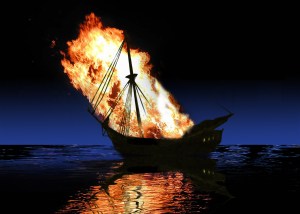
The ‘Boston Massacre’ of 1770 was a direct result of the tensions between colonists andgaspee-shippey the “Regulars” sent to enforce the will of the Crown.  Two years later, Sons of Liberty looted and burned the HMS Gaspee in Narragansett Bay, RI.
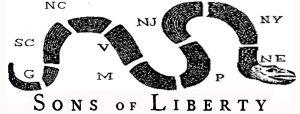
The Tea Act, passed by Parliament on May 10, 1773, was less a revenue measure than it was an effort to prop up the British East India Company, by that time burdened with debt and holding eighteen million pounds of unsold tea.  The measure actually reduced the price of tea, but Colonists saw it as an effort to buy popular support for taxes already in force, and refused the cargo.  In Philadelphia and New York, tea ships were turned away and sent back to Britain while in Charleston, the cargo was left to rot on the docks.

British law required a tea ship to offload and pay customs duty within 20 days, or the cargo was forfeit.  The Dartmouth arrived in Boston at the end of November with a cargo of tea, followed by the tea ships Eleanor and Beaver.  Sam Adams called for a meeting at Faneuil Hall on the 29th, which then moved to Old South Meeting House to accommodate the crowd.  25 men were assigned to watch Dartmouth, making sure it didn’t unload.

7,000 gathered at Old South Meeting House on December 16th, 1773, the last day of Dartmouth’s deadline.  Royal Governor Hutchinson held his ground, refusing Dartmouth permission to leave.  Adams announced that “This meeting can do nothing further to save the country.”

sons-of-libertyThat night, somewhere between 30 and 130 Sons of Liberty, some dressed as Mohawk Indians, boarded the three ships in Boston Harbor.  There they threw 342 chests of tea, 90,000 pounds in all, into Boston Harbor.  £9,000 worth of tea was destroyed, worth about $1.5 million in today’s dollars.

In the following months, other protesters staged their own “Tea Parties”, destroying imported British tea in New York, Philadelphia, Charleston, and Greenwich, NJ.  There was even a second Boston Tea Party on March 7, 1774, when 60 Sons of Liberty, again dressed as Mohawks, boarded the “Fortune”.  This time they dumped 3,000lbs of the stuff into the harbor.  That October in Annapolis Maryland, the Peggy Stewart was burned to the water line.

For decades to come, the December 16 incident in Boston Harbor was blithely referred to as “the destruction of the tea.” The earliest newspaper reference to “tea party” wouldn’t come to us until 1826.

John Crane of Braintree is one of the few original tea partiers ever identified, and the only man injured in the event. An original member of the Massachusetts Society of the Cincinnati and early member of the Sons of Liberty, Crane was struck on the head by a tea crate and thought to be dead.  His body was carried away and hidden under a pile of shavings at a Boston cabinet maker’s shop.  It must have been a sight when John Crane “rose from the dead”, the following morning.

Great Britain responded with the “Intolerable Acts” of 1774, including the occupation of intolerable-actsBoston by British troops.    Minutemen clashed with “Lobster backs” a few months later, on April 19, 1775.  No one alive today knows who fired the first shot at Lexington Green. History would record it as “The shot heard ’round the world”.

December 14, 1862 Angel of Marye’s Heights

No one will ever know how many lives were saved by his courage, and his kindness, this day in 1862

One of the bloodiest battles of the Civil War began on the 11th of December, 1862, when nearly 200,000 combatants collided in the town of Fredericksburg, Virginia.

The Union crossing of the Rappahannock was intended to be a surprise, depending on pontoons coming down from Washington to meet up with General Ambrose Burnside’s Union army in Falmouth, across the river from Fredericksburg.  The army of the Potomac arrived on November 19, with no sign of pontoons.  When they finally arrived, heavy snows slowed military operations for an additional week.  Lt. General James Longstreet and Lt. General Thomas “Stonewall” Jackson had more than enough time to prepare their defenses.

Burnside’s crossing began on the morning of December 11, as engineer battalions constructed bridges in the face of determined Confederate fire. Several groups of soldiers had to row across the river, the battle moving through the streets and buildings of Fredericksburg, as Union and Confederate troops fought the first urban combat of the Civil War.

On the morning of the 13th, Robert E. Lee’s Confederate forces occupied a seven mile long curving line, with the five divisions of Longstreet’s Corps on the left along Marye’s Heights, west of town.  Fighting began on both ends of the Confederate position, more or less simultaneously.  George Meade had some early successes against Stonewall Jackson’s dug-in positions on the right, but requested reinforcements never arrived.  By the end of the day, the old farmer’s expression “slaughter pen”, had taken on a whole new meaning.

In contrast to the swampy approaches on the Confederate right, 5,000 soldiers under James Longstreet looked out from behind the stone wall on Marye’s Heights to an open plain, crossed from left to right by a mill run, 5′ deep, 15′ wide and filled with 3′ of freezing water.

Confederate artillery commander Edward Porter Alexander looked out on that field, and said “a chicken could not live on that field when we open on it”.  He was right.  For six hours, the Union army threw one attack after another against the rebels behind the wall.  Fourteen assaults, in all.  As the sun went down on the evening of December 13, the ground before Marye’s Heights was carpeted with the mangled, dead and dying bodies of Union soldiers.

The Army of the Potomac suffered over 13,000 casualties, about two-thirds of them in front of that wall.  Lee’s army, by comparison, had suffered around 4,500 losses.  Watching the great Confederate victory unfold from his hilltop command post, Robert E. Lee said “It is well that war is so terrible, or we should grow too fond of it.”

Union ambulance corps had all they could do to remove their wounded from the plains, but dared not enter within the Confederate’s range of fire in front of that wall.  All through the night of the 13-14th, the moans of mangled and dying Union soldiers could be heard along the heights.

I don’t doubt that some Confederate soldiers reveled in all this carnage, but I’m sure that the moans and cries of agony were difficult for most to hear.  There wasn’t a man among them who didn’t understand that, but for the grace of God, that could be himself.  For Sergeant Richard Kirkland, Company G, Second South Carolina Infantry, it wasn’t good enough to sit and listen.  He could no longer stand to hear “those poor people crying for water”.  Kirkland left his position and made his way to General Joseph Kershaw’s headquarters, asking permission to help.

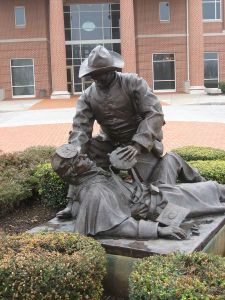
On the morning of December 14, 1862, Richard Kirkland took as many canteens as he could carry, and stepped into the no man’s land between two watching armies.  No one fired, nor even moved.  Sgt. Kirkland worked his way alone from one wounded man to the next, straightening out a shattered leg here, there spreading out an overcoat, always with a quiet word of encouragement and a drink of water.

Kirkland was out there for no less than 1½ hours.  Alone in no man’s land, he never left until he had helped every fallen soldier, Federal and Confederate, on that part of the battlefield.

moment_of_mercy
Moment of Mercy, by Felix de Weldon. 1965, Fredericksburg, VA. Photo credit Claire H. New York

General Kershaw later gave this account:  “Unharmed he reached the nearest sufferer. He knelt beside him, tenderly raised the drooping head, rested it gently upon his own noble breast, and poured the precious life-giving fluid down the fever scorched throat. This done, he laid him tenderly down, placed his knapsack under his head, straightened out his broken limb, spread his overcoat over him, replaced his empty canteen with a full one, and turned to another sufferer.”

Kirkland would not survive the war.  He met his end while leading an infantry charge the following September, at a place called Chickamauga. No one will ever know how many lives were saved by his courage, and his kindness,  this day in 1862.  Richard Rowland Kirkland will forever remain, the Angel of Marye’s Heights.

December 11, 1913 The Boll Weevil of Coffee County

Facing economic ruin, local farmers were forced to diversify their crops, just to recoup some of the losses caused by the beetle

Few machines have changed the course of history, like Eli Whitney’s cotton gin.

The long, hot summers of the southeastern United States have always been ideal for growing cotton, but there was a time when the stuff was extremely expensive to produce.  Cotton comes out wet from the boll, its protective capsule requiring about ten man hours just to remove the seeds to produce a pound of cotton.  By comparison, a cotton gin can process about a thousand pounds a day, at comparatively little expense.

In 1792, the year that Whitney invented his machine, the region exported 138,000 pounds a year to Europe and the northern colonies.  Two years later that number had risen to 1,600,000 pounds.  By the time of the Civil War, Britain alone was importing ¾ of the 800 million pounds they used each year, from the American south.

Enterprise, Alabama got its start when John Henry Carmichael first settled there in 1881.  Within a few years the Alabama Midland Railway came to Enterprise.  By the turn of the century the place was a major cotton growing hub.

bollweevil
Anthonomus grandis

Anthonomus grandis, the boll weevil, is a small beetle, about the size of your little fingernail.  Indigenous to Mexico, the beetle crossed the Rio Grande near Brownsville, sometime around 1892.  The insect spread rapidly, producing eight to ten generations in a single growing season and preying mainly on the young cotton boll.

Boll weevils are capable of destroying entire cotton crops, which it did in 1915, the year the insect reached Enterprise and most of Coffee County.  Facing economic ruin, local farmers were forced to diversify their crops, just to recoup some of the losses caused by the beetle.

Within two years, Enterprise became one of the leading peanut producers in the country.  Not only had farmers been able to stave of disaster, but they were already becoming prosperous as a result of the thriving new crop base.

Town fathers decided to build a monument, their “herald of prosperity”, to the boll weevil.  The bug that had almost ruined them.

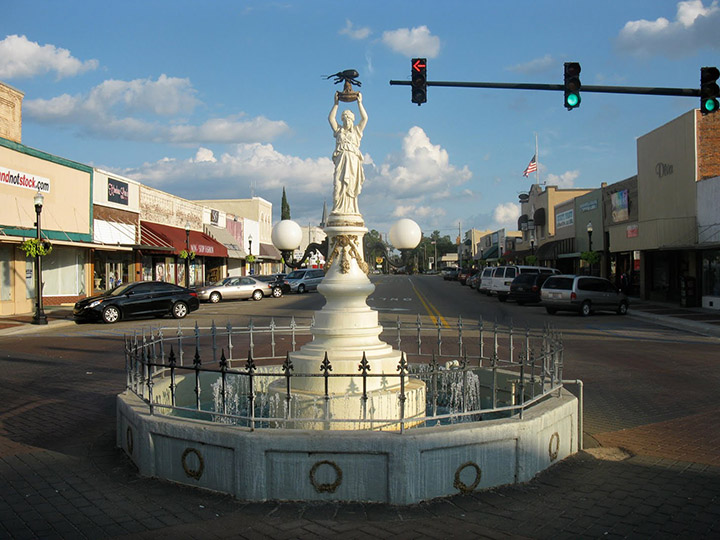
Designed in Italy at a cost of $1,800, the monument depicts a female figure in a flowing gown, arms stretched high over her head, and holding in her hands a trophy.

bollweevil-statue-detail
You can’t have a Boll Weevil monument without a Boll Weevil on it

The monument was dedicated on December 11, 1919 at the intersection of College and Main Street, in the heart of the town’s business district.  You can’t have a Boll Weevil monument without a Boll Weevil on it.  Thirty years later, Luther Baker added a big bug on top of the trophy.  At the base of the monument appears this inscription:  “In profound appreciation of the Boll Weevil and what it has done as the herald of prosperity this monument was erected by the citizens of Enterprise, Coffee County, Alabama.”

The original has been vandalized so many times that they moved it to a protected facility, and put a replica in its place.  And that is why you can drive down the Main Street of Enterprise Alabama today, in the footsteps of my own brother Dave, and there you will find a statue of…a bug.

December 10, 1917 Halifax Explosion

French sailors abandoned ship as fast as they could, warning everyone who would listen of what was about to happen

As “The Great War” dragged itself to the end of its third year in Europe, Halifax harbor in Nova Scotia, was the bustling scene of supply, munition, and troop ships destined for “over there”.  With a population of 50,000 at the time, Halifax was the busiest port in Atlantic Canada.

The Norwegian vessel Imo left its mooring in Halifax harbor on the morning of December 6, destined for New York City.   The French ship Mont Blanc was entering the harbor at this time, intending to join the convoy which would form her North Atlantic escort.  In her holds, Mont Blanc carried 200 tons of Trinitrotoluene (TNT), and 2,300 tons of TNP – Trinitrophenol or “Picric Acid”, a substance then in use as a high explosive.  In addition, the freighter carried 35 tons of high octane gasoline and 20,000 lbs of gun cotton.  Not wanting to draw the attention of pro-German saboteurs, the freighter flew no flags warning of its cargo.  Mont Blanc was a floating bomb

Somehow, signals became crossed as the two ships passed, colliding in the narrows at the harbor entrance and igniting the TNP onboard Mont Blanc.  French sailors abandoned ship as fast as they could, warning everyone who would listen of what was about to happen.

Meanwhile, the spectacle of a flaming ship was too much to resist, as crowds gathered around the harbor.  The high-pitched whine emitted by picric acid under combustion remains a feature of fireworks displays to this day.  You can only imagine the scene as the burning freighter brushed the harbor pier, setting it ablaze, before running aground.

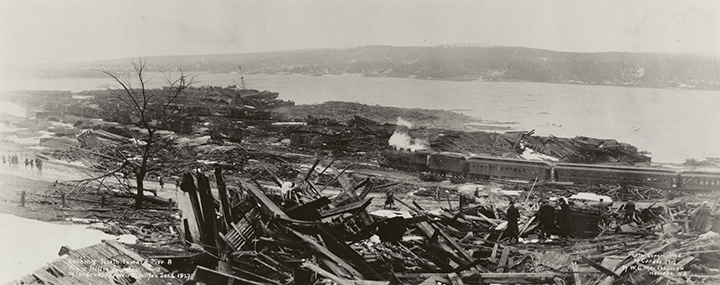
The explosion and resulting fires killed over 1,800, flattening the north end of Halifax and shattering windows as far as 50 miles away.  With over 1,600 homes flattened, it was one of the largest non-nuclear explosions in history.  Mont Blanc’s anchor landed two miles away, one of her gun barrels, three.  Later analysis estimated the explosive output at 2.9 kilotons, a force greater than many tactical nuclear weapons.

9,000 were wounded on the morning of December 7, as a blizzard descended across Nova Scotia.  Boston Mayor James Michael Curley wrote to the US Representative in Halifax “The city of Boston has stood first in every movement of similar character since 1822, and will not be found wanting in this instance. I am, awaiting Your Honor’s kind instruction.”

Curley was as good as his word.  He and Massachusetts Governor Samuel McCall composed a Halifax Relief Committee to raise funds and organize aid.  McCall reported that the effort raised $100,000 in its first hour alone. President Woodrow Wilson authorized a $30,000 carload of Army blankets sent to Halifax.  Within 12 hours of the explosion, the Boston Globe reported on the first train leaving North Station, with “30 of Boston’s leading physicians and surgeons, 70 nurses, a completely equipped 500-bed base hospital unit and a vast amount of hospital supplies”.

Delayed by deep snow drifts, the train arrived on the morning of December 8, the first non-Canadian relief train on the scene.

There was strong sentiment at the time, that German sabotage lay behind the disaster.  A front-page headline on the December 10 Halifax Herald Newspaper proclaimed “Practically All the Germans in Halifax Are to Be Arrested”.

$750,000 in relief aid would arrive from Massachusetts alone, equivalent to more than $15 million today.  Canadian Prime Minister Robert Borden would write to Governor McCall on December 9, “On behalf of the Government of Canada, I desire to convey to Your Excellency our very sincere and warm thanks for your sympathy and aid in the appalling calamity which has befallen Halifax”.

The following year, Nova Scotia sent the city of Boston a gift of gratitude, a very large Christmas tree.

In 1971, the Lunenburg County Christmas Tree Producers Association sent Boston another tree, to promote their Christmas tree exports, and to once again acknowledge the support of the people and government of Boston after the 1917 disaster. The Nova Scotia government later took over the annual gift of the Christmas tree, to promote trade and tourism.

And so it is that, every year, the people of Nova Scotia send the people of Boston their official Christmas tree.  More recently, the principle tree is joined by two smaller trees, donated to Rosie’s Place and the Pine Street Inn, two of Boston’s homeless shelters.

This is no Charlie Brown shrub we’re talking about. The 1998 tree required 3,200 man-hours to decorate:  17,000 lights connected by 4½ miles of wire, and decorated with 8,000 bulbs.

In 2013, the tree was accompanied by a group of runners, in recognition of the Boston Marathon bombing earlier that year.2016-boston-christmas-tree

This year’s tree stands just short of 46′, for the first time selected from the Cape Breton area. It takes two men a day and a half to prepare for cutting, a crane holding the tree upright while the chainsaw does its work.  It’s a major media event, as the tree is paraded through Halifax on a 53’ flatbed, before boarding the ferry across the Bay of Fundy to begin its 750-mile journey south.

For a small Canadian province, it’s been no small commitment.  Last year Nova Scotia spent $242,000 on the program, including transportation, cutting & lighting ceremonies, and all the promotions that went with it.  Premier Stephen McNeil says the program is well worth the expense. “(It) gives us a chance to showcase our beautiful part of the world to a global community”.  Tim Whynot, manager of stewardship and outreach for the provincial Department of Natural Resources, may have the last word.  “With the Tree for Boston, obviously the history of why we do it is pretty significant…we don’t want that to be forgotten”.

December 8, 1941 Day of Infamy

There was no knowing if the attack on Pearl Harbor had been an isolated event, or whether there would be a continuation of such attacks, sabotage on facilities, or even assassination attempts

It was early on a Sunday morning, December 7th, 1941, when the armed forces of Imperial Japan attacked the US Navy’s Pacific anchorage at Pearl Harbor.

The President of the United States, Franklin Delano Roosevelt, was notified almost immediately.  It had been an act of war, a deliberate attack on one sovereign nation by another, and Roosevelt intended to ask the Congress for a declaration of war.

Work began almost immediately on what we now know as Roosevelt’s “Day of Infamy” speech, to be delivered to a joint session of Congress the following day.

There was no knowing if the attack on Pearl Harbor had been an isolated event, or whether there would be a continuation of such attacks, sabotage on facilities, or even assassination attempts.

The speech was scheduled for noon on the 8th, and the Secret Service knew they had afdr problem. Roosevelt was fond of his 1939 Lincoln V12 Convertible.  Roosevelt called it the “Sunshine Special,” but the car was anything but secure.  Armored Presidential cars would not come into regular use for another 20 years, after the assassination of President Kennedy.

Federal regulations of the time restricted the purchase of any vehicle costing $750 or higher, $10,455 in today’s dollars, and that wasn’t going to get them an armored limo. They probably couldn’t have gotten one that quickly anyway, even if there had been no restriction on spending.

In 1928, Al Capone had purchased a Cadillac 341A Town Sedan with 3,000 pounds of armor and inch-thick bulletproof windows.  It was green and black, matching the Chicago police cars of the era, and equipped with a siren and flashing lights hidden behind the grill.  Capone himself was at Palm Island, Florida in 1941, having been in and out of Alcatraz by this time and reduced to a neurosyphilitic wreck.  His limo had been sitting in a Treasury Department parking lot, ever since being seized in his IRS tax evasion suit from years earlier.

Mechanics cleaned and checked Capone’s Caddy well into the night of December 7th, al-capones-limomaking sure that it would safely get the Commander in Chief the few short blocks to Capitol Hill.  It apparently did, because Roosevelt continued to use it until his old car could be fitted with the same features.  To this day, Presidential limousines have flashing police lights hidden behind their grilles.
Roosevelt probably learned that he was riding in Al Capone’s limo after he got in, on the way to Capitol Hill.  He didn’t seem to be bothered, the President’s only comment was “I hope Mr. Capone won’t mind.”

December 7, 1941 USS Oklahoma

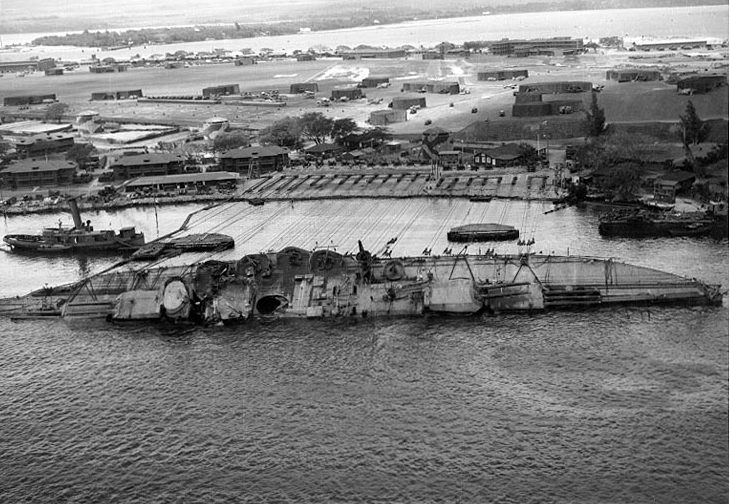
The Oklahoma turned turtle during the attack, trapping hundreds of sailors within her hull

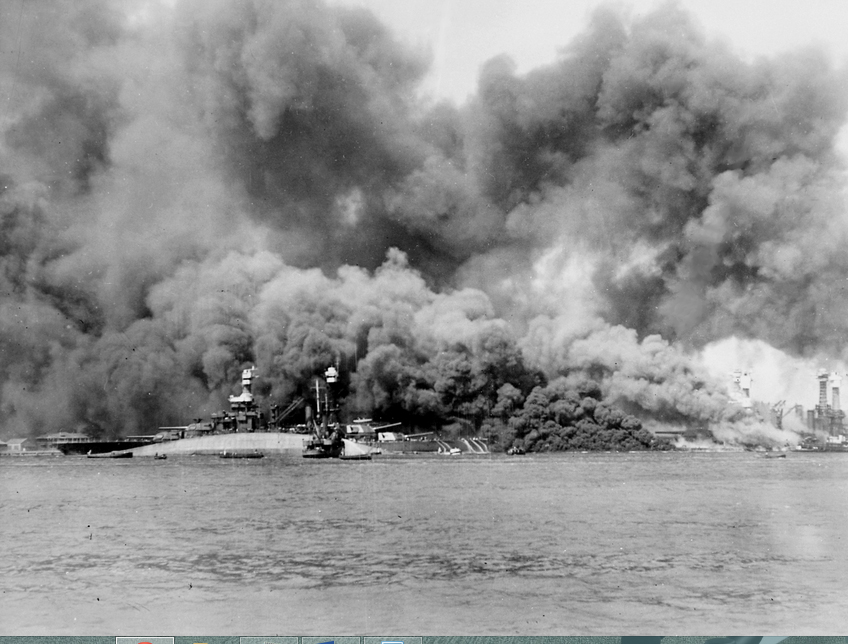
Air forces of the Imperial Government of Japan attacked the US Navy anchorage at Pearl Harbor, 75 years ago, today. The attack killed 2,403 and wounded another 1,178.  All eight battleships then in harbor were damaged.  Four sank to the bottom along with a number of smaller ships. 188 aircraft were destroyed, most while still on the ground.

Most would be re-floated and some returned to service, but not all. The Nevada-class righting-of-the-uss-oklahomabattleship USS Oklahoma was raised from the bottom, but was never repaired. In 1947 she would sink under tow to the mainland, very nearly taking two ocean going tugs to the bottom, with her.

The Pennsylvania-class battleship USS Arizona remains on the bottom, a monument to the event and to the 1,102-honored dead who remain entombed within her hull.

The hulk of the Arizona is such a prominent part of the memorial today, that it’s easy to believe it’s the only ship still lying at the bottom of Pearl Harbor.  But Arizona is not alone.

Less well known is the Florida-class dreadnought USS Utah, which defied salvage efforts. Now a War Grave, 64 honored dead remain within her hull, lying at the bottom not far from the Arizona.

Likewise, little remembered, is the fate of the 429 killed aboard the battleship USS Oklahoma. The Oklahoma turned turtle during the attack, trapping hundreds of sailors within her hull. Faint tapping sounds came from within.  Frantic around the clock rescue efforts resulted in the deliverance of 32 sailors.

Bulkhead markings would later reveal that, at least some of the doomed would live for another seventeen days.

Seventeen days alone in that black, upside down place, they died waiting and hoping for the rescue that would come too late. The last mark was drawn by the last survivor on Christmas Eve, 1941.

December 4, 1966  War Dogs of Vietnam

A Military Working Dog (MWD) is anything but a “disposable” asset. It is a highly trained, specialized soldier who complements and adds to the abilities of his human partner, as that two legged soldier complements those of the dog.

There are times when two highly trained individuals are able to function at a level higher than the sum of their parts.  Professional athletes like NFL linemen and NHL forwards are two examples.  Another is often the partnership formed between law enforcement officers.

On the battlefield, few assets more powerful than a well equipped and highly trained soldier. Unless we’re pairing that soldier with a Military Working Dog.

A Military Working Dog (MWD) is anything but a “disposable” asset.  It is a highly trained, specialized soldier who complements and adds to the abilities of his human partner, as that two legged soldier complements those of the dog.

“Nemo”, born in October 1962, entered the United States Air Force as a sentry dog in 1964, at the age of 1½ years.  After an 8-week training course at Lackland AFB Sentry Dog Training School in San Antonio, Texas, the 85 pound German Shepard was assigned to Airman Leonard Bryant Jr., and sent to Fairchild Air Base in Washington for duty with Strategic Air Command.

The pair was transferred to the Republic of South Vietnam with a group of other dog teams, and assigned to the 377th Security Police Squadron, stationed at Tan Son Nhut Air Base.  Six month later, in July, Bryant rotated back to the States, and Nemo was paired with 22-year-old Airman 2nd Class Robert Thorneburg.

Early on the morning of December 4, 60 Vietcong guerrillas emerged from the jungle, setting off a near simultaneous alarm from several sentry dogs on perimeter patrol.

Three dogs, Rebel, Cubby and Toby, were killed with their handlers in a hail of bullets.  Several other handlers were wounded, including one who was able to maintain contact with the enemy, notifying Central Security Control of their location and direction of travel.

Thanks to the early warning, a machine gun team was ready and waiting when 13 infiltrators approached the main aircraft parking ramp.  None of them lived to tell the story.  Security forces quickly deployed around the perimeter, driving some infiltrators off and others into hiding.  Daylight patrols reported that all VC infiltrators were gone, either killed or captured, but they had made a big mistake.  They should have brought the dogs with them.

That night, Thorneburg and Nemo were out on patrol near an old Vietnamese graveyard, about ¼ mile from the air base’ runways.  Nemo alerted on something.  Before Thorneburg could radio for backup, that something started shooting.  Thorneburg released the dog and charged in shooting, killing one VC before being shot in the shoulder.  Nemo was badly wounded, shot in the face, the bullet entering below his eye and exiting his mouth.  Ignoring his injury, Nemo attacked the four enemy soldiers hiding in the brush, giving his partner time to call for reinforcements.

Four additional VC were discovered hiding underground, as quick reaction teams scoured the area.  They found Nemo and Thornburg, both seriously wounded, together on the ground.  Both would survive, though Thorneburg was shot a second time, while returning to base.

I’m sure that individual dog handlers during the Vietnam era were as good to their dogs as they knew how to be.  That’s a guess, but having an MWD handler in the family, I think it’s a good one.  The Department of Defense bureaucracy was another matter.  The vast majority of MWDs were left behind as “surplus equipment”.

Nemo was one of the few lucky ones.  He was officially recognized for having saved thenemo-on-the-plane life of his handler, and preventing further destruction of life and property.   MWD Nemo was given the best of veterinary care and, on June 23 1967, USAF Headquarters directed that he be returned to the United States, the first sentry dog officially retired from active service.  The C124 Globemaster touched down at Kelly Air Force Base, Texas, on July 22, 1967.  Nemo lived out the seven years remaining to him in a permanent retirement kennel at the DoD Dog Center at Lackland Air Force Base.

December 3, 1586, Spuds

Now the fifth largest food crop on the planet, there was a time when taters were thought fit for no one but peasants and livestock.

The expedition that would end in the Lost Colony of Roanoke began in 1585, financed by Sir Walter Raleigh and led by Sir Ralph Lane.  On board was the Oxford trained mathematician and astronomer Sir Thomas Herriot, the man who introduced potatoes to England on this day the following year.

The Inca of Peru seem to have been the first to cultivate potatoes, around 8,000BC.

Wild potatoes contain toxins to defend themselves against fungi and bacteria, toxins unaffected by the heat of cooking.  In the Andes, mountain people learned to imitate the wild guanaco and vicuña, licking clay before eating the poisonous plants. In this manner, toxins pass harmlessly through the digestive system. Mountain people dunk wild potatoes in “gravy” made of clay and water, accompanied with coarse salt. Eventually, growers developed less toxic tubers, though the poisonous varieties are still favored for their frost resistance.  Clay dust is sold in Peruvian and Bolivian markets, to this day.

Spanish Conquistadors who arrived in Peru in 1532 eventually brought potatoes home to Spain.  The first written mention of the potato comes from a delivery receipt dated November 28, 1567, between the Grand Canaries and Antwerp.

Among its other virtues, the potato provides more caloric energy per acre of cultivation than either maize or grain and, being below ground, is likely to survive calamities that would flatten other crops.  Taters quickly became staple foods in northern and eastern Europe, while in other areas remaining the food of peasants and livestock.

French army pharmacist Antoine-Augustin Parmentier was captured by Prussians during the seven years war, and learned to appreciate the gustatorial delights of the potato while in captivity.  Primarily used as hog feed in his native France, Parmentier was determined to bring respectability to the lowly tuber.  It must have been a tough sell, many believed that potatoes caused leprosy.  The Paris Faculty of Medicine declared them edible in 1772, thanks largely to Parmentier’s efforts.  He would host dinners featuring multiple potato dishes, inviting such luminaries as Benjamin Franklin and Antoine Lavoisier.  Franklin was enormously popular among the French nobility.  Before long Louis XVI was wearing a purple potato flower in his lapel.  Marie Antoinette wore them in her hair.

Sir Walter Raleigh first introduced potatoes to Ireland in 1589.  By 1845 the crop occupied one third of arable land in Ireland. This was due entirely to landless laborers, renting tiny plots from landowners interested only in raising cattle or producing grain for market. An acre of potatoes and the milk of a single cow was enough to sustain a family.  Even poor families could grow enough surplus to feed a pig, which could then be sold for cash.

Calamity struck in 1845, in the form of a blight so horrific that US military authorities once considered stockpiling the stuff as a biological weapon.  Seemingly overnight, Ireland’s staple food crop was reduced to a black, stinking ooze.  There followed the seven years’ “an Gorta Mór”, “the Great Hunger”, killing over a million Irish and reducing the population by 20-25% through death and emigration.  Throughout the Irish potato famine, the country continued to produce and export thirty to fifty shiploads per day of food produce, more than enough to feed the population.  Today, many see the effects of the absentee landlord system and the penal codes as a form of genocide.  At the time, already strained relations with England were broken, giving rise to Irish republicanism and leading to Irish independence in the following century.

Until Nazis tore it down, there was a statue of Sir Francis Drake in Offenburg, Germany, giving him credit for introducing the potato. His right hand rested on the hilt of his sword, his left gripping a potato plant. The inscription read “Sir Francis Drake, disseminator of the potato in Europe in the Year of Our Lord 1586. Millions of people who cultivate the earth bless his immortal memory”.

Today, potatoes are the 5th largest crop on the planet, following rice, wheat, maize and sugar cane.  Almost 5,000 varieties are preserved in the International Potato Center in Peru.

In the Star Wars movie “The Empire Strikes Back”, there’s a chase sequence through an “asteroid” field in which some of the asteroids are, in fact, potatoes.potato-asteroid

Scientists have created genetically modified potatoes to ward off pests.  The “New Leaf”, approved in 1995, incorporated a bacterial gene rendering it resistant to the Colorado potato beetle, an “international superpest” so voracious that some credit it for creating the modern pesticide industry.  Other varieties were genetically modified to resist phytophthora infestans, the cause the Irish potato famine.  Seeming to prefer insecticides and anti-fungal sprays, “food activists” decry such varieties as “Frankenfoods”.  Each time, the improved variety has been hounded out of business.
In 2014, the J.R. Simplot Company received approval for their “Innate” potato.  Rather than “transgenic” gene splicing, the introduction of genome sequences from unrelated species, the innate variety uses a “silencing” technique on the tuber’s own genes, to resist the bruising and browning that results in 400 million pounds of waste and a cost to consumers of $90 million.

The Innate potato produces less acrylamide, a known carcinogen produced by normal potatoes in the high heat of fryers.  This might actually be the first genetically modified variety to succeed in the marketplace, but McDonald’s, possibly the largest potato user on the planet, has already announced that “McDonald’s USA does not source GMO potatoes, nor do we have current plans to change our sourcing practices.”

You can never underestimate the power of hysterical people in large groups.