While the future President Taft labored in the Philippines, Helen Herron Taft took up residence in Japan, where she came to appreciate the beauty of the native cherry trees.
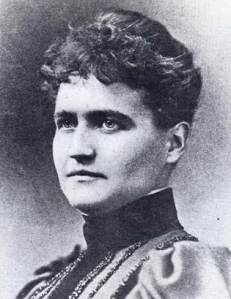
Eliza Ruhamah Scidmore
Eliza Scidmore was an American journalist, world traveler, author and socialite. The first female board member of the National Geographic Society, her brother was a career diplomat, who served 38 years in the Asian Pacific. Frequent visits led to a passionate interest in all things Japanese, most especially the ‘Sakura’, the Japanese blossoming cherry tree, which she called “the most beautiful thing in the world”.
In January 1900, Federal judge William Howard Taft was summoned to Washington, to meet with the President. He hoped it was to discuss a Supreme Court appointment, but it wasn’t meant to be. One day judge Taft would get his wish, becoming the only man in United States history to serve both as President, and as Chief Justice of the Supreme Court. For now, the American war in the Philippines was ongoing. Taft would head up the commission to organize civilian self-government in the island nation.
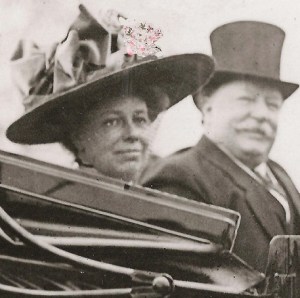
1st Lady & President Taft
While the future President Taft labored in the Philippines, Helen Herron Taft took up residence in Japan, where she came to appreciate the beauty of the native cherry trees.
Years later the Japanese Consul in New York learned of the First Lady’s interest in the Sakura, and suggested the city of Tokyo make a gift of Cherry trees, to the government of the United States.
For Eliza Scidmore, it was a dream 34 years in the making. It was she who raised the money to make it happen.
On March 27, 1912, the Viscountess Chinda, wife of the Japanese ambassador to the United States joined First Lady Helen Taft, in planting two Japanese Yoshina cherry trees on the bank of the Potomac River, near the Jefferson memorial. The two were planted in a formal ceremony, the first of 3,020 trees.
It was the second such effort. 2,000 trees had arrived from Japan two years earlier, in January 1910, but they had fallen prey to disease along their journey. A private Japanese citizen donated the funds to transport a new batch of trees. The 3,020 were taken from the bank of the Arakawa River in the Adachi Ward suburb of Tokyo, to be planted along the Potomac River Basin, East Potomac Park, and the White House grounds.
The blossoming trees were overwhelmingly popular with visitors to the Washington Mall. In 1934 city commissioners sponsored a three-day celebration of the late March blossoming cherry trees, which grew into the annual Cherry Blossom Festival.
During WWII, aerial bombardment laid waste to Tokyo and its surrounding suburbs. After the war, cuttings from the cherry trees of Washington were sent back to Japan, to restore the Tokyo collection.
It’s not clear to me, if the trees along the Arakawa River today are entirely from the Potomac collection, or some combination of American and native stock. After the conflagration that was the war in the Pacific, I’m not sure it matters. It may even be the whole point.
It wasn’t long before the entire Regiment adopted the bald eagle, calling themselves the “Eagle Regiment”, in honor of their new mascot. Much deliberation followed as to what to name him, before it was decided. He would be called “Old Abe”.
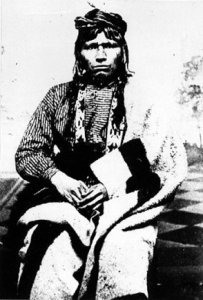
Ahgamahwegezhig
In 1861, leader of the Lac du Flambeau Ojibwe band Ahgamahwegezhig, or “Chief Big Sky”, captured an eaglet, and sold it for a bushel of corn to the McCann family of Chippewa County, Wisconsin. Captain John Perkins, Commanding Officer of the Eau Claire “Badgers”, bought the young bald eagle from Daniel McCann.
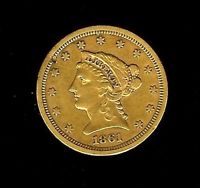
The asking price was $2.50. Militia members were asked to pitch in twenty-five cents, as was one civilian: tavern-keeper S.M. Jeffers. Jeffers’ refusal earned him “three lusty groans”, causing him to laugh and tell them to keep their quarters. Jeffers threw in a single quarter-eagle, a gold coin valued at 250¢, and that was that. From that moment onward, the militia unit called itself the Eau Claire “Eagles”.
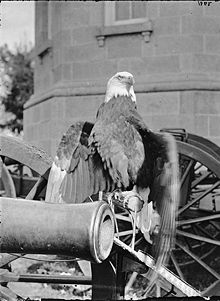
Perkins’ Eagles entered Federal Service as Company C of the 8th Wisconsin Volunteer Infantry Regiment. It wasn’t long before the entire Regiment adopted the bald eagle, calling themselves the “Eagle Regiment”, in honor of their new mascot. Much deliberation followed as to what to name him, before it was decided. He would be called “Old Abe”.
Old Abe accompanied the regiment as it headed south, travelling all over the western theater and witness to 37 battles. David McLain wrote “I have frequently seen Generals Grant, Sherman, McPherson, Rosecrans, Blair, Logan, and others, when they were passing our regiment, raise their hats as they passed Old Abe, which always brought a cheer from the regiment and then the eagle would spread his wings”.
Abe became an inspirational symbol to the troops, like the battle flag carried with each regiment. Colonel Rufus Dawes of the Iron Brigade recalled, “Our eagle usually accompanied us on the bloody field, and I heard [Confederate] prisoners say they would have given more to capture the eagle of the Eighth Wisconsin, than to take a whole brigade of men.”
Confederate General Sterling Price spotted Old Abe on his perch during the battle of Corinth, Mississippi. “That bird must be captured or killed at all hazards”, Price remarked. “I would rather get that eagle than capture a whole brigade or a dozen battle flags”.
Old Abe was presented to the state of Wisconsin at the end of the war. He lived 15 years in the “Eagle Department”, a two-room apartment in the basement of the Capitol, complete with custom bathtub, and a caretaker. Photographs of Old Abe were sold to help veteran’s organizations. He was a national celebrity, traveling across the country and appearing at the 1876 Centennial Exposition in Philadelphia, the 1880 Grand Army of the Republic National Convention, and dozens of fundraising events.
Old Abe & caretaker George Gilles
A small fire broke out in a Capitol basement workshop, fed by cleaning solvents and shop rags. The fire was quickly extinguished thanks to the bald eagle’s cries of alarm, but not before Old Abe inhaled a whole lot of that thick, black smoke. Abe’s health began to decline, almost immediately. Veterinarians and doctors were called, but to no avail. Bald eagles have been known to live as long as 50 years in captivity. Old Abe died in the arms of caretaker George Gilles on March 26, 1881. He was 20.
His remains were stuffed and mounted. For the next 20 years his body remained on display in the Capitol building rotunda. On the night of February 26, 1904, a gas jet ignited a newly varnished ceiling, burning the Capitol building to the ground.
Since 1915, Old Abe’s replica has watched over the Wisconsin State Assembly Chamber of the new capitol building.
In 1921, the 101st infantry division was reconstituted in the Organized Reserves with headquarters in Milwaukee. It was here that the 101st first became associated with the “Screaming Eagle”. The Screaming Eagles of the 101st Airborne participated in the D-Day invasion, the Battle of the Bulge, Operation Market Garden, and Bastogne, becoming the basis of the HBO series “A Band of Brothers”.
After WWII, elements of the 101st Airborne were mobilized to Little Rock by President Eisenhower to protect the civil rights of the “Little Rock Nine”, a group of black students enrolled in Little Rock Central High School in September 1957, as the result of the US Supreme Court’s landmark ruling in the historic Brown v. Board of Education case.
For 104 years, Old Abe appeared in the trademark of the J.I. Case farm equipment company of Racine, Wisconsin.
Winston Churchill once said “A lie gets halfway around the world before the truth has a chance to get its pants on.” We all know how stories change with the retelling. Some stories take on a life of their own. Ambrose Armitage, serving with Company D of the 8th Wisconsin Infantry, wrote in his diary on September 14, 1861, that Company C had a “four month old female eagle with them”. Two years later, Armitage wrote, “The passing troops have been running in as they always do to see our eagle. She is a great wonder”.
Ten years after his death, a national controversy sprang up and lasted for decades, as to whether Old Abe was, in fact, a “she”. Suffragettes claimed that “he” had laid eggs in the Wisconsin capitol. Newspapers weighed in, including the Washington Post, Detroit Free Press, St. Louis Post Dispatch, Oakland Tribune, and others.
Bald eagles are not easily sex-differentiated, there are few clues available to the non-expert, outside of the contrasts of a mated pair. It’s unlikely that even those closest to Old Abe, had a clue as to the eagle’s sex.
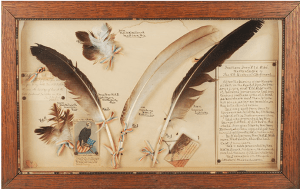
University of Wisconsin Biotechnology Center Sequencing Facility researchers had access to four feathers, collected during the early days at the Grand Army of the Republic Memorial Hall. In March of 2016, samples were taken from the hollow quill portion (calamus) of each feather, and examined for the the presence of two male sex chromosomes (ZZ) or both a male and female chromosome (ZW). After three months, the results were conclusive. All four samples showed the Z chromosome, none having a matching W. After 155 years, Old Abe could keep his name.
The fire started in a wicker scrap bin on the 8th floor, and spread quickly. A bookkeeper warned coworkers on the 10th by telephone, but there was no way to contact anyone on the 9th.
As the late 19th century gave way to the 20th, the increasing number of women in the workforce was driving a change in women’s fashion. Gone were the confinements of Victorian era bodices. The “shirtwaist” blouses of the Edwardian era were patterned on men’s shirts only looser, ranging from plain, “ready to wear” simplicity to the elaborate detail and stitching that transformed the plain shirtwaist to haute mode.
A September 16, 1906 article in the Pittsburgh Press said, “A very fashionable woman with a half a hundred waists boasts that there are no two alike.” Shirtwaist blouses were sold around the country, but most were made in Philadelphia and New York City.
At the turn of the century there were over 450 textile factories in Manhattan alone, employing something like 40,000 garment workers. Many of them were young, immigrant women of Jewish and Italian ethnicity, working nine hours a day on weekdays and seven on Saturdays. Wages were typically low: $7 to $12 per week, equivalent to $3.20 to $5.50 per hour, in 2016.
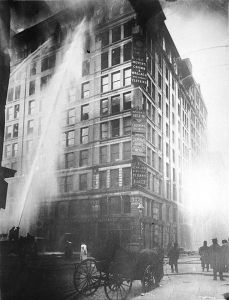
The Triangle Shirtwaist factory was located in the Asch Building in the Greenwich Village area of New York City, now known as the Brown Building and part of New York University. In 1911, the factory occupied the 8th – 10th floors, employing some 500 people.
The fire started in a wicker scrap bin on the 8th floor, and spread quickly. A bookkeeper warned coworkers on the 10th by telephone, but there was no way to contact anyone on the 9th floor. Survivor Yetta Lubitz said the first warning came about the same time as the flames themselves.
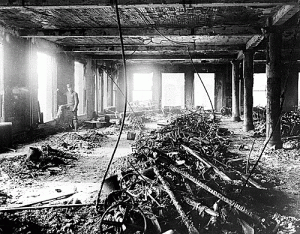
Every one of the fatalities that day, came from the 200 working on this one floor. The Washington Place stairwell was locked to prevent thefts & unauthorized breaks, and the foreman had fled with the keys. The Greene Street stairwell was packed solid in three minutes. The only survivors were those who fled to the roof.
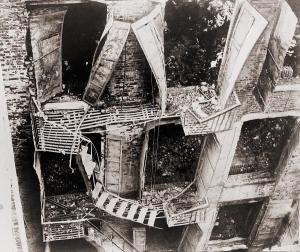
Terrified employees crowded onto a rickety fire escape, collapsing it under the weight and dropping 20 people some 100′ to their death. Fire companies were quick to arrive, but ladders only reached up to the 6th or 7th floors. A life net was unfurled, but ripped away when three women jumped for it, simultaneously. For the most part, fire companies could only look on helplessly, along with the crowd gathered on the street. 62 people, some already on fire, jumped or fell to the street below. As on 9/11, at least one couple stepped off together, holding hands as they fell.
With one exit on fire and the other locked, elevator operators Joseph Zito and Gaspar Mortillalo did everything they could to save lives. Mortillalo made three trips before being forced to give up when the rails of his elevator buckled under the heat. Desperate to get out, some victims pried open the other elevator door, hoping to slide down greasy cables, or just to jump into the shaft and hope for the best. The weight and impact of their bodies warped Zito’s elevator car, making another rescue attempt impossible.
Reporter William Gunn Shepard learned a sound that day, that many of us remember from those first hours of 9/11. Before the media censored itself. “I learned a new sound that day, a sound more horrible than description can picture — the thud of a speeding living body on a stone sidewalk”.
Louis Waldman, later to become a Socialist state assemblyman, described the scene: “Horrified and helpless, the crowds — I among them — looked up at the burning building, saw girl after girl appear at the reddened windows, pause for a terrified moment, and then leap to the pavement below, to land as mangled, bloody pulp”.
146 died that day, 123 women and 23 men.
The company’s owners, Max Blanck and Isaac Harris, survived by fleeing to the roof when the fire began. The pair had four suspicious factory fires between 1902 and 1910, but arson was not suspected in this case.
Blanck and Harris were indicted on charges of 1st and 2nd degree manslaughter, but the jury acquitted them both. Their attorney convinced the jury that witnesses may have been “coached”, since their stories didn’t change on cross examination.
They lost a subsequent civil suit in 1913 in which plaintiffs won compensation amounting to $75 per dead victim. The insurance company paid $60,000 more than the reported losses, for a profit of $336 per corpse.
The fire led to 64 new laws regulating the health and safety of New York’s factory workers, and helped spur the growth of the International Ladies’ Garment Workers’ Union (ILGWU). In 1913, Blanck was once again arrested for locking a factory door during working hours. He was fined $20.
The Triangle Shirtwaist conflagration led to the largest loss of life by fire, in New York history. The second largest would be the “Happy Land” night club fire in the Bronx. 79 years later, to the day.
The random and silly teenage fad of the era, went unrecorded. Dad doesn’t mention if the kid was eating goldfish, sagging his toga or doing a Chinese fire drill around the chariot. That particular silliness would wait for another day
Two thousand years before Romulus and Remus founded the Roman Republic, Nomadic bands of hunters and gatherers established the world’s oldest civilization in the fertile valleys of the Tigris and Euphrates Rivers. They called it “Sumeria”.
100 years ago, “Sumerologists” labored to learn the customs and ways of this ancient civilization. One such team pieced together a stone tablet and, through years of study, managed to decipher the cuneiform words contained thereon.
Turns out it was a father, 5,000 years ago, bitching about his son. The kid won’t work, he’s disrespectful, and he hangs out with the wrong kind of people. If he isn’t borrowing the chariot, all the kid wants to do is drink wine and lie around the house. These kids today.
The random and silly teenage fad of the era went unrecorded. Dad doesn’t mention if the kid was eating goldfish, sagging his toga or doing a Chinese fire drill around the chariot. That particular silliness would wait for another day, but one thing is certain. The random enthusiasms peculiar (though not exclusive) to youth, are as old as history itself.
In the 1830s, it was a favorite practice in younger, more educated (and probably bored) circles, to intentionally misspell words, and abbreviate them when talking to one another. As always, holding the key to the code meant the difference between being with the “in crowd”, and everyone else. As teenagers today have their own slang based on distortions of common words: “Awks” means that’s awkward, “YOLO” means You Only Live Once, and “BFF”, means Best friends forever, the in-crowd of the 1830s had a whole vocabulary of abbreviations.
On March 23, 1839, the initials “O.K.” were first published in The Boston Morning Post. This particular abbreviation stood for “Orl Korrekt.” All correct. Other popular slang of the era included “KY” for “No use” (“Know Yuse”), “KG” for “No Go” (“Know Go”), and “OW” for all right (“Oll Wright”).
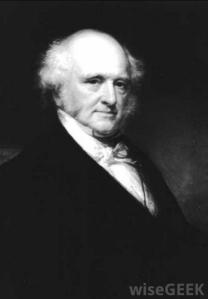
The expression got a boost in the Presidential election of 1840, during the re-election campaign of democrat Martin van Buren, also known as “Old Kindherhook”, after the village of his birth.
The others dropped from use, probably around the same time that parents figured them out, but OK steadily made its way into the speech of ordinary Americans. I found myself texting it, just the other day.
There’s a lesson in here somewhere, IMHO, for anyone raising a teenager. And for the kid who thinks he/she’s the first in all recorded history, to ever (fill in the blank). LOL.
Some 30 states had passed legislation by the height of the eugenics movement, legalizing the involuntary sterilization of individuals considered “unfit” for reproduction. All told, some 60,000 individuals were forcibly sterilized in state-sanctioned procedures.
In 380BC, Plato described a system of state-controlled human breeding in his Socratic dialogue “The Republic”, intended to create a “guardian class” over his ideal society.
In the 19th century, Francis Galton studied the theories of his cousin Charles Darwin on the evolution of species, applying them to a system of selective breeding intended to bring better human beings into the world. He called it his theory of “Eugenics”.
Eugenics gained worldwide respectability in the early 20th century, when countries from Brazil to Japan adopted policies regarding the involuntary sterilization of certain mental patients.
“Better Babies” competitions sprang up at state fairs across the United States, where babies were measured, weighed, and “judged”, like livestock. By the 20s, these events evolved into “Fitter Family” competitions.
One of the leaders of the eugenics movement was the pacifist and Stanford University professor, David Starr Jordan. After writing several books on the subject, Jordan became a founding member of the Eugenics Committee of the American Breeders Association. The upper class of America was being eroded by the lower class, he said. Careful, selective breeding would be required to preserve the nation’s “upper crust”.
Margaret Sanger
Margaret Higgins Sanger believed that birth control should be compulsory for “unfit” women who “recklessly perpetuated their damaged genetic stock by irresponsibly breeding more children in an already overpopulated world.”
An early advocate for birth control, Sanger has her supporters to this day, including former Presidential candidate Hillary Rodham Clinton. “I admire Margaret Sanger enormously”, Clinton said. “Her courage, her tenacity, her vision…” Time Magazine points out that “Sanger opened the first birth-control clinic in the United States”, describing her as “An advocate for women’s reproductive rights who was also a vocal eugenics enthusiast…”
Detractors have described Sanger as a “thoroughgoing racist”, citing her own words in What Every Girl Should Know, published in 1910:“In all fish and reptiles where there is no great brain development, there is also no conscious sexual control. The lower down in the scale of human development we go the less sexual control we find. It is said that the aboriginal Australian, the lowest known species of the human family, just a step higher than the chimpanzee in brain development, has so little sexual control that police authority alone prevents him from obtaining sexual satisfaction on the streets”.
Admire or detest the woman as you prefer, Sanger’s work established organizations that later evolved into the Planned Parenthood Federation of America.
Around the world, eugenics policies took the form of involuntarily terminated pregnancies, compulsory sterilization, euthanasia, and even mass extermination.
Madison Grant, the New York lawyer known for his work in developing the discipline of wildlife management, was a leader in the eugenics movement, once receiving an approving fan letter from none other than Adolf Hitler.
Public policy and academic types conducted three international eugenics conferences to advance their ideas. The first such conference was held in Great Britain in 1912, followed by two more in 1921 and again in 1932, both in New York City. Colleges and universities offered eugenics as an academic discipline, delving into the ethical and public policy considerations of eliminating the “degenerate” and “unfit”.
In Pennsylvania, 270 involuntary sterilizations were performed without benefit of law, between 1892 and 1931. On March 21, 1905, the Pennsylvania legislature passed “An Act for the Prevention of Idiocy”, requiring that every institution in the state entrusted with the care of “ idiots and imbecile children”, be staffed by at least one skilled surgeon, whose duty it was to perform surgical sterilization. The bill was vetoed by then-Governor Samuel Pennypacker, only to return in 1911, 1913, 1915, 1917, 1919, and in 1921.
By the height of the movement, some 30 states had passed eugenics legislation, legalizing the involuntary sterilization of individuals considered “unfit” for reproduction. All told, some 60,000 individuals were forcibly sterilized in state-sanctioned procedures.
California forced Charlie Follett to undergo a vasectomy in 1945 at the age of 15, when Follett found himself abandoned by alcoholic parents. He was only one of some 20,000 Californians forced to undergo such a procedure.
Vermont passed a sterilization law in 1931, aimed at what then-University of Vermont zoology professor Henry Perkins called the “rural degeneracy problem.” An untold number of “defectives” were forced to undergo involuntary sterilization, including Abenakis and French-Canadian immigrants.
Indiana passed the first eugenic sterilization law in 1907, but it was legally flawed. To remedy the situation, the Eugenics Record Office (ERO) of the Carnegie Institution of Washington’s Station for Experimental Evolution crafted a eugenics statute, adopted by the Commonwealth of Virginia as a state statute in 1924.
That September, Superintendent of the ‘Virginia State Colony for Epileptics and Feebleminded’ Dr. Albert Sidney Priddy, filed a petition to sterilize Carrie Buck, an 18-year-old patient at his institution whom he claimed to be “incorrigible”. A “genetic threat to society”. Buck’s 52 year old mother had a record of prostitution and immorality, Priddy claimed, and the child to whom Buck gave birth in the institution further proved the point.
Buck’s guardian brought her case to court, arguing that the law violated the equal protection clause of the 14th amendment. After losing in district court, the case was appealed to the Amherst County Circuit Court, the Virginia Supreme Court, and finally the United States Supreme Court.
Dr. Priddy died along the way, Dr. John Hendren Bell taking his place. SCOTUS decided the “Buck vs Bell” case on May 2, 1927, ruling in an 8–1 decision that Buck, her mother, and daughter Vivian, were all “feeble-minded” and “promiscuous.”
In the majority ruling, Justice Oliver Wendell Holmes, Jr., wrote: “”It is better for all the world, if instead of waiting to execute degenerate offspring for crime, or to let them starve for their imbecility, society can prevent those who are manifestly unfit from continuing their kind…. Three generations of imbeciles are enough.”
It was later revealed that Carrie Buck had been raped by a member of the Dobbs family, the foster family who had taken her in and later had her committed. To save their family “honor”. No matter. Buck was compelled to undergo tubal ligation, and later paroled to become a domestic worker with a family in Bland, Virginia. Buck’s daughter Vivian, was adopted by this same Dobbs family.
In a later examination of Vivian, ERO field worker Dr. Arthur Estabrook pronounced her “feeble minded” saying that she “showed backwardness”, supporting the “three generations” theory expressed in the SCOTUS opinion.
The child died from complications of measles in 1932, after only two years in school. Dr. Estabrook failed to explain in his report, how she seemed to do well for those two years, nor did he explain how she came to be listed on her school’s honor roll, in April 1931.
Part of the roof had either blown off this joint, or burned off, depending on which version you read. Jack, the owner, tore off the rest of it and kept the insurance money, calling it the “Skyline Lounge”
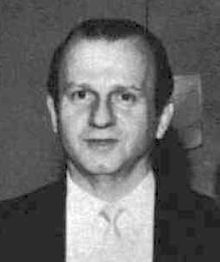
Jacob Leon Rubenstein was a troubled child, growing up on the west side of Chicago. Marked a juvenile delinquent in his adolescence, Rubenstein was arrested for truancy at age 11, eventually skipping enough school to spend time at the Institute of Juvenile Research.
As with cartoonist Charles M Shulz, those who knew Jacob Rubenstein called him “Sparky”. Some say the nickname was due to a resemblance to “Sparkplug”, the old nag with the patchwork blanket, from the Snuffy Smith cartoon strip. Rubenstein hated the nickname and was quick to fight anyone who called him that. It may have been that quick temper, that made the name stick.
Rubinstein spent the early 40s at racetracks in Chicago and California, until being drafted into the Army Air Forces, in 1943. Honorably discharged in 1946, Rubenstein returned to Chicago, before moving to Dallas the following year.
Rubenstein managed a series of Dallas nightclubs and strip joints, featuring ladies like “Candy Barr” and “Chris Colt and her ’45’s”. Somewhere along the line, he shortened his name to “Ruby”.
Ruby was involved in typical underworld activities, such as gambling, narcotics and prostitution. There were rumored associations with Mafia boss Santo Trafficante. The less-than-honest part of the Dallas police force knew that Ruby was always good for free booze, prostitutes, and other favors. This was one unsavory guy.
Today, you may know Rick Danko, Levon Helm, Garth Hudson and Robbie Robertson as musicians who went on the road with Bob Dylan in 1965, later morphing into “The Band”, and performing such rock & roll standards as “The Night they Drove Old Dixie Down”, “Up on Cripple Creek”, and “The Weight”.
In earlier days, the joints these guys played were so rough, that they performed with blackjacks, hidden in special pockets sewn into their coats. In 1963, they played a week in a Fort Worth nightclub. It was a huge venue, but no one was there that first night, save for two couples, a couple of drunk waiters and a one-armed go-go dancer. The band wasn’t through with their first set before a fight broke out, and someone was tear-gassed. The band played on, coughing and choking, with teargas wafting across the stage, their faces wet with tears.
Part of the roof had either blown off this joint, or burned off, depending on which version you read. Jack, the owner, tore off the rest of it and kept the insurance money, calling it the “Skyline Lounge”. There was no need to pay for security, even without the roof. Jack said “Boys, this building ain’t exactly secure enough for you to leave your musical equipment unattended.” Band members were told they’d best stay overnight, with guns, lest anyone come over the wall to steal their equipment. Problem solved.
Months later, the country was stunned at the first Presidential assassination in over a half-century. I was 5½ at the time, I remember it to this day. An hour after the shooting, former marine and defector to the Soviet Union Lee Harvey Oswald killed Dallas police officer J.D. Tippit, who had stopped him for questioning. Thirty minutes later, Oswald was arrested in a movie theater.
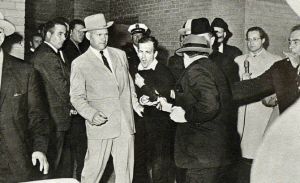
By Sunday, November 24, Oswald was formally charged with the murders of President John F. Kennedy and Dallas police officer J. D. Tippit. He was taken to the basement of Dallas police headquarters, where an armored car waited to transport the prisoner to a more secure county jail. The scene was crowded with press and police.
Half the country watched on live TV, as a man came out of the crowd, firing a single bullet from his .38 into the belly of Lee Harvey Oswald. Four musicians were shocked to realize the shooter was the man they had worked for months earlier, at that burned out dive bar. Jack Ruby.
Oswald was taken unconscious to Parkland Memorial Hospital, the same hospital where John F. Kennedy died, two days earlier. He was dead within two hours.
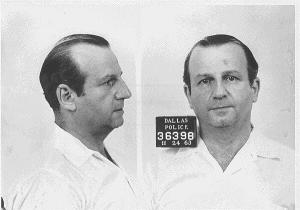
Jack Ruby was sentenced to death in the murder of Lee Harvey Oswald, on March 14, 1964. The Texas Court of Criminal Appeals overturned Ruby’s conviction in October 1966, on the grounds that the trial should have taken place in a different county than that in which his high profile crime had taken place. Ruby died of lung cancer the following January, while awaiting retrial.
The Warren Commission found no evidence linking Jack Ruby’s murder of Lee Harvey Oswald, to any broader conspiracy to assassinate the President. What became of Jacob Leon “Sparky” Rubenstein’s fine establishment, is unknown to this writer.
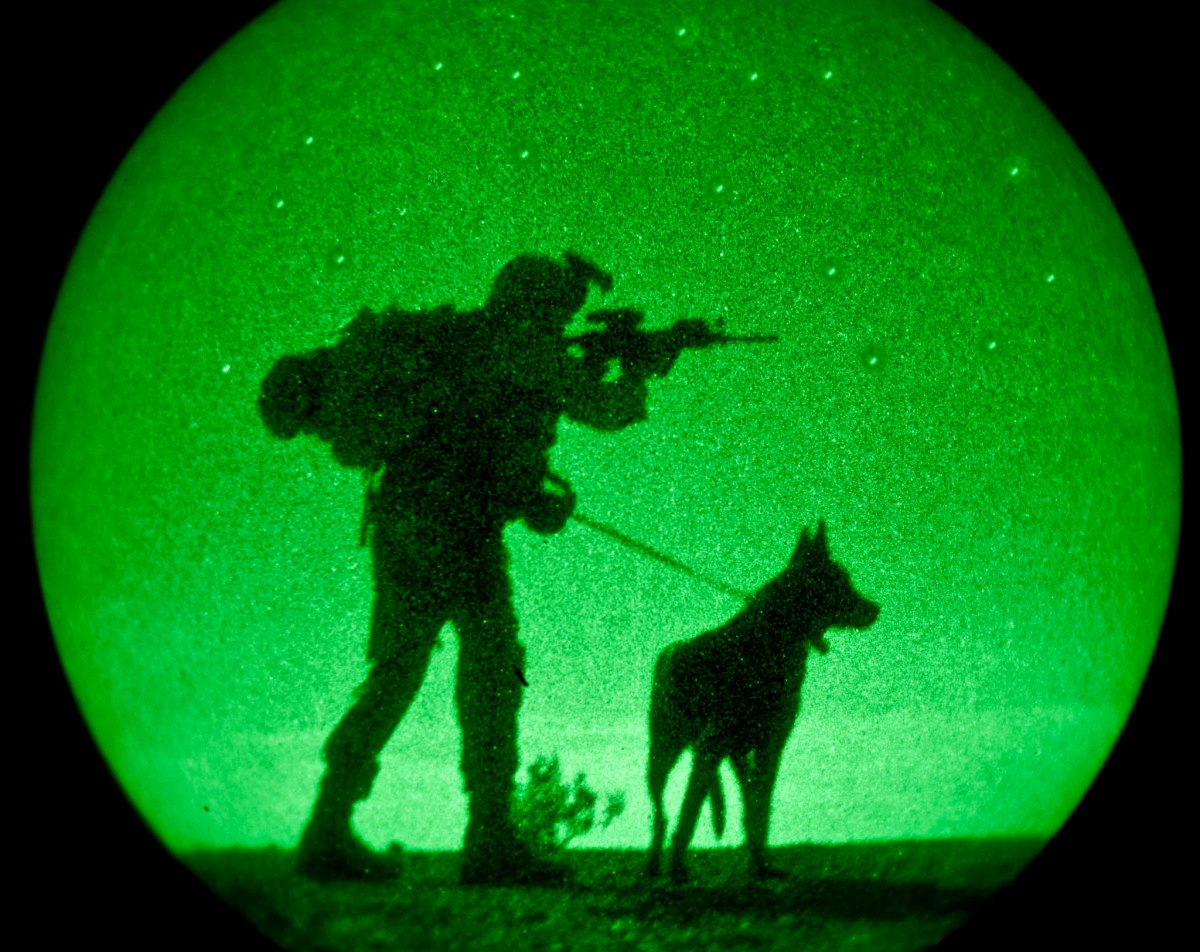
It’s K-9 Veteran’s Day. March 13, 2017. I could tell you no other story today, half as fitting as this.
The history of war dogs is as old as history itself. The dogs of King Alyattes of Lydia killed some of his Cimmerian adversaries and routed the rest around 600BC, permanently driving the invader from Asia Minor in the earliest known use of war dogs in battle.
King Molossus of Epirus, grandson of the mighty Achilles, used a large, powerfully built breed specifically trained for battle. Today, “molosser” describes a body type more than any specific breed. Modern molossers include the Mastiff, Bernese Mountain Dog, Newfoundland and Saint Bernard.
Ancient Greeks, Romans and Egyptians often used dogs as sentries or on patrol. In late antiquity, Xerxes I, the Persian King who faced the Spartan King Leonidas across the pass at Thermopylae, was accompanied by a pack of Indian hounds.
Attila the Hun went to war with a pack of hounds, as did the Spanish Conquistadors of the 1500s.
Sallie’s likeness rests at the foot of a statue in Gettysburg, looking out for the spirits of “her boys” for all eternity
A Staffordshire Bull Terrier named Sallie “joined up” in 1861, serving the rest of the Civil War with the 11th Pennsylvania Volunteer Infantry. At Cedar Mountain, Antietam, Fredericksburg, Chancellorsville, and Spotsylvania, Sallie would take her position alongside the colors, barking ferociously at the adversary.
Abraham Lincoln spotted Sallie from a reviewing stand in 1863, and tipped his hat.
Sallie was killed at Hatcher’s Run in February 1865. Several of “her” men laid down their arms then and there to bury her, despite being under Confederate fire.
WWI Messenger Dog
Dogs performed a variety of roles in WWI, from ratters in the trenches, to sentries, scouts and runners. “Mercy” dogs were trained to seek out the wounded on the battlefield, carrying medical supplies with which the stricken could treat themselves.
Sometimes, these dogs simply provided the comfort of another living soul, so that the gravely wounded should not die alone.
By the end of the “Great War”, France, Great Britain and Belgium had at least 20,000 dogs on the battlefield, Imperial Germany over 30,000. Some sources report that over a million dogs served over the course of the war.
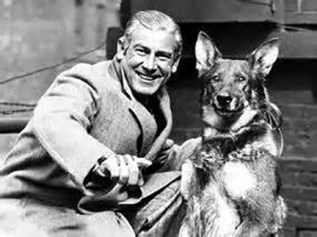
Lee Duncan & Rin Tin Tin
The famous Rin Tin Tin canine movie star of the 1920s was rescued as a puppy, from the bombed out remains of a German Army kennel, in 1917. (Read more about him, Here).
GHQ of the American Expeditionary Force recommended using dogs as sentries, messengers and draft animals in the spring of 1918, however the war was over before US forces put together any kind of a War Dog program.
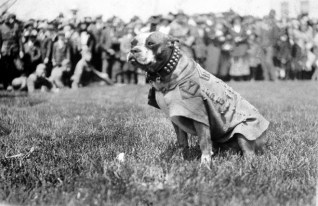
America’s first war dog, “Sgt. Stubby”, went “Over There” by accident, serving 18 months on the Western Front before coming home to a well-earned retirement.
Sgt. Stubby
On March 13, 1942, the Quartermaster Corps began training dogs for the US Army “K-9 Corps.” In the beginning, the owners of healthy dogs were encouraged to “loan” their dogs to the Quartermaster Corps, where they were trained for service with the Army, Navy, Marine Corps and Coast Guard.
The program initially accepted over 30 breeds of dog, but the list soon narrowed to German Shepherds, Belgian Sheep Dogs, Doberman Pinschers, Collies, Siberian Huskies, Malamutes and Eskimo Dogs.
WWII-era Military Working Dogs (MWDs) served on sentry, scout and patrol missions, in addition to performing messenger and mine-detection work. The keen senses of scout dogs saved countless lives, by alerting to the approach of enemy forces, incoming fire, and hidden booby traps & mines.
The most famous MWD of WWII was “Chips”, a German Shepherd assigned to the 3rd Infantry Division in Italy. Trained as a sentry dog, Chips broke away from his handler and attacked an enemy machine gun nest. Wounded in the process, his singed fur demonstrated the point-blank fire with which the enemy fought back. To no avail. Chips single-handedly forced the surrender of the entire gun crew.
Chips was awarded the Distinguished Service Cross, Silver Star and Purple Heart, the honors later revoked due to an Army policy against the commendation of animals. It makes me wonder if the author of such a policy ever saw service beyond his own desk.
Of the 549 dogs who returned from service in WWII, all but four were able to return to civilian life.
Over 500 dogs died on the battlefields of Vietnam, of injuries, illnesses, and combat wounds. 10,000 servicemen served as dog handlers during the war, with an estimated 4,000 Military Working Dogs. 261 handlers paid the ultimate price. K9 units are estimated to have saved over 10,000 human lives.
War dog memorial, University of Tennessee
It’s only a guess, but, having an MWD handler in the family, I believe I’m right: hell would freeze before any handler walked away from his dog. The military bureaucracy, is another matter. The vast majority of MWDs were left behind during the Vietnam era. Only about 200 dogs survived the war to be assigned to other bases. The remaining dogs were either euthanized or left behind as “surplus equipment”.
In 2011, a Belgian Malinois named “Cairo” accompanied the Navy SEAL “Neptune Spear” operation that took out Osama bin Laden.
Today there are about 2,500 dogs in active service. Approximately 700 deployed overseas. The American Humane Association estimates that each MWD saves an average 150-200 human lives over the course of its career.
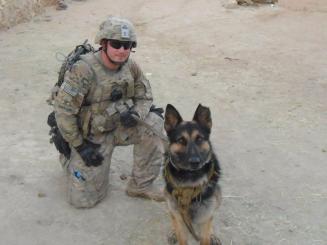
Nate & Zino
NPR’s “Here & Now” broadcast an excellent segment out of their Boston affiliate WBUR in 2014, when our son-in-law Nate was reunited with “Zino”, the Tactical Explosives Detection Dog (TEDD) with whom he served in Afghanistan.
Their story ends well, but that isn’t always the case. Many have been left behind, no longer qualified to travel on military transport after being “retired” on foreign soil.
In 2015, Congressman Frank LoBiondo (R-NJ) and Senator Claire McCaskill (D-MO) introduced language in their respective bodies, mandating that MWDs be returned to American soil upon retirement, and that their handlers and/or handlers’ families be given first right of adoption.
LoBiondo’s & McCaskill’s language became law on November 25, when the President signed the 2016 National Defense Authorization Act (NDAA). It’s a small step in recognizing what we owe to those who have stepped up in defense of our nation, both two legged and four.
Boston’s NPR Station WBUR broadcast a segment on Nate & Zino’s reunion, if you’re interested in listening to it. It’s a great story.
Another letter asked for Goizueta’s autograph, since the signature of “one of the dumbest executives in American business history” would probably become valuable in the future.
Europeans long believed that natural mineral waters held medicinal qualities, and favored the beverages over often polluted common drinking water. British chemist Joseph Priestley invented a means of carbonating water in 1772. Jacob Schweppe’s Geneva, Switzerland company was bottling the stuff by the 1780s. The first soda water manufacturer in the US was Yale University chemist Benjamin Silliman in 1807, though it was Joseph Hawkins of Baltimore who secured the first US patent in 1809.
At first sold for their therapeutic value, consumers increasingly bought carbonated beverages for refreshment. By the time of the Civil War, “soft drinks” were flavored with ginger, vanilla, fruits, roots, herbs, and countless other flavorings. The first cola drink appeared in 1881.
Confederate Cavalry officer John Stith Pemberton was wounded by a saber slash across his chest at the Battle of Columbus, Georgia. Like many wounded veterans, he became addicted to the morphine given him to help ease the pain. A chemist in civil life, Pemberton experimented with painkillers to take the place of opiates, landing on a combination of the coca plant and kola nut in 1886. Vicksburg, Mississippi pharmacist Joseph Biedenharn installed bottling equipment in the back of his soda fountain, selling the first bottles of Coca Cola on March 12, 1894.
The most famous rivalry in the soft drink business began in the 1930s, when Pepsi offered a 12oz bottle for the same 5¢ as Coca Cola’s six ounces.
The Coca Cola Company’s flagship brand had a 60% share by the end of WWII, but that declined to less than 24% by the early 80s, most of the difference lost to Pepsi and their “Pepsi challenge” blind taste test promotions of the late 70s.
By the 80s, market analysts believed that baby boomers were likely to switch to diet drinks as they aged, and any growth in the full calorie segment was going to come from younger consumers who preferred the sweeter taste of Pepsi.
Roberto Goizueta came on board as Coca Cola Company CEO in 1980, saying that there would be “no sacred cows” among their products. He meant it. The company launched the top secret “Project Kansas”, to test and perfect the flavor for a new version of Coke. The company’s marketing department fanned out, holding taste tests, surveys, and focus groups.
Early results were favorable, the newer, sweeter mixture overwhelmingly beating both Pepsi and Coke itself. Most tasters said that they would buy the product, but a small minority of 10–12% were angry and alienated at the very thought of it. This small percentage was adamant. They would stop drinking Coke products altogether, and they frequently swayed other members of their focus groups.
The way things turned out, the company should have listened to this group a little more carefully.
On an April Friday in 1985, Coke let the media know that a major announcement was coming the following Tuesday. Coca Cola officials spent a busy weekend preparing for the re-launch, while Pepsi Executives announced a company-wide holiday, taking out a full page New York Times ad proclaiming that “Pepsi had Won the Cola Wars”.
Skepticism was high on the day of the Big Announcement. Reporters were fed questions by Pepsi officials, and Goizueta fumbled, refusing to state the reason for the change. He certainly wasn’t going to give Pepsi any credit for their performance in taste tests, explaining “[It’s] smoother, uh, uh, rounder yet, uh, yet bolder…a more harmonious flavor”.
The backlash was soon in coming, and closely tracked earlier focus group results. Atlanta based Coca Cola’s southern customers described the change as another surrender to the “Yankees”. Over 400,000 calls and letters came into company headquarters, including one addressed to “Chief Dodo, The Coca-Cola Company”. Another letter asked for Goizueta’s autograph, since the signature of “one of the dumbest executives in American business history” would probably become valuable in the future. A psychiatrist hired by Coke to listen in on calls, told executives some people sounded as if they were discussing the death of a family member.
Even Max Headroom and his “C-c-c-catch the wave!” couldn’t save the company. Ads for “New Coke” were booed at the Houston Astrodome, while Pepsi ran ads in which a smiling first-time Pepsi drinker said “Now I know why Coke did it!”
Even Fidel Castro weighed in, calling the change a sign of capitalist decadence. Company President Donald Keough realized it was over, on a visit to the Mediterranean Principality of Monaco. A small restaurant owner proudly said that he had “the real thing, it’s a real Coke,” offering Keough’s party a bottle of the old stuff.
And so it was that, in 1985, Coca Cola announced that they’d bring back their 91-year old formula. A reporter asked Keough if the whole thing had been a publicity stunt. Keough’s answer is itself, a classic. “We’re not that dumb,” he said, “and we’re not that smart”.
Ordinary flu strains prey most heavily on children, elderly, and those with compromised immune systems. Not this one.
In the world of virology, “Antigenic Drift” describes changes which happen slowly, the random mutation of virus DNA which takes place over months, or years. It’s why we get a new flu vaccine every year, even though there’s already some level of “herd immunity”.
“Antigenic Shift” occurs when two or more DNA strands combine, instantaneously forming a new virus sub-type. Like the dealer at some giant, cosmic poker table, this process may deal us a pair of twos. Occasionally, fate deals us aces & eights. The death hand.
When the “Great War” broke out in 1914, US Armed Forces were small compared with the mobilized forces of European powers. The Selective Service Act, enacted May 18, 1917, authorized the federal government to raise an army for the United States’ entry into WWI. Two months after the American declaration of war against Imperial Germany, a mere 14,000 American soldiers had arrived “over there”. Eleven months later, that number stood at well over a million.
General “Black Jack” Pershing insisted that his forces be well trained before deployment. New recruits poured into training camps by the tens of thousands, while somewhere, some microscopic, chance recombination of surface proteins created a new virus, novel to almost every immune system in the world.
On the morning of March 11, 1918, most of the recruits at Fort Riley, Kansas, were turning out for breakfast. Private Albert Gitchell reported to the hospital, complaining of cold-like symptoms of sore throat, fever and headache. By noon, more than 100 more had reported sick with similar symptoms.
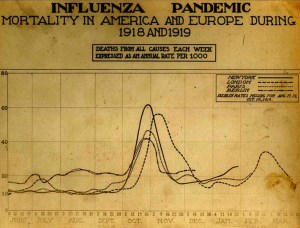
Ordinary flu strains prey most heavily on children, elderly, and those with compromised immune systems. Not this one. This flu would kick off a positive feedback loop between small proteins called cytokines, and white blood cells. This “cytokine storm” resulted in a death rate for 15-34 year olds 20 times higher in 1918, than in previous years. Perversely, it was their young and healthy immune systems that were most likely to kill them.
Physicians described the most viscous pneumonia they had ever seen, death often coming within hours of the first symptoms. There’s a story about four young, healthy women playing bridge well into the night. By morning, three were dead of influenza.
Over the next two years, this strain of flu infected one in every four people in the United States, killing an estimated 675,000 Americans. Eight million died in Spain alone, following an initial outbreak in May. Forever after, the pandemic would be known as the Spanish Flu.
In 1918, children skipped rope to a rhyme:
“I had a little bird, Its name was Enza. I opened the window, and in-flu-enza”.
In the trenches, the flu cut down combatants on every side. “Operation Michael”, the final, no holds barred German offensive that would determine the outcome of the war, launched from the Hindenburg line in March. Crown Prince Rupprecht wrote in August that “poor provisions, heavy losses, and the deepening influenza have deeply depressed the spirits of men in the 3rd Infantry Division”.
Some sources indicate that as many as half of the Americans killed in WWI, died of the flu.
The parades and parties following the cease fire in November threw gasoline on the fire. The end of war was a complete disaster from a public health standpoint. Millions more contracted the flu and thousands more died. President Wilson himself fell ill, while participating in 1919 treaty negotiations in Versailles.
Around the planet, the Spanish flu infected 500 million people. A third of the population of the entire world, at that time. Estimates run as high 50 to 100 million killed. For purposes of comparison, the “Black Death” of 1347-51 killed 20 million Europeans.
History has a way of swallowing some events whole, like they never happened. Today, the Spanish flu is all but overshadowed by the Great War, even though in the end, the flu pandemic of 1918-19 proved a far deadlier adversary, than the war itself.
Grant was in constant pain in his last year, as the cancer literally throttled the life from his body. He wrote at a furious pace despite his suffering, often finishing 25 to 50 pages a day. No re-writes, no edits. there was no time for that.
Hiram Grant was born in Point Pleasant, Ohio on April 27, 1822. His family called him by his middle name Ulysses, or sometimes just “Lyss”, for short.
A clerical error changed the name of the future Commander-in-Chief during his first days at the United States Military Academy at West Point. He didn’t seem to mind, though, probably thinking that “US Grant” was preferable to “H.U.G.”. Predictably, Grant became known as “Uncle Sam” or simply “Sam.” It was as good a name as any, though, as with future President Harry S. Truman, the “S” doesn’t actually stand for anything.
The 1862 Civil War Battle of Fort Donelson secured the name, when then-Brigadier General Ulysses S. Grant received a request for terms from the fort’s commanding officer, Confederate Brigadier General Simon Bolivar Buckner. Grant’s reply was that “no terms except an unconditional and immediate surrender can be accepted. I propose to move immediately, upon your works.” The legend of “Unconditional Surrender” Grant, was born.
Grant had been a light smoker before Donelson, generally preferring a pipe, if anything. A reporter spotted him holding an unlit cigar during the battle, a gift from Admiral Foote. Soon, ten thousand cigars were sent to him in camp. He gave away as many as he could, but it started the habit of smoking cigars that became one of his trademarks, and probably led to his death of throat cancer, in 1885.
On this day in 1864, President Abraham Lincoln signed a document promoting Ulysses S. Grant to the rank of Lieutenant General of the United States Army, officially putting then-Major General Grant in charge of all Union armies. Lincoln preferred Henry Wagner Halleck for the promotion, at the time fearing that Grant would challenge him for the 1864 Republican Presidential nomination. Lincoln submitted to the will of Congress only after Grant publicly dismissed the idea of running for President.
46 year old U.S. Grant would be elected the 18th President of the United States four years later, going on to serve two terms after becoming, at that time, the youngest man ever so elected.
Grant was a gifted writer. The penning of his autobiography is a story in itself. Gravely ill at the time and financially destitute, Grant knew with certainty that he was dying of throat cancer. The proceeds from his unwritten memoirs were his only means of supporting his family after his death.
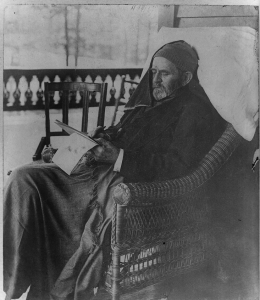
Grant was in constant pain in his last year, as the cancer literally throttled the life from his body. He wrote at a furious pace despite his suffering, often finishing 25 to 50 pages a day. No re-writes, no edits. There was no time for that. The writing of Grant’s two volume memoir was literally a race with death. Many of his wartime contemporaries felt that they received too little credit in Grant’s retelling of events, but that may be understood under the circumstances.
In June 1885, as the cancer spread through his body, the family moved to Mount MacGregor, New York, to make him more comfortable. Propped up on chairs and too weak to walk, Grant worked to finish the book as friends, admirers and even former Confederate adversaries, made their way to Mount MacGregor to pay their respects.
He finished the manuscript on July 18, 1885. Five days later, he was gone. On release, the book received universal critical praise. Mark Twain, who published the memoir, compared them to the Commentaries of Julius Caesar. Gertrude Stein admired the book, saying she could not think of Grant without weeping. Ulysses Grant’s memoirs quickly became a best seller, his family receiving 75% of the net royalties after expenses. The book would earn $450,000, over $10 million in today’s dollars, comfortably re-establishing the Grant family fortune.
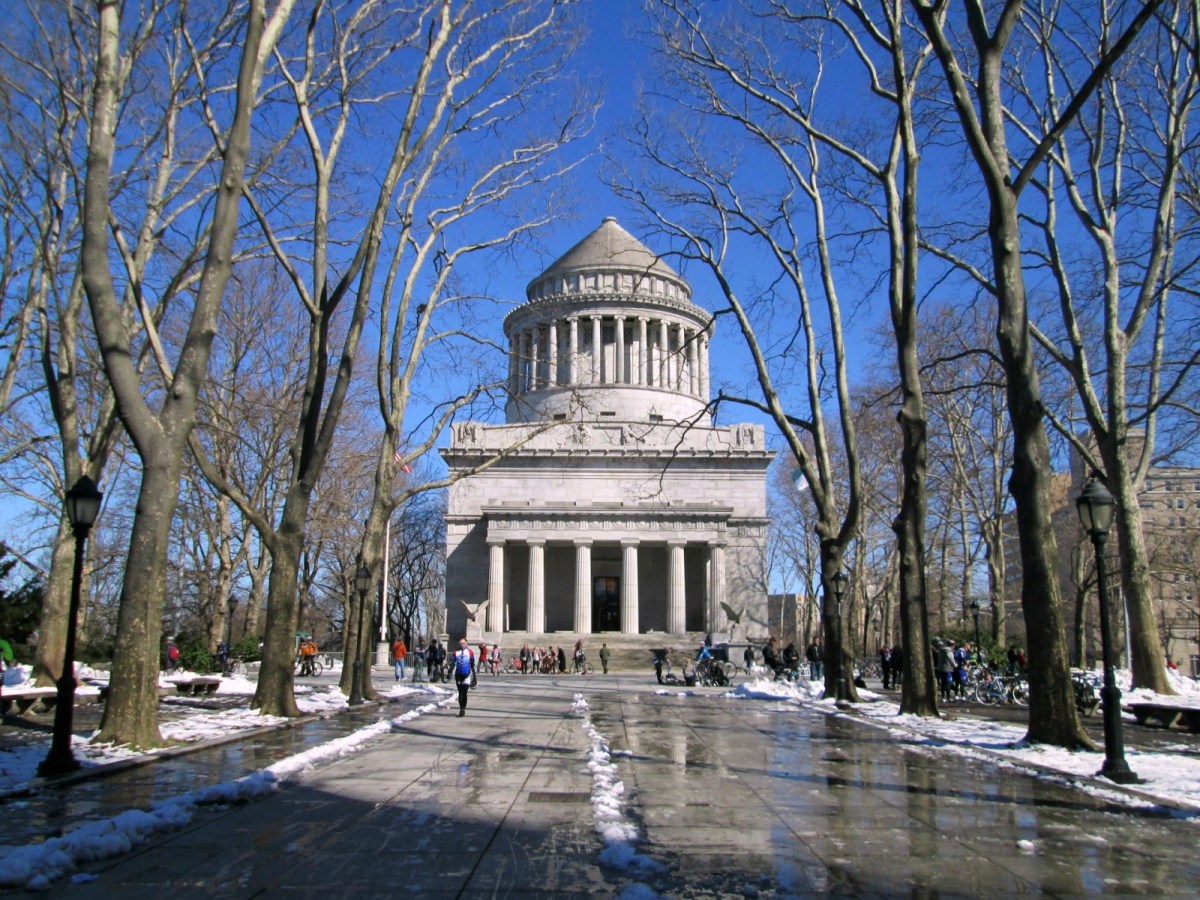
Grant’s wife Julia died on March 4, 1877, and was buried with her husband in Grant’s monumental tomb overlooking the Hudson River, in New York City.
Next time someone asks you who’s buried in Grant’s tomb, you can tell them that it’s Hiram Ulysses Grant. If you really want to show off, don’t forget to include his wife, Julia.


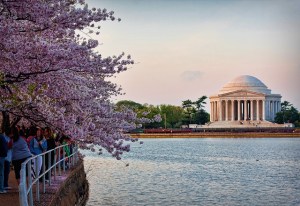
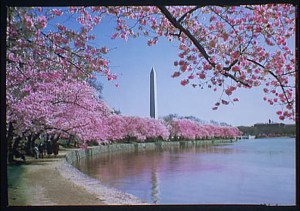 1934 city commissioners sponsored a three-day celebration of the late March blossoming cherry trees, which grew into the annual Cherry Blossom Festival.


 Abe became an inspirational symbol to the troops, like the battle flag carried with each regiment. Colonel Rufus Dawes of the Iron Brigade recalled, “Our eagle usually accompanied us on the bloody field, and I heard [Confederate] prisoners say they would have given more to capture the eagle of the Eighth Wisconsin, than to take a whole brigade of men.”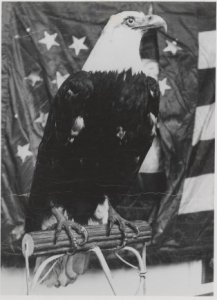


 After WWII, elements of the 101st Airborne were mobilized to Little Rock by President Eisenhower to protect the civil rights of the “Little Rock Nine”, a group of black students enrolled in Little Rock Central High School in September 1957, as the result of the US Supreme Court’s landmark ruling in the historic Brown v. Board of Education case.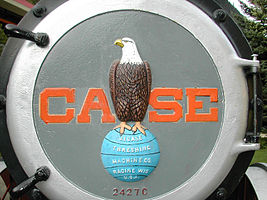


 At the turn of the century there were over 450 textile factories in Manhattan alone, employing something like 40,000 garment workers. Many of them were young, immigrant women of Jewish and Italian ethnicity, working nine hours a day on weekdays and seven on Saturdays. Wages were typically low: $7 to $12 per week, equivalent to $3.20 to $5.50 per hour, in 2016.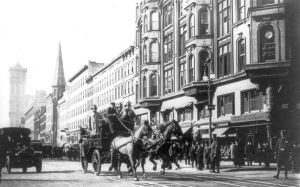


 100 years ago, “Sumerologists” labored to learn the customs and ways of this ancient civilization. One such team pieced together a stone tablet and, through years of study, managed to decipher the cuneiform words contained thereon.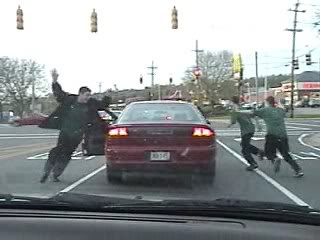


 In a later examination of Vivian, ERO field worker Dr. Arthur Estabrook pronounced her “feeble minded” saying that she “showed backwardness”, supporting the “three generations” theory expressed in the SCOTUS opinion.

 As with cartoonist Charles M Shulz, those who knew Jacob Rubenstein called him “Sparky”. Some say the nickname was due to a resemblance to “Sparkplug”, the old nag with the patchwork blanket, from the Snuffy Smith cartoon strip. Rubenstein hated the nickname and was quick to fight anyone who called him that. It may have been that quick temper, that made the name stick.
 prostitution. There were rumored associations with Mafia boss Santo Trafficante. The less-than-honest part of the Dallas police force knew that Ruby was always good for free booze, prostitutes, and other favors. This was one unsavory guy.
 Part of the roof had either blown off this joint, or burned off, depending on which version you read. Jack, the owner, tore off the rest of it and kept the insurance money, calling it the “Skyline Lounge”. There was no need to pay for security, even without the roof. Jack said “Boys, this building ain’t exactly secure enough for you to leave your musical equipment unattended.” Band members were told they’d best stay overnight, with guns, lest anyone come over the wall to steal their equipment. Problem solved.
 Half the country watched on live TV, as a man came out of the crowd, firing a single bullet from his .38 into the belly of Lee Harvey Oswald. Four musicians were shocked to realize the shooter was the man they had worked for months earlier, at that burned out dive bar. Jack Ruby.
 Jack Ruby was sentenced to death in the murder of Lee Harvey Oswald, on March 14, 1964. The Texas Court of Criminal Appeals overturned Ruby’s conviction in October 1966, on the grounds that the trial should have taken place in a different county than that in which his high profile crime had taken place. Ruby died of lung cancer the following January, while awaiting retrial.
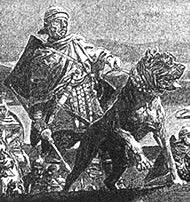 dogs of King Alyattes of Lydia killed some of his Cimmerian adversaries and routed the rest around 600BC, permanently driving the invader from Asia Minor in the earliest known use of war dogs in battle.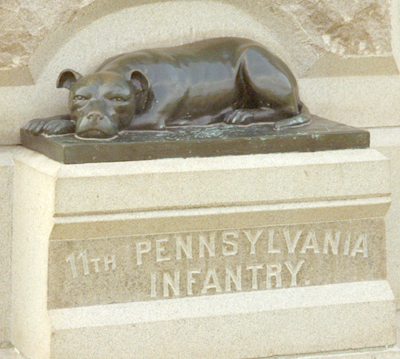

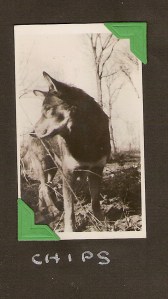 The most famous MWD of WWII was “Chips”, a German Shepherd assigned to the 3rd Infantry Division in Italy. Trained as a sentry dog, Chips broke away from his handler and attacked an enemy machine gun nest. Wounded in the process, his singed fur demonstrated the point-blank fire with which the enemy fought back. To no avail. Chips single-handedly forced the surrender of the entire gun crew.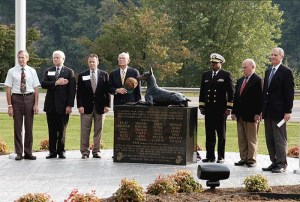


 The most famous rivalry in the soft drink business began in the 1930s, when Pepsi offered a 12oz bottle for the same 5¢ as Coca Cola’s six ounces.
 “no sacred cows” among their products. He meant it. The company launched the top secret “Project Kansas”, to test and perfect the flavor for a new version of Coke. The company’s marketing department fanned out, holding taste tests, surveys, and focus groups.
 On an April Friday in 1985, Coke let the media know that a major announcement was coming the following Tuesday. Coca Cola officials spent a busy weekend preparing for the re-launch, while Pepsi Executives announced a company-wide holiday, taking out a full page New York Times ad proclaiming that “Pepsi had Won the Cola Wars”.


 On the morning of March 11, 1918, most of the recruits at Fort Riley, Kansas, were turning out for breakfast. Private Albert Gitchell reported to the hospital, complaining of cold-like symptoms of sore throat, fever and headache. By noon, more than 100 more had reported sick with similar symptoms.
 within hours of the first symptoms. There’s a story about four young, healthy women playing bridge well into the night. By morning, three were dead of influenza.
 Around the planet, the Spanish flu infected 500 million people. A third of the population of the entire world, at that time. Estimates run as high 50 to 100 million killed. For purposes of comparison, the “Black Death” of 1347-51 killed 20 million Europeans.
 The 1862 Civil War Battle of Fort Donelson secured the name, when then-Brigadier General Ulysses S. Grant received a request for terms from the fort’s commanding officer, Confederate Brigadier General Simon Bolivar Buckner. Grant’s reply was that “no terms except an unconditional and immediate surrender can be accepted. I propose to move immediately, upon your works.” The legend of “Unconditional Surrender” Grant, was born.
 later, going on to serve two terms after becoming, at that time, the youngest man ever so elected.
 In June 1885, as the cancer spread through his body, the family moved to Mount MacGregor, New York, to make him more comfortable. Propped up on chairs and too weak to walk, Grant worked to finish the book as friends, admirers and even former Confederate adversaries, made their way to Mount MacGregor to pay their respects.
 Historical Easter Eggs - Today in History
You must be logged in to post a comment.