

There’s an old cliché that, if you speak with those who are convicted of a crime, all of them say they are innocent. It’s an untrue statement on its face, but there are only two possible conclusions in the alternative. Either all convicts are guilty as charged, or someone, at some time, has been wrongly convicted.
To agree with the former is to accept the premise that what government does is 100% right, 100% of the time.
Iva Ikuko Toguri was born in Los Angeles on July 4, 1916, the daughter of Japanese immigrants. She attended schools in Calexico and San Diego, returning to Los Angeles where she enrolled at UCLA, graduating in January, 1940 with a degree in zoology.
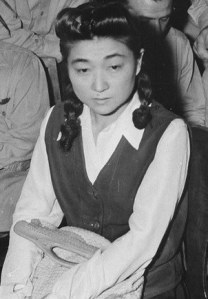
In July of the following year, Iva sailed to Japan without an American passport. She variously described the purpose of the trip as the study of medicine, and going to see a sick aunt. In September, Toguri appeared before the US Vice Consul in Japan to obtain a passport, explaining that she wished to return to permanent residence in the United States. Because she had left without a passport, her application was forwarded to the State Department for consideration. It was still on someone’s desk when Imperial Japan attacked Pearl Harbor, fewer than three months later.
Iva later withdrew the application, saying that she’d remain in Japan voluntarily for the duration of the war. She enrolled in a Japanese language and culture school to improve her language skills, taking a typist job for the Domei News Agency. In August 1943, she began a second job as a typist for Radio Tokyo.
In November of that year, Toguri was asked to become a broadcaster for Radio Tokyo on the “Zero Hour” program, part of a Japanese psychological warfare campaign designed to lower the morale of US Armed Forces. The name “Tokyo Rose” was in common use by this time, applied to as many as 12 different women broadcasting Japanese propaganda in English. Toguri DJ’d a program with American music punctuated by Japanese slanted news articles for 1¼ hours, six days a week, starting at 6:00pm Tokyo time. Altogether, her on-air speaking time averaged 15-20 minutes for most broadcasts.
Toguri called herself “Orphan Annie,” earning 150 yen per month (about $7.00 US). She wasn’t a professional radio personality, but many of those who later recalled hearing her enjoyed the program, especially the music.
Shortly before the war ended, Toguri married Felipe Aquino, a Portuguese citizen of Japanese-Portuguese ancestry. The marriage was registered with the Portuguese Consulate, though she didn’t renounce her US citizenship, continuing her Zero Hour broadcast until after the war was over.
 After the war, a number of reporters were looking for the mythical “Tokyo Rose”, and two of them found Iva Aquino. They were Henry Brundidge and Clark Lee, and they offered her a significant sum for her story. The money never materialized, but she signed a contract giving the two rights to her story, and identifying herself as Tokyo Rose.
FBI.gov states on its “Famous Cases” website that, “As far as its propaganda value, Army analysis suggested that the program had no negative effect on troop morale and that it might even have raised it a bit. The Army’s sole concern about the broadcasts was that “Annie” appeared to have good intelligence on U.S. ship and troop movements”.
US Army authorities arrested her in September, while FBI and the Army Counterintelligence investigated her case. By the following October, authorities decided that the evidence did not merit prosecution, and she was released.
Matters may have ended there, except for the public outcry that accompanied Aquino’s return to the US. Several groups, along with the noted broadcaster Walter Winchell, were outraged that the woman they knew as “Tokyo Rose” wanted to return to this country, instead demanding her arrest on treason charges.
Department of Justice sent attorneys to Japan to interview witnesses, one of whom was the reporter, Henry Brundidge. Once again quoting FBI.gov, “Problematically, Brundidge enticed a former contact of his to perjure himself in the matter”.
The trial began on July 5, 1949, lasting just short of three months. The jury found Aquino guilty on one of fifteen treason charges, ruling that “[O]n a day during October, 1944, the exact date being to the Grand Jurors unknown, said defendant, at Tokyo, Japan, in a broadcasting studio of the Broadcasting Corporation of Japan, did speak into a microphone concerning the loss of ships.”
Aquino was sentenced to ten years and fined $10,000 for the crime of treason, only the seventh person in US history to be so convicted. She was released from the Federal 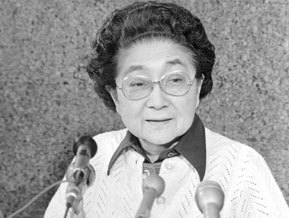 Reformatory for Women at Alderson, West Virginia in 1956, having served six years and two months of her sentence.
President Gerald Ford pardoned her on January 19, 1977, 21 years almost to the day after her release from prison. Iva Toguri Aquino passed away in 2006, at the age of 90. Neither perjury nor suborning charges were ever brought against Brundidge or his witness.


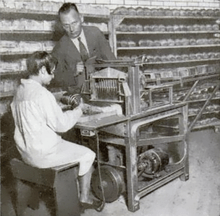 The project almost ended in a fire in 1917, when the prototype was destroyed along with the blueprints. Rohwedder soldiered on, by 1927 he had scraped up enough financing to rebuild his bread slicer.
 Article 1, Section 8 of the Constitution includes the “Commerce Clause”, permitting the Congress “To regulate Commerce with foreign Nations, and among the several States, and with the Indian Tribes”. That’s it. The Federal District Court sided with the farmer, but the Federal government appealed to the US Supreme Court, arguing that, by withholding his surplus from the interstate wheat market, Filburne was effecting that market, and therefore fell under federal government jurisdiction under the commerce clause.
 government had a billion bushels of wheat stockpiled at the time, about two years’ supply, and the amount of steel saved by not making bread slicers has got to be marginal, at best.


 were pulled on May 28, 1941, while the liner was at Saint Thomas in the US Virgin Islands. The ship had been called into service by the United States Navy, and ordered to return to Newport News.
 During her service to the United States Navy, West Point was awarded the American Defense Service Medal, American Campaign Medal, European-African-Middle Eastern Campaign Medal, Asiatic-Pacific Campaign Medal, and World War II Victory Medal.
 adrift in foul seas, running aground in the Canary Islands the following day.


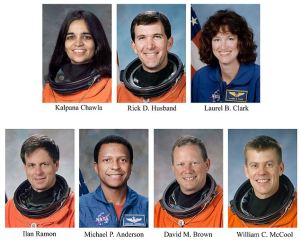 STS-107 launched from the Kennedy Space Center aboard the Space Shuttle Columbia on January 16, 2003. A piece of insulating foam broke away from the external fuel tank eighty seconds after launch, striking Columbia’s left wing and leaving a small hole in the carbon composite tiles along the leading edge. Three previous Space Shuttle missions had experienced similar damage and, while some engineers thought this one could be more serious, they were unable to pinpoint the precise location or extent of the damage. NASA managers believed that, even if there had been major damage, little could be done about it.
 Payload Specialist Colonel Ilan Ramon, born Ilan Wolferman, was an Israeli fighter pilot and the first Israeli astronaut to join the NASA space program. Colonel Ramon’s mother is an Auschwitz survivor, his grandfather and several family members killed in the Nazi death camps. In their memory, Ramon carried a copy of “Moon Landscape”, a drawing by 14 year old holocaust victim Petr Ginz, depicting what the boy thought earth might look like from the moon. Today, there are close to 84,000 pieces of Columbia and assorted debris, stored in the Vehicle Assembly Building at the Kennedy Space Center. To the best of my knowledge, that drawing by a 14 year old boy who never made it out of Auschwitz, is not among them.

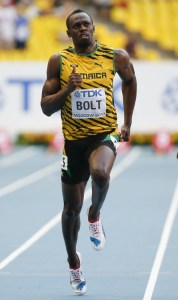 Roger Bannister became the first human to run a sub-four minute mile on May 6, 1954, with an official time of 3 minutes 59.4 seconds. The Jamaican sprinter Usain Bolt is recorded as the fastest man who ever lived. At the 2009 World Track and Field Championships, Bolt ran 100 meters at an average 23.35 mph from a standing start, and the 20 meters between the 60 & 80 markers at an average 27.79 mph.
 smashing the elevated train tracks on Atlantic Ave and hurling entire buildings from their foundations. Horses, wagons, and dogs were caught up with broken buildings and scores of people as the brown flood sped across the North End. Twenty municipal workers were eating lunch in a nearby city building when they were swept away, parts of the building thrown fifty yards. Part of the tank wall fell on a nearby fire house, crushing the building and burying three firemen alive.
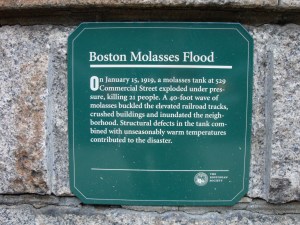 In 1983, a Smithsonian Magazine article described the experience of one child: “Anthony di Stasio, walking homeward with his sisters from the Michelangelo School, was picked up by the wave and carried, tumbling on its crest, almost as though he were surfing. Then he grounded and the molasses rolled him like a pebble as the wave diminished. He heard his mother call his name and couldn’t answer, his throat was so clogged with the smothering goo. He passed out, then opened his eyes to find three of his four sisters staring at him”.


 William Phipps, somewhere around the time when his own wife was accused of witchcraft. This is the story as it’s commonly told, but the real origin of the late 17th century witchcraft hysteria started in Boston, four years earlier.
 Robert Calef, a Boston merchant who knew her, said “Goody Glover was a despised, crazy, poor old woman, an Irish Catholick who was tried for afflicting the Goodwin children. Her behavior at her trial was like that of one distracted. They did her cruel. The proof against her was wholly deficient. The jury brought her guilty. She was hung. She died a Catholick.” After the hanging, a contemporary wrote that the crowd wanted to destroy her cat as well, “but Mr. Calef would not permit it”.
 would not survive the witchcraft hysteria of 1692.


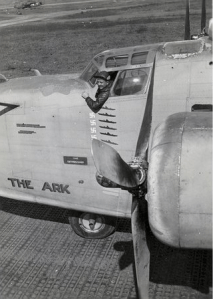
 Later in the same conflict, an Iraqi Hughes 500 helicopter was taken out by bombs dropped from an American Air Force F-15E bomber. At least one Iraqi PC-7 Turboprop pilot got spooked, bailing out of a perfectly good aircraft before a shot was fired in his direction.


 Earhart worked at a variety of jobs from photographer to truck driver, earning money to take flying lessons from pioneer female aviator Anita “Neta” Snook. She bought a second hand Kinner Airster in 1921, a bright yellow biplane she called “The Canary”, and flew it to 14,000’ the following year, a world altitude record for female pilots.
 low on fuel on July 2, 1937, and then she vanished. The four million dollar search and rescue effort which followed was the most expensive in history, but to no avail. Earhart and Noonan were never seen again.
 robber crab or palm thief, Birgus latro is the largest terrestrial hermit crab in the world, weighing up to 9lbs and measuring over 3′ from leg tip to leg tip.

 birth of a son. The Tsarevich Alexei Nikolayevich. The public was informed of the happy news with a 301 gun salute from the cannons of the Peter and Paul Fortress. Those hopes would be dashed in less than a month, when the infant’s navel began to bleed. It continued to bleed for two days, and took all the doctors at the Tsar’s disposal to stop it.
 exception. The bleeding episodes suffered by the Tsarevich were often severe, despite his parents never ending attempts to protect him. Doctors’ efforts were frequently in vain, and Alexandra turned to a succession of quacks, mystics and “wise men” for a cure.
 Influential people approached Nicholas and Alexandra with dire warnings, leaving dismayed by their refusal to listen. According to the Royal Couple, Rasputin was the only man who could save their young son Alexei. By 1916 it was clear to many in the nobility. The only course was to kill Rasputin, before the monarchy was destroyed.
 nothing to fear for your children, they will reign for hundreds of years in Russia…[I]f it was your relations who have wrought my death…none of your children or relations will remain alive for two years. They will be killed by the Russian people…”
 Historical Easter Eggs - Today in History
You must be logged in to post a comment.