October 28, 1944 Mascot

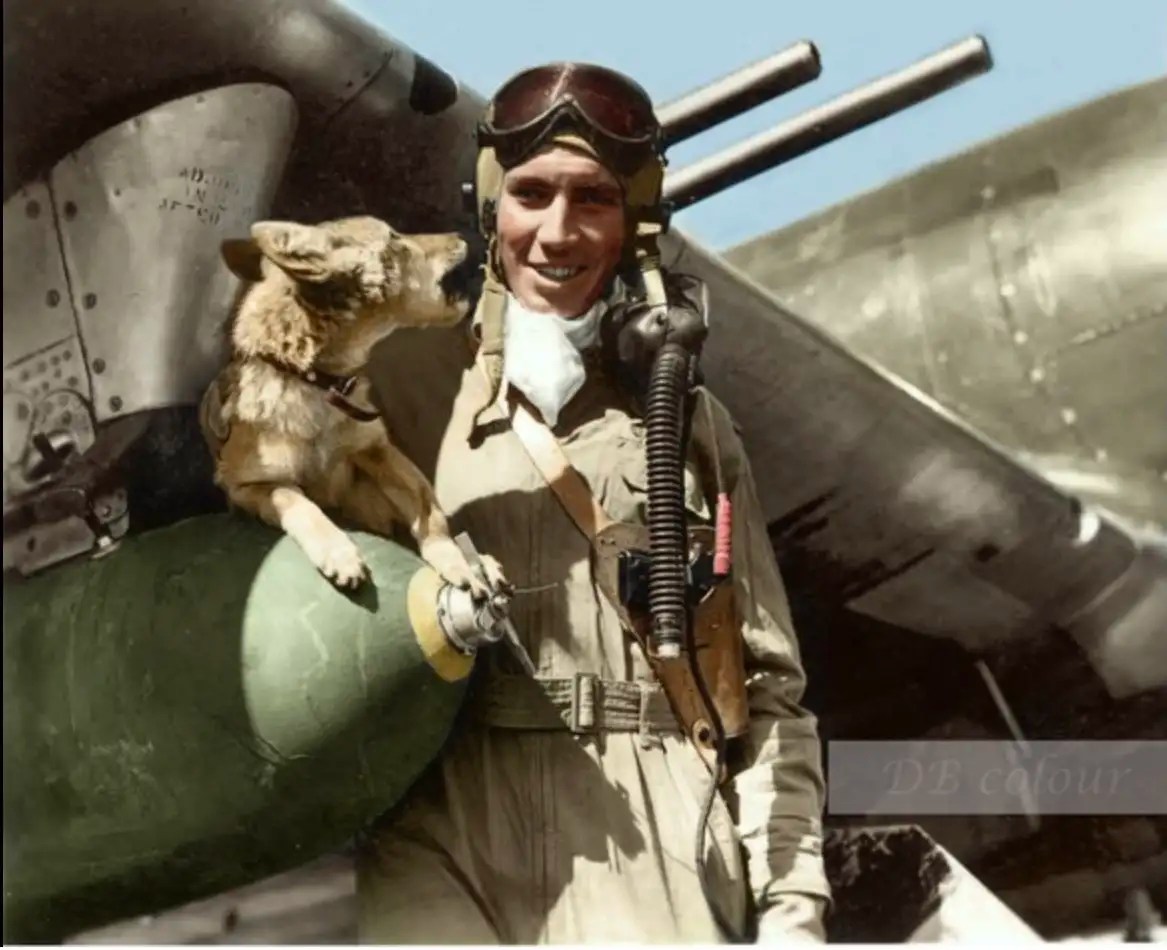
The “war to end wars” had Jackie the Baboon and Whiskey & Soda, the lion cub mascots of the Lafayette flying corps. World War II and Wild Bill Crump had Jeep, the only four-legged co-pilot to serve in the war to retake Europe.

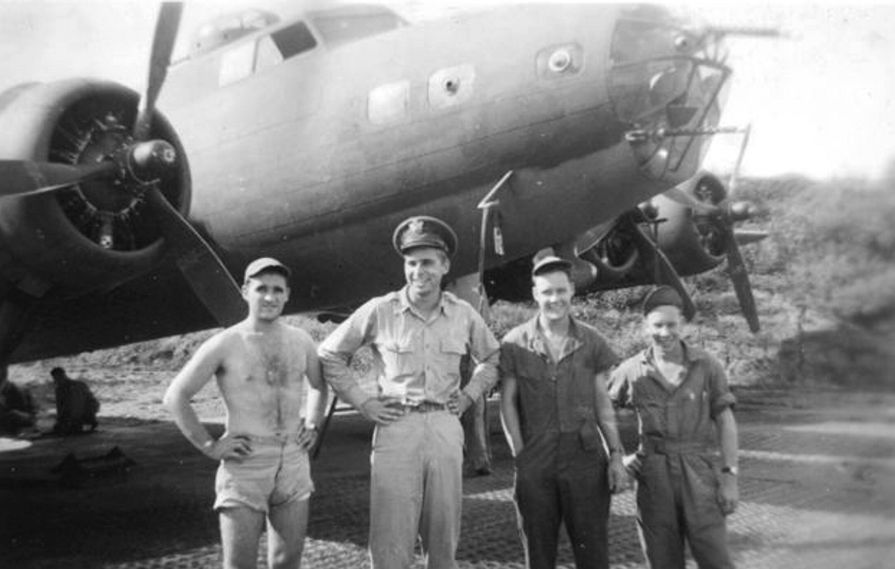
John William “Wild Bill” Crump was born in 1924 in the village of Opportunity, Washington. From the age of 5 he seemed destined for the air, his first flight with his father at the stick.

The world was at war in 1944, and badly in need of pilots. Wild Bill Crump arrived at Harding Field, Nebraska at the age of 20 to complete pilot training.

He came upon the most unlikely of co-pilots while earning his wings. Abandoned and alone, it was a two-week-old puppy. A young coyote in need of a home.

“Eugene the Jeep” came to public attention some eight years before that, part of the Popeye cartoon strip by E.C. Segar (rhymes with cigar).

Eugene was a dog-like of character with the magical power to go, just about anywhere. 

Popeye

In the early phase of World War II, military contractors labored to develop an off-road vehicle. It had to be capable of going anywhere, or close to it.  Like Popeye’s sidekick Eugene, the General Purpose GP (“Jeep”) was just the thing.  Eventually, the name stuck.

You see this coming, right? Crump named his new sidekick, “Jeep”.

Next came Baton Rouge. Training on the iconic P-47. The P-47 was a high-altitude fighter-bomber, the foremost ground attack aircraft of the American war effort in WW2.

P-47 cockpits were built for one, but regulations said nothing about a coyote.

So it was, there in Baton Rouge the pair learned to work together. When orders came for England, there was little question of what was next. The luxury liner RMS Queen Elizabeth was serving as a troop ship. No one would notice a little coyote pup smuggled on-board.

Next came RAF Martlesham Heath Airfield in Ipswich, England and the 360th fighter squadron, 359th fighter group.

Jeep became the unit mascot complete with his own “dog tags”, and vaccination records. He’d often entertain the airmen taking part in howling contests.

Curled up in the cockpit, Jeep came along on no fewer than five combat missions.  One time, a series of sharp barks warned the pilot of incoming flak.

Wild Bill Crump survived the war, reenlisting in a time for the Berlin airlift. He later piloted for Bob Hope and the Les Brown Band, entertaining the troops in Berlin. Sadly, his co-pilot and battle buddy did not. On October 28,1944, a group of children brought the animal to school. Left tied to a tree he slipped his bonds, attempting to return home. It was raining at the time. Visibility was poor. Jeep was hit and killed by a military vehicle while returning to base.

Crump went on to fly 77 missions aboard the P51 Mustang “Jackie,” named after his high school sweetheart.  The fuselage bore the image of a coyote in honor of his late co-pilot.

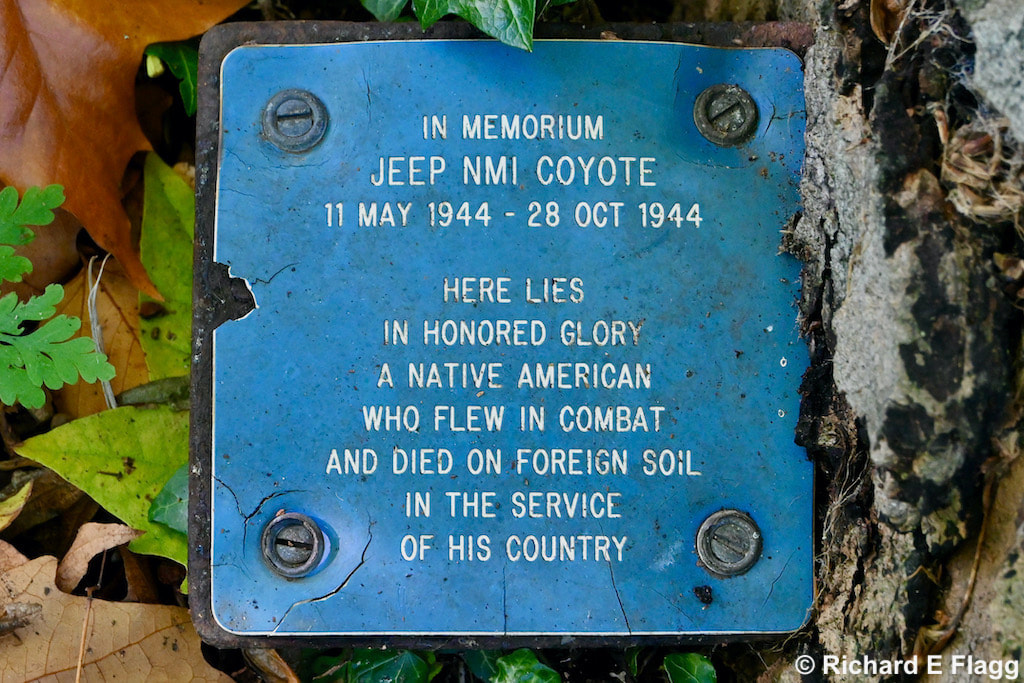
Jeep was buried with full military honors. A plaque marks his grave on the grounds of Playford Hall, an Elizabethan mansion dating back to 1590 and located in Ipswich, England.

As long as men have made war, animals have come along. And not just working animals. Archaeological evidence demonstrates that, when Norsemen went a’ Viking, they did so in the company of house cats. The idea may be amusing, but why not? Men at sea need food, and food attracts vermin. The Viking ship’s cat was literally a life saver.

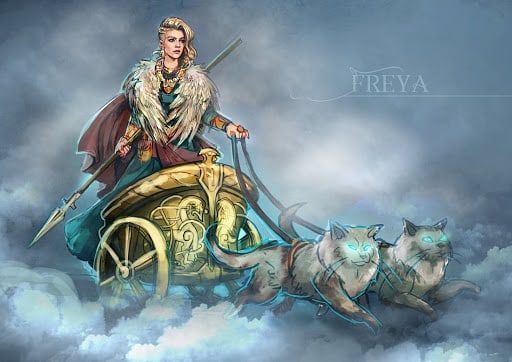
Fun fact: The Norse goddess Freya traveled in a carriage drawn by cats.

In ancient Skandinavian cultures, companion animals were laid to rest in elaborate burial mounds complete with favorite toys and treats. The Greeks and Romans of antiquity commissioned carved epitaphs expressing gratitude and deep sorrow over the loss of pets. Millions of animals did their part in the world wars. Jackie the Baboon helped fight the Great War as did Whiskey & Soda, the lion cub mascots of the Lafayette flying corps. “Vojtek” the Siberian brown bear accompanied Polish troops during World War 2.

Some 16 million Americans served in the Armed Services during World War 2. Nearly 300,000 were pilots. Only one of them, fighting to liberate Europe from the Nazi horde, was a coyote.

October 27, 1962 Archipov

Anyone alive on or after this day in 1962, probably owes their life to one man. I wonder how many remember his name.

Come join me for a moment, in a thought experiment.  A theater of the mind.

Imagine. Two nuclear superpowers, diametrically opposed, armed to the teeth and each deeply distrustful of the other. We’re talking here, about October 1962. The Cuban Missile Crisis. Now imagine at the height of the standoff, a misunderstanding leads some fool to push the button. The nuclear first strike is met with counterattack and response in a series of ever-escalating retaliatory launches.

You’ve seen enough of human nature. Counterattacks are all but inevitable, right? Like some nightmare shootout at the OK corral, only this one is fought with kiloton-sized weapons. Cities the world over evaporate in fireballs. Survivors are left to deal with a shattered, toxic countryside and nuclear winter, without end.

Are we talking about an extinction event? Possibly. Terrible as it is, it’s not so hard to imagine, is it?

In 1947, members of the Science and Security Board of the Bulletin of Atomic Scientists envisioned a “Doomsday Clock”. A symbolic clock face, dramatizing the threat of global nuclear catastrophe.  Initially set at seven minutes to midnight, the “time” has varied from seventeen minutes to two.

The Cuban Missile Crisis of October 1962 didn’t make it onto the doomsday clock. Those 13 days went by far too quickly to be properly assessed. And yet, the events of 62 years ago brought us closer to extinction than at any time before or since.

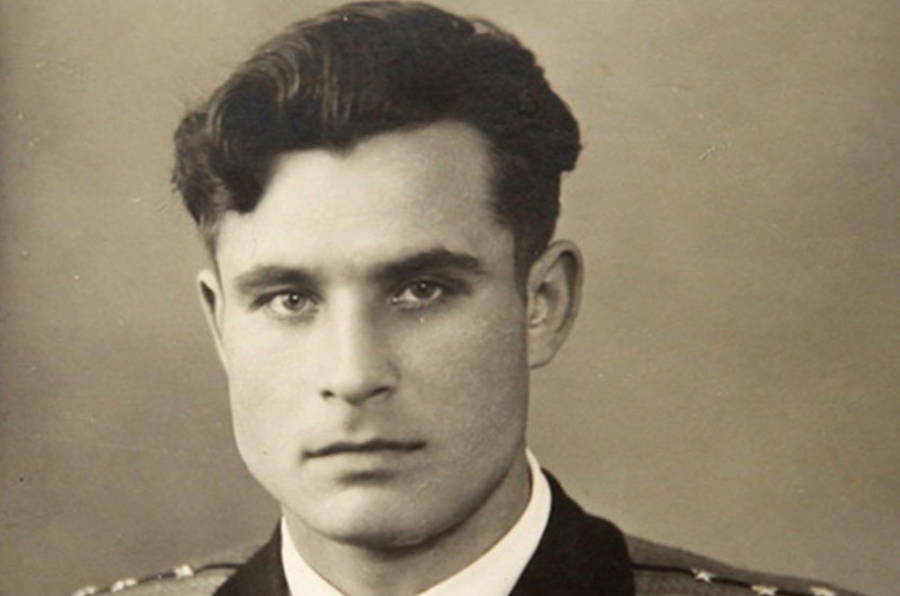
On this day in 1962, an unsuspecting world stood seconds away from the abyss. The fact that we’re here to talk about it came down to one man, Vasili Arkhipov. Many among us have never heard his name. Chances are very good that we can thank him for our lives.

As WW2 gave way to the nuclear age, Cold War military planners adopted a policy of “Deterrence”. “Mutually Assured Destruction” (MAD). Soviet nuclear facilities proliferated across the “Eastern Bloc”, while US nuclear weapons dispersed across the NATO alliance. By 1961 some 500 US nuclear warheads were installed in Europe, from West Germany to Turkey, Italy to Great Britain.

Judging President Kennedy weak and ineffective, communist leaders made their move in 1962, signing a secret arms agreement in July. Medium-range ballistic missiles with a range of 2,000 miles were headed to the Caribbean basin.

By mid- October, US reconnaissance aircraft revealed Soviet ballistic nuclear missile sites under construction Cuba. 90 miles from American shores. President John F. Kennedy warned of the “gravest consequences”, ordering a blockade of the island nation. Relations turned to ice as Soviet military vessels joined the standoff.

Tensions dialed up to 11 on October 27, when USAF Major Rudolph Anderson’s U-2 reconnaissance aircraft was shot down over the village of Veguitas. His body still stapped into his ejection seat.

Wreckage of Major Rudolf Anderson Jr.’s U2 at the Museo del Aire, Havana, Cuba H/T theaviationgeekclub.com

The US Navy practiced a submarine attack protocol at that time, called “hunt to exhaustion”. Anatoly Andreev described what it was like to be on the receiving end:

“For the last four days, they didn’t even let us come up to the periscope depth … My head is bursting from the stuffy air. … Today three sailors fainted from overheating again … The regeneration of air works poorly, the carbon dioxide content [is] rising, and the electric power reserves are dropping. Those who are free from their shifts, are sitting immobile, staring at one spot. … Temperature in the sections is above 50 [122ºF].”

I’m not sure I could think straight under conditions like that.

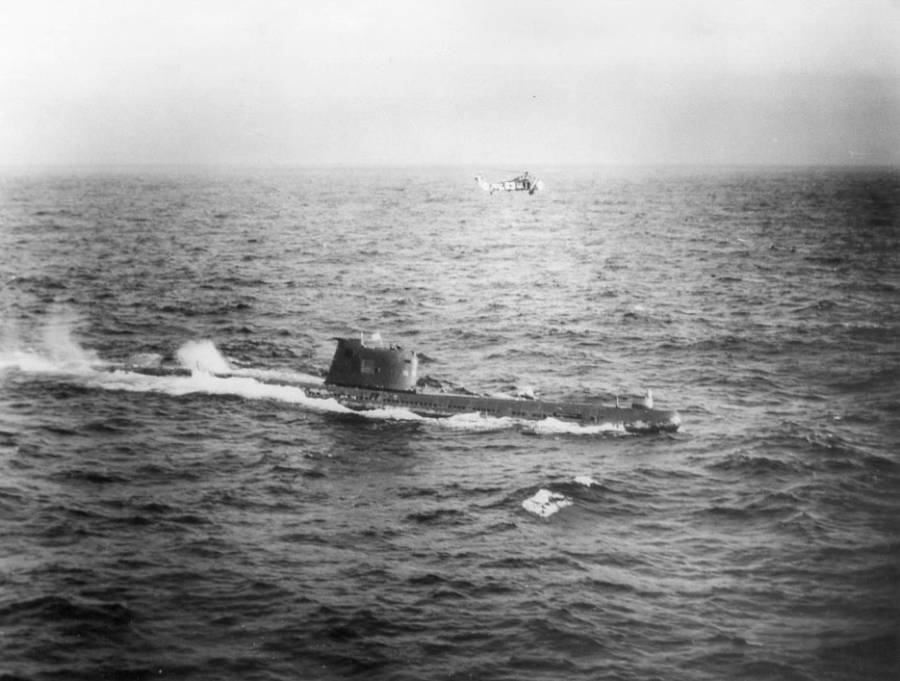
On the 27th, US Navy destroyers began to drop depth charges. This was not a lethal attack, intending only to bring the sub to the surface. Deep under the water, captain and crew had no way of knowing that. B-59 had not been in contact with Moscow for several days. Now depth charges were exploding to the left and right. Captain Valentin Savitsky made his decision. Convinced that war had begun, the time had come for the “special weapon”. “We’re gonna blast them now!,” he reportedly said. “We will die, but we will sink them all – we will not become the shame of the fleet.” Political officer Ivan Maslennikov concurred. Send it.

On most nuclear-armed Soviet submarines, two signatures were all that was needed. With Chief of (submarine fleet) Staff officer Vasili Archipov on board, the decision required approval by all three senior officers. To Archipov, this didn’t feel like a “real” attack. What if they’re only trying to get us to the surface?

Archipov said no.

Perhaps it was his role in averting disaster aboard the nuclear-powered submarine K-19, the year before. Maybe it was his calm, unflappable demeanor when Captain Savitsky had clearly “lost his temper”. Somehow, Archipov was able to keep his head together under unimaginable circumstances and convince the other two. B-59 came to the surface to learn that, no. World War III had not begun after all.

The submarine went quietly on its way. Kruschev announced the withdrawal of Soviet missiles the following day. The Cuban Missile Crisis was over.

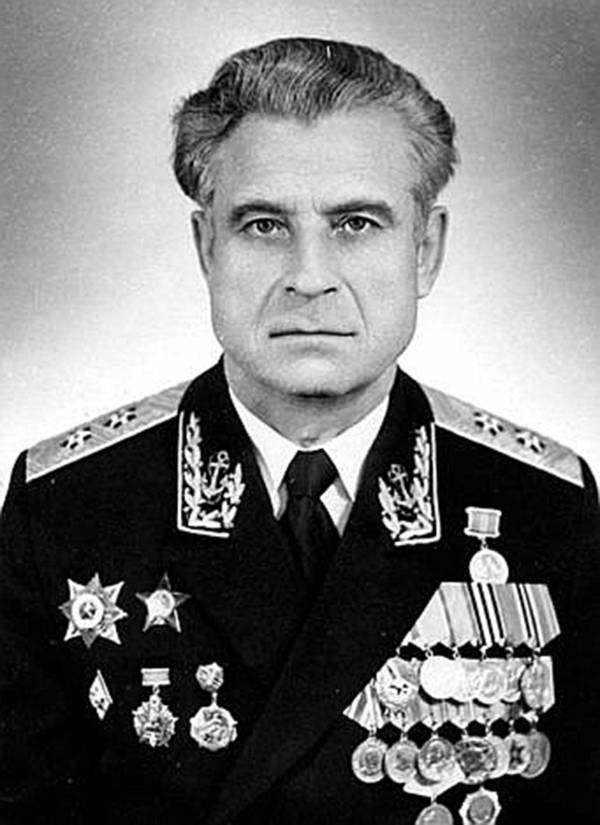
Vasily Aleksandrovich Arkhipov

These events wouldn’t come to light for another 40 years.

B-59 crewmembers were criticized on returning to the Soviet Union. One admiral told them “It would have been better if you’d gone down with your ship.”

Vasily Aleksandrovich Arkhipov retired from the submarine service in 1988 and died, ten years later. Cause of death was kidney cancer, likely the result of radiation exposure sustained during the K-19 incident, back in 1961.

Lieutenant Vadim Orlov was an intelligence officer back in 1962, onboard the B-59. In 2002, then Commander Orlov (retired) gave Archipov full credit for averting nuclear war. Former U.S. Defense Secretary Robert McNamara said in 2002 “We came very, very close, closer than we knew at the time.” Historian Arthur Schlesinger Jr. was an advisor to President Kennedy. “This was not only the most dangerous moment of the Cold War”, he said. “It was the most dangerous moment in human history.”

September 22, 1776 Nathan Hale

The Connecticut schoolteacher was young and untried when he placed is confidence in the wrong place. It would prove to be a fatal mistake.

The nine Hale brothers of Coventry, Connecticut supported the Patriot side from the earliest days of the American Revolution. Five of them participated in the battles at Lexington and Concord. Nathan was the youngest and destined to be the most famous of them all. He was still at home at this time, finishing out the term of a teaching contract in New London, Connecticut.

Nathan Hale’s unit participated in the siege of Boston. Hale himself joined General George Washington’s army in the spring of 1776, as the army moved to Long Island to block the British move on the strategically important port city of New York.

On June 29, General Howe appeared off Staten Island with a fleet of 45 ships. By the end of the week, he’d assembled an overwhelming fleet of 130.

There was an attempt at peaceful negotiation on July 13, when General Howe sent a letter to General Washington under flag of truce. The letter was addressed “George Washington, Esq.”, intentionally omitting Washington’s rank. Washington declined to receive the letter, responding that there was no one present by that address. Howe tried the letter again on the 16th, this time addressing “George Washington, Esq., etc., etc.”. Again, Howe’s letter was refused.

The following day, General Howe sent Captain Nisbet Balfour in person to ask if Washington would meet with Howe’s adjutant, Colonel James Patterson. Considerations of honor having thus been settled, a meeting was scheduled for July 20.

Patterson told Washington that General Howe had come with powers to grant pardons.  Washington refused, saying “Those who have committed no fault want no pardon”.

Patriot forces were comprehensively defeated at the Battle of Brooklyn, fought on August 27, 1776. With the Royal Navy in command on the water, Howe’s army dug in for a siege, confident that the adversary was trapped and waiting to be destroyed at their convenience.

On the night of August 29-30, Washington withdrew his army to the ferry landing and across the East River, to Manhattan.

With horse’s hooves and wagon wheels muffled, oarlocks stuffed with rags, the Patriot army withdrew even as a rearguard tended fires, convincing the redcoats in their trenches that the Americans were still there.

The surprise was comprehensive for the British side, on waking on the morning of the 30th.  The Patriot army had vanished.

The Battle of Long Island would almost certainly have ended in disaster for the Patriot cause but for that silent evacuation over the night of August 29-30, one of the great military feats of the American revolution.

Following evacuation, the Patriot army found itself isolated on Manhattan island, virtually surrounded.  Only the thoroughly disagreeable current conditions of the Throg’s Neck-Hell’s Gate segment of the East River prevented Admiral Sir Richard Howe (William’s brother) from enveloping Washington’s position, altogether.

Expecting a British assault in September, General Washington became increasingly desperate for information on British movements.

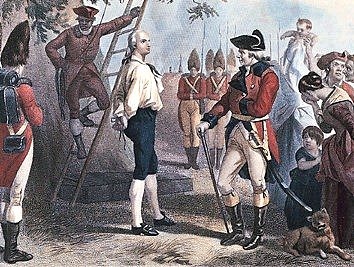
Nathan Hale Capture

Washington asked for volunteers for a dangerous mission, to go behind enemy lines as a spy.  Up stepped a volunteer.  His name was Nathan Hale.

Hale set out on his mission on September 10, disguised as a Dutch schoolmaster. He was successful for about a week but appears to have been something less than “street smart”.  The young and untrained Patriot turned spy, bestowed his trust where it did not belong.

Major Robert Rogers was an old British hand, a leader of Rangers during the earlier French and Indian War. Rogers must have suspected that this Connecticut schoolteacher was more than he pretended to be, intimating that he himself was a spy in the Patriot cause.

Hale took Rogers into his confidence, believing the two to be playing for the same side.  Consider Tiffany, a British loyalist and Barkhamsted Connecticut shopkeeper was himself a sergeant of the French and Indian War. Tiffany recorded what happened next in his journal:

The time being come, Captain Hale repaired to the place agreed on, where he met his pretended friend” (Rogers), “with three or four men of the same stamp, and after being refreshed, began [a]…conversation. But in the height of their conversation, a company of soldiers surrounded the house, and by orders from the commander, seized Captain Hale in an instant. But denying his name, and the business he came upon, he was ordered to New York. But before he was carried far, several persons knew him and called him by name; upon this he was hanged as a spy, some say, without being brought before a court martial.”

“Stay behind spy” Hercules Mulligan had better success, reporting on British goings-on from the 1776 capture of New York to their withdrawal seven years later.  But that must be a story for another day.

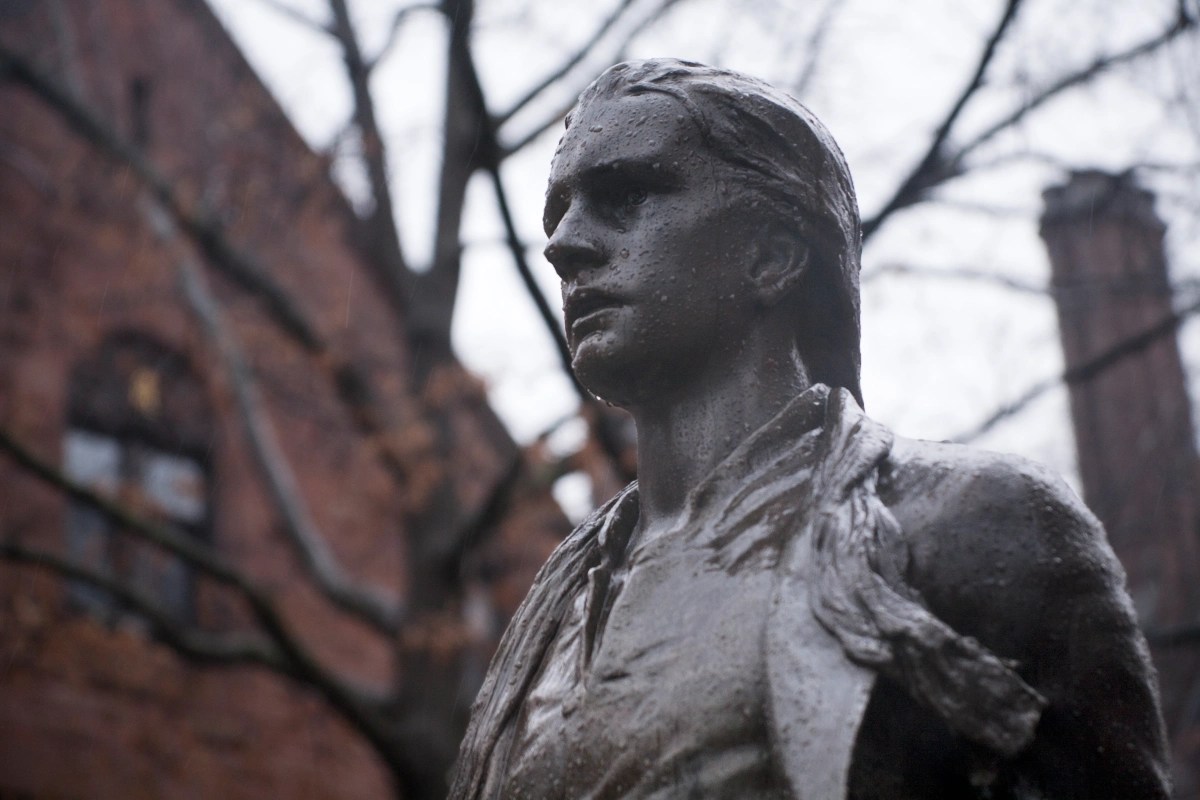
Nathan Hale was hanged on this day in 1776, described by CIA.gov as “The first American executed for spying for his country”.

There is no official account of Nathan Hale’s final words. However, an eyewitness statement from British Captain John Montresor exists. He was present at the hanging.

Montresor spoke with American Captain William Hull the following day under flag of truce.  The captain gave Hull the following account: “‘On the morning of his execution,’ said Montresor, ‘my station was near the fatal spot, and I requested the Provost Marshal to permit the prisoner to sit in my marquee, while he was making the necessary preparations. Captain Hale entered: he was calm, and bore himself with gentle dignity, in the consciousness of rectitude and high intentions. He asked for writing materials, which I furnished him: he wrote two letters, one to his mother and one to a brother officer.’ He was shortly after summoned to the gallows. But a few persons were around him, yet his characteristic dying words were remembered. He said, ‘I only regret, that I have but one life to lose for my country‘.

Nathan Hale was barely three months past his 21st birthday on the day he died.

September 21, 1780 André

He asked not that his life be spared, but only that he be executed by firing squad. A death considered worthy of a gentleman of the age and not hanging, an end reserved for thieves and scoundrels.

In an age before radio or television, John André was an interesting man to be around. A gifted storyteller with a great sense of humor he could draw, paint and cut silhouettes. He was an excellent writer, he could sing, and he could write verse.  John André was a British Major at the time of the American Revolution, who took part in his army’s occupations of Philadelphia and New York.

John André was a spy.

A favorite of colonial era loyalist society, Major André dated Peggy Shippen for a time, the daughter of a prominent Philadelphia loyalist. Shippen went on to marry Benedict Arnold in 1779, forming a link between the spy and an important general in the cause of American independence.

Hat tip artist Dale Watson for this image of Peggy Shippen

The relationship nearly changed the outcome of the American revolution.

Arnold was the Commandant of West Point at the time, the future location of one of our great military academies. A prominence overlooking the Hudson River, West Point was a fortified position offering decisive military advantage to the side holding the position. The British capture of West Point would have split the colonies in half.

The author (left) on a 2022 “history ramble” weekend with family members. It doesn’t take a military strategist to understand the importance of West Point’s commanding position over the Hudson River.

The Sloop of War HMS Vulture sailed up the Hudson River on September 20, 1780, Major André meeting with General Arnold on the river’s banks the following day. Dressed in civilian clothes, John André struck a bargain with the patriot general. Arnold would receive £20,000, over a million dollars today, in exchange for which he would give up West Point.

Tasked with returning the signed papers to British lines, Major André was stopped by three Patriot Militiamen two days later. They were John Paulding, David Williams and Isaac Van Wart. One of the three wore a Hessian overcoat, making André believe they might be loyalists. “Gentlemen”, he said, “I hope you belong to our party”. “What party”, came the reply, and André said “The lower (British) party”. “We do”, they said, to which André replied that he was a British officer and must not be detained. That was as far as he got.

You need not be a military strategist to recognize the importance of the commanding heights at West Point. The discovery of those papers brought Benedict Arnold’s treachery to light. Arnold immediately fled on hearing of André’s arrest, even as George Washington was headed to his place for a meeting over breakfast.

John André was tried and sentenced to death as a spy. He asked if he could write a letter to General Washington.  In it he asked not that his life be spared, but that he be executed by firing squad, a death more worthy of a gentleman than hanging, an execution at that time commonly reserved for criminals.

General Washington believed that Arnold’s crimes to be far more egregious than those of John André. Furthermore, he was impressed with the man’s courage.  Washington wrote to General Sir Henry Clinton asking for an exchange of prisoners.

Having received no reply, Washington wrote in his General Order of October 2 “That Major André General to the British Army ought to be considered as a spy from the Enemy and that agreeable to the law and usage of nations it is their opinion he ought to suffer death. The Commander in Chief directs the execution of the above sentence in the usual way this afternoon at five o’clock precisely.”

John André was executed by hanging in Tappan, New York. He was 31.

A vintage postcard illustration depicting the execution of Major John Andre, hung as a spy for aiding and abetting General Benedict Arnold during the American Revolutionary War in Trenton, New Jersey on 2nd October 1780, published in New York, circa 1903. Andre’s body was later disinterred from American soil and buried in Westminster Abbey, London. (Photo by Paul Popper/Popperfoto via Getty Images)

John André lived for a time in Benjamin Franklin’s house back in 1777-’78, during the British occupation of Philadelphia. As he was packing to leave, Geneva-born American patriot and portrait artist Pierre-Eugène Du Simitiere came to say goodbye. The officer was always known as a gentleman. Simitiere was shocked to find André stoop to looting the home of such a prominent patriot. For a man known for extravagant courtesy, this was way out of character. André was packing books, musical instruments and scientific apparatus, even an oil portrait of Franklin, offering not so much as a response to Simitiere’s protests.

Nearly two hundred years later, the descendants of Major-General Lord Charles Grey returned the painting to the United States, explaining that André had probably looted Franklin’s home under direct orders from the General himself. A Gentleman always, it would explain the man’s inability to defend his own actions.

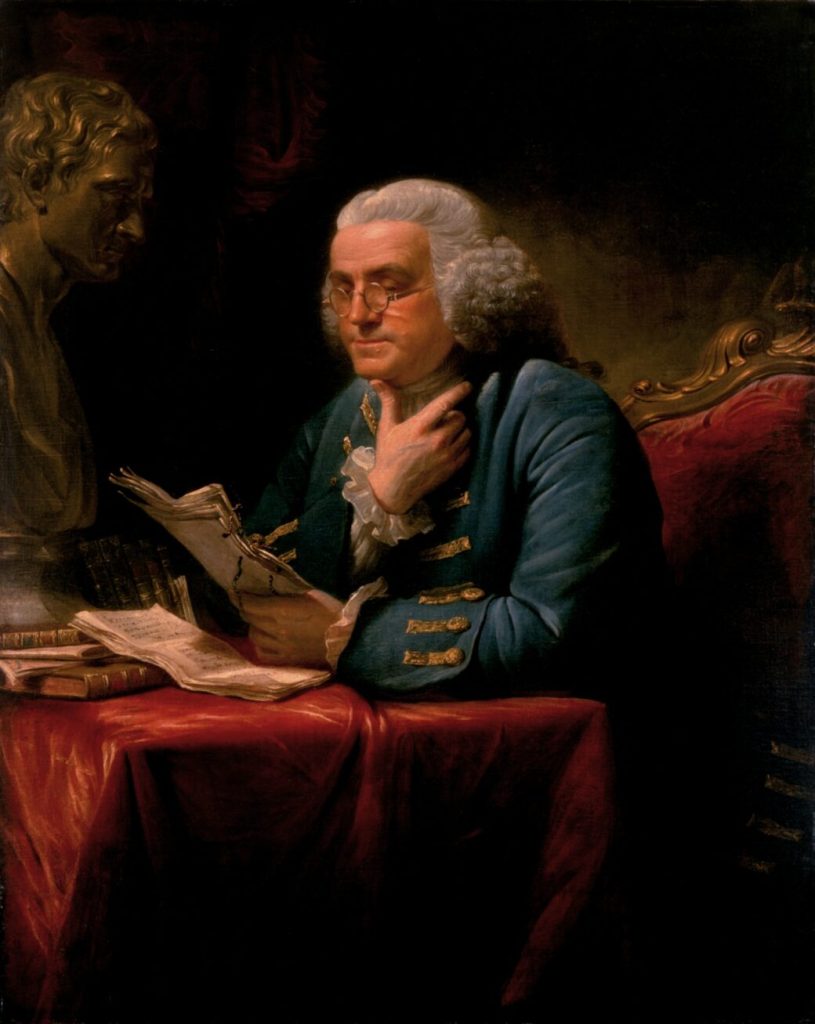
Today that oil portrait of Benjamin Franklin hangs in the White House.

Benedict Arnold went on to lead British forces against his former comrades. As the story goes, Arnold once asked one of his officers what the Americans might do should he (Arnold) be captured. The officer replied: “They will cut off the leg which was wounded when you were fighting so gloriously for the cause of liberty, and bury it with the honors of war, and hang the rest of your body on a gibbet.”

The story refers to a grievous injury the turncoat general received at the Battle of Saratoga, heroically leading patriot infantry against a position remembered as Breymann redoubt. It was the second time a bullet had shattered the general’s leg in service to the Revolution. Arnold walked with a pronounced limp for the rest of his life.

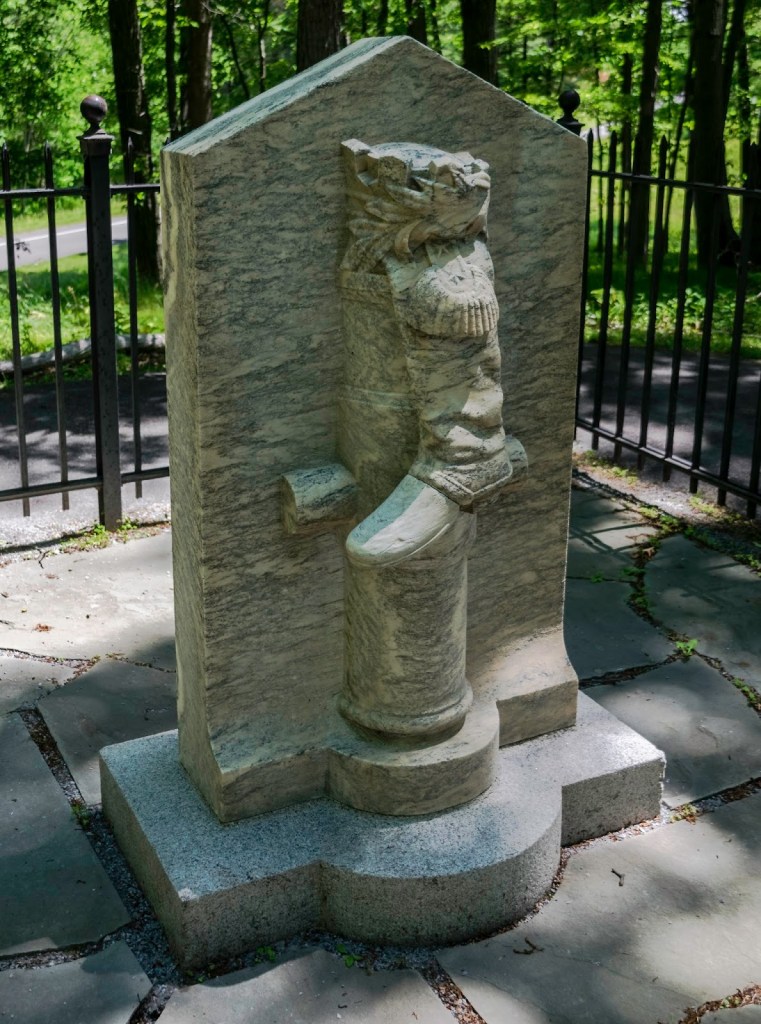
On the grounds near the battlefield at Saratoga there stands the statue of a cannon’s barrel, and a leg. An officer’s boot, really, dedicated to a Hero of the Revolution. The cannon’s barrel is pointed down as a sign of dishonor. The monument declines to give this hero a name.

It is one of the most forlorn places I have ever seen.

August 29, 1893  Need to Know

The president’s surgery on board the yacht Oneida remains to this day a wonder to oral surgeons, and enough to make the rest of us squirm.

During the summer of 1921, 39-year-old Franklin Delano Roosevelt was enjoying family vacation time at Campobello Island off the Atlantic coast. On August 10, he complained of fever and chills and took to bed. The condition persisted for weeks. Four physicians attended the future president of the United States.  The diagnosis, poliomyelitis.

Roosevelt spent the rest of his life in a wheelchair, able to stand only for brief and painful moments with the help of leg braces. For an unprecedented four terms in office, the press went to great lengths to deemphasize if not hide altogether the president’s disability.


On October 2, 1919, a near fatal stroke left President Woodrow Wilson incapacitated, unable to speak or to move. First Lady Edith Wilson jealously guarded her husband’s condition from the press and the president’s opponents, blocking access and screening presidential paperwork, sometimes even signing the president’s name without his knowledge or consent.  Edith herself denied usurping the presidency, claiming only to be acting as “Steward”.

If you were around in 1978, you may remember the cringeworthy media coverage of Jimmy Carter’s hemorrhoids, raising the question of what’s in the legitimate public interest and what if any right does a president have to any sense of personal dignity, let alone privacy.

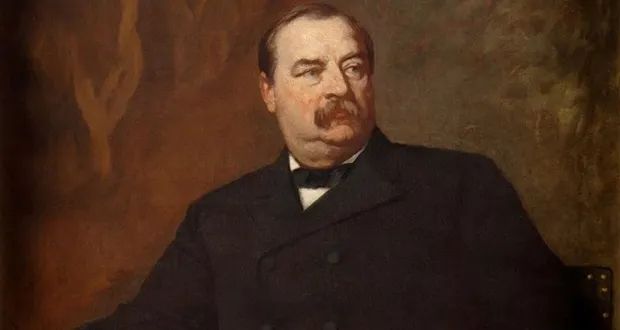
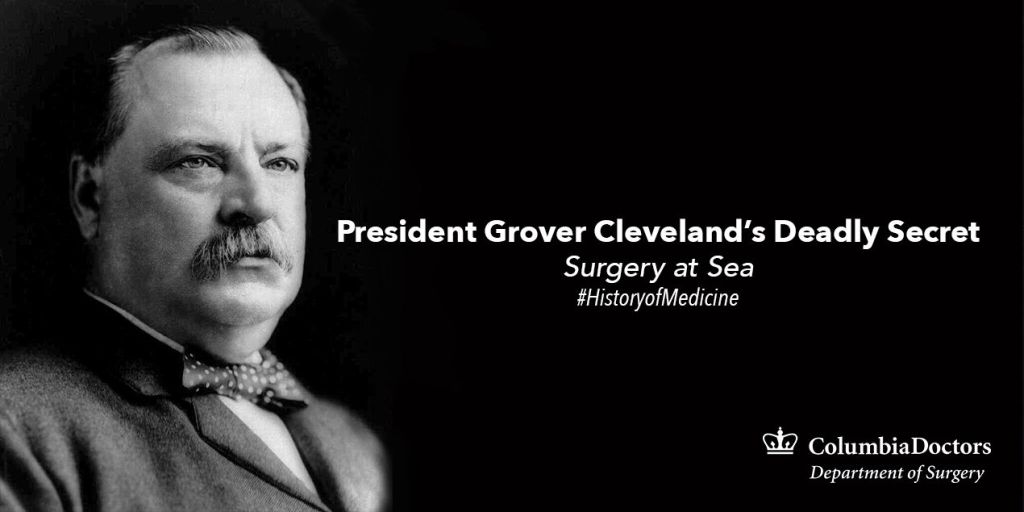
Fun fact:  The only former executioner ever elected President of the United States, Stephen Grover Cleveland is remembered for being the only president before Donald John Trump, to serve non-consecutive terms.  The 22nd and 24th president of the United States was also something of a medical miracle.

President Cleveland’s second inauguration took place during the Panic of 1893, the worst economic downturn in American history until the great depression. The nation suffered vast unemployment. Countless businesses closed their doors.  The railroad industry was devastated.  With the nation struggling, many looked to a new chief executive for hope and guidance.

Early in his second term, Cleveland noticed a bumpy patch on the roof of his mouth.   The president’s personal physician, Joseph Bryant, took one look and pronounced  “It’s a bad looking tenant… I would have it evicted immediately”.

The health of the famously rotund, cigar chomping president was already a matter of public concern. Cleveland feared a cancer diagnosis would set off a panic.  The tumor would have to be removed and the procedure kept secret.

The only answer to the prying eyes of the press was to do it on the move, and to leave no scar.  President Cleveland  announced a four-day vacation aboard the private yacht Oneida, a cruise through Long Island Sound to Buzzard’s Bay and on to the President’s summer home Gray Gables, on Cape Cod.

What followed is enough to amaze an oral surgeon and to make the rest of us squirm. On July 1, 1893, the President was strapped to a chair and anesthetized with ether.  The tumor extended through the hard palate and upper jaw extending nearly to the left eye socket. A surgical team of six removed nearly the entire left side of the upper jaw along with five teeth and the tumor as the yacht moved through calm seas in Long Island Sound. 

The operation took ninety minutes.  There was no external incision. It was all done through the president’s mouth. The trademark mustache remained undisturbed. Later on, Cleveland was fitted with a rubber prosthesis, restoring the president’s speech and hiding extensive facial disfigurement.

The procedure was carried out in strict secrecy but didn’t remain that way for long. On August 29, 1893, reporter Elisha Jay Edwards of the Philadelphia Press broke the story of a presidential surgery too bizarre to be true. White house staff denied the story, launching a coordinated smear campaign against the journalist. Even Oneida’s steward stuck to the story, declaring the president never missed a meal on his summer cruise. Other newspapers piled on, denouncing Edwards as a “liar” and a “disgrace to journalism”.

A medical miracle for its time, what had transpired onboard Oneida remained secret until 1917.  Nine years after Cleveland’s death.

One of the foremost newspapermen of the age, Elisha Edwards was ruined, struggling just to find work over the next fifteen years. The newspaperman wouldn’t see his reputation restored for another 24 years.

To this day, there remains no clear standard as to what is in the public interest to know, and where lies the individual’s right, president or not, to a modicum of privacy.

August 21, 1986  When Lakes Explode

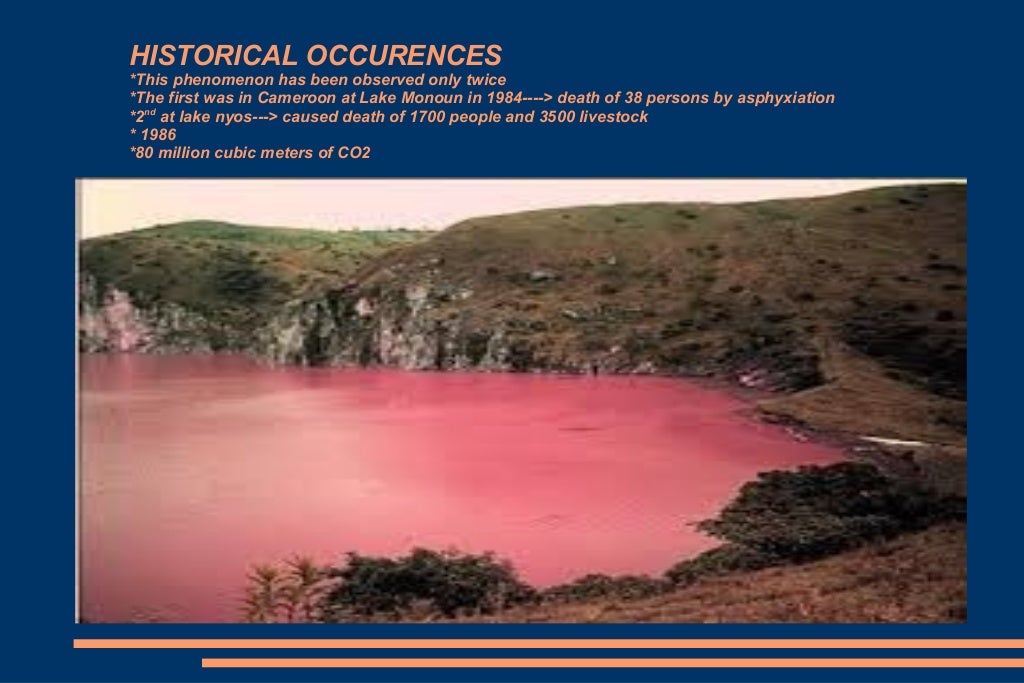
Think about the explosive force of a beer or a soda can shaken before opening. Now imagine 80 million cubic meters of that stuff coming out of solution.

On August 15, 1984, villagers in the Central African nation of Cameroon made a grisly discovery.

Lake Monoun lies near the center of a volcanic field containing some 34 recent craters. Survivors reported a loud sound at 10:30 that night. The next morning, dozens of dead lay strewn about near the lake

Two men riding atop a truck carrying ten other passengers told the unlikeliest of tales, how the truck itself died along with the ten people inside, and yet these two survived.

Hat tip U.S. Geological Survey – Dead cattle, pictured after the Lake Nyos disaster of 1986.

Local speculation centered around a release of toxic volcanic gases.  37 dead were laid to rest.  The living moved on. 

Two years later, a similar but vastly larger event took place at nearby Lake Nyos, killing 1,746 and some 3,500 livestock.  This time, the world took notice.

Thirty-nine years ago today, a man walking near Lake Nyos in northwest Cameroon discovered dozens of dead animals. Approaching a nearby village, there wasn’t another living creature for miles around.

There was no sign of struggle. People, livestock, wildlife. Even the insects had lay down where they were and just… died.

The culprit was a rare and little understood phenomenon called a limnic eruption.

With a depth of nearly 700 feet, Lake Nyos’ water column is relatively stable due to a climate that rarely warms above 90° Fahrenheit, or cools below 70°.  Over the years, volcanic activity causes carbon dioxide to seep into the frigid depths of the lake.  A warm upper layer covers the surface to the extent that sunlight penetrates the brown waters of the crater.

Over time, dissolved Co2 becomes an explosive time bomb waiting only for a landslide, an earthquake, or simply a critical mass of gas.

Limnic eruption

1.6 million tons of the stuff exploding to the surface in the dead of night and racing across the ground.  Being heavier than air, the suffocating cloud swept along valleys and low lying areas, asphyxiating all in its path.  As far as 15 miles from the lake.  Survivors described feelings of weakness followed by a loss of consciousness.

It’s why those two guys survived sitting on top of the truck.  Co2 is heavier than air.

Only three lakes in the world contain the requisite geology and climate to threaten another limnic eruption. All three are located in the northwest corner of the African nation of Cameroon.

May 18, 1965  Boldly Going where No Man has Gone Before

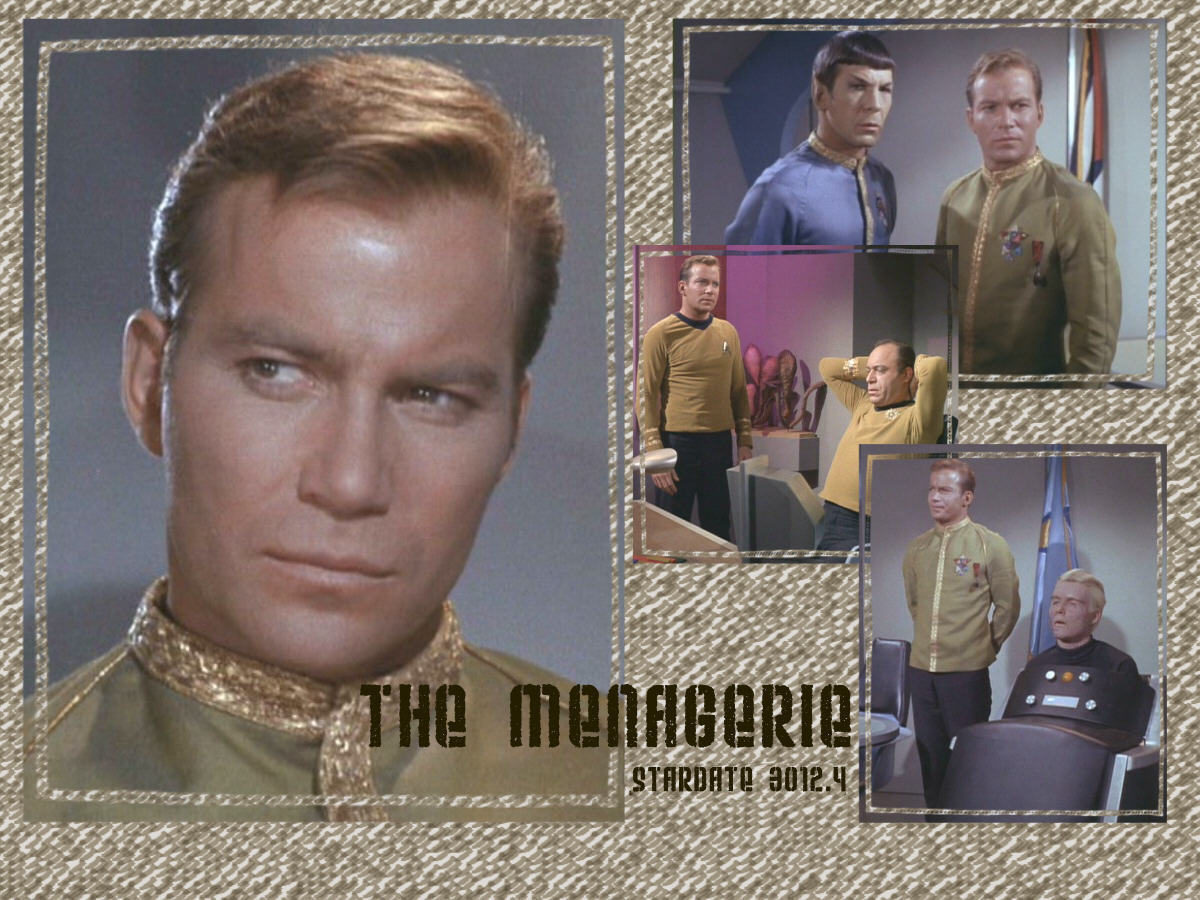
Many years from now a boy will be born on March 22, 2233, in Riverside, Iowa.  Destined to become the youngest captain in Star Fleet history, he would boldly go where no man has gone before.  But first, he needed a name.

On May 18, 1965, a World War II fighter pilot, veteran of 89 combat missions named Gene Roddenberry, offered several suggestions.  16 to be exact, among which were Hannibal, Timber, Flagg and Raintree.

Roddenberry decided on James T. Kirk, based on a journal entry of the 18th century British explorer, Captain James Cook: “ambition leads me … farther than any other man has been before me”.

Kirk was killed in 2329 on the Enterprise (B), after the ship was eaten by a Nexus energy ribbon on its maiden voyage. Only he didn’t die, because Jean-Luc Picard found him alive in the timeless Nexus, negotiating hotel deals for Priceline.com.

Or something like that.

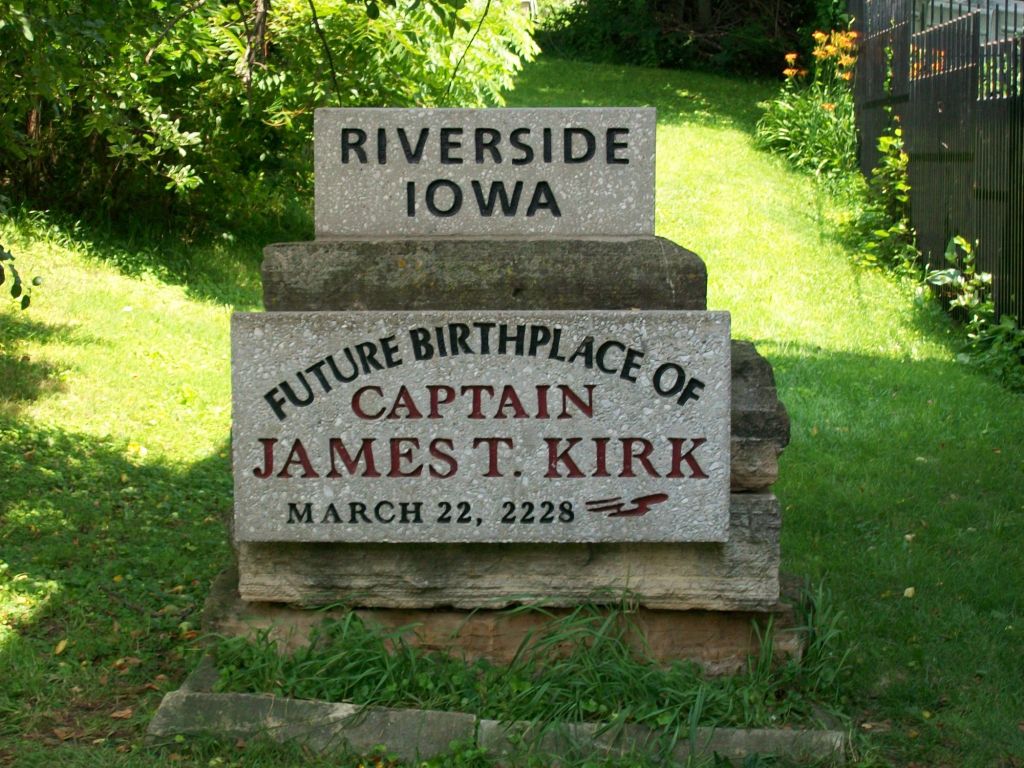
In his 1968 book “Making of Star Trek”, Gene Roddenberry says that James Kirk was born in a small town in Iowa. Full-time Trekkie and part-time Riverside Councilman Steve Miller thought “Why not Riverside”. In 1985, Miller moved that Riverside declare itself the Future Birthplace of James T. Kirk.  The motion passed unanimously.

Just like that, the official slogan went from “Where the best begins” to “Where the Trek begins.”  The annual summer festival… that changed from “River Fest” to “Trek Fest”.

The Riverside connection became Holy Writ when the 2009 film Star Trek identified the place as Kirk’s hometown. Today there is a granite monument in Riverside, population 963, declaring itself the “Future Birthplace of Captain James T. Kirk.

Oh… In case you wanted to know what the “T” stands for… it’s Tiberius.

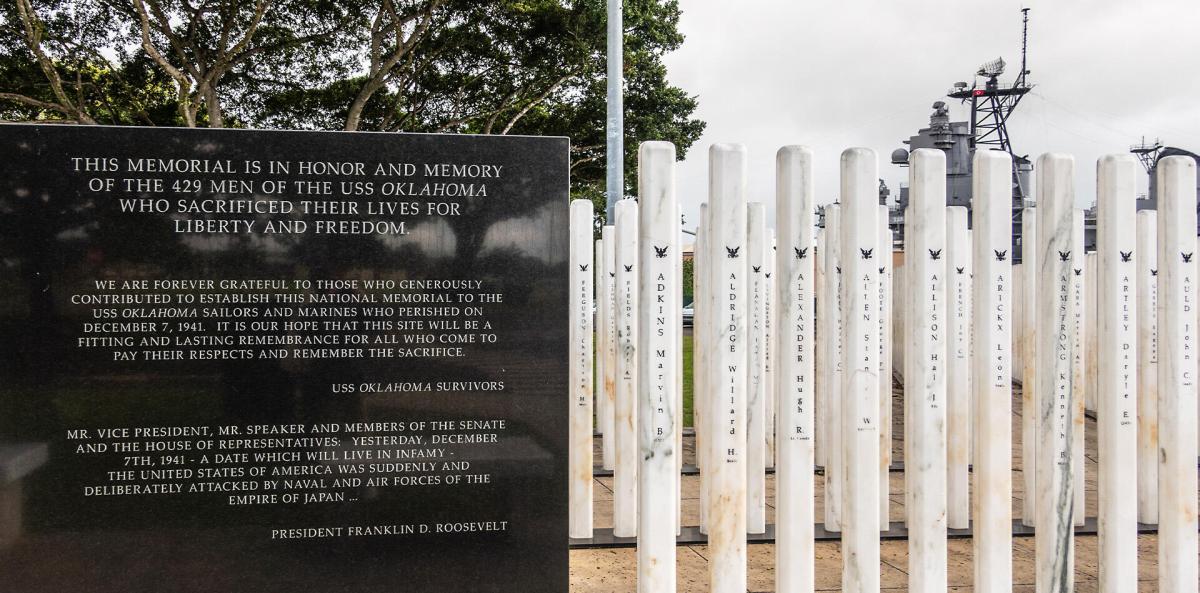
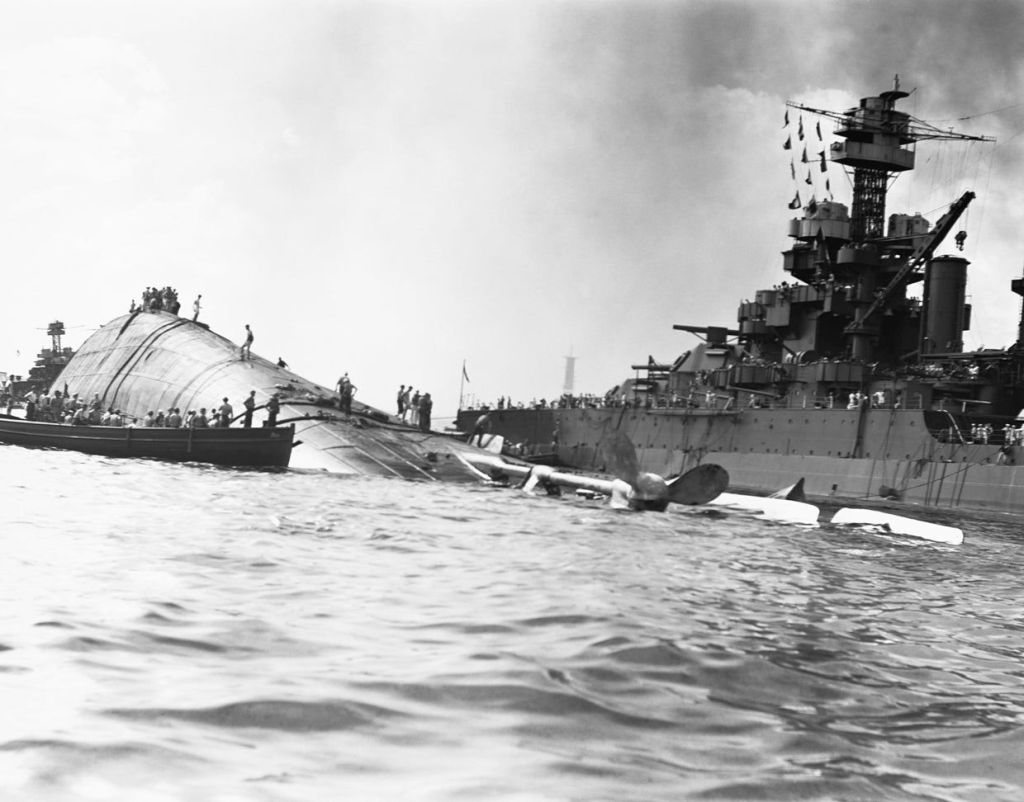
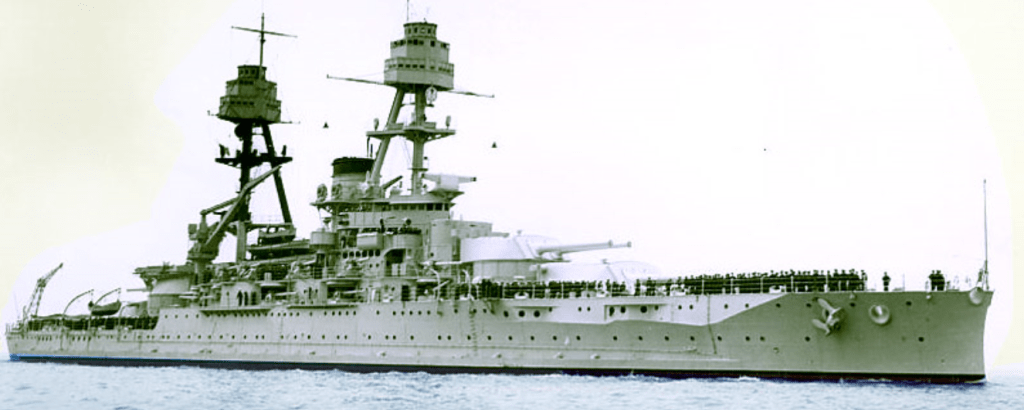
May 17, 1947  The Last Voyage of the USS Oklahoma

The only US warship ever named after the 46th state, she was destroyed in an enemy sneak attack before she knew she was at war.

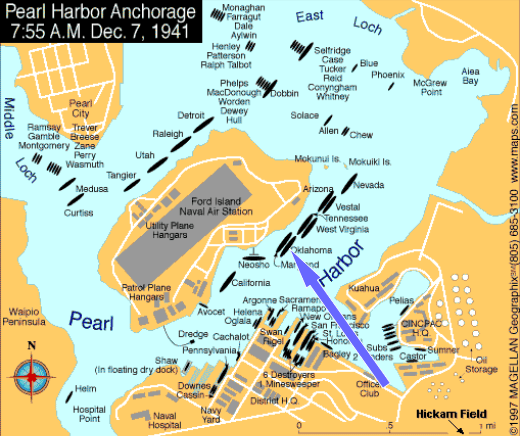
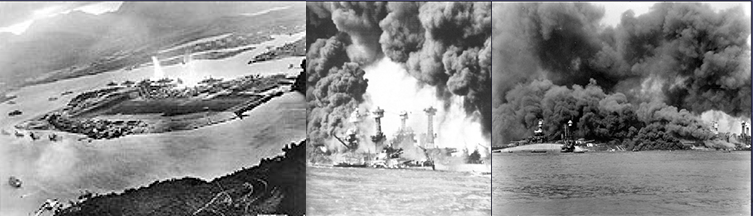
It was literally out of the blue when the first wave of enemy aircraft arrived at 7:48 local time, December 7, 1941.  353 Imperial Japanese warplanes approached in two waves out of the southeast, fighters, bombers, and torpedo planes, across Hickam Field and over the waters of Pearl Harbor.  Tied in place and immobile, the eight vessels moored at “Battleship Row” were easy targets.

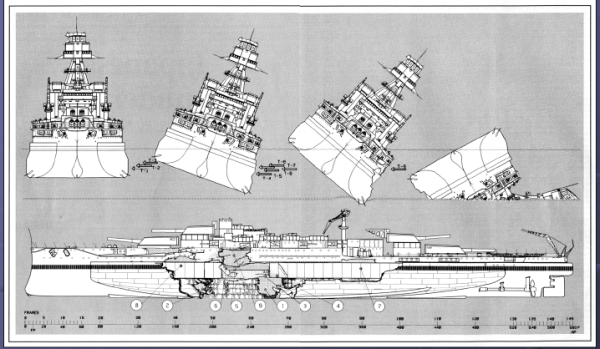
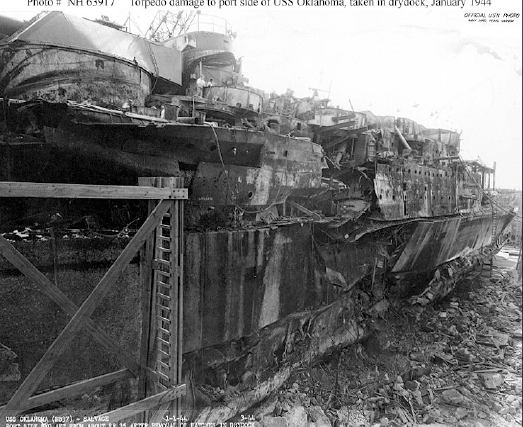
In the center of the Japanese flight path, sailors and Marines aboard the USS Oklahoma fought back furiously.  She didn’t have a chance.  Holes as wide as 40′ were torn into the hull in the first ten minutes of the fight.  Eight torpedoes smashed into her port side, each striking higher on the hull as the Battleship began to roll

Hat Tip John F. DeVirgilio for this graphic

Bilge inspection plates had been removed for a scheduled inspection the following day, making counter-flooding to prevent capsize, impossible.   Oklahoma rolled over and died as the ninth torpedo slammed home.  Hundreds scrambled out across the rolling hull, jumped overboard into the oil covered, flaming waters of the harbor, or crawled out over mooring lines in the attempt to reach USS Maryland in the next berth.

The damage was catastrophic.  Once the pride of the Pacific fleet, all eight battleships were damaged, and four of them sunk.  Nine cruisers, destroyers, and other ships were damaged, and another two sunk. 347 aircraft were damaged, most caught while still on the ground.  159 of those were destroyed altogether.  2,403 were dead or destined to die from the attack, another 1,178 wounded.

Nine Japanese torpedoes struck Oklahoma’s port side during the first ten minutes of the attack.

Frantic around the clock rescue efforts began almost immediately to get at 461 sailors and Marines trapped inside.  Tapping could be heard as holes were drilled to get to those trapped inside. 

Only 32 were delivered from certain death. 14 Marines and 415 sailors lost their lives onboard Oklahoma, either immediately or in the days and weeks to come.  Bulkhead markings later revealed that at least some of the doomed lived on in that pitch black, upside-down hell, waiting for rescue that would come too late.  The last survivor drew the last such mark on Christmas Eve, 17 days after the attack.


Of sixteen ships lost or damaged, thirteen would be repaired and returned to service.  USS Arizona remains on the bottom, a monument to the event and to the 1,102-honored dead who remain entombed within her hull.  The USS Utah defied salvage efforts. She, too, is a War Grave, 64 honored dead remaining within her hull, lying at the bottom not far from the Arizona.  Repairs were prioritized, and USS Oklahoma was beyond repair.  She, and her dead, would have to wait.

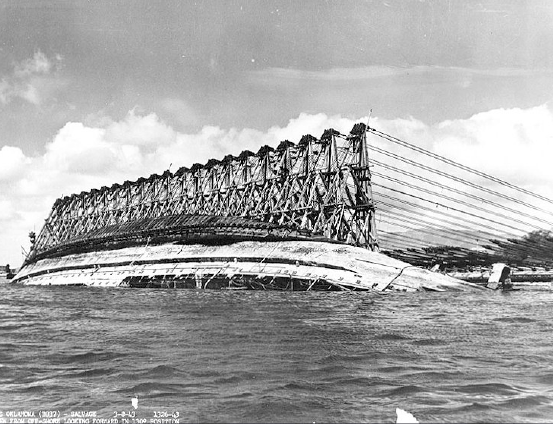
The extraordinarily difficult salvage at last began in March of 1943.  21 giant A-frames were fixed to the hull, 3″ cables connecting compound pulleys to 21 electric motors, each capable of pulling 429 tons.  Two pull configurations were used over 74 days, first the configuration below, then direct connections once the hull had achieved 70°. 

That May, the decks of USS Oklahoma once again saw the light of day.

At last fully righted, the ship was now 10 feet below water.  Massive temporary wood and concrete structures called “cofferdams” closed the gaping wounds left by torpedoes, so the hull could be pumped out and re-floated.  A problem even larger than those torpedo holes were the gaps between hull plates, caused by the initial capsize and righting operations.  Divers stuffed kapok in the gaps as water was pumped out.

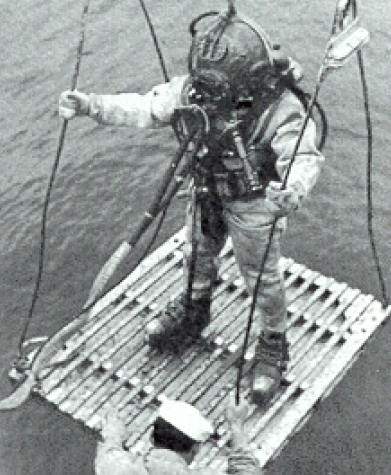
Individual divers spent 2-3 years on the Oklahoma salvage job.  Underwater arc welding and hydraulic jet techniques were developed during this period and remain in use to this day.  1,848 dives were performed for a total of 10,279 man hours under pressure.  For all that, no military and only one civilian diver lost his life, that, when his air hose became severed.

Salvage workers entered the pressurized hull through airlocks wearing masks and protective suits.   Bodies were in advanced stages of decomposition by this time, and the oil and chemical-soaked interior was toxic to life.  Most victims were impossible to identify.

Twenty 10,000 gallon per minute pumps operated for 11 hours straight.  On November 3, 1943, the ‘Mighty Okie’ broke from the bottom and once again floated on her own.

Oklahoma entered dry dock the following month, a total loss to the American war effort.  She was stripped of guns and superstructure and sold for scrap on December 5, 1946, to the Moore Drydock Company of Oakland, California.

The battered hulk left Pearl Harbor for the last time in May 1947, headed for a scrapyard in San Francisco bay.  She never made it.  Taken under tow by the ocean-going tugs Hercules and Monarch, the three vessels entered a storm some 540 miles east of Hawaii. 

On May 17, disaster struck.  Piercing the darkness, Hercules’ spotlight revealed that the former battleship was listing heavily.  Naval base at Pearl Harbor instructed them to turn around when these two giant tugs ground to a halt and found themselves moving… backward.  Despite her massive engines, Hercules was being dragged astern, hurtling past Monarch, herself swamped at the stern and being dragged backward at 17mph.

Fortunately for both tugs, skippers Kelly Sprague of Hercules and George Anderson of Monarch had loosened the cable drums connecting 1,400-foot tow lines to Oklahoma.  Monarch’s line played out and detached.  With Oklahoma forever sunk beneath the waves and Hercules’ tow line pointing straight down, Hercules detached with a crash at the last possible moment, the 409-ton tug bobbing to the surface like the float on a child’s fishing line.

Ordered in March 1911 and launched three years later, the 583’ Nevada-class battleship USS Oklahoma was designed to fight at the most extreme ranges expected by gunnery experts. Commanded by Charles B. McVay, Jr., father of the ill-fated skipper of the USS Indianapolis Charles Butler McVay III, Oklahoma’s role in the Great War was limited, due to a shortage of oil in major theaters of operation. Notable among her exploits of WW1 were the memorable fist fights crew members got into with Sinn Féin members in Berehaven, County Cork, and casualties sustained during the 1918-19 flu pandemic.

Oklahoma was up-armored in a 1927 – ’29 refit.  Additional anti-torpedo armor bulges were added, briefly making her the widest battleship in the United States fleet. Oklahoma was dispatched to Europe in 1936 to evacuate American civilians during the Spanish civil war.

The only US warship ever named after the 46th state, she was destroyed in an enemy sneak attack before she knew she was at war.

Of the 429 killed, 394 were buried as unknown persons.  Since 2015, advances in forensic science and dna technology have led to the identification of 346.  Many warships sunk during World War 2 have since been found. The final resting place of the USS Oklahoma remains, a mystery.

February 1, 1901 The Last Doughboy

The people the author sought were over 101. One was 113. The search could not have been easy, beginning with the phone call to next of kin. There is no delicate way to ask the question. “Is he still with us?” Most times, the answer was “no”.

In 2003, author Richard Rubin set out to interview the last surviving veterans of the Great War, the “War to End All Wars”.  World War One.

The people the author sought were all over 101. One was 113. It could not have been easy, beginning with the phone call to next of kin. There is no delicate way to ask the question. “Is he still with us?” Most times the answer was “no”.

Sometimes it was “yes”, and Rubin would ask for an interview. The memories his subjects sought to bring back were 80 years old and more.  Some spoke haltingly, and with difficulty.  Others were fountains of information, as clear and lucid as if the memories of which they spoke were made only  yesterday.

Rubin writes “Quite a few of them told me that they were telling me things that they hadn’t talked about in 50, 60, 70 years. I asked a few of them why not, and the surprising response often was that nobody had asked.”

Anthony Pierro of Swampscott, Massachusetts, served in Battery E of the 320th Field Artillery and fought in several of the major battles of 1918, including Oise-Aisne, St. Mihiel, and Meuse-Argonne.

Pierro recalled his time in Bordeaux as the best time of the war. “The girls used to say, ‘upstairs, two dollars.’” Pierro’s nephew Rick interrupted the interview. “But you didn’t go upstairs.”  Although possibly unexpected, Uncle Anthony’s response was a classic.  “I didn’t have the two dollars”.

Reuben Law of Carson City, Nevada remembered a troop convoy broken up by a German U-Boat while his own transport was swept up in the murderous Flu pandemic of 1918.

The people Rubin spoke with weren’t all men. 107-year-old Hildegarde Schan of Plymouth, Massachusetts spoke of caring for the wounded.

Howard Ramsey helped start an American burial ground in France, 150 miles north of Paris. Today, the 130½ acres of the Meuse-Argonne American Cemetery serves as the final resting place for the largest number of US military dead in Europe.

“So I remember one night”, Ramsey said, “It was cold, and we had no blankets, or nothing like that. We had to sleep, we slept in the cemetery, because we could sleep between the two graves, and keep the wind off of us, see?”

Arthur Fiala of Kewaunee, Wisconsin remembered traveling across France in a boxcar marked “40-8″. Room enough for 40 men, or eight horses.

Arthur Fiala

There was J. Laurence Moffitt of Orleans, Massachusetts. Today, we see the “Yankee Division” only on highway signs. At 106, this man was the last surviving member of his outfit, with a memory so clear he could recall every number from every fighting unit of the 26th Division.

George Briant was caught in an open field with his battery, as German planes dropped bombs from the sky.  Briant felt as if he was hit by every one of them, spending several months in the hospital. When it was through, he begged to go back to the front.  

On the last night of the war, November 10, 1918, Briant came upon the bodies of several men who had just been shelled.

“Such fine, handsome, healthy young men”, he said, “to be killed on the last night of the war.  I cried for their parents. I mean it’s a terrible, terrible thing to lose anyone you love in a war, but imagine knowing precisely when that war ends, and then knowing that your loved one died just hours before that moment.

Rubin interviewed dozens of men and a handful of women, a tiny and ever diminishing living repository for memory of the War to End All Wars. Their stories are told in their own words and linked HERE, if you care to learn more.  I highly recommend it.  The words of these women and men are far more powerful than anything I can offer.

Frank Woodruff Buckles, born Wood Buckles, is one. Born on February 1, 1901, Buckles enlisted with the First Fort Riley Casualty Detachment at the age of sixteen, training for trench casualty retrieval and ambulance operations.

Frank Woodruff Buckles, S/N 15577

Buckles’ unit set sail from Hoboken New jersey in December 1917 aboard HMS Carpathia, a vessel made famous by the Titanic rescue, five years earlier.

Frank never saw combat but he did see a lot of Germans, with a Prisoner-of War escort company.  Returning home in January 1920 aboard USS Pocahontas, Buckles was paid $143.90, including a $60 bonus.

Buckles was a civilian in 1940, working for the White Star Lines and WR Grace shipping companies. His work took him to the Philippines, where he remained after the outbreak of WWII. He was helping to resupply U.S. troops when captured by Japanese forces in January 1942, imprisoned for thirty-nine months as a civilian prisoner in the Santo Tomas and Los Baños prison camps. 

He was rescued by the 11th Airborne Division on February 23, 1945. The day he was scheduled to be executed.

Buckles married Audrey Mayo of Pleasanton, California in 1946, and returned from whence he had come.  Back to the land, back to the Gap View Farm near Charles Town, West Virginia in January 1954, to farm the land his ancestors worked back in 1732.

Audrey Mayo Buckles lived to ninety-eight and passed away on June 7, 1999.  Frank continued to work the farm until 106, and still drove his tractor.  For the last four years of his life he lived with his daughter Susannah near Charles Town, West Virginia.

Once asked his secret to a long life, Buckles responded, “When you start to die, don’t”.

On December 3, 2009, Frank Buckles became the oldest person ever to testify before the United States Congress, where he campaigned for a memorial to honor the 4.7 million Americans who served in World War 1.

“We still do not have a national memorial in Washington, D.C. to honor the Americans who sacrificed with their lives during World War I. On this eve of Veterans Day, I call upon the American people and the world to help me in asking our elected officials to pass the law for a memorial to World War I in our nation’s capital. These are difficult times, and we are not asking for anything elaborate. What is fitting and right is a memorial that can take its place among those commemorating the other great conflicts of the past century. On this 92nd anniversary of the armistice, it is time to move forward with honor, gratitude, and resolve”.

The United States came late to the Great War, not fully trained, equipped or mobilized until well into the last year.  Even so, fully 204,000 Americans were wounded in those last few months.  116,516 never came home from a war in which, for all intents and purposes, the US fought for a bare five months.

Frank Woodruff Buckles passed away on February 27, 2011 at the age of 110, and went to his rest in Arlington National Cemetery.  The last of the Doughboys, the only remaining American veteran of WWI, the last living memory of the war to end all wars, was gone.

The United States House of Representatives and Senate proposed concurrent resolutions for Buckles to lie in state, in the Capitol rotunda. For reasons still unclear, the plan was blocked by Speaker John Boehner and Senate Majority Leader Harry Reid.  Neither Boehner nor Reid would elaborate, proposing instead a ceremony in the Amphitheater at Arlington National Cemetery.  The President of the United States personally attended the funeral.

Washington Post reporter Reporter Paul Duggan described the occasion:

“The hallowed ritual at grave No. 34-581 was not a farewell to one man alone. A reverent crowd of the powerful and the ordinary—President Obama and Vice President Biden, laborers and store clerks, heads bowed—came to salute Buckles’s deceased generation, the vanished millions of soldiers and sailors he came to symbolize in the end”.

Frank Woodruff Buckles, the last living American veteran of WW1 was survived by the British Women’s Royal Air Force (WRAF) servicewoman Florence Beatrice (Patterson) Green who died on February 4, 2012, at the age of 110.

Afterward

Sixteen million Americans joined with allies the world over to defeat the Axis Powers of World War 2.  They were the children of Frank Buckles’ and Florence Green’s generation, sent to complete what their parents had begun.  According to the Department of Veterans Affairs some 66,000 remained alive in 2024.

If actuarial projections are any indication, the Frank Buckles of his generation, the last living veteran of WW2, can be expected to pass from among us sometime around 2044.

That such an event should pass from living memory is a loss beyond measure.

December 2, 1859 John Brown

To some, the man was a hero.  To others he was a kook. The devil incarnate.


Following the war for independence, American politics split between those supporting a strong federal government and those favoring greater self-determination for the states. In the South, climate conditions led to dependence on agriculture, the rural economy of the southern states producing cotton, rice, sugar, indigo and tobacco. Colder states to the north tended to develop manufacturing economies, urban centers growing up in service to hubs of transportation and the production of manufactured goods.

During the first half of the 19th century, 90% of federal government revenue came from tariffs on foreign manufactured goods. Most of this revenue was collected in the South, with the region’s greater dependence on imported goods.  Much of federal spending was directed toward the North, toward the construction of roads, canals and other infrastructure.

The debate over economic issues and rights of self-determination, so-called ‘state’s rights’, grew and sharpened in 1828 with the threatened secession of South Carolina and the “nullification crisis” of 1832-33. South Carolina declared such tariffs unconstitutional and therefore null and void within the state. A Cartoon from the era says it all – Northern domestic manufacturers getting fat at the expense of impoverishing the South under protective tariffs.

Chattel slavery came to the Americas well before the colonial era, from Canada to Mexico to Brazil and around the world. Moral objections to what was clearly a repugnant practice could be found throughout, but economic forces had as much to do with ending the practice as any other. The “peculiar institution” died out first in the colder regions of the US and may have done so in warmer climes as well, but for Eli Whitney’s invention of a cotton engine (‘gin’) in 1792.

Removing cotton seeds by hand requires ten man-hours to remove the seeds from a single pound of cotton. By comparison, a cotton gin can process about a thousand pounds a day at comparatively little expense.

The year of Whitney’s invention, the South exported 138,000 pounds a year to Europe and the northern colonies. Sixty years later, Britain alone was importing 600 million pounds a year of the stuff, from the American south. Cotton was King, and with good reason.  The crop is easily grown, is more easily transportable and can be stored indefinitely, compared with food crops.  The southern economy turned overwhelmingly to this one crop and with it, the need for cheap, plentiful labor.

By then the issue of slavery was so joined and intertwined with ideas of self-determination, as to be indistinguishable.

The Cotton Gin

The short-lived “Wilmot Proviso” of 1846 sought to ban slavery in new territories, after which the Compromise of 1850 attempted to strike a balance.  The Kansas Nebraska Act of 1854 created the territories of Kansas and Nebraska, basically repealing the Missouri Compromise and allowing settlers to determine their own way through popular sovereignty.

John_Brown
John Brown

This attempt to democratize the issue instead had the effect of drawing up battle lines.  Pro-slavery forces established a territorial capital in Lecompton, while “antis” set up an alternative government in Topeka.

John Brown Sr. came to the Kansas Territory as a result of violence, sparked by the expansion of slavery into the Kansas-Nebraska territories between 1854 and 1861, a period known as “Bleeding Kansas”.  To some, the man was a hero.  To others he was a kook. The devil incarnate.  A radical abolitionist and unwavering opponent of the “peculiar institution” of slavery, John Brown believed that armed confrontation was the only way to bring it to an end.

BleedingKansasFight

In Washington DC, a United states Senator was beaten nearly to death on the floor of the Senate, by a member of the House of Representatives. The following day Brown and four of his sons: Frederick, Owen, Salmon, and Oliver, along with Thomas Weiner and James Townsley, set out on a “secret expedition”.

The group camped between two deep ravines off the road that night, remaining in hiding until sometime after dark on the 24th. Late that night, they stopped at the house of James P. Doyle, ordering him and his two adult sons, William and Drury, to go with them as prisoners. Doyle’s wife pleaded for the life of her 16 year old son John, whom the Brown party left behind. The other three, all former slave catchers, were led into the darkness.  Owen Brown and one of his brothers murdered the brothers with broadswords. John Brown, Sr. fired the coup de grace into James Doyle’s head to ensure that he was dead.

The group went on to the house of Allen Wilkinson, where he too was brought out into the darkness and murdered with broadswords. Sometime after midnight, the group forced their way into the cabin of James Harris. His two house guests were spared after interrogation, but Wilkinson was led to the banks of Pottawatomie Creek where he too was slaughtered.

There had been 8 killings to date in the Kansas Territory; Brown and his party had just murdered five in a single night. The massacre lit a powder keg of violence in the days that followed.  Twenty-nine people died on both sides in the next three months alone.

Harper's Ferry

Brown would go on to participate in the Battle of Black Jack and the Battle of Osawatomie in the Kansas Territory.  Brown lead a group to the armory in Harper’s Ferry Virginia in a hare brained scheme to capture the weapons contained there and trigger a slave revolt. The raid was ended by a US Army force under Colonel Robert E. Lee, and a young Army lieutenant named James Ewell Brown (JEB) Stuart.

Brown supporters blamed the 1856 massacre on everything from defending the honor of the Brown family women, to self defense, to a response to threats of violence from pro slavery forces. Free Stater and future Kansas Governor Charles Robinson may have had the last word when he said, “Had all men been killed in Kansas who indulged in such threats, there would have been none left to bury the dead.”

John Brown was hanged on December 2, 1859.

The 80-year-old nation forged inexorably onward, toward a Civil War that would kill more Americans than every conflict from the American Revolution to the War on Terror, combined.