
January 5, 1709 Frost Fair

The science is politicized. Vast sums of public largesse and political capital are lavished on the climate.  We are told to expect global warming, and warned of a coming ice age. The skeptical taxpayer who has to pay for it all is forced to wade through competing narratives, in an exercise not unlike taking a sip from a fire hose. 

Over the past two weeks, temperatures have dipped near 0° Fahrenheit, as far south as Alabama.  The capital of Florida awoke only yesterday to snow in the palm trees, as frozen iguanas fell to the ground.    Ice hangs from the Spanish mosses of Savannah, as something called a “bomb cyclone” worked its way toward the New England coast.

Yikes.

In July 1983, temperatures of -129° were recorded at the Soviet Vostok Station in Antarctica, the coldest temperature ever measured by ground instruments. NASA satellite data recorded a low temperature of -135.8°F in August, 2010.

Four years later, a Russian research ship full of environmental, scientific and activist types, the Akademik Shokalskiy, got stuck in Antarctic ice, as did the Chinese icebreaker Xue Long, which had come to their rescue.

Very few media outlets got around to reporting that they were there to study “global warming”.

The environmental activist types would object to my use of the term, preferring what they feel to be the more descriptive “climate change”.  They’re right to prefer the term. We can all agree that climate is changing, five ice ages demonstrate that much, but it does beg the question.  How, exactly, will we know we’ve reached climate optimum?

In England, accounts of the River Thames freezing over date back as early as 250AD. The river was open to wheeled traffic for 13 weeks in 923 and again in 1410.  That time, the freeze lasted for 14 weeks. By the early 17th century, the Thames became a place of “Frost Fairs”.
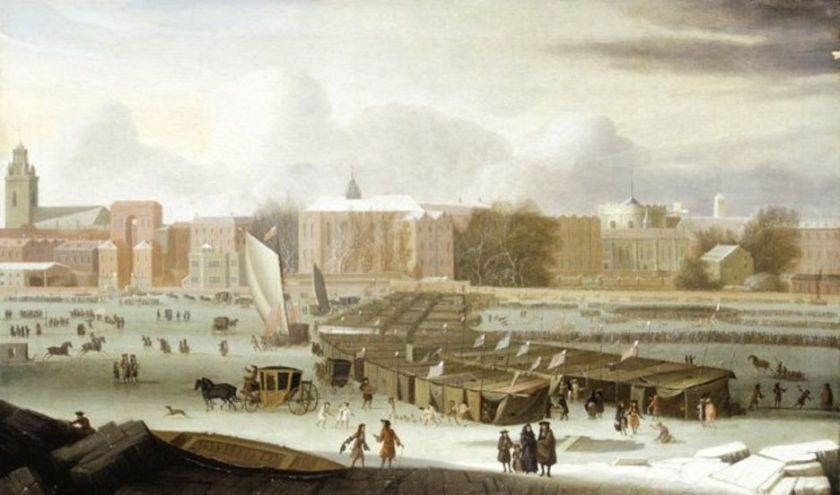
_72554538_abrahamhondius

The “Medieval Warm Period” lasting from 950 to 1250 was followed by the “Little Ice Age”, a 300-year period beginning in the 16th century.  King Henry VIII rode a sleigh down the Thames from London to Greenwich in 1536.  Elizabeth I was out on the ice shooting at archery targets, in 1564.

English writer John Evelyn describes the famous “Frost Fair” of the winter of 1683-’84:  “Coaches plied from Westminster to the Temple, and from several other stairs too and fro, as in the streets; sleds, sliding with skeetes, a bull-baiting, horse and coach races, puppet plays and interludes, cooks, tipling and other lewd places, so that it seemed to be a bacchanalian triumph, or carnival on the water”.

The Great Frost of the winter of 1708-09 was held in the coldest winter Europe had seen in 500 years.  William Derham, an English clergyman and natural philosopher best known for calculating a reasonably accurate estimate of the speed of sound, recorded a low of −12°C (10 °F) on the night of January 5, 1709.  It was the lowest he’d measured since beginning readings in 1697, prompting the comment that “I believe the Frost was greater than any other within the Memory of Man”.

24,000 Parisians died of cold in the next two weeks.  Animals froze in their stalls and crops planted the prior year, failed.  The resulting famine killed an estimated 600,000 in France alone while, in Italy, the lagoons and canals of Venice, froze solid.
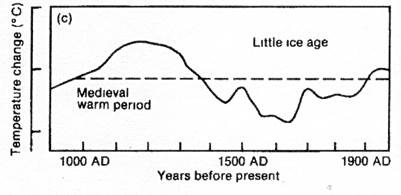
clip_image0026Breaks in cold weather inevitably marked the end of the frost fairs, sometimes all of a sudden.  In January 1789, melting ice dragged a ship with it, while tied to a riverside tavern, in Rotherhite.  Five people were killed when the building was pulled down on their heads.

The last Thames River frost fair took place in 1814, the year someone led an elephant across the ice, below Blackfriar’s Bridge.  Structural changes in river embankments and the demolition of the medieval London Bridge have increased water flow in the Thames, making it possible that the river will never freeze again.

Today, many blame weather extremes on “anthropogenic” (human) causes, associating what used to be called global warming”, with CO2. Others contend the reverse: that historic increases in carbon do not precede but rather result from, climate extremes. A third group associates the sun with climate change (imagine that), linking an extended period of low solar activity called the “Maunder Minimum”, with the brutal cold of 1645-1715.

The science is politicized. Vast sums of public largesse and political capital are lavished on the climate.  We are told to expect global warming, and warned of a coming ice age. The skeptical taxpayer who has to pay for it all is forced to wade through competing narratives, in an exercise not unlike taking a sip from a fire hose.

Meanwhile, the sun is going to do what the sun is going to do, which at the moment appears to be another quiet period in solar activity.  Very quiet. Before it’s over, we may find ourselves wishing for a little Global Warming.

Feature image, top:  The Battery, Charleston SC, January 2, 2018

January 4, 1642  The Three Kingdoms

In the American colonies, the Petition of Right would pop up 129 years later, reflected in the 3rd, 5th, 6th and 7th amendments of the United States’ Constitution.  Four parts in ten, of what we now know as the Bill of Rights.

Agree or disagree with US government policy, what we do in this country we do as a nation.  It would seem absurd to us to see the President and Congress raise separate armies to go to war with one another, yet that’s just what happened in 17th century England.

Queen Elizabeth I passed away without issue in 1603, succeeded by her first cousin twice removed, King James VI of Scotland.  For the first time, the Kingdoms of England and Scotland were united under single rule.

Edgehill-attack-on-the-train-web
Royalist attack on the Parliamentary train at the Battle of Edgehill, October 23, 1642

The English Parliament of the age didn’t have a permanent role in government, instead being a temporary advisory body, summoned and dismissed at the will of the King.  Practically speaking, the King had no means to enforce his will on matters of taxation, without the consent of the “gentry”, the untitled land-owning classes who were the primary means of national tax collection.  This gave rise to an elected “House of Commons”, joining the House of Lords to form a Parliament.

James thought of Kings as “little Gods on Earth”, and had long gotten whatever he wanted from a supine Scottish Parliament.  The English Parliament was another matter.  James’ entire reign and that of his son Charles I, was one long contest of wills with the English governing body.

Charles’ 1625 marriage to a Roman Catholic, the French princess Henrietta Maria, did little to win him support in Protestant England.  His interventionist policies in the 30 years’ war made things worse, ending with Parliament bringing impeachment proceedings against his minister, the Duke of Buckingham.

Marston-Moor-2-web
Battle of Marston Moor, July 2, 1644

Parliament drew up the “Petition of Right”, invoking the Magna Carta and severely limiting the King’s right of non-Parliamentary taxation, along with other restrictions on the Royal Prerogative.  Charles looked to the House of Lords to check the power of the Commons, but both houses ratified the measure by the end of May.

The King dissolved this first Parliament in 1629, putting nine of its leaders in prison and unwittingly making them martyrs for their cause.  The following 11 years are sometimes called “the personal rule” or the “eleven years’ tyranny”.  By 1640 Charles had severe money problems, forcing him to call another Parliament.

The King wanted a more docile body this time, so he appointed many of his adversaries as Sheriffs, knowing that this would require them to stay within their counties, making them ineligible for election.  On others he bestowed aristocratic titles, making them ineligible for the House of Commons.  Of course, that only moved them to the House of Lords.

Measures the King saw as reasonable, the legislative body saw as opportunity to negotiate, and this “Short Parliament” was dissolved within a month.  That was May 1640, and Charles once again called a Parliament that November.  This “Long Parliament”, proved as uncooperative as any before it.

Cavalry-battle-time-of-Civil-War-web-1
A significant Parliamentary victory was won at the Battle of Cheriton, fought on March 29, 1644

In January, Charles directed the legislature to surrender five members of the Commons and one Peer on grounds of high treason.  On the following day, January 4, 1642, the King himself entered the House of Commons with an armed guard of 400, demanding that the offenders be handed over.  The Speaker, William Lenthall, replied, “May it please your Majesty, I have neither eyes to see nor tongue to speak in this place but as the House is pleased to direct me, whose servant I am here.”

Lenthall might as well have told the King “I work for these people.  I don’t work for you”.

It was a grave breach of protocol.  No King had ever entered the House of Commons.  Making things worse, the botched arrest had cut the feet out from under Charles’ supporters.  The two sides began to arm themselves that summer.  Full-scale civil war broke out that October.

Civil war ensued between Royalist and Parliamentary forces, as Ireland and Scotland broke with England’s primacy among the Three Kingdoms.

The period 1639-’51 saw a series of intertwined conflicts within and between the three kingdoms, including the Bishops’ Wars of 1639 and ’40, the Scottish Civil War of 1644–’45; the Irish Rebellion of 1641, Confederate Ireland, 1642–’49 and the Cromwellian conquest of Ireland in 1649, collectively known as the Eleven Years War or Irish Confederate Wars and finally, the first, second and third English Civil Wars of 1642–’46, 1648–’49 and 1650–’51.

A “Rump” House of Commons indicted the King on treason charges, in a trial which was never recognized by the upper house.  Charles maintained that he was above the law, while the court argued that “the King of England was not a person, but an office whose every occupant was entrusted with a limited power to govern by and according to the laws of the land and not otherwise”.

800px-Sir_Anthony_Van_Dyck_-_Charles_I_(1600-49)_-_Google_Art_Project
Charles I in Three Positions by van Dyck, 1635–36

Charles I was found guilty of treason and sentenced to die by decapitation.   Clothed in two shirts by his own request lest any shiver of cold be misinterpreted as a sign of fear, he put his head on the block on January 30, 1649.  “A subject and a sovereign are clean different things,” he said. “I shall go from a corruptible to an incorruptible Crown, where no disturbance can be”.  With that, the King of England extended his hands to signal that he was ready, and his head was parted with a stroke.

Some 300,000 citizens of what is now known as the ‘United Kingdom’ lost their lives in the series of conflicts.  Roughly 6% of the population, almost twice that lost in the American Civil War.  Nationally, the burial rate increased by 29%, between 1643-’64.

The Protestant Reformation begun some 100 years earlier was itself ‘reformed during this period, as Charles’ stranglehold on church-state policy was replaced by more individualized religious experience.  Ritual was set aside in favor of The Sermon, as individual congregations coalesced around charismatic speakers.  Gone were the days of strong opposition and religious persecution, as previously ‘lunatic fringe’ sects from Muggletonians to Puritans and Quakers expanded across the British Isles and on to Great Britain’s overseas dominions.

The Rump House of Commons disbanded the House of Lords and England briefly became a Commonwealth.  The Scottish Parliament proclaimed Charles eldest son King Charles II of Scotland a week after the execution of his father, but Royalist hopes were dashed two years later when Charles was deposed and exiled to France.

cromwell-battle-of-dunbar
Oliver Cromwell at the Battle of Dunbar, painted by Andrew Carrick Gow, 1886

“1st Lord Protector of the Commonwealth of England, Scotland, and Ireland” Oliver Cromwell became virtual dictator for much of the 1650s. Succeeded by his son Richard upon his death on 1658, the son was not the equal to his father. When the Royalists returned to power, they had Cromwell’s corpse dug up, hung in chains, and beheaded.  Parliament was reinstated, and the monarchy of the Three Kingdoms restored to Charles II, in 1660.

After that, all legal documents were dated as if Charles had succeeded his father, back in 1649.

In the American colonies, the Petition of Right would pop up 129 years later, reflected in the 3rd, 5th, 6th and 7th amendments of the United States’ Constitution.  Four parts in ten, of what we now know as the Bill of Rights.

January 3, 1870 Mr. Roebling’s Bridge

To aid in the work, Emily Roebling took a crash course in bridge engineering. For 11 years she studied higher mathematics, catenary curves, materials strength, and the intricacies of cable construction, all while acting as the pivot point on the largest bridge construction project in the world, and nursemaid to a desperately sick husband.

At the time it was built, the span across the East river linking Brooklyn with Manhattan was the longest suspension bridge in the world.

In 1869, civil engineer John Roebling had already invested two years in site work.   With the ferry coming in, he should have paid more attention to his surroundings.  Focused on what he was doing on the pier, the engineer’s toes were crushed as the boat docked, so badly that several had to be amputated.

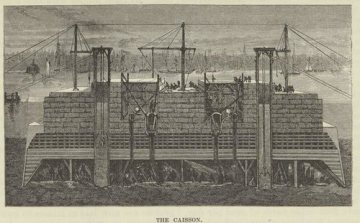
brooklyn-bridge-caisson-granger“Lockjaw” is such a sterile term, it doesn’t begin to describe the condition known as Tetanus. In the early stages, the anaerobic bacterium Clostridium Tetani produces tetanospasmin, a neurotoxin producing mild spasms in the jaw muscles. As the disease progresses, sudden and involuntary contractions effect most skeletal muscle groups, becoming so powerful that bones are fractured and the muscles tear themselves apart. These were the last days of John Roebling, the bridge engineer who would not live to see his most famous work.
Roebling was the first casualty of the project.  He would not be the last.

Brooklyn Bridge Caisson ConstructionRoebling’s 32-year-old son Washington took over the project, beginning construction on January 3, 1870.
Enormous yellow pine boxes called “caissons” were built on the Brooklyn and New York sides of the river, descending at the rate of 6-in. per week in search of bedrock. Like giant diving bells, the New York side ended up at 78′ below mean high tide, the Brooklyn side 44′. Pressurized air was pumped into these boxes, keeping water and mud at bay, as workers excavated the bottom. In 1872, these “sandhogs” began to experience a strange illness that came to be called “caisson disease”.

Civil War era submarine designer Julius Hermann Kroehl may have recognized what was happening, but Kroehl was five years in his grave by this time, victim of the same “fever”. Today we call it “the bends”. Pop the top off a soda bottle and you’ll see the principle at work. Without sufficient decompression time, dissolved gasses come out of solution and the blood turns to foam. Bubbles form in or migrate to any part of the body, resulting in symptoms ranging from joint pain and skin rashes, to paralysis and death.  The younger Roebling was badly injured as a result of the bends in 1872, leaving him partially paralyzed and bedridden, incapable of supervising construction on-site.

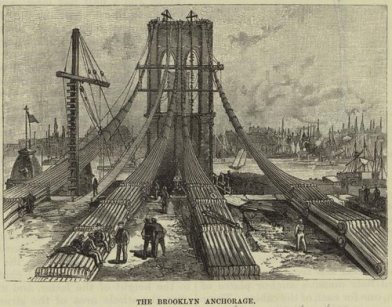
brooklyn-anchorageRoebling conducted the entire project looking out his apartment window, designing and redesigning details while his wife, Emily Warren Roebling, became the critical connection between her husband and the job site.
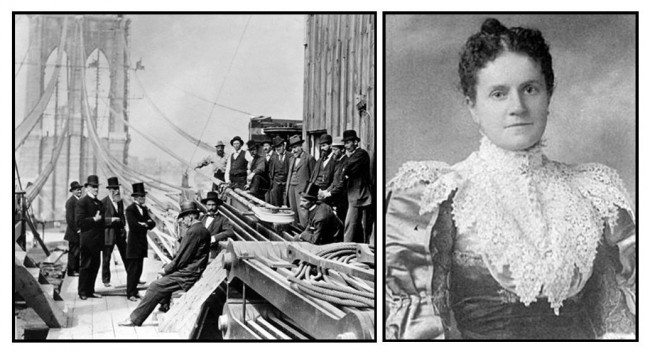
To aid in the work, Emily Roebling took a crash course in bridge engineering. For 11 years she studied higher mathematics, catenary curves, materials strength, and the intricacies of cable construction, all while acting as the pivot point on the largest bridge construction project in the world, and nursemaid to a desperately sick husband.

Emily-Warren-Roebling-e1389630968571
Emily Warren Roebling, the “first woman field engineer”.

Historian David McCullough wrote in his book, The Great Bridge: The Epic Story of the Building of the Brooklyn Bridge: “By and by it was common gossip that hers was the great mind behind the great work and that this, the most monumental engineering triumph of the age, was actually the doing of a woman, which as a general proposition was taken in some quarters to be both preposterous and calamitous. In truth, she had by then a thorough grasp of the engineering involved”.

Unlikely as it sounds, fires broke out at the bottom of the river on several occasions, started by workmen’s candles, fed by the oakum used for caulking, and turbocharged by all that pressurized air. On at least one occasion, the caisson had to be filled with millions of gallons of water, before the fire went out for good.

Brooklyn bridge builders

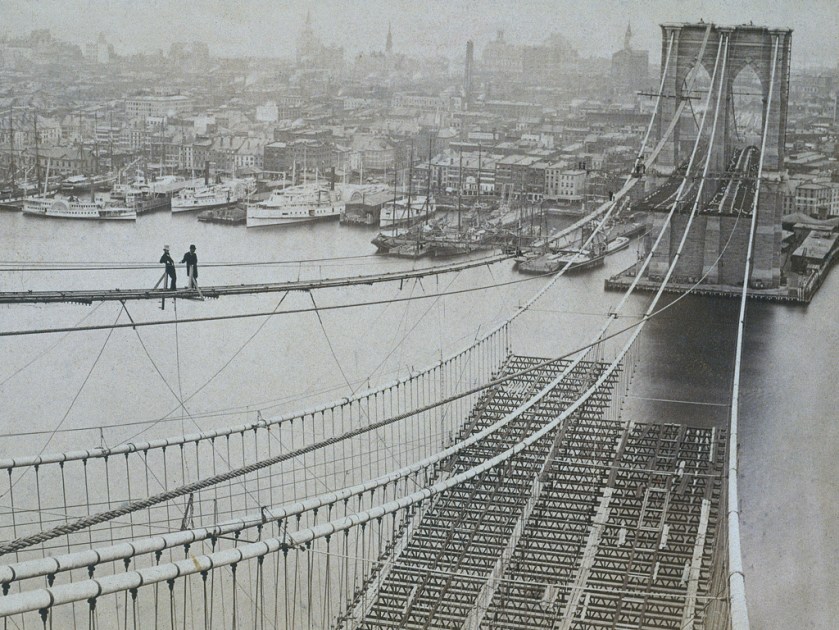
A footbridge connected the two sides in 1877, and soon the wires began to be strung. Wooden “buggies” carried men back and forth along wires suspended hundreds of feet above the water, as individual wires were woven into the four great cables that support the bridge. The work was exacting, with each wire bound together to precise specifications. Rumors about corruption and sleaze surrounded the project when J. Lloyd Haigh, the wire contractor, was discovered to be supplying inferior material. It was way too late to do anything about it, and 150 extra wires were bundled into each cable to compensate. The tactic worked.  Haigh’s shoddy wire remains there, to this day.

Construction was completed in 1883, the bridge opening for use on May 24. The first person to cross was Emily Roebling. Six days later, a rumor started that the bridge was about to collapse.  At least 12 people were killed in the resulting stampede. A year later, a publicity stunt by P. T. Barnum helped to put people’s minds at ease when Jumbo, the circus’ prize elephant, led a parade of 20 other elephants across the bridge.

Brooklyn Bridge

For a long time the span was called the “New York and Brooklyn Bridge” or the “East River Bridge”, officially becoming the “Brooklyn Bridge” only in 1915. At least 27 were killed in its construction; 3 from the bends, several from cable stringing accidents and others crushed under granite blocks or killed in high falls.

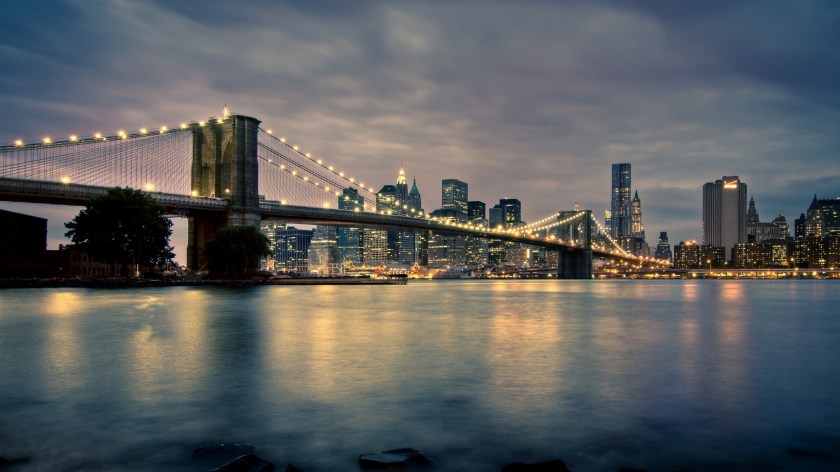
Even today, popular culture abounds with stories of suckers “buying” the Brooklyn Bridge. It was the longest bridge in the world for its time, and would remain so until 1903. Roebling had designed his project to be six times the strength required for the job. Even with the defective cables installed, the bridge is four times as strong as it needs to be. Many of the Brooklyn Bridge’s contemporary structures have long since gone.  Johann Augustus Röbling’s bridge carries 145,000 cars, every day.


January 2, 1935 Nazis of the Amazon

In 1935, the third Reich reached out to the Amazon basin, in search of ‘lebensraum’.  Living space.  3 SS officers bankrolled by the Nazi government, came with dozens of helpers to explore the region bordering French Guyana, with an eye toward colonizing the area for the ‘thousand-year’ Reich.

In 1978, the British-American science fiction thriller “The Boys from Brazil”  told the story of a bizarre plot to clone Adolf  Hitler, hatched by the “Angel of Death” Josef Mengele in his Brazilian jungle hideout.

In the film, Mengele met his fate at the jaws of a pack of vengeful Dobermans, under orders from one of his 94 ‘baby dictators’.

A story as squirrelly is this one could only come from the minds of Hollywood, but parts of it were closer to reality, than anyone knew at the time.

In the years following WW2, thousands of Nazi officers, senior party members and Nazi collaborators escaped across the Atlantic to find refuge in South America, especially Argentina, Chile and Brazil.

Though widely believed to be dead, Mengele himself was very much alive at the time of the film, living under an assumed identity in Bertioga, São Paulo.  The Angel of Death would escape the noose he so richly deserved, succumbing to a stroke while swimming in 1979, and drowning.

Long before there were Nazis, before there was even a Germany, ethnically German people have been emigrating in search of a better life.  In the United States, some 57 million people identify as being of full or part German ancestry, forming the largest single ethnic group, in the country.  I am one of them.

Outside of Germany itself,  The second largest German population in the world, resides in Brazil.

Mention Oktoberfest, and you’re speaking of an annual celebration of Germanic traditions, in Munich.  The second-largest Oktoberfest is a two-way tie, between the one held in Waterloo, Canada, and the city of Blumenau, in Santa Catarina, Brazil.

Oktoberfest Blumenau
Outside of Munich, Oktoberfest Blumenau in Brazil is one of the two largest celebrations of the original festival, in the world.

Outside of Europe, descendants of German immigrant ancestors have largely assimilated into their host societies, adopting local languages and adapting Germanic-sounding surnames to spellings and sounds more familiar to their adopted cultures.

Brazilians of German ancestry are in every sense Brazilian, except to the racially obsessed mind, of a Nazi.

In 1935, the third Reich reached out to the Amazon basin, in search of ‘lebensraum’.  Living space.  3 SS officers bankrolled by the Nazi government, came with dozens of helpers to explore the region bordering French Guyana, with an eye toward colonizing the area for the ‘thousand-year’ Reich.

Talk about squirrelly ideas.  The hardships of life in the Amazon jungle made this a strange choice of destination, but the idea made sense to these people.  With over 1 million ethnic Germans already living in the country, the pieces were already in place.  Or so they believed.

SS officer Joseph Greiner died of a ‘fever’ while on the expedition, most likely yellow fever or malaria. Expedition leader Schulz Kampfhenkel returned to the Fatherland with glowing reports of “The Guyana Projekt”.  “The two largest scantly populated, but rich in resources, areas on earth” Kampfhenkel wrote to his boss, the failed chicken farmer turned Reichsführer-SS Heinrich Himmler, “are in Siberia and South America”.

article-1080071-0238C02C000005DC-732_468x623As befitting a man who completely buys into Nazi ideas of racial superiority, the SS officer wrote “For the more advanced white race it offers outstanding possibilities for exploitation”, adding that the people who lived there “cannot be measured in civilised terms as we know them in Germany”.

A propaganda film was made of Greiner’s work in the jungle, but Himmler showed ‘scant interest’ in such grandiose plans.  “Given time”, the bloodless bureaucrat wrote to his jungle emissary, “the plan may be submitted again”.

So it is, that there is a Nazi graveyard by a tributary of the River Jary,  in the Amazon jungle. There you will find a 9-ft. cross, bearing this inscription: “Joseph Greiner died here on 2.1.1936“.

January 1, 1995 Rogue Wave

“None of the state-of-the-art weather forecasts and wave models—the information upon which all ships, oil rigs, fisheries, and passenger boats rely—had predicted these behemoths. According to all of the theoretical models at the time under this particular set of weather conditions, waves of this size should not have existed”.

From the time of Aristotle, mankind has looked to the field of scientific inquiry to explain the world around us.

From Copernicus to Charles Darwin to Stephen J. Hawking, the greatest of scientific minds have struggled to explain not only “that” the universe works, but also the “how” and the “why”.

We live in a near-miraculous age, when science has conquered complexities from space travel to molecular biology, to medicine, climate and astral physics.

Except sometimes, science has not the foggiest notion of why things happen.

Rogue Wave

In 1826, French scientist and naval officer captain Jules Dumont d’Urville described waves as high as 108.3 feet tall, in the Indian Ocean.  Despite having three colleagues as witnesses, d’Urville was publicly ridiculed by fellow scientists. “Everybody knew” at that time, that no wave could exceed 30 feet.   Walls of water the size of 10 story buildings, simply didn’t exist.

Either that, or very few who’d ever seen such a thing, lived to tell about it.

For nearly 100 years, oceanographers, meteorologists, engineers and ship designers have used a standard linear model to predict wave height.  This model suggests that there will hardly ever be a wave higher than 50 feet. One of 100 feet or larger is possible but unlikely, occurring maybe once in 10,000 years.

Serious study of the subject is younger than you might think.  The first scientific article on “freak waves” was written in 1964, by professor Lawrence Draper.   Far from ridiculing old sailors’ stories about monster waves, professor Draper posited not only that wave heights “can exceed by an appreciable amount the maximum values which have been accepted in responsible circles“, but also a terrifying phenomenon he called ‘freak wave holes’, the exact opposite of a rogue wave.  God help anyone caught at the bottom of one of those things.

rogue wave_destructionOnce considered mythical but for the old sailor’s stories and the damage inflicted on ships themselves, the first scientific measurement of a rogue wave occurred in the North sea in 1984, when a 36′ wave was measured off the Gorm oil platform, in a relatively placid sea.

What really caught the attention of the science community was the “New Year’s wave” measured from the Draupner oil platform off the coast of Norway, on January 1, 1995.  Laser instruments measured this thing at 84-ft.  Oil platform damage above the water line, confirmed the measurement.

Not to be confused with a tidal wave which is caused by underwater earthquake or volcanic eruption, a rogue wave is a different kind of animal. Oceanographers define rogue waves as being two or more times the height of the mean top-third of waves, in any given sea state.

rogue wave (3)

These literal freaks of nature are rare, unpredictable, appear and disappear without warning or trace, and are capable of sudden and catastrophic damage.  Modern ships are designed to withstand a “breaking pressure” of 6 metric tons per square meter or 21psi. A 39-ft wave in the usual linear model produces just over a third of that. A rogue wave can generate breaking pressures of 140psi and more.

In 2000, the British oceanographic research vessel RRS Discovery measured individual waves up to 95.5-ft. Analysis of the data took years, noting that “none of the state-of-the-art weather forecasts and wave models—the information upon which all ships, oil rigs, fisheries, and passenger boats rely—had predicted these behemoths. According to all of the theoretical models at the time under this particular set of weather conditions, waves of this size should not have existed”.

rogue wave (2)

In December 1900, Thomas Marshall, James Ducat, and Donald McArthur vanished from the Flannan Island lighthouse, in the Hebrides Islands of Scotland.  No serious storm had been reported between the 12th and the 17th, and there was speculation about supernatural causes.  Subsequent inspection revealed wave-damage, 200ft. above sea level.

flannan-isles-lighthouseIn 1909, the 500-ft. cargo liner SS Waratah disappeared off Durban South Africa, with 211 passengers and crew.

The liner RMS Queen Mary was broadsided by a 92-ft. monster in 1942, nearly pushing the 1,019-ft vessel over on her side. The 81,961-ton liner listed all the way over to 52°, before slowly righting herself.

In 1966, heavy glass was smashed 80-ft. above the waterline of the Italian liner SS Michelangelo, killing three and tearing a hole in her superstructure.

In 1995, the 963-ft. RMS Queen Elizabeth 2 was forced to “surf” a 95-ft. behemoth to avoid being sunk. The ship’s master said this thing “came out of the darkness” and “looked like the White Cliffs of Dover.”

The 1975 sinking of the Edmund Fitzgerald is widely blamed on the 1-2-3 punch of a freak wave phenomenon peculiar to Lake Superior, known as the “three sisters”.

rogue-wave

In 2007, NOAA compiled a catalog of over 50 historical incidents, most likely associated with rogue waves.

Serious scientific study of non-linear fluid dynamics began only 20-30 years ago. Researchers now believe that ‘super rogue waves’ of up to eight times the surrounding sea state, are possible.

rogue wave
“The Perfect Storm” movie based on the Sebastian Junger book of the same title depicts the last moments of the Gloucester fisherman Andrea Gail in September, 1991

European Space Agency satellite radar studies have proven that waves cresting at 65 to 98-ft. occur far more regularly than previously believed. Rogue waves occur several times a day, in all of the world’s oceans. One three-week period in 2004 identified over ten individual giants measuring 82-ft. and above, in the South Atlantic, alone.

MIT researchers Themis Sapsis and Will Cousins working with the Office of Naval Research, the Army Research Office and the American Bureau of Shipping have combined high resolution scanning technology with advanced algorithms, to digitize and map the sea state in real time, to predict the possible formation of rogue waves. The method only gives 2-3 minutes warning, but that is enough. Research is ongoing. Lighthouse keepers, mariners and oil platform operators the world over, anxiously await the results.