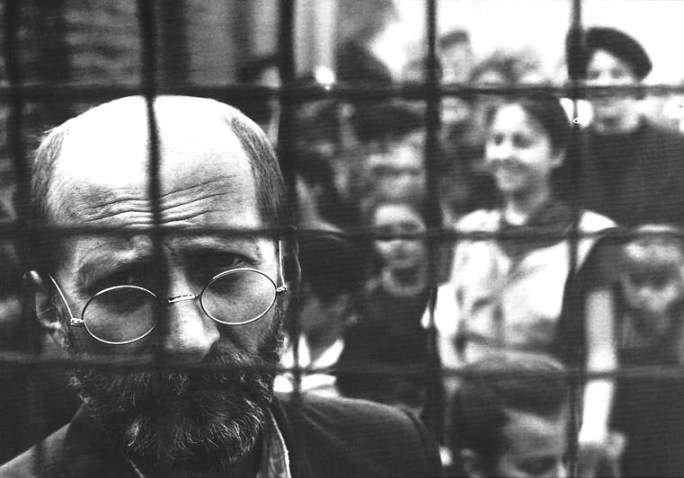
August 5, 1942 Old Doctor

The children’s author was offered sanctuary on the “Aryan side” but the man refused, saying that he would stay with his children. Janusz Korczak and his orphaned children were last seen boarding the train to the Treblinka extermination camp on August 5 or 6.

Janusz Korczak was a children’s author and pediatrician, a teacher and himself a lifelong learner, a student of pedagogy, the art of science of education, and how children learn.
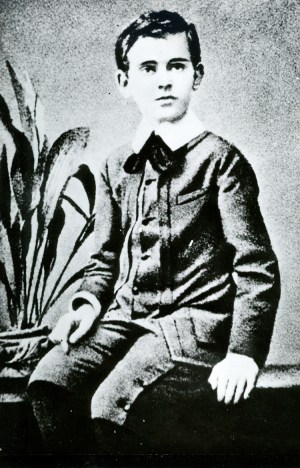
Korczak10lat0001Born Henryk Goldszmit into the Warsaw family of Józef Goldszmit, in 1878 or ’79 (the sources vary), Korczak was the pen name by which he wrote children’s books.

Henryk was an exceptional student, of above-average intelligence. His father fell ill when the boy was only eleven or twelve and was admitted into a mental hospital, where he died, six years later. As the family’s situation worsened, the boy would tutor other students, to help with household finances.

Goldszmit was a Polish Jew, though not particularly religious, who never believed in forcing religion on children.

He wrote his first book in 1896, a satirical tome on child-rearing, called Węzeł gordyjski (The Gordian Knot). He adopted the pen name Janusz Korczak two years later, writing for the Ignacy Jan Paderewski Literary Contest.

220px-Janusz_KorczakKorczak wrote for several Polish language newspapers while studying medicine at the University of Warsaw, becoming a pediatrician in 1904. Always the writer, Korczak received literary recognition in 1905 with his book Child of the Drawing Room (Dziecko salonu), while serving as medical officer during the Russo-Japanese war.

He went to Berlin to study in 1907-’08 and worked at the Orphan’s Society in 1909, where he met Stefania “Stefa” Wilczyńska, an educator who would become his associate and close collaborator.

In the years before the Great War, Korczak ran an orphanage of his own design, hiring Wilczyńska as his assistant. There he formed a kind of quasi-Republic for Jewish orphans, complete with its own small parliament, court, and newspaper. The man was born to be an educator.

1307809-Janusz-Korczak-Quote-I-am-well-versed-in-reading-the-pages-of-war

In early modern European Royalty, 15th – 18th century, a “whipping boy” was the friend and constant companion to the boy prince or King, whose job it was to get his ass kicked, for the prince’s transgressions. The Lord was not the be struck by his social inferior. It was thought that, to watch his buddy get whipped for his misdeeds would have the same instructional effect, as the beating itself.

The extent of the custom is open to debate and it may be a myth altogether, but one thing is certain.  Poland has been described as the “whipping boy of Europe”, for good reason.

JK2The Polish nation, the sixth largest in all Europe, was sectioned and partitioned for over a century, by Austrian, Prussian, and Russian imperial powers. Korczak volunteered for military service in 1914, serving as military doctor during WW1 and the series of Polish border wars between 1919-’21.

The “Second Polish Republic” emerging from all this in 1922 was roughly two-thirds Polish, the rest a kaleidoscope of ethnic, linguistic and religious minorities.  Relations were anything but harmonious between ethnic Russians, Germans, Lipka Tatars and others, and most especially Poland’s Jewish minority, the largest in pre-WW2 Europe.
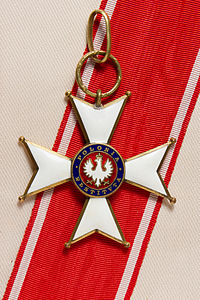
Polonia_Restituta_-_Commander's_Cross_pre-1939_w_rib
Silver Cross of the Polonia Restituta

Janusz Korczak returned to his life’s work in 1921 of providing for the children of this Jewish community, all the while writing no fewer than thirteen children’s books, along with another seven on pedagogy and other subjects.

In the inter-war years, Korczak put together a children’s newspaper, the Mały Przegląd (Little Review), as a weekly supplement to the daily Polish-Jewish newspaper, Nasz Przegląd (Our Review).

Korczak had his own radio program promoting the rights of children, to whom he was known as Pan Doktor (“Mr. Doctor”) or Stary Doktor (“Old Doctor”).

The Polish government awarded “Old Doctor” the Polonia Restituta in 1933, a state order bestowed on individuals for outstanding achievements in the fields of education, science and other civic accomplishments.

Yearly visits to Mandatory Palestine, the geopolitical entity partitioned from the Ottoman Empire in 1923 and future Jewish state of Israel, led to anti-Semitic crosscurrents in the Polish press, and gradual estrangement from non-Jewish orphanages.
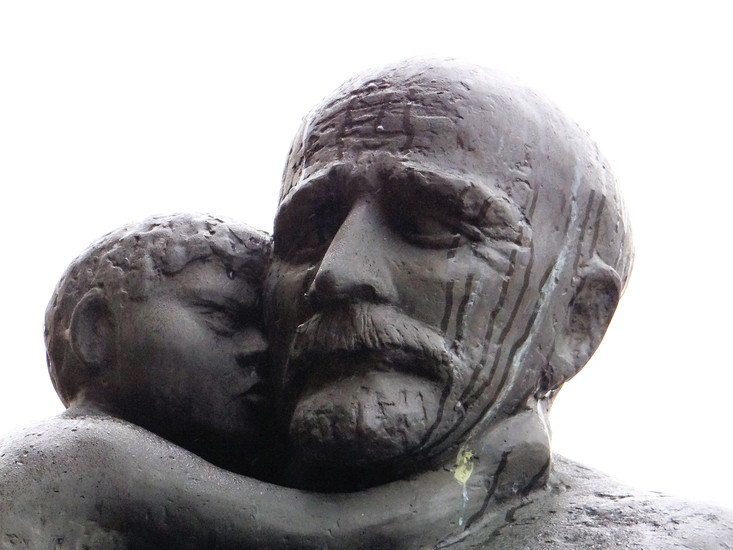
165210

The second Republic’s brief period of independence came to an end in September 1939, with the Nazi invasion of Poland.  Korczak volunteered once again but was refused, due to his age.

Tales of Polish courage in the face of the Wehrmacht are magnificent bordering on reckless, replete with images of horse cavalry riding out to meet German tanks. Little Poland never had a chance, particularly when the Soviet Union piled on, two weeks later.

As an independent nation-state the Sovereign Republic of Poland was dead, though Polish air crews went on to make the largest contribution to the Battle of Britain, among the United Kingdom’s thirteen non-British defenders.  Polish Resistance made significant contributions to the Allied war effort, throughout WW2.
janusz-korczak

Warsaw became the largest Jewish ghetto in Nazi-occupied Europe within the following year.  The Jews of Poland were herded into the city, barely existing on meager rations while awaiting the death squads of the SS.  Old Doctor and his orphans were forced into the Ghetto, in 1939.

There were nearly 200 of them on this day in 1942, when soldiers of the Gross-Aktion (Great Action) Warsaw, came for their “Resettlement to the East”.

ŚmierćMiasta
The Pianist, by Władysław Szpilman

The extermination camp at Treblinka, awaits.

Polish-Jewish composer and musician Władysław Szpilman, one of precious few survivors of the Jewish ghetto, describes the scene in his 1946 memoir, The Pianist:

“He told the orphans they were going out into the country, so they ought to be cheerful. At last they would be able to exchange the horrible suffocating city walls for meadows of flowers, streams where they could bathe, woods full of berries and mushrooms. He told them to wear their best clothes, and so they came out into the yard, two by two, nicely dressed and in a happy mood. The little column was led by an SS man…”

Eyewitness Joshua Perle states that:  Janusz Korczak was marching, his head bent forward, holding the hand of a child… A few nurses were followed by two hundred children, dressed in clean and meticulously cared for clothes, as they were being carried to the altar.
251012_Janusz_Korczak_monument_at_Jewish_Cemetery_in_Warsaw_-_03

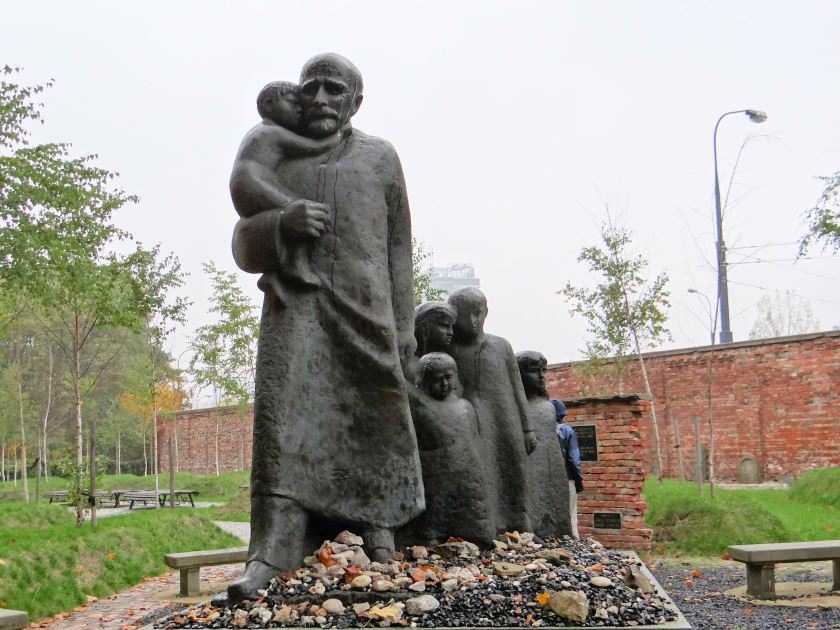
At the Umschlagplatz, the rail-side assembly area on the way to Treblinka, an SS officer recognized Korczak, and called him aside.  The children’s author was offered sanctuary on the “Aryan side” but the man refused, saying that he would stay with his children.  Stary Doktor was offered deportation to the Theresienstadt concentration camp instead, but again he refused.

The man who refused freedom to die with his orphaned children was last seen boarding the train to Treblinka on August 5 or 6, where all 200 were murdered, the following day.

800px-פולין_001
Janusz Korczak memorial stone, Treblinka

“Dr. Janusz Korczak’s children’s home is empty now. A few days ago we all stood at the window and watched the Germans surround the houses. Rows of children, holding each other by their little hands, began to walk out of the doorway. There were tiny tots of two or three years among them, while the oldest ones were perhaps thirteen. Each child carried the little bundle in his hand”. — Mary Berg, The Diary

August 4, 1693 Drinking the Stars

The Roman Rebublic built on and improved what the Greeks had begun, creating their own God of Wine and calling him Bacchus. It was the ancient Romans who first developed the concept of Terroir, “tare WAHr”, the notion that regional climate, soils and aspect (terrain) can effect the taste of wine.

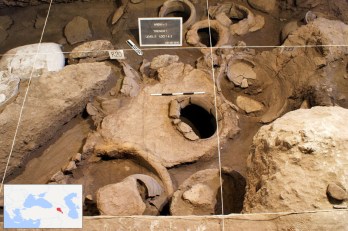
1-armeniaThe oldest winery for which archaeological evidence exists was established around BC4100, in present-day Armenia. The Egyptian Pharoahs were producing a wine-like substance from 3100BC for use in public ceremonies, due to its resemblance to blood.

Archaeologists discovered a 3,700 year old wine cellar in the north of Israel.  Phoenecian traders plied the Mediterranean from the shores of the Middle East to Gibraltar, transporting grapevines and wine in ceramic jugs.   Traders introduced wine to the ancient Greeks sometime around BC800, who then began to perfect the beverage, even naming a God of the grape harvest: Dionysus.

alexakis-history-of-wineSounds like a great job, as Greek Gods go.
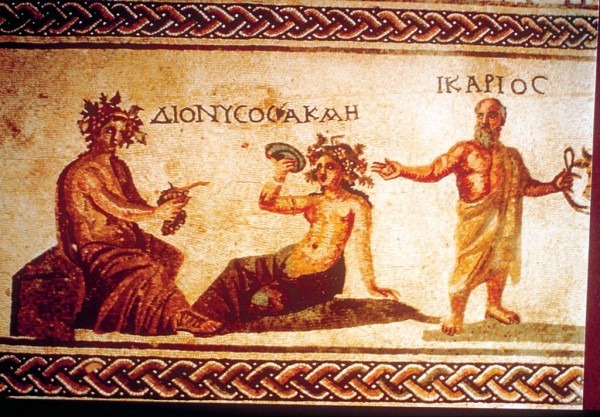
As the Greek city-states rose in power, viticulture and wine making traveled the eastern Mediterranean with Greek armies, into Sicily and the boot of Italy, and north toward Rome.

wine history

The Roman Republic built on and improved what the Greeks had begun, creating their own God of Wine and calling him Bacchus. It was the ancient Romans who first developed the concept of Terroir, “tare WAHr”, the notion that regional climate, soils and aspect (terrain) can effect the taste of wine.

bacchus-12The legions of Rome expanded the Empire across Europe from modern day France and Germany into Portugal and Spain.  Everywhere the Legions went, vineyards were soon to follow. To this day, some regions are said to have more ‘Terroir’, than others.
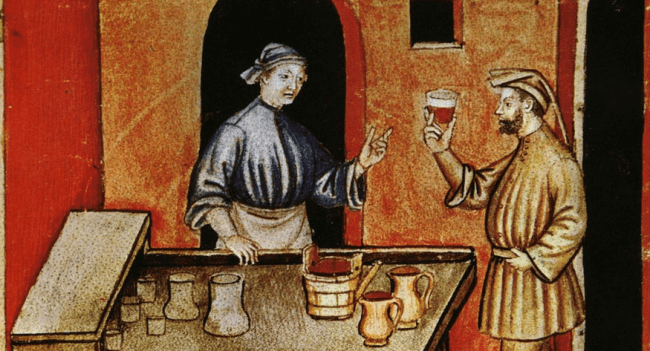
Wine seemed better suited to the sensibilities of the Roman palate, and Tacitus maligned the bitter brew of Germanic barbarians.  Nevertheless, letters home from cavalry commanders of the Roman Britain period (ca AD97-103), include requests for more “cerevisia”.

Muhammad directed the “Righteous” to abstain from alcohol sometime in the seventh century, but promised “[R]ivers of water unaltered, rivers of milk the taste of which never changes, rivers of wine delicious to those who drink…” in heaven.  (Surah 47.15 of the Qur’an.)

Local production of rustic beers continued well beyond the collapse of the Roman empire, while the monasteries of Europe became prime repositories of viticulture and wine making technique.

The wines of medieval and renaissance-era Europe tended to be almost universally red and almost always, still.  The in-bottle refermentation that gives “sparkling” wine its ‘fizz’ was a problem.  Fermentable sugars were frequently left over when weather began to cool in the fall, particularly with the white grape varietals. Refermentation would set in with the warm spring weather, converting bottles into literal time bombs. Caps would pop off and wine would spoil. Sometimes the whole batch would explode, one pressurized bottle going off in sympathetic detonation with the other.

best-medieval-wine-650x351

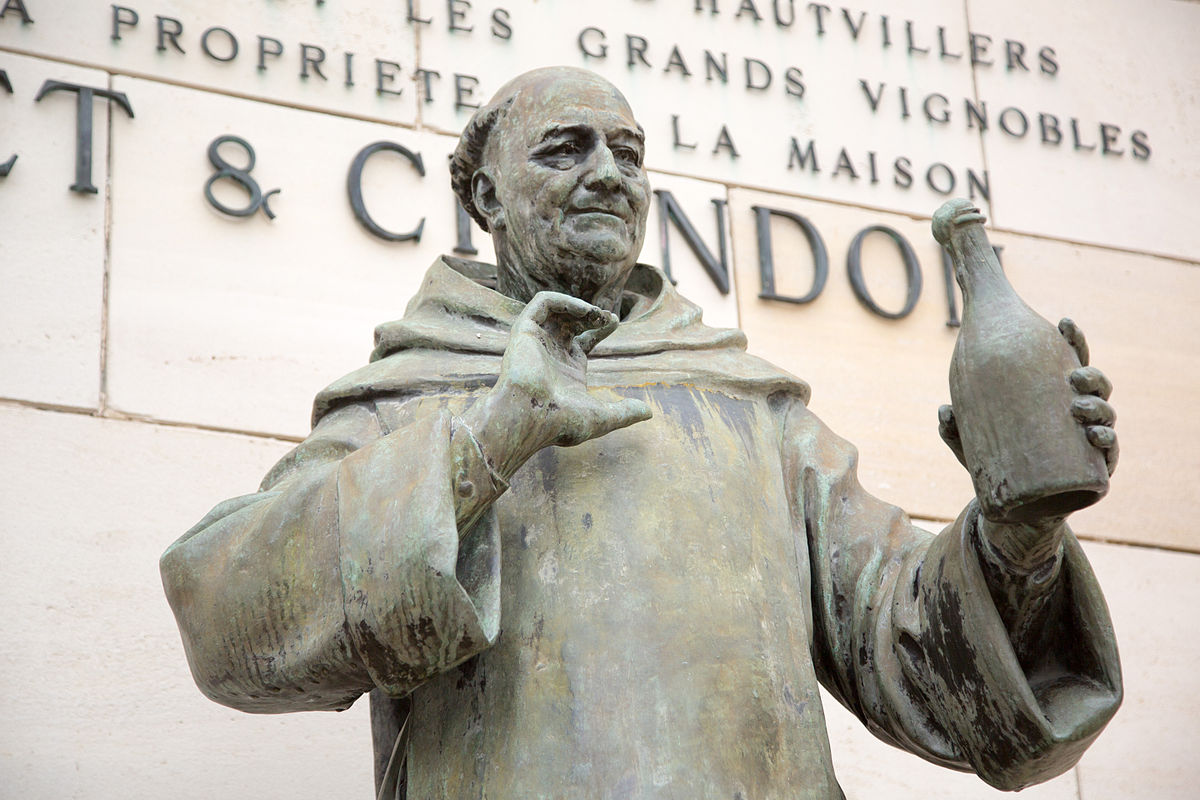
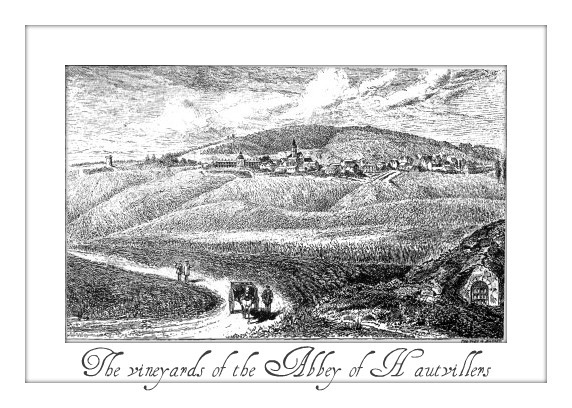
Pierre Perignon entered the Benedictine Order at the age of 19, doing his novitiate at the abbey of Saint-Vannes near Verdun and transferring to the abbey of Hautvillers in 1668.

On August 4, 1693, the date traditionally ascribed to Brother (Dom) Pérignon’s invention of Champagne, the monk is supposed to have said “Come quickly, I am drinking the stars!”.

hautvillers-vineyardsThe story is almost certainly a myth, a later embellishment to the story.  During his 47 year career, Pérignon went to considerable lengths to eliminate bubbles from his wine.  Dom Pérignon never succeed in that goal, yet he did make bubbly wine a whole lot better, using corks for the first time to prevent the escape of carbon dioxide, and perfecting a ‘gentle’ pressing technique which left out the murkiness of the skins.

It is almost certainly Dom Pérignon who perfected the double fermentation process. He was an early advocate of natural farming methods we would call “organic”, today.  Pérignon insisted on “blind” tasting, not wanting to know what vineyard a grape came from prior to selection, and strictly avoiding the addition of foreign substances, insisting that all blending take place at the grape stage.

Dom PerignonPérignon didn’t like white grapes because of their tendency to enter refermentation. He preferred the Pinot Noir, and would aggressively prune the plants so that vines grew no higher than three feet and produced a smaller crop. The harvest was always in the cool, damp early morning hours, and Pérignon took every precaution to avoid bruising or breaking his grapes. Over-ripe and overly large fruit was always thrown out. Pérignon never permitted grapes to be trodden upon, always preferring the use of multiple presses.
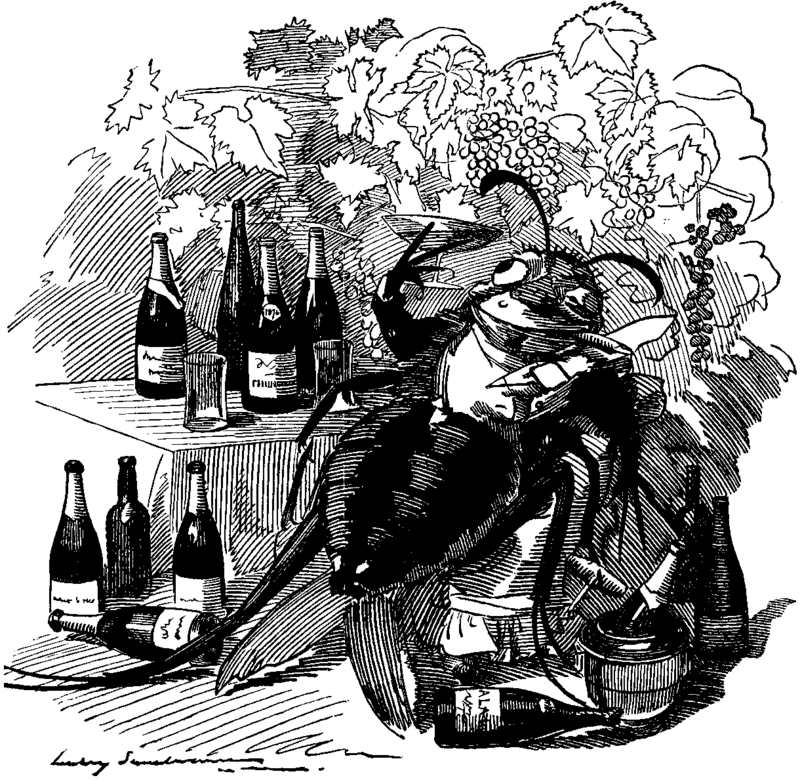

In 1891, the Madrid Agreement established among the European powers, that only sparkling wines from a certain region in northeast France may be labeled “Champagne”.  The principle was re-asserted in the Treaty of Versailles ending WW1, providing protections for a French wine industry which had, ironically, been saved and literally rebuilt from the ground up by grafting “inferior” American root stock onto French vines.

But that must remain a story for another day.

800px-Phylloxera_cartoon
1890 cartoon from Punch depicting the Phylloxera aphid, which all but obliterated the French wine industry.

That American companies like Korbel, Cook’s and others may continue to call their bubbly wines Champagne is due to the United States’ Senate never having ratified the treaty formally ending WW1, back in 1920.  The United States entered the Madrid system in 2003, but the Champagne name dispute, remains unsettled.

california-champagne-header

Benjamin Franklin, born nine years before brother Pérignon’s death in 1715, is supposed to have said “Beer is proof that God loves us and wants us to be happy.” That’s close, but the quote seems to come from a letter to André Morellet dated 1779, in which the Founding Father wrote  “Behold the rain which descends from heaven upon our vineyards; there it enters the roots of the vines, to be changed into wine; a constant proof that God loves us, and loves to see us happy“.

Either way, I enthusiastically approve Mr. Franklin’s message.  Cheers.

If you enjoyed this “Today in History”, please feel free to re-blog, “like” & share on social media, so that others may find and enjoy it as well. Please click the “follow” button on the right, to receive email updates on new articles.  Thank you for your interest, in the history we all share.

August 3, 1908 The Old Man of La Chappelle

Research suggests that we all carry Neanderthal genes and that these may have changed our immune systems, leaving us vulnerable to diseases such diabetes and cancer.

In the 17th century, the German Reformed Church teacher and hymn writer Joachim Neander liked to hike a valley outside of Düsseldorf. The beauty of nature was inspirational, clearing his mind and inspiring verses like “See how God this rolling globe/swathes with beauty as a robe…Forests, fields, and living things/each its Master’s glory sings.”  The theologian contracted tuberculosis and died at the age of thirty but lived on in a way, in the valley which came to bear his name.

Nearly 200 years later, three years before Charles Darwin published the Origin of Species, workers quarrying limestone in the Neander Valley discovered an unusual skull.  This was no ordinary head, elongated and nearly chinless as it was, with heavy ridges over the eyes.  Heavy bones were found alongside,  which fitted together, oddly.

From top, clockwise:  a) Neander Valley by Friedrich Wilhelm Schreiner, oil on cardboard, 1855, b) original bones discovered the following year, and c)Artist’s conception of what he looked like, H/T Artist: Kennis & Kennis Reconstructions

The state of archaeological science had much to learn in 1856.  Who knows, 22nd century historians and scientists may look back at our time, and say we had a long way to go.  At the time, even to discern fossils from ordinary rock was beyond the ability of many scientists. One common method involved licking the fossil. If the thing had animal material, it would stick to your tongue.

Despite such misconceptions, scholars of the day had no shortage of theories. This was a lost Cossack, a bowlegged rider suffering from rickets, a painful condition resulting in weak and misshapen bones. To some, the life of pain resulting from such a condition made perfect sense, the bony eye ridges resulting from perpetually furrowed brow.

British geologist William King suspected something different. Something more radical. This was no aberrant human being nor even a lost ancestor. This was a member of a long lost alternate humanity.   An extinct but parallel species to our own.  King published a paper in 1864 hypothesizing his idea of an evolutionary dead end, naming the long lost species after the poet who had once wandered the valley in which it was discovered. He called it Homo Neanderthalensis: Neanderthal Man.

Neanderthal mother and child
“Neanderthal sculptures, named Nana and Flint, at the Gibraltar Museum”. H/T Jaap Scheeren, New York Times

Having no context from which to draw conclusions, King fell back on the pseudo science of phrenology to describe Neanderthal man, along with preconceptions of “primitive” and “savage” races. The image of a stupid and grunting brute emerged from this analysis. King opined that “The thoughts and desires which once dwelt within it never soared beyond those of a brute.” Today we may look at such thinking as itself savage and primitive, but applying modern ideas to earlier times is a dangerous undertaking. Ideas of Eugenics survived well after King’s time, and into the modern era.

On this day in 1908, the brothers Amadee and Jean Bouyssonie found the most complete Neanderthal skeleton to date in a small cave near La Chapelle-aux-Saints, in France.  This skeleton includes the skull, jaw, most of the vertebrae and several ribs, along with most of the long bones of his arms and legs, plus a number of smaller bones from the hands and feet.

Sarlat and sites 402
The Old Man of La Chapelle-Aux-Saints reconstructed burial in the Musée de l’Homme de Néandertal, France

French palaeontologist Marcellin Boule studied the remains and envisioned a brutish, hairy and gorilla-like beast with opposable toes and bent spine, walking on bowed legs with bent knees.  Boule’s reconstruction was influential. Decades later, scientists and popular culture viewed Neanderthal as bent and stupid brutes. Boule got it wrong that time but, to his credit, was one of the first to recognize Piltdown Man, as a paleoanthropological hoax.

Subsequent analysis of the “Old Man of La Chappelle” revealed not the bent-over beast of Boule’s imagination, but a fully erect biped, bent with advanced osteoarthritis.

What’s more, massive tooth loss and lack of mobility revealed that this specimen could neither hunt nor scavenge with ease, and would have had great difficulty in chewing his food. This and the unmolested state of the skeleton compared with animal bones found nearby suggest a man greatly cared for by his contemporaries, as well as deliberate burial of the body.

This wasn’t even an “old man” by our standards.  The skeleton is currently estimated to have been that of a man between 25 and 40 years, demonstrating the Hobbesian adage that life was once indeed, “Nasty, Brutish and Short”.

Today, to call someone a “Neanderthal” is to insult him as a stupid savage.  It appears that our cousin was nothing of the sort.

Skeleton_and_restoration_model_of_Neanderthal_La_Ferrassie_1

The hyoid bone situated at the floor of the mouth serves as a connecting-point for the tongue and other musculature, giving humans the ability to speak. A delicate structure likely to be lost in most fossilized remains, the first Neanderthal hyoid was only discovered in 1989.

An international team of researchers analysed this fossil Neanderthal bone using 3D x-ray imaging and mechanical modelling and, yes.  Neanderthal could not only speak, but was capable of highly complex speech not unlike ourselves, though his voice was likely high and grating.  Certainly not the base grunting commonly associated with “cave-men”.

img_1054neanderthalsmShorter in stature and considerably more powerful than Cro-Magnon, our direct ancestor and all but indistinguishable from ourselves, Neanderthal bodies were suited to the ice age of the early and middle Paleolithic era.

Neanderthal emerged on the Eurasian landmass between 100,000 and 200,000 years ago.  Possessed of a brain only slightly smaller than Cro-Magnon, Neanderthals walked upright, formed and used simple tools and controlled fire.  They even buried their own dead, at least sometimes, and some researchers theorize that they built boats and sailed the Mediterranean.  Imperfectly formed tools and weapons found alongside more sophisticated specimens even suggest that he educated his children.

He might even fit in if you brought him back today, provided you dressed him right.

Despite all that, Neanderthal man is an evolutionary dead end and not our ancestor, though he did “coexist” for a time, with our Cro-Magnon forebears.  It’s even possible if not probable that the two bred together and produced children, though this was likely your random hookup rather than any long-term cross-breeding.

Modern DNA analysis suggests that the two species even shared some genetic disorders, such as psoriasis, Crohn’s disease and a variety of auto-immune conditions such as Lupus.

image_1481e-Neanderthal

Research even suggests that we  carry Neanderthal genes, every one of us, and that these may have changed our immune systems leaving us vulnerable to diseases such diabetes and cancer.

The idea is not as strange as it sounds. Last year, Sir Richard Branson was in the news, claiming that he had looked into his family ancestry. Forty generations back, it turns out that Branson is related to Charlemagne.  That’s no big deal, according to Genetecist Adam Rutherford. Speaking at the Chalke Valley History Festival, Rutherford explained that “Literally every person in Europe is directly descended from Charlemagne. Literally, not metaphorically. You have a direct lineage which leads to Charlemagne,” adding “Looking around this room, every single one of you … is directly descended between 21 and 24 generations from Edward III.”  The only difference between celebrities and the rest of us it turns out, is the means to prove it.

0506-Neanderthal-woman-genes

So, maybe calling someone ‘Neanderthal’ isn’t such an insult, after all.  Perhaps there’s one in there somewhere, peering back at us from our bathroom mirror.

If you enjoyed this “Today in History”, please feel free to re-blog, “like” & share on social media, so that others may find and enjoy it as well. Please click the “follow” button on the right, to receive email updates on new articles.  Thank you for your interest, in the history we all share.

August 2, 1864 Both Barrels

Named for one of it’s own private soldiers, the Mitchell Thunderbolts were not your standard military company. These guys were “organized strictly for home defense” and absolutely refused to take orders.  From anyone. They recognized no superior officer and the right to criticism was reserved and freely exercised from that “splendid old gentleman” Colonel John Billups, down to the lowliest private.

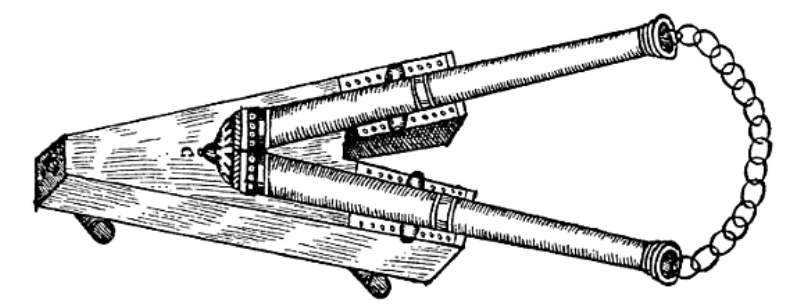
In 1642, Italian gun maker Antonio Petrini conceived a double barrel cannon, with tubes joined at 45° and firing solid shot joined together, by chain.  This was the year of the “Great Rebellion“, the English Civil War, when the King and Parliament raised armies to go to war – with each other.  The idea must have looked good as proposed to King Charles I of England, the weapon capable of slicing through his enemies, like grass before a scythe.

The idea was to fire both barrels simultaneously, but there was the rub.  Wild ideas occur to the imagination of imperfect combustion, and a chained ball swinging around to take out the gun crew.  The King himself was mute on the subject, and went on to lose his head, in 1649.  Petrini’s manuscript resides to this day in the tower of London.  There is no documented proof that the weapon was ever fired, save for the designer’s own description of the ‘Grandissima Ruina’ left behind, by his creation.

Capture_zps80a1eeae

Two-hundred years later the former British colonies in America, found themselves embroiled in their own Civil War.

In the early days of its independence, the Confederate Congress enacted a measure, allowing local cities and towns to form semi-military companies for the purpose of local defense. As the very flower of young southern manhood was called up and sent to the front, these “home guard” units often comprised themselves of middle-age and older gentlemen, and others for various reasons, unable to leave home and hearth.

ALHullAugustus Longstreet Hull was born 1847 in “The Classic City” of Athens Georgia, and enlisted in the Confederate Army on September 8, 1864.
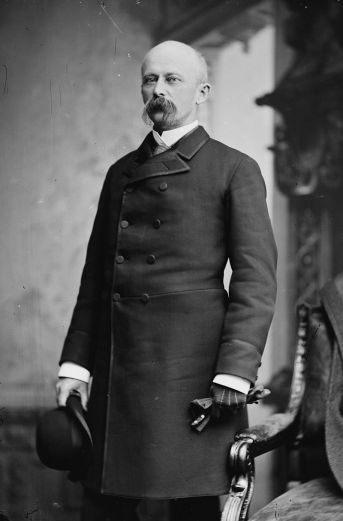

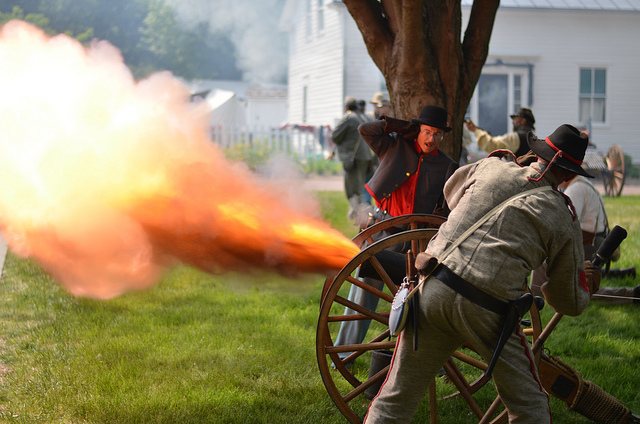
After the war, Hull worked twenty-seven years as a banker, before publishing the Annals of Athens, in 1906.  In it, Mr. Hull writes with not a little biting wit, of his own home town home guard unit, Athens’ own, Mitchell Thunderbolts.

“From the name one might readily infer that it was a company made up of fierce and savage men, eager for the fray and ready at all times to ravage and slaughter; yet such was not the case, for in all their eventful career no harm was done to a human being, no property was seized and not one drop of blood stained their spotless escutcheon.

Thus from their patriotism sprang the “Thunderbolts”, a company whose deeds must live in order that history may be complete, whose fame, though not blazoned to the world in song and story, is yet of such a character as to entitle the names of its members to be inscribed alongside those “that were not born to die.”

Named for one of it’s own private soldiers, the Mitchell Thunderbolts were not your standard military company. These guys were “organized strictly for home defense” and absolutely refused to take orders.  From anyone. They recognized no superior officer and the right to criticism was reserved and freely exercised by everyone from that “splendid old gentleman” Colonel John Billups, down to the lowliest private.

800px-Middleton_P._Barrow_-_Brady-Handy
Georgia Senator Middleton Pope Barrow

General Howell Cobb sent the future United States Senator Captain Middleton Pope Barrow to Athens in 1864, to inspect the Thunderbolts. Having no intention of submitting to “inspection” by any mere stripling of a Captain, Dr. Henry Hull (Augustus’ father) “politely informed him that if he wished to inspect him, he would find him on his front porch at his home every morning at 9 o’clock“.

John Gilleland, 53, was a local dentist, builder and mechanic, and member in good standing of the Mitchell Thunderbolts.  Gilleland must have liked Petrini’s idea because he took up a collection in 1862, and raised $350 to build the Confederate States of America’s own, double-barrel cannon.

Measuring 13 inches wide by 4-feet 8½” inches and weighing in at some 1,300 pounds, this thing had two barrels diverging at 3° and equipped with three touch holes, one for each barrel and a third should you wish to fire them, together.  It was the secret “super weapon” of the age, two cannonballs connected by a chain and designed to “mow down the enemy somewhat as a scythe cuts wheat.”

As with Mr. Petrini’s invention, the insurmountable problem remained, how to fire the two, simultaneously.

The atmosphere was festive on April 22, 1862, when a crowd gathered to watch Gilleland test his creation. The weapon was aimed at two upright poles stuck into the ground, but uneven ignition and casting imperfections sent the two balls spinning wildly off to the side, where they “plowed up about an acre of ground, tore up a cornfield, mowed down saplings, and then the chain broke, the two balls going in different directions“.

046_zps0a76b542
Double Barrel Cannon model, H/T ModelExpo

On its second test, two chain-connected balls shot through the air and into a stand of trees.   According to one witness, the “thicket of young pines at which it was aimed looked as if a narrow cyclone or a giant mowing machine had passed through“.

On the third firing, the chain snapped right out of the barrel.  One ball tore into a nearby cabin and destroyed the chimney, while the other spun off and killed a cow, who wasn’t bothering anyone.

Gilleland considered all three tests successful, but the only thing that was safe, seems to have been those target posts.

The dentist went straight to the Confederate States’ arsenal in Augusta where Colonel George Rains subjected his creation to extensive testing, before reporting the thing too unreliable for military use. The outraged inventor wrote angry letters to Georgia Governor Joseph “Joe” Brown and to the Confederate government in Richmond, but to no avail.

At last, the contraption was stuck in front of the Athens town hall and used as a signal gun, to warn the citizens of approaching Yankees.

7239343410_30c6de36eb_z

There it remained until August 2, 1864, when the gun was hauled out to the hills west of town to meet the Federal troops of Brigadier General George Stoneman.  The double-barrel cannon was positioned on a ridge near Barber’s Creek and loaded with canister shot, along with several conventional guns.  Outnumbered home guards did little real damage but the noise was horrendous, and Stoneman’s raiders withdrew to quieter pastures.

There were other skirmishes in the area, but all of them minor. In the end, Athens escaped the devastation of Sherman’s march to the sea, and the weapon was moved back to town.

Gilleland’s monstrosity was sold after the war and lost, for a time.  The thing was recovered and restored back in 1891, and returned to the Athens City Hall, where it remains to this day, a contributing property of the Downtown Athens Historic District.  Come and see it if you’re ever in Athens, right there at the corner of Hancock and College Avenue.  There you will find it, pointing north, toward the Yankees.  Just in case.

800px-Doublebarreledcannonathensgeorgia-plaque

If you enjoyed this “Today in History”, please feel free to re-blog, “like” & share on social media, so that others may find and enjoy it as well. Please click the “follow” button on the right, to receive email updates on new articles.  Thank you for your interest, in the history we all share.


August 1, 1086 The Doomsday Book

Edward the Confessor, King of England, died in January of 1066, without an heir to the throne. Anglo-Saxon Kings didn’t generally pick their own successors, but several believed he had done just that .  Edward’s death touched off an international succession crisis.  The events of the following months, would change the course of history.

Edward the Confessor, King of England, died in January of 1066, without an heir to the throne. Anglo-Saxon Kings didn’t generally pick their own successors, but several believed he had done just that .  Edward’s death touched off an international succession crisis.  The events of the following months, would change the course of history.

Edward’s brother-in-law Harold Godwinson was elected King by the Witenagemot, an early version of our own Town Meeting.  There were others with claims of their own.  One of these was Harold’s younger brother Tostig, Earl of Northumbria, whose animosity for his brother would prove fatal for them both.

il_fullxfull.756977332_djs5

After conducting a few inconclusive raids in the spring of that year, Tostig went to a Norman Duke called William “the Bastard”, looking for help. William had openly declared his intention to take the English throne, and had no use for the King’s little brother.  Tostig then went to the King of Norway, King Harald III “Hardrada”, the name variously translated as “stern counsel”, or “hard ruler”.

Hardrada believed that he himself had claim to the English throne, and was dismayed at Godwinson’s succession.  The two sailed for England at the head of a powerful fleet of 300 Viking ships and an army of 10,000 warriors, meeting the northern Earls Edwin and Morcar in battle at Fulford Gate on September 20.

The battle was a comprehensive defeat for the English. When Harald came to Stamford Bridge a week later, it was in expectation of formal capitulation and tribute.

Facts_Harald_Hardrada_Last_Great_Viking_5

Meanwhile, King Harold was at the head of an army in the south, anticipating William’s invasion from Normandy. My military friends will appreciate what happened next.  Harold marched his army north, traveling day and night and covering 190 miles in four days, on foot, completely surprising the Viking army waiting at Stamford Bridge. The Vikings must have looked at the horizon and wondered how a peace party could raise that much dust, only to face the “gleam of handsome shields and white coats-of-mail”.

Thinking they were there to accept submission, Harald’s army had left half their numbers behind to watch the ships.  Worse still, many of Harald’s warriors had removed their heavy armor, and scattered over both sides of the River Derwent.

Battle of Stamford Bridge

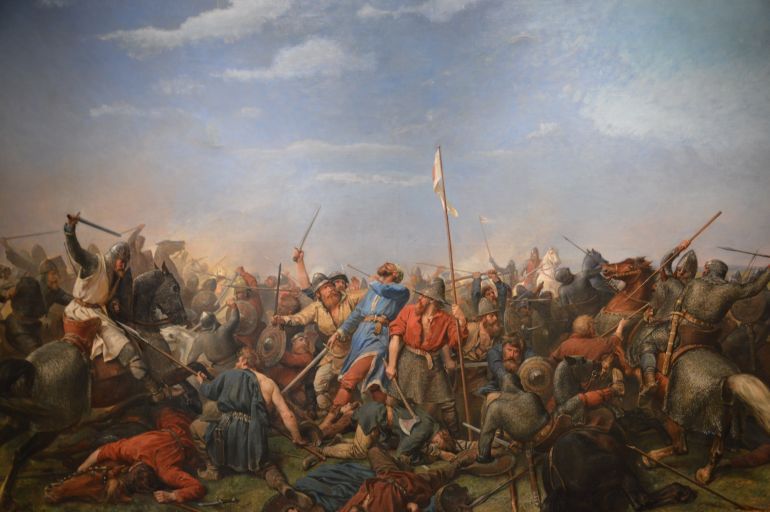
The English army charged through the loose ranks of Norwegians, as the rest struggled to form the skjaldborg (shield wall) on the opposite bank.

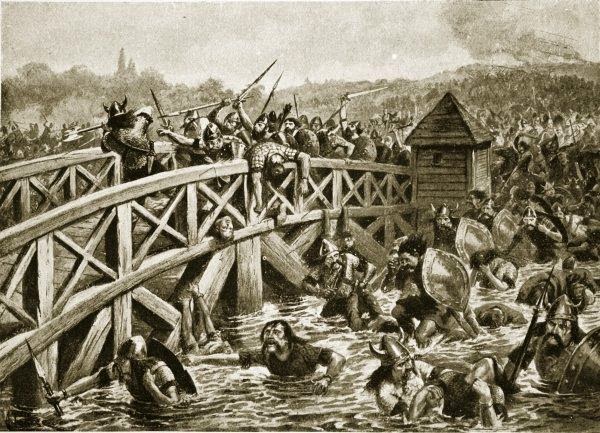
According to the Anglo-Saxon Chronicle, one giant Viking warrior stood alone at the top of Stamford Bridge. Swinging the great two handed Dane Axe, for a time this man held back the entire English army, crowding onto the narrow choke point.   40 English soldiers lay mangled and dead in heaps around this beast, when an English soldier moved beneath the bridge, spearing the Viking warrior from below.

Facts_Harald_Hardrada_Last_Great_Viking_7

The savagery of the battle can only be imagined. This was before the age of industrialized warfare, when every injury was personally administered with a bladed weapon of some kind. 5,000 of King Harold’s soldiers would be dead before it was over, about a third of his force. Two thirds of King Harald’s Vikings died that day, about 6,000.  In the end, Harald Hardrada invoked his berserkergang (the state of going berserk), and waded into his foe, madly hacking and slashing all about him until an arrow found his throat.

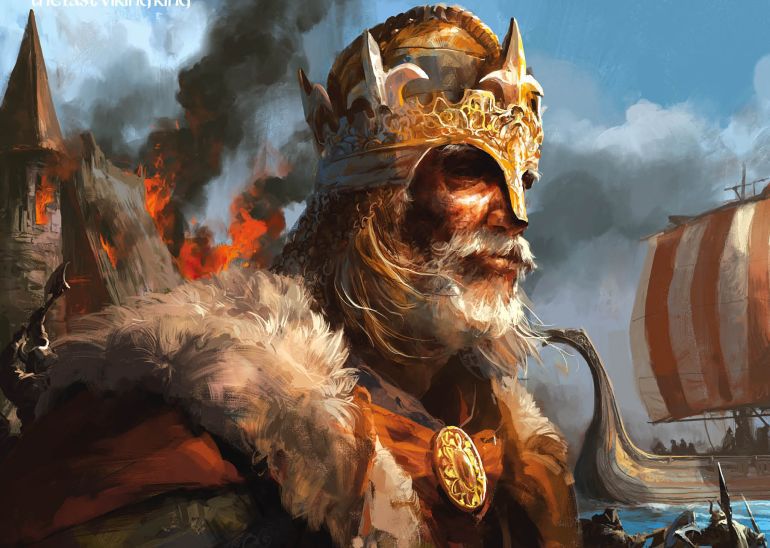
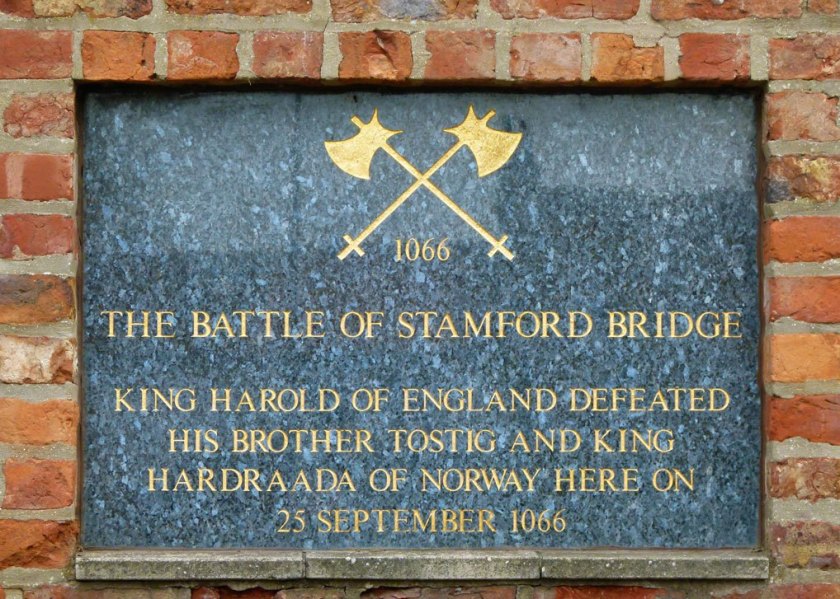
Thus ends the tale of the last ‘Great Viking’.  Harald was dead, as was his ally Tostig, his reward, in the words of King Harold, “Seven feet of English soil, or as much more as he is taller than other men“.

Battle_of_Stamford_Bridge-04

Of 300 ships that had arrived on the 20th, the battered remnants of the Viking army required only 24, to sail away.

Meanwhile, William was in final preparations for his own channel crossing, a voyage many considered unlikely at that late time of year.  The Norman landing Harold had been waiting for took place three days later, just as his battered army was disbanding and heading home for the Fall harvest.

tumblr_la6h4gVLfh1qe23mao1_500A greatly diminished Anglo Saxon army marched south, meeting the Norman invader in October, 1066.  In an age of mechanized warfare, it is odd to think you could have been on a neighboring hill, and not heard a thing.  History changed that day, when King Harold took an arrow to the eye, at a place called Hastings.   The last of the Anglo Saxon Kings, was dead.  William was crowned King of England that December.  Henceforward and forever more, William the Bastard would be known as “William the Conqueror”.

Main rivals to the new King were now gone, but William wouldn’t be secure on his throne for another six years. Lands were confiscated from resisting members of the English elite and from lords who had fought and died in service to Harold.

800px-Norman-conquest-1066.svg
H/T By Amitchell125 at English Wikipedia

Such lands were enfeoffed, a process of the European middle ages through which land was granted in exchange for feudal allegiance, while the King retained ultimate title. Such confiscations led to revolts and further confiscations, as widows and daughters were forced into marriages with Norman barons.

Castles were built at an unprecedented rate, controlling military strongpoints across the land and, in the words of historian Robert Liddiard, “legitmizing a new elite”. Liddiard remarks that “to glance at the urban landscape of Norwich, Durham or Lincoln is to be forcibly reminded of the impact of the Norman invasion.”

7PASTmN

Beginning in 1085, seven or eight panels of commissioners fanned out across the land, taking sworn statements in every shire and village. Elaborate records were compiled of all lands and estates held by the King through his tenants, down to every agricultural plot and fishpond, and its value in pounds.

It was all done for purposes of taxation, particularly to see what was owed during the reign of Edward the Confessor. You can imagine how that went over but, as always, history is written by the victor.

So complete was the Norman conquest that William himself was able to spend three-quarters of his time, defending his interests in France. According to these records, no more than 5% of all lands remained in English hands by 1086.

While exact dates are subject to dispute, the major part of the “Great Survey” is traditionally held to have been bound and presented to King William on this day in 1086, in Salisbury.

1200px-Domesday-book-1804x972Late in the 12th century, King’s Treasurer Richard FitzNeal likened the Great Survey to the Book of Judgement, the book of “Domesday” (middle English for “Doomsday”), because its pronouncements were final and inviolate, as the Last day of Judgement.

Nothing even remotely similar to the “Domesday Book” would be attempted again, until 1873. For most English towns and villages (most but not all – no Domesday records are known to survive for London or Winchester), the Domesday book remains the starting point of history. The final and dispositive arbiter of lands and titles held, across the British Isles.

If you enjoyed this “Today in History”, please feel free to re-blog, “like” & share on social media, so that others may find and enjoy it as well. Please click the “follow” button on the right, to receive email updates on new articles.  Thank you for your interest, in the history we all share.


July 31, 1917  Did we really send men to fight in That?

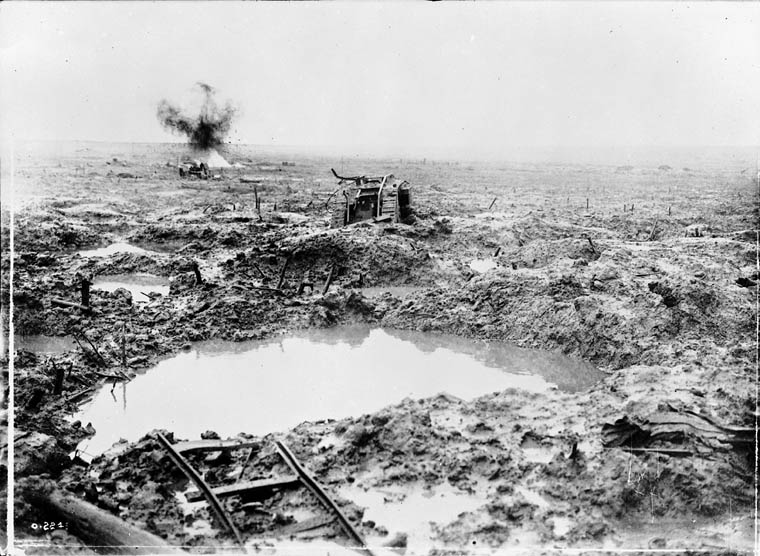
Following the battle of Passchendaele, staff officer Sir Launcelot Kiggell is said to have broken down in tears.  “Good God”, he said, “Did we really send men to fight in That”?! 

The “War to end all Wars” exploded across the European continent in the summer of 1914, devolving into the stalemate of trench warfare, by October.

The ‘Great War’ became Total War, the following year.  1915 saw the first use of asphyxiating gas, first at Bolimow in Poland, and later (and more famously) near the Belgian village of Ypres.  Ottoman deportation of its Armenian minority led to the systematic extermination of an ethnic minority, resulting in the death of ¾ of an estimated 2 million Armenians living in the Empire at that time, and coining the term ‘genocide‘.

Battle-of-Passchendaele
Battle of Passchendaele

Kaiser Wilhelm responded to the Royal Navy’s near-stranglehold of surface shipping with a policy of unrestricted submarine warfare, as the first zeppelin raids were carried out against the British mainland.  German forces adopted a defensive strategy on the western front, developing the most sophisticated defensive capabilities of the war and determined to “bleed France white”, while concentrating on the defeat of Czarist Russia.

Russian Czar Nicholas II took personal command that September, following catastrophic losses in Galicia and Poland.  Austro-German offensives resulted in 1.4 million Russian casualties by September with another 750,000 captured, spurring a “Great Retreat” of Russian forces in the east, and resulting in political and social unrest which would topple the Imperial government, fewer than two years later.   In December, British and ANZAC forces broke off a meaningless stalemate on the Gallipoli peninsula, beginning the evacuation of some 83,000 survivors.  The disastrous offensive had produced some 250,000 casualties.  The Gallipoli campaign was remembered as a great Ottoman victory, a defining moment in Turkish history.  For now, Turkish troops held their fire in the face of the allied withdrawal, happy to see them leave.

The-third-battle-of-Ypres-1917-9
Passchendaele, 1917

A single day’s fighting in the great battles of 1916 could produce more casualties than every European war of the preceding 100 years, civilian and military, combined. Over 16 million were killed and another 20 million wounded, while vast stretches of the Western European countryside were literally torn apart.

1917 saw the resumption of unrestricted submarine warfare, and a German invitation to bring Mexico into the war, against the United States.  As expected, these policies brought America into the war on the allied side.  The President who won re-election for being ‘too proud to fight’ asked for a congressional declaration of war, that April.

Sealed TrainMassive French losses stemming from the failed Nivelle offensive of that same month (French casualties were fully ten times what was expected) combined with irrational expectations that American forces would materialize on the western front led to massive unrest in the French lines.  Fully one-half of all French forces on the western front mutinied.  It’s one of the great miracles of WW1 that the German side never knew, else the conflict may have ended, very differently.
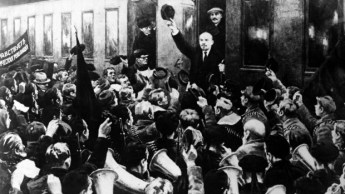
The sealed train carrying the plague bacillus of communism had already entered the Russian body politic.  Nicholas II, Emperor of all Russia, was overthrown and murdered that July, along with his wife, children, servants and a few loyal friends, and their dogs.

This was the situation in July 1917.

third-battle-of-ypres-passchendaele-ww1-007For eighteen months, British miners worked to dig tunnels under Messines Ridge, the German defensive works laid out around the Belgian town of Ypres.  Nearly a million pounds of high explosive were placed in some 2,000′ of tunnels, dug 100′ deep.  10,000 German soldiers ceased to exist at 3:10am local time on June 7, in a blast that could be heard as far away, as London.
Buoyed by this success and eager to destroy the German submarine bases on the Belgian coast, General Sir Douglas Haig planned an assault from the British-held Ypres salient, near the village of Passchendaele.

general

British Prime Minister David Lloyd George opposed the offensive, as did the French Chief of the General Staff, General Ferdinand Foch, both preferring to await the arrival of the American Expeditionary Force (AEF).  Historians have argued the wisdom of the move, ever since.

The third Battle of Ypres, also known as the Battle of Passchendaele, began in the early morning hours of July 31, 1917. The next 105 days would be fought under some of the most hideous conditions, of the entire war.

In the ten days leading up to the attack, some 3,000 guns fired an estimated 4½ million shells into German lines, pulverizing whole forests and smashing water control structures in the lowland plains.  Several days into the attack, Ypres suffered the heaviest rainfall, in thirty years.

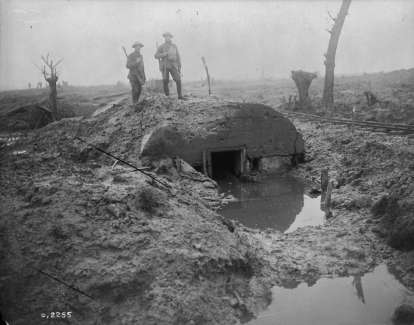
pillbox
German pillbox, following capture by Canadian soldiers.

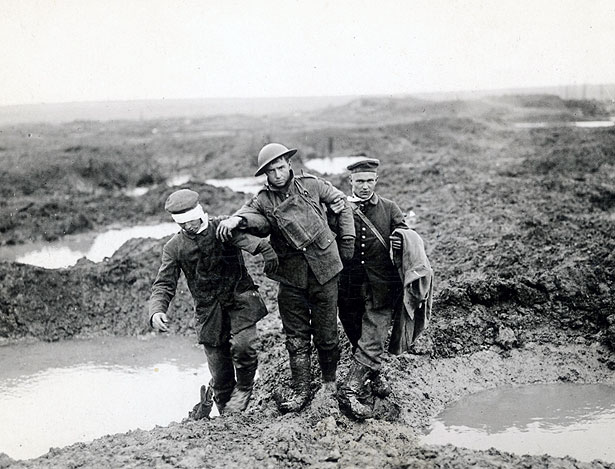
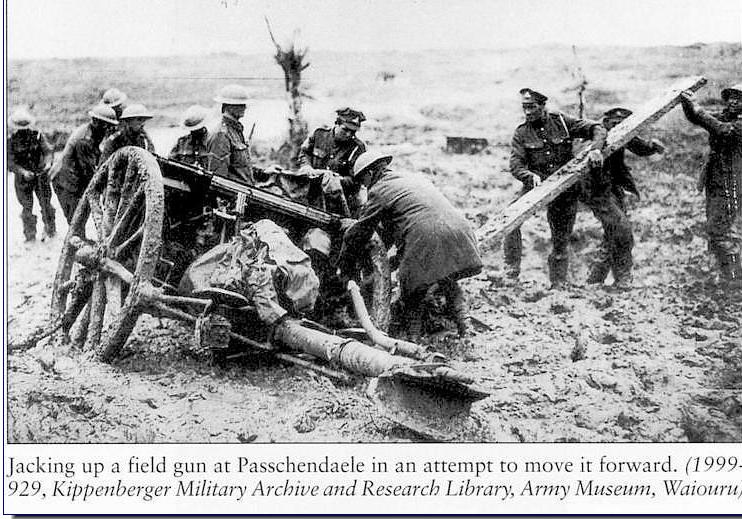
Conditions defy description. Time and again the clay soil, the water, the shattered remnants of once-great forests and the bodies of the slain were churned up and pulverized, by shellfire.  You couldn’t call the stuff these people lived and fought in mud – it was more like a thick slime, a clinging, sucking ooze, capable of claiming grown men, even horses and mules.  Most of the offensive took place across a broad plain formerly crisscrossed with canals, but now a great, sucking mire in which the only solid ground seemed to be German positions, from which machine guns cut down sodden commonwealth soldiers, as with a scythe.

Soldiers begged for their friends to shoot them, rather than being left to sink in that muck. One sank up to his neck and slowly went stark raving mad, as he died of thirst. British soldier Charles Miles wrote “It was worse when the mud didn’t suck you down; when it yielded under your feet you knew that it was a body you were treading on.”

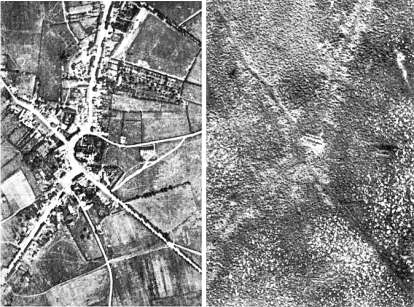
Passchendaele, aerial
Passchendaele, before and after the offensive. H/T Imperial War Museums/Wikimedia Commons

In 105 days of this hell, Commonwealth forces lost 275,000 killed, wounded and missing.  The German side another 200,000.  90,000 bodies were never identified.  42,000 were never recovered and remain there, to this day.  All for five miles of mud, and a village barely recognizable, after its capture.

Following the battle of Passchendaele, staff officer Sir Launcelot Kiggell is said to have broken down in tears.  “Good God”, he said, “Did we really send men to fight in That”?!  The soldier turned war poet Siegfried Sassoon reveals the bitterness of the average “Joe Squaddy” whom his government had sent sent to fight and die, at Passchendaele.  The story is told in the first person by a dead man, in all the bitterness of which the poet is capable.  It’s called:

Memorial Tablet – by Siegfried Sassoon
Sassoon“Squire nagged and bullied till I went to fight,
(Under Lord Derby’s Scheme). I died in hell (They called it Passchendaele). My wound was slight,
And I was hobbling back; and then a shell
Burst slick upon the duck-boards: so I fell
Into the bottomless mud, and lost the light.

At sermon-time, while Squire is in his pew,
He gives my gilded name a thoughtful stare;
For, though low down upon the list, I’m there;
‘In proud and glorious memory’…that’s my due.
Two bleeding years I fought in France, for Squire:
I suffered anguish that he’s never guessed.
Once I came home on leave: and then went west…
What greater glory could a man desire?”

If you enjoyed this “Today in History”, please feel free to re-blog, “like” & share on social media, so that others may find and enjoy it as well. Please click the “follow” button on the right, to receive email updates on new articles.  Thank you for your interest, in the history we all share.


July 30, 1916 Black Tom

The explosion at Black Tom was the most spectacular, but by no means the only such attack. The archives at cia.gov reports that “[B]etween 1915 and spring 1917, 43 American factories suffered explosions or fires of mysterious origin, in addition to the bombs set on some four dozen ships carrying war supplies to the Allies”.

In the early months of World War I, Britain’s Royal Navy largely swept the seas of the Kaiser’s surface ships and blockaded ports in Germany. The United States was neutral at the time, and more than a hundred German ships sought refuge in American harbors.

The blockade made it impossible for the Central Powers of Germany and Austria-Hungary to import war materiel from overseas, while Great Britain, France, and Russia continued to buy products from US farms and factories. American businessmen were happy to sell to any foreign customer who had the cash, but for all intents and purposes, such trade was limited to the allies.

British-blockadeTo the Central Powers, such trade had the sole purpose of killing their boys on the battlefields of Europe.
The first and most overt reaction from the Kaiser came in the form of unrestrained submarine warfare, when even vessels flying the flags of neutral countries were attacked. Less apparent at the time, was the covert campaign of sabotage carried out by German agents on US soil.

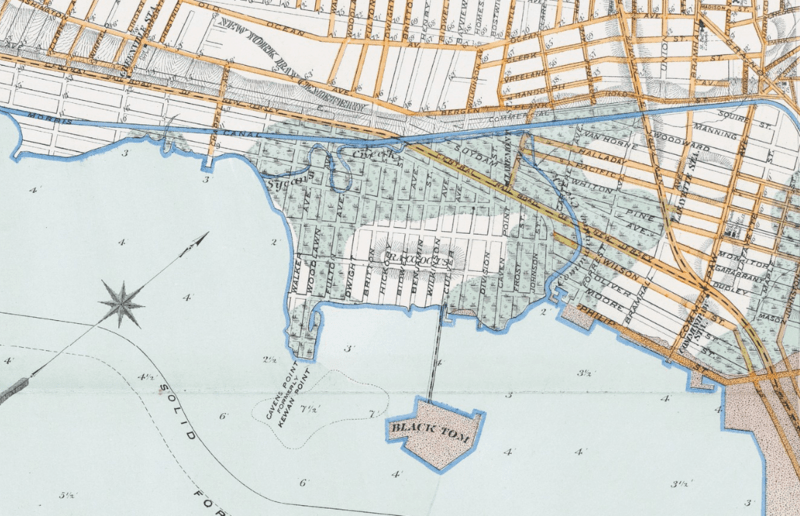
“Black Tom” was originally an island in New York Harbor, next to Liberty Island. So called after a former resident, by WWI, landfill had expanded the island to become part of Jersey City. The area contained a mile-long pier with warehouses and rail lines operated by the Lehigh Valley Railroad, and served as a major hub in the trade of war materiel to the allies.

Sanitary_&_Topographical_Map_of_Hudson_County,_N.J
Black Tom Island, 1880

On July 30, 1916, the Black Tom terminal had over two million pounds of small arms and artillery ammunition in freight cars, and one hundred thousand pounds of TNT on a nearby Barge.

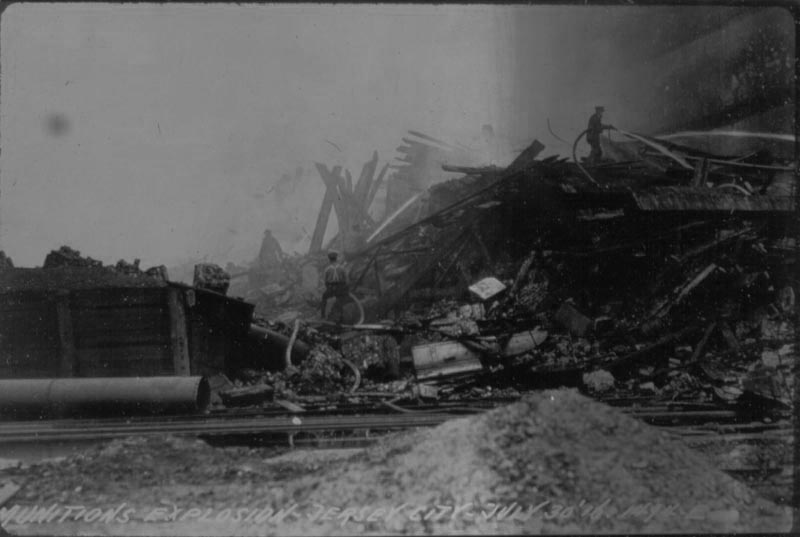
Guards discovered a series of small fires around 2:00am. Some tried to put them out while others fled, fearing an explosion. The first and loudest blast took place at 2:08am, a detonation so massive as to be estimated at 5.5 on the Richter scale. People were awakened from Maryland to Connecticut in what many thought was an earthquake. The Brooklyn Bridge shook and the walls of Jersey City’s municipal building were cracked as shrapnel flew through the air. Windows broke as far as 25 miles away, while fragments embedded themselves in the clock tower at the Jersey Journal building in Journal Square, over a mile away. The clock stopped at 2:12 am.

Black_Tom_explosion_-_firefighters_-_1916
Firefighters were unable to fight the fires until the bullets and shrapnel stopped flying. Photo: Wikimedia Commons

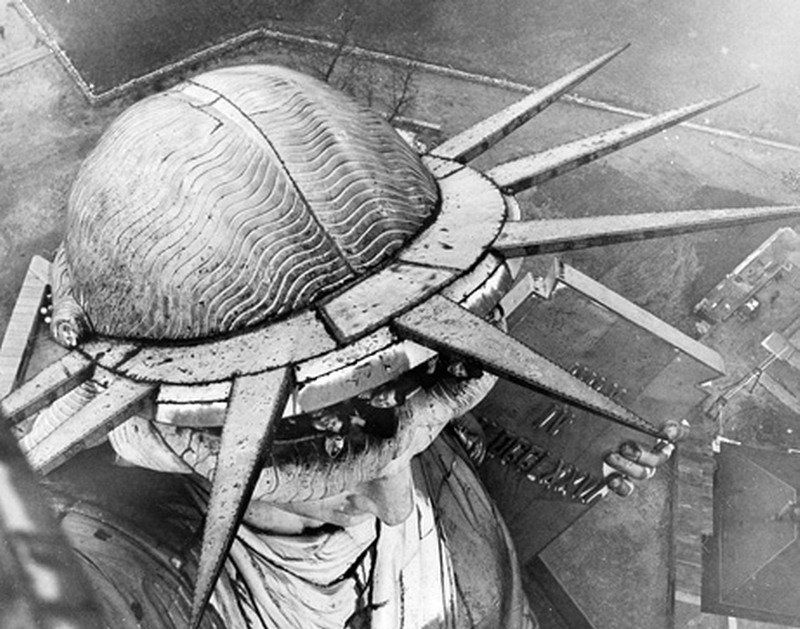
Stained Glass windows were shattered at St. Patrick’s Church, and Ellis Island was evacuated to Manhattan. Damage to the skirt and torch carried by the Statue of Liberty alone, came to over $2¼ million in 2017 dollars. To this day, the ladder to “Lady Liberty’s” torch, remains off limits to visitors.

The enormous vaulted ceiling of Ellis Island’s main hall, collapsed.  According to one Park officer, damage to the Ellis Island complex came to $500,000 “half the one million dollars it cost the government to build the facility.”

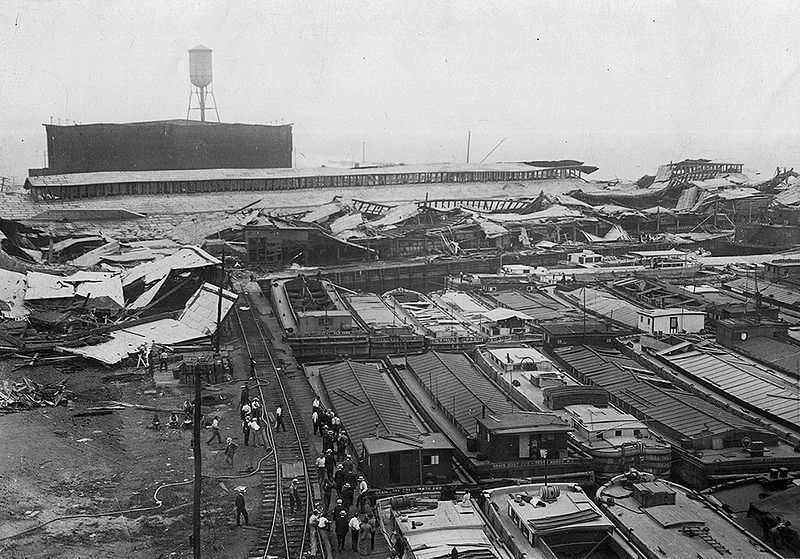
Wrecked_warehouses_and_scattered_debris_after_the_Black_Tom_Explosion,_1916Known fatalities in the explosion included a Jersey City police officer, a Lehigh Valley Railroad Chief of Police, a ten week old infant, and the barge captain.
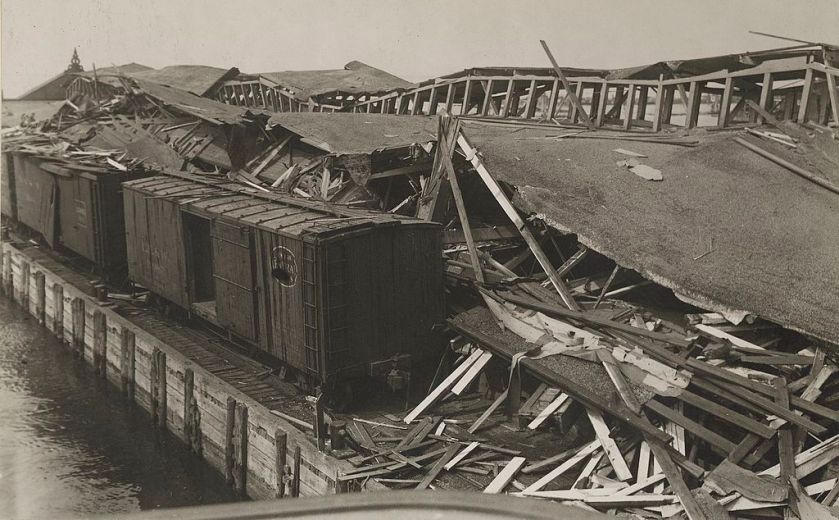
The explosion at Black Tom was the most spectacular, but by no means the only such attack. The archives at cia.gov reports that “[B]etween 1915 and spring 1917, 43 American factories suffered explosions or fires of mysterious origin, in addition to the bombs set on some four dozen ships carrying war supplies to the Allies”.

Responsibility for the Black Tom explosion was never proven, conclusively. Early suspicions centered on accidental causes. Legal wranglings would climb the judicial ladder all the way to the United States Supreme Court, and continue well into the second World War. Anna Rushnak, an elderly Czechoslovak immigrant who ran a four-bits-a-night boarding house in Bayonne was thrown from her bed by the explosion, to find then-23-year-old Michael Kristoff sitting on the edge of his bed, mumbling “What I do? What I do?”

View_of_the_debris_of_the_Lehigh_Valley_pier_after_Black_Tom_explosion_(cropped)
Lehigh Valley Railroad pier, after the explosion

Kristoff, a Slovakian subject of the Austro-Hungarian Empire, (Germany’s principle ally in WW1), was arrested by Bayonne Police and interrogated, and judged to be “insane but harmless.”

In 1922, the Lehigh Valley Railroad was buried in lawsuits, and looking to fix blame on a German act of sabotage. Kristoff came into the judicial spotlight once again, and located in an Albany jail where he was serving time for theft. Kristoff admitted working for the Germans “for a few weeks” back in 1916, but was released before the claim could be investigated. Kristoff was finally traced to a pauper’s grave in 1928 and there ends his story, yet that ‘insane but harmless’ label may be open to question. Papers carried on the body exhumed from that potter’s field were indeed those of Michael Kristoff, but the dental records didn’t match.

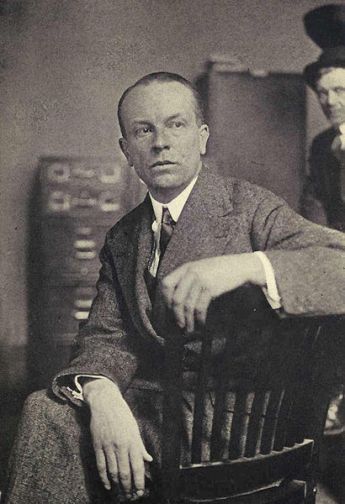
410px-Franz_von_Rintelen
“German Master Spy Franz Von Rintelen and his “pencil bomb” were responsible for acts of sabotage in the United States during World War I”. H/T Smithsonian

Meanwhile, suspicion fell on the German-born naturalized citizen Kurt Jahnke who ran sabotage operations for the German Admiralty out of bases in San Francisco and Mexico City, and his assistant, Imperial German Navy Lieutenant Lothar Witzke. Witzke was arrested on February 1, 1918 in Nogales, Arizona and convicted by court martial. He was sentenced to death, though the war was over before sentence could be carried out. President Wilson later commuted the sentence, to life.

By 1923, most countries were releasing POWs from the “Great War”, including spies. A report from Leavenworth prison shows Witzke heroically risking his life, entering a boiler room after an explosion and probably averting disaster. It may be on that basis that he was finally released. Lieutenant Lothar Witzke was pardoned by President Calvin Coolidge on November 22, 1923, and deported to Berlin, where a grateful nation awarded him the Iron Cross, 1st and 2nd Class.

The U.S.–German Peace Treaty of 1921 established the German-American Mixed Claims Commission, which declared in 1939 that Imperial Germany had, in fact been responsible and awarded a judgement of $50 million.  The Nazi government refused to pay and the matter was finally settled in 1953, with a judgement of $95 million (including interest) against the Federal Republic of Germany. The final payment was made in 1979.

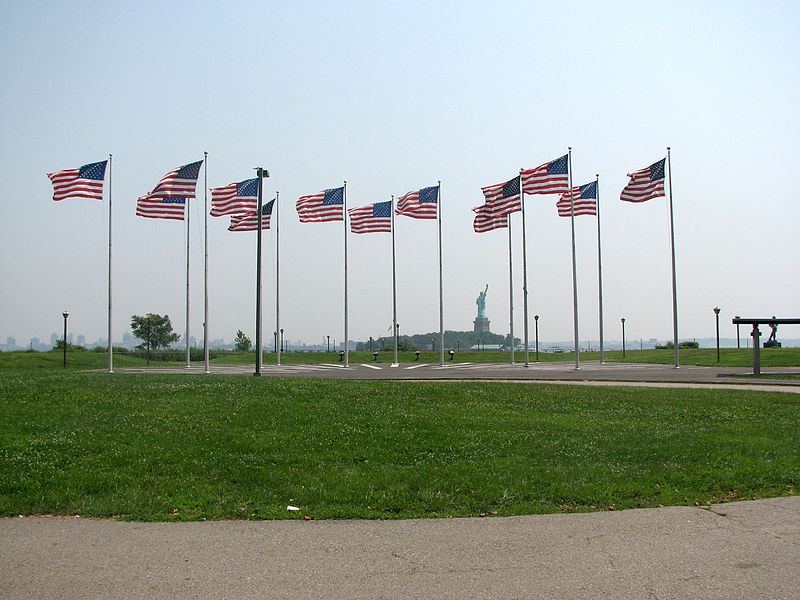
The Black Tom explosion and related acts of pro-German espionage resulted in the Federal Espionage Act signed into law in June 1917, creating, among its other provisions, a “Bureau of Investigation” under the United States Department of Justice.  Now, nothing remains of the Black Tom terminal or the largest foreign terrorist attack on American soil until 9/11, save for a plaque, as seen in the photograph below.  That, and the FBI.

Feature image, top of page: Shrapnel damage can be seen in this image of the Statue of Liberty
800px-StatueOfLibertyFromBlackTomIslandToday
View of the Statue of Liberty from the site of the Black Tom explosion
If you enjoyed this “Today in History”, please feel free to re-blog, “like” & share on social media, so that others may find and enjoy it as well. Please click the “follow” button on the right, to receive email updates on new articles.  Thank you for your interest, in the history we all share.


July 29, 1967 Inferno at Sea

Damage Control Chief Gerald Farrier “simply disappeared” in the first of a dozen or more explosions, in the first few minutes of the fire.  By the third such explosion, Damage Control Team #8 was wiped out.

The Super Carrier USS Forrestal departed Norfolk in June 1967, with a crew of 552 officers and 4,988 enlisted men. Sailing around the horn of Africa, she stopped briefly at Leyte Pier in the Philippines, before sailing on to “Yankee Station” in the South China Sea, arriving on July 25.

Before the cruise, damage control firefighting teams were shown training films of navy ordnance tests, demonstrating how a 1000-lb bomb could be directly exposed to a jet fuel fire for a full 10 minutes. Tests were conducted using the new Mark 83 bomb, featuring a thicker, heat resistant wall compared with older munitions, and “H6” explosive, designed to burn off at high temperatures, like an enormous sparkler.

Along with Mark 83s, ordnance resupply had included sixteen AN-M65A1 “Fat Boy” bombs, Korean war era surplus intended to be used on the second bombing runs of the 29th.  These were thinner skinned than the newer ordnance, armed with 10+ year-old “Composition B” explosive.  Already far more sensitive to heat and shock than the newer ordnance, composition B becomes more volatile as the explosive ages.  The stuff becomes more powerful as well, as much as 50%, by weight.

250px-Yankee_Station_Location_1These older bombs were way past their “sell-by” date, having spent the better part of the last ten years in the heat and humidity of Subic Bay depots.  Ordnance officers wanted nothing to do with the Fat Boys, with their rusting shells leaking paraffin, and rotted packaging.  Some had production date stamps as early as 1953.
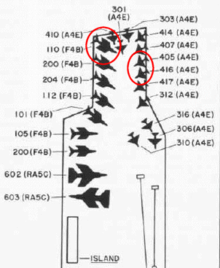
Handlers feared the old bombs might spontaneously detonate from the shock of a catapult takeoff.

In 1967, the carrier bombing campaign was the longest and most intense such effort in US Naval history.   Over the preceding four days, Forrestal had already launched 150 sorties against targets in North Vietnam.  Combat operations were outpacing production, using Mark 35s faster than they could be replaced.

When Forrestal met the ammunition ship Diamond Head on the 28th, the choice was to take on the Fat Boys, or cancel the second wave of attacks scheduled for the following day.

220px-CVA-59_fire_aft_deck_planIn addition to the bombs, ground attack aircraft were armed with 5″ “Zuni” unguided rockets, carried four at a time in under-wing rocket packs.   Known for electrical malfunctions and accidental firing, standard Naval procedure required electrical pigtails to be connected, at the catapult.
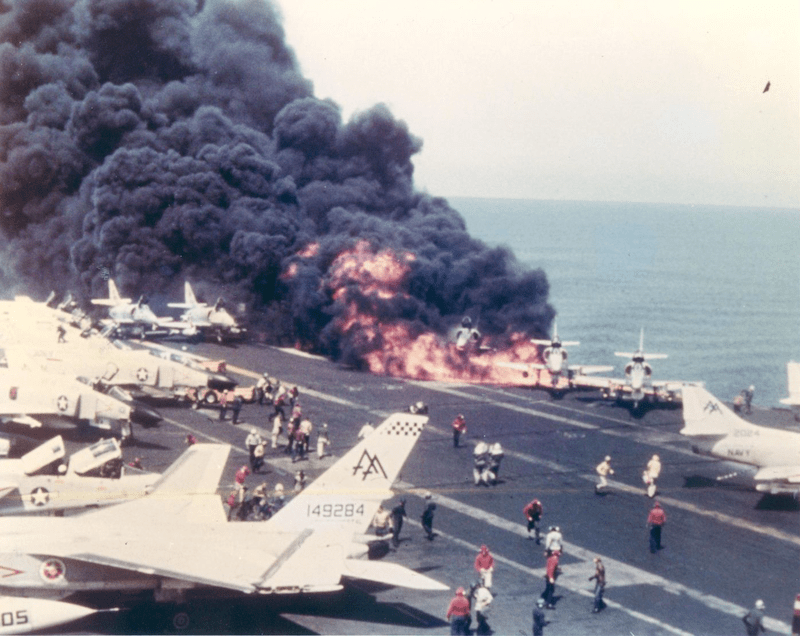
Ordnance officers found this slowed the launch rate and deviated from standard procedure, connecting pigtails while aircraft were still, “in the pack”. The table was set, for disaster.

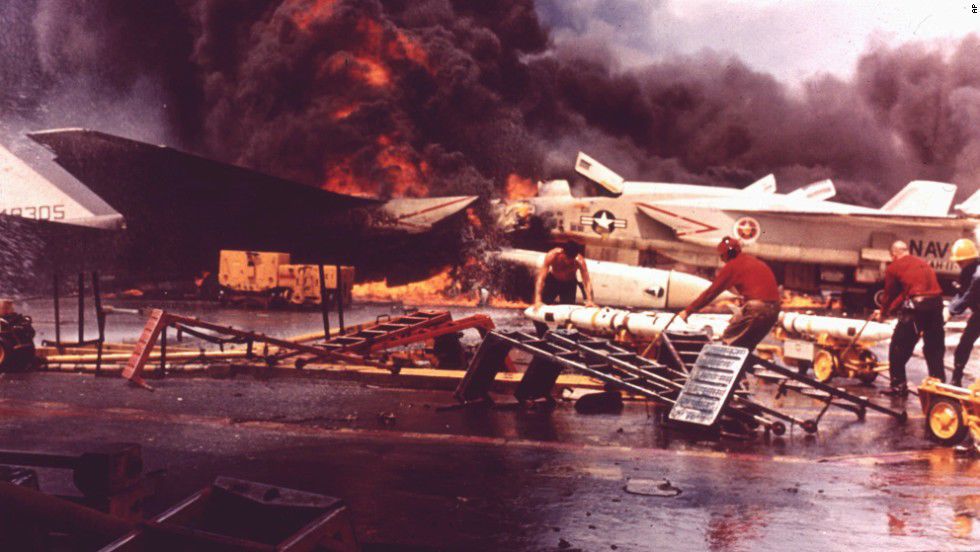
At 10:50-am local time, preparations were underway for the second strike of the day.  Twenty-seven aircraft were on deck, fully loaded with fuel, ammunition, bombs and rockets.  An electrical malfunction fired a Zuni rocket 100′ across the flight deck, severing the arm of one crewmember and into the 400-gallon external fuel tank of an A-4E Skyhawk, awaiting launch.

The rocket’s safety mechanism prevented the weapon from exploding, but the A-4’s torn fuel tank was spewing flaming jet fuel onto the deck. Other tanks soon overheated and exploded, adding to the conflagration.

800px-USS_Forrestal_A-4_Skyhawk_burning.png

In WW2, virtually all American carrier crew were trained firefighters.  This changed over time and, by 1967, the United States Navy had adopted the Japanese method at Midway, relying instead on specialized and highly trained damage control and fire fighting teams.

Damage Control Team #8 came into action immediately, as Chief Gerald Farrier spotted one of the Fat Boy bombs turning cherry red in the flames.  Farrier  was working without benefit of protective clothing, there had been no time.  Farrier held his PKP fire extinguisher on the 1000-lb bomb, hoping to keep it cool enough to prevent its cooking off as his team brought the conflagration under control.

USS_Forrestal_fire_1_1967

Firefighters were confident that their ten-minute window would hold as they fought the flames, but the composition B explosives proved as unstable as the ordnance people had feared.  Farrier “simply disappeared” in the first of a dozen or more explosions, in the first few minutes of the fire.  By the third such explosion, Damage Control Team #8 was wiped out.

Future United States Senator John McCain managed to scramble out of his cockpit and down the fuel probe.  Lieutenant Commander Fred White made it out of his own aircraft a split-second later, but he was killed in that first explosion.

The port quarter of the Forrestal ceased to exist in the violence of the explosions, office furniture thrown to the floor as much as five decks below.  Huge holes were torn into the flight deck while a cataract of flaming jet fuel, some 40,000 US gallons of the stuff, poured through ventilation ducts and into living quarters below.

Ninety-one crew members were killed below decks, by explosion or fire.

800px-USS_Forrestal_explosion_29_July_1967

With trained firefighters now dead or incapacitated, sailors and marines fought heroically to bring the fire under control, though they sometimes made matters worse.  Without training or knowledge of fire fighting, hose teams sprayed seawater, some washing away retardant foam being used to smother the flames.

With the life of the carrier itself at stake, tales of incredible courage, were commonplace. Medical officers worked for hours in the most dangerous conditions imaginable. Explosive ordnance demolition officer LT(JG) Robert Cates “noticed that there was a 500-pound bomb and a 750-pound bomb in the middle of the flight deck… that were still smoking. They hadn’t detonated or anything; they were just setting there smoking. So I went up and defused them and had them jettisoned.” Sailors volunteered to be lowered through the flight decks into flaming and smoked-filled compartments, to defuse live bombs.

The destroyer USS George K. MacKenzie plucked men out of the water as the destroyer USS Rupertus maneuvered alongside for 90 minutes, directing on-board fire hoses at the burning flight and hangar decks.

800px-USS_Repertus_assists_USS_Forrestal

Throughout the afternoon, crew members rolled 250-pound and 500-pound bombs across the decks, and over the side.  The major fire on the flight deck was brought under control within four hours, but fires burning below decks would not be declared out until 4:00am the following day.

Panel 24E of the Vietnam Memorial records the names of 134 crewmen who died in the conflagration. Another 161 were seriously injured.  26 aircraft were destroyed and another 40, damaged.  Damage to the Forrestal itself exceeded $72 million, equivalent to over $415 million today.

Gary Childs of Paxton Massachusetts, my uncle,  was among the hundreds of sailors and marines who fought to bring the fire under control.  Gary was below decks when the fire broke out, leaving moments before his quarters were engulfed in flames. Only by that slimmest of margins did Uncle Gary and an untold number of others escape being #135.

If you enjoyed this “Today in History”, please feel free to re-blog, “like” & share on social media, so that others may find and enjoy it as well. Please click the “follow” button on the right, to receive email updates on new articles.  Thank you for your interest, in the history we all share.

July 28, 1914 Four Horsemen of the Apocalypse

Few could imagine a war in which a single day’s fighting, could produce casualties equal to that of every war of the preceding 100 years, combined. 

In 1869, Germany had yet to come into its own as an independent nation. Forty-five years later, she was one of the Great Powers, of Europe.

Great Powers, 1914

Alarmed by the aggressive growth of her historic adversary, the French government had by that time increased compulsory military service from two years to three, in an effort to offset the advantage conferred by a German population of some 70 million, contrasted with a French population of 40 million.

Joseph Caillaux was a left wing politician, once Prime Minister of France and, by 1913, a cabinet minister under the more conservative administration of French President Raymond Poincare.

Never too discreet with his personal conduct, Caillaux paraded through public life with a succession of women, who were not Mrs Caillaux. One of them was Henriette Raynouard.  By 1911, Madame Raynouard had become the second Mrs Caillaux.

A relative pacifist, many on the French right considered Caillaux to be too “soft” on Germany. One of them was Gaston Calmette, editor of the leading right-wing newspaper Le Figaro, who regularly excoriated the politician.

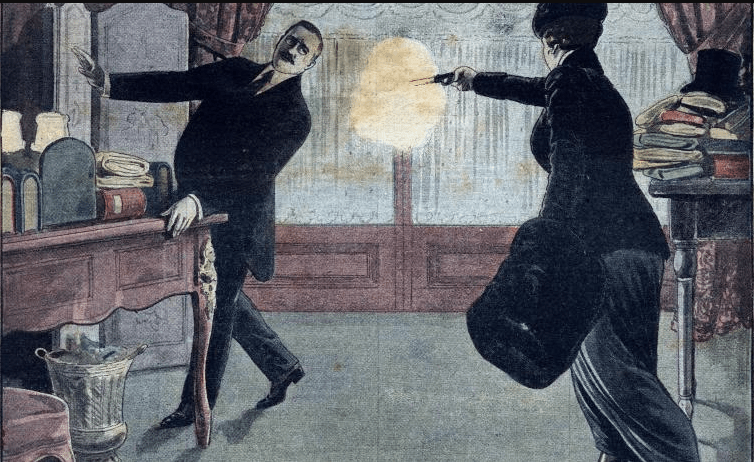
On March 16, 1914, Madame Caillaux took a taxi to the offices of Le Figaro. She waited for a full hour to see the paper’s editor, before walking into his office and shooting him at his desk. Four out of six rounds hit their mark.  Gaston Calmette was dead before the night was through.

Cailloux Affair

It was the crime of the century.  This one had everything: Left vs. Right, the fall of the powerful, and all the salacious details anyone could ever ask for. It was the OJ trial, version 1.0, and the French public was transfixed.

The British public was similarly distracted, by the latest in a series of Irish Home Rule crises.

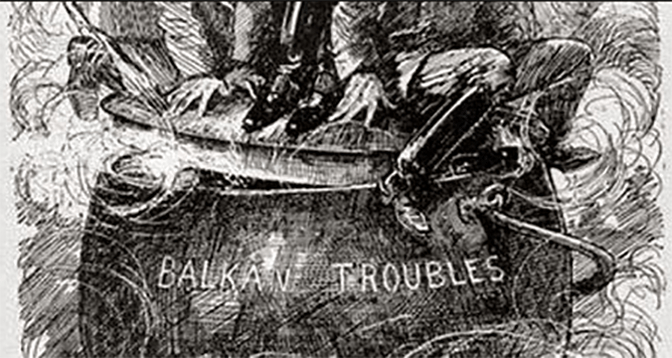
The Austro-Hungarian Empire, a sprawling amalgamation of 17 nations, 20 Parliamentary groups and 27 political parties, desperately needed to bring the Balkan peninsula into line, following the June 28 assassination of the heir apparent to the dual monarchy. That individual Serbians were complicit in the assassination is beyond doubt, but so many government records of the era have disappeared that, it’s impossible to determine official Serbian complicity. Nevertheless, Serbia had to be brought to heel.

Balkan Troubles

Having given Austria his personal assurance of support in the event of war with Serbia, even if Russia entered in support of her Slavic ally, Kaiser Wilhelm of Germany left on a summer cruise in the Norwegian fjords. The Kaiser’s being out of touch for those critical days in July has been called the most expensive maritime disaster in naval history.

The Austro-Hungarian Empire delivered a deliberately unacceptable ultimatum to Serbia on the 23rd, little more that a bald pretext for war.  Czar Nicholas wired Vienna as late as the 27th proposing an international conference concerning Serbia, but to no avail. Austria responded that same day.  It was too late for such a proposal.

The Austro-Hungarian Empire declared war on Serbia the following day, the day on which Madame Caillaux was acquitted of the murder of Gaston Calmette, on the grounds of being a “crime of passion”.

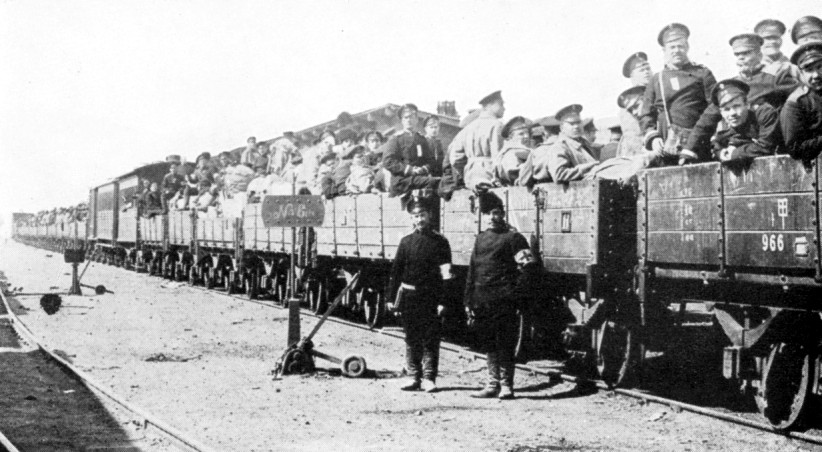
As expected, Russia mobilized in support of Serbia.  For her part, Imperial Germany feared little more than a two-front war, with the “Russian Steamroller” to the east, and the French Republic to the west.  Germany invaded neutral Belgium in pursuit of the one-two punch strategy by which she sought first to defeat France, before turning to face the far larger Russian adversary.

russ-mob

On August 3, British Foreign Secretary Sir Edward Grey announced before Parliament, his government’s intention to defend Belgian neutrality, a treaty obligation German diplomats had dismissed as a “scrap of paper”.

Pre-planned timetables took over – France alone would have 3,781,000 military men under orders before the middle of August, arriving at the western front on 7,000 trains arriving as often as every eight minutes.

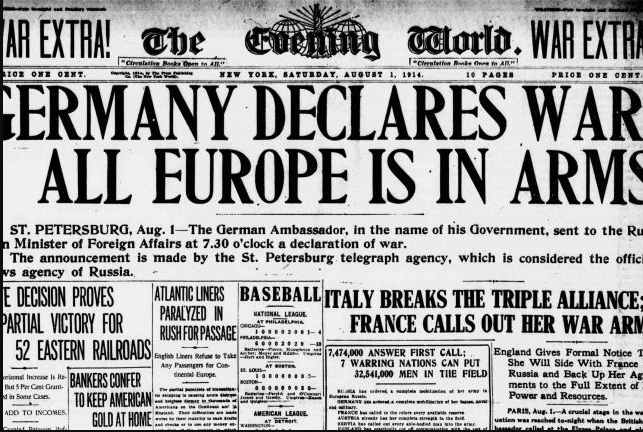
Declaration

This time there would be no “Phoney War”, no “Sitzkreig”, as some wags were wont to call the early days of WWII.   Few could imagine a cataclysm to rock a century and beyond, a war in which a single day’s fighting could produce casualties equal to that of every war of the preceding 100 years, combined.  Fewer still understood on this date, one-hundred and four years ago, today.  The four horsemen of the Apocalypse, were only days away.

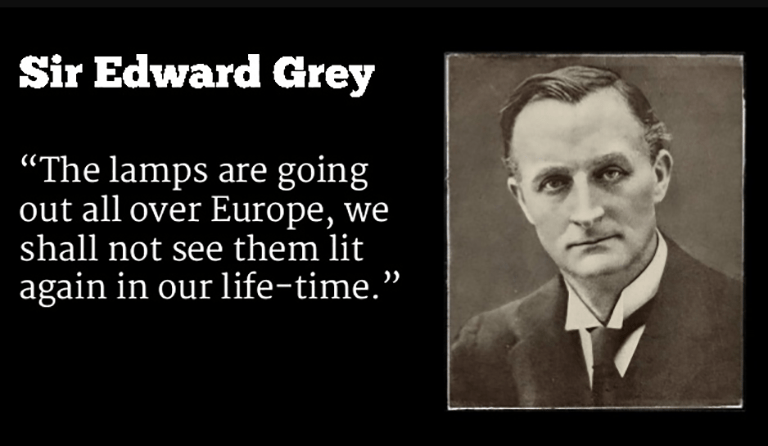
Sir Edward Grey

If you enjoyed this “Today in History”, please feel free to re-blog, “like” & share on social media, so that others may find and enjoy it as well. Please click the “follow” button on the right, to receive email updates on new articles.  Thank you for your interest, in the history we all share.

July 26 1945 USS Indianapolis

The United States Navy lost over 350 ships to combat operations during WW2.  Not one  resulted in court martial but, on this occasion, someone was going to pay. 

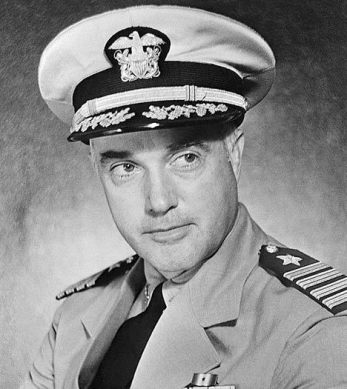
The Portland class heavy cruiser USS Indianapolis set out on its secret mission on July 16, 1945, under the command of Captain Charles Butler McVay III.  She was delivering “Little Boy” to the Pacific island of Tinian, the atomic bomb which would later be dropped on Hiroshima.

Indianapolis made her delivery on July 26, arriving at Guam two days later and then heading for Leyte to take part in the planned invasion of Japan. She was expected to arrive on the 31st.

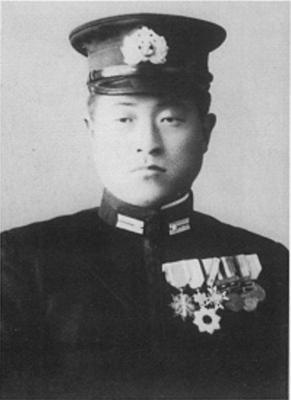
Indianapolis SubThe Japanese submarine I-58, Captain Mochitsura Hashimoto commanding, fired a spread of six torpedoes at the cruiser, two striking Indianapolis’ starboard bow at fourteen minutes past midnight on Monday, July 30. The damage was massive.  Within 12 minutes, the 584-ft, 9,950-ton vessel had rolled over, gone straight up by the stern, and sunk beneath the waves.
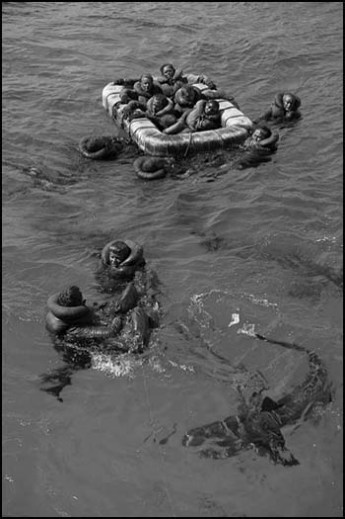
Approximately 300 of Indianapolis’ 1,196-member crew were killed outright, leaving nearly 900 treading water. Many had no life jackets.  There had been no time, and there were few life boats.

indianapolis_2
Caribbean Reef sharks circling the sailors in reenactment scene after USS Indianapolis had been sunk by Japanese submarine. As seen on OCEAN OF FEAR: WORST SHARK ATTACK EVER. H/T photographer: Tim Calver

The ordeal faced by the survivors, is beyond description.  Alone and stranded in open ocean, these guys treaded water for four days, hoping and praying for the rescue that did not come.

Shark attacks began on the first day, and never let up. Kapok-filled life vests became waterlogged and sank after 48 hours, becoming worse than useless. Exhaustion, hypothermia, and severe sunburn took their toll as the hours turned into days. Some men went insane and began to attack their shipmates, while others found the thirst so unbearable that they drank seawater, setting off a biological chain reaction which killed them within a few hours. Some simply swam away, following some spectral vision that only he could see. Through it all, random individuals would suddenly rise up screaming from the ocean, then to disappear forever, as the sharks claimed another victim.

Navy Command had not the slightest idea of what happened to Indianapolis, nor why she didn’t show up on the 31st.  A random patrol aircraft passing the area that Thursday afternoon, that finally discovered men floating in open ocean. The last Indianapolis survivor was plucked from the ocean Friday afternoon, well past half-dead after nearly five days in the water. Of the 900 or so who survived the sinking, only 316 remained alive at the end of the ordeal.

mochitsura-hashimoto
Mochitsura Hashimoto

The Navy had committed multiple errors, from denying McVay’s requested escort to informing him that his route was safe, even when the surface operations officer knew there were at least two Japanese submarines, operating in the area.

No captain in the history of the United States Navy was subjected to court-martial for losing a ship sunk by an act of war.  The United States Navy lost over 350 ships to combat operations during WW2.  It didn’t matter.  On this occasion, someone was going to pay.

A hastily convened court of inquiry was held in Guam on August 13, leading to McVay’s court-martial. There was evidence that the Navy itself had put the ship in harm’s way.  When prosecutors flew the I-58 commander in to testify, Hashimoto swore that zigzagging would have made no difference. The Japanese Commander even became part of a later effort to exonerate McVay, but to no avail. Charles Butler McVay III was convicted of “hazarding his ship by failing to zigzag“, his career ruined.

450729-charles-mcvay
Charles Butler McVay, III

McVay had wide support among Indianapolis’ survivors, but opinion was by no means unanimous. Birthdays, anniversaries and holidays would come and go and there was always some piece of hate mail, blaming him for the death of a loved one. One Christmas missive read “Merry Christmas! Our family’s holiday would be a lot merrier if you hadn’t killed my son”.

McVay began to doubt himself.  By 1968 he must have felt the weight of Indianapolis’ dead, like a great stone upon his shoulders.

On November 6, 1968, Charles Butler McVay III sat down on his front porch in Litchfield Connecticut, took out his Navy revolver, and killed himself.  He was cremated, his ashes scattered at sea.

It would take more than 20 years, for the evidence which exonerated him to be declassified.

Afterward:
Hunter Alan Scott was eleven and living in Pensacola when he saw the movie “Jaws”, in 1996. He was fascinated by the movie’s brief mention of the Indianapolis’ shark attacks, the next year, he created his 8th grade “National History Day” project on the USS Indianapolis sinking. The boy interviewed nearly 150 survivors and reviewed 800 documents.  The more he read, the more he became convinced that Captain McVay was innocent of the charges for which he’d been convicted.

Scott’s National History Day project went up to the state finals, but it was rejected because he had used the wrong type of notebook to organize the material.

artbHe couldn’t let it end there. Scott began to attend Indianapolis survivors’ reunions, at their invitation, and helped to gain a commitment in 1997 from then-Representative Joe Scarborough that he would introduce a bill in Congress to exonerate McVay the following year.
Senator Bob Smith of NH joined Scarborough in a joint resolution.  Hunter Scott and several Indianapolis survivors were invited to testify before Senator John Warner and the Senate Armed Services committee on September 14, 1999.

Holding a dog tag in his hand, Scott testified “This is Captain McVay’s dog tag from when he was a cadet at the Naval Academy. As you can see, it has his thumbprint on the back. I carry this as a reminder of my mission in the memory of a man who ended his own life in 1968. I carry this dog tag to remind me that only in the United States can one person make a difference no matter what the age. I carry this dog tag to remind me of the privilege and responsibility that I have to carry forward the torch of honor passed to me by the men of the USS Indianapolis”.

The United States Congress passed a resolution in 2000, signed into law by President Bill Clinton on October 30, exonerating Charles Butler McVay III of the charges which had led to his court martial, humiliation and suicide.

170819163129-02-uss-indianapolis-crew-restricted-exlarge-169
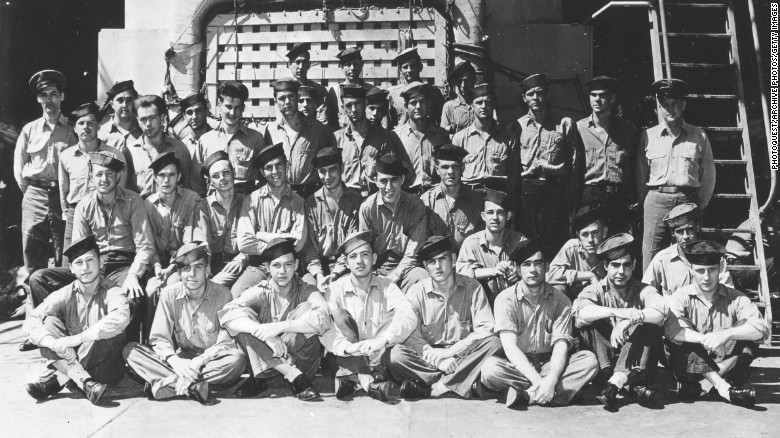
Some of Indianapolis’ crew, before her sinking.

The record cannot not be expunged.  Congress has rules against even considering bills altering military records, and there is no means by which to reverse a court-martial.  It’s never happened.  Yet Captain McVay had exonerated, something that the Indianapolis survivors had tried to accomplish without success.  Until the intervention of a 12-year-old boy.  Who said one person can’t make a difference?

Today, only 22 of  Indianapolis’ survivors remain alive.  The wreck of the “Indy” was discovered in August 2017, in 18,000-feet of water.  Leader of the civilian expedition which located the wreck, Microsoft co-founder Paul Allen, said”To be able to honor the brave men of the USS Indianapolis and their families through the discovery of a ship that played such a significant role in ending World War II is truly humbling”.

If you enjoyed this “Today in History”, please feel free to re-blog, “like” & share on social media, so that others may find and enjoy it as well. Please click the “follow” button on the right, to receive email updates on new articles.  Thank you for your interest, in the history we all share.