
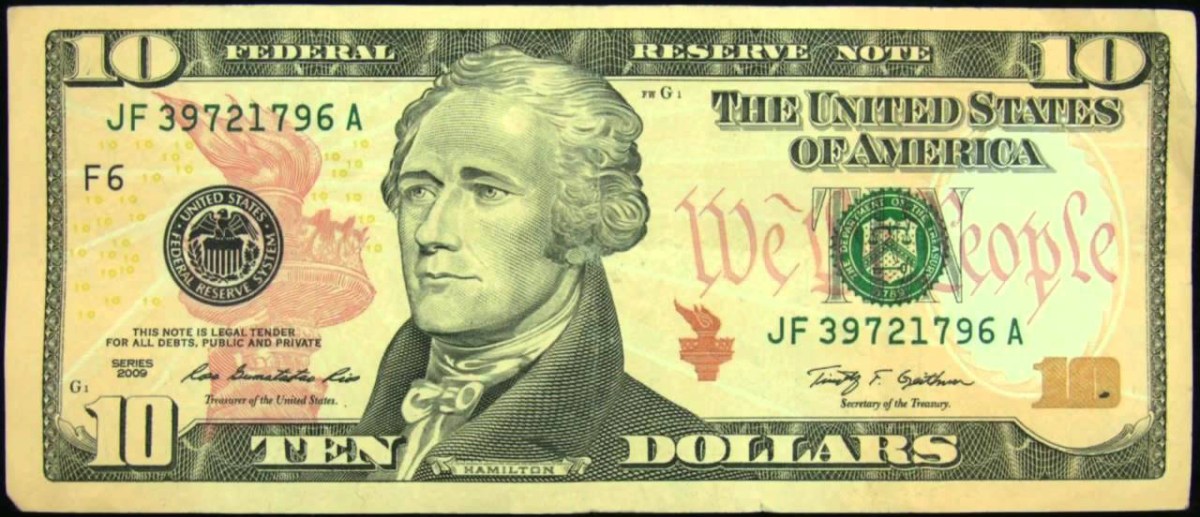
What would it be like to turn on CNN or Fox News, to learn that Former Secretary of the Treasury Jacob Lew had been party to a duel, and that he was near death after being shot by Vice President Mike Pence.
The year was 1804, and President Jefferson’s Vice President, Aaron Burr, had a long standing personal conflict with one of the Founding Fathers. Alexander Hamilton, the only signer of the Constitution from the state of New York, had been the first Secretary of the Treasury serving under President George Washington.

The animosity between Hamilton and Burr probably began in 1791, when Burr defeated Hamilton’s father-in-law Philip Schuyler in a US Senate election. The conflict escalated during the 1800 Presidential election, one of the ugliest election seasons in our nation’s history. Called the “Revolution of 1800”, the contest pitted Thomas Jefferson and his Democratic-Republicans, against former Vice President John Adams and his Federalist party.
Both sides were convinced as an article of faith, that the other side would destroy the young nation. Federalists attacked Jefferson as an un-Christian deist, whose sympathies with the French Revolution would bring about a similar cataclysm in the young American Republic. Democratic-Republicans criticized the alien and sedition acts, and the deficit spending the Adams administration used to support Federal policy.
“The father of modern political campaigning”, Burr enlisted the help of New York’s Tammany Hall in his pursuit of election, transforming what was then a social club into a political machine.
The election was a decisive victory for the Democratic-Republicans, not so much for the selection of President and Vice President. At the time, electors cast two votes, the first and second vote-getters becoming President and Vice President. The electoral vote tied at 73 between Thomas Jefferson and Aaron Burr, moving the selection to the House of Representatives.
Hamilton exerted his influence on behalf of Thomas Jefferson, who was elected on the 36th ballot, making Burr his VP.
Today we’re accustomed to the idea of “Judicial Review”, the idea that Supreme Court decisions are final and inviolate, but that wasn’t always the case. The Landmark Supreme Court case Marbury v Madison established the principle in 1803, a usurpation of power so egregious to Democratic-Republicans that it led to the impeachment of Associate Justice Samuel Chase, a signer of the Declaration of Independence. As VP, Aaron Burr presided over Chase’ impeachment.
Relations became toxic between Jefferson and his VP. Burr knew that he wouldn’t be kept on for the 1804 re-election campaign, and so he ran for Governor of New York, losing the election by a decisive margin to a virtual unknown, Morgan Lewis. It was a humiliating defeat, the largest in New York electoral politics up to that time.
 Burr blamed Hamilton for his defeat, challenging him to a duel over comments made during the election. Dueling was illegal at this time but enforcement was comparatively lax in New Jersey. The pair rowed across the Hudson River with their “seconds”, meeting at the waterfront town of Weehawken, New Jersey. It was July 11, 1804. Hamilton “threw away” his shot, firing into the air. Aaron Burr shot to kill.
Murder charges were filed in both New York and New Jersey, but neither ever went to trial.
Aaron Burr went on to preside over Justice Chase’ impeachment trial, later that year. It had to have been the high point of the Vice President’s political career, a career that otherwise ended the day he met Alexander Hamilton in Weehawken.
Burr headed for New Orleans, where he got mixed up with one General James Wilkinson, possibly the sleaziest character of the founding generation. At that time, Wilkinson was a paid agent for Spanish King Charles IV. 100 years later Theodore Roosevelt would say of Wilkinson, “In all our history, there is no more despicable character.”
Wilkinson would take his payments in silver dollars, hidden in rum, sugar and coffee casks. All those clinking coins almost undid him, when a messenger was caught and killed with 3,000 of them. The messenger’s five murderers were themselves Spaniards, who testified at trial that the money belonged to the spy Wilkinson. Payment for services rendered to their King. Wilkinson’s luck held out, as the killers spoke no English. Thomas Power, interpreter for the Magistrate, was another Spanish spy. He translated: ‘They just say they’re wicked murderers motivated by greed.’
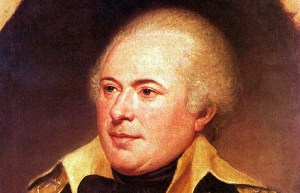
The nature of Burr’s discussions with Wilkinson is unknown, but in 1806, Burr led a group of armed colonists toward New Orleans, with the apparent intention of snatching the territory and turning it into an independent Republic. It’s probably safe to assume that Aaron Burr saw himself at the head of such a Republic.
Seeing no future in it and wanting to save his own hide, General Wilkinson turned on his former ally, sending dispatches to Washington accusing the former Vice President of treason. Burr was tracked down in Alabama on February 19, 1807, arrested for treason and sent to Richmond, Virginia, for trial.
Burr was acquitted on September 1 of that year, on grounds that he had not committed an “overt act” as specified in the Constitution. He was not guilty in the eyes of the law, but the court of public opinion would forever regard him as traitor. Aaron Burr spent the next several years in Europe before returning to New York, and resuming his law practice.
The Vice President who killed the man on our $10 bill, died in obscurity on September 14, 1836, at the age of 80.


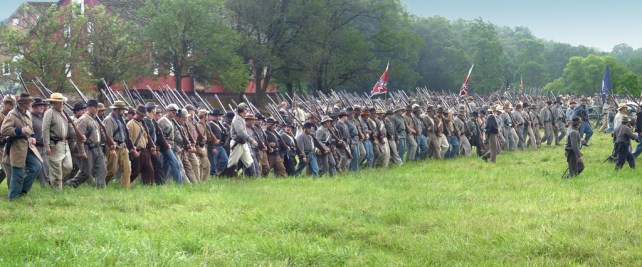
 help a sense of relief as you step across a low spot and your objective, the “copse of trees”, drops out of sight. If you can’t see them they can’t shoot at you. Then you look to your right and realize that cannon would be firing down the length of your lines from Little Round Top, as would those on Cemetery Hill to your left. Rising out of the draw you are now in full sight of Union infantry. You quicken your pace as your lines are torn apart from the front and sides. Fences hold in some spots along the Emmitsburg Road. Hundreds of your comrades are shot down in the attempt to climb over.
 The “High tide of the Confederacy” marks the point between the corner of a stone wall and that copse of trees, the farthest the shattered remnants of Longstreet’s assault would ever get. Lewis Armistead made it over that wall before being shot down, falling beside the wheels of a Union cannon.


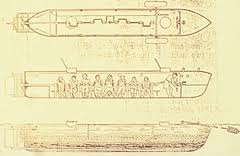 build a secret Super Weapon for the Confederacy. A submarine. They completed construction on their first effort, the “Pioneer”, that same year in New Orleans. The trio went on to build two more submarines in Mobile, Alabama, the “American Diver”, and their last and most successful creation, the “Fishboat”, later renamed HL Hunley.
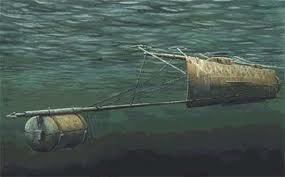 The original plan was to tow a floating mine called a “torpedo”, with a contact fuse. They would dive beneath their victim and surface on the other side, pulling the torpedo into the side of the target.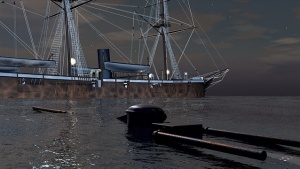
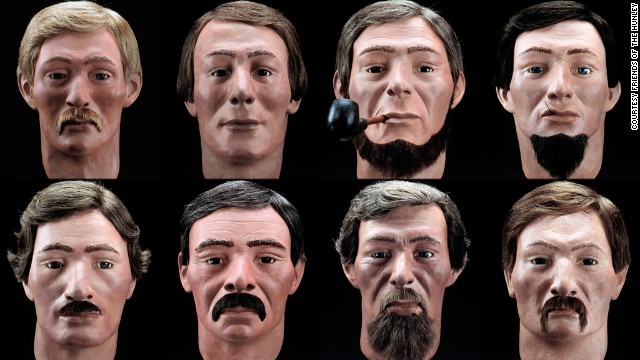
 Charleston Navy Yard, and submerged in 55,000 gallons of chilled, fresh water, where scientists and historians worked on unlocking its secrets.

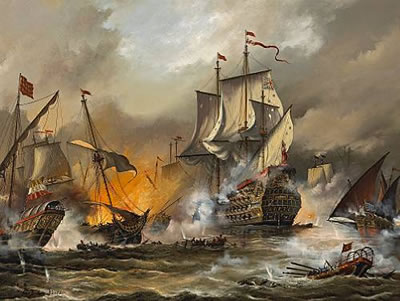
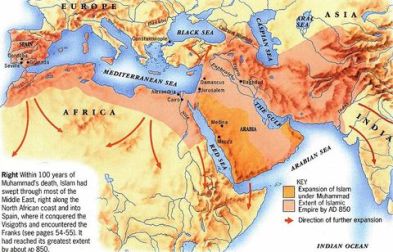 into Western Europe at the Battle of Tours, in 732.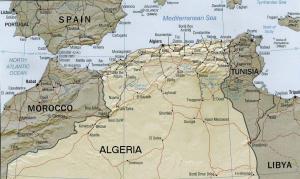


 A funeral may be for a young military service member killed in the wars in Iraq or Afghanistan, or a veteran of Korea or WWII, who spent his last days in the old soldier’s home. It could be a four-star General or a Private. It doesn’t matter.


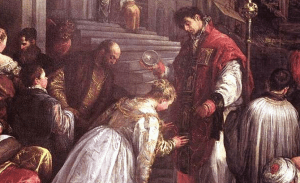 He was condemned to be beaten to death with clubs and beheaded, the sentence carried out on February 14, 269.
 13-15 in honor of the goddess Februata Juno. Greek historian Plutarch described the occasion as follows: “Lupercalia, [when] many of the noble youths and of the magistrates run up and down through the city naked, for sport and laughter striking those they meet with shaggy thongs. And many women of rank also purposely get in their way, and like children at school present their hands to be struck, believing that the pregnant will thus be helped in delivery, and the barren to pregnancy.”
 on November 3, or maybe you’d like to get a head start with St. Valentine of Raetia on January 7. Maybe you’d prefer the only female St. Valentine (Valentina), a virgin martyred in Palestine on July 25, A.D. 308.


 Ironically, Henry himself may have been the problem, when it came to the inability to produce a male heir. Researchers revealed in 2011 that Henry’s blood group may have been “Kell positive”, a rare condition which would have initiated an auto-immune response in the mother’s body, targeting the body of the baby inside of her. It’s unlikely that first pregnancies would have been effected, but the mother’s antibodies would have attacked second and subsequent Kell-positive babies as foreign objects.


 Returning to England, Oglethorpe would continue to serve on the Board of Trustees, though he often found himself outvoted. Despite his opposition, the Board of Trustees gradually relaxed their restrictions on land ownership, on hard liquor, and on slavery. By 1750, Georgia’s founding father was no longer involved with the board that created it. His grand experiment was over when Trustees voted to return their governing charter, making Georgia the 13th of Britain’s American colonies.


 In 1788, Virginia voted to ratify the Constitution and join the Union. Former Governor Patrick Henry persuaded the state legislature to reconfigure the 5th Congressional District, thereby forcing his political enemy James Madison to run against a powerful opponent named James Monroe. Henry’s redistricting tactic failed and Madison won, anyway. One day he would become the nation’s fourth president. All was not over for James Monroe, though. He would become #5.

 and other “interest” groups, ensuring that we look on one another as “us and them”, rather than just, plain, fellow Americans. Talk about “the conduct of public affairs for private advantage”. (Hat tip to my favorite curmudgeon, Ambrose Bierce, for that one).

 It was the “dead-ball” era, when an “inside baseball” style of play relied on stolen bases, hit-and-run plays and, more than anything else, speed.
 causing the ball to drop. Sandpapered, cut or scarred balls tended to “break” to the side of the scuff mark. Balls were rarely replaced in those days. By the end of a game, the ball was scarred, misshapen and entirely unpredictable. Major League Baseball outlawed “doctored” pitches on February 10, 1920, though it remained customary to play an entire game with the same ball.
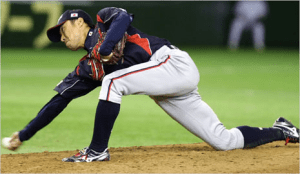 facing “submarine” pitcher Carl Mays. These are not to be confused with the windmill underhand pitches we see in softball. Submarine pitchers throw side-arm to under-handed, their upper bodies so low that some of them scuff their hands on the ground, the ball rising as it approaches the strike zone.
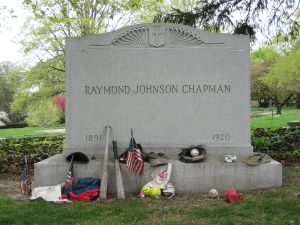 29-year-old Ray Chapman had said this was his last year playing ball. He wanted to spend more time in the family business he had just married into. The man was right. Raymond Johnson Chapman died 12 hours later, the only player in the history of Major League Baseball, to die from injuries sustained during a game.
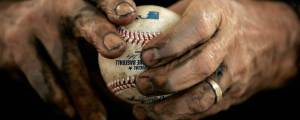 Philadelphia Athletics third base coach Lena Blackburne took up the challenge in 1938, scouring the riverbanks of New Jersey for just the right mud. Blackburne found his mud hole, describing the stuff as “resembling a cross between chocolate pudding and whipped cold cream”. By his death in the late fifties, Blackburne was selling his “Baseball Rubbing Mud” to every major league ball club in the country, and most minor league teams.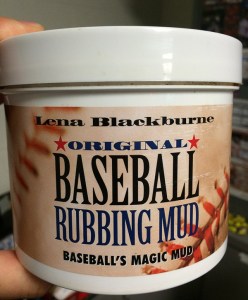

 Historical Easter Eggs - Today in History
You must be logged in to post a comment.