

By 1967, the Republic of Korea (ROK) had some 44,829 South Korean forces in Vietnam. An overwhelming force of NVA and Vietcong had the misfortune of surrounding a platoon of “Blue Dragon” Marines on February 15 of that year, near the village of Trà Bình. Poor visibility precluded air support, and the fighting that followed was close and personal. When it was over, 243 NVA lay dead. Korean Marines lost fewer than a dozen men.
Any combat veteran of the war in Southeast Asia will tell you, in Vietnam they faced a tough and disciplined soldier. POW interrogations of captured NVA revealed one  Lieutenant Trung to be particularly hard core, a tough guy in a world of tough guys. A US Marine Corps Lieutenant of Korean ancestry, dressed in the uniform of the Blue Dragon Marines, and paid a visit to Lt. Trung’s cell. Not a word or gesture passed between the two, the mere presence of a Blue Dragon was enough to get this guy talking. Korean fighters are no joke.
For two years, an elite, all-officer force of 31 North Korean commandos were trained in infiltration and exfiltration techniques, weaponry, navigation, concealment and hand-to-hand combat, with particular emphasis on knife fighting. They were “Unit 124”, highly trained and fanatically loyal soldiers, tough as rawhide and each prepared to die for the supreme leader of the Democratic People’s Republic of Korea, (DPRK), Kim Il-Sung.
On January 17, 1968, Unit 124 infiltrated the 2½ mile demilitarized zone (DMZ), cutting the wire and entering South Korea. Their mission was to assassinate ROK President Park Chung-hee in his home, the South Korean Executive Mansion known as “Blue House”.
It’s hard to think of anything goofier, and at the same time more lethal, than the hare- brained political calculations of DPRK leadership. Somehow it made sense to these guys, that to assassinate the South Korean President and hurl his head out of the official residence, would start a popular uprising leading to the re-unification of the Korean peninsula under DPRK government.
On the 19th, four brothers of the Woo family were out gathering firewood, when they stumbled upon Unit 124. A fierce debate ensued among the commandos, as to what to do with these guys. Training dictated that they be immediately killed, yet somehow that didn’t seem right. Wasn’t communist ideology supposed to be a “people’s movement”? Besides, it would have taken too long to bury their bodies in the frozen ground.
The decision was made to convert them on the spot. Talk about goofy. After a suitably long harangue on the wonders of communism, the Woo brothers wisely proclaimed themselves converts. Whereupon they were released, and went directly to the authorities.
Unit 124 broke camp, for the next two days averaging 10kph over mountainous terrain, despite carrying an average 70lbs apiece in equipment.
Commandos made it to within 100 meters of Blue House on January 21, when they were challenged at a road block. The firefight broke out without warning, dissolving into a running gunfight and manhunt lasting until the 29th. When it was over, 26 South Korean military and police personnel were killed along with two dozen civilians, and 66 wounded. Four Americans were killed in efforts to prevent Unit 124 members from re-crossing the DMZ.
29 commandos were killed or committed suicide. One escaped, back into North Korea. Only one, Kim Shin-jo, was captured alive.
History has a way of swallowing some events whole. The Battle of Khe Sanh started in Vietnam the same day as the raid. Two days later a US Navy technical research ship, the USS Pueblo, was captured by North Korean forces. The Tet Offensive broke out all across South Vietnam on January 31st. Soon the Blue House raid was all but forgotten.
Kim Shin-Jo was interrogated for a year, to learn how the raid had been carried out. Meanwhile, ROK authorities “recruited” their own commando assassination squad, as a bit of payback. The 31 members of “Unit 684” were recruited from South Korean death row  and other hardened prisoners, possibly due to the suicidal nature of their mission. The “training” they were subjected to on Silmido Island, off the coast of Inchon, was beyond brutal. Seven of them would not survive it.
The raid was never carried out. North-South relations were thawing by August of 1971, as the Silmido Island recruits staged an insurrection. How it started is unclear, but 20 inmate/recruits were dead before it was over, along with a number of their overseers. The four surviving Unit 684 recruits were tried for their role in the uprising by a military tribunal, and executed in 1972.
In May of 2010, Seoul courts ordered the government to pay $231 million to the families of 21 members of Unit 684.
Kim Shin-jo’s parents were murdered by North Korean authorities and his relatives “purged”, after he became a citizen of the ROK in 1970. Now a married father of two, Kim renounced his communist ideology, since becoming a pastor of the Seoul “Sungrak” (“Holy Joy”) Baptist Church.
I’m indebted for this story to a man who was a family friend, almost before my parents decided to start a family. I have known this man longer than I can remember, and flatter myself to regard him as a personal friend. He was one of the interrogators, during both the Trung and the Kim episodes related above. Thank you, Victor, for your story, and for your service.


 south after a brief stay in Charleston, South Carolina. Landing at Yamacraw bluff, they were greeted by Chief Tomochichi of the Yamacraws, along with two Indian traders, John and Mary Musgrove.
 originally come from its native Southeast Asia to West Africa, where the same strains were grown by European colonists. The rice industry failed in Africa, but the combination of English agricultural technology and African labor made the crop a mainstay of the early colonial economy.
 On January 20, 1788, Bryan brought official recognition to the First African Baptist Church and its 67 members, five years before the first “white” Baptist Church in Savannah. In 1802, Bryan founded the “Second Colored Baptist Church”, renamed the “Second African Baptist Church” in 1823.
 he called “I have a Dream”. Two years later, the same speaker would deliver his speech from the steps of the Lincoln memorial in Washington.

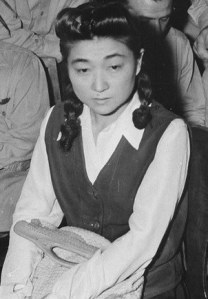
 “Zero Hour” program, part of a Japanese psychological warfare campaign designed to lower the morale of US Armed Forces. The name “Tokyo Rose” was in common use by this time, applied to as many as 12 different women broadcasting Japanese propaganda in English. Toguri DJ’d a program with American music punctuated by Japanese slanted news articles for 1¼ hours, six days a week, starting at 6:00pm Tokyo time. Altogether, her on-air speaking time averaged 15-20 minutes for most broadcasts.
 After the war, a number of reporters were looking for the mythical “Tokyo Rose”, and two of them found Iva Aquino. They were Henry Brundidge and Clark Lee, and they offered her a significant sum for her story. The money never materialized, but she signed a contract giving the two rights to her story, and identifying herself as Tokyo Rose.
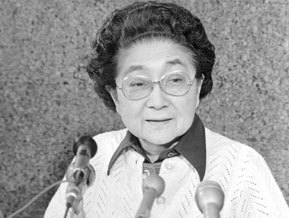 Reformatory for Women at Alderson, West Virginia in 1956, having served six years and two months of her sentence.

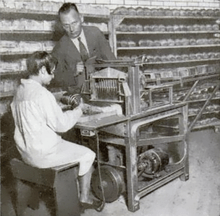 The project almost ended in a fire in 1917, when the prototype was destroyed along with the blueprints. Rohwedder soldiered on, by 1927 he had scraped up enough financing to rebuild his bread slicer.
 Article 1, Section 8 of the Constitution includes the “Commerce Clause”, permitting the Congress “To regulate Commerce with foreign Nations, and among the several States, and with the Indian Tribes”. That’s it. The Federal District Court sided with the farmer, but the Federal government appealed to the US Supreme Court, arguing that, by withholding his surplus from the interstate wheat market, Filburne was effecting that market, and therefore fell under federal government jurisdiction under the commerce clause.
 government had a billion bushels of wheat stockpiled at the time, about two years’ supply, and the amount of steel saved by not making bread slicers has got to be marginal, at best.


 were pulled on May 28, 1941, while the liner was at Saint Thomas in the US Virgin Islands. The ship had been called into service by the United States Navy, and ordered to return to Newport News.
 During her service to the United States Navy, West Point was awarded the American Defense Service Medal, American Campaign Medal, European-African-Middle Eastern Campaign Medal, Asiatic-Pacific Campaign Medal, and World War II Victory Medal.
 adrift in foul seas, running aground in the Canary Islands the following day.


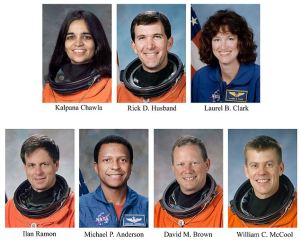 STS-107 launched from the Kennedy Space Center aboard the Space Shuttle Columbia on January 16, 2003. A piece of insulating foam broke away from the external fuel tank eighty seconds after launch, striking Columbia’s left wing and leaving a small hole in the carbon composite tiles along the leading edge. Three previous Space Shuttle missions had experienced similar damage and, while some engineers thought this one could be more serious, they were unable to pinpoint the precise location or extent of the damage. NASA managers believed that, even if there had been major damage, little could be done about it.
 Payload Specialist Colonel Ilan Ramon, born Ilan Wolferman, was an Israeli fighter pilot and the first Israeli astronaut to join the NASA space program. Colonel Ramon’s mother is an Auschwitz survivor, his grandfather and several family members killed in the Nazi death camps. In their memory, Ramon carried a copy of “Moon Landscape”, a drawing by 14 year old holocaust victim Petr Ginz, depicting what the boy thought earth might look like from the moon. Today, there are close to 84,000 pieces of Columbia and assorted debris, stored in the Vehicle Assembly Building at the Kennedy Space Center. To the best of my knowledge, that drawing by a 14 year old boy who never made it out of Auschwitz, is not among them.

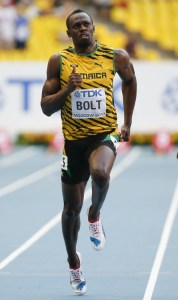 Roger Bannister became the first human to run a sub-four minute mile on May 6, 1954, with an official time of 3 minutes 59.4 seconds. The Jamaican sprinter Usain Bolt is recorded as the fastest man who ever lived. At the 2009 World Track and Field Championships, Bolt ran 100 meters at an average 23.35 mph from a standing start, and the 20 meters between the 60 & 80 markers at an average 27.79 mph.
 smashing the elevated train tracks on Atlantic Ave and hurling entire buildings from their foundations. Horses, wagons, and dogs were caught up with broken buildings and scores of people as the brown flood sped across the North End. Twenty municipal workers were eating lunch in a nearby city building when they were swept away, parts of the building thrown fifty yards. Part of the tank wall fell on a nearby fire house, crushing the building and burying three firemen alive.
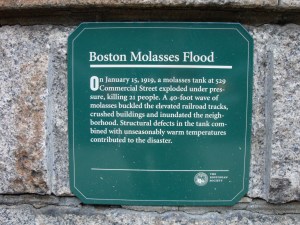 In 1983, a Smithsonian Magazine article described the experience of one child: “Anthony di Stasio, walking homeward with his sisters from the Michelangelo School, was picked up by the wave and carried, tumbling on its crest, almost as though he were surfing. Then he grounded and the molasses rolled him like a pebble as the wave diminished. He heard his mother call his name and couldn’t answer, his throat was so clogged with the smothering goo. He passed out, then opened his eyes to find three of his four sisters staring at him”.


 William Phipps, somewhere around the time when his own wife was accused of witchcraft. This is the story as it’s commonly told, but the real origin of the late 17th century witchcraft hysteria started in Boston, four years earlier.
 Robert Calef, a Boston merchant who knew her, said “Goody Glover was a despised, crazy, poor old woman, an Irish Catholick who was tried for afflicting the Goodwin children. Her behavior at her trial was like that of one distracted. They did her cruel. The proof against her was wholly deficient. The jury brought her guilty. She was hung. She died a Catholick.” After the hanging, a contemporary wrote that the crowd wanted to destroy her cat as well, “but Mr. Calef would not permit it”.
 would not survive the witchcraft hysteria of 1692.


 Later in the same conflict, an Iraqi Hughes 500 helicopter was taken out by bombs dropped from an American Air Force F-15E bomber. At least one Iraqi PC-7 Turboprop pilot got spooked, bailing out of a perfectly good aircraft before a shot was fired in his direction.

 Historical Easter Eggs - Today in History
You must be logged in to post a comment.