January 10, 1869 Rasputin

Rumors of sexual trysts between the “Mad Monk” and the Tsarina herself were almost certainly unfounded, but so widespread that postcards depicting these liasons were openly circulated


The line of succession to the Imperial Russian throne traditionally followed the male line, as it had for most of its history.  The Tsarina Alexandra had delivered four healthy babies by 1903, each of them a girl.  Olga, Tatiana, Maria and Anastasia.  In 1904 she labored to deliver her fifth. That August, the country waited and hoped for an heir to the throne.  All of Russia prayed for a boy.

The prayers of the nation were answered on August 12 (July 30 Old Style calendar), with the alexei_nikolaevich_1904birth of a son.  The Tsarevich Alexei Nikolayevich.  The public was informed of the happy news with a 301 gun salute from the cannons of the Peter and Paul Fortress.  Those hopes would be dashed in less than a month, when the infant’s navel began to bleed.  It continued to bleed for two days, and took all the doctors at the Tsar’s disposal to stop it.

The child suffered from hemophilia, a hereditary condition passed down from his Grandmother British Queen Victoria, who had lost a son and a grandson to the disease, both at the age of three.

The early years of any small boy are punctuated by dents and dings and Alexei was notsesarevich-alexei-in-1913 exception.  The bleeding episodes suffered by the Tsarevich were often severe, despite his parents never ending attempts to protect him.   Doctors’ efforts were frequently in vain, and Alexandra turned to a succession of quacks, mystics and “wise men” for a cure.

“We had the good fortune”, Tsar Nicholas wrote to his diary in 1905, “to meet the man of God Grigori from the province of Tobolsk”.  “Grigory” was Grigory Efimovich Rasputin.  Born on this day in 1869, Rasputin was a strange man, a peasant wanderer and self proclaimed “Holy Man”, a seer of the future proclaiming the power to heal.

The scandals seemed never-ending, involving Rasputin’s carryings-on with society ladies and prostitutes alike.  Rumors of sexual trysts between the “Mad Monk” and the Tsarina herself were almost certainly unfounded, but so widespread that postcards depicting these liasons were openly circulated.  What the Tsar and Tsarina saw as a pious and holy man, the Nobility saw as a foul smelling, sex crazed peasant with far too much influence on decisions of State.   Alexandra believed the man had the power to make her boy better.  Many around her openly spoke of this man ruining the Royal Family, and the nation.

rasputinInfluential people approached Nicholas and Alexandra with dire warnings, leaving dismayed by their refusal to listen.  According to the Royal Couple, Rasputin was the only man who could save their young son Alexei.  By 1916 it was clear to many in the nobility.  The only course was to kill Rasputin, before the monarchy was destroyed.

A group of five nobles led by Prince Felix Yusupov lured Rasputin to the Moika Palace on December 16, 1916, using the possibility of a sexual encounter with Yusopov’s beautiful wife, Irina, as bait.  Pretending that she was upstairs with unexpected guests, the five “entertained” Rasputin in a basement dining room, feeding him arsenic laced pastries and washing them down with poisoned wine.  None of it seemed to have any effect.

Panicked, Yusupov pulled a revolver and shot Rasputin, who went down, but soon got up and attacked his tormentors.  Rasputin then tried to run away, only to be shot twice more and have his head beaten bloody with a dumbbell.  At last, his  hands and feet bound, Grigory Efimovich Rasputin was thrown from a bridge into the icy Malaya Nevka River.

Police found the body two days later, with water in the lungs and hands outstretched.  Poisoned, shot in the chest, back and head, with his head stove in, Rasputin was still alive when he hit the water.

In the end, the succession question turned out to be moot.  A letter attributed to Rasputin, which he may or may not have written, contained a prophecy.  “If I am killed by common assassins and especially by my brothers the Russian peasants, you, Tsar of Russia, have russian_imperial_family_1911nothing to fear for your children, they will reign for hundreds of years in Russia…[I]f it was your relations who have wrought my death…none of your children or relations will remain alive for two years. They will be killed by the Russian people…”

The stresses and economic dislocations of WWI proved too much.  Tsar Nicholas II abdicated the throne within three months.  Bolshevik forces murdered the Russian Imperial family:  Tsar Nicholas, his wife Tsarina Alexandra and all five children, less than a year later.

December 25, 1914 Christmas Truce

Captain Bruce Bairnsfather later wrote: “I wouldn’t have missed that unique and weird Christmas Day for anything”.

“Sitzkrieg”. “Phony War”. Those were the terms used to describe the September ‘39 to May 1940 period, when neither side of what was to become the second world war, was yet prepared to launch a major ground war against the other.

It was different 25 years earlier, at the outbreak of “The Great War”. Had you been alive in August of 1914, you would have witnessed what might be described as the simultaneous detonation of a continent.  France alone suffered 140,000 casualties over the four day “Battle of the Frontiers”, where the River Sambre met the Meuse.  27,000 Frenchmen died in a single day, August 22, in the forests of the Ardennes and Charleroi.  The British Expeditionary Force escaped annihilation on August 22-23, only by the intervention of mythic angels, at a place called Mons.  In the East, a Russian army under General Alexander Samsonov was encircled and so thoroughly shattered at Tannenberg, that German machine gunners were driven to insanity at the damage inflicted by their own guns, on the milling and helpless masses of Russian soldiers.  Only 10,000 of the original 150,000 escaped death, destruction or capture.  Samsonov himself walked into the woods, and shot himself.

The “Race to the Sea” of mid-September to late October was more a series of leapfrog movements and running combat, in which the adversaries tried to outflank one another.  It would be some of the last major movement of the Great War, ending in the apocalypse of Ypres, in which 75,000 from all sides lost their lives.  All along a 450-mile front, millions of soldiers dug into the ground to shelter themselves from what Private Ernst Jünger later called the “Storm of Steel”.

On the Western Front, it rained for much of November and December that first year.  The no man’s land between British and German trenches was a wasteland of mud and barbed wire. Christmas Eve, 1914 dawned cold and clear.  The frozen ground allowed men to move about for the first time in weeks. That evening, English soldiers heard Germans singing Christmas carols.  They saw lanterns and small fir trees, and messages were shouted along the trenches.  In places, British soldiers and even a few French joined in the Germans’ songs.

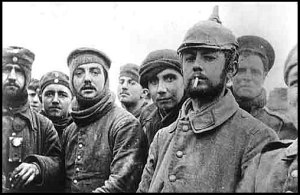
The following day was Christmas, 1914. A few German soldiers emerged from their trenches at the first light of dawn, approaching the Allies across no man’s land and calling out “Merry Christmas” in the native tongue of their adversaries. Allied soldiers first thought it was a trick, but these Germans were unarmed, standing out in the open where they could be shot on a whim. Tommies soon climbed out of their own trenches, shaking hands with the Germans and exchanging gifts of cigarettes, food and souvenirs. In at least one sector, enemy soldiers played a friendly game of soccer.

christmastruce2Captain Bruce Bairnsfather later wrote: “I wouldn’t have missed that unique and weird Christmas Day for anything. … I spotted a German officer, some sort of lieutenant I should think, and being a bit of a collector, I intimated to him that I had taken a fancy to some of his buttons. … I brought out my wire clippers and, with a few deft snips, removed a couple of his buttons and put them in my pocket. I then gave him two of mine in exchange. … The last I saw was one of my machine gunners, who was a bit of an amateur hairdresser in civil life, cutting the unnaturally long hair of a docile Boche, who was patiently kneeling on the ground whilst the automatic clippers crept up the back of his neck.”
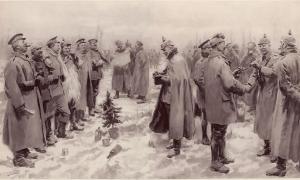
Captain Sir Edward Hulse Bart reported a sing-song which “ended up with ‘Auld lang
syne’ which we all, English, Scots, Irish, Prussians, Wurttenbergers, etc, joined in. It was absolutely astounding, and if I had seen it on a cinematograph film I should have sworn that it was faked!”

Nearly 100,000 Allied and German troops were involved in the unofficial ceasefire ofChristmas Truce 1914, as seen by the Illustrated London News. December 24-25, 1914, lasting in some sectors until New Year’s Day.

A few tried to replicate the event the following year, but there were explicit orders preventing it. Captain Llewelyn Wyn Griffith recorded that after a night of exchanging carols, dawn on Christmas Day 1915 saw a “rush of men from both sides … [and] a feverish exchange of souvenirs” before the men were quickly called back by their officers.

One German unit tried to leave their trenches under a flag of truce on Easter Sunday 1915, but they were warned off by the British opposite them.

German soldier Richard Schirrmann wrote in December 1915, “When the Christmas bells sounded in the villages of the Vosges behind the lines …. something fantastically unmilitary occurred. German and French troops spontaneously made peace and ceased hostilities; they visited each other through disused trench tunnels, and exchanged wine, cognac and cigarettes for Westphalian black bread, biscuits and ham. This suited them so well that they remained good friends even after Christmas was over”.

Some will tell you, that the bitterness engendered by continuous fighting made such fraternization all but impossible.  Yet there are those who believe that soldiers never stopped fraternizing with their opponents, at least during the Christmas season.  Heavy artillery, machine gun, and sniper fire were all intensified in anticipation of Christmas truces, minimizing such events in a way that kept them out of the history books.

ronald-mckinnon
Private Ronald MacKinnon

Even so, there is evidence of a small Christmas truce occurring in 1916, previously unknown to historians. 23-year-old Private Ronald MacKinnon of Princess Patricia’s Canadian Light Infantry, wrote home about German and Canadian soldiers reaching across battle lines near Arras, sharing Christmas greetings and trading gifts. “I had quite a good Christmas considering I was in the front line”, he wrote. “Christmas Eve was pretty stiff, sentry-go up to the hips in mud of course. … We had a truce on Christmas Day and our German friends were quite friendly. They came over to see us and we traded bully beef for cigars”. The letter ends with Private MacKinnon noting that “Christmas was ‘tray bon’, which means very good.”

Private Ronald MacKinnon of Toronto Ontario, Regimental number 157629, was killed barely three months later on April 9, 1917, during the Battle of Vimy Ridge.

December 10, 1917 Halifax Explosion

French sailors abandoned ship as fast as they could, warning everyone who would listen of what was about to happen

As “The Great War” dragged itself to the end of its third year in Europe, Halifax harbor in Nova Scotia, was the bustling scene of supply, munition, and troop ships destined for “over there”.  With a population of 50,000 at the time, Halifax was the busiest port in Atlantic Canada.

The Norwegian vessel Imo left its mooring in Halifax harbor on the morning of December 6, destined for New York City.   The French ship Mont Blanc was entering the harbor at this time, intending to join the convoy which would form her North Atlantic escort.  In her holds, Mont Blanc carried 200 tons of Trinitrotoluene (TNT), and 2,300 tons of TNP – Trinitrophenol or “Picric Acid”, a substance then in use as a high explosive.  In addition, the freighter carried 35 tons of high octane gasoline and 20,000 lbs of gun cotton.  Not wanting to draw the attention of pro-German saboteurs, the freighter flew no flags warning of its cargo.  Mont Blanc was a floating bomb

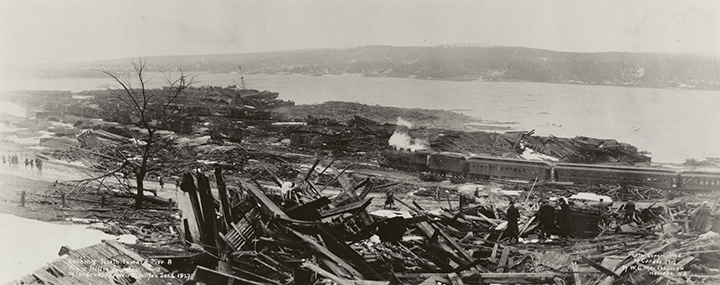
Somehow, signals became crossed as the two ships passed, colliding in the narrows at the harbor entrance and igniting the TNP onboard Mont Blanc.  French sailors abandoned ship as fast as they could, warning everyone who would listen of what was about to happen.

Meanwhile, the spectacle of a flaming ship was too much to resist, as crowds gathered around the harbor.  The high-pitched whine emitted by picric acid under combustion remains a feature of fireworks displays to this day.  You can only imagine the scene as the burning freighter brushed the harbor pier, setting it ablaze, before running aground.

The explosion and resulting fires killed over 1,800, flattening the north end of Halifax and shattering windows as far as 50 miles away.  With over 1,600 homes flattened, it was one of the largest non-nuclear explosions in history.  Mont Blanc’s anchor landed two miles away, one of her gun barrels, three.  Later analysis estimated the explosive output at 2.9 kilotons, a force greater than many tactical nuclear weapons.

9,000 were wounded on the morning of December 7, as a blizzard descended across Nova Scotia.  Boston Mayor James Michael Curley wrote to the US Representative in Halifax “The city of Boston has stood first in every movement of similar character since 1822, and will not be found wanting in this instance. I am, awaiting Your Honor’s kind instruction.”

Curley was as good as his word.  He and Massachusetts Governor Samuel McCall composed a Halifax Relief Committee to raise funds and organize aid.  McCall reported that the effort raised $100,000 in its first hour alone. President Woodrow Wilson authorized a $30,000 carload of Army blankets sent to Halifax.  Within 12 hours of the explosion, the Boston Globe reported on the first train leaving North Station, with “30 of Boston’s leading physicians and surgeons, 70 nurses, a completely equipped 500-bed base hospital unit and a vast amount of hospital supplies”.

Delayed by deep snow drifts, the train arrived on the morning of December 8, the first non-Canadian relief train on the scene.

There was strong sentiment at the time, that German sabotage lay behind the disaster.  A front-page headline on the December 10 Halifax Herald Newspaper proclaimed “Practically All the Germans in Halifax Are to Be Arrested”.

$750,000 in relief aid would arrive from Massachusetts alone, equivalent to more than $15 million today.  Canadian Prime Minister Robert Borden would write to Governor McCall on December 9, “On behalf of the Government of Canada, I desire to convey to Your Excellency our very sincere and warm thanks for your sympathy and aid in the appalling calamity which has befallen Halifax”.

The following year, Nova Scotia sent the city of Boston a gift of gratitude, a very large Christmas tree.

In 1971, the Lunenburg County Christmas Tree Producers Association sent Boston another tree, to promote their Christmas tree exports, and to once again acknowledge the support of the people and government of Boston after the 1917 disaster. The Nova Scotia government later took over the annual gift of the Christmas tree, to promote trade and tourism.

And so it is that, every year, the people of Nova Scotia send the people of Boston their official Christmas tree.  More recently, the principle tree is joined by two smaller trees, donated to Rosie’s Place and the Pine Street Inn, two of Boston’s homeless shelters.

This is no Charlie Brown shrub we’re talking about. The 1998 tree required 3,200 man-hours to decorate:  17,000 lights connected by 4½ miles of wire, and decorated with 8,000 bulbs.

In 2013, the tree was accompanied by a group of runners, in recognition of the Boston Marathon bombing earlier that year.2016-boston-christmas-tree

This year’s tree stands just short of 46′, for the first time selected from the Cape Breton area. It takes two men a day and a half to prepare for cutting, a crane holding the tree upright while the chainsaw does its work.  It’s a major media event, as the tree is paraded through Halifax on a 53’ flatbed, before boarding the ferry across the Bay of Fundy to begin its 750-mile journey south.

For a small Canadian province, it’s been no small commitment.  Last year Nova Scotia spent $242,000 on the program, including transportation, cutting & lighting ceremonies, and all the promotions that went with it.  Premier Stephen McNeil says the program is well worth the expense. “(It) gives us a chance to showcase our beautiful part of the world to a global community”.  Tim Whynot, manager of stewardship and outreach for the provincial Department of Natural Resources, may have the last word.  “With the Tree for Boston, obviously the history of why we do it is pretty significant…we don’t want that to be forgotten”.

December 1, 2013 Sacred Soil

The Flanders Fields Memorial Garden will open in 2014, marking the centenary of the “great War”. “The war to end all wars”.

This November 11, nineteen short days ago, marked the 98-year anniversary of the end of WWI.
At the time, it was “The Great War”.  The “War to end all wars”.  There is barely a piece of 20th or 21st century history which cannot be traced back to it.  International Communism was borne of the Great War, without which there would have been no cold war, no Korean War, nor Vietnam. The killing fields of Cambodia would have remained mere rice fields.  The spiritual descendants of Chiang Kai-shek’s brand of capitalism would be running all of China, instead of only Taiwan.
The current boundaries of the Middle East arose from the Great War. While the region’s tribal alliances and religious differences are nothing new, they would have taken a very different shape if not for those boundaries.
World War II, a conflagration which left more dead, wounded or missing than any conflict in world history (WWI was only #5), was little more than the Great War, part 2. A Marshall of France, on looking at the Versailles Treaty formally ending WWI, said “This isn’t peace. This is a cease-fire that will last for 20 years”. He was off by something like 36 days.
I’ve long believed that we can’t be participating citizens of a self-governing Republic, we can’t know where we want our country to go, if we don’t understand where it’s been.  It’s one of the principle benefits of examining history.  It’s why I think something wonderful happened three years ago, and I don’t think many of us heard about it.
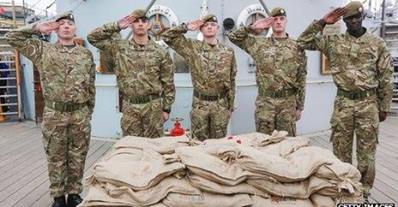
More than 1,000 British and Belgian schoolchildren visited 70 battlefields of the Great War in the summer of 2013.  Ypres.  Passchendaele.  Verdun.  The Somme.  All over Northern France and Belgium, the region known as “Flanders”, there they collected samples of the sacred soil of those fields.
The soil from those battlefields was placed in WWI-style burlap sandbags, each stenciled with a red poppy, where it came from, and the dates.  These seventy sandbags were transported to London, and installed with great care at Wellington Barracks, the central London home of the Grenadier Guards, Coldstream Guards and Scots Guards. There the soil of the Great War will nourish and support a garden.  Ready for the following year – a solemn remembrance of the centenary of that war.
That day, December 1, 2013, was for the Flanders Fields Memorial Garden, the first full day of forever.
I can’t think of anything more fitting than that it was children, our future and posterity, who retrieved the sacred soil of Flanders and installed it at that garden. It is now for that posterity to keep our history alive, and not let it fade into some sepia toned and forgotten past.

This is what it looked like