September 21, 1780 André

He asked not that his life be spared, but only that he be executed by firing squad. A death considered worthy of a gentleman of the age and not hanging, an end reserved for thieves and scoundrels.

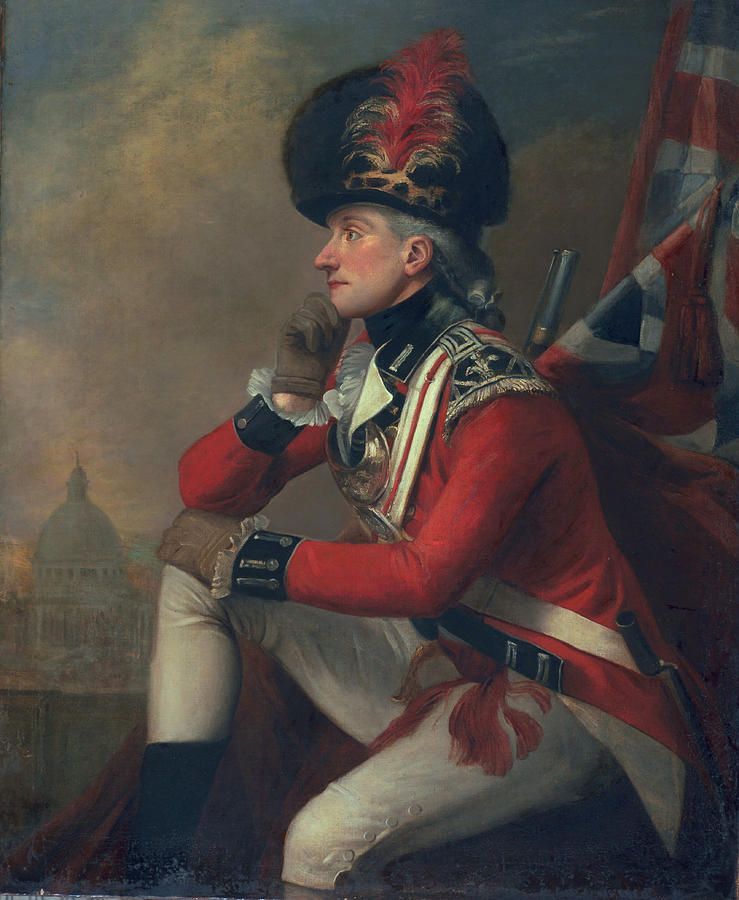
In an age before radio or television, John André was an interesting man to be around. A gifted storyteller with a great sense of humor he could draw, paint and cut silhouettes. He was an excellent writer, he could sing, and he could write verse.  John André was a British Major at the time of the American Revolution, who took part in his army’s occupations of Philadelphia and New York.

John André was a spy.

A favorite of colonial era loyalist society, Major André dated Peggy Shippen for a time, the daughter of a prominent Philadelphia loyalist. Shippen went on to marry Benedict Arnold in 1779, forming a link between the spy and an important general in the cause of American independence.

Hat tip artist Dale Watson for this image of Peggy Shippen

The relationship nearly changed the outcome of the American revolution.

Arnold was the Commandant of West Point at the time, the future location of one of our great military academies. A prominence overlooking the Hudson River, West Point was a fortified position offering decisive military advantage to the side holding the position. The British capture of West Point would have split the colonies in half.

The author (left) on a 2022 “history ramble” weekend with family members. It doesn’t take a military strategist to understand the importance of West Point’s commanding position over the Hudson River.

The Sloop of War HMS Vulture sailed up the Hudson River on September 20, 1780, Major André meeting with General Arnold on the river’s banks the following day. Dressed in civilian clothes, John André struck a bargain with the patriot general. Arnold would receive £20,000, over a million dollars today, in exchange for which he would give up West Point.

Tasked with returning the signed papers to British lines, Major André was stopped by three Patriot Militiamen two days later. They were John Paulding, David Williams and Isaac Van Wart. One of the three wore a Hessian overcoat, making André believe they might be loyalists. “Gentlemen”, he said, “I hope you belong to our party”. “What party”, came the reply, and André said “The lower (British) party”. “We do”, they said, to which André replied that he was a British officer and must not be detained. That was as far as he got.

You need not be a military strategist to recognize the importance of the commanding heights at West Point. The discovery of those papers brought Benedict Arnold’s treachery to light. Arnold immediately fled on hearing of André’s arrest, even as George Washington was headed to his place for a meeting over breakfast.

John André was tried and sentenced to death as a spy. He asked if he could write a letter to General Washington.  In it he asked not that his life be spared, but that he be executed by firing squad, a death more worthy of a gentleman than hanging, an execution at that time commonly reserved for criminals.

General Washington believed that Arnold’s crimes to be far more egregious than those of John André. Furthermore, he was impressed with the man’s courage.  Washington wrote to General Sir Henry Clinton asking for an exchange of prisoners.

Having received no reply, Washington wrote in his General Order of October 2 “That Major André General to the British Army ought to be considered as a spy from the Enemy and that agreeable to the law and usage of nations it is their opinion he ought to suffer death. The Commander in Chief directs the execution of the above sentence in the usual way this afternoon at five o’clock precisely.”

John André was executed by hanging in Tappan, New York. He was 31.

A vintage postcard illustration depicting the execution of Major John Andre, hung as a spy for aiding and abetting General Benedict Arnold during the American Revolutionary War in Trenton, New Jersey on 2nd October 1780, published in New York, circa 1903. Andre’s body was later disinterred from American soil and buried in Westminster Abbey, London. (Photo by Paul Popper/Popperfoto via Getty Images)

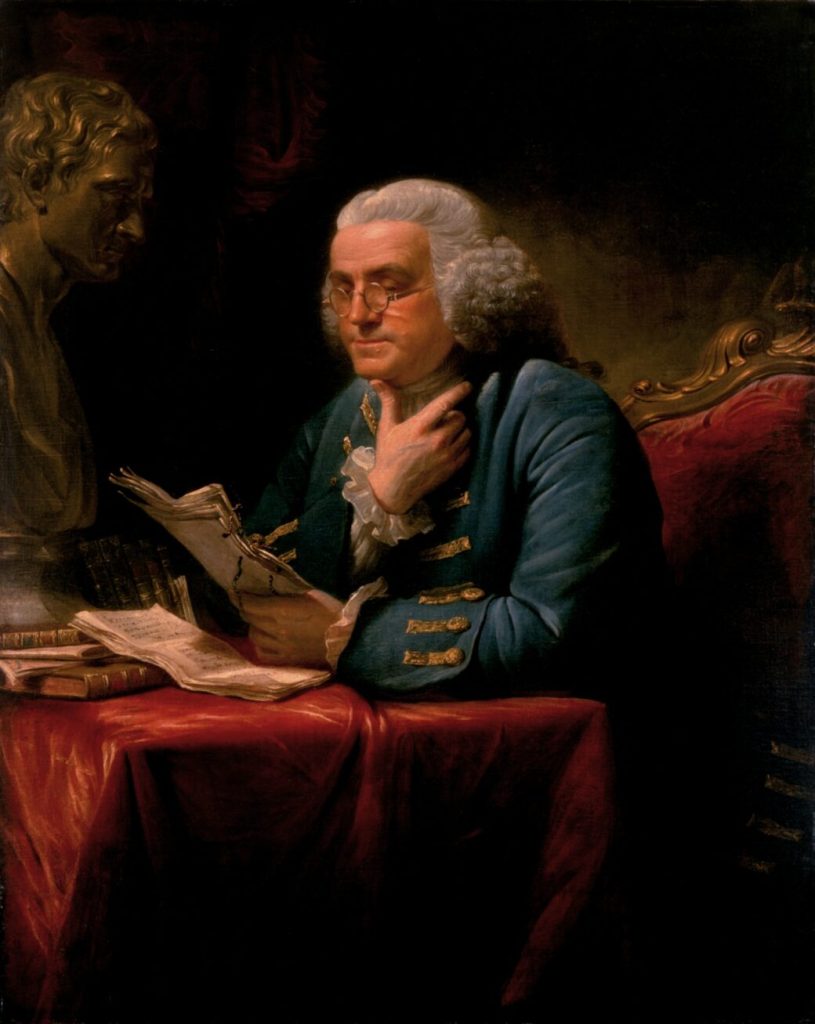
John André lived for a time in Benjamin Franklin’s house back in 1777-’78, during the British occupation of Philadelphia. As he was packing to leave, Geneva-born American patriot and portrait artist Pierre-Eugène Du Simitiere came to say goodbye. The officer was always known as a gentleman. Simitiere was shocked to find André stoop to looting the home of such a prominent patriot. For a man known for extravagant courtesy, this was way out of character. André was packing books, musical instruments and scientific apparatus, even an oil portrait of Franklin, offering not so much as a response to Simitiere’s protests.

Nearly two hundred years later, the descendants of Major-General Lord Charles Grey returned the painting to the United States, explaining that André had probably looted Franklin’s home under direct orders from the General himself. A Gentleman always, it would explain the man’s inability to defend his own actions.

Today that oil portrait of Benjamin Franklin hangs in the White House.
Benedict Arnold went on to lead British forces against his former comrades. As the story goes, Arnold once asked one of his officers what the Americans might do should he (Arnold) be captured. The officer replied: “They will cut off the leg which was wounded when you were fighting so gloriously for the cause of liberty, and bury it with the honors of war, and hang the rest of your body on a gibbet.”

The story refers to a grievous injury the turncoat general received at the Battle of Saratoga, heroically leading patriot infantry against a position remembered as Breymann redoubt. It was the second time a bullet had shattered the general’s leg in service to the Revolution. Arnold walked with a pronounced limp for the rest of his life.

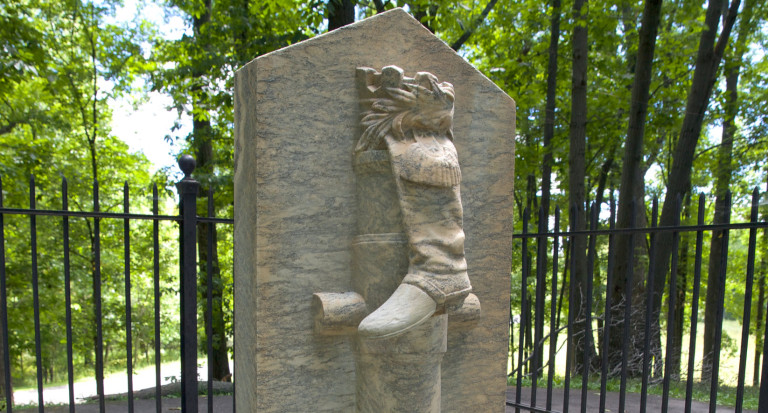
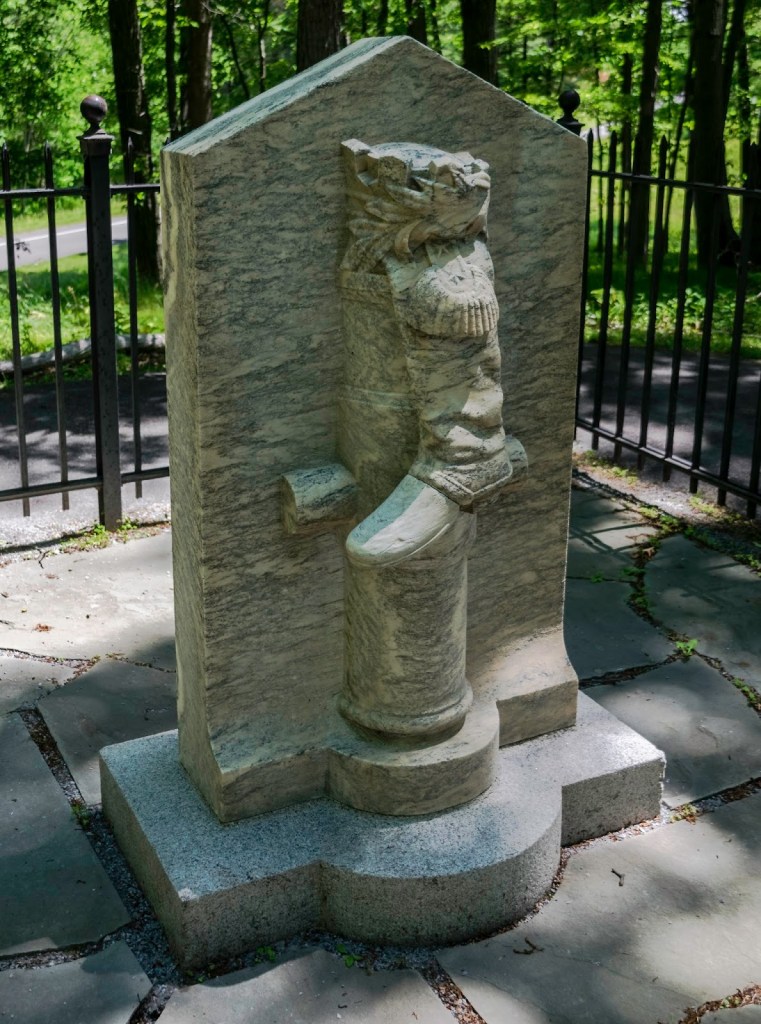
On the grounds near the battlefield at Saratoga there stands the statue of a cannon’s barrel, and a leg. An officer’s boot, really, dedicated to a Hero of the Revolution. The cannon’s barrel is pointed down as a sign of dishonor. The monument declines to give this hero a name.

It is one of the most forlorn places I have ever seen.
January 14, 1741 Turncoat

As a British officer, Arnold himself once asked an American prisoner “What will the Americans do with me if they catch me?” The reply though mostly forgotten, is one for the ages. “They will cut off the leg which was wounded when you were fighting so gloriously for the cause of liberty, and bury it with the honors of war, and hang the rest of your body on a gibbet.”

Three hours from the upstate New York village of Sleepy Hollow, in the woods of Schuylerville, there stands the statue of a leg.  A boot, actually, a man’s riding boot, along with an epaulet and a cannon barrel pointing downward, denoting the death of a General.  It seems the loneliest place on earth out there in the woods, with nothing but a footpath worn into the forest floor to lead you there.

The back of the stone bears these words.  “In memory of the most brilliant soldier of the Continental Army“.  A most brilliant soldier who, according to his own memorial, has no name.

Breymann-Redoubt-at-Saratoga
Breymann’s RedoubtSaratoga Battlefield. H/T American Battlefield trust

In 1632, Reverend John Lothropp was an ordained minister of the Church of England. That was the year he renounced his orders, and joined the cause of religious independence. Lothropp was arrested and jailed for his apostasy, pardoned only on condition that he leave and never come back. He accepted the terms of his exile, arriving in Plymouth Massachusetts a short fourteen years after the original pilgrims.

John Lothropp is mostly forgotten today but his old house on Cape Cod, now houses the oldest public library in America.  That, and a host of famous relatives, direct descendants including George Bush the elder and the younger, Franklin Roosevelt, Ulysses Grant, James Garfield and Millard Fillmore. Oh, and the guy who once wore that riding boot, up in Schuylerville. Benedict Arnold, born this day in 1741.

The year was 1777, October 7, the last day of the Battle of Saratoga.  General Horatio Gates was in overall command of American forces, a position greatly exceeding his capabilities.  Gates was cautious to the point of timidity, generally believing his men better off behind prepared fortifications, than taking the offensive.

Benedict Arnold
General Benedict Arnold

Gates’ subordinate, General Benedict Arnold, could not have been more different.  Arnold was imaginative and daring, a risk taker possessed of physical courage bordering on thereckless.  The pair had been personal friends once but that was time, long past.  By this time the two men were constantly at odds.

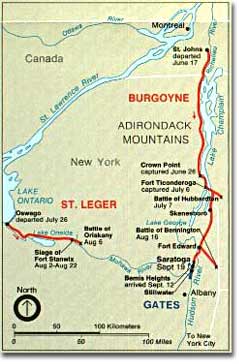
British General John “Gentleman Johnny” Burgoyne led a joint land and water invasion of 7,000 British and Hessian troops south along the New York side of Lake Champlain, down the Hudson River valley.

The invasion started out well for Burgoyne with the bloodless capture of Fort Ticonderoga, but Gentleman Johnny ran into a buzz saw outside of Bennington, Vermont, losing almost 1,000 men to General John Stark’s New Hampshire rebels and a militia unit headed by Ethan Allen, calling itself the “Green Mountain Boys”.

Burgoyne intended to continue south to Albany, linking up with forces under Sir William Howe and cutting the colonies in half.  The 10,000 or so Colonial troops situated on the high ground near Saratoga, were all that stood in his way.

Burgoyne's Route to SaratogaPatriot forces selected a site called Bemis Heights about 10 miles south of Saratoga, spending a week constructing defensive works with the help of Polish engineer Thaddeus Kosciusko.  Theirs was a formidable position with mutually supporting cannon on overlapping ridges, with interlocking fields of fire.
Burgoyne had no choice but to stop and give battle at the American position, or be chopped to pieces trying to pass it by.

The Battle of Freeman’s Farm, the first of two battles for Saratoga, occurred on September 19.  Technically a Patriot defeat in that the British held the ground at the end of the day, it was a costly victory.  English casualties were almost two to one.  Worse, the British column was out at the end of a long and tenuous supply line, while fresh men and supplies all but poured into the American position.

Freeman’s Farm could have been worse for the Patriot cause, but for Benedict Arnold’s anticipating British moves, and taking steps to block them in advance.

The personal animosity between Gates and Arnold boiled over in the days that followed.  Gates’ report to Congress made no mention of Arnold’s contributions at Freeman’s Farm, though field commanders and the men involved with the day’s fighting, unanimously credited Arnold for the day’s successes.  A shouting match between Gates and Arnold resulted in the latter being relieved of command, and replaced by General Benjamin Lincoln.

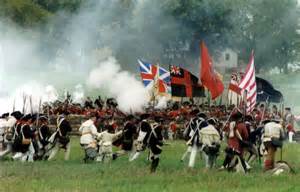
Saratoga ReenactmentThe second and decisive battle for Saratoga, the Battle of Bemis Heights, occurred on October 7, 1777.

Lieutenant Colonel Heinrich Christoph Breymann’s Hessian grenadier regiment formed the right anchor of Burgoyne’s line, manning a wooden fortification near the length of a football field and some 7-feet high.  It was a strategically important position, with nothing between itself and the regiment’s main camp to the rear.

Though relieved of command Arnold was on the field, directing the battle on the American right.  As the Hessian position began to collapse, General Arnold left his troops facing Balcarre’s Redoubt on the right, riding between the fire of both armies and joining the final attack on the rear of the German post.  Arnold was shot through the left leg during the final moments of the action, shattering the same leg which had barely healed after the same injury at the Battle of Quebec City, only two years earlier.  The same leg wounded in the defense of Ridgefield, only six months earlier.

saratogabig.jpgIt would have been better in the chest, he said, than to have received such a wound in that leg.
Burgoyne had no choice but to capitulate, surrendering his entire force on October 17.  It was a devastating defeat for the British cause, and finally brought France in on the American side.  A colonial Army had gone toe to toe with the most powerful military on the planet, and still stood.

One British officer described the battle:  “The courage and obstinacy with which the Americans fought were the astonishment of everyone, and we now became fully convinced that they are not that contemptible enemy we had hitherto imagined them, incapable of standing a regular engagement, and that they would only fight behind strong and powerful works.”

One year earlier almost to the day, Benedict Arnold led a stick-built “Navy” literally constructed on the shores of lake Champlain, in a suicidal action by the shores of Valcour Island. Three years later, a man who would otherwise be remembered among the top tier of our founding fathers, betrayed the American fortifications at West Point to the British spy, John André.

The name of one of our top Revolution-era warriors, a General whom one of his own soldiers later described as “the very genius of war,” became that of Traitor.  As a British officer, Arnold himself once asked an American prisoner “What will the Americans do with me if they catch me?” The reply though mostly forgotten, is one for the ages. “They will cut off the leg which was wounded when you were fighting so gloriously for the cause of liberty, and bury it with the honors of war, and hang the rest of your body on a gibbet.”

home-design
The forest has grown around it now.  The only memorial on the Saratoga Battlefield, to an American Hero with no name.

So it is that there is the statue of a leg in the forest south of Saratoga, dedicated to a nameless Hero of the Revolution.  On the back of the monument are inscribed these words:

Saratoga Obelisk“In memory of
the most brilliant soldier of the
Continental Army
who was desperately wounded
on this spot the sally port of
BURGOYNES GREAT WESTERN REDOUBT
7th October, 1777
winning for his countrymen
the decisive battle of the
American Revolution
and for himself the rank of
Major General.”

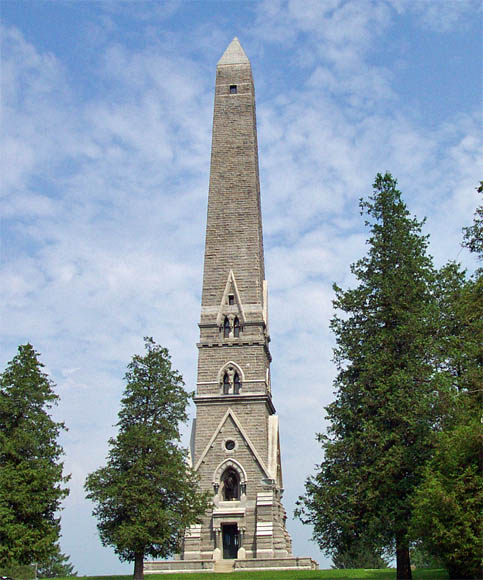
Today, the Saratoga battlefield and the site of Burgoyne’s surrender are preserved as the Saratoga National Historical Park.  On the grounds of the park stands an obelisk, containing four niches.

Three of them hold statues of American heroes of the Battle.  General Horatio Gates. General Philip John Schuyler.  Colonel Daniel Morgan.

The fourth niche, where Benedict Arnold’s statue was intended to go, remains empty.