
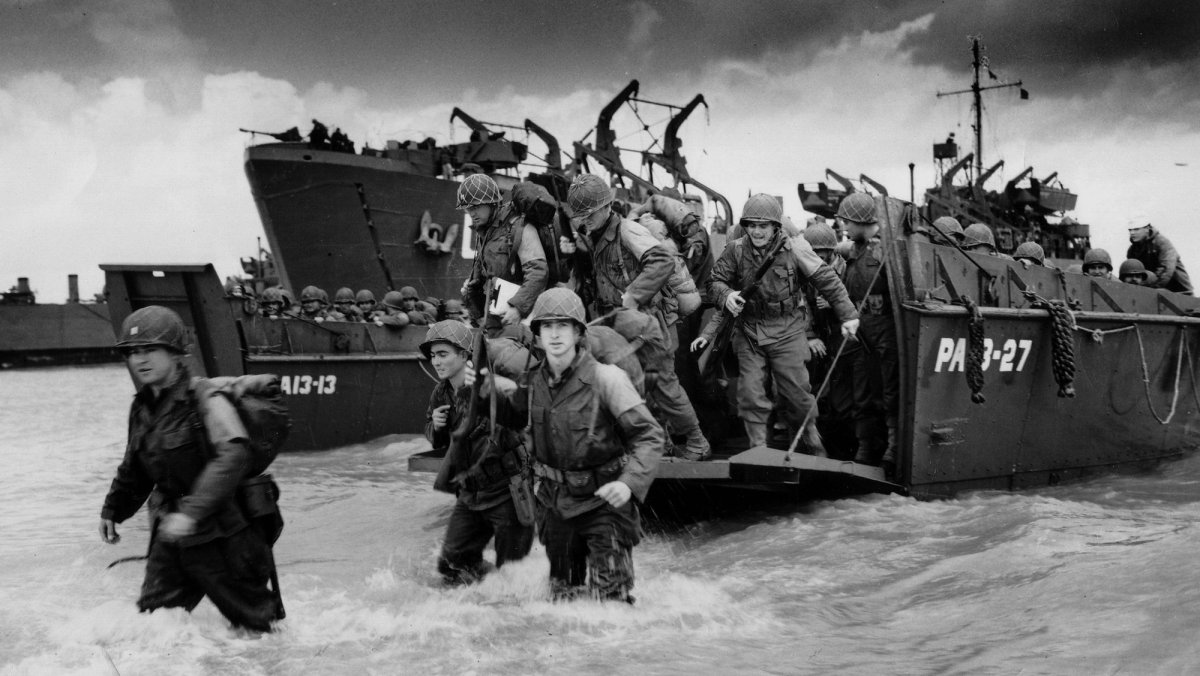
On June 6, 2019, CNN reported on the alarming number of US Military service deaths in training accidents, and other “circumstances unrelated to war. “Since 2006” they wrote, “a total of 16,652 active-duty personnel and mobilized reservists have died while serving in the US armed forces. Seventy-three percent of these casualties occurred under circumstances unrelated to war”.
We would hope that those to whom we entrust the lives of our best and brightest would learn and adjust in response, that those lives not be lost in vain. War is, after all, a dangerous business.
Be that as it may no service member’s life lost in ‘circumstances unrelated to war’ is any less valuable, any less heroic, than those who died facing the adversary.
Permit me to speak then, of “Exercise Tiger.” A dress rehearsal for the largest seaborne invasion in history, gone terribly wrong. Their sacrifice taught important lessons and saved the lives of unknown legions of heroes. They, too, have earned the right to be remembered.
The largest amphibious attack in history began on June 6, 1944, on the northern coast of France. British and Canadian forces came ashore at beaches codenamed Gold, Juno and Sword. Americans faced light opposition at Utah Beach while heavy resistance at Omaha Beach resulted in over 2,000 American casualties.

By the end of day, some 156,000 Allied troops had stormed the beaches of Normandy. Within a week that number would rise to 326,000 troops, more than 50,000 vehicles and over 100,000 tons of equipment.
Overlord’s success resulted from lessons learned from the largest amphibious training exercise of the war, the six phases of “Operation Fabius”, itself following the unmitigated disaster of a training exercise that killed more Americans than the actual landing at Utah beach.
Slapton is a village and civil parish in the River Meadows of Devon County, where the southwest coast of England meets the English Channel. Archaeological evidence suggests human habitation from at least the bronze age. The “Domesday Book”, the recorded manuscript of the “Great Survey” of England and Wales completed in 1086 by order of William the Conqueror, names the place as “Sladone”, with a population of 200.
In late 1943, 750 families, some 3,000 locals, were evacuated with their livestock to make way for “Operation Tiger”, a D-Day landing rehearsal scheduled for the following spring. Some had never so much as left their home village.
Thousands of US military personnel were moved into the region during the winter of 1943-44. The area was mined and bounded with barbed wire and patrolled by sentries. Secrecy was so tight that even those in surrounding villages had no idea of what was happening.
Exercise Tiger was scheduled to begin on April 22, covering all aspects of the “Force U” landing on Utah beach and culminating in a live-fire beach landing at Slapton Sands at first light, on April 27.
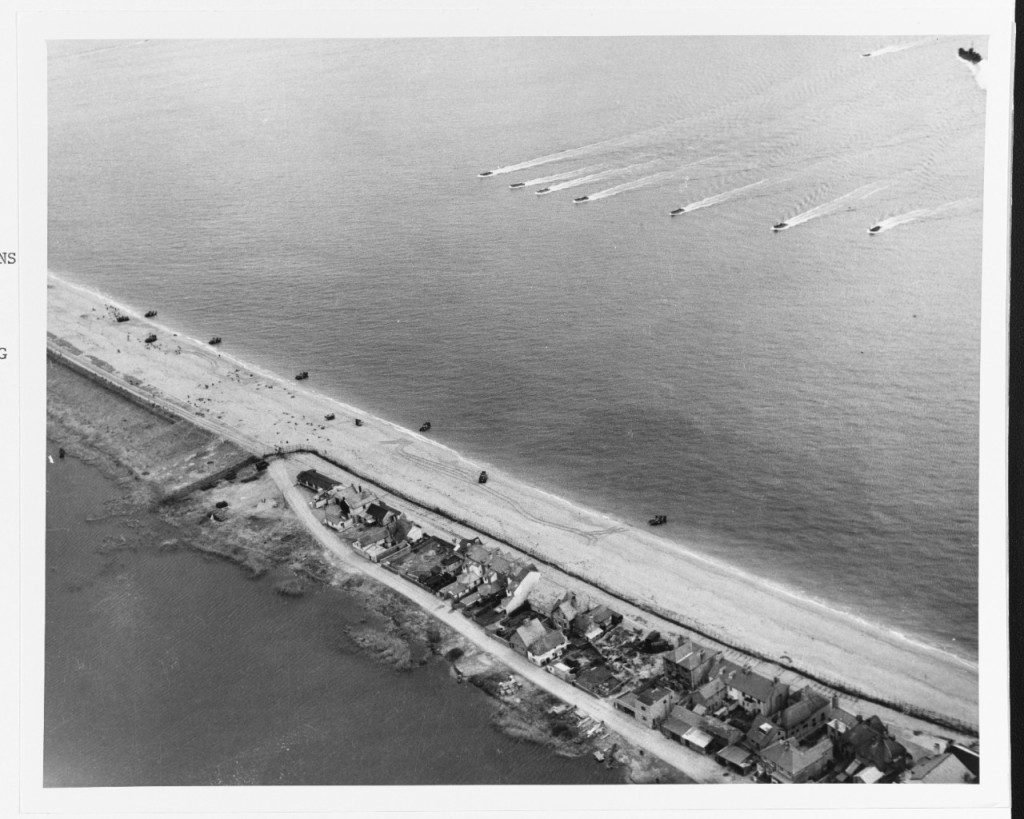
Nine large tank landing ships (LSTs) shoved off with 30,000 troops on the evening of the 26th, simulating the overnight channel crossing. Live ammunition was used in the exercise, to harden troops off to the sights, sounds and smells of actual battle. Naval bombardment was to commence 50 minutes before H-Hour, however delays resulted in landing forces coming under direct naval bombardment. An unknown number were killed in this “friendly fire” incident. Fleet rumors put the number as high as 450.
Two Royal Navy Corvettes, HMS Azalea and Scimitar, were to guard the exercise from German “Schnellboots” (“S-Boots”), the fast attack craft based out of Cherbourg.
Scimitar withdrew for repairs following a collision with an LST on the 27th. In the early morning darkness of the following day, the single corvette was leading 8 LSTs carrying vehicles and combat engineers of the 1st Engineer Special Brigade through Lyme Bay, when the convoy was spotted by a nine vessel S-Boat patrol.
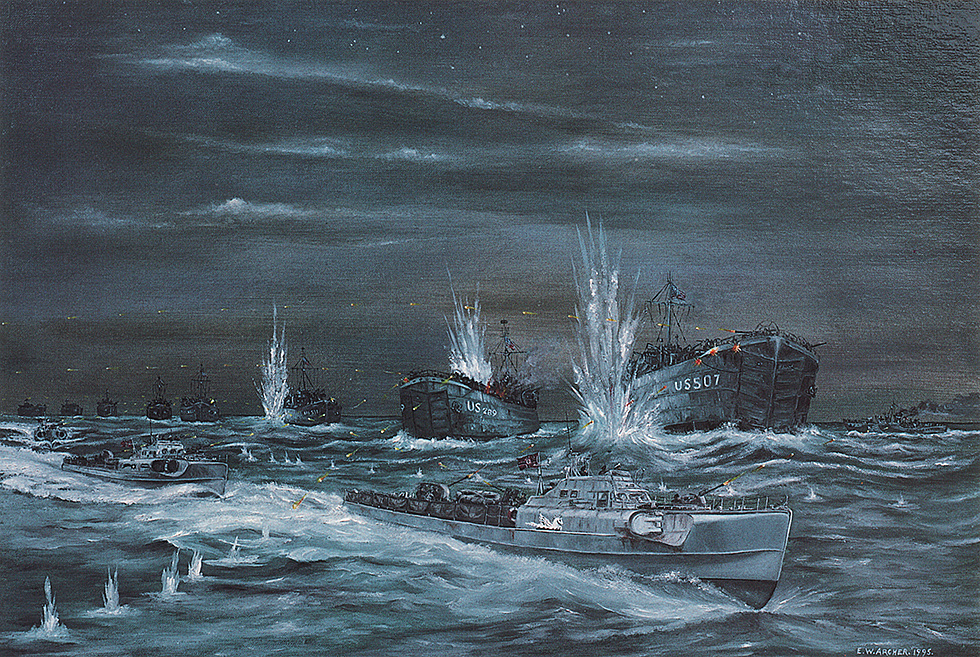
8 landing craft in single-file didn’t have a chance against fast-attack craft capable of 55mph. LST-531 was torpedoed and sunk in minutes, killing 424 Army and Navy personnel. LST-507 suffered the same fate, with the loss of 202. LST-289 made it to shore in flames, with the loss of 123. LST-511 was damaged in yet another friendly fire incident. Unable to wear their lifebelts correctly due to the large backpacks they wore, many men placed them around their waists. That only turned them upside down. That is how they died, thrashing in the water with their legs above the waves. Dale Rodman, who survived the sinking of LST-507, said, “The worst memory I have is setting off in the lifeboat away from the sinking ship and watching bodies float by.”
Survivors were sworn to secrecy due to official embarrassment, and the possibility of revealing the real invasion, scheduled for June. Ten officers with high level clearance were killed in the incident, but no one knew that for sure until their bodies were recovered. The D-Day invasion was nearly called off, because any of them could have been captured alive, revealing secrets during German interrogation and torture.
There’s a surprising amount of confusion about the final death toll. Estimates range from 639 to 946, nearly five times the number killed in the actual Utah Beach landing. Some or all the personnel from that damaged LST may have been aboard the other 8 on the 28th, and log books went down along with everything else. Many of the remains have never been found.
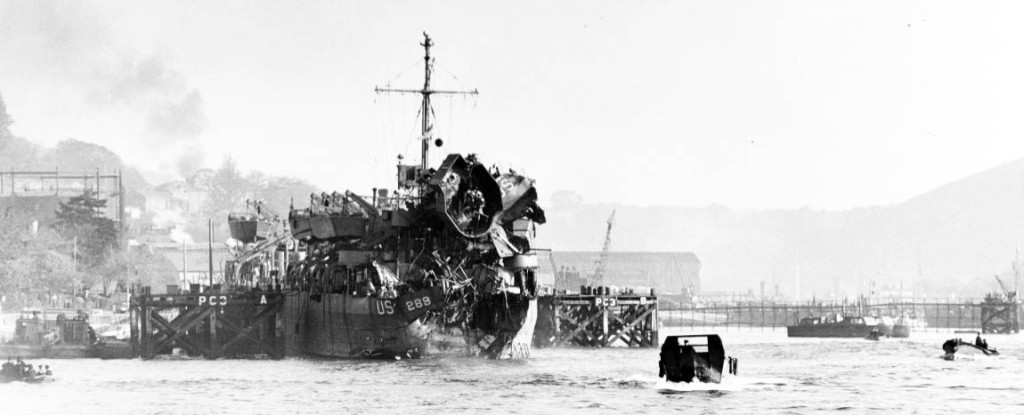
That number would surely have been higher, had not Captain John Doyle disobeyed orders and turned his LST-515 around, plucking 134 men from the frigid water.
Today, the Exercise Tiger disaster is all but forgotten. Some have charged official cover-ups, though information from SHAEF press releases appeared in the August edition of Stars & Stripes. At least three books contain the information. It seems more likely that the immediate need for secrecy and subsequent D-Day invasion swallowed the Tiger disaster, whole. History has a way of doing that.

Some of Slapton’s residents came home to rebuild their lives after the war, but many never returned. In the early 1970s, Devon resident and civilian Ken Small discovered an artifact of the Tiger exercise, while beachcombing on Slapton Sands. With little or no help from either the American or British governments, Small purchased rights from the U.S. Government to a submerged Sherman tank from the 70th Tank Battalion. The tank was raised in 1984 with the help of local residents and dive shops, and now stands as a memorial to Exercise Tiger. Not far away is a memorial to the villagers who never came home.
A plaque was erected at Arlington National Cemetery in 1995, inscribed with the words “Exercise Tiger Memorial”. A 5,000-pound stern anchor bears silent witness to Exercise Tiger in Mexico, Missouri, as does an M4 Sherman tank at Fort Rodman Park in New Bedford, Massachusetts.

In 1676, Isaac Newton wrote to rival Robert Hooke: “…If I have seen a little further, it is by standing on the shoulders of Giants.”
Today, we celebrate ‘The Boys of Pointe du Hoc’ and all the heroes of D-Day, for it is they who broke down the door to Fortress Europe. It is well that we should do this, and to remember. They, too, have stood on the shoulders of giants.


 Historical Easter Eggs - Today in History
You must be logged in to post a comment.