
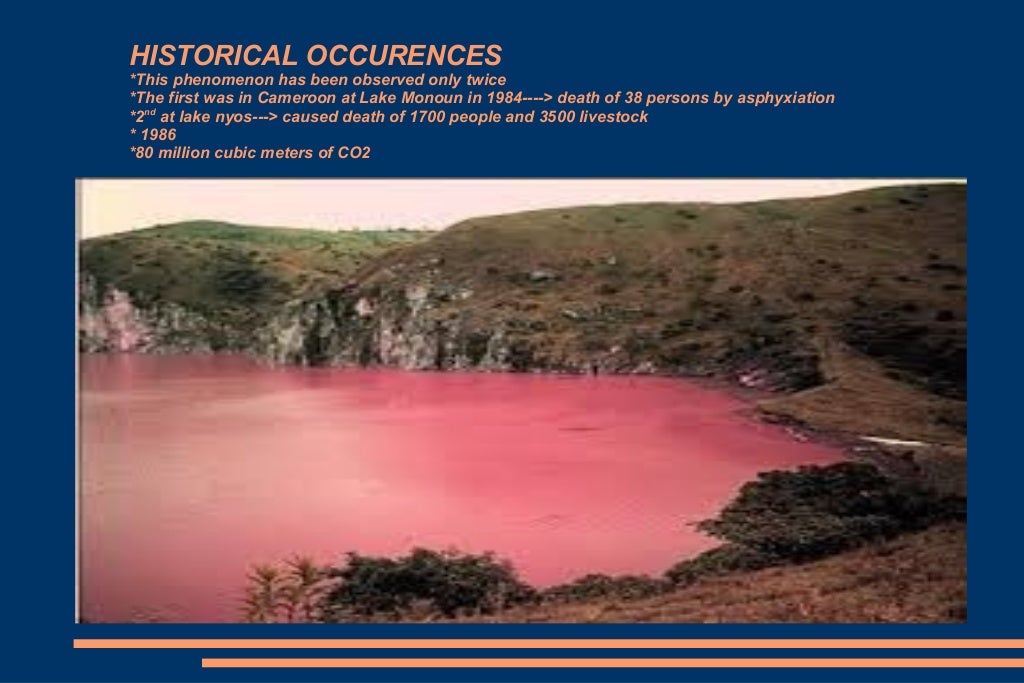
On August 15, 1984, villagers in the Central African nation of Cameroon made a grisly discovery.
Lake Monoun lies near the center of a volcanic field containing some 34 recent craters. Survivors reported a loud sound at 10:30 that night. The next morning, dozens of dead lay strewn about near the lake
Two men riding atop a truck carrying ten other passengers told the unlikeliest of tales, how the truck itself died along with the ten people inside, and yet these two survived.

Local speculation centered around a release of toxic volcanic gases. 37 dead were laid to rest. The living moved on.
Two years later, a similar but vastly larger event took place at nearby Lake Nyos, killing 1,746 and some 3,500 livestock. This time, the world took notice.
Thirty-nine years ago today, a man walking near Lake Nyos in northwest Cameroon discovered dozens of dead animals. Approaching a nearby village, there wasn’t another living creature for miles around.
There was no sign of struggle. People, livestock, wildlife. Even the insects had lay down where they were and just… died.

The culprit was a rare and little understood phenomenon called a limnic eruption.
With a depth of nearly 700 feet, Lake Nyos’ water column is relatively stable due to a climate that rarely warms above 90° Fahrenheit, or cools below 70°. Over the years, volcanic activity causes carbon dioxide to seep into the frigid depths of the lake. A warm upper layer covers the surface to the extent that sunlight penetrates the brown waters of the crater.
Over time, dissolved Co2 becomes an explosive time bomb waiting only for a landslide, an earthquake, or simply a critical mass of gas.
1.6 million tons of the stuff exploding to the surface in the dead of night and racing across the ground. Being heavier than air, the suffocating cloud swept along valleys and low lying areas, asphyxiating all in its path. As far as 15 miles from the lake. Survivors described feelings of weakness followed by a loss of consciousness.
It’s why those two guys survived sitting on top of the truck. Co2 is heavier than air.

Only three lakes in the world contain the requisite geology and climate to threaten another limnic eruption. All three are located in the northwest corner of the African nation of Cameroon.

 Historical Easter Eggs - Today in History
You must be logged in to post a comment.