December 20, 1874 The Beautiful Story of the “Ugliest Woman in the World”

Historical Easter eggs

Wanted: The Ugliest Woman. Nothing Repulsive Maimed or Disfigured. Good Pay Guaranteed and Long Engagement for Successful Applicant. Send Recent Photo – Newspaper advertisement

Mary Ann Webster arrived in this world on December 20, 1874, borne of a working class family in the East London township of Plaistow. Hers was a normal childhood, no different than any of her seven siblings. At the age of 20, she qualified to become a nurse.
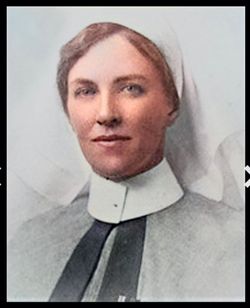
Mary Ann Webster

If the last three years have taught us anything about the nursing profession, it’s a heartfelt respect for those who care for others. Sometimes, at no small risk to themselves.

Today we revere the profession, but such was not always the case. No less a person than the “mother of modern nursing” Florence Nightingale once described the job, as being for ‘those who were too old, too weak, too drunken, too dirty, too stupid or too bad to do anything else’.

When Mary Ann Webster joined the profession, it certainly wasn’t for the money.

Then came the day Mary Ann met a farmer named Thomas Bevan. The couple fell in love and and were wed in 1903. Over time, the union produced four children. Theirs was a happy marriage until that day in 1914, when Thomas entered their small cottage and dropped dead at her feet. 

A terrible storm was gathering in 1914 Europe, about to plunge a continent into war. Left without her principle source of support with four children to feed Mary Ann Bevan faced a terrible storm of her own, even then taking place within her own body.

Acromegaly is a neuroendocrine disorder, known to cause excess growth hormones in the body. 

“Dalip Singh Rana is an Indian retired professional wrestler and wrestling promoter better known by his ring name The Great Khali” – hat tip wikipedia

Usually caused by a non-malignant tumor on the pituitary gland, Acromegaly results in gigantism when the condition begins before puberty. If you’re a professional wrestling fan, think of the Punjabi wrestler “The Great Khali”, or Andre the Giant.

When contracted in adulthood, Acromegaly results in a thickening of the skin, enlargement of extremities and facial features and a deepened, “husky” voice accompanied by severe headaches and joint pain. 

Today the condition can be dealt with, if detected early. Early 20th century medicine offered no options for the treatment of such a disease.

In a world beset by the catastrophe of World War I, Mary Ann Bevan was left with four children to feed, no husband and a rapidly developing personal horror about to render her own appearance, a thing of the past.

As the condition advanced, coworkers and patients alike were at first put off by her changing facial features and then disgusted. Reviled and alone work went from difficult to impossible, leaving the young widow nothing but odd jobs to support herself and her children.

Then one day the newspaper arrived, in 1920: 

Wanted: The Ugliest Woman. Nothing Repulsive Maimed or Disfigured. Good Pay Guaranteed and Long Engagement for Successful Applicant. Send Recent Photo.

Newspaper ad

If you’ve ever thought to yourself that people seem judgmental in the age of social media, you’re not alone. You’re not wrong either, but that’s nothing new. People have flocked to gawk at and ridicule “freaks of nature” going back to medieval days, if not before. In the court of King Charles I, two conjoined brothers called Lazarus and Joannes Baptista Colloredo were a source of mean-spirited entertainment. 2-foot 5-inch Matthias Buchinger amazed 18th century crowds in England and Ireland with feats of magic, art and music, despite having no hands and no feet.

So minutely detailed was Buchinger’s calligraphy the locks of his own hair seen in the self-portrait above, are actually 7 biblical psalms and the Lord’s Prayer. But I digress.

This sort of voyeurism came to a pinnacle in the form of the “Freak Show” of late 19th and early 20th century United States and England. Which brings us back to Mary Ann Bevan. The man behind the newspaper advert was Claude Bartram, agent for the Barnum & Bailey Circus.

Allthatsinteresting.com writes: “She was paraded alongside other notable sideshow acts including Lionel, the Lion-Faced Man, Zip the “Pinhead,” and Jean Carroll, the Tattooed Lady. Dreamland visitors were invited to gawk at the 154 pounds she carried on her 5′ 7″ frame, as well as her size 11 feet and size 25 hands. Bevan bore the humiliating treatment calmly. “Smiling mechanically, she offered picture postcards of herself for sale,” thus securing sufficient money for herself and for her children’s education”.
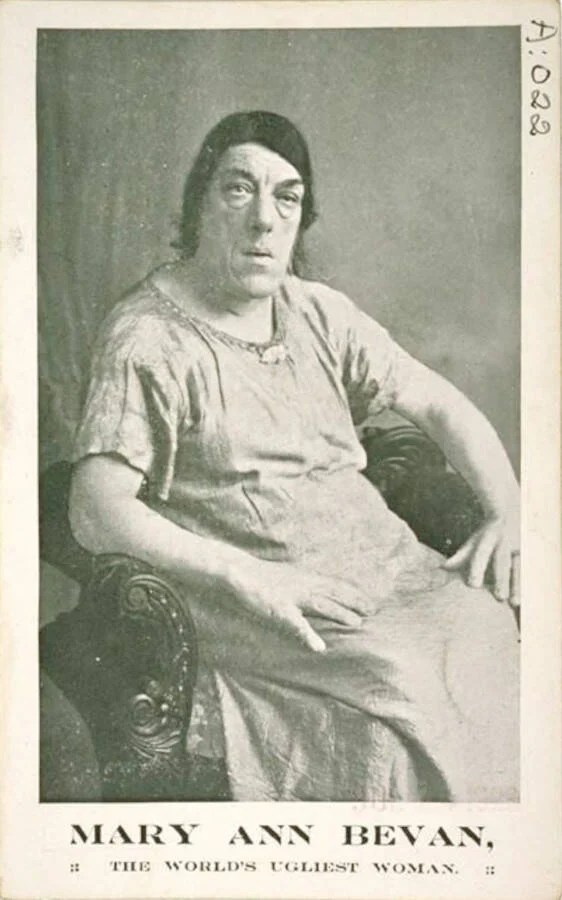
Postcards like this earned her as much as $12 apiece, sold at fairgrounds.

What it is to appear in a carnival freak show, I leave to the imagination. The sneers and taunts, the comments… Mary Ann found romance in later life with a giraffe keeper, remembered only as Andrew. She even agreed to a beauty makeover one time, at a New York salon. With her face made up complete with a massage, new hairdo and manicure, one of the snottier commenters asserted: ”the rouge and powder and the rest were as out of place on Mary Ann’s countenance as lace curtains on the portholes of a dreadnought.”

Mary Ann herself looked in the mirror and sighed saying simply, “I guess I’ll be getting back to work.”
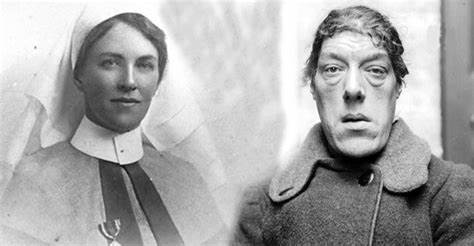
Mary Ann Bevan performed at Coney Island until the day she died on December 26, 1933. She was only 59. She is buried at Southeast London’s Brockley and Ladywell Cemetery.

Save for aficionados of the American sideshow circuit she faded from history after that, until 2000. The Hallmark greeting card company used her image in an unfunny and cruel joke about blind dates, raising no small storm of criticism from the public. To their credit, Hallmark removed the card from the market.

If there is a last word on the subject of personal appearance, let it go to Mary Ann herself. During two years of performing in New York and enduring the humiliation, sneers and derision of strangers the young mother more than provided for her family, earning the equivalent of 1.6 million dollars in today’s value.

June 22, 1918 Showmen’s Rest

The Michigan Central locomotive smashed into the rear of the stalled circus train at 60mph.  Strong men, bareback riders, trapeze performers and acrobats were killed instantly and others horribly maimed, as wooden circus cars telescoped into one another. 

In the circus world, the term “First of May” describes the first season when an employee comes to work with the circus.

There’s an oft-repeated but mistaken notion, that the circus goes back to Roman antiquity.  The panem et circenses, “bread and circuses” of Juvenal (circa A.D. 100), refers more to the ancient precursor of the modern racetrack, than to the modern circus. The only common denominator is the word itself, as the Latin root ‘circus’, translates into English, as “circle”.

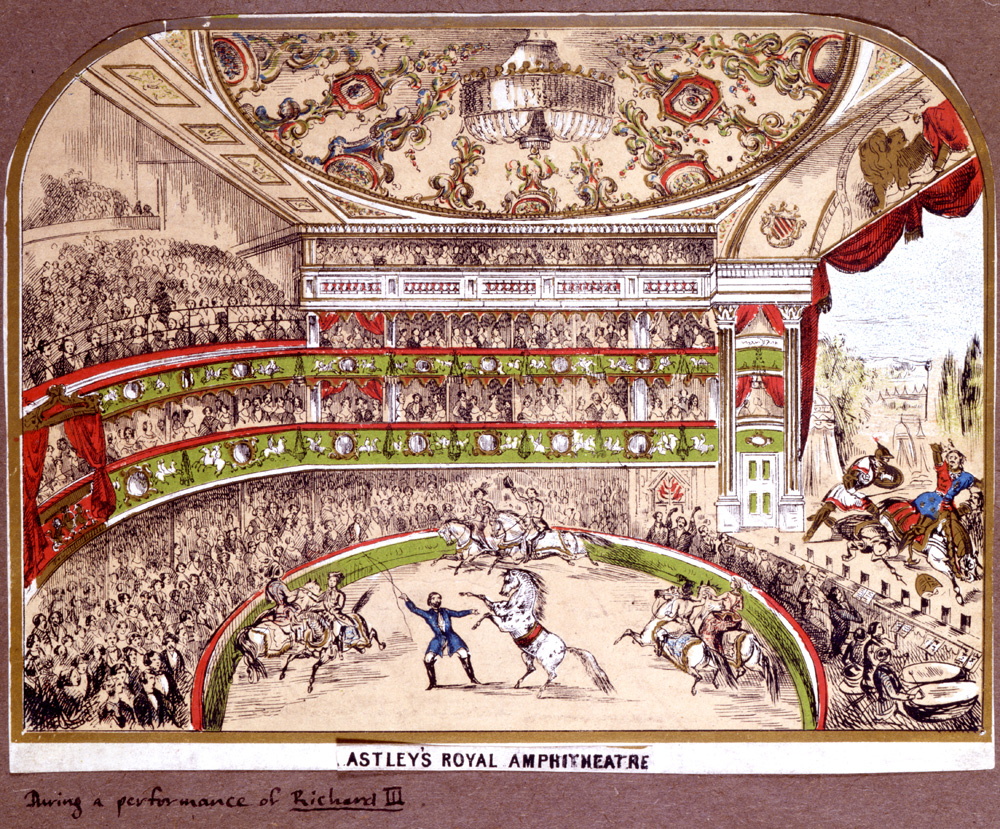
Astleys_royal_amphitheatreThe father of the modern circus is the British Sergeant-Major turned showman, Philip Astley.  A talented horseman, Astley opened a riding school near the River Thames in 1768, where he taught in the morning and performed ‘feats of horsemanship’ in the afternoon.

Astley’s afternoon shows had gained overwhelming popularity by 1770, and he hired acrobats, rope-dancers, and jugglers to fill the spaces between equestrian events.  The modern circus, was born.

Equestrian and trick riding shows were gaining popularity all over Europe at this time, performers riding in circles to keep their balance while standing on the backs of galloping horses.  It didn’t hurt matters, that the “ring” made it easier for spectators to view the event.

In 1825, Joshuah Purdy Brown of Somers New York replaced the wooden structure common to European circuses with a canvas tent, around the time when a cattle dealer named Hachaliah Bailey bought a young African elephant, which he exhibited all over the country.  The exotic animal angle was a great success.  Other animals were added and soon farmers were leaving their fields, to get into the traveling menagerie business.

The unique character of the American traveling circus emerged in 1835, when 135 such farmers and menagerie owners combined with three affiliated circuses to form the American Zoological Institute.

Phineas Taylor Barnum and William Cameron Coup launched P.T. Barnum’s Museum, Menagerie & Circus in 1871, where the “museum” part was a separate exhibition of human and animal oddities.  It wouldn’t be long, before the ‘sideshow” became a standard feature of the American circus.

There have been no fewer than 81 major circuses in American history, and countless smaller ones.  ‘The Greatest Show on Earth’ broke down its tent for the last time last month, when the Ringling Brothers Barnum & Bailey Circus ended a 146-year run.  There was a time though, when the circus really Was, the greatest show on earth.

The American war machine was spinning up to peak operational capacity in 1918, as the industrial might of the nation pursued the end to the war ‘over there’.hagenbeck-wallace-circus

At 3:56 on the morning of June 22, 1918, an engineer with the Michigan Central Railroad was at the controls of an empty 21-car troop train.  Automatic signals and flares should have warned him that there was a stalled train on the track ahead.  A frantic flag man tried and failed to get him to stop.  Alonzo Sargent had been fired before, for sleeping on the job.  Tonight, Sargent was once again, asleep at the wheel.

The Hagenbeck-Wallace circus was a big deal in those days.  The famous lion tamer Clyde Beatty was a member, as was a young Red Skelton, on this night tagging along with his father, who worked as a clown.

The 26-car Hagenbeck-Wallace circus train was enroute from Hammond Indiana to Monroe Wisconsin, when an overheated axle box required them to make an unscheduled stop.

Most of the 400 circus employees were asleep at that early hour, in one of four rear sleeping cars.  The Michigan Central locomotive smashed into the rear of the stalled train at 60mph.  Strong men, bareback riders, trapeze performers and acrobats were killed instantly.  Others were horribly maimed, as wooden sleeping cars telescoped into one another.  Confused and bleeding survivors struggled to emerge from the wreckage, as gas-fed lanterns began to set all that wood on fire.

hammond-circus-train-wreck

Those lucky enough to escape looked on in horror, as friends and family members were burned alive.  Some had to be physically restrained from rushing back into the inferno.

127 were injured and an estimated 86 crushed or burned to death in the wreck.  Hours afterward a clown, his name was Joe Coyle, could be seen weeping inconsolably, beside the mangled bodies of his wife and two children.

The rumor mill went berserk.  Wild lions and tigers had escaped and were roaming the streets and back yards of Gary, Indiana.  Elephants died in the heroic attempt to put out the flames, spraying water on the burning wreckage with their trunks.  None of the stories were true.  The animals had passed through hours earlier, on one of two additional trains, and were now waiting for the train that would never come.

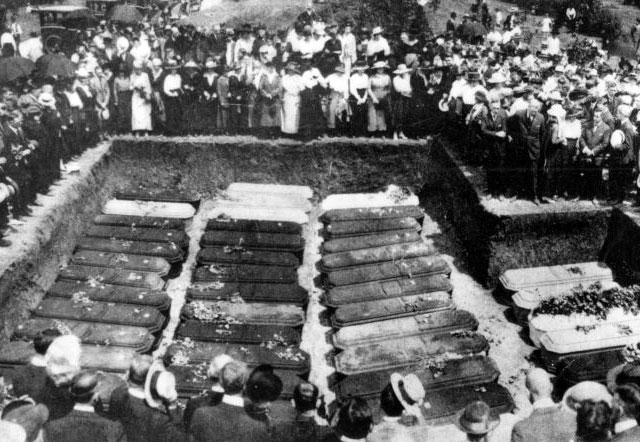
showmans-rest-circus-mass-grave

The Showmen’s League of America was formed in 1913, with Buffalo Bill Cody its first President.  The group had  purchased a 750-plot parcel at the Woodlawn Cemetery in Forest Park, Illinois only a year earlier, calling it “Showmen’s Rest”.  They had no idea their investment would be used so soon.

Only thirteen were ever identified.  A mass grave was dug for the unidentified and unidentifiable.  Most of the dead were roustabouts or temporary workers, hired just recently and known only by nicknames.  Some performers were known only by stage names, their gravestones inscribed with names like “Baldy,” “4-Horse Driver”, “Smiley,” and “Unknown Female #43.

Only one show had to be canceled, as erstwhile ‘competitors’ Barnum & Bailey, Ringling brothers and others lent workers, performers and equipment.  The show would go on.

Today, the International Circus Hall of Fame is located in the former Hagenbeck-Wallace Circus winter headquarters in Peru, Indiana.

In the elephant world, an upraised trunk symbolizes joy.  Five elephant statues circumscribe the Showmen’s Rest section of Woodlawn cemetery.  Each has a foot raised with a ball underneath.  Their trunks hang low, a symbol of mourning.  The largest of the five bears the inscription, “Showmen’s League of America.”  On the other four, appear these words.  “Showmen’s Rest”.