November 14, 1975 Wreck of the Edmund Fitzgerald

The largest fresh water system on the planet, the Great Lakes of North America are estimated to hold no fewer than 6,000 shipwrecks with the loss of some 30,000 lives. Lake Superior alone forms the watery grave for some 350 wrecks, fewer than half of which have ever been found.

As early as 1888, the largest cargo on the Great Lakes shipping routes was Iron Ore. Great quantities of the stuff were brought up from mines in Minnesota and Michigan to be processed in iron works in Toledo, Ohio, Detroit, Michigan and other ports. A great fleet of freighters known as “lakers” provide the transportation.

In 2019, iron ore remained the third highest value metal mined in the US behind only gold and copper. Most of it is mined in the upper Midwest.

In the life insurance business, revenues are earned by assessing and properly pricing risk, and reinvesting those revenues into tangible assets. Small wonder then that the Northwestern Mutual Life Insurance Company would be invested in iron ore.

In 1954, construction began on the St Lawrence Seaway, a system of locks, channels and canals linking Montreal Quebec to the Great Lakes, as far inland as Duluth Minnesota. Three years later, Northwestern Mutual commissioned the construction of the largest freighter of its time, designed to be “within a foot of the maximum length allowed” by the system of locks.

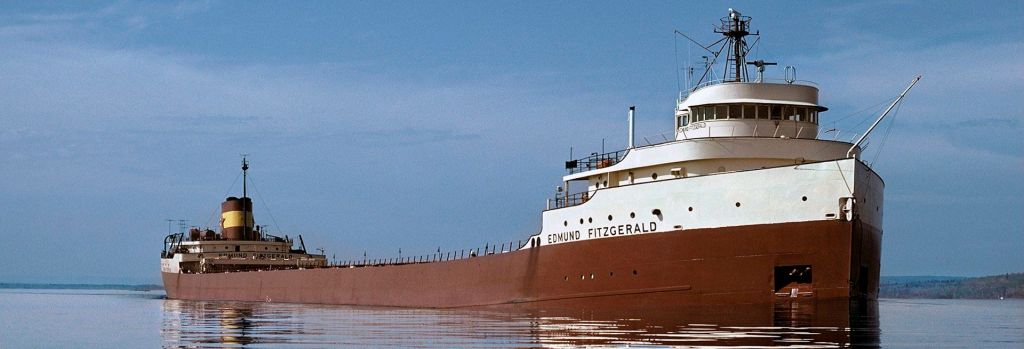
Measuring 729 feet long and weighing over 13,600 tons without cargo, she was the ‘Queen of the Great Lakes’. On June 8, 1958, the vessel was christened SS Edmund Fitzgerald, after the firm’s president.

A favorite of Great Lakes boating enthusiasts “the Big Fitz”, “the Mighty Fitz”, set out on her maiden voyage on September 24, 1958. For 17 years she plied the Great Lakes carrying taconite pellets, a form of iron ore.
According to NASA, major hurricanes form ‘the greatest storm on earth’, expending energy equivalent to 10,000 nuclear bombs over the life of the storm.

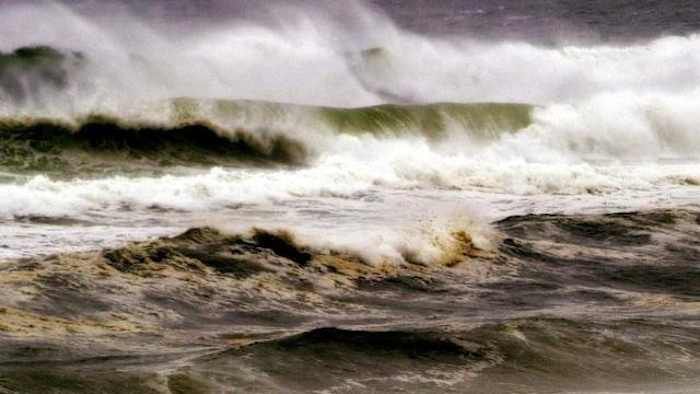
Every year around this time, violent weather systems rise up mid-continent when frigid air masses from the north collide with warmer fronts coming up from the Gulf of Mexico, resulting in inland weather systems equivalent to low-level hurricanes. These ‘mid-latitude cyclones’ are capable of producing sustained winds of 84 miles per hour and mountainous seas. To Great Lakes sailors, these late-season gales howling across the largest freshwater system on the planet, are the ‘Witch of November’.

‘The wind in the wires made a tattle-tale sound
When the wave broke over the railing
And every man knew, as the captain did too
‘Twas the witch of November come stealin’’

The National Weather Service published an advisory on November 9, 1975, even as the Fitz was loading iron ore.  With 26,116 tons in her holds and Captain Ernest McSorley in command, she set out at 2:30 that afternoon.  McSorley was at the end of a long and successful career as a mariner. This was to be his last voyage.

The 647-ft freighter Arthur M. Anderson departed shortly after the Fitz, with Captain Jesse B. Cooper at the helm. 

The storm gathered strength throughout that night and the following day. Throughout it all, the two vessels remained in radio contact, Anderson trailing by 10-15 miles. 

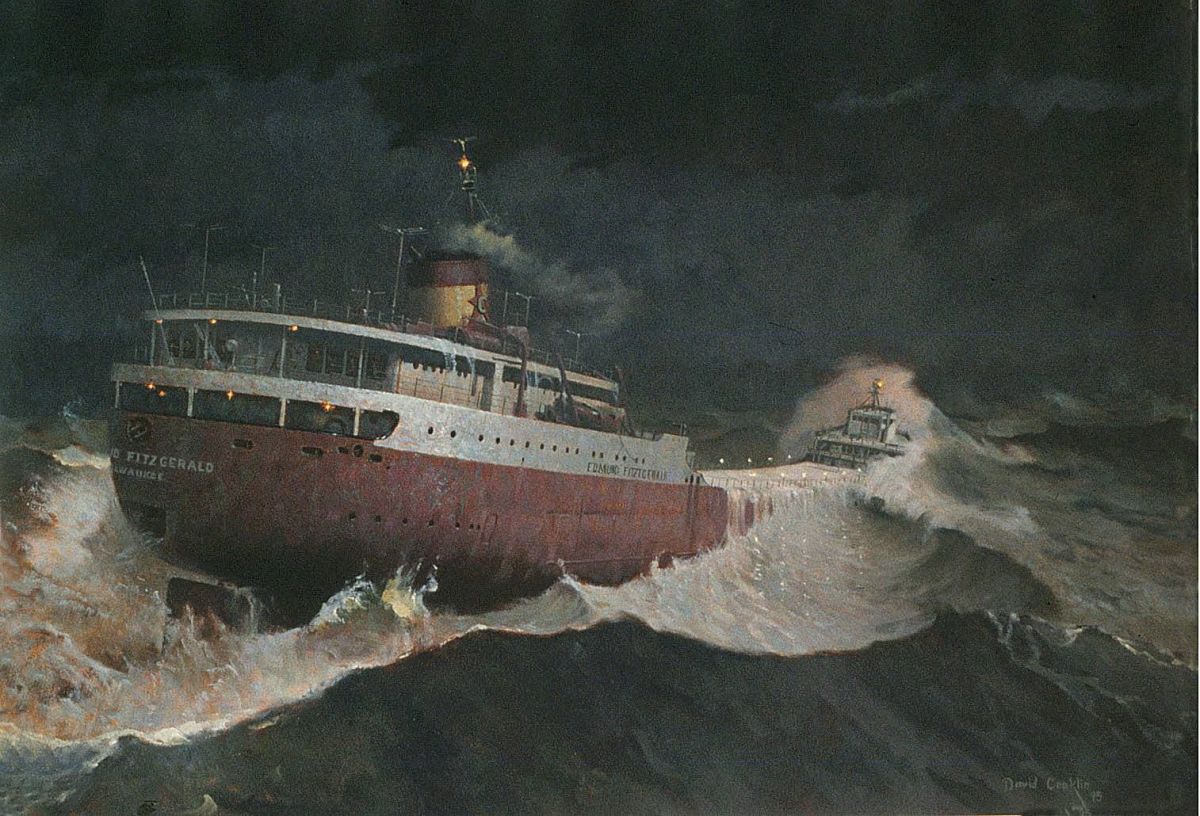
With howling winds and towering seas, Captain Cooper inquired at 7:10pm on the 10th, about Fitzgerald and her crew.   McSorley replied, “We are holding our own”. Ten minutes later, the Mighty Fitz disappeared.

Does anyone know where the love of God goes, when the winds turn the minutes to hours…

The search dragged on for four days, finding nothing more than debris and a few empty lifeboats.  The wreck was discovered on November 14 by a US Navy Lockheed P-3 Orion turboprop aircraft using the same equipment submarines use to identify magnetic anomalies. 

Edmund Fitzgerald lay 530 feet below the surface of the lake, 17 miles from the safety of Whitefish Bay.

In a musty old hall in Detroit they prayed
In the maritime sailors’ cathedral
The church bell chimed ’til it rang twenty-nine times
For each man on the Edmund Fitzgerald

Thirty years later, a computer simulation run by the National Oceanic and Atmospheric Administration and the National Weather Service estimated that wind gusts ran as high as 86 mph that night with waves up to 46 feet high.
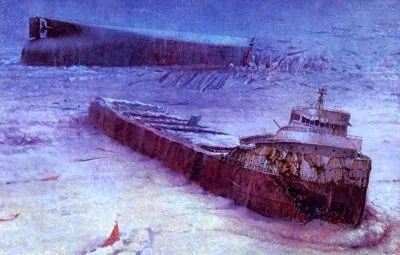
The Edmund Fitzgerald was the largest vessel ever claimed by the Great Lakes, but not the greatest loss of life.  That dubious honor goes to the SS Eastland which rolled over while tied to a pier in 1915, killing 844.

Today, the death of the 29 who served aboard the decks of that the greatest of all the lakers may be as unknown as any of the other 30,000 lost souls, save for the loved ones left behind and a few maritime historians. And a Canadian singer/songwriter, named Gordon Lightfoot.

The legend lives on from the Chippewa on down
Of the big lake they call Gitche Gumee
Superior, they said, never gives up her dead
When the gales of November come early

March 29, 1848 The Day Niagara ran Dry

Fish flopped in the dry riverbed as, upstream, factories ground to a halt.  Souvenir hunters and daredevils walked out on the dry river bed.  Some even drove buggies.   One unit of the United States Army cavalry paraded back and forth across the river.  Treasure hunters found artifacts from the War of 1812:  muskets, bayonets, even tomahawks.

Even as Athens and Sparta vied for control of the Peloponnese, half a world away the earliest of indigenous peoples settled the Niagara valley of modern-day Ontario and western New York.  These were the Onguiaahra, a farming people growing corn, beans and squash in the rich soil of the Niagara escarpment, hunting deer and elk and fishing the tributary waterways of the Niagara valley.

The Onguiaahra were some 12,000 in number when the French explorer Samuel de Champlain came to the region in 1615.  French explorers called them “Neutrals”, the peace makers between the perpetually warring tribes of the Seneca, Cayuga, Onondaga, Oneida and Mohawk Nations to the south, and the Huron to the north.  Vying for control of the rich French fur trade, peoples of this “Iroquois Confederacy” systematically destroyed the villages of the neutrals, killing their people or driving them east, toward Albany.  By 1653 the Onguiaahra had ceased to exist in any meaningful sense but their name lives on, in a word translating as “Thunder of Waters”.

Niagara_falls_panorama

Niagara Falls are three in number, 3,160 tons of water cascading over the precipice every second, hitting the bottom at American and Bridal Veil Falls with 280 tons of force and an astonishing 2,509 striking the Canadian side, at the famous Horseshoe Falls.

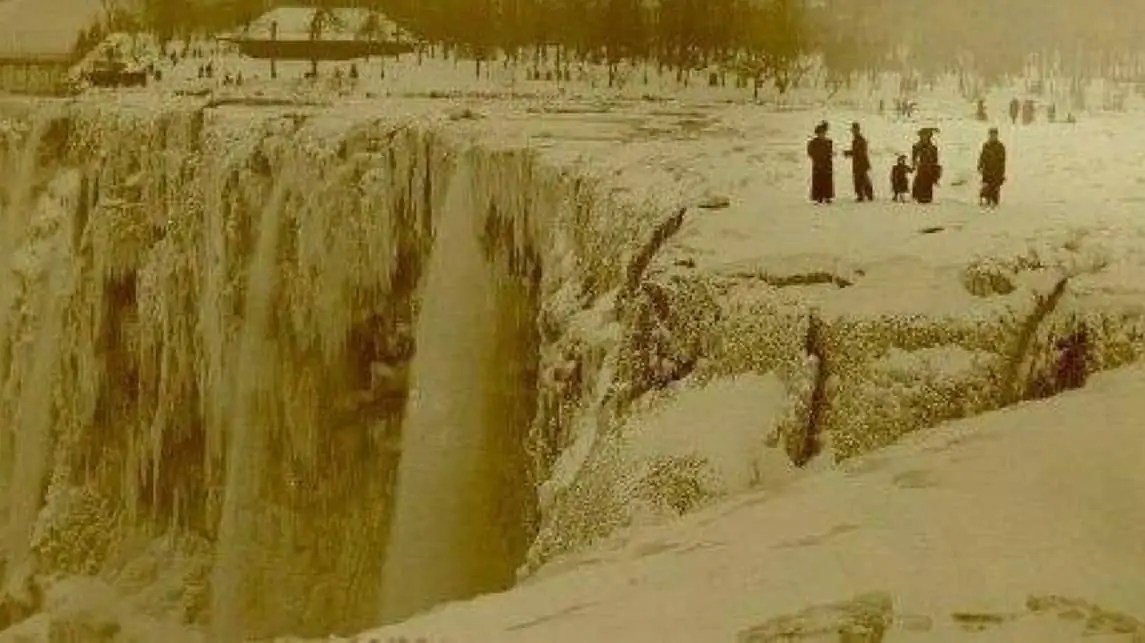
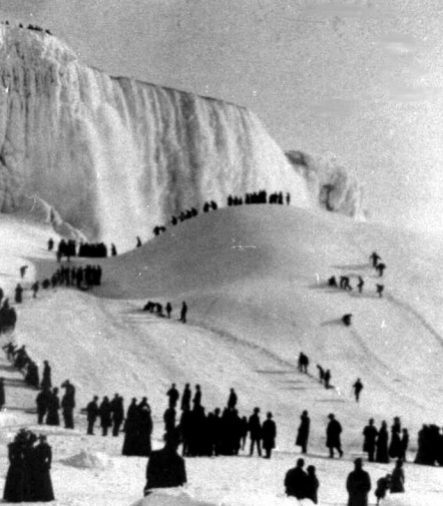
Pictures have been around since the age of photography, purporting to show Niagara Falls “frozen solid”.  That’s not so unusual.  The Washington Post reports:

niagara-frozen-2017-1

“Niagara Falls gets cold every year. The average temperature in Niagara Falls in January is between 16 and 32 degrees. Naturally, it being that cold, ice floes and giant icicles form on the falls, and in the Niagara River above and below the falls, every year. The ice at the base of the falls, called the ice bridge, sometimes gets so thick that people used to build concession stands and walk to Canada on it. It’s nothing out of the ordinary. It is not, to put it bluntly, big polar vortex news”.

niagara-frozen-2017-2
niagara-frozen-2017-3
Niagara “Frozen” in 1906, 1902 and 1936.  Hat Tip Snopes.com

Despite outward appearances, water flows in abundance under those bridges of ice.  Only once in recorded history did Niagara Falls run dry.  On this day in 1848, roughly 212,000 cubic feet per second dried, to a trickle.  Not dried, really, nor did it freeze.  Strong southwest winds had driven massive amounts of ice to the head of Niagara River, effectively putting a cork in the bottle.

March 29, 1848 When Niagara Falls Ran Dry

Fish flopped in the dry riverbed as, upstream, factories ground to a halt.  Souvenir hunters and daredevils walked out on the dry river bed.  Some even drove buggies.   One unit of the United States Army cavalry paraded back and forth across the river.  Treasure hunters found artifacts from the War of 1812:  muskets, bayonets, even tomahawks.  At the base of the Falls, Maid of the Mist owners took the opportunity to dynamite rocks which had endangered their boat.

Meanwhile upstream the pressure built, an that much water is not to be denied.  The ice dam broke on March 31. By that evening, the flow was back to normal.

Lifelong “Stooges” fans will appreciate this classic comedy bit, “Niagara Falls”

The Falls “dried up” once again in 1961 but, this time, it happened on purpose.  Over three days and 1,264 truckloads of fill, the US Army Corps of Engineers built a cofferdam that June, diverting water to the Canadian side.  There was concern that rock falls were going to cause erosion, “shutting down” the Falls. 

Dryniagara

On inspection, engineers determined that removing the rocks would accelerate erosion.  The idea was abandoned by November and the cofferdam, blown up.  To this day, the waters of Niagara flow, unvexed, to the sea.

A Trivial Matter
In 1901, Schoolteacher Annie Edson Taylor became the first person to go over Niagara Falls in a barrel.  Sixteen others have followed, at least on purpose.  Five of them died, including the guy who went over in a kayak, and one on a jet ski.  On Saturday, July 9, 1960, 7-year-old Roger Woodward was accidentally swept over Horsehoe Falls. He miraculously survived the 162-foot plunge wearing only a bathing suit and a life jacket. James Honeycutt did not, losing his life in the attempt to rescue the boy.  They say that 90% of the fish who go over the Falls live to tell the tale.