January 12, 1968 The Strangest Dogfight

Theirs was a secret war, waged in the mists of the Annamite Mountains. Two months later, North Vietnamese commandos attacked and destroyed Site 85, inflicting the largest loss of US Air Force personnel of the war in Vietnam

To the extent that most of us think about aerial combat, at least the non-pilots among us, I think we envision some variation of the dog fights between Snoopy and the Red Baron. Two aircraft, bobbing and weaving through the sky, each attempting to get the other in his sights.

red-baron
Manfred von Richtofen

In the real world, Manfred von Richthofen, the most prolific ace of WWI with 80 confirmed kills, was killed by a single bullet fired from the ground, while pursuing Canadian pilot Wilfred May behind Allied lines. The Red Baron landed his red Fokker tri-plane in a beet field and died moments later, and was buried with full military honors, by his enemies.

Possibly the strangest dogfight of WWII took place on August 17, 1943, between two German long-range “Condor” maritime patrol bombers, and an American B-24D Liberator bomber in the skies over the Atlantic Ocean.

Twenty-eight ton, four-engine bombers were never meant for diving attacks and multiple-G banking turns. It must have looked like a motocross race between cement mixers.

Stripped of armor to increase range and carrying a full load of depth charges, the American anti-submarine bomber with its 10-man crew dove out of the clouds at 1,000 feet, throttles open and machine guns firing. The first Condor never came out of that diving turn, while machine gun fire from the second tore into the American bomber. Rear-gunners returned fire, as Liberator pilot Hugh Maxwell Jr. crash landed in the water, his aircraft breaking into three pieces.the-ark
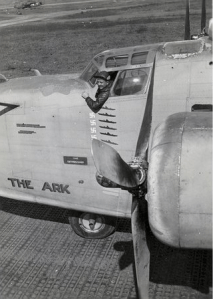
Maxwell had named his B-24 “The Ark”, explaining that “it had a lot of strange animals aboard, and I hoped it would bring us through the deluge”. It must have worked, seven out of ten crew members lived to be plucked from the water. The second Condor made it back to Bordeaux, where it crashed and burned on landing.

Surviving Liberator crew members were rescued by the British destroyer Highlander, along with three Germans from that first Condor. It was all the Highlander crew could do, to keep the soaking wet combatants apart on the decks of the destroyer.

On the first night of the Gulf War in 1991, an Iraqi Mirage fighter intercepted an American EF-111, an unarmed F-111 bomber modified for radar-jamming patrol. Flying at 200′ and equipped with sophisticated terrain-following radar, the bomber was able to climb up and over hilltops, while the French-made Mirage fighter had no such systems. The last that was seen of that Iraqi fighter, was when he plowed his aircraft into that same hillside.

f-15eLater in the same conflict, an Iraqi Hughes 500 helicopter was taken out by bombs dropped from an American Air Force F-15E bomber. At least one Iraqi PC-7 Turboprop pilot got spooked, bailing out of a perfectly good aircraft before a shot was fired in his direction.

The strangest dogfight in history took place on January 12, 1968, when four Soviet-made Antonov AN-2 Colt biplanes took off from their base in North Vietnam, headed west toward Laos.

Only 125 nautical miles from Hanoi, Phou Pha Thi mountain had long been used as a staging base for CIA directed Hmong guerilla fighters and Thai security forces. Lima Site 85 was the American radar facility, perched atop the 5,800′ mountain.

CIA-operated “Air America” captain Ted Moore was flying a UH-1D Huey helicopter at the

phou_pha_thi
Lima site 85, atop 5,800 Phou Pha Thi Mountain

time, carrying a load of ammunition to Phou Pha Thi. Moore arrived to see two North Vietnamese biplanes, dropping 122mm mortar shells through holes in the floor and strafing the mountaintop with 57mm rockets. “It looked like WWI,” he later recalled. Moore gave chase, positioning his helicopter above one biplane, as flight mechanic Glenn Woods fired an AK-47 rifle down from above.

Moore and Woods dropped back to the second biplane, as the first crashed into a ridge west of the North Vietnamese border. Moments later, the second crashed into a mountainside, as the other two slipped back into North Vietnamese air space. The entire chase had taken about 20 minutes.

Theirs was a secret war, waged in the mists of the Annamite Mountains. Two months later, North Vietnamese commandos attacked and destroyed Site 85, inflicting the largest loss of US Air Force personnel of the war in Vietnam.

On July 27, 2007, Air America veterans Marius Burke and Boyd Mesecher presented the CIA with “An Air Combat First”, an oil on canvas painting by Keith Woodcock, depicting the shoot-down. The event was attended by members of the Air America Board, pilot Ted Moore, wife of flight mechanic Glenn Woods Sawang Reed, CIA paramilitary veteran Bill Lair; and the painting’s donors. Presumably, the painting hangs at CIA Headquarters in Langley, Virginia. A testament to the only time in the history of the Vietnam war, that an enemy fixed-wing aircraft was shot down, by a helicopter.

December 4, 1966  War Dogs of Vietnam

A Military Working Dog (MWD) is anything but a “disposable” asset. It is a highly trained, specialized soldier who complements and adds to the abilities of his human partner, as that two legged soldier complements those of the dog.

There are times when two highly trained individuals are able to function at a level higher than the sum of their parts.  Professional athletes like NFL linemen and NHL forwards are two examples.  Another is often the partnership formed between law enforcement officers.

On the battlefield, few assets more powerful than a well equipped and highly trained soldier. Unless we’re pairing that soldier with a Military Working Dog.

A Military Working Dog (MWD) is anything but a “disposable” asset.  It is a highly trained, specialized soldier who complements and adds to the abilities of his human partner, as that two legged soldier complements those of the dog.

“Nemo”, born in October 1962, entered the United States Air Force as a sentry dog in 1964, at the age of 1½ years.  After an 8-week training course at Lackland AFB Sentry Dog Training School in San Antonio, Texas, the 85 pound German Shepard was assigned to Airman Leonard Bryant Jr., and sent to Fairchild Air Base in Washington for duty with Strategic Air Command.

The pair was transferred to the Republic of South Vietnam with a group of other dog teams, and assigned to the 377th Security Police Squadron, stationed at Tan Son Nhut Air Base.  Six month later, in July, Bryant rotated back to the States, and Nemo was paired with 22-year-old Airman 2nd Class Robert Thorneburg.

Early on the morning of December 4, 60 Vietcong guerrillas emerged from the jungle, setting off a near simultaneous alarm from several sentry dogs on perimeter patrol.

Three dogs, Rebel, Cubby and Toby, were killed with their handlers in a hail of bullets.  Several other handlers were wounded, including one who was able to maintain contact with the enemy, notifying Central Security Control of their location and direction of travel.

Thanks to the early warning, a machine gun team was ready and waiting when 13 infiltrators approached the main aircraft parking ramp.  None of them lived to tell the story.  Security forces quickly deployed around the perimeter, driving some infiltrators off and others into hiding.  Daylight patrols reported that all VC infiltrators were gone, either killed or captured, but they had made a big mistake.  They should have brought the dogs with them.

That night, Thorneburg and Nemo were out on patrol near an old Vietnamese graveyard, about ¼ mile from the air base’ runways.  Nemo alerted on something.  Before Thorneburg could radio for backup, that something started shooting.  Thorneburg released the dog and charged in shooting, killing one VC before being shot in the shoulder.  Nemo was badly wounded, shot in the face, the bullet entering below his eye and exiting his mouth.  Ignoring his injury, Nemo attacked the four enemy soldiers hiding in the brush, giving his partner time to call for reinforcements.

Four additional VC were discovered hiding underground, as quick reaction teams scoured the area.  They found Nemo and Thornburg, both seriously wounded, together on the ground.  Both would survive, though Thorneburg was shot a second time, while returning to base.

I’m sure that individual dog handlers during the Vietnam era were as good to their dogs as they knew how to be.  That’s a guess, but having an MWD handler in the family, I think it’s a good one.  The Department of Defense bureaucracy was another matter.  The vast majority of MWDs were left behind as “surplus equipment”.

Nemo was one of the few lucky ones.  He was officially recognized for having saved thenemo-on-the-plane life of his handler, and preventing further destruction of life and property.   MWD Nemo was given the best of veterinary care and, on June 23 1967, USAF Headquarters directed that he be returned to the United States, the first sentry dog officially retired from active service.  The C124 Globemaster touched down at Kelly Air Force Base, Texas, on July 22, 1967.  Nemo lived out the seven years remaining to him in a permanent retirement kennel at the DoD Dog Center at Lackland Air Force Base.
November 30, 1953 Dien Bien Phu

“What historians call the First Indochina War, many contemporaries called ‘la sale guerre’. The ‘dirty war'”.

Speak of France, and most of us think of the five-sided country between Spain and Germany. That would be partly correct, but “la Métropole” or “Metropolitan France” today accounts for only 82.2% of the landmass of la République Française. The overseas departments and territories which make up “la France d’outre-mer”, “Overseas France”, account for the rest.
That overseas percentage would have been higher in the mid-20th century, with many former colonial territories added in, among them Laos, Cambodia and Vietnam.
Japanese occupation of southeast Asia caused the Europeans to leave French Indochina during WWII. Within a year of re-occupation, French forces faced virulent opposition from the Nationalist-Communist Viet Minh, led by Ho Chi Minh and Vo Nguyen Giap. It was a low level, rural insurgency at first, later becoming a full-scale modern war when Chinese Communists entered the fray in 1949.
What historians call the First Indochina War, many contemporaries called “la sale guerre”.  The “dirty war”. The government forbade the use of metropolitan recruits, fearing that would make the war more unpopular than it already was. Instead, French professional soldiers and units of the French Foreign Legion were augmented with colonial troops, including Moroccan, Algerian, Tunisian, Laotian, Cambodian, and Vietnamese ethnic minorities.
The war went poorly for the French.  By 1952 they were looking for a way out. Premier René Mayer appointed Henri Navarre to take command of French Union Forces in May that year, with a single order. Navarre was to create military conditions which would lead to an “honorable political solution”.
Late in the preceding year, the French army had air lifted soldiers into a fortified position at Na San, adjacent to a key Viet Minh supply line to Laos. Superior French fire power, armor and air resources had driven Vo Nguyen Giap’s forces back with heavy losses, in what French planners called the “hérisson” or “hedgehog” strategy.
In June, Major General René Cogny proposed a “mooring point” at Dien Bien Phu:  a lightly defended point from which to launch raids. Navarre wanted to replicate the Na San strategy, and ordered that Dien Bien Phu be taken and converted into a heavily fortified base.
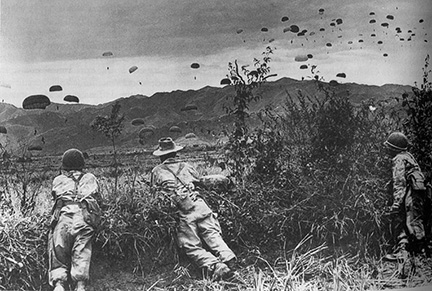
“Operation Castor” began on the 20th of November, with three parachute infantry battalions dropped into Dien Bien Phu. The operation was completed with minimal French casualties on November 30, as supplies, troops, and engineering equipment poured into the isolated base.
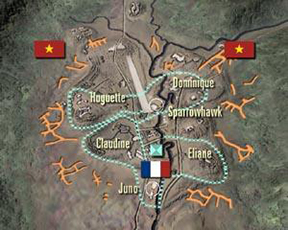
Under the command of Colonel Christian de Castries, French forces built seven fortified positions to defend the base, each reportedly named after one of his mistresses. 10,800 French troops were committed, with another 16,000 in reserve.
Vo felt that he’d made a serious mistake at Na San, rushing his troops in piecemeal against French defenses. This time, he carefully prepared his positions, moving 50,000 men into position around the valley, meticulously stockpiling ammunition and placing his anti-aircraft and heavy artillery, with which he was well supplied.
The French staff based their battle plan on the assumption that it was impossible for the Viet Minh to place enough artillery on the surrounding high ground, due to the rugged terrain. Communist forces didn’t possess enough artillery to do serious damage anyway, or so they thought.
French officers quickly learned how mistaken they had been. The first sporadic artillery fire began on January 31, around the time that patrols discovered the enemy’s presence in every direction. Heavy artillery virtually ringed the valley in which they found themselves, and air support was quickly nullified by the enemy’s well placed anti-aircraft fire.

dien_bien_phu-base
Enemy artillery virtually ringed the French position by March of 1953.

The Viet Minh assault began in earnest on March 13, when several outposts came under furious artillery barrage. Air support became next to impossible, and counter-battery fire was next to useless against Giap’s fortifications. Lieutenant Colonel Charles Piroth commanded the French artillery at Dien Bien Phu. He was a professional soldier and no lightweight, having had his arm amputated in 1946 with no anesthesia. When it became clear how wrong his assumptions had been, he circled the camp making apologies to his officers, returned to his tent, and killed himself with a hand grenade.
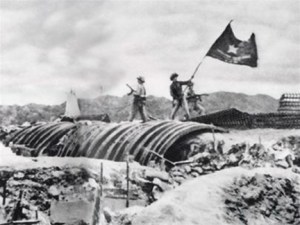
“Beatrice” was the first fire base to fall, then “Gabrielle” and “Anne-Marie”. Viet Minh controlled 90% of the airfield by the 22nd of April, making even parachute drops next to impossible. On May 7, Vo ordered an all-out assault of 25,000 troops against the 3,000 remaining in garrison. By nightfall it was over.  The last words from the last radio man were “The enemy has overrun us. We are blowing up everything. Vive la France!”

victory_in_battle_of_dien_bien_phu
Vo ordered an all-out assault of 25,000 troops against the 3,000 remaining in garrison, on May 7. By nightfall it was over.

Military historian Martin Windrow wrote that Dien Bien Phu was “the first time that a non-European colonial independence movement had evolved through all the stages from guerrilla bands to a conventionally organized and equipped army able to defeat a modern Western occupier in pitched battle”.
The Geneva conference opened the following day, resulting in a Vietnam partitioned into two parts. In the north was the “Democratic Republic of Vietnam” administered by the communists, and the State of Vietnam in the south, under Emperor Bao Dai and Prime Minister Ngo Dinh Diem. The North was supported by both the People’s Republic of China and the Soviet Union, and continued to terrorize patriots in north and south alike.
US support for the south increased as France withdrew its own.  By the late 50s, the US was sending technical and financial aid in expectation of social and land reform. By 1960, the National Front for the Liberation of South Vietnam (NLF, or “Viet Cong”) had taken to murdering Diem supported village leaders.  JFK responded by sending 1,364 American advisers into South Vietnam, in 1961.
The next war in Indochina, had begun.