February 13, 1542 Six Wives of Henry VIII

The science to prove or disprove the theory didn’t exist in the Tudor era, but it may not matter. Anyone attempting to bring that particularly bit of news to Henry VIII, very likely would have paid for it, with his head.

Catherine of Aragon, the youngest daughter of Ferdinand and Isabella, came to England to marry Arthur, the eldest son and heir to the throne of Henry VII, in 1501. Arthur died the following year and his younger brother took the throne, asking Catherine to marry him in 1509.

The Spanish princess-turned Queen Consort of England was by all accounts a devoted wife, but the marriage bore no sons. Henry came to believe, or said he believed, that it was punishment from God for marrying his brother’s wife. By this time the King had fallen hard for the daughter of Thomas Boleyn, 1st Earl of Wiltshire, Anne. Henry was in a pickle. His wife wouldn’t agree to a divorce, and Anne Boleyn was not about to give it up as a mere mistress. She was going to be the King’s wife, or nothing.

HenryVIII_wivesThe problem was, the Pope refused to grant the divorce. Henry launched the Reformation so that he could divorce his wife and marry this young girl from Kent, getting his divorce the following year and going on to become Supreme Head of the Church of England.

Catherine of Aragon died alone in a convent some three years later, the only Class Act in this whole, sorry story.

Catherine had been popular with the people, but this second wife was not. To many, she was ”the King’s whore”. Many believed Boleyn to be a witch who had cast a spell on the King. The marriage produced a daughter, Elizabeth, but again no sons.

On the day that Catherine of Aragon was buried at Peterborough Abbey, Anne miscarried a male child. The Savoyard ambassador Eustace Chapuys commented “She has miscarried of her saviour”.  There would be no divorce this time.  The King of England concocted a plot based on a rumor, and Anne was convicted of incest, adultery and treason. Anne Boleyn was executed by decapitation in 1536. She would not be the last.

Henry married Jane Seymour, 11 days later. Though she bore him a son, she died two weeks after the birth. Years later, Henry would request on his deathbed that he be buried next to her.

Henry+VIIIAnne of Cleaves would be wife #4, an arranged marriage with a German Princess intended to secure an alliance with the other major Protestant power on the continent, especially after England’s break with Rome over that first divorce. Henry was put off by her appearance however, apparently believing himself to be quite the prize. The marriage went unconsummated. They were amicably divorced after 6 months.

Catherine Howard was 19 and Henry 49 when she became wife #5. He was hugely fat by this time, with festering ulcers on his leg that never healed. Henry’s suits of armor reveal a waistline grown from 32″ to 54″. The man weighed 400lbs on his passing, five years later. Catherine was young and flirtatious, preferring the company of young courtiers to that of the fat old guy she was married to. She would be tried and convicted of adultery two years later. As with her predecessor, execution was by the headsman’s axe. Catherine Howard lost her head on, February 13, 1542.

Katherine Parr was the 6th and last wife of Henry VIII. Henry died in January 1547, Parr going on to marry Thomas Seymour, 1st Baron of Sudeley, six months later. Katherine died in September 1548, as the result of complications of childbirth.

Ironically, Henry himself may have been the problem, when it came to the inability to produce a male heir. Researchers revealed in 2011 that Henry’s blood group may have been “Kell positive”, a rare condition which would have initiated an auto-immune response in the mother’s body, targeting the body of the baby inside of her. It’s unlikely that first pregnancies would have been effected, but the mother’s antibodies would have attacked second and subsequent Kell-positive babies as foreign objects.

The science to prove or disprove the theory didn’t exist in the Tudor era, but it may not matter. Anyone attempting to bring that particularly bit of news to Henry VIII, very likely would have paid for it, with his head.

February 12, 1733 The Last Colony

Tomochichi presented a symbol of power to the King of England, a bald eagle feather, the first time this symbol of our nation was connected to the American colonies.

In 1727 England, the anonymously published book “The Sailor’s Advocate”, argued for improvements in the terrible working conditions, that sailors of the day were forced to endure.

The pamphlet’s “unknown” author was James Oglethorpe, a crusader, an idealist, and member of the British Parliament.  Oglethorpe saw urbanization as the great evil of his day, the stripping of the productively employed from the countryside, while depositing them in cities with no opportunity for meaningful work.

Oglethorpe chaired a committee on prison reform the following year, calling attention to the horrendous conditions in English debtors’ prisons, and the hopeless plight of those released with no means of support.

To deal with the problem, Oglethorpe and others petitioned in 1730 to form a committee of trustees, to form the 13th Colony in America. They would call this new colony “Georgia”, a new start for the worthy poor, and a military buffer against Spanish Florida to the south, and French Louisiana to the west.  The charter was signed by King George II on April 21, 1732.slide_11

Thousands applied to go, trustees narrowing the number down to an initial 114 colonists. Those who couldn’t pay their own way would be subject to a period of indenture, typically 5-7 years.

It was November of that year, when the first group of colonists left aboard the “Anne”, bound for the new world.  James Oglethorpe and his 114 pilgrims scrambled up the 40′ banks of the Savannah River on February 12, 1733, there to establish the Province of Georgia and its Colonial Capital of Savannah.

tumblr_oeuwsvcOCx1s9fj4po1_500
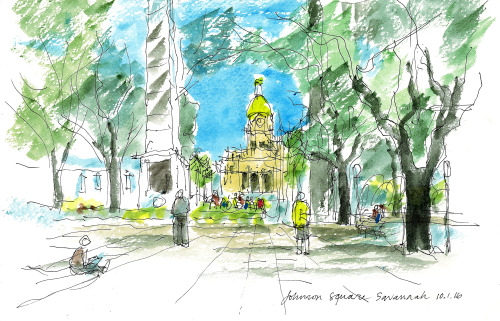
Artist’s depiction of Johnson Square, the earliest public square in Savannah

A personal friendship developed between Oglethorpe and native Chieftan Tomochichi, Mico (Leader) of the Yamacraw, a formal treaty of friendship signed in May of that year.

The Trustees obtained £10,000 for the Georgia colony that first year, the subsidy becoming smaller in the following years. Georgia was the only American colony thus dependent on a Parliamentary allowance.

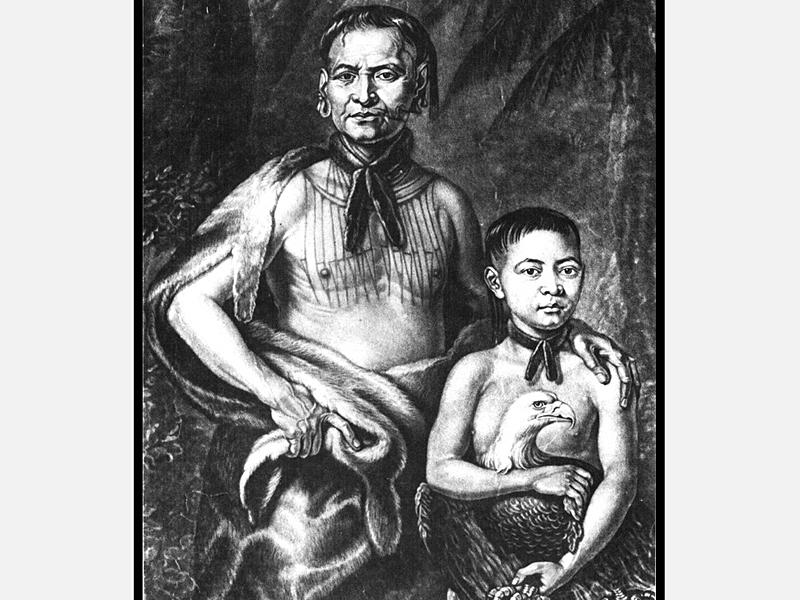
Oglethorpe returned to England two years later along with several “goodwill ambassadors”, among them Chief Tomochichi himself, his wife Senauki, their nephew Toonahowi, and six other members of the Lower Creek tribes. Members of the Indian delegation were treated as celebrities, entertained by Trustees and personal guests of the King and Queen, after which the group became tourists, visiting the Tower of London, St. Paul’s Cathedral and enjoying a number of plays, from Shakespearean dramas to comic farces.

Tomochichi presented a symbol of power to the King of England, a bald eagle feather, the first time this symbol of our nation was connected to the American colonies.

m-1123
“As the principal mediator between the native population and the new English settlers during the first years of Georgia’s settlement, Tomochichi (left) contributed much to the establishment of peaceful relations between the two groups and to the ultimate success of Georgia. His nephew, Toonahowi, is seated on the right in this engraving, circa 1734-35, by John Faber Jr.” – Hat tip for this image, to the Hargrett Rare Book and Manuscript Library, University of Georgia Libraries

The home town to Oglethorpe’s Utopian experiment, Savannah, was founded around four wards, each containing eight blocks situated around its own central square. Established to help the poor and to produce materials like silk and olives for England, Georgia issued each colonist 50 acres of land – perfect for the yeoman farmer, but too small for major landholders.  Its motto was “Non Sibi Sed Allis”. “Not for Themselves But for Others”.  Oglethorpe outlined four by-laws for the Georgia province, four prohibitions forming the legal framework of his Utopian experiment.

1. No rum, Brandy or spirits were allowed in Georgia, though beer, wine and ale, were OK.
2. No African slaves were permitted, though they were occasionally “borrowed” for construction projects.
3. Oglethorpe believed that every man ought to be able to speak for himself. Hence, no lawyers were allowed.
4. No Catholics were allowed either, as it was feared that they’d be too sympathetic with co-religionist Spain, then in control of the Florida territory.

“If we allow slaves,” Oglethorpe had said, “we act against the very Principles by which we associated together, which was to relieve the distressed.”

Returning to England, Oglethorpe continued to serve on the Board of Trustees, though he often found himself outvoted.  Despite his opposition, the Board of Trustees gradually relaxed their restrictions on land ownership, on hard liquor, and on slavery. By 1750, Georgia’s founding father was no longer involved with the board which had given it life. Oglethorpe’s grand experiment was over in 1754, when Trustees voted to dissolve their governing charter, making Georgia the 13th of Great Britain’s American colonies.

Tomochichis-Grave-in-Wright-Square
Mico Tomochichi’s monument, Wright Square, Savannah, Georgia

Chief Tomochichi died in 1739 at age 97, requesting that he be buried among his English friends. The Mico of the Yamacraw was interred in Wright Square, and saluted with cannon and musket fire. James Oglethorpe himself was one of the pall bearers. If you ever visit the city of my childhood, there you will find Wright Square and Tomochichi’s monument, dedicated on April 21, 1899. A bronze tablet is engraved with Cherokee roses and arrowheads, and inscribed with these words. “In memory of Tomochichi – the Mico of the Yamacraws – the companion of Oglethorpe – and the friend and ally of the Colony of Georgia”.

Featured image, top:  LaFayette Square, Savannah, named for the Frenchman and Aide-de-Camp to General George Washington, Marie-Joseph Paul Yves Roch Gilbert du Motier, Marquis de Lafayette.