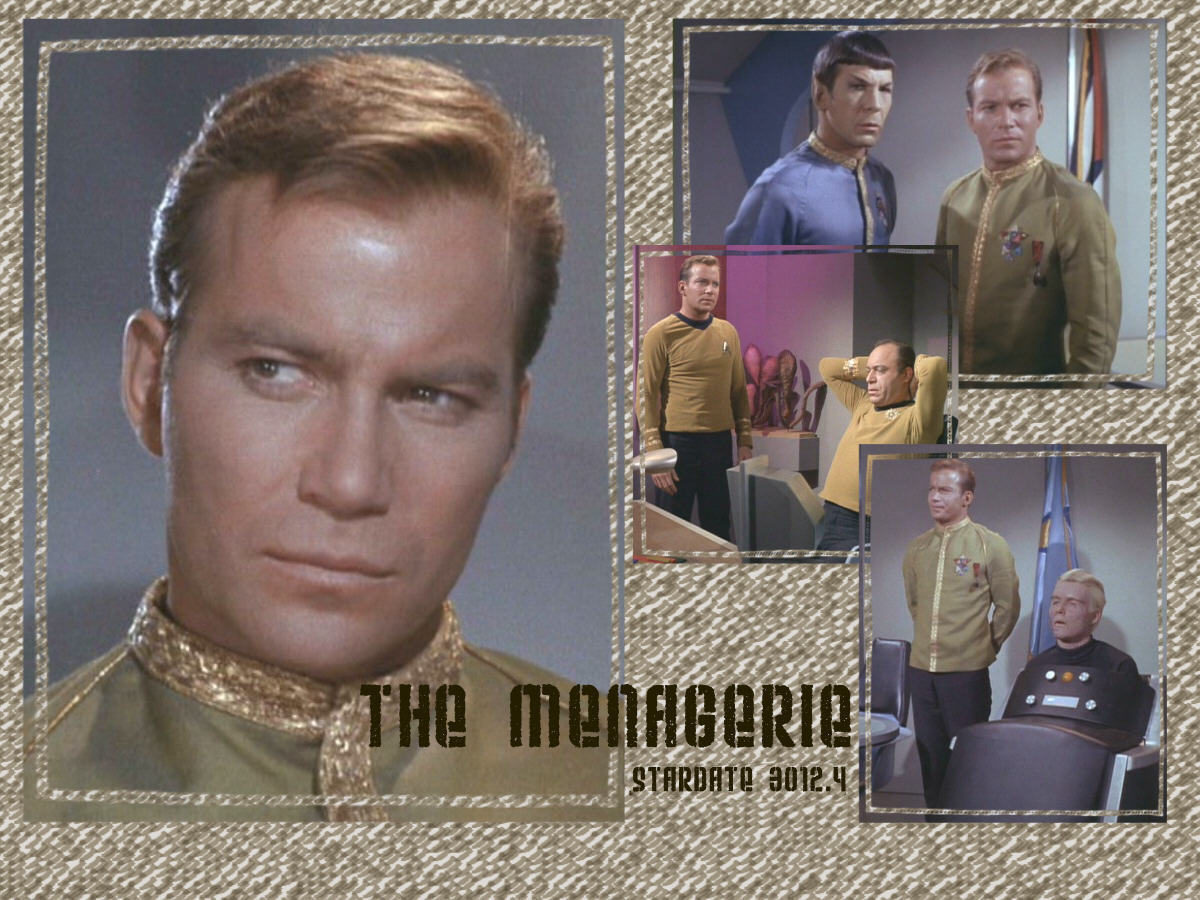
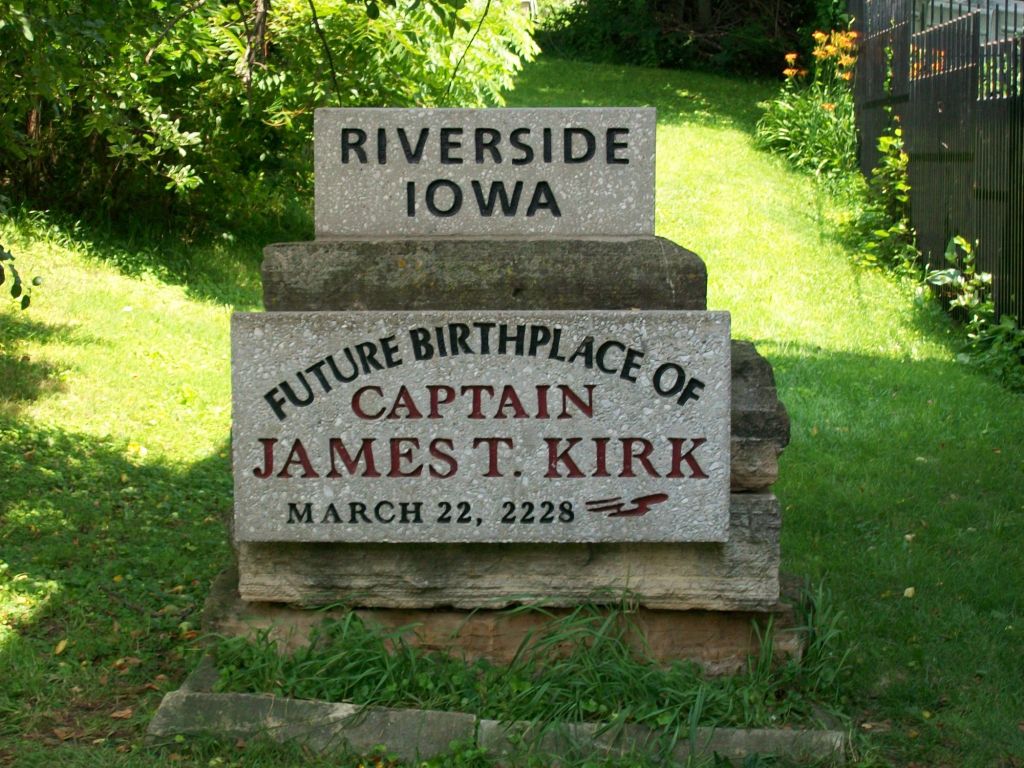
Many years from now a boy will be born on March 22, 2233, in Riverside, Iowa. Destined to become the youngest captain in Star Fleet history, he would boldly go where no man has gone before. But first, he needed a name.
On May 18, 1965, a World War II fighter pilot, veteran of 89 combat missions named Gene Roddenberry, offered several suggestions. 16 to be exact, among which were Hannibal, Timber, Flagg and Raintree.
Roddenberry decided on James T. Kirk, based on a journal entry of the 18th century British explorer, Captain James Cook: “ambition leads me … farther than any other man has been before me”.
Kirk was killed in 2329 on the Enterprise (B), after the ship was eaten by a Nexus energy ribbon on its maiden voyage. Only he didn’t die, because Jean-Luc Picard found him alive in the timeless Nexus, negotiating hotel deals for Priceline.com.
Or something like that.
In his 1968 book “Making of Star Trek”, Gene Roddenberry says that James Kirk was born in a small town in Iowa. Full-time Trekkie and part-time Riverside Councilman Steve Miller thought “Why not Riverside”. In 1985, Miller moved that Riverside declare itself the Future Birthplace of James T. Kirk. The motion passed unanimously.
Just like that, the official slogan went from “Where the best begins” to “Where the Trek begins.” The annual summer festival… that changed from “River Fest” to “Trek Fest”.
The Riverside connection became Holy Writ when the 2009 film Star Trek identified the place as Kirk’s hometown. Today there is a granite monument in Riverside, population 963, declaring itself the “Future Birthplace of Captain James T. Kirk.
Oh… In case you wanted to know what the “T” stands for… it’s Tiberius.
In 2013, the New York Times conducted a linguistics survey of regional and vernacular speech in the US. An unexpected result related to the use of certain terms was that words and phrases predicted with uncanny accuracy, where the respondent had come from.
One such question yielded a surprising result: “What do you call the night before Halloween?”
For Graphics Editor Josh Katz, the answer was, ” Mischief Night.” Growing up in the Philadelphia suburbs, that’s what Everyone called it.
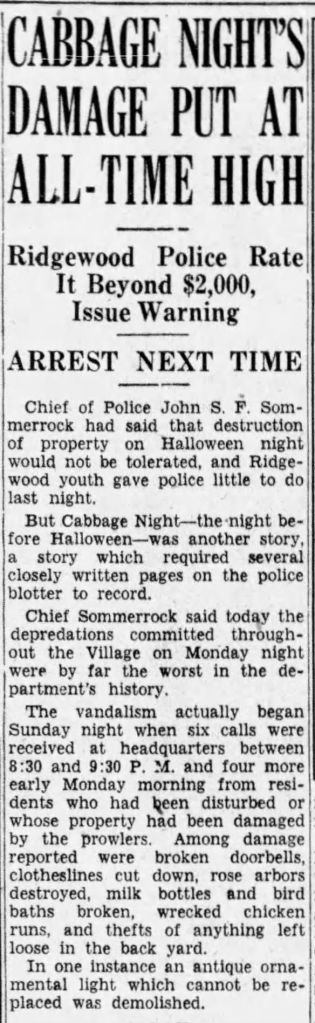
For my reprobate Framingham buddies and me, the answer is “Cabbage Night.”
For most Americans, this day bears no name, no significance beyond… October 30.
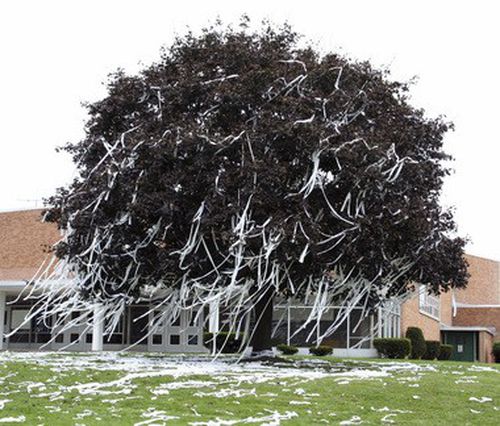
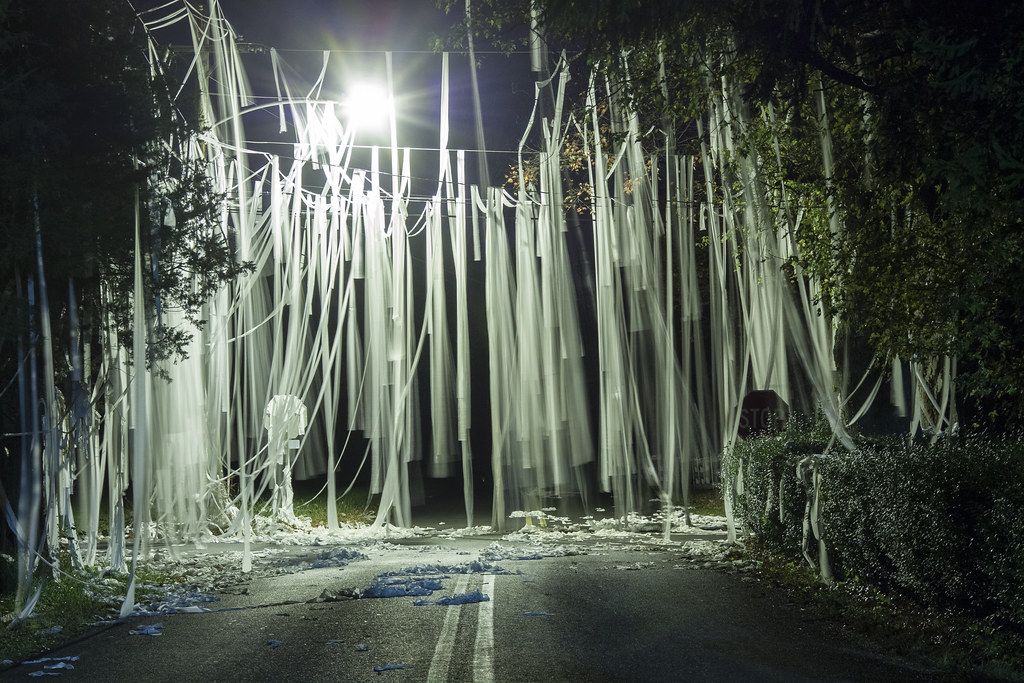
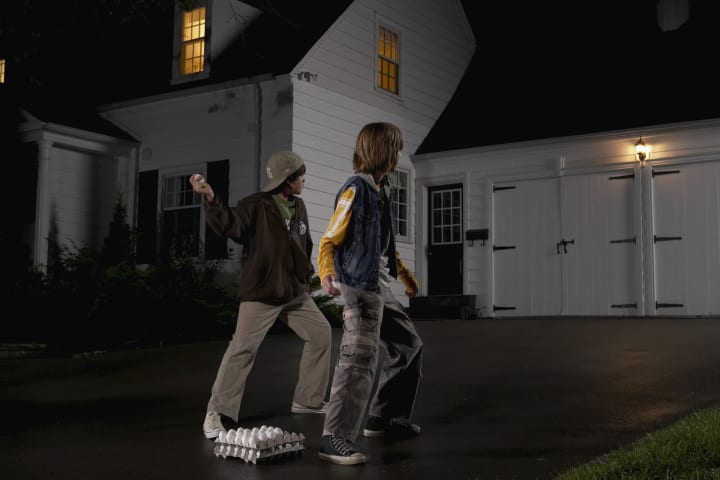
For some of us, this is (or was), a night for those aged out of trick-or-treating to engage in harmless (and sometimes not-so-harmless) mischief.
As early as 1583, the Puritan pamphleteer Phillip Stubbs decried the eve of May Day as “Mischief Night”.
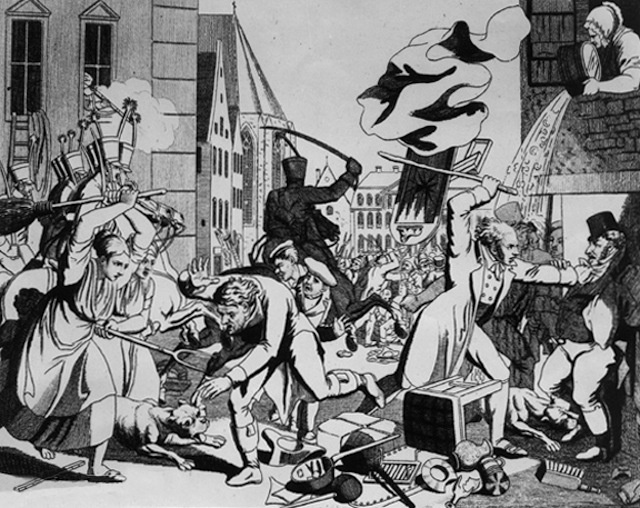
In 1900s England, the event shifted to later in the year and became associated with Guy Fawkes Day, held on November 5. As All-Hallows Eve gained popularity in the US, “Mischief Night” moved to the eve of Halloween.
The pranks were mostly harmless – greased doorknobs or burning bags of dog-poo left on front steps, in hopes that the occupants would come stomp them out. Sometimes, things got out of control. In 1991, 160 fires were started in Camden New Jersey.
If you’re from Detroit, you’ll recognize October 30 as Devil’s Night. According to the Detroit Historical Society, Devil’s Night carryings-on were mostly “genteel”, until someone started lighting abandoned properties on fire. Over 800 such fires were ignited in 1984.
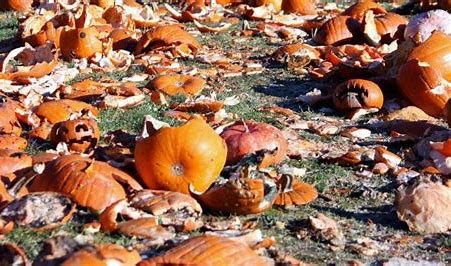
During the late 19th century, parts of western Massachusetts experienced bumper crops of certain vegetables, prompting local delinquents to pull rotten cabbages out of the ground and throw them at houses. On October 30, 1892, the Berkshire County Eagle lamented “…pent up devilry, accumulated in a year’s time, in the minds of a hundred boys, break[ing] forth on cabbage night in Dalton, and persons admiring safety stay in doors.”
According to the Dictionary of Regional American English (DARE), some parts of Pennsylvania recognize “Chalk Night” as a time to chalk fences and sidewalks and everything else that doesn’t run away, perpetrators sometimes adding a prank or two for good measure.
In parts of New Hampshire, October 30 is “Gate Night,” when livestock is let loose to roam, and a good time for the occasional apple fight.
Local revelers know October 30 as “Corn Night” in Nebraska, “Goosey Night” in parts of New Jersey, and “Beggar’s Night” in central Iowa. Cincinnati cuts right to the chase with “Damage Night”.
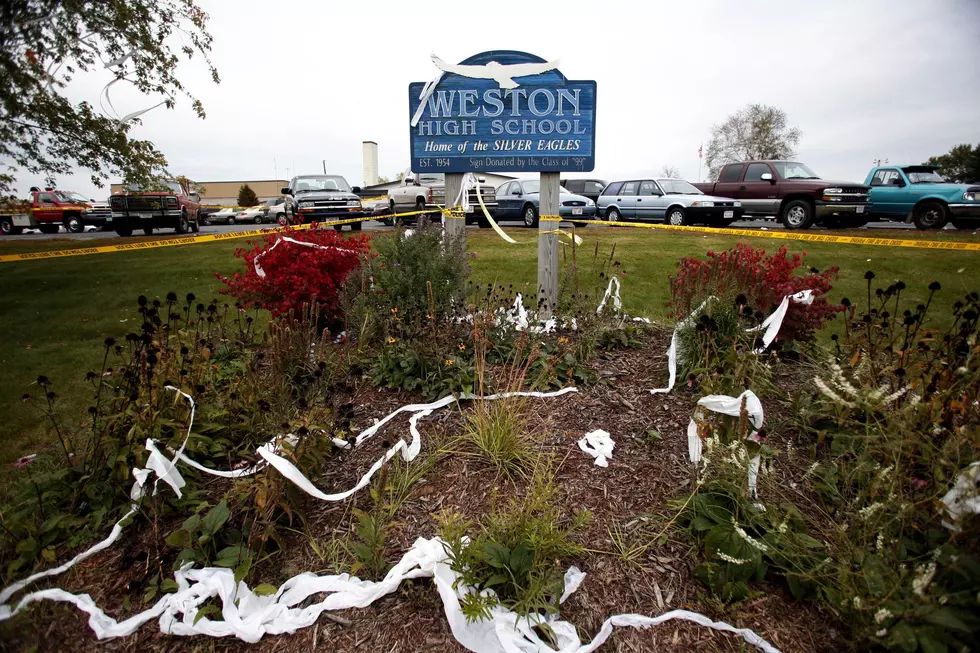
So, go ahead. Ring the neighbor’s doorbell and run like hell. Hang a roll of toilet paper on someone’s tree and go toss a cabbage or two. My buddies and I, we’re going to bed early. We’re all grandfathers now.
The US chapter of Fenian Brotherhood was founded in 1858, based on the idea that Ireland should be free of English rule to become an independent, self-governing Republic. The Brotherhood traced its lineage back to 1758. By 1866, many of the membership were battle hardened veterans of the Civil War, ended only a year before.
The idea was to bring pressure on Britain to withdraw from Ireland. The attacks were directed toward British army forts, customs posts, and other targets in Canada. Fenians invaded Canada no fewer than five times between 1866 and 1871.
Irish Canadian Catholics were divided by the raids, with many feeling torn between loyalty to their new home and sympathy for the Fenians’ objectives. Canadian-Irish Protestants and French Catholics were generally loyal to the crown. Many took up arms against the raiders.
In April 1866 some 700 Fenians headed north to Campobello Island, New Brunswick, intending to seize the island. The war party became discouraged and dispersed after a show of force by the British Navy at Passamaquoddy Bay, but they would be back.
Next, a group of 1,000 to 1,300 Fenians sabotaged the US Navy side-wheeler gunboat USS Michigan, slipping across the Canadian border at the Niagara River on June 1. A Fenian ambush west of Ft. Erie led to the Battle of Ridgeway, in which 13 Canadian Militia were killed. 94 were wounded or incapacitated by disease.
Further fighting took place the following day, in which the Canadian Militia’s inexperience led to battlefield confusion. A number were taken prisoner. Realizing that they couldn’t hold their position, the Fenians released their prisoners and withdrew to Buffalo on the 3rd, but again, they would return
This seems to have been the high water mark of the Fenian uprising. President Andrew Johnson began to crack down, dispatching Generals Ulysses Grant and George Meade to Buffalo to assess the situation. Their orders on the 7th of June were to arrest anyone who even looked like a Fenian.
The Fenian “army of liberation” may have had little effect on Irish Independence, but it served to fire up Canadian Nationalism. Canada was more properly called “British North America” in those days. It seems that the Fenian raids tipped many of the more reluctant votes toward the security of nationhood, particularly in the Maritime provinces. Some historians will tell you that Ridgeway is “the battle that made Canada.” The Canadian Confederation was formed in 1867, uniting Nova Scotia, New Brunswick, Ontario and Quebec into one Dominion of Canada.
There would be several more Fenian raids over the years that followed, from Pigeon Hill and Mississquoi County in modern day Quebec, to the 1870 Pembina raid in the Dakota territory.
US authorities ultimately arrested the men and confiscated their arms, but many felt that the government had turned a blind eye to the invasions, seeing them as payback for British assistance to the Confederacy during the late Civil War.
The Fenian Brotherhood was a nation within a nation, organized for the purpose of winning Irish independence by force. A member of the British House of Commons rightly called them “a new Irish nation on the other side of the Atlantic, recast in the mould of Democracy, watching for an opportunity to strike a blow at the heart of the British Empire.”
In modern times, scores of self-styled ‘Militia’ have adopted the use of military style drill in this country, from the far-left Los Macheteros and Black Panthers, to Posse Comitatus and the far-right militia units of the nineties. And yet I believe it is accurate to say, the Fenian Brotherhood remains the only organization in United States history, to have publicly armed and drilled on this scale.
“We are the Fenian Brotherhood, skilled in the arts of war,
And we’re going to fight for Ireland, the land we adore,
Many battles we have won, along with the boys in blue,
And we’ll go and capture Canada, for we’ve nothing else to do”.
In 1974, logger Oliver ‘Porky’ Bickar chartered a helicopter and flew 70 old tires to the peak of the long-dormant Mount Edgecumbe volcano in Alaska. Dousing the pile with gasoline and setting the thing alight, townspeople gaped at the ominous black cloud rising from the volcano. Local police and fire were in on the gag but the Coast Guard, was not. ‘Coasties’flew over to inspect the situation but instead of molten lava, there was a great pile of burning tires surrounded by the giant words April Fool, spray painted on the sides of the crater.
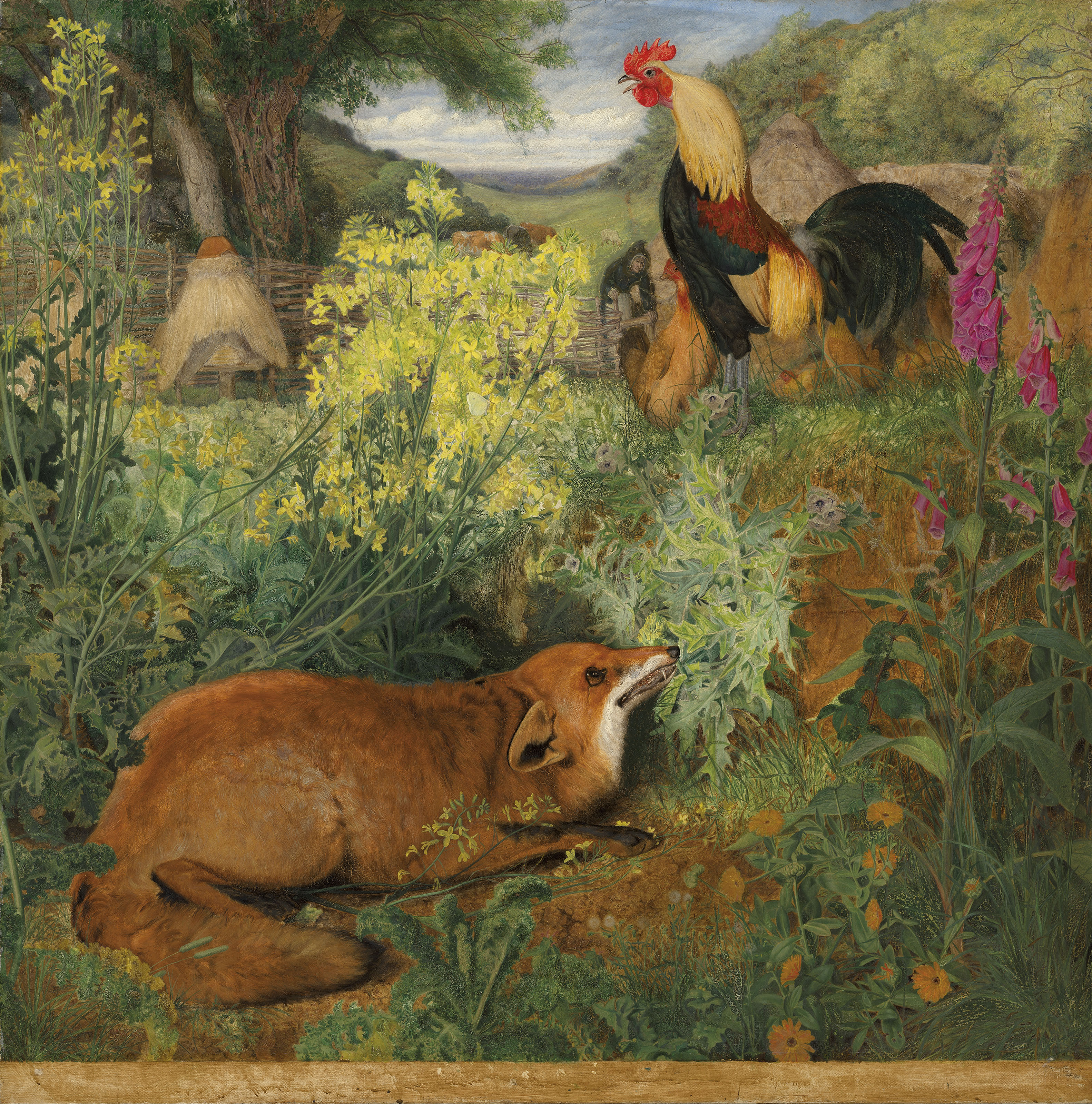
In Chaucer’s Canterbury Tales, “March 32” of 1392 is the day the wily fox tricked the vain cock Chanticleer. The fox appealed to the rooster’s vanity and insisted he would love to hear the cock crow, just as his amazing father had. Standing on tiptoe with neck outstretched and eyes closed, the rooster obliged with unfortunate, if not unpredictable results.
April Fools. The ancient Roman festival of Hilaria held on March 25, may be a precursor. The Medieval Feast of Fools, held December 28, remains to this day a time in which pranks are played in Spanish-speaking countries.
In 1582, France switched from the Julian calendar to the Gregorian moving New Year to January 1 as specified by the Council of Trent, of 1563. Those who didn’t get the news and continued to celebrate New Year in late March/April 1, quickly became the butt of jokes and hoaxes.
Paper fish were placed on their backs, as these “poisson d’avril” (April fish) were said to symbolize the young, naïve, easily caught first fish of Spring.
The Flemish children of Belgium lock their parents or teachers out, letting them in only if they promise to bring treats that evening or the next day.
In 1539, Flemish poet Eduard de Dene wrote of a nobleman who sent his servants on fool’s errands on April 1.
In Scotland, April Fools’ Day is traditionally called Hunt-the-Gowk Day. Though the term has fallen into disuse, a “gowk” is a cuckoo or a foolish person. The prank consists of asking someone to deliver a sealed message requesting unspecified assistance. The message reads “Dinna laugh, dinna smile. Hunt the gowk another mile”. On reading the message, the recipient will explain that in order to help, he’ll first need to contact another person, sending the victim on down the road with the same message.
In Poland, “Prima Aprilis” is so strong that the anti-Turkish alliance with Leopold I, signed on April 1, 1683, was backdated to March 31.
Animals were kept at the Tower of London since the 13th century, when Emperor Frederic II sent three leopards to King Henry III. In later years, elephants, lions and even a polar bear were added to the collection, the polar bear trained to catch fish in the Thames.
In 1686, John Aubrey referred to the holiday as “Fooles holy day”, the first British reference.
On April 1, 1698, citizens were invited to the Tower of London to witness the “Washing of the Lions” in the tower moat. Quite a few were sucked in. The April 2 edition of Dawks’ News-Letter reported that “Yesterday being the first of April, several persons were sent to the Tower Ditch to see the Lions washed.” The “annual ceremony of washing the lions,” lasted throughout the 18th & 19th centuries, always held on April 1st.
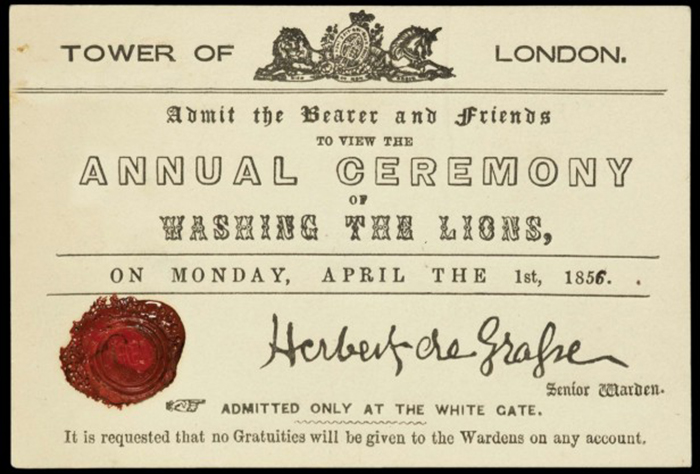
By the mid-19th century the prank became quite elaborate. Tickets were printed and distributed for the event, specifying that attendees be “Admitted only at the White Gate”, and that “It is requested that no Gratuities will be given to the Wardens on any account.”In “Reminiscences of an Old Bohemian”, Gustave Strauss laments his complicity in the hoax in 1848. “These wretched conspirators”, as Straus called his accomplices, “had a great number of order-cards printed, admitting “bearer and friends” to the White Tower, on the 1st day of April, to witness…the famous grand annual ceremony of washing the lions”.
Pandemonium broke out when hundreds showed up, only to realize they’d been pranked. “In the midst of the turmoil” Strauss wrote, “some one spotted me to whom I had given an order of admission, and he would have set the whole mob upon me. Knowing of old that discretion is, as a rule, the better part of valour…I had to skedaddle, and keep dark for a time, until the affair had blown over a little”.
In 1957, (you can guess the date), the BBC reported the delightful news that mild winter weather had virtually eradicated the dread spaghetti weevil of Switzerland. Swiss farmers were now happily anticipating a bumper crop of spaghetti. Footage showed smiling Swiss, happily picking spaghetti from the trees.An embarrassingly large number of viewers were fooled, calling BBC offices asking how to grow their own spaghetti tree. Callers were told to “Place a piece of spaghetti in a tin of tomato sauce, and hope for the best.”
Instantly recognizable to a generation of British TV viewers, Sir Patrick Alfred Caldwell-Moore hosted the longest running BBC production hosted by the same presenter, The Sky at Night. The author of over 70 books on astronomy and renowned for his expertise in moon observation, Moore’s signature monocle and stern on-air personae made him The authority for all things, astronomical. In 1976, Moore informed his viewers that a rare alignment of Pluto and Jupiter would temporarily reverse the law of gravity allowing viewers to float through the air. At 9:47am Moore instructed his viewers to ‘Jump Now!‘. Most took the so-called Jovian-Plutonian effect as harmless good fun but many, did not. One caller claimed that she and 11 friends had taken flight and ‘orbited gently around the room’. Another man claimed to have risen so high as to hit his head on the ceiling, demanding compensation for unspecified injuries.
The Warby Parker Company website describes a company mission of “offer[ing] designer eyewear at a revolutionary price, while leading the way for socially conscious businesses”.
On April 1, 2012, Warby Parker released a new line of eyeglasses for dogs, appropriately called “Warby Barker”.
For only $95, your hipster pooch could be sporting the latest styles in canine eyeware, in irresistible dog treat shades like “Gravy Burst” and “Dusty Bacon.” There was a monocle option too, for those partial to that Prussian Field Marshall look.
Anyone falling for the gag got an “April Fools!” message on the on-line shopping cart.
Not to be outdone, Burger King announced the introduction of a new Whopper flavored mouthwash, for those who just can’t get enough of a good thing. I know it’s true because I read it on-line, but it should be mentioned here. There is no “White Gate” at the Tower of London. Never was.
Fish flopped in the dry riverbed as, upstream, factories ground to a halt. Souvenir hunters and daredevils walked out on the dry river bed. Some even drove buggies. One unit of the United States Army cavalry paraded back and forth across the river. Treasure hunters found artifacts from the War of 1812: muskets, bayonets, even tomahawks.
Even as Athens and Sparta vied for control of the Peloponnese, half a world away the earliest of indigenous peoples settled the Niagara valley of modern-day Ontario and western New York. These were the Onguiaahra, a farming people growing corn, beans and squash in the rich soil of the Niagara escarpment, hunting deer and elk and fishing the tributary waterways of the Niagara valley.
The Onguiaahra were some 12,000 in number when the French explorer Samuel de Champlain came to the region in 1615. French explorers called them “Neutrals”, the peace makers between the perpetually warring tribes of the Seneca, Cayuga, Onondaga, Oneida and Mohawk Nations to the south, and the Huron to the north. Vying for control of the rich French fur trade, peoples of this “Iroquois Confederacy” systematically destroyed the villages of the neutrals, killing their people or driving them east, toward Albany. By 1653 the Onguiaahra had ceased to exist in any meaningful sense but their name lives on, in a word translating as “Thunder of Waters”.
Niagara Falls are three in number, 3,160 tons of water cascading over the precipice every second, hitting the bottom at American and Bridal Veil Falls with 280 tons of force and an astonishing 2,509 striking the Canadian side, at the famous Horseshoe Falls.
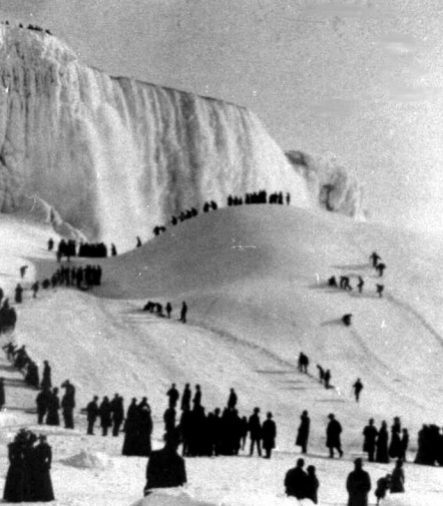
Pictures have been around since the age of photography, purporting to show Niagara Falls “frozen solid”. That’s not so unusual. The Washington Post reports:
“Niagara Falls gets cold every year. The average temperature in Niagara Falls in January is between 16 and 32 degrees. Naturally, it being that cold, ice floes and giant icicles form on the falls, and in the Niagara River above and below the falls, every year. The ice at the base of the falls, called the ice bridge, sometimes gets so thick that people used to build concession stands and walk to Canada on it. It’s nothing out of the ordinary. It is not, to put it bluntly, big polar vortex news”.
Niagara “Frozen” in 1906, 1902 and 1936. Hat Tip Snopes.com
Despite outward appearances, water flows in abundance under those bridges of ice. Only once in recorded history did Niagara Falls run dry. On this day in 1848, roughly 212,000 cubic feet per second dried, to a trickle. Not dried, really, nor did it freeze. Strong southwest winds had driven massive amounts of ice to the head of Niagara River, effectively putting a cork in the bottle.
Fish flopped in the dry riverbed as, upstream, factories ground to a halt. Souvenir hunters and daredevils walked out on the dry river bed. Some even drove buggies. One unit of the United States Army cavalry paraded back and forth across the river. Treasure hunters found artifacts from the War of 1812: muskets, bayonets, even tomahawks. At the base of the Falls, Maid of the Mist owners took the opportunity to dynamite rocks which had endangered their boat.
Meanwhile upstream the pressure built, an that much water is not to be denied. The ice dam broke on March 31. By that evening, the flow was back to normal.
Lifelong “Stooges” fans will appreciate this classic comedy bit, “Niagara Falls”
The Falls “dried up” once again in 1961 but, this time, it happened on purpose. Over three days and 1,264 truckloads of fill, the US Army Corps of Engineers built a cofferdam that June, diverting water to the Canadian side. There was concern that rock falls were going to cause erosion, “shutting down” the Falls.
On inspection, engineers determined that removing the rocks would accelerate erosion. The idea was abandoned by November and the cofferdam, blown up. To this day, the waters of Niagara flow, unvexed, to the sea.
A Trivial Matter
In 1901, Schoolteacher Annie Edson Taylor became the first person to go over Niagara Falls in a barrel. Sixteen others have followed, at least on purpose. Five of them died, including the guy who went over in a kayak, and one on a jet ski. On Saturday, July 9, 1960, 7-year-old Roger Woodward was accidentally swept over Horsehoe Falls. He miraculously survived the 162-foot plunge wearing only a bathing suit and a life jacket. James Honeycutt did not, losing his life in the attempt to rescue the boy. They say that 90% of the fish who go over the Falls live to tell the tale.
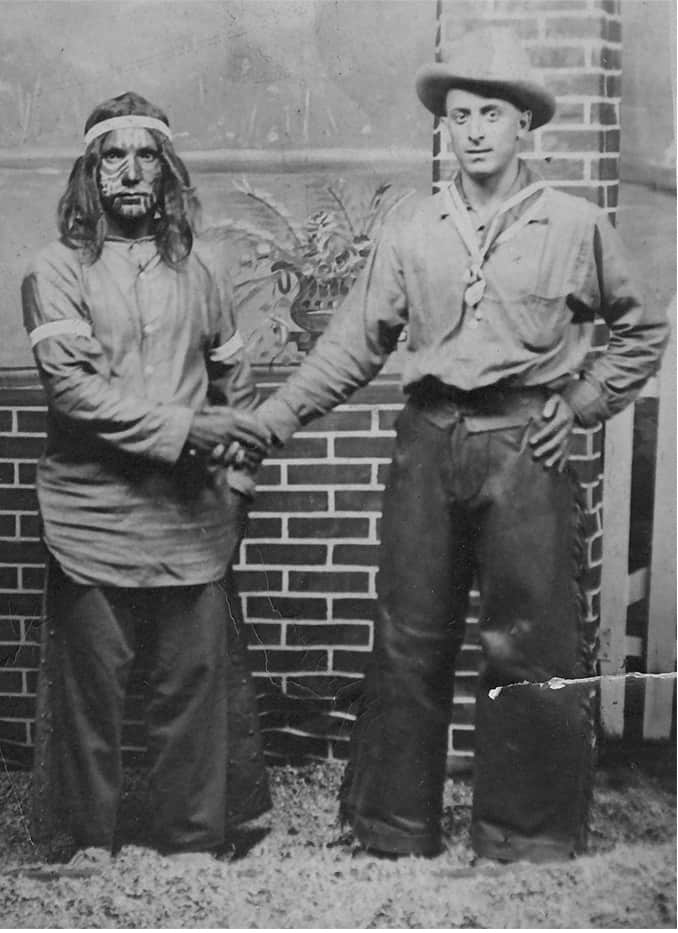
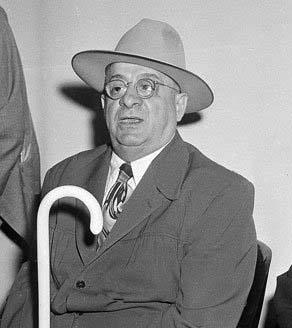
The 20th century personification of a 19th century wild west gunfighter, no one suspected Richard James Hart to be the brother of the infamous gangster, Al Capone.
A boy was born on this day in 1892 in the south of Italy, James Vincenzo, the first son of a barber named Gabriele Capone and his wife, Teresa. A second son named Ralph came along before the small family emigrated to the United States in pursuit, of a better life.
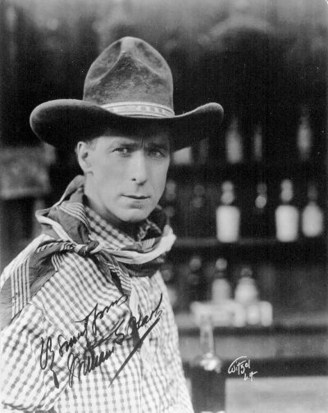
Silent film cowboy star William S Hart
Gabriele and Teresa would have seven more children in time: Frank and Alphonse followed by Ermina who sadly died in infancy, followed by John, Albert, Matthew and Mafalda.
Most of the brothers followed a life of petty crime but not Vincenzo, the first-born who would often take the ferry to Staten Island to escape the overcrowded mayhem, of the city.
Vincenzo got a job there with help from his father. He was cleaning stables and learning how to care for horses. There he learned to ride and preferred the more “American sounding” part of his name, “James”.
James’ newfound love of horses led to a fascination with Buffalo Bill Cody and the “Wild West” shows, popular at this time. At sixteen he joined the circus, and left the city for good. His family had no idea where he had gone until a letter, about a year later. He was in Kansas he wrote, working as a roustabout with a traveling circus.
This was the age of the silent film, William S. Hart one of the great “cowboy” stars of the era. Hart was larger than life, the six-gun toting cow-punching gunslinger from a bygone era.
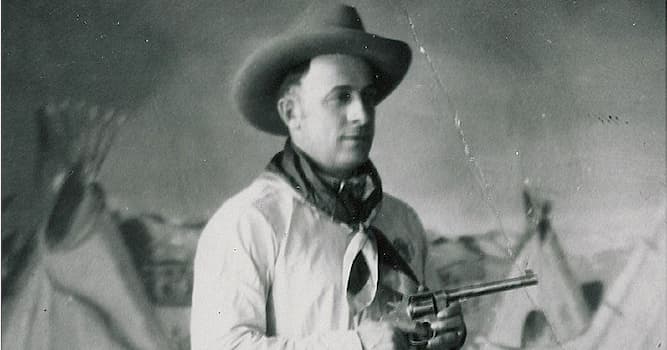
The roustabout idolized the silent film star and adopted his mannerisms, complete with low-slung six-shooters, red bandanna and ten-gallon hat. He worked hard to lose his Brooklyn accent and explained his swarthy complexion, explaining he was part native American.
James even adopted the silent film star’s name and enlisted in the Army as Richard James Hart claiming to be a farmer, from Indiana. Some stories will tell you that Hart fought in France and rose to the rank of Lieutenant, in the military police. Others will tell you he joined the American Legion after the war only to be thrown out when it was learned, the whole story was fake.
Be that as it may, Vincenzo legally changed his name to Richard James Hart.
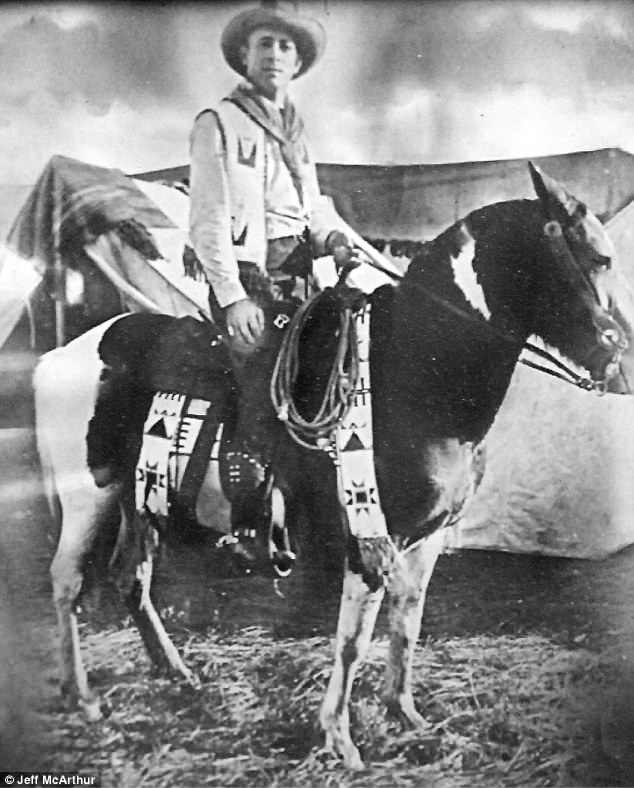
Richard Hart stepped off the freight train in 1919, a walking, talking anachronism. The personification of a 19th century Wild West gunfighter, from his cowboy boots to the embroidered vest to that broad-brimmed Stetson hat. This was Homer Nebraska, a small town of about 500, some seventeen miles from Sioux City Iowa.
Richard James “Two Gun” Hart
He claimed to be a hero of the Great War, personally decorated by General John J. Pershing. Intelligent, ambitious and not the least afraid of hard work, Hart took jobs as paper hanger, house painter, whatever it took.
He was short and powerfully built with the look of a man who carried mixed Indian or Mexican blood, regaling veterans at the local American Legion with tales of his exploits, against the Hun.
The man could fight and he knew how to use those guns, amazing onlookers with feats of marksmanship behind the Legion post.
Any doubts concerning the man’s physical courage were put to rest that May when a flash-flood nearly killed the Winch family of neighboring Emerson, Nebraska. Dashing across the raging flood time after time, two-gun Hart brought the family to safety. Nineteen-year-old Kathleen was so taken with her savior she married him that Fall, a marriage which produced four sons.
The small town was enthralled by this new arrival, the town council appointing Hart as Marshall. He was a big fish in a small pond, elected commander of the Legion post and district commissioner for the Boy Scouts of America.
The 18th Amendment to the Constitution was ratified on January 16 of that year, the Volstead Act passed by the United States Congress over the veto of President Woodrow Wilson. “Prohibition” was now the law of the land, making it illegal to produce, import, transport or sell intoxicating liquor.
Richard Hart became a prohibition agent in the Summer of 1920 and went immediately to work, destroying stills and arresting area bootleggers.
Hart was loved by temperance types and hated by the “wets”, famous across the state of Nebraska. The Homer Star reported that this hometown hero was “becoming such a menace in the state that his name alone carries terror to the heart of every criminal.”
Officials at the federal Bureau of Indian Affairs took note and before long, Hart was performing the more difficult (and dangerous) job of liquor suppression on the reservations.
Hart brought his chaps and six-shooters to South Dakota where the Yanktown reservation superintendent reported to his superiors in Washington “I wish to commend Mr. Hart in highest terms for his fearless and untiring efforts to bring these liquor peddlers and moonshiners to justice. …This man Hart is a go-getter.”
Hart became proficient in Lakota and Omaha dialects. Tribal leaders called him “Two Gun”, after the twin revolvers he wore. Some members of the Oglala tribe called him “Soiko”, a name roughly translating as “Big hairy boogey-man”.
By 1927, Two-Guns Hart had achieved such a reputation as to be appointed bodyguard to President Calvin Coolidge, on a trip through the Black Hills of South Dakota.
By 1930, Richard James Hart was so famous a letter addressed only as “Hart” and adorned with a sketch of two pistols, arrived to his attention.
Hart became livestock inspector after repeal of prohibition, and special agent assigned to the Winnebago and Omaha reservations. He was re-appointed Marshall of his adopted home town but, depression-era Nebraska was tough. The money was minuscule and the Marshall was caught, stealing cans of food.
The relatives of one bootlegging victim from his earlier days tracked him down and beat him so severely with brass knuckles, the prohibition cowboy lost the sight of one eye.
Fellow members of the American Legion had by this time contacted the Army, only to learn that Hart’s World War 1 tales were fake. His namesake Richard Jr. went on to lose his life fighting for the nation in World War 2. but Richard himself was never in the Army.
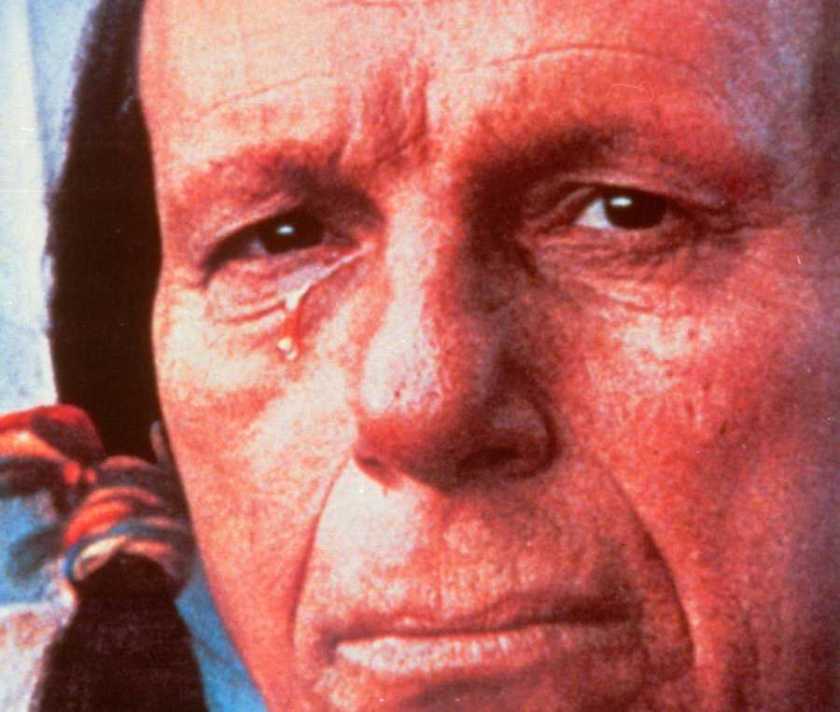
Turns out that other parts of the lawman’s story were phony, too. A good story but altogether fake. Like the Italian-American actor Espera Oscar de Corti better known character “Iron Eyes Cody”, the “crying Indian”, who possessed not a drop of native American blood.
The lawman had left the slums of Brooklyn to become a Prohibition Cowboy while his little brother Alphonse, pursued a life of crime.
A Trivial Matter
James Vincenzo Capone’s strange double-life came to the public eye for the first time in 1951, when defense attorneys subpoenaed Richard Hart to testify on behalf of his brother Ralph. Hart faded into anonymity following a rash of newspaper stories, and died within a year in the small Nebraska town where he stepped off that freight train, some 33 years earlier.
Wanted: The Ugliest Woman. Nothing Repulsive Maimed or Disfigured. Good Pay Guaranteed and Long Engagement for Successful Applicant. Send Recent Photo – Newspaper advertisement
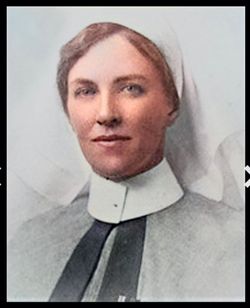
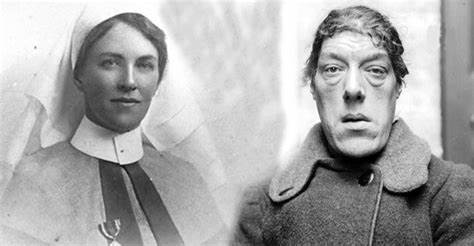
Mary Ann Webster arrived in this world on December 20, 1874, borne of a working class family in the East London township of Plaistow. Hers was a normal childhood, no different than any of her seven siblings. At the age of 20, she qualified to become a nurse.
Mary Ann Webster
If the last three years have taught us anything about the nursing profession, it’s a heartfelt respect for those who care for others. Sometimes, at no small risk to themselves.
Today we revere the profession, but such was not always the case. No less a person than the “mother of modern nursing” Florence Nightingale once described the job, as being for ‘those who were too old, too weak, too drunken, too dirty, too stupid or too bad to do anything else’.
When Mary Ann Webster joined the profession, it certainly wasn’t for the money.
Then came the day Mary Ann met a farmer named Thomas Bevan. The couple fell in love and and were wed in 1903. Over time, the union produced four children. Theirs was a happy marriage until that day in 1914, when Thomas entered their small cottage and dropped dead at her feet.
A terrible storm was gathering in 1914 Europe, about to plunge a continent into war. Left without her principle source of support with four children to feed Mary Ann Bevan faced a terrible storm of her own, even then taking place within her own body.
Acromegaly is a neuroendocrine disorder, known to cause excess growth hormones in the body.
“Dalip Singh Rana is an Indian retired professional wrestler and wrestling promoter better known by his ring name The Great Khali” – hat tip wikipedia
Usually caused by a non-malignant tumor on the pituitary gland, Acromegaly results in gigantism when the condition begins before puberty. If you’re a professional wrestling fan, think of the Punjabi wrestler “The Great Khali”, or Andre the Giant.
When contracted in adulthood, Acromegaly results in a thickening of the skin, enlargement of extremities and facial features and a deepened, “husky” voice accompanied by severe headaches and joint pain.
Today the condition can be dealt with, if detected early. Early 20th century medicine offered no options for the treatment of such a disease.
In a world beset by the catastrophe of World War I, Mary Ann Bevan was left with four children to feed, no husband and a rapidly developing personal horror about to render her own appearance, a thing of the past.
As the condition advanced, coworkers and patients alike were at first put off by her changing facial features and then disgusted. Reviled and alone work went from difficult to impossible, leaving the young widow nothing but odd jobs to support herself and her children.
Then one day the newspaper arrived, in 1920:
Wanted: The Ugliest Woman. Nothing Repulsive Maimed or Disfigured. Good Pay Guaranteed and Long Engagement for Successful Applicant. Send Recent Photo.
Newspaper ad
If you’ve ever thought to yourself that people seem judgmental in the age of social media, you’re not alone. You’re not wrong either, but that’s nothing new. People have flocked to gawk at and ridicule “freaks of nature” going back to medieval days, if not before. In the court of King Charles I, two conjoined brothers called Lazarus and Joannes Baptista Colloredo were a source of mean-spirited entertainment. 2-foot 5-inch Matthias Buchinger amazed 18th century crowds in England and Ireland with feats of magic, art and music, despite having no hands and no feet.
So minutely detailed was Buchinger’s calligraphy the locks of his own hair seen in the self-portrait above, are actually 7 biblical psalms and the Lord’s Prayer. But I digress.
This sort of voyeurism came to a pinnacle in the form of the “Freak Show” of late 19th and early 20th century United States and England. Which brings us back to Mary Ann Bevan. The man behind the newspaper advert was Claude Bartram, agent for the Barnum & Bailey Circus.
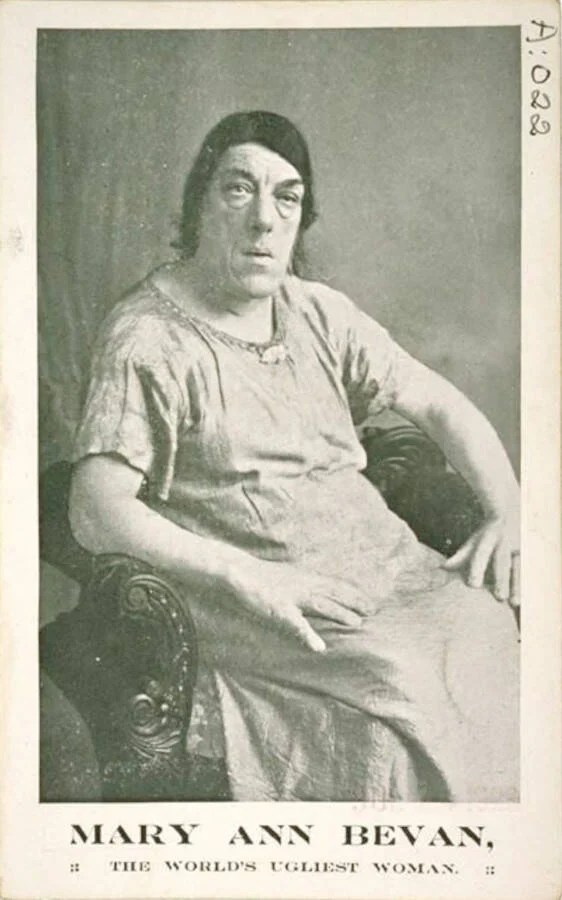
Allthatsinteresting.com writes: “She was paraded alongside other notable sideshow acts including Lionel, the Lion-Faced Man, Zip the “Pinhead,” and Jean Carroll, the Tattooed Lady. Dreamland visitors were invited to gawk at the 154 pounds she carried on her 5′ 7″ frame, as well as her size 11 feet and size 25 hands. Bevan bore the humiliating treatment calmly. “Smiling mechanically, she offered picture postcards of herself for sale,” thus securing sufficient money for herself and for her children’s education”.
Postcards like this earned her as much as $12 apiece, sold at fairgrounds.
What it is to appear in a carnival freak show, I leave to the imagination. The sneers and taunts, the comments… Mary Ann found romance in later life with a giraffe keeper, remembered only as Andrew. She even agreed to a beauty makeover one time, at a New York salon. With her face made up complete with a massage, new hairdo and manicure, one of the snottier commenters asserted: ”the rouge and powder and the rest were as out of place on Mary Ann’s countenance as lace curtains on the portholes of a dreadnought.”
Mary Ann herself looked in the mirror and sighed saying simply, “I guess I’ll be getting back to work.”
Mary Ann Bevan performed at Coney Island until the day she died on December 26, 1933. She was only 59. She is buried at Southeast London’s Brockley and Ladywell Cemetery.
Save for aficionados of the American sideshow circuit she faded from history after that, until 2000. The Hallmark greeting card company used her image in an unfunny and cruel joke about blind dates, raising no small storm of criticism from the public. To their credit, Hallmark removed the card from the market.
If there is a last word on the subject of personal appearance, let it go to Mary Ann herself. During two years of performing in New York and enduring the humiliation, sneers and derision of strangers the young mother more than provided for her family, earning the equivalent of 1.6 million dollars in today’s value.
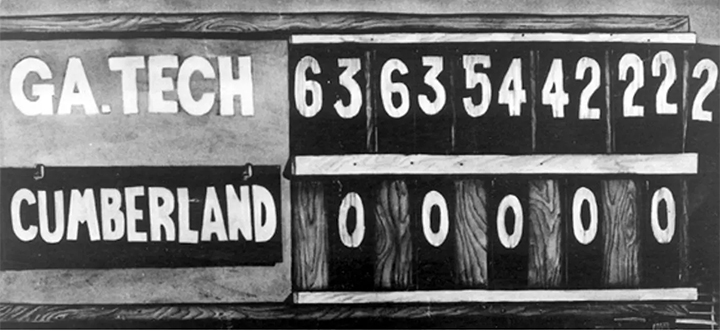
The most lopsided college football game ever was in 1916, when Georgia Tech rushed for 1,650 yards and didn’t allow a single first down by Cumberland College. Final score, 222-0.
During one 1965 regular season game, the Major League St. Louis Cardinals played a single 40-minute inning scoring seven unearned runs in a 12-2 victory over the Milwaukee Braves. Wags coined the term “Blowout”.
Over the years, plenty of other sporting events have qualified for that term:
• Russia’s 1976 Olympic victory over Japan in men’s basketball, 129-63. • The St. Francis College Fighting Saints ’96 baseball season run record of 71-1. • Secretariat’s 1973 Belmont Stakes victory, of 31 lengths.
The most lopsided college football game ever occurred in 1916, when Georgia Tech rushed for 1,650 yards and didn’t allow a single first down by Cumberland College. Final score, 222-0.
In 1927, Kansas City’s Haven High School football team beat Sylvia High 256-0. In a record-setting season of blowouts, the 1901 Michigan Wolverines team defeated every opponent they faced that season by a combined score, of 550-0.
In 1940, Chicago Bears’ coach George Halas showed his players newspaper clippings, in which the Washington Redskins’ owner called Bears players “crybabies and quitters” after losing 7-3 during regular season. Chicago went on to beat Washington 73-0 in post-season, in a game so lopsided it had to be finished with practice balls. Chicago had deposited all the game balls in the stands by that time, kicking extra points.
In 1987, the National League Chicago Colts defeated Louisville, 36-7. The modern Major League Baseball record for margin of victory was set in 2007, when the Texas Rangers defeated the Baltimore Orioles, 30-3. Those 30 runs remain a modern-era record for runs scored in a nine-inning MLB game by one team.
On this day in 1956, the Minnesota Lakers scored one of the most lopsided round ball victories ever over the St. Louis Hawks, 133-75. That blowout was second only to the 1991 Cleveland Cavaliers victory over the Miami Heat, 148-80.
In 2009, Dallas’ Christian Covenant High School girls basketball skunked Dallas Academy, 100-0. The victory was widely condemned: Dallas Academy, a school for students with learning disabilities, had a team of eight out of an entire student body population of 20 girls, and yet Covenant continued a full-court press with three-point shots well after taking a halftime lead of 59-0. Covenant’s administration called for a forfeit of its win, calling the performance “shameful and an embarrassment.” The coach declined to apologize, and was fired.
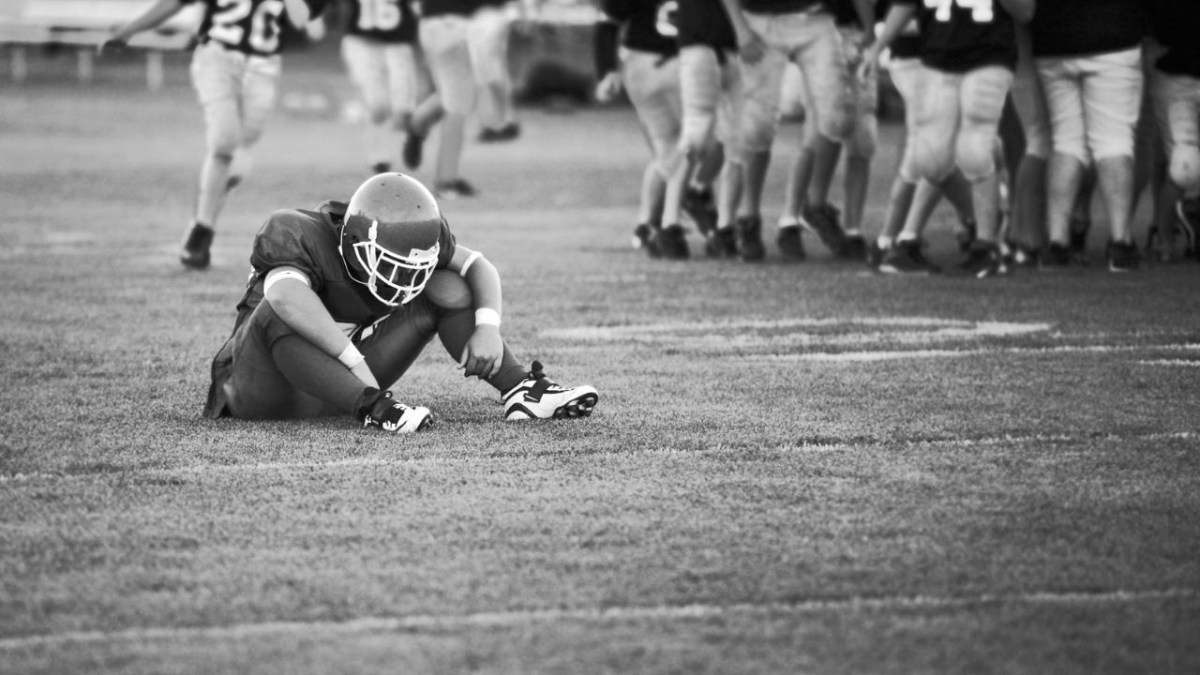
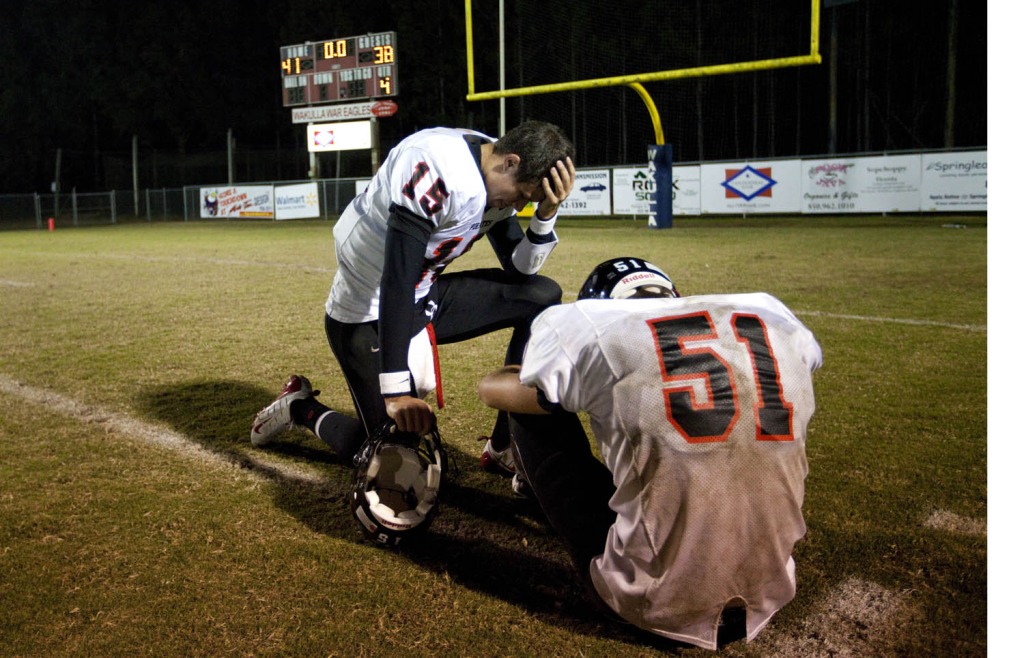
CRAWFORDVILLE, FLA. 12/9/11-PASCOFB120911HACKLEY05-Pasco quarterback Jacob Guy and Nick Wilson kneel dejected on the field after loosing to Wakulla 41-38 in triple overtime Friday in Crawfordville, Fla.
COLIN HACKLEY PHOTO
Three players have won PGA Tour matches by 16 strokes: J.D. Edgar at the 1919 Canadian Open; Joe Kirkwood, Sr., at the 1924 Corpus Christi Open; and Bobby Locke at the 1948 Chicago Victory National Championship. Tiger Woods has the largest margin of victory in the modern era, with a 15-stroke win at the 2000 U.S. Open.
For nearly thirty years, one skier’s wipeout in Oberstock Germany, introduced ABC’s “Wide World of Sports”
The Detroit Red Wings beat the New York Rangers 15-0 in 1944, but some of the worst sports disasters ever, have been in international hockey. The 2007 Slovakia women’s team defeated Bulgaria 82-0 in a 2010 Winter Olympics qualifying tournament. At the 1998 Asia-Oceania Junior Championships, South Korea eclipsed Thailand 92-0. South Korean forward Donghwan Song alone scored 31 goals.
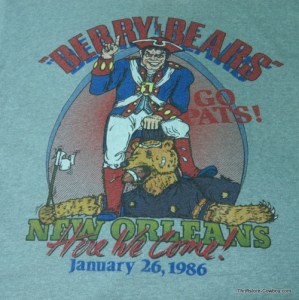
For those of us who rooted for the New England Patriots during the losing years, the 1986 Super Bowl XX was the worst moment…evah. Everyone was wearing their “Berry the Bears” shirts. Life was good when New England took the earliest lead in Super Bowl history with a field goal, at 1:19.
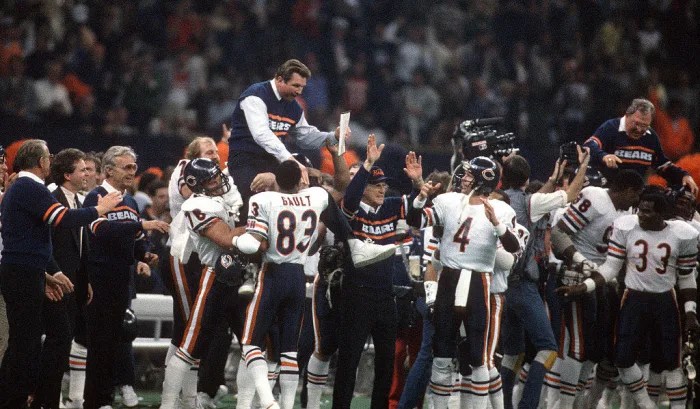
After that, the room got quiet. Real quiet. Chicago held the Patriots to -19 yards. In the first half. Game MVP went to a defensive end with the spectacularly appropriate name of Richard Dent. “Da Bears” set or tied Super Bowl records that day for sacks (7), and fewest rushing yards allowed (also 7). Final score, 46-10.
The day of ignominy lived on for another fourteen years, until the Denver Broncos took us out of our misery with a 55-10 drubbing at the hands of the San Francisco 49ers, in Superbowl XXIV.
No fewer than 97 languages from Amharic (yimarish for women and yimarih for men) to Māori (manaakitia koe) to Yiddish (tsu gezunt) and even Esperanto (Sanon) offer similar blessings, for those who sneeze.
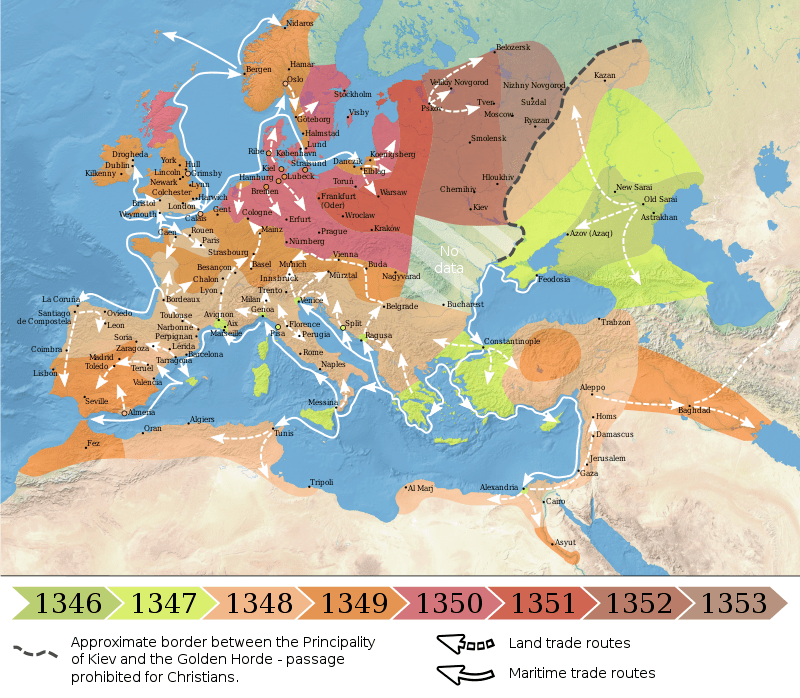
Emerging as we are following two years of worldwide pandemic, the modern mind can scarcely imagine the world experienced by out medieval ancestors, afflicted with the Bubonic Plague. Yersinia Pestis.
Peaking between 1346 and 1353, the “Black Death” was the most deadly pandemic in human history, killing an estimated 75 to 200 million at a time when worldwide population stood less than a half-million.
European populations took 200 years to recover.
Even so, this was far from the first. Modern research points to the existence of Y. Pestis in ancient Swedish tombs, indicating a possible role in the “Neolithic Decline” in which European populations collapsed, some 5-6 thousand years ago.
The Plague of Justinian (541–542 CE, with recurrences until 750) was the first worldwide pandemic brought about by Y. Pestis. Populations from China to Roman Britain were decimated with particular emphasis, on the Sassanian and Byzantine empires. While numbers are uncertain, Procopius wrote of 10,000 dying every day in Constantinople, alone.
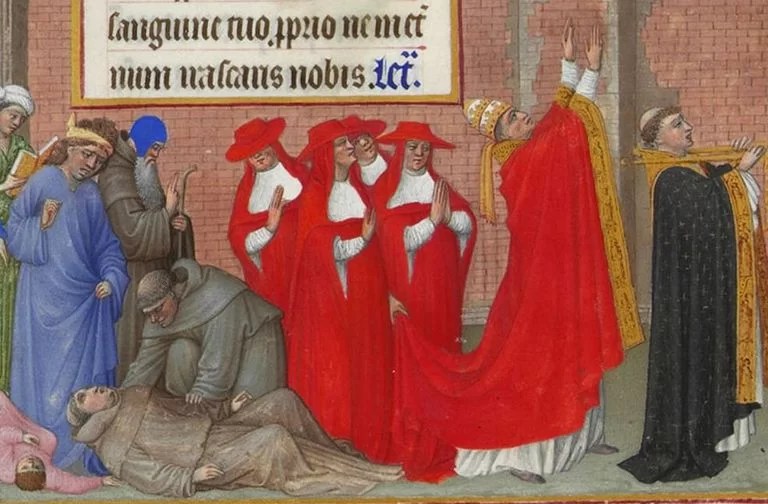
In 590, Pope Pelagius II succumbed to the “Black Death” leading to the election of Gregory I, one of the last popes to retain his baptismal name.
Fun Fact: In the early centuries of the Roman church, popes retained baptismal names. In 533, Mercurius was elected head of the worldwide Catholic Church. Deeming it inappropriate that the Bishop of Rome carry the name of a pagan Roman god, Mercurius adopted the papal name John II in honor of his predecessor, venerated as a martyr. Since 1555, all Popes have adopted a Pontificial name as well as an Italian name, in honor of Vatican citizenship.
Today we remember Gregory also for the Gregorian chant, but not for the eponymous calendar. That would come to us from a later Gregory.
Around the time of Gregory I, it was believed (with some justification) that sneezing spread the plague. Many believed in addition, that the soul briefly departed the body during a sneeze, rendering the…err…sneezer, temporarily vulnerable to demonic possession.
So it was on this day, February 16, 600, Pope Gregory I issued a papal bull. A decree, requiring all Christians to invoke the blessings of God, when in the presence of anyone who sneezed.
“The phrase, God bless you, became a sort of protection or verbal talisman to protect the sneezer. We see similar practices in other cultures. For example, the Spanish “Salud” (health), German “Gesundheit” (health), Gaelic “Dia dhuit” (God be with you), and Bengali “Jeebo” (stay alive) are all responses to sneezing”.
H/T compellingtruth.org
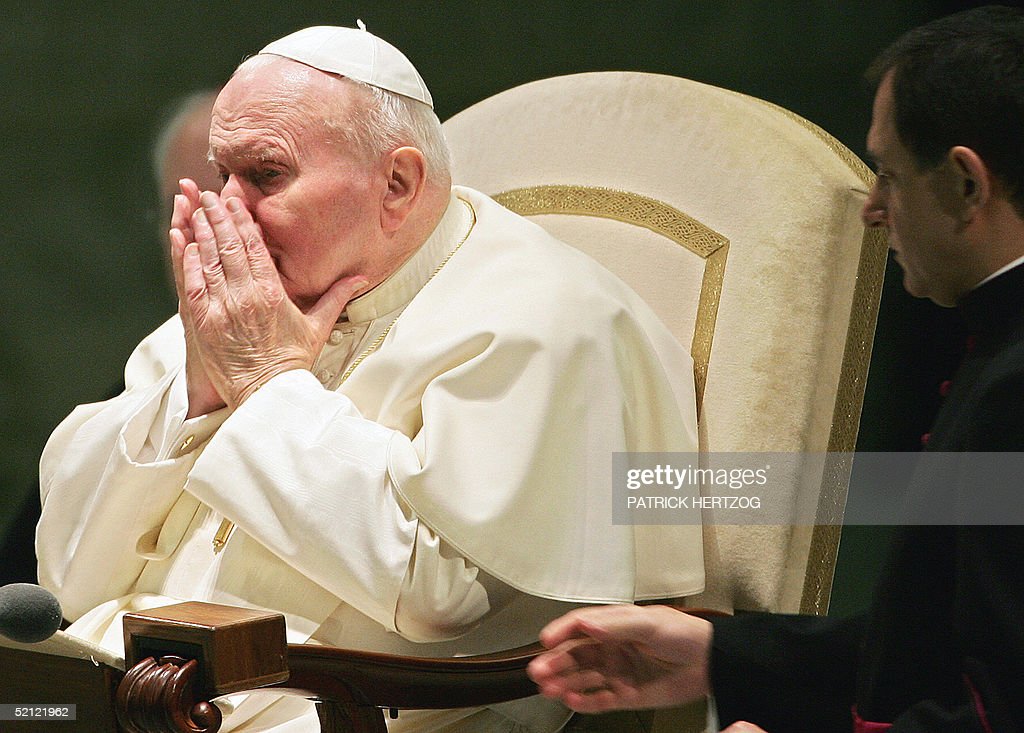
ROME, ITALY: This picture taken 26 January 2005 shows Pope John Paul II sneezing during his weekly general audience at the Vatican. Vatican officials 02 February 2005 said they had delayed an early morning health update on the 84-year-old Pope John Paul II, who was admitted to hospital suffering from breathing problems after falling ill with the flu. According to initial reports, the pope spend a “fairly good night” in hospital and was to undergo tests on Wednesday. AFP PHOTO/ PATRICK HERTZOG (Photo credit should read PATRICK HERTZOG/AFP via Getty Images)
While the origins are murky, it seems ol’ Gregory didn’t invent the idea. He just…ordered it. So it is by the year 750, “God Bless You” became the near-universal response to a sneeze and remains so, to this day.
No fewer than 97 languages from Amharic (yimarish for women and yimarih for men) to Māori (manaakitia koe) to Yiddish (tsu gezunt) and even Esperanto (Sanon) offer similar blessings, for those who sneeze.
Today, a sneeze is understood to be the body’s way of ejecting an irritant. But, did you know? An estimated 18% to 35% of the population sneezes, when subjected to sudden, bright light. Gesundheit.
The numbers are hazy, but port records indicate that somewhere between ten and twenty thousand former Confederates moved to Brazil during the twenty years following the Civil War. A great uncle of former First Lady Rosalynn Carter, was one of them.
Most of us were taught that 600,000+ died during the American Civil War. 618,222 to be precise, more than the combined totals of every conflict in which the United States was ever involved, from the Revolution to the War on Terror. Recently, sophisticated data analysis techniques have been applied to newly digitized 19th century census figures, indicating that the real figure may be considerably higher.
The actual number may lie somewhere between 650,000 and 850,000. dead.
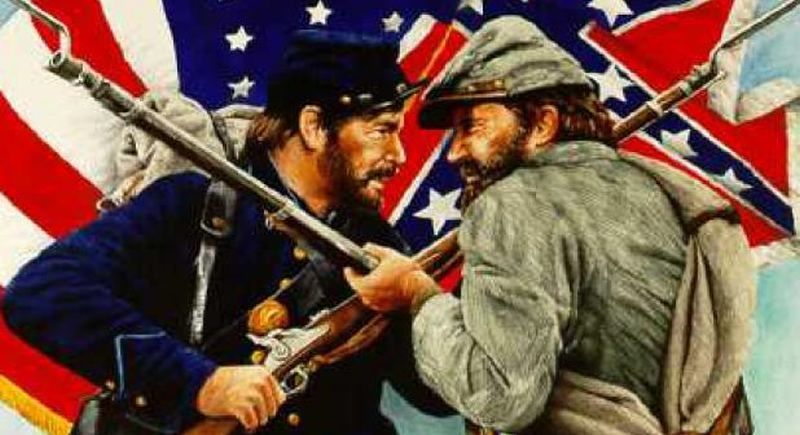
The cataclysm of the Civil War would leave in its wake animosities which would take generations to heal. “Reconstruction” would be 12 years in the making but some never did reconcile themselves to the war’s outcome. Vicksburg, Mississippi fell after a long siege on July 4, 1863. The city would not celebrate another Independence Day for 70 years.
In 1865, Emperor Dom Pedro II of Brazil wanted to encourage domestic cultivation of cotton. Men like Jefferson Davis and Robert E. Lee advised southerners against emigration, but the Brazilian Emperor offered transportation subsidies, cheap land and tax breaks to those who would move.
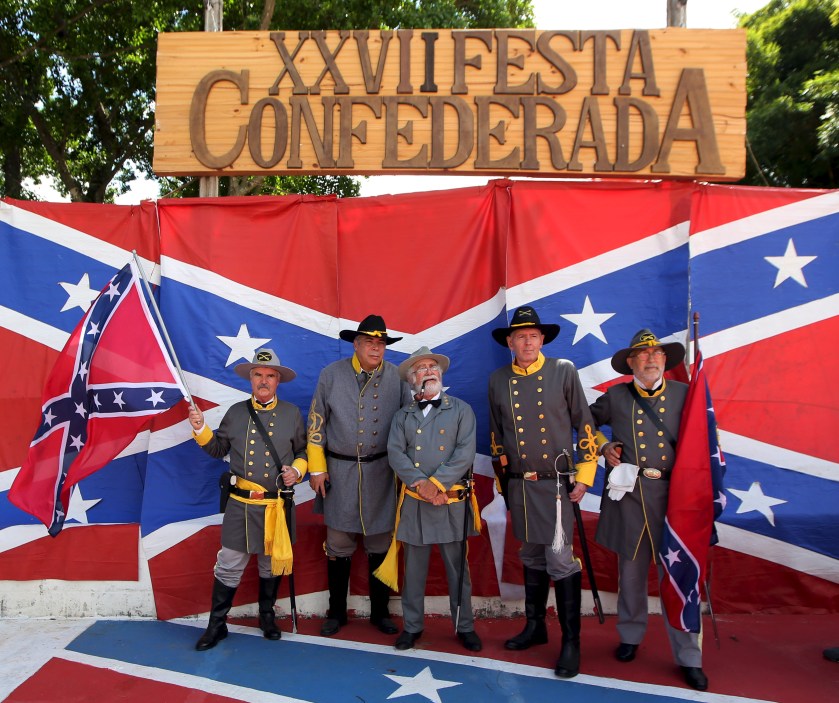
Descendants of American Southerners wearing Confederate-era uniforms pose for a photograph during a party to celebrate the 150th anniversary of the end of the American Civil War in Santa Barbara D’Oeste, Brazil,
Colonel William Hutchinson Norris, veteran of the Mexican American War and former member of the Alabama House of Representatives and later State Senator, was the first to make the move. Together with his son Robert and 30 families of the former Confederacy, Norris arrived in Rio de Janeiro on December 27, 1865, aboard the ship “South America”.
The numbers are hazy, but port records indicate that somewhere between ten and twenty thousand former Confederates moved to Brazil during the twenty years following the Civil War. A great uncle of former First Lady Rosalynn Carter, was one of them.
Some of these “Confederados” settled in the urban areas of São Paulo. Most made their homes in the northern Amazon region around present-day Santa Bárbara d’Oeste and a place the locals called “Vila dos Americanos”, and the inhabitants called “Americana”. Some would return to the newly re-united states. Most would never return. Their descendants, Portuguese speaking Brazilians one and all, remain there to this day.
‘I don’t speak English and the only place I’ve been to in the U.S. is Disneyworld, but I feel the heritage,’ said 77-year-old Alcina Tanner Coltre, whose great-great-grandparents migrated from Mississippi along with their 15-year-old son. ‘My great-grandfather married a Brazilian woman, so he integrated into Brazilian culture pretty quickly, but it’s really important to me to come out every year to remember where we come from.’
UK Daily Mail
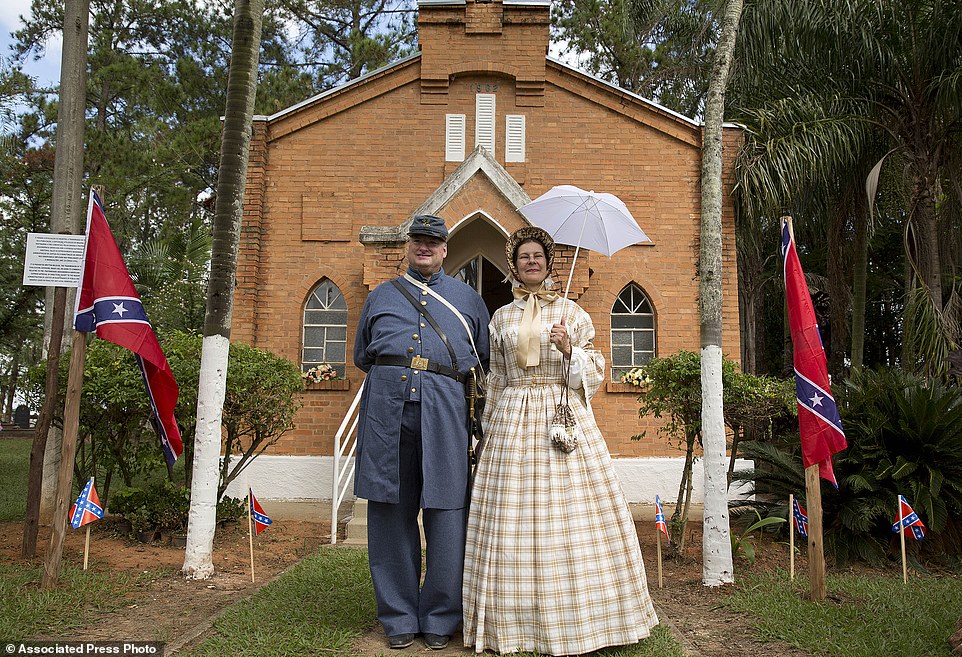
Descendants of American Southerners Philip Logan and his wife Eloiza Logan, pose for pictures during a party to celebrate the 150th anniversary of the end of the American Civil War in Santa Barbara d’Oeste, Brazil, Sunday, April 26, 2015. Thousands turn out every year, including many of those who trace their ancestry back to the dozens of families who, enticed by the Brazilian government’s offers of land grants, settled here from 1865 to around 1875, as well as country music enthusiasts, history buffs and locals with a hankering for buttermilk biscuits. (AP Photo/Andre Penner)
Confederados earned a reputation for honesty and hard work. Dom Pedro’s program was judged a success by immigrant and government alike. The settlers brought modern cultivation techniques and new food crops, all of which were quickly adopted by native Brazilian farmers.
Small wonder. Mark Twain once wrote “The true Southern watermelon is a boon apart, and not to be mentioned with common things. It is chief of this world’s luxuries, king by the grace of God over all the fruits of the earth. When one has tasted it, he knows what the angels eat. It was not a Southern watermelon that Eve took; we know it because she repented”.
That first generation kept to itself for the most part, building themselves Baptist churches and town squares, while traditional southern dishes like barbecue, buttermilk biscuits, vinegar pie and southern fried chicken did their own sort of culinary diplomacy with native populations.
Slavery remained legal in Brazil until 1888, but this nation of 51% African or mixed-race ancestry (according to the 2010 census), seems more interested in understanding and celebrating their past, than tearing their culture apart because of it.
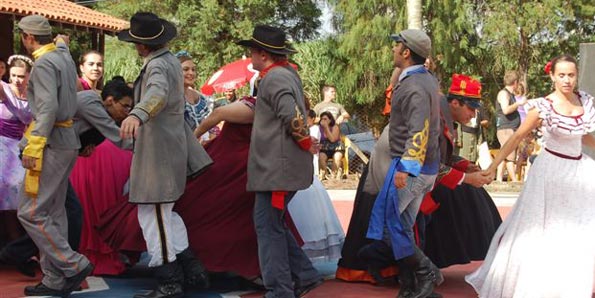
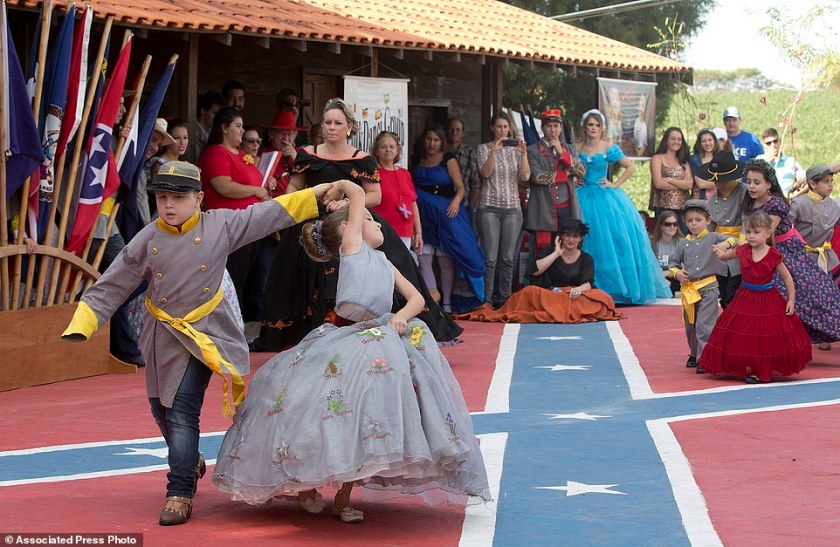
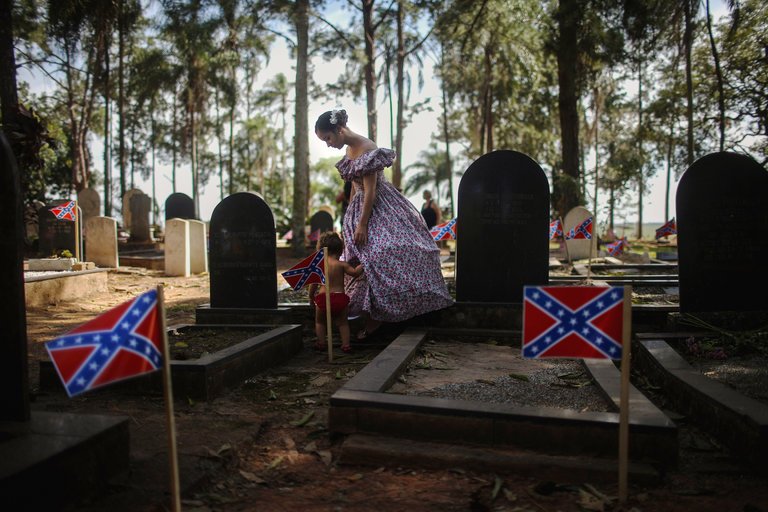
Today, descendants of those original Confederados preserve their cultural heritage through the Associação Descendência Americana (American Descendants Association), with an annual festival called the Festa Confederada. There you’ll find hoop skirts and uniforms in gray and butternut, along with the food, the music and the dances of the antebellum South.
There you will also find the Confederate battle flag. It seems that Brazilians have thus far resisted that peculiar urge afflicting the American left, to hide from its own history.
‘“This is a joyful event,” said Carlos Copriva, 52, a security guard who described his ancestry as a mix of Hungarian and Italian. He was wearing a Confederate kepi cap that he had bought online as he and his wife, Raquel Copriva, who is Afro-Brazilian, strolled through the bougainvillea-shaded cemetery. Smiling at her husband, Ms. Copriva, 43, who works as a maid, gazed at the graves around them. “We know there was slavery in both the United States and Brazil, but look at us now, white and black, together in this place,” she said while pointing to the tombstones. “Maybe we’re the future and they’re the past.”’
“A woman in a traditional hoop skirt walked past graves adorned with Confederate battle flags in Santa Bárbara d’Oeste, Brazil. An annual celebration of the area’s many Confederate settlers was held in the cemetery last month”. Hat tip to Mario Tama/Getty Images, New York times, for this image







 In 1582, France switched from the Julian calendar to the Gregorian moving New Year to January 1 as specified by the Council of Trent, of 1563. Those who didn’t get the news and continued to celebrate New Year in late March/April 1, quickly became the butt of jokes and hoaxes.
 In Scotland, April Fools’ Day is traditionally called Hunt-the-Gowk Day. Though the term has fallen into disuse, a “gowk” is a cuckoo or a foolish person. The prank consists of asking someone to deliver a sealed message requesting unspecified assistance. The message reads “Dinna laugh, dinna smile. Hunt the gowk another mile”. On reading the message, the recipient will explain that in order to help, he’ll first need to contact another person, sending the victim on down the road with the same message.
 Animals were kept at the Tower of London since the 13th century, when Emperor Frederic II sent three leopards to King Henry III. In later years, elephants, lions and even a polar bear were added to the collection, the polar bear trained to catch fish in the Thames.
 In “Reminiscences of an Old Bohemian”, Gustave Strauss laments his complicity in the hoax in 1848. “These wretched conspirators”, as Straus called his accomplices, “had a great number of order-cards printed, admitting “bearer and friends” to the White Tower, on the 1st day of April, to witness…the famous grand annual ceremony of washing the lions”.
 In 1957, (you can guess the date), the BBC reported the delightful news that mild winter weather had virtually eradicated the dread spaghetti weevil of Switzerland. Swiss farmers were now happily anticipating a bumper crop of spaghetti. Footage showed smiling Swiss, happily picking spaghetti from the trees.
 The Warby Parker Company website describes a company mission of “offer[ing] designer eyewear at a revolutionary price, while leading the way for socially conscious businesses”.


















 Historical Easter Eggs - Today in History
You must be logged in to post a comment.