The Confucian maxim may have crossed from China to Japan with a Tendai-Buddhist legend, sometime around the 8th century. At the time, the story had nothing to do with monkeys.
The Analects of Confucius is a written record of the sayings of the philosopher and his contemporaries, compiled between 475 and 221BC. In it, a follower named Yen Yüan asked the Master about perfect virtue. Confucius said, “To subdue one’s self and return to propriety, is perfect virtue. If a man can for one day subdue himself and return to propriety, all under heaven will ascribe perfect virtue to him”.
“I beg to ask the steps of that process”, asked the student. Confucius replied, “Look not at what is contrary to propriety. Listen not to what is contrary to propriety. Speak not what is contrary to propriety. Make no movement which is contrary to propriety”.
It was an ancient idea, even then. Zarathrusta, also known as Zoroaster, is in some respects the father of the world’s first monotheistic religion. It was sometime around 1200BC when Zoroaster taught his followers on the high Iranian Plateau “Humata, Hukhta, Hvarshta”. “Good Thoughts, Good Words, Good Deeds”.
The Confucian maxim may have crossed from China to Japan with a Tendai-Buddhist legend, sometime around the 8th century. At the time, the story had nothing to do with monkeys.
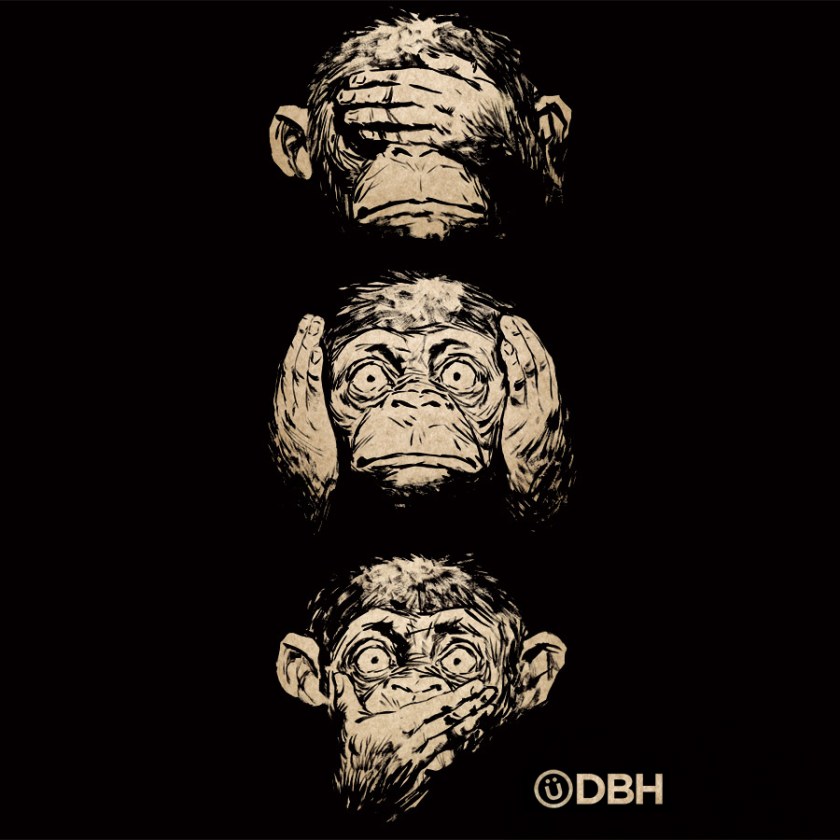
3 Wise Monkeys by Yannick Bouchard
In medieval Japanese, mi-zaru, kika-zaru, and iwa-zaru translate as “don’t see, don’t hear, and don’t speak”, -zaru being an archaic negative verb conjugation and pronounced similarly to “saru”, the word for monkey.
The visual play on words, then, depicts Iwazaru covering his mouth, Kikazaru covering his ears, and Mizaru covering his eyes.
Though it’s unusual to see him anymore, there is a fourth monkey. Shizaru is generally depicted with his arms crossed or covering his privates, his name variously translated as “do no evil”, or “know no evil”.
The first known depiction of the “Three Mystic Apes” appears over the doors of the Tōshō-gū shrine in Nikkō, Japan, carved sometime in the 17th century.
Mohandas Karamchand Gandhi was a Hindu lawyer, member of the merchant caste from coastal Gujarat, in western India. Today he is known by the honorific “Mahatma”, from Gandhithe Sanskrit “high-souled”, or “venerable”.
Ghandi is recognized as the Father of modern India, who brought Independence to his country through non-violent protest. Mohandas Gandhi lived a life of poverty and simplicity, owning almost no material possessions at the time of his assassination by Hindu nationalist Nathuram Vinayak Godse on January 30, 1948.
Beside the clothes on his back, Gandhi owned a tin cup and a spoon, a pair of sandals, his spectacles and a set of three carved monkeys, reminding him to hear no evil, see no evil and speak no evil.
If you enjoyed this “Today in History”, please feel free to re-blog, “like” & share on social media, so that others may find and enjoy it too. Please click the “follow” button on the right, to receive email updates on new articles. Thank you for your interest, in the history we all share.
The $1 million the Confederate government sunk into their Canadian office, probably did them more harm than good. Those resources could have been put to better use.
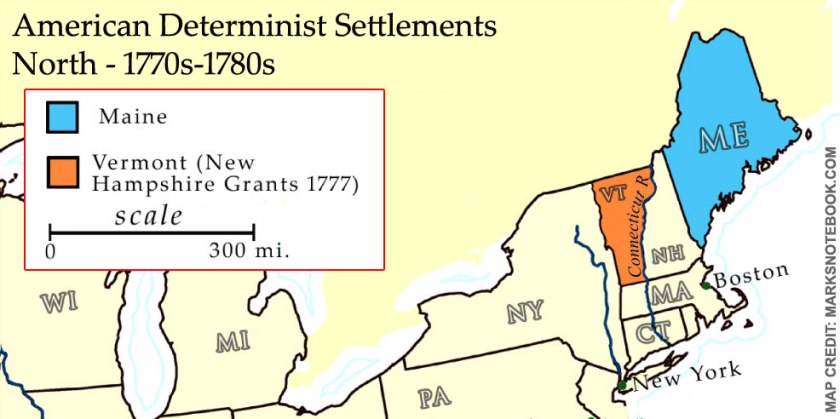
In the late 18th century, lands granted by the governor of New Hampshire led the colonial province into conflict with the neighboring province of New York. Conflict escalated over jurisdiction and appeals were made to the King, as the New York Supreme Court invalidated these “New Hampshire grants”. Infuriated residents including Ethan Allen and his “Green Mountain Boys” rose up in anger. Two natives of Westminster Vermont, then part of the New Hampshire land grants, were killed on March 13, 1775, by British Colonial officials. Today, the event is remembered as the “Westminster Massacre”.
The battles at Lexington and Concord broke out a month later, ushering in a Revolution and eclipsing events to the north. New York consented to admitting the “Republic of Vermont” into the union in 1790, ceding all claims on the New Hampshire land grants in exchange for a payment of $30,000. Vermont was admitted as the 14th state on March 4, 1791, the first state so admitted following the adoption of the federal Constitution.
Organized in 1785, St. Albans forms the county seat of Franklin County, Vermont. 15 miles from the Canadian border and situated on the eastern shore of Lake Champlain, it’s not the kind of place you’d expect, for a Civil War story.
St. Albans Vermont, 1864
The Confederate States of America maintained government operations in Canada, from the earliest days of the Civil War. Toronto was a logical relay point for communications with Great Britain, from whom the Confederate government sought unsuccessfully to gain support.
Secondly, Canada provided a safe haven for prisoners of war, escaped from Union camps.
Former member of Congress and prominent Ohio “Peace Democrat” Clement Vallandigham fled the United States to Canada in 1863, proposing to detach the states of Illinois, Indiana and Ohio from the Union, in exchange for sufficient numbers of Confederate troops to enforce the separation. Vallandigham’s five-state “Northwestern Confederacy” would include Kentucky and Missouri, breaking the Union into three pieces. Surely that would compel Washington to sue for peace.
In April 1864, President Jefferson Davis dispatched former Secretary of the Interior Jacob Thompson, ex-Alabama Senator Clement Clay, and veteran Confederate spy Captain Thomas Henry Hines to Toronto, with the mission of raising hell in the North.
This was no small undertaking. A sizeable minority of Peace Democrats calling themselves “Copperheads” were already in vehement opposition to the war. So much so that General Ambrose Burnside declared in his General Order No. 38, that “The habit of declaring sympathy for the enemy will not be allowed in this” (Ohio) “department. Persons committing such offenses will be at once arrested with a view of being tried. . .or sent beyond our lines into the lines of their friends. It must be understood that treason, expressed or implied, will not be tolerated in this department“.
Hines and fellow Confederates worked closely with Copperhead organizations such as the Knights of the Golden Circle, the Order of the American Knights, and the Sons of Liberty, to foment uprisings in the upper Midwest.
In the late Spring and early Summer of 1864, residents of Maine may have noted an influx of “artists”, sketching the coastline. No fewer than fifty in number, these nature lovers were in fact Confederate topographers, sent to map the Maine coastline.
The Confederate invasion of Maine never materialized, thanks in large measure to counter-espionage efforts by Union agents.
J.Q. Howard, the U.S. Consul in St. John, New Brunswick, informed Governor Samuel Cony in July, of a Confederate party preparing to land on the Maine coast.
The invasion failed to materialize, but three men declaring themselves to be Confederates were captured on Main Street in Calais, preparing to rob a bank.
Disenchanted Rebel Francis Jones confessed to taking part in the Maine plot, revealing information leading to the capture of several Confederate weapons caches in the North, along with operatives in Maine, Massachusetts, New York, Pennsylvania, Maryland, Illinois, Kentucky, Tennessee and Ohio.
Captain Hines planned an early June uprising in the Northwest, timed to coincide with a raid planned by General John Hunt Morgan. Another uprising was planned for August 29, timed with the 1864 Democratic Convention in Chicago. It seems the conspirators’ actions didn’t quite live up to the heat of their rhetoric, and both operations fizzled. A lot of these guys were more talk than action, yet Captain Hines continued to send enthusiastic predictions of success, back to his handlers in Richmond.
The Toronto operation tried political methods as well, supporting Democrat James Robinson’s campaign for governor of Illinois. If elected they believed, Robinson would turn over the state’s militia and arsenal to the Sons of Liberty. They would never know. Robinson lost the election.
Bennett Henderson Young
All this cost money, and lots of it. In October 1864, the Toronto operation came to St. Albans, to make a withdrawal.
Today, St. Albans is a quiet town of 6,918. In 1864 the town was quite wealthy, home to manufacturing and repair facilities for railroad locomotives. Located on a busy rail line, St. Albans was also home to four banks.
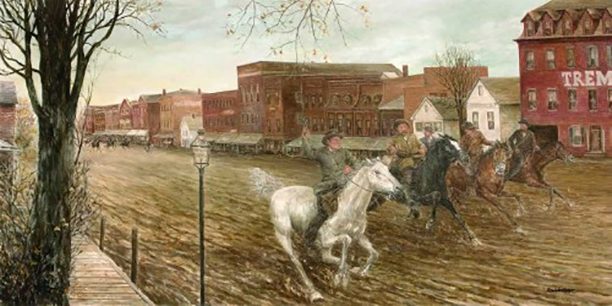
Nicholasville, Kentucky native Bennett Henderson Young was a member of the Confederate 8th Kentucky Cavalry, captured during Morgan’s 1863 raid into Ohio. By January, Young had escaped captivity and fled to Canada. On October 10, Bennett crossed the Canadian border with two others, taking a room at the Tremont House, in St. Albans. The trio said they had come for a “sporting vacation”.
In the following days, small groups filtered into St. Albans, quietly taking rooms across the town. There were 21 of them, former POWs and cavalrymen all, hand selected by Young for their daring and resourcefulness.
On October 19 the group split up. Announcing themselves to be Confederate soldiers, groups of them simultaneously robbed three of St. Albans’ four banks, while eight or nine held the townspeople at gunpoint, on the village green. One resident was killed before it was over and another wounded. Young ordered his troops to burn the town, but the bottles of “Greek Fire” they carried for the purpose, failed to ignite. Only one barn was burned down and the group got away with a total of $208,000, and all the horses they could find. It was the northernmost Confederate action of the Civil War.
The group was arrested on returning to Canada and held in Montreal. The Lincoln administration sought extradition, but the Canadian court decided otherwise, ruling that the raiders were under military orders at the time, and neutral Canada could not extradite them to America. The $88,000 found with the raiders, was returned to Vermont.
The $1 million the Confederate government sunk into their Canadian office, probably did them more harm than good. Those resources could have been put to better use, but we have the advantage of hindsight. Neither Captain Hines nor Jefferson Davis could know how their story would turn out. In the end, they both fell victim to that greatest of human weaknesses, of believing what they wanted to believe.
Entering via a long tunnel, the boys discovered what turned out to be a cave complex, its walls covered with depictions of animals. Hundreds of them. Four teenagers in Nazi occupied France, had discovered some of the oldest and finest prehistoric art, in the world.
The Battle of France began on May 10, 1940, with the German invasion of France and the Low Countries of Belgium, Luxembourg and the Netherlands. By the end of May, German Panzer columns had hurled the shattered remnants of the allied armies into the sea, at a place called Dunkirk.
The speed and ferocity of the German Blitzkrieg left the French people shocked and prostrate in the wake of their surrender, that June. All those years their government had told them, the strength of the French army combined with the Maginot Line was more than a match for the German military.
France had fallen in six weeks.
On June 18, Charles DeGaulle addressed the French nation from his exile in Great Britain, exhorting his countrymen to fight on. Resist. The idea caught on quickly in occupied regions.
Germany installed a Nazi-approved French government in the southern part of “La Métropole” in July, headed by WW1 hero Henri Pétain. Resistance against this new government in Vichy was slower to form. This was, after all a French government, and French attitudes took a decidedly anti-English turn with the July 3 British attack on the French fleet, at Mers-el-Kébir.
Before long, Vichy’s collaborationist policies hardened French attitudes against itself. The French Resistance was born.
Sometime around this period, a tree fell unseen near the French village of Montignac. On September 12, 1940, 18-year old Marcel Ravidat was walking his black & white mongrel dog “Robot”, in the woods. Coming upon the downed tree, the pair noticed a deep hole had opened up, where the tree had once stood. Stories differ as to which of the two went down the hole first, but it soon became clear. Marcel Ravidat and his dog had discovered something more than a mere hole in the ground.
The boy returned to the site with three buddies, Jacques Marsal, Georges Agnel, and Simon Coencas. Entering via a long tunnel, the boys discovered what turned out to be a cave complex, its walls covered with depictions of animals. Hundreds of them.
History is no single narrative. It is a thousand times a thousand, each layered and intertwined with the other. Here, four teenagers in Nazi occupied France, had discovered some of the oldest and finest prehistoric art, in the world.
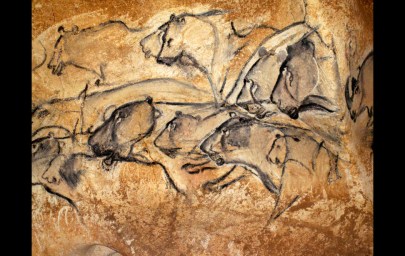
The Lascaux Caves are located in the Dordogne region, in Southwestern France. Some 17,000 years ago, Upper Paleolithic artists mixed mineral pigments such as iron oxide (ochre), haematite, and goethite, suspending pigments in animal fat, clay or the calcium-rich groundwater of the caves themselves. Shading and depth were added with charcoal.
Colors were swabbed or blotted onto surfaces. There is no evidence of brushwork. Sometimes, pigments were placed in a hollow tube, and blown onto the wall. Where the cave rock is softer, images are engraved.
The colour, size, quality and quantity of the images at Lascaux, are astonishing. Abbé Breuil, a Catholic priest and the first expert to examine its walls, called it the “Sistine chapel of prehistory”.
The artist or artists who created such images, nearly 2,000 of them occupying some 37 chambers, would have been recognizable as modern humans. Living as they did some 5,000 years before the Holocene Glacial Retreat, (yes, they had “climate change” back then), these cave-dwellers were pre-agricultural, subsisting on what they could find, or what they could kill.
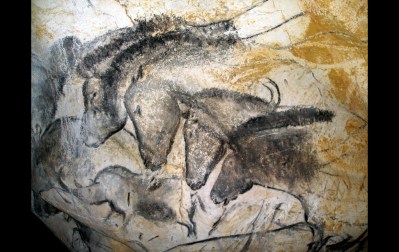
More than 900 of their images are recognizable as animals. 605 of them have been precisely identified. Hundreds of images depict horses, stags, cattle, lions and bison. Other subjects appear with less frequency. There are seven cats, a bird, a bear, a wooly rhinoceros, and one human.
The purpose served by these images is unclear. Perhaps they tell stories of past hunts, or maybe they were used to call up the spirits for a successful hunt. At least one professor of art and archaeology postulates that the dot and lattice patterns overlying many of these paintings may reflect trance visions, similar to the hallucinations produced by sensory deprivation.
36 animals occupy the “Great Hall of Bulls”, including a single black Auroch specimen measuring 17ft long, the largest such image ever discovered in cave art. One semi-spherical chamber, the “Apse”, is covered from the floor to its 8’9″ vaulted ceiling with overlapping, entangled drawings and engravings, demonstrating that these people erected scaffolding to create such work.
The Lascaux caves were used by the French Resistance for weapons storage during the war, and opened to the public in 1948. That would prove to be a mistake.
The underground environment had been stable for all those thousands of years. Now the light, the air circulation, and the exhalations of thousands of visitors a day, were irreparably changing the cave environment. By the 1950s, colors had noticeably begun to change and fade. Crystals and lichens began to grow on the walls, black and white molds grew quickly throughout the cave complex.
The cave was closed to the public in 1963, the paintings restored and a monitoring system installed. Molds, lichens and crystallized minerals bedevil the ancient cave art to this day. Only a handful of scientific experts are now permitted access to the site, and that’s only for a few days per month. Some of the most eminent preservation specialists on the planet continue to wrestle with the problem.
The prehistory buff can find a lot to like in the Vézère region of France. The valley has 147 prehistoric sites, 15 of them listed as Unesco World Heritage sites.
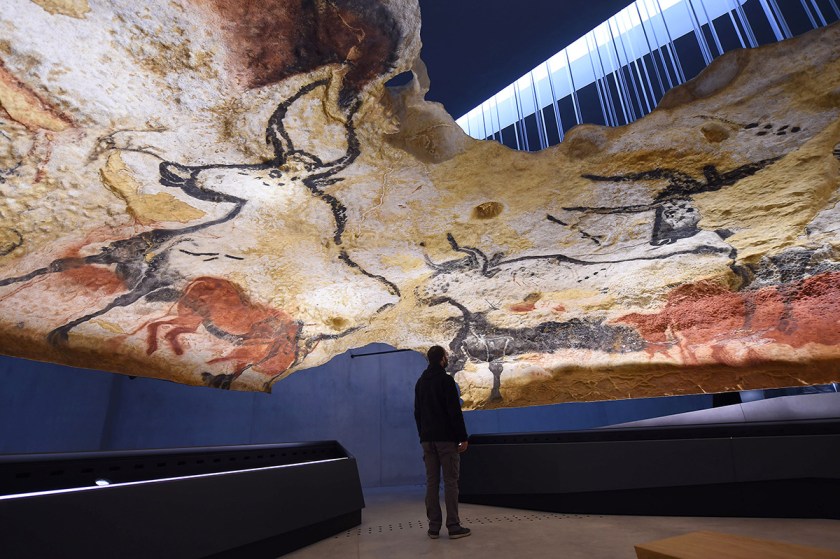
“Lascaux II” opened in 1983, an exact replica of the Hall of the Bulls and the “Painted Gallery” areas at the original, educating and informing the public without further harm to the archetype.
Inside the museum that houses Lascaux 4 (Mehdi Fedouach/AFP/Getty Images)
The 800 square meter mobile “Lascaux 3” began a world tour in 2012, scheduled to continue through 2020. Most recently, the exhibit departed the Kyushu National Museum in Fukuoka, Japan, on September 3. The €57 million ($68 million), multi-media Lascaux IV opened last December, 8,500 square meters of high-tech exhibit space where each visitor is free to explore four exhibition rooms, equipped with an electronic compagnon de visite, a tablet-like device which looks like it’s been flaked and formed out of slate, Fred Flintstone style.
Kindly permit me a personal note, on which to end. Years ago, the Long family convened our annual “Blue Gray Ramble” at the Petersburg battlefield, in Virginia. There’s a cut running parallel to the lines there, almost a ravine, not far from the crater. The thing has got to be 12 feet deep, narrowing downward to a hard, dry stream bed.
Working our way down the bottom of the cut, we encountered an archaeologist’s dream of fossils: Gastropods, scallop shells, copepods, shark’s teeth. The denizens of a long forgotten sea, cast in stone and exposed to the light of a Civil War battlefield.
We were there that weekend to discover history, and that is what we did, albeit from a new and unexpected perspective.
‘With you it rests, Callimachus, either to bring Athens to slavery, or, by securing her freedom, to be remembered by all future generations…We generals are ten in number, and our votes are divided: half of us wish to engage, half to avoid a combat. Now, if we do not fight, I look to see a great disturbance at Athens which will shake men’s resolutions, and then I fear they will submit themselves. But, if we fight the battle…we are well able to overcome the enemy.’
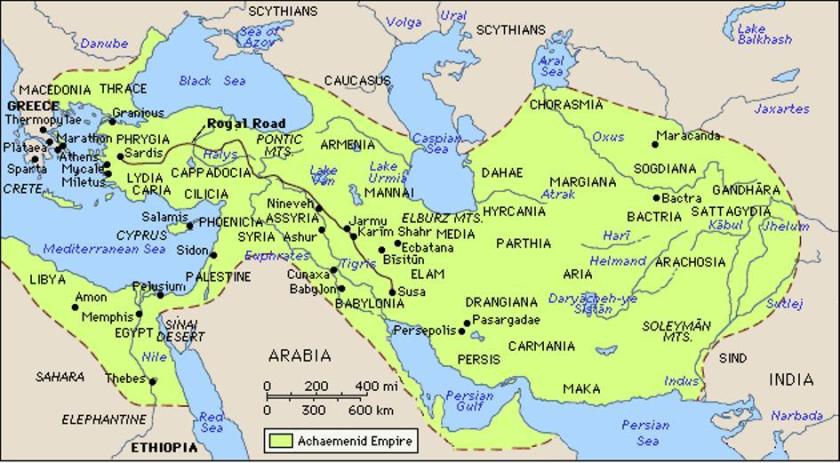
200 years before the classical age of Greece, King Darius I, third King of the Persian Achaemenid Empire, ruled over an area stretching from North Africa to the Indian sub-continent, from Kazakhstan to the Arabian Peninsula. Several Anatolian coastal polities rebelled in 499BC, with support and encouragement from the mainland city states of Athens and Eritrea.
Achaemenid Empire
This “Ionian Revolt” lasted until 493BC. Though ultimately unsuccessful, the Greeks had exposed themselves to the wrath of Darius. Herodotus records that, every night before dinner, Darius required one of his servants three times, to say to him “Master, remember the Athenians“.
Darius I
The Persian “King of Kings” sent emissaries to the Greek city states, demanding gifts of earth and water, signifying Darius’ dominion over all the land and sea. Most capitulated, but Athens put Darius’ emissaries on trial and executed them. Sparta didn’t bother with a trial. They threw Darius’ ambassadors down a well. “There is your earth”, they said. “There is your water”.
Athens and Sparta were now effectively at war with the Persian Empire.
2507 years ago, Darius sent an amphibious expedition to the Aegean, attacking Naxos and sacking Eritrea. A force of some 600 triremes commanded by the Persian General Datis and Darius’ own brother Artaphernes then sailed for Attica, fetching up in a small bay near the town of Marathon, about 25 miles from Athens.
An army of 9,000-10,000 hoplites (armored infantry) marched out of Athens under the leadership of ten Athenian Strategoi (Generals), to face the 25,000 infantry and 1,000 cavalry of the Persians. The Athenian force was soon joined by a full muster of 1,000 Plataean hoplites, while Athens’ swiftest runner Pheidippides was dispatched to Lacedaemon, for help.
The festival of Carneia was underway at this time, a sacrosanct religious occasion during which the Lacedaemonian (Spartan) army would not fight, under any circumstance. Sparta would be unavailable until the next full moon, on September 9. With 136 miles to Marathon, Spartan reinforcement was unlikely to arrive for the next week or more.
The Athenian force arrived at the Plain of Marathon around September 7, blocking the Persian route into the interior.
Facing a force more than twice as large their own, Greek Generals split 5 to 5 whether to risk battle.
A “Polemarch” is an Athenian civil dignitary, with full voting rights in military matters. General Miltiades, who enjoyed a degree of deference due to his experience fighting Persians, went to the Polemarch Callimachus, for the deciding vote.
The stakes are difficult to overstate. Arguably, the future of Western Civilization hung in the balance.
With Athens behind them now defenseless, its every warrior here on the plain of Marathon, Miltiades spoke. ‘With you it rests, Callimachus, either to bring Athens to slavery, or, by securing her freedom, to be remembered by all future generations…We generals are ten in number, and our votes are divided. Half of us wish to engage, half to avoid a combat. Now, if we do not fight, I look to see a great disturbance at Athens which will shake men’s resolutions, and then I fear they will submit themselves. But, if we fight the battle…we are well able to overcome the enemy.’
With less than a mile between them, the two armies had faced one another for five days and five nights. On September 12, 490BC, the order went down the Athenian line. “At them!”
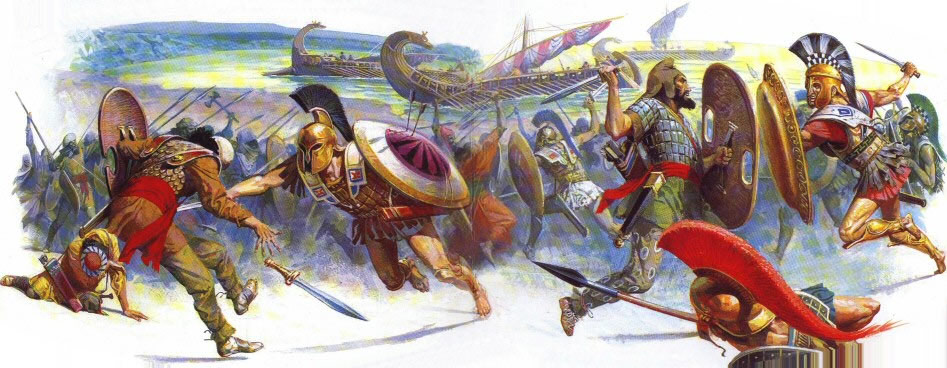
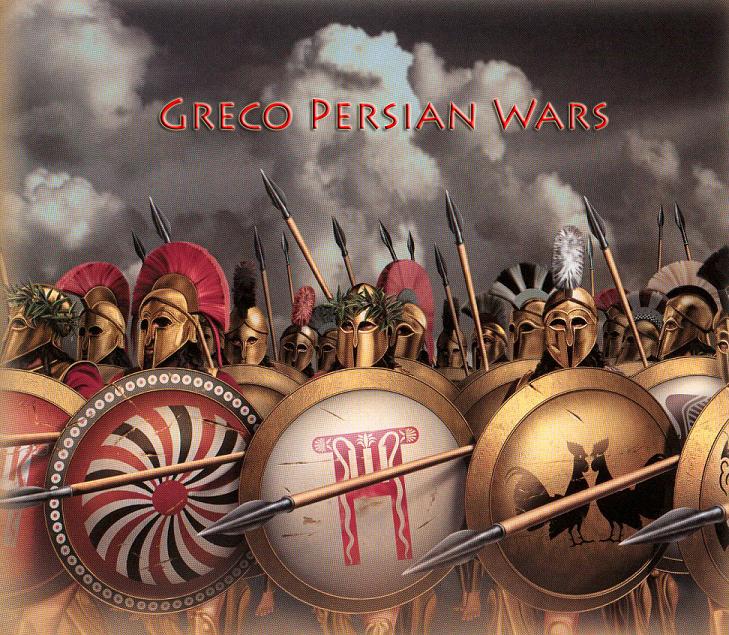
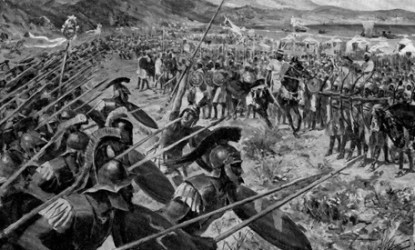
Weighed down with 70lbs per man of bronze and leather armor, the Greek line likely marched out to 200 yards, the effective range of Persian archers. Greek heavy infantry closed the last 200 meters at a dead run, the first time a Greek army had fought that way.
Persian shafts flew by the thousands, yet the heavy armor and wooden shields of the hoplite formation, held. Bristling with arrows yet seemingly unhurt, the Greek phalanx smashed into the Persian adversary, like an NFL front line into an ‘Antifa” demonstration.
Tom Holland, author of Persian Fire, describes the impact. “The enemy directly in their path … realized to their horror that [the Athenians], far from providing the easy pickings for their bowmen, as they had first imagined, were not going to be halted … The impact was devastating. The Athenians had honed their style of fighting in combat with other phalanxes, wooden shields smashing against wooden shields, iron spear tips clattering against breastplates of bronze … in those first terrible seconds of collision, there was nothing but a pulverizing crash of metal into flesh and bone; then the rolling of the Athenian tide over men wearing, at most, quilted jerkins for protection, and armed, perhaps, with nothing more than bows or slings. The hoplites’ ash spears, rather than shivering … could instead stab and stab again, and those of the enemy who avoided their fearful jabbing might easily be crushed to death beneath the sheer weight of the advancing men of bronze“.
Darius’ force was routed, driven across the beach and onto waiting boats. 6,400 Persians lay dead in the sand, an unknown number were chased into coastal swamps, and drowned. Athens lost 192 men that day, Plataea, 11.
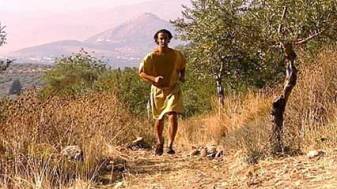
In the popular telling of this story, Pheidippides ran the 25 miles to Athens and announced the victory with the single word “Nenikēkamen!” (We’ve won!”), and dropped dead.
That version first appeared in the writings of Plutarch, some 500 years later. It made for a good story for the first Olympic promoters, too, back in 1896, but that’s not the way it happened.
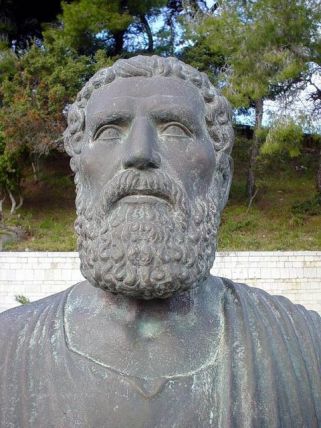
Herodotus of Halicarnassus, described by no less a figure than Cicero as the “Father of History”, tells us that Pheidippides was already spent. No wonder. The man had run 140 miles from Athens to Lacedaemon, to ask for Spartan assistance.
Despite the exhaustion of battle and the weight of all that armor, the Athenian host marched the 25 miles back home, arriving in time to head off the Persian fleet. The Spartans arrived at Marathon the following day, having covered 136 miles in three days.
Though a great victory for the Greeks, Darius’ loss at Marathon barely put a dent in the vast resources of the Achaemenid Empire. The Persian King, would return.
Simonides’ famous encomium to the dead was inscribed on a commemorative stone at Thermopylae, atop a hill on which the Greeks made their final stand. “Go tell the Spartans, stranger passing by, that here, obedient to Spartan law, we lie.”
In 490BC, Persian King Darius I sent an amphibious expedition into the Aegean, only to be defeated by a far smaller force of Athenians at the Bay of Marathon.
As Achaemenid Emperor, leader of the most powerful state of his time, King Darius I was sovereign over 21 million square miles and more. He had more to deal with than a handful of malcontents in the Peloponnese. At the moment, Darius had an Egyptian revolt to put down, but the “King of Kings'” would be back. He had a score to settle with the Greeks. King Darius died before he was through, so it was that the Persian King Xerxes would return to finish what his father had begun, ten years earlier.
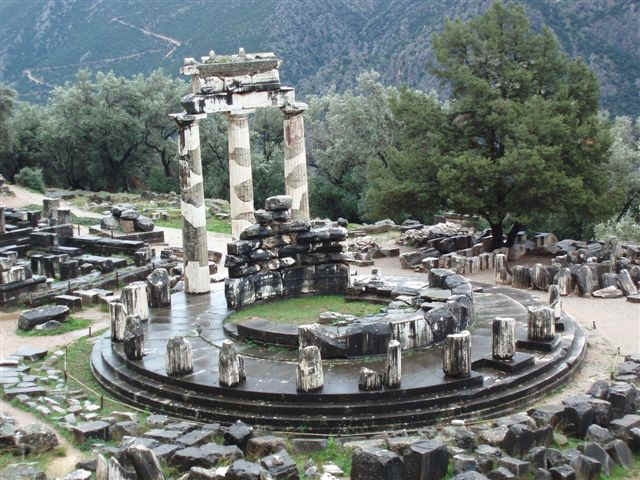
In 480BC, news of a massive Persian army on the move reached Lacedaemonia, principal region of the Spartan state. De facto military leaders of the Greek alliance, the Spartans were then celebrating the religious festival of Carneia. Spartan law forbade military activity at this time, the same reason they had shown up late at Marathon, ten years earlier. Spartan leaders went to the Temple of Apollo at Delphi, for advice.
The Temple of Apollo, at Delphi
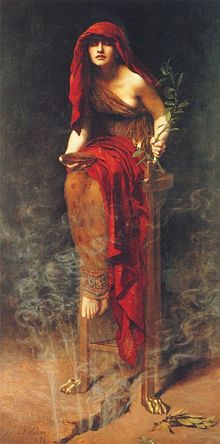
The Oracle at Delphi was a seer, usually selected from among epileptics, as the Greeks believed seizures were evidence that the person was in touch with the Gods. A careful ritual was observed, before the Priestess would speak. First she would bathe in the Castalian Spring, before drinking from another stream. A priest would then pour ice water over a goat, to determine the presence of Apollo. The goat’s shivering was understood to indicate that the God was present, and that he had invested his powers in the Oracle. If the signs were fortuitous, the Oracle would then inhale the gas emitted from a chasm near the temple. With volcanic gasses rising from the ground beneath her, the “Pythia” would then mount to the Tripod. Only then would she speak.
Oracle at the Temple of Apollo, at Delphi
“Hear your fate”, she said. “O dwellers in Sparta of the wide spaces. Either your famed, great town must be sacked by Perseus’ sons, or, if that be not, the whole land of Lacedaemon shall mourn the death of a king of the house of Heracles. For not the strength of lions or of bulls shall hold him, strength against strength; for he has the power of Zeus, and will not be checked until one of these two he has consumed.”
For King Leonidas of Sparta, the meaning was clear. He himself would have to die, to fulfill the Oracle’s prophesy.
Leonidas gathered up a small blocking force of 300 Spartan Peers, all of them “Sires”. This was understood to be a suicide mission. Leonidas wanted only those warriors who would leave behind, a son.
Several Greek city states were technically at war with one another in 480BC, but that was dropped, as preparations were made for a two-pronged defense. An allied Greek navy would meet the Persian triremes at the straits of Artemisium, while an army of Hoplites, Greek heavy infantry, would meet the Persian army at the narrow pass known as the “Hot Gates”. Thermopylae.
The 300 marched out at the head of an allied army of 7,000, to meet a Persian army which modern estimates put at 100,000 to 150,000. A native of Trachis told the Spartan General Dienekes, that Persian archers were so numerous their arrows would block out the sun. “Good”, replied Dienekes. “Then we shall fight in the shade”.
When the overwhelming Persian army demanded the Spartans lay down their arms, Leonidas’ response was short and sweet. “Molon Labe”, he said. Come and get them.
The two armies collided, on or about the 8th of September, 480BC. Thermopylae, a mountain pass delineated by the Phocian Wall on one side and the Aegean Sea on the other, measured the width of two carts abreast. Great piles of Persian dead choked the pass by the end of the 9th, but nothing that Xerxes could throw at the Greek heavy infantry could break their phalanx.
A traitor to his people then rose among the local population, Ephialtes of Trachis, who led the Persians through a narrow path to come around behind the Greek line.
Knowing he was betrayed and would soon be surrounded, Leonidas sent most of the allied soldiers away. They would be needed for the battle yet to come.
On day three, King Leonidas was left with his 300 Spartans, 700 Thespian allies, and an unreliable contingent of 400 Thebans. True to form, the Theban band defected en masse to the Persian side, at the earliest opportunity. Still, the hordes of Xerxes were unable to break through the Greek line, even on two fronts. They backed off and rained down arrows from a distance, until no Greek was left standing.
Artemisium devolved into a meaningless stalemate, yet the Greek alliance had demonstrated itself more than capable of standing up to the mightiest empire of its time. Athens, lacking the manpower to fight simultaneously on land and sea, abandoned their city to be burnt to the ground. The regrouped Greek Navy crushed the Persians at Salamis. The last Persian invader was driven off the Greek mainland the following August, following the Greek victory at Plataea.
Simonides’ famous encomium to the dead was inscribed on a commemorative stone at Thermopylae, atop a hill on which the Greeks made their final stand. The original stone is gone now, but the epitaph was engraved on a new stone in 1955.
“Go tell the Spartans, stranger passing by, that here, obedient to Spartan law, we lie.”
Built under the reign of King Solomon in the 10th century BC, Solomon’s Temple was the first holy temple in ancient Jerusalem. According to Rabbinic sources the temple stood on part of the Temple Mount, also known as Mount Zion, for 410 years, before being sacked and burned to the ground by Babylonian King Nebuchadnezzar II, in 587 BC.
Built under the reign of King Solomon in the 10th century BC, Solomon’s Temple was the first holy temple in ancient Jerusalem. According to Rabbinic sources the temple stood on part of the Temple Mount, also known as Mount Zion, for 410 years, before being sacked and burned to the ground by Babylonian King Nebuchadnezzar II, in 587 BC.So important is this event to the Jewish people that it is commemorated still as the saddest day of the Jewish calendar. A day of fasting and mourning known as Tisha B’Av.
A second temple was built on the site in 516BC, and expanded during the reign of Herod the Great. This second temple stood until the Roman sack of Jerusalem in 70AD, according to Jewish tradition falling on the same day as the first temple.
The first Roman involvement with the Kingdom of Judea came in 67BC. The client Kingdom of the Herodian Dynasty became a Roman Province in the year 6AD.
Long standing religious disputes erupted into a full scale Jewish revolt in 66. Thousands of Jews were executed in Jerusalem and the second temple plundered, resulting in the Battle of Beth Horon, in which a Syrian Legion was destroyed by Jewish rebels. The future emperor Vespasian appointed his son Titus as second in command, entering Judea in 67 at the head of four legions of Roman troops.
“Depiction of the Roman triumph celebrating the Sack of Jerusalem on the Arch of Titus in Rome. The procession features the Menorah and other vessels taken from the Second Temple”. H/T Wikipedia
A three year off and on siege followed, with Vespasian being recalled to Rome in 69 to become Emperor. The Great Jewish Revolt was now Titus’ war.
The Jewish historian Josephus acted as intermediary throughout much of the siege, though his impartiality has been questioned since he was both friend and adviser to Titus. At one point Josephus entered the city to negotiate, but later fled, wounded by an arrow in a surprise attack which almost caught Titus himself.
The Siege and Destruction of Jerusalem by the Romans Under the Command of Titus, A.D. 70, Oil on canvas by David Roberts, 1850
A brutal siege of Jerusalem followed through most of the year 70, in which Jewish Zealots burned their own food supply, forcing defenders to “Fight to the End”. During the final stages, Zealots following John of Giscala still held the Temple, while a splinter group called the Sicarii (literally, “Dagger Men”), led by Simon Bar Giora, held the upper part of the city. The Second Temple, one of the last fortified bastions of the rebellion, was destroyed on Tisha B’Av, July 29 or 30, 70AD. By September 7 the Roman army under Titus had fully occupied and plundered all of Jerusalem.
Mountain fortress of Masada. Note the siege ramp to the right, by which the besieging force gained access to the top. The Romans built that.
The first Jewish-Roman war would last for three more years, culminating in the Roman siege of the mountain fortress of Masada, in which defenders committed mass suicide in April of 73 rather than being conquered by the Romans.
There would be two more Jewish-Roman wars: Kitos War (115–117), sometimes called the “Rebellion of the Exile”, and the Bar Kokhba Revolt of 132 through 135. The wars had a cataclysmic impact on the Jewish people, the resulting diaspora changing them from a major Eastern Mediterranean population into a scattered and persecuted minority. The Jewish people would not reestablish a major presence in the Levant until the constitution of the State of Israel, in 1948.
Emperor Justinian built a Christian church in the 530s on the ruins of the Second Temple, which was burned to the ground by Sassanid Emperor Khosrau II early in the 7th century. The Umayyad Caliphate built the “Farthest”, or “al-Aqsa” mosque and the Dome of the Rock on the site, following the Islamic conquest of Jerusalem in 637. Islamic authorities have ruled over the city ever since, with the exception of an 88-year period following the First Crusade, 1099-1187.
The Jerusalem Islamic “Waqf”, a religious trust acting as civil administrators for the “Haram esh-Sharif” ( “The Noble Sanctuary”), or “Temple Mount” to Christians and Jews. The Waqf has held administrative authority over the holy sites of Jerusalem since the Muslim reconquest of the city in 1187. The most recent Waqf was established by the Hashemite Kingdom of Jordan, following the 1948 war. Israel recaptured the old city after the 6-day war in 1967, when they informed Waqf authorities that it would be allowed ongoing control over the old parts of the city.
An uneasy status quo remains to this day, with Israel maintaining “overall sovereignty” and the Muslim authorities maintaining “religious sovereignty”, over the Old City of Jerusalem. .9 square kilometers walled up within the modern city, the Old City is home to some of the most religiously significant sites, on the planet: the Temple Mount and Western Wall for Jews, the Church of the Holy Sepulchre for Christians, and the Dome of the Rock and al-Aqsa Mosque for Muslims.
National Geographic explains that 12/21/12 brings to a close not the end of time, but the end of the 12th Bak’tun, an almost 400-year period in the Mayan Long Count calendar. The world doesn’t end, according to this explanation, it just “rolls over” to the year zero and starts over, kind of like old cars used to do, when they reached 100,000 miles on the odometer.
One of the more profoundly silly bits of pop culture nonsense served up in the recent past, may be the world coming to an end on 12/21/12, according to the Mayan calendar. The calendar itself isn’t silly, it’s actually a very sophisticated mathematical construct, but the end of the world part certainly was.
According to linguist, anthropologist and Mayanist scholar Floyd Glenn Lounsbury and his “Lounsbury Correlation”, the Mayan Calendar dates back 5,131 years to August 13, 3114 BC. This day seems as good as any, though I’m sure there can be little certainty about a date that far in the past.
The Mayans were skilled mathematicians, and it shows in their calendar. They were the first to recognize the concept of zero, and worked extensively in a base 20 number system.
The Mayans used three separate calendars, each period represented by its own glyph. The Long Count was mainly used for historical purposes, able to specify any date within a 2,880,000 day cycle, about 7,885 solar years. The Haab was a civil calendar, consisting of 18 months of 20 days, and one 5-day Uayeb, a nameless period rounding out the 365-day year. The Tzolkin was the “divine” calendar, used mainly for ceremonial and religious purposes. Consisting of 20 periods of 13 days, the Tzolkin goes through a complete cycle every 260 days. The significance of this cycle is unknown, though it may be connected with the 263 day orbit of Venus. There is no year in the Haab or Tzolkin calendars, though a Haab and Tzolkin date may be combined to specify a particular day within a 52-year cycle.
National Geographic explains that 12/21/12 brings to a close not the end of time, but the end of the 12th Bak’tun, an almost 400-year period in the Mayan Long Count calendar. The world doesn’t end, according to this explanation, it “rolls over” to the year zero and starts over, kind of like old cars used to do, when the odometer reached 100,000 miles.
It doesn’t really roll over to “zero”, either. The base 20 numerical system means that 12/22/12 begins the next 400 year (actually 394.3 years) period to begin the 13th Bak’tun. It will reset to zero at the end of the 20th Bak’tun, about 3,000 years from now. Please let me know how that turns out.
The Mayan calendar system became extinct in most areas after the Spanish conquests of the 16th century, though it continues in use in many modern communities in highland Guatemala and in Veracruz, Oaxaca and Chiapas, Mexico.
The table of Long Count units below illustrates the Mayan units of measurement. A day is a K’in, there are 20 K’ins in a Winal, and so on. Today’s date, according to the Mayan calendar, is Long Count: 13.0.4.12.14, Calendar Round: 8 Ix 12 Yaxk’in, Year Bearer: 6 Ik’, Lord of Night: G2, 13 Bak’tun, 0 K’atun, 4 Tun, 12 Winal, 14 K’in, 8 Ix, G2, 12 Yaxk’in. Got it? Me neither.
The Battle of Cannae, fought this day in 216 BC, is studied by historians and military tacticians to this day. A Roman army, estimated at 86,000 Roman and allied troops, was drawn in and enveloped by Hannibal’s far smaller force.
There were two great powers in the Mediterranean region of 264BC: the Romans on the Italian peninsula, and Carthage, a North African maritime power settled by Phoenician travelers some 800 years earlier, in modern day Tunisia.
A dispute in Sicily that year led to war between the two powers, ending in Roman victory in 241BC and a vanquished Carthage being stripped of her Navy.
Hamilcar Barca was a great general of this, the first “Punic” war, the name deriving from the Latin word for Phoenician. Barca made his then 12-year-old son Hannibal swear undying hatred for the Romans.
At the age of 20, Hannibal Barca set out on what would become the second Punic war. It was late Spring, 218BC, when Hannibal left the Iberian outpost of “New Carthage”, now the Spanish city of Cartagena. Crossing into hostile Gaul (France) at the head of 38,000 infantry, 8,000 cavalry, and 37 war elephants, Hannibal arrived at the Rhône River in September.
Hannibal’s crossing of the Alps that winter is one of the great feats of military history, costing almost half his force before entering Italy that December.
What followed was a series of crushing defeats for Rome. First at the Battle of Trebia, then Lake Trasimene, Hannibal’s army laid waste to the Italian peninsula.
There was almost no family in all of Rome that didn’t lose one or more members in the swath of destruction brought down on them by Hannibal and his Carthaginian army.
At this point, Rome took the extreme step of appointing one man, absolute dictator of the Roman Republic. His name was Quintus Fabius Maximus Verrucosus. Rather than joining the Carthaginians in pitched battle, Fabius sought to wear them down in a series of “hit & run” and “scorched earth” tactics.
Fabius was right. His tactics were a military success and bought the Republic time in which to rebuild its military, but they were a political flop. The Roman psyche would accept nothing short of pitched battle. In six months, Fabius “Cunctator” (“the Delayer”) was replaced by the co-consuls Gaius Terentius Varro, and Lucius Aemilius Paullus.
In the co-consul system, Varro would be supreme commander of the army on one day, and Paullus the next. Knowing full well how this system worked and wanting to draw the more aggressive Varro into pitched battle, Hannibal sprung his trap on a day when Varro was in command.
The Battle of Cannae, fought this day in 216 BC, is studied by historians and military tacticians to this day. A Roman army, estimated at 86,000 Roman and allied troops, was drawn in and enveloped by Hannibal’s far smaller force. Squeezed into a pocket so tightly they could barely raise their weapons, the Legions were attacked from all sides.
Unable to function as a disciplined unit, as many as 75,000 Romans were hacked to death, equivalent to the seating capacity of the New York Mets’ Citi Field and Harvard Stadium, combined.
Another 10,000, were captured. Among the dead was a current Consul, the most powerful elected official in the Roman Republic, as well as both consuls from the preceding year.
80 senators, almost a third of the entire Roman Senate, were wiped out on that single day.
There was now no military force left between Hannibal and Rome itself. Most powers would have admitted defeat, and sued for peace. Not Rome. Unable to defeat the Carthaginian army in open battle, Rome returned to Fabian tactics, harassing the Carthaginians and wearing them down in an endless series of scorched earth and guerrilla tactics.
For 16 years, Hannibal remained undefeated on Italian soil, while his political adversaries at home never once sent him reinforcement. He was finally recalled to Carthage to defend his homeland against Roman attacks in North Africa and Spain. Hannibal was defeated by his own tactics at the Battle of Zama, the second Punic War ending in 201BC.
Hannibal, Louvre Museum.
Carthage was a thoroughly defeated power as Hannibal grew into his old age, but some in Rome wouldn’t let it go. Misbehaving Italian children were threatened that Hannibal would come and get them if they weren’t good. Roman politician Marcus Porcius Cato, “Cato the Elder”, ended his every speech, “Carthago delenda est”, “Carthage must be destroyed“.
The third Punic War saw the Romans attack Carthage itself. After three years of siege, the city fell in 146BC. Thousands were slaughtered, as many as 70,000 sold into slavery. Though the salting of fields is probably a later embellishment to the story, the city was sacked, then burned to the ground. Utterly destroyed.
Hannibal himself had grown elderly by the time of 181-183BC, fleeing from one town to the next to escape his Roman pursuers. Unwilling to be paraded through Rome in a cage, Hannibal committed suicide by poison sometime that same year. In a letter found after his death, Hannibal had written “Let us relieve the great anxiety of the Romans, who have found it too weighty a task, to wait for the death of a hated old man”.
This wasn’t the first recorded solar eclipse, just the first to have been predicted beforehand.
On this day in 585BC, ancient precursors of the Iranian and Turkish people squared off for battle, along the banks of the River Halys in modern Turkey. They were the Medes and the Lydians. They had been fighting one another for more than 15 years.
A total eclipse of the sun occurred sometime during the battle, causing both Kings and both armies to immediately cease fighting and lay down their weapons.
The Greek historian Herodotus wrote that Thales of Miletus had predicted the eclipse in a year when the Medians and the Lydians were at war. It’s possible to calculate the date with precision because you can run the “solar clock” backwards as well as forward, and May 28 became one of the cardinal dates from which other dates in antiquity are calculated.
This wasn’t the first recorded solar eclipse, just the first to have been predicted beforehand. Two Chinese astrologers had lost their heads for failing to predict one, back in the 22nd or 23rd century BC. Clay tablets from Babylon record an eclipse in Ugarit in 1375 BC. Other records report solar eclipses which “turned day into night” in 1063 and 763 BC.
Predicting a solar eclipse isn’t the same as predicting a lunar eclipse; the calculations are far more difficult. When the moon passes through the shadow of the sun, the event can be seen by half of the planet, the total eclipse phase lasting over an hour. In a solar eclipse, the shadow of the moon occupies only a narrow path, and the total eclipse phase is only about 7½ minutes at any given place.
The method Thales used to make his prediction is unknown, and there is no record of the ancient Greeks predicting any further eclipses. It’s possible that he borrowed his prediction from Egyptian astrologers, using their techniques of land measurement (geo metry in Greek), later codified by Euclid and loved by 8th graders the world over.
Be that as it may, for the first time in history a full eclipse of the sun had been predicted beforehand. The Battle of Halys marked the first time in history, that a war was ended when day turned to night. Aylattes, King of Lydia, and Cyaxares, King of the Medes, put down their weapons and declared a truce, and their soldiers followed suit. The kings of Cilicia and Babylon helped negotiate a more permanent treaty. Alyattes’ daughter Aryenis married Cyaxares’ son Astyages to seal the bargain, and the Halys River, now known as the River Kızılırmak, was agreed to be the border between the two peoples.
2,000 years later, the ancient civilization of Rome still permeates our everyday lives.
According to legend, Romulus and Remus were the sons of Rhea Silvia, the daughter of King Numitor of Alba Longa, a mythical city located in the Alban Hills southeast of what would become Rome. Numitor was deposed by his younger brother Amulius, who forced Rhea to become a vestal virgin so that she would not give birth to rival claimants to his title. However, Rhea was already pregnant by the war god Mars, and destined to give birth to Romulus and Remus.
Learning of the birth, Amulius ordered the infants drowned in the Tiber river, but the pair survived, washing ashore at the foot of the Palatine hill where they were suckled by a she-wolf.
Later discovered by the shepherd Faustulus, the boys were reared by the shepherd and his wife. Much later, the twins became leaders of a band of young shepherd warriors. On learning their true identity, the twins attacked Alba Longa, killed King Amulius, and restored their grandfather to the throne.
Abduction of the Sabine Women, by Giambologna
Romulus and Remus founded a town on the site where they had been saved, the traditional date being April 21, 753BC. Romulus later murdered his brother after some petty quarrel, making himself sole ruler of the settlement. He modestly called it “Rome”, after himself.
No new town would last long without women, so Romulus invited the neighboring Sabines to a festival, where he kidnapped their women. A war ensued, but the Sabine women persuaded the Sabine men away from seizing the place. They drew up a peace treaty, merging the two communities under the joint rule of Romulus and the Sabine king, Titus Tatius.
The Romulus and Remus mythology developed in the 4th century BC, the exact date of the founding set by the Roman scholar Marcus Terentius Varro, in the first century BC.
There would be six more kings of Rome, the last three believed to be Etruscan. The Roman Republic was formed around 509 BC, and ended around the time of the murder of Julius Caesar in 44BC.
Vincenzo Camuccini, “Morte di Cesare”, 1798,
The Roman Imperial period which emerged would later split in two, ending in the final dissolution of the Western Roman Empire on September 4, 476, when Romulus Augustus, the last Emperor of the Western Empire, was deposed by the Germanic chieftain, Odoacer.
The Eastern Empire, originally known as Byzantium, would last for another thousand years. The end came on May 29, 1453, when the capital city of Constantinople fellto the Ottoman Turks, who came to call the city “Istanbul”.


“I beg to ask the steps of that process”, asked the student. Confucius replied, “Look not at what is contrary to propriety. Listen not to what is contrary to propriety. Speak not what is contrary to propriety. Make no movement which is contrary to propriety”.
 The visual play on words, then, depicts Iwazaru covering his mouth, Kikazaru covering his ears, and Mizaru covering his eyes.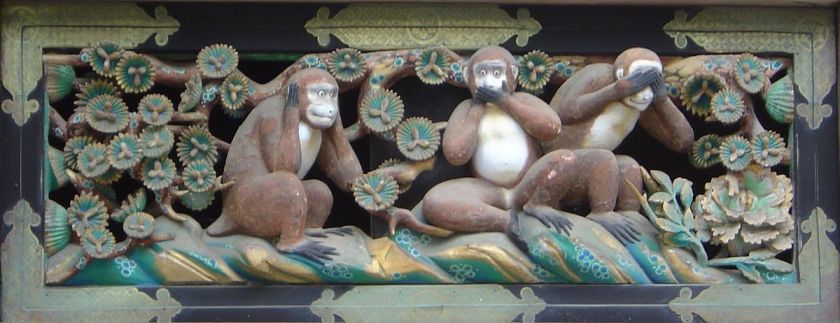



 In April 1864, President Jefferson Davis dispatched former Secretary of the Interior Jacob Thompson, ex-Alabama Senator Clement Clay, and veteran Confederate spy Captain Thomas Henry Hines to Toronto, with the mission of raising hell in the North.
 The Confederate invasion of Maine never materialized, thanks in large measure to counter-espionage efforts by Union agents.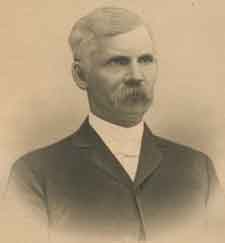

 The group was arrested on returning to Canada and held in Montreal. The Lincoln administration sought extradition, but the Canadian court decided otherwise, ruling that the raiders were under military orders at the time, and neutral Canada could not extradite them to America. The $88,000 found with the raiders, was returned to Vermont.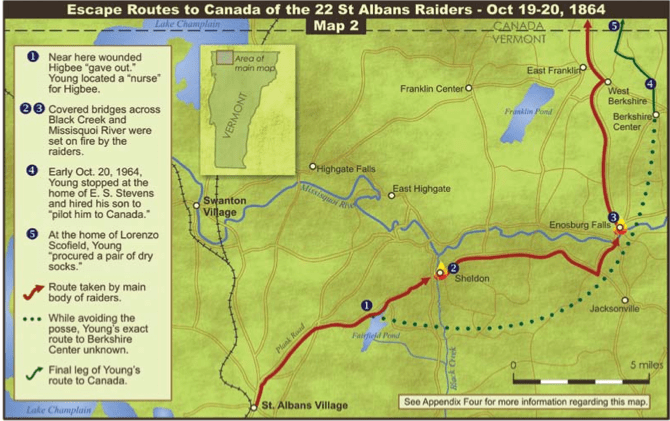


 The Lascaux Caves are located in the Dordogne region, in Southwestern France. Some 17,000 years ago, Upper Paleolithic artists mixed mineral pigments such as iron oxide (ochre), haematite, and goethite, suspending pigments in animal fat, clay or the calcium-rich groundwater of the caves themselves. Shading and depth were added with charcoal.
 The artist or artists who created such images, nearly 2,000 of them occupying some 37 chambers, would have been recognizable as modern humans. Living as they did some 5,000 years before the Holocene Glacial Retreat, (yes, they had “climate change” back then), these cave-dwellers were pre-agricultural, subsisting on what they could find, or what they could kill.
 The purpose served by these images is unclear. Perhaps they tell stories of past hunts, or maybe they were used to call up the spirits for a successful hunt. At least one professor of art and archaeology postulates that the dot and lattice patterns overlying many of these paintings may reflect trance visions, similar to the hallucinations produced by sensory deprivation.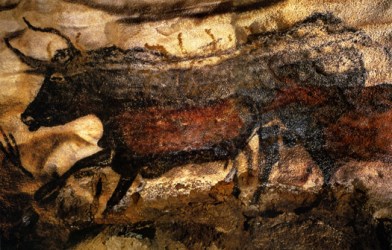

 Weighed down with 70lbs per man of bronze and leather armor, the Greek line likely marched out to 200 yards, the effective range of Persian archers. Greek heavy infantry closed the last 200 meters at a dead run, the first time a Greek army had fought that way.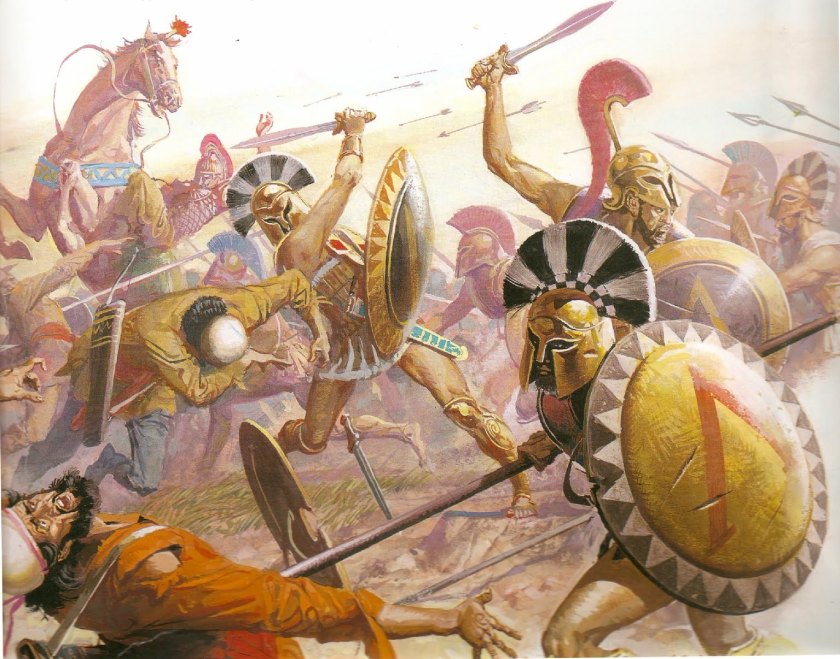

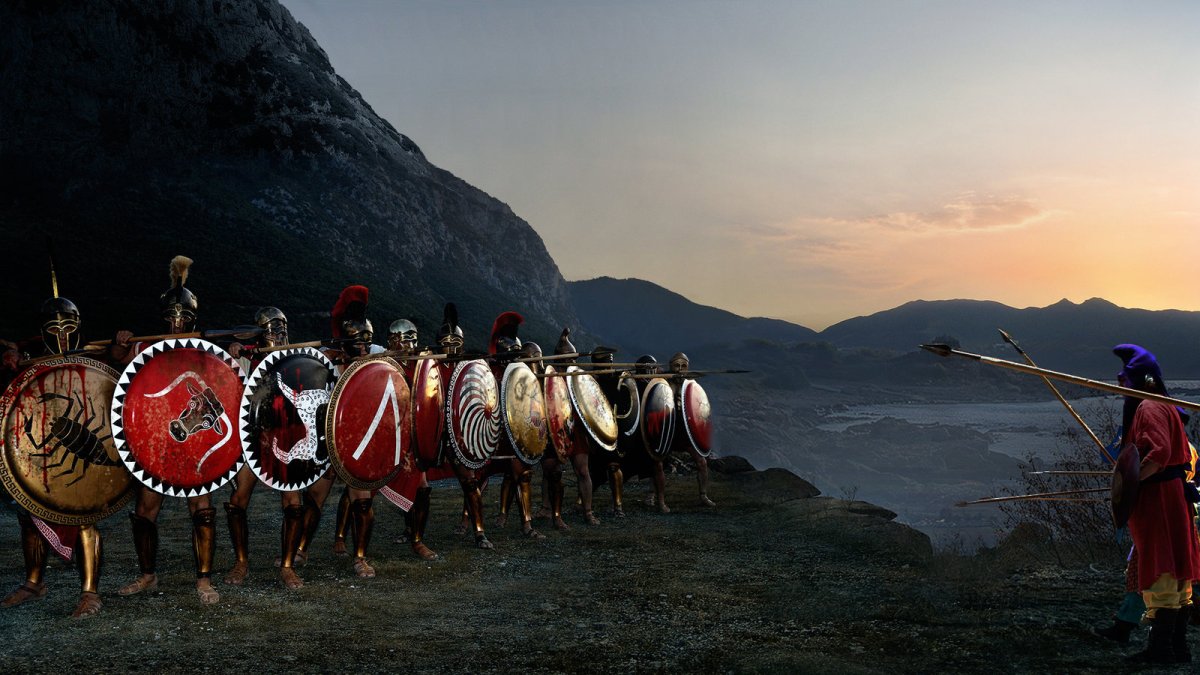
 The 300 marched out at the head of an allied army of 7,000, to meet a Persian army which modern estimates put at 100,000 to 150,000. A native of Trachis told the Spartan General Dienekes, that Persian archers were so numerous their arrows would block out the sun. “Good”, replied Dienekes. “Then we shall fight in the shade”.
 Knowing he was betrayed and would soon be surrounded, Leonidas sent most of the allied soldiers away. They would be needed for the battle yet to come.


 So important is this event to the Jewish people that it is commemorated still as the saddest day of the Jewish calendar. A day of fasting and mourning known as Tisha B’Av.


 “Haram esh-Sharif” ( “The Noble Sanctuary”), or “Temple Mount” to Christians and Jews. The Waqf has held administrative authority over the holy sites of Jerusalem since the Muslim reconquest of the city in 1187. The most recent Waqf was established by the Hashemite Kingdom of Jordan, following the 1948 war. Israel recaptured the old city after the 6-day war in 1967, when they informed Waqf authorities that it would be allowed ongoing control over the old parts of the city.

 One of the more profoundly silly bits of pop culture nonsense served up in the recent past, may be the world coming to an end on 12/21/12, according to the Mayan calendar. The calendar itself isn’t silly, it’s actually a very sophisticated mathematical construct, but the end of the world part certainly was.
 The Mayans used three separate calendars, each period represented by its own glyph. The Long Count was mainly used for historical purposes, able to specify any date within a 2,880,000 day cycle, about 7,885 solar years. The Haab was a civil calendar, consisting of 18 months of 20 days, and one 5-day Uayeb, a nameless period rounding out the 365-day year. The Tzolkin was the “divine” calendar, used mainly for ceremonial and religious purposes. Consisting of 20 periods of 13 days, the Tzolkin goes through a complete cycle every 260 days. The significance of this cycle is unknown, though it may be connected with the 263 day orbit of Venus. There is no year in the Haab or Tzolkin calendars, though a Haab and Tzolkin date may be combined to specify a particular day within a 52-year cycle.
 It doesn’t really roll over to “zero”, either. The base 20 numerical system means that 12/22/12 begins the next 400 year (actually 394.3 years) period to begin the 13th Bak’tun. It will reset to zero at the end of the 20th Bak’tun, about 3,000 years from now. Please let me know how that turns out.


 Predicting a solar eclipse isn’t the same as predicting a lunar eclipse; the calculations are far more difficult. When the moon passes through the shadow of the sun, the event can be seen by half of the planet, the total eclipse phase lasting over an hour. In a solar eclipse, the shadow of the moon occupies only a narrow path, and the total eclipse phase is only about 7½ minutes at any given place.

 According to legend, Romulus and Remus were the sons of Rhea Silvia, the daughter of King Numitor of Alba Longa, a mythical city located in the Alban Hills southeast of what would become Rome. Numitor was deposed by his younger brother Amulius, who forced Rhea to become a vestal virgin so that she would not give birth to rival claimants to his title. However, Rhea was already pregnant by the war god Mars, and destined to give birth to Romulus and Remus.


 Historical Easter Eggs - Today in History
You must be logged in to post a comment.