July 8, 1776 The Liberty Bell

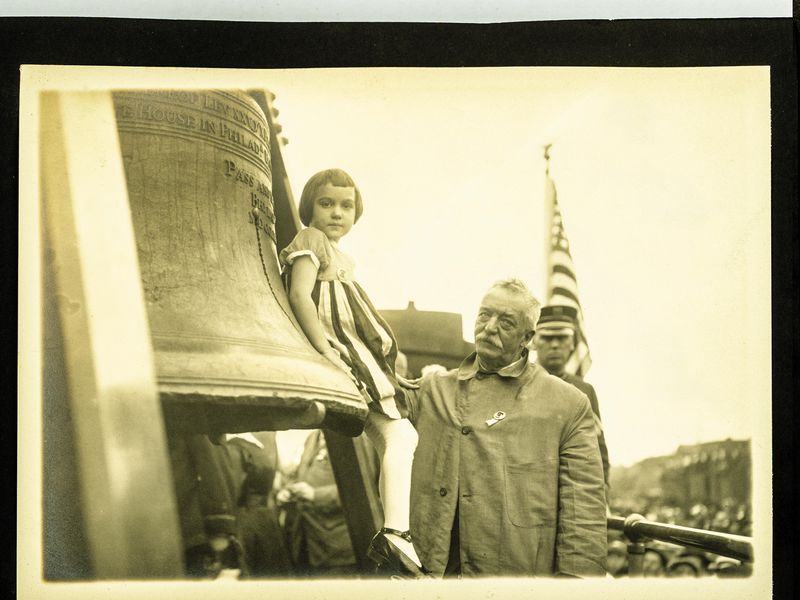
In Denver, a group of blind girls were allowed to touch the Bell. One of them wanted to read the letters. You could have heard a pin drop, as a hushed crowd heard a small, sightless girl, pronounce these words:  “Proclaim…Liberty…throughout…all…the…land.”

For thousands of years, bells have rung out to announce religious and civic occasions, weddings, funerals and other public announcements. The rich tones of a well-cast bell is capable of carrying for miles. Great Britain has so many bells, the place has been called the “Ringing Isle”.

The first bell in the city of Philadelphia would ring out to alert citizens of civic events and proclamations, and to the occasional public danger.  Originally hung from a tree near the Pennsylvania State House, (now known as Independence Hall), that first bell  dates back as far as the city itself, around 1682.

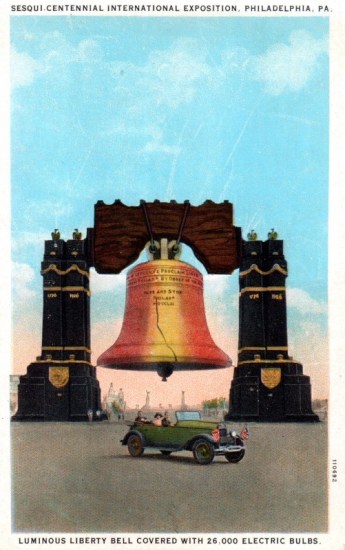
Sesqui-bellpostcard001-501x800
Eighty-foot-high replica of the Liberty Bell, built for the Sesquicentennial International Exposition in 1926

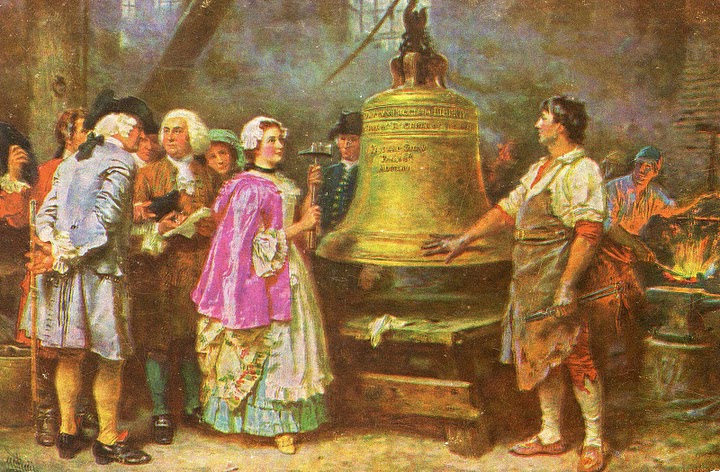
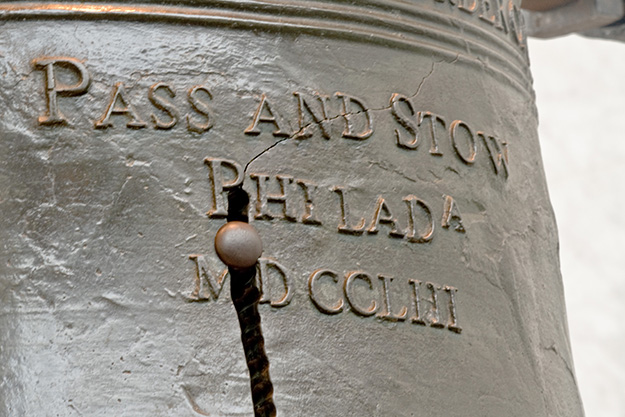
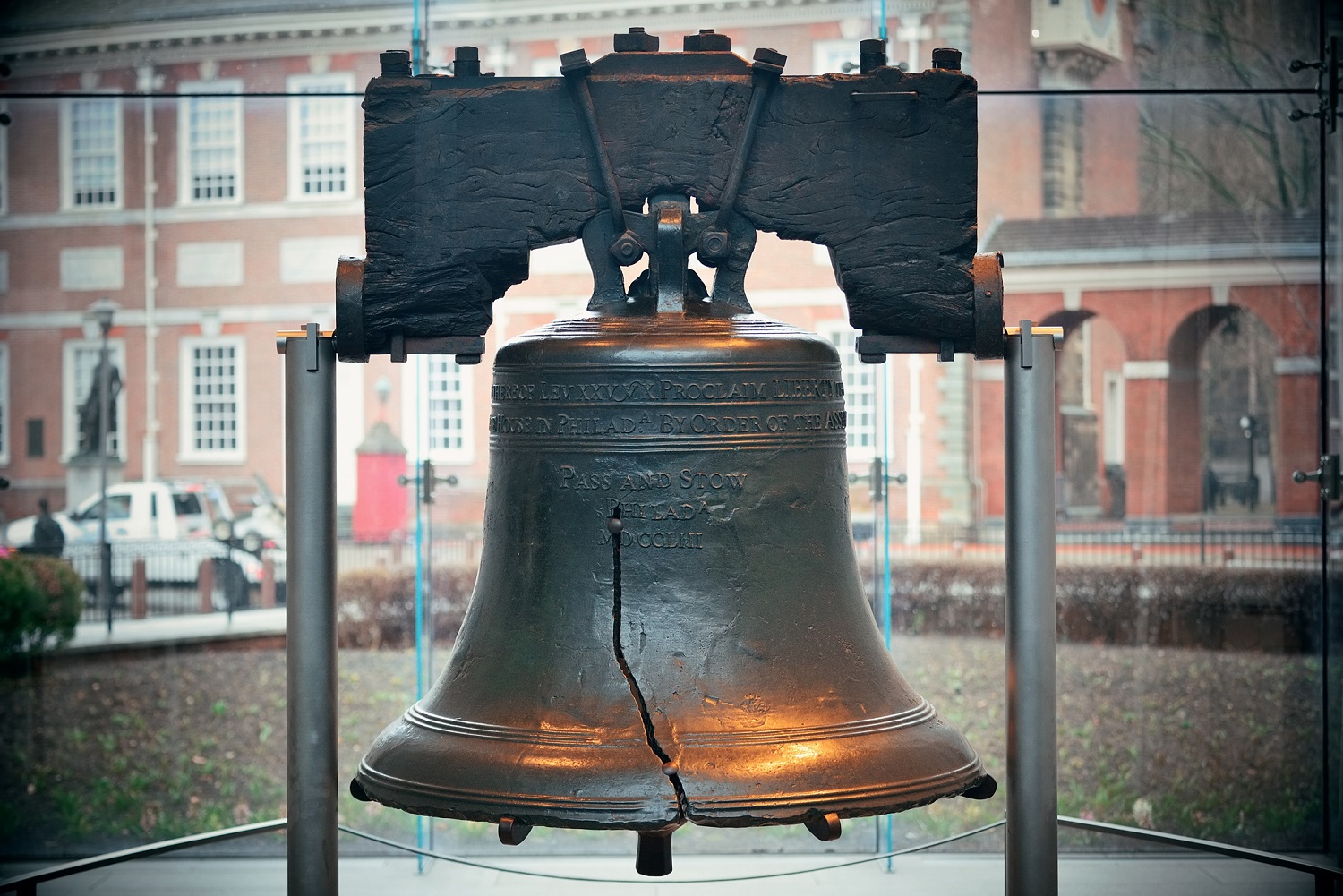
The “Liberty Bell” was ordered from the London bell foundry of Lester and Pack in 1752, (today the Whitechapel Bell Foundry), though that name wouldn’t come around until much later.   Weighing in at 2,080 lbs, the bell arrived in August of that year.  Written upon it was a passage from the Book of Leviticus, the third book of the Hebrew Bible; the third of five books of the Torah. “Proclaim LIBERTY throughout all the land unto all the inhabitants thereof”.

Mounted to a stand to test the sound, the first strike of the clapper cracked the bell’s rim. Authorities attempted to return it, but the ship’s master couldn’t take it on board.  The bell was broken into pieces, melted down and re-cast by two local workmen, John Pass and John Stow.

The recast bell used 10% copper, making the metal less brittle.  Pass and Snow bragged that the bell’s lettering was clearer on this second casting than the original. The newly re-cast bell was ready in March 1753, when City officials scheduled a public celebration to test the sound. There was free food and drink all around, but the crowd gasped and started to laugh when the bell was struck. It didn’t break this time, it was worse.  Somebody said the thing sounded like two coal scuttles, banging together.

Humiliated, Pass and Stow hurriedly took the bell away, and once again broke it into pieces, and melted it down.

The whole performance was repeated, three months later. This time, most thought the sound to be satisfactory, and the bell was hung in the steeple of the State House. One who did not like the sound was Isaac Norris, speaker of the Pennsylvania Provincial Assembly.  Norris ordered a second bell in 1754 and attempted to return the old one for credit, but his efforts proved unsuccessful.

157d02a0f0a37536d64b750a91cce3b6
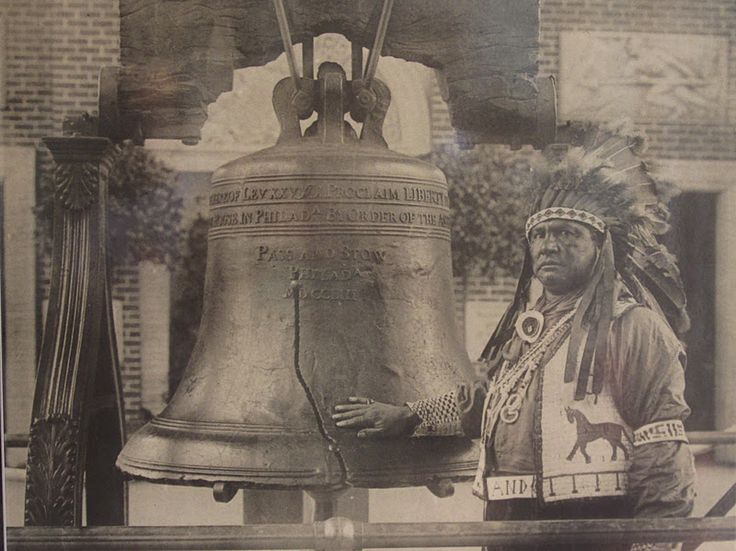
Chief Little Bear with Liberty Bell, 1915

The new bell was attached to the tower clock, while the old one was, by vote of the Assembly, devoted “to such Uses as this House may hereafter appoint.”  One of the earliest documented uses of the old bell comes to us in a letter from Benjamin Franklin to Catherine Ray, dated October 16, 1755: “Adieu. The Bell rings, and I must go among the Grave ones, and talk Politiks.

Legends have grown around the bell, ringing in the public reading of the Declaration of independence on July 4, 1776.  The story is a myth.  There was no such reading on that day.  The 2nd Continental Congress’ Declaration was announced to the public four days later on July 8, to a great ringing of bells.  Whether the old bell itself rang on this day, remains uncertain. John C. Paige, author of an historical study of the bell for the National

Liberty bell, 1908
Liberty Bell, 1908

Park Service, wrote “We do not know whether or not the steeple was still strong enough to permit the State House bell to ring on this day. If it could possibly be rung, we can assume it was. Whether or not it did, it has come to symbolize all of the bells throughout the United States which proclaimed Independence.”

Bells are easily melted down and recast as bullets, and the bell was removed for safekeeping before the British occupation of Philadelphia, in 1777. The distinctive large crack began to develop sometime in the early 19th century, around the time when abolitionist societies adopted the symbol and began calling it “The Liberty Bell”.

The Philadelphia Public Ledger reported the last clear note ever sounded by the Liberty Bell, in its February 26, 1846 edition:

“The old Independence Bell rang its last clear note on Monday last in honor of the birthday of Washington and now hangs in the great city steeple irreparably cracked and dumb. It had been cracked before but was set in order of that day by having the edges of the fracture filed so as not to vibrate against each other … It gave out clear notes and loud, and appeared to be in excellent condition until noon, when it received a sort of compound fracture in a zig-zag direction through one of its sides which put it completely out of tune and left it a mere wreck of what it was.”

The bell would periodically travel to expositions and celebrations, but souvenir hunters would break off pieces from the rim.  Additional cracking developed after several of these trips, and the bell’s travels were sharply curtailed after its return from Chicago, in 1893.

passandstow

With the 1915 World’s Fair about to open in San Francisco, there were discussions of sending the Liberty Bell to California.  The bell had never been west of St. Louis at that time, and the Philadelphia establishment balked. Former Pennsylvania governor Samuel Pennypacker complained that “The Bell is injured every time it leaves…children have seen this sacred Metal at fairs associated with fat pigs and fancy furniture. They lose all the benefit of the associations that cling to Independence Hall, and the bell should, therefore, never be separated from [Philadelphia].”

With the California tour off for now, Philadelphia Mayor Rudolph Blankenburg offered the next best thing. Bell Telephone had just completed a new transcontinental line, 3,400 miles of wire suspended from 130,000 poles. Three hundred dignitaries gathered at Bell offices in Philadelphia and San Francisco on February 11, 1915. With Alexander Graham Bell himself listening in from his own private line in Washington DC, the Liberty bell was sounded at 5pm, with all of them listening in on candlestick phones.

The California trip gained fresh impetus following the May 7 sinking ofn the British liner Lusitania.  A cross-country whistle stop tour was planned for the bell, using the “best cushioned” rail car, in history.

As the nation’s most prominent German-American, Mayor Blankenburg himself came along, delivering “loyalty lectures” to immigrant groups on the importance of devotion to their adopted home country.  “It is important to prepare against a possible foe abroad“, he would say, “….Let us, therefore, abolish all distinctions that may lead to ill feeling and let us call ourselves, before the whole world, Americans, first, last and all the time.”

apr2017_k13_libertybell
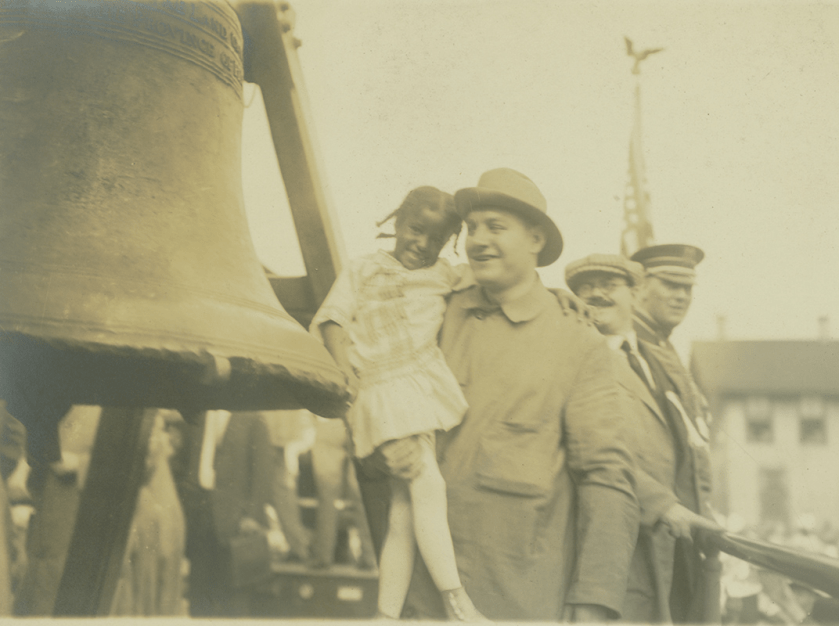
“A quarter of the U.S. population (including a girl in Moline, Illinois) turned out for the Liberty Bell”. H/T Smithsonian

The Liberty Bell drew crowds beyond anyone’s wildest expectations.  Fully one- quarter of the American population turned out to see the liberty bell, a generator rigged so the bell could be seen by day or night.  In many cities, those on the train couldn’t see where the crowd ended.

“Big Jim” Quirk, one of the police officers assigned to the train, recalled “In Kansas City, an old colored man who had been a slave came to touch it—he was 100 years old.” When the train pulled into another town, “an aged Mammie hobbled to the door of her cabin near the tracks, raised her hands and with her eyes streaming tears called out, ‘God Bless the Bell! God Bless the Dear Bell!’  It got to us somehow.”

In Denver, a group of blind girls were allowed to touch the Bell. One of them wanted to read the letters. You could have heard a pin drop, as a hushed crowd heard a small, sightless girl, pronounce these words:  “Proclaim…Liberty…throughout…all…the…land.”

Liberty Bell, Atchison, Kansas
Liberty Bell 1915, Atchison, Kansas. H/T Smithsonian Magazine, for this image

The Liberty Bell was enlisted once again in 1917 as the United States prepared to send her soldiers “over there” in the first democratically financed war, in history. Americans hurried to buy up war bonds, far exceeding the national goal of $2 Billion.

Today, two other bells join the Liberty Bell in the Independence National Historical Park in Philadelphia, PA. Weighing in at 13,000lbs, a half-ton for every original colony, the Centennial Bell was cast for America’s 100th birthday in 1876. To this day, this enormous bell rings once an hour, in the tower at Independence Hall.

In 1976, the people of Great Britain presented a gift to the people of the United States, in recognition of the friendship between the former adversaries.  Weighing in at six tons and cast at the same foundry which produced the original bell, the “Bicentennial Bell” was dedicated by her Royal Highness, Queen Elizabeth, II, on July 6, 1976.  On the side of the bell are inscribed these words:

FOR THE
PEOPLE OF THE UNITED STATES
FROM THE
PEOPLE OF BRITAIN
4 JULY 1976
LET FREEDOM RING

Back in 1893, the Liberty Bell passed through Indianapolis.  Former President Benjamin Harrison may have had the last word on the subject, a sentiment fit to be inscribed on the old bell itself, below that verse from the Torah. “This old bell was made in England”, Harrison said, “but it had to be re-cast in America before it was attuned to proclaim the right of self-government and the equal rights of men.

liberty-bell-museum

July 1, 1863 Gettysburg

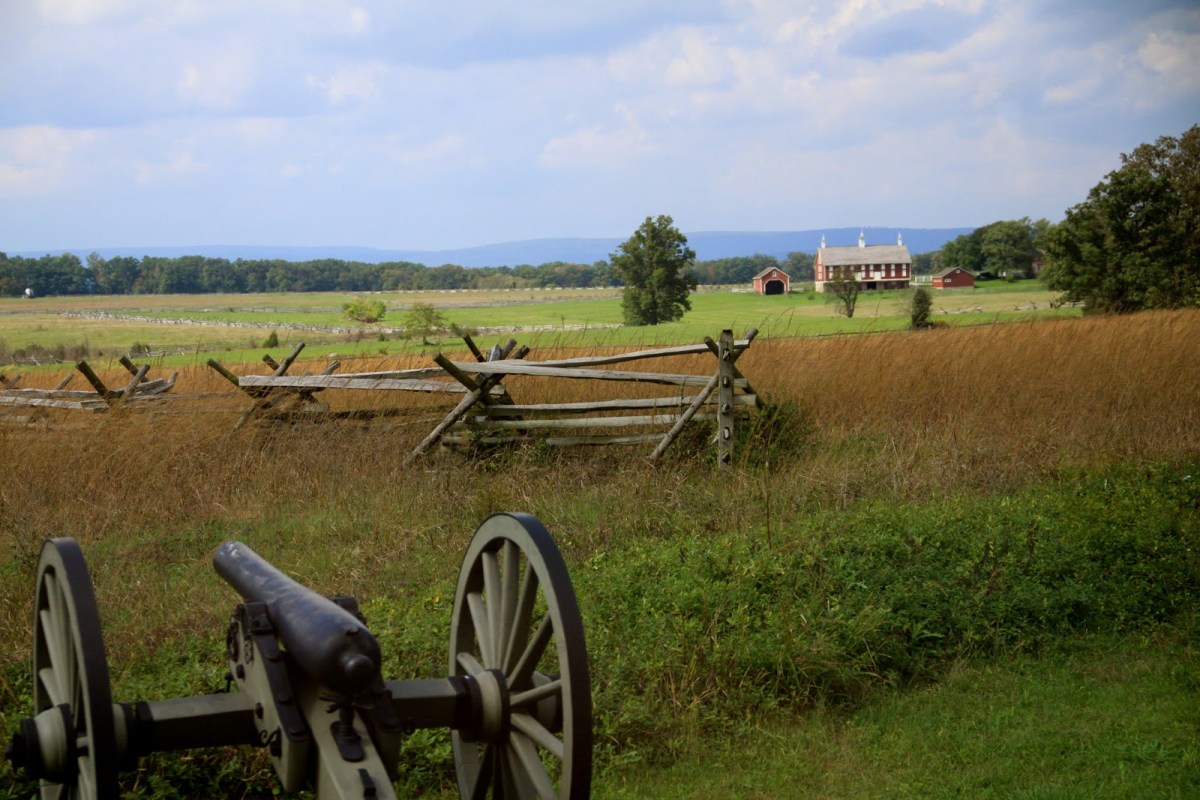
The “North” came up from the south that day, the “South” approached from the north.  No one wanted the fight to be in Gettysburg, it was more of an accident.

After two years of civil war, the man his soldiers called “Marse Robert” sought to take the war to his adversary. Robert E. Lee intended to do enough damage to create overwhelming political pressure in the North, to end the war and let the South go its own way. Lee had his best cartographers draw up maps of the Pennsylvania countryside, all the way to Philadelphia.  

One hundred and fifty-nine years ago today, the Union and the Confederacy met in the south central Pennsylvania town of Gettysburg.

Joseph “Fighting Joe” Hooker, to whom Lee contemptuously referred as “Mr. F.J. Hooker”, wanted to attack Richmond, but Lincoln ordered him to intercept Lee’s army to protect Washington DC.  Hooker was replaced on the 28th by Major General George Gordon Meade, “that damn old goggle eyed snapping turtle” to his men, in a move that so surprised the general that he thought he was being arrested over army politics, when the messenger came to his tent.

Gettysburg_Battle_Map_Day1
Gettysburg_Battle_Map_Day2
Gettysburg_Battle_Map_Day3

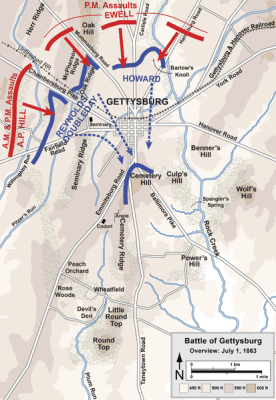
The “North” came up from the south that day, the “South” approached from the north.  No one wanted the fight to be in Gettysburg, it was more of an accident.

What started out as a skirmish turned into a general engagement as fighting cascaded through the town. Confederate forces held the town at the end of the day, with the two armies’ taking parallel positions along a three-mile-long “fishhook” from Cemetery Hill and Culp’s Hill to the north, toward two prominences known as Big and Little Round Top to the south.

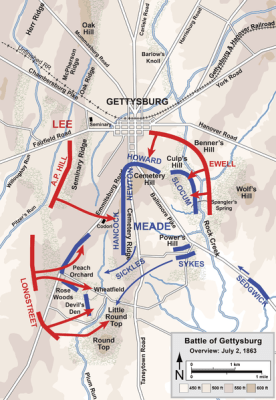
Fighting would continue and prove inconclusive at Culp’s Hill on day two, as the two armies stretched their positions toward the Round Tops.

Dan Sickles, the Tammany Hall politician best known for murdering the nephew of Francis Scott Key (he would be the first in American legal history to plead temporary insanity), had been ordered to move his corps into position on cemetery ridge, anchored at Little Round Top. Instead he took his corps a mile forward, into a Peach Orchard, only to be torn apart in the Confederate assault. Some of the most savage fighting of the Civil War took place that day in places like Devil’s Den, the Wheat Field, and bloody run. Sickles himself lost a leg to a cannonball. There was a foot race to the top of Little Round Top, leading to as many as 15 attacks and counterattacks for control of this small prominence at the Union’s extreme left. At the end of the day, the positions of the Armies had not changed.

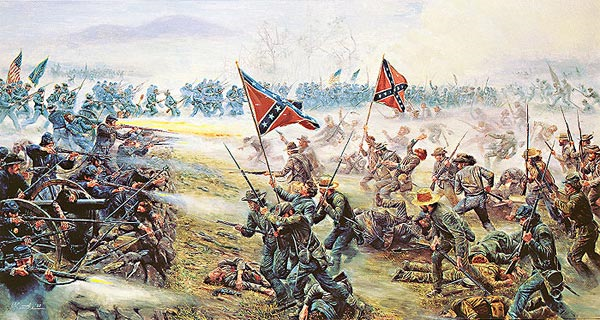
Picketts Charge

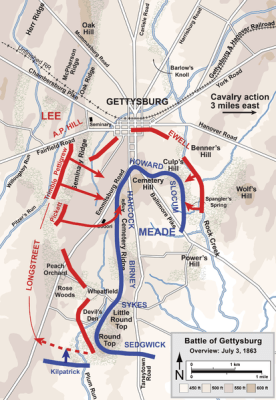
On day 3, the last day, Lee came up the middle. 13,000 Confederate soldiers came across 1¼ miles of open field, to attack the Union Center. The target was a position between a small copse of trees and a corner in a stone fence called the angle. Cannon fire from their left, right and center tore them apart as they pressed on. A battered remnant actually penetrated Union lines: the “high water mark” of the Confederacy. It’s anyone’s guess what would have happened, had 4,000 Confederate cavalry smashed into the Union rear at that point, as Lee seems to have intended. But a 23-year-old general named George Armstrong Custer had waded into them with his 450 Union cavalry, routing the much larger force and very possibly changing history.

Lee withdrew in the rain of the 4th, ending the largest battle of the civil war. Lincoln was convinced that the time had come to destroy the Army of Northern Virginia, but Meade and his battered army did not follow. Lee and his army slipped back across the line and returned to Confederate territory. The most lethal war in American history would continue for two more years.

Years before, then-Secretary of War Jefferson Davis brought some 75 camels into West Texas, to try the creatures out as pack animals. Davis’ camel experiment had been a flop but the King of Siam, (now Thailand), didn’t know that. Seeing the military advantage to the Confederacy, the King wrote to President Abraham Lincoln, proposing to send elephants to help the Union war effort. This “animal arms race” appears to have gotten no further than the King’s one letter to Lincoln but, the imagination runs wild, doesn’t it? What would war elephants have looked like, at Gettysburg?

June 25, 1876 Little Big Horn

No whites were to be permitted onto these territories but for Federal Government officials, but the rich resources of the Black Hills, first in timber and then in gold, made the provision near-impossible to enforce.

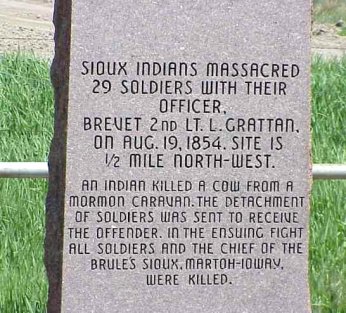
During the late summer of 1854, 4,000 natives of the Brulé and Oglala Sioux gathered in the future Wyoming territory, near the modern city of Torrington, WY.   On August 17, visiting Miniconjou High Forehead killed a wandering cow, belonging to a Mormon traveling the nearby Oregon trail.  The native camp accorded with the terms of the treaty of 1851 and the cow episode could have been amicably handled, but events quickly spun out of control.

GrattanPhilKonstantin

Chief Conquering Bear attempted to negotiate recompense, offering a horse or cow from the tribe’s herd.  The owner refused, demanding $25.  That same treaty of 1851 specified that such matters would be handled by the local Indian agent, in this case one John Whitfield, scheduled to arrive within days with tribal annuities more than sufficient to settle the matter to everyone’s satisfaction.

Ignorant of this provision or deliberately choosing to ignore it, senior officer Lieutenant Hugh Fleming from nearby Fort Laramie requested that the Sioux Chief arrest High Forehead, and hand him over to the fort.  Conquering Bear refused, not wanting to violate traditional rules of hospitality.  Beside that, the Oglala Chief would’ve had no authority over a Miniconjou.

6th Infantry Regiment Second Lieutenant John Grattan arrived with a force of twenty-nine and a bad attitude, intent on arresting the cow’s killer.  One Ft. Laramie commander later remarked, “There is no doubt that Lt. Grattan left this post with a desire to have a fight with the Indians, and that he had determined to take the man at all hazards.”  French-Native interpreter Lucienne Auguste was contemptuous, taunting Sioux warriors as “women” and threatening that the soldiers had come not to talk, but to kill.

What followed was all but inevitable.  Not to be thus denigrated, angry warriors took up flanking positions around the soldiers, one of whom panicked and fired, mortally wounding Conquering Bear.  And then all hell broke out. When it was over all thirty soldiers were dead, their bodies ritually mutilated.

The Federal government was quick to respond to the “Gratton Massacre”, Secretary of War Jefferson Davis characterizing the incident as “the result of a deliberately formed plan.”

The first Sioux War of 1854 – ’56 became the first of seven major wars and countless skirmishes between the United States and various sub-groups of the Sioux people, culminating in the Ghost Dance War of 1890.

Diametrically opposite cultures steeped in mutual distrust engaged in savage cruelty each upon the other, often at the expense of innocents. There was even one major massacre of natives by other natives, when a war band of some 1,500 Oglala/Brulé Sioux attacked a much smaller group of Pawnee, during their summer buffalo hunt. Seventy-one Pawnee warriors were killed along with 102 of their women and children, their bodies horribly mutilated and scalped, some even set on fire.

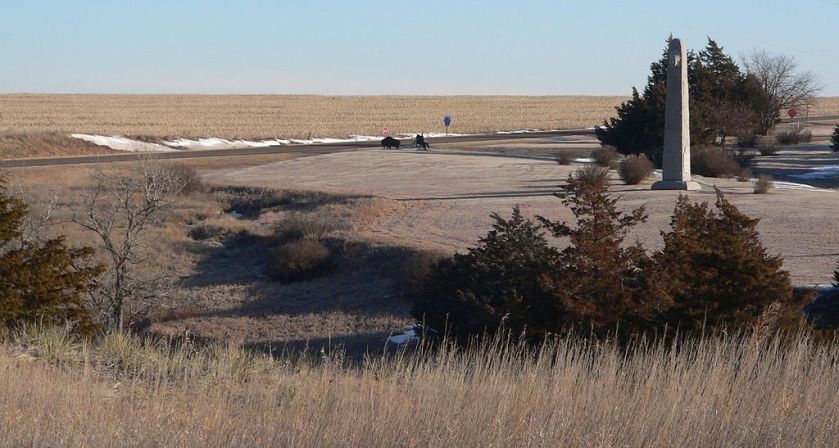
Today, a 35-foot obelisk stands in mute witness to the horrors of “Massacre Canyon”.

Massacre_Canyon_monument_from_SW_1
Massacre Canyon Monument

In the early eighteenth century, peoples of the Suhtai and Tsitsista tribes migrated across the northern Mississippi River, pushing the Kiowa to the southern plains and in turn being pushed westward, by the more numerous Lakota, or “Teton” Sioux. These were the first to adopt the horse culture of the northern plains, the two tribes merging in the early 19th century to become the northern Cheyenne.

The ten bands comprising the northern Cheyenne spread from the black hills of South Dakota, to the Platte Rivers of Colorado, at times antagonistic to and at others allied with all or part of the seven nations of the Sioux.

In 1866, the Lakota people went to war behind Chief Red Cloud, over Army encroachment onto the Powder River basin area in northeastern Wyoming. The war ended two years later with the Treaty of Fort Laramie, granting a Great Sioux Reservation to include the western half of South Dakota including the Black Hills, as well as a large, “unceded territory” in Wyoming and Montana and the Powder River Country, as Cheyenne and Lakota hunting grounds.

No whites were to be permitted onto these territories but for Federal Government officials, but the rich resources of the Black Hills, first in timber and then in gold, made the provision near-impossible to enforce.

The Army attempted for a time to keep settlers out of Indian territories, while political pressure mounted on the Grant administration to take back the Black Hills from the Lakota.   Delegations of Sioux Chieftains traveled to Washington, D.C. in an effort to persuade the President to honor existing treaties, and to stem the flow of miners into their territories. Congress offered $25,000 for the land, and for the tribes to relocate south to Indian Territory, in modern-day Oklahoma.  Chief Spotted Tail spoke for the whole delegation: “You speak of another country, but it is not my country; it does not concern me, and I want nothing to do with it. I was not born there … If it is such a good country, you ought to send the white men now in our country there and let us alone.”

The government now determined to force the issue, and imposed a deadline of January 31.  That many of the tribes even knew of such a time limit seems unlikely.  The government’s response was unworthy of a Great Nation.  On February 8, 1876, Major General Philip Sheridan ordered the commencement of military operations against those deemed “hostiles”.

The Great Sioux War of 1876-’77 began with a ham-fisted assault on the frigid morning of March 17, when Colonel Joseph Reynolds and six companies of cavalry attacked a village believed to that of the renegade Crazy Horse, but turned out to be a village of Northern Cheyenne.

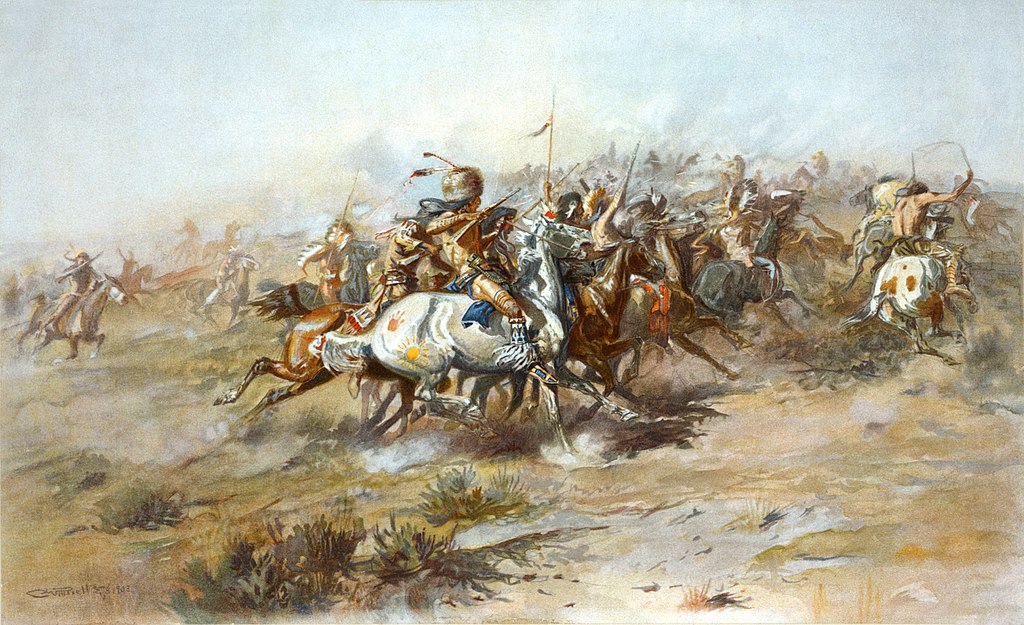
800px-Little_Big_Horn
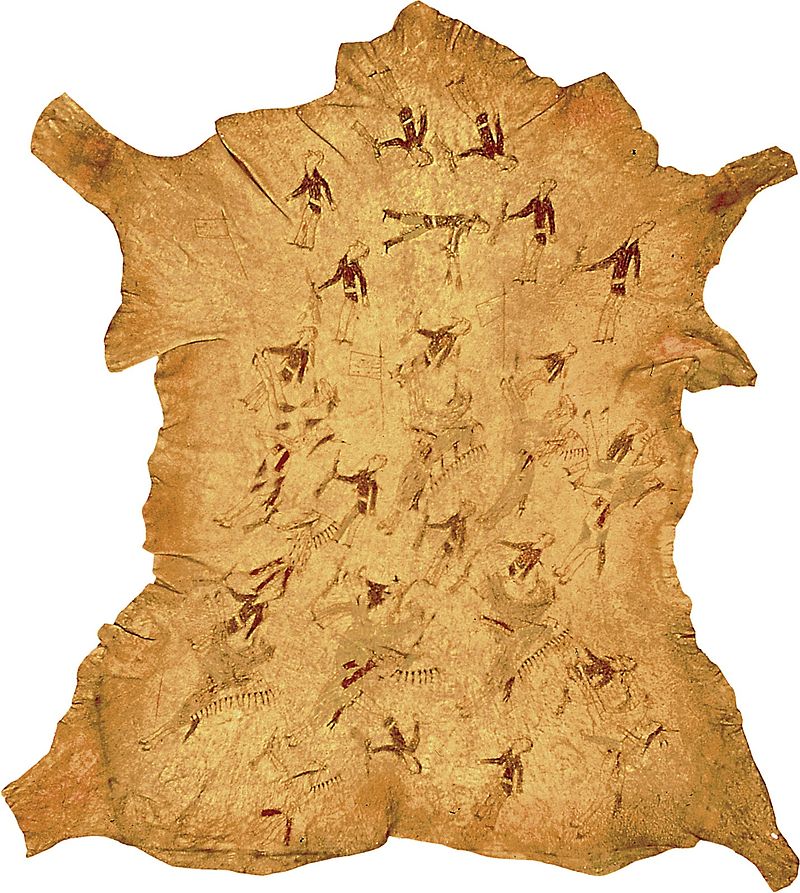
Cheyenne Artist’s Depiction of the Battle of Little bighorn

A second, far larger campaign was launched that Spring, when three columns were sent to converge on the Lakota hunting grounds. Brigadier General George Crook’s column was the first to make contact, resulting in the Battle of Rosebud Creek on June 17. While Crook claimed victory afterward, the native camp was vastly larger than expected, and Crook withdrew to camp and wait for reinforcements.  He had just taken his force out of what was to come.

General Alfred Terry dispatched the 7th Cavalry, 31 officers and 566 enlisted men led by Lieutenant Colonel George Armstrong Custer, to begin a reconnaissance in force along the Rosebud.  Custer was given the option of departing from his orders and going on the offence, should there be “sufficient reason”.   For a man possessed of physical bravery bordering on recklessness – Custer had proven that thirteen years earlier at Gettysburg – there was bound to be sufficient reason.

Custer divided his force into three detachments, more concerned about preventing the escape of the “hostiles” than with fighting them.

It was a big mistake.

Battle-of-Little-BighornThe tale of those other two columns is worth a “Today in History” essay of their own if not an entire book, but this is a story about Little Big Horn. Suffice it to say that Major Marcus Reno‘s experience of this day was as grizzly and as shocking, as that moment when the brains and face of his Arikara scout Bloody Knife spattered across his own face. Reno’s detachment had entered a buzz saw and would have been annihilated altogether, had it not met up with that of captain Frederick Benteen.
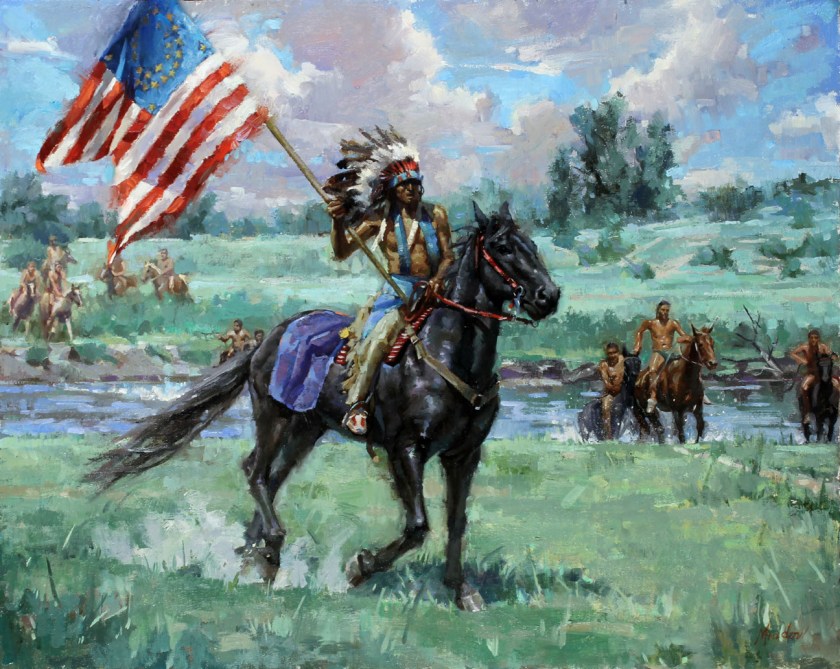
To describe what followed as “Custer’s last stand“ is to conjure images of soldiers fighting back to back, or crouched behind dead and dying horses amidst a swirling tide of warriors. Later archaeological evidence reveals not piles of spent casings marking the site of each man’s last desperate stand, but rather a scattering of brass across the hillside. Like a handful of rice, tossed across a hardwood floor.

2,500 warriors swept down on 268.  It was the worst defeat to American Arms since the disastrous rout at Bladensburg, 62 years earlier. There were no survivors.

CaptureTheFlag_LittleBighorn
Capture The Flag, at Little Bighorn

The Battle of Little Big Horn, the Natives called it the “Battle of the Greasy Grass”, may be more properly regarded as the Indian’s last stand.  Custer’s detachment was destroyed, to a man.  Within hours, an enormous encampment of 10,000 natives or more were returning to their reservations, leaving no more than 600 in their place.

Crook and Terry awaited reinforcements for nearly two months after the battle.  Neither cared to venture out again, until there were at least 2,000 men.

June 23, 1865 Civil War – the Final Chapter

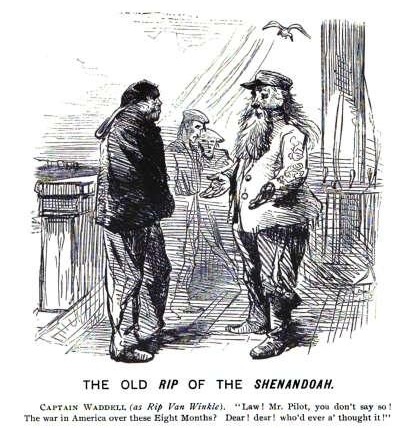
Editorial cartoons of the era satirized “Rip van Waddell” for continuing hostilities, long after the Civil War was over.

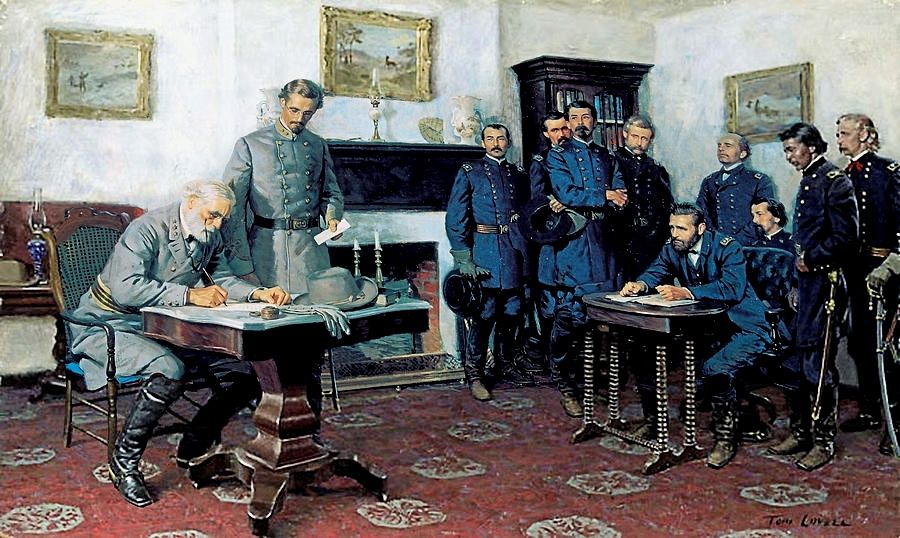
On April 9, General Robert E. Lee surrendered the Army of Northern Virginia. President Lincoln was assassinated on the 14th. Confederate President Jefferson Davis was captured on the 10th of May.

The last fatality of the war between the states, the “war of northern aggression” to half the nation, occurred at the Battle of Palmito Ranch in Brownsville, TX over May 12–13, resulting in the death of Private John J. Williams of 34th Indiana regiment.  He was the last man killed during the Civil War.

General Joseph E. Johnston surrendered the remains of three Confederate Armies to General William Tecumseh Sherman at Bennett Place on April 26.  Organized resistance came to a full stop when Confederate General E. Kirby Smith surrendered his forces to General E. R. S. Canby in New Orleans on May 26.

And yet the last hostile action of the civil War was still nearly a month away.

Both sides long practiced economic warfare against the other.  The federal “Anaconda Plan” sought to strangle the economy of the South while Confederate commerce raiders roamed the oceans of the world, destroying the other side’s merchant shipping.

Rip_Van_Waddell
Editorial cartoon satirizing “Rip Van Waddell” still engaged in combat after everyone else thought the Civil War was over.

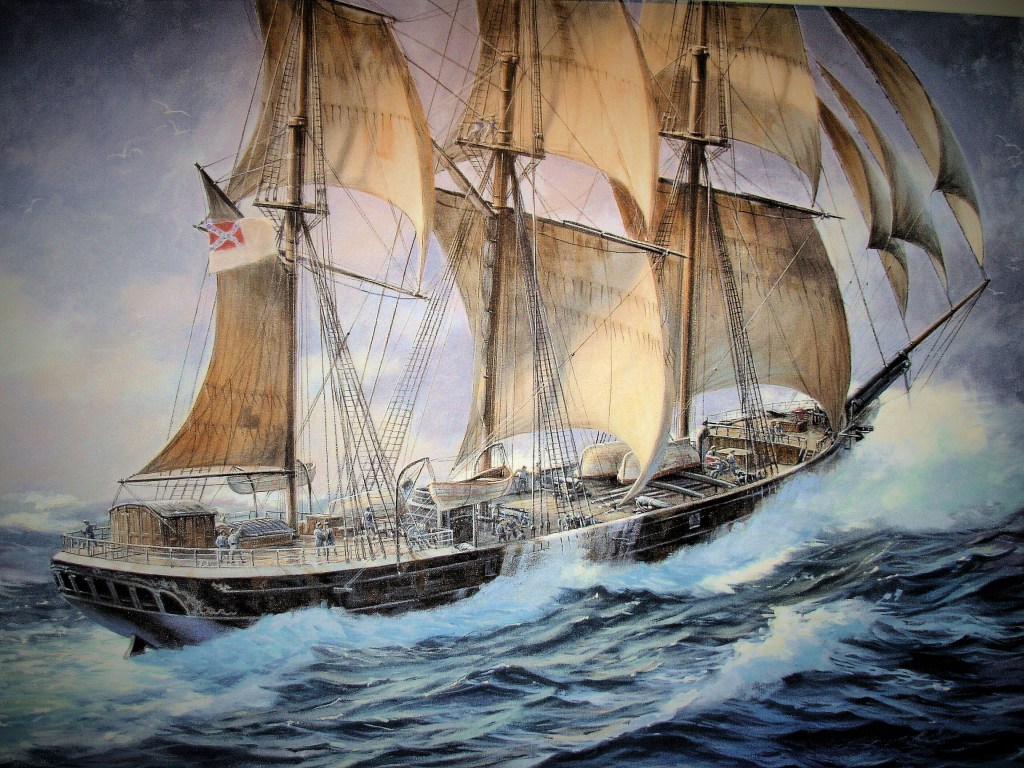
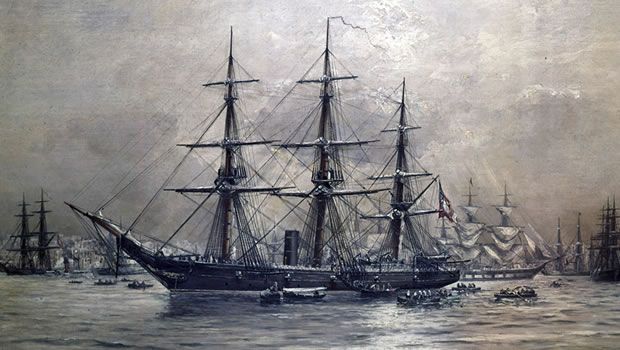
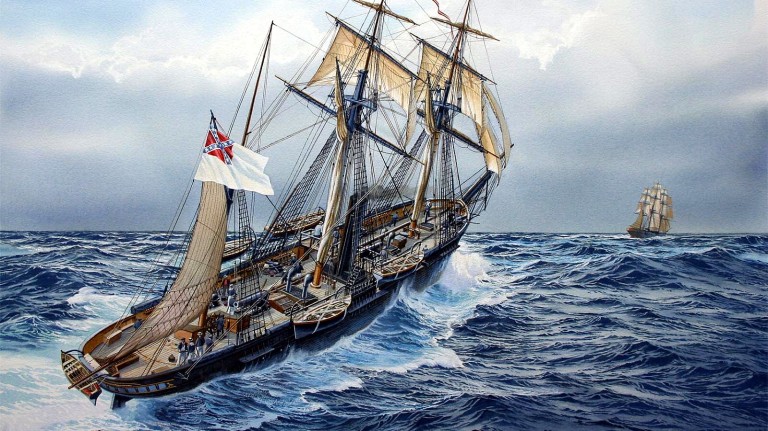
The Confederate raider CSS Shenandoah, Lieutenant James Iredell Waddell Commanding, was in the Bering Sea hunting prizes at this time, between the coasts of Alaska and Siberia.

On June 22, the last round of the Civil War was a warning shot, fired across the bows of a whaler off the Aleutian Islands.

It must have been a sight, to see a wooden hulled Union whaler laden with oil, burned to the waterline under starlit skies amidst the ice floes of the Bering Sea.

Waddell learned of Lee’s surrender on June 23, along with Jeff Davis’ proclamation that the “war would be carried on with re-newed vigor”.  Waddell elected to continue hostilities, capturing 21 more whalers in the waters just below the Arctic Circle.  The last 11 were captured in the space of just 7 hours.

The only Confederate ship to circumnavigate the globe, Shenandoah traversed 58,000 miles in 12 months and 17 days at sea, capturing or sinking 38 merchant vessels, mostly whaling ships.  The voyage had taken 1,000 prisoners without a single battle casualty on either side.

Waddell was on the way to attack San Francisco on August 2, when he learned in a chance meeting with the British Barque Barracouta, that the war was truly over.

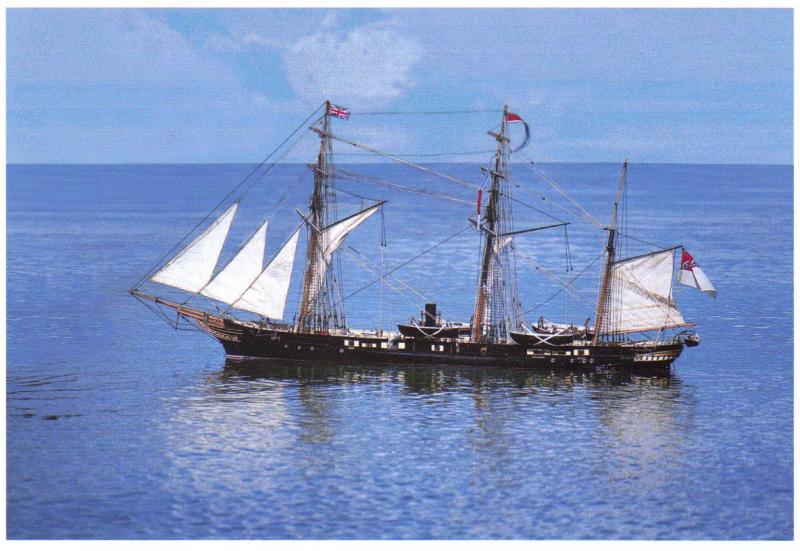
Believing they would all be hanged as pirates, Captain Waddell aimed to surrender to neutral England.  He took down his battle flag and put CSS Shenandoah through a radical alteration at sea. She was dismantled as a man-of-war; her battery dismounted and struck below, her hull repainted to resemble an ordinary merchant vessel.

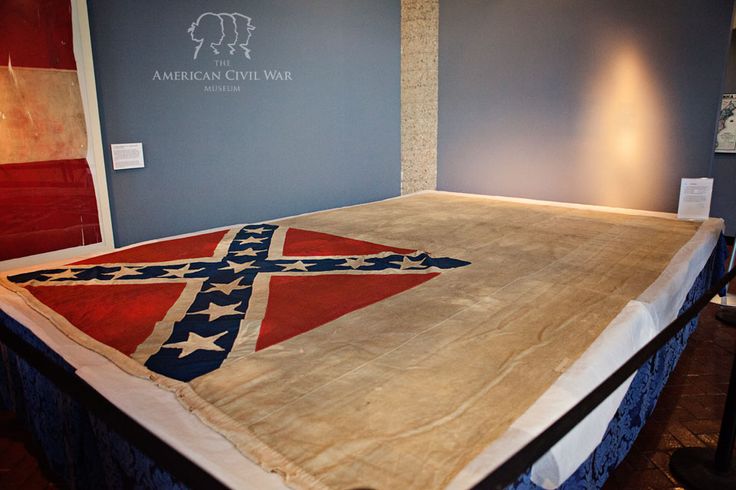
There followed a 9,000 mile race down the coast of Mexico, around Cape Horn and across the Atlantic, with American vessels in constant pursuit. CSS Shenandoah made it to English territorial waters outside the Mersey, when the pilot refused to take the ship into Liverpool.  He needed to know, under which flag this vessel sailed.  The crew raised the Stainless Banner, the third and last official flag of the Confederacy.

CSS Shenandoah’s “Stainless Banner” displayed on the Sesquicentennial (150 year) anniversary of her final voyage

CSS Shenandoah sailed up the River Mersey with flag aloft, spectators lining both sides of the river.  Captain Waddell surrendered to Captain James A. Paynter of HMS Donegal.  The Stainless Banner was lowered for the last time at 10:00am on November 6, 1865, in front of CSS Shenandoah’s officers and crew, and the Royal Navy detachment who had boarded her.

The last official act of the Civil War occurred later that morning, when Captain Waddell walked up the steps of Liverpool Town Hall, presenting the letter by which he surrendered his vessel to the British government.

The officers and crew were unconditionally released following investigation, as they had done nothing to justify further detention. CSS Shenandoah was returned to the United States where the Government sold her to Majid bin Said, the first Sultan of Zanzibar.  Bin Said renamed the vessel El Majidi, in honor of himself. The former CSS Shenandoah was blown ashore and wrecked in a hurricane, in 1872.

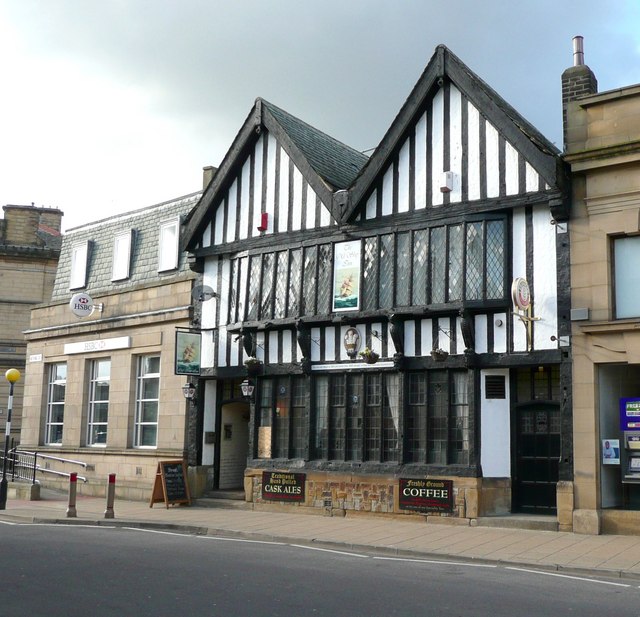
HMS Donegal survived longer than any other player in this story. Launched in 1858, she remained in service to the British Crown until 1925 when she was sold, and broken up for scrap. Some of Donegal’s timbers were used to build the front of the Prince of Wales public house in the town of Brighouse, in West Yorkshire. The place still operates to this day, as the Old Ship Inn.

The-Old-Ship-by-Humphrey-Bolton
The Old Ship pub in Brighouse was built from the timbers of the decommissioned HMS Donegal in 1926

June 22, 1807 The Chesapeake-Leopard affair

American public opinion was outraged over the humiliation, as the four men were transported to Halifax for trial.   Federalists and Democratic-Republicans alike were united as never before.  President Thomas Jefferson remarked “Never since the Battle of Lexington have I seen this country in such a state of exasperation as at present, and even that did not produce such unanimity.”


The Napoleonic Wars took place between 1799 and 1815, pitting a series of seven international coalitions against the forces of Napoleon Bonaparte and his Grande Armée.  The former American colonies benefited from the European conflict, remaining on the sidelines and doing business with both sides.  Within a ten-year period, the fledgling United States had become one of the world’s largest neutral shippers.

In 1807, two third-rate French warships were penned up in Maryland’s Chesapeake Bay, blockaded by a number of English warships outside of the harbor.

4467229436_5635b36a0a
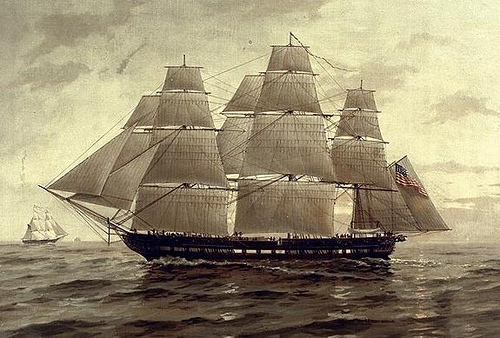
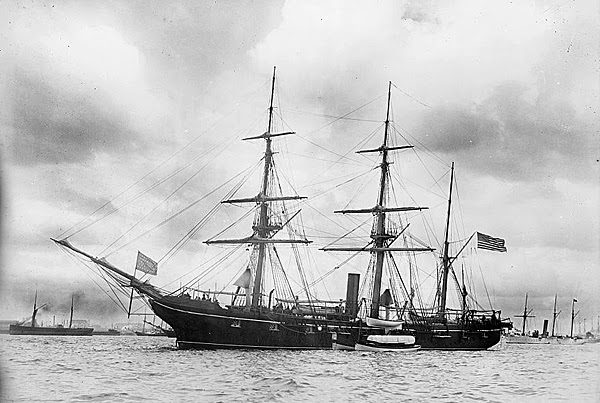
The American frigate, USS Chesapeake

London born Jenkin Ratford was an English sailor who deserted the British Navy and defected to the neutral United States.  This story might have ended better for him had he not run his mouth, but that wasn’t this guy.  Ratford couldn’t resist taunting British officers, boasting of his escape to the “land of liberty”

The USS Chesapeake was preparing for a Mediterranean cruise with Ratford aboard when she emerged from Norfolk, Virginia.  Her decks were laden with supplies and stores of every kind and her guns, unwisely stored.  Chesapeake was nowhere near combat ready when she was approached by the HMS Leopard on June 22.

The Chesapeake’s commander, Commodore James Barron, was unconcerned when Leopard, under the command of Captain Salusbury Pryce Humphreys, asked permission to board.  Lieutenant John Meade of Her Majesty’s Navy presented Barron with a search warrant.  Barron declined to submit, and the officer returned to the Leopard.

Chesapeake_Leopard

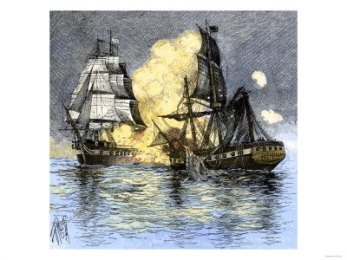
Humphreys then used a hailing trumpet and ordered the American ship to comply, to which Barron responded “I don’t hear what you say”. Humphreys then fired two rounds across Chesapeake’s bow, followed immediately by four broadsides.

Chesapeake fired only a single shot before striking colors and surrendering.  Humphreys refused the surrender and boarded, taking Ratford and three American born sailors with them when they left.

There was but token resistance, and yet the “Chesapeake-Leopard Affair” left three American crewmembers dead, and 18 wounded.

American public opinion was outraged over the humiliation, as the four men were transported to Halifax for trial.   Federalists and Democratic-Republicans alike were united as never before.  President Thomas Jefferson remarked “Never since the Battle of Lexington have I seen this country in such a state of exasperation as at present, and even that did not produce such unanimity.”

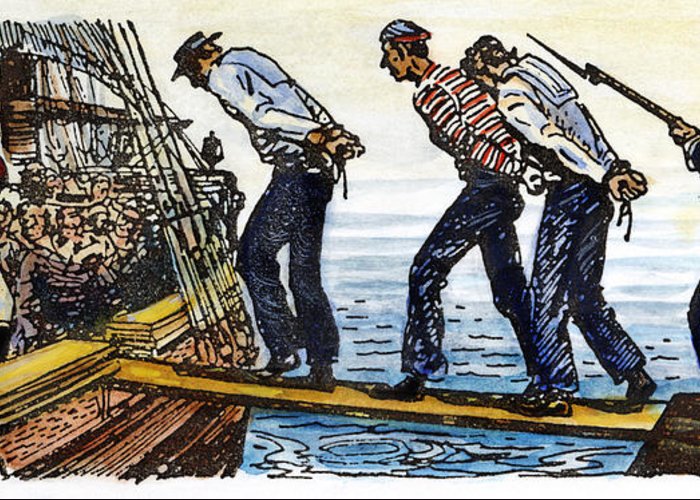
The English court found all four guilty of desertion and hanged Ratford by the fore yardarm of his former vessel, HMS Halifax.  The three Americans, David Martin, John Strachan, and William Ware, were sentenced to 500 lashes.

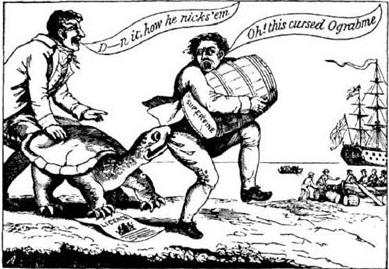
With the puny American navy deployed to the Mediterranean to check the Barbary pirates, President Jefferson’s options were limited to economic retaliation.  The Embargo Act of 1807 intended to extract concessions from France and Great Britain, instead had the effect of imposing crippling setbacks on some industries, while others railed against government interference in the private economy.  Many conclude that the only solution, lay in violence.

2661E817-FD9D-331B-F65F29408EE37509
Political cartoon depicting merchants harassed cursing the “Ograbme”—“embargo” spelled backwards.

British envoys delivered proclamations reaffirming the practice of impressment,  amounting to the kidnapping of sailors and forcing their labor aboard British ships.  In total, the Royal Navy impressed over 9,000 sailors claiming to be American citizens, becoming the driving force behind the United States going to war with England, in 1812.

Despite being wounded, Barron was blamed for the “Chesapeake-Leopard Affair”.  A court-martial suspended him from service for five years, without pay.   Commodore Stephen Decatur was one of the presiding officers at the court-martial. In 1820, Barron challenged Decatur to a duel, killing his fellow Commodore over his comments concerning the 1807 incident.

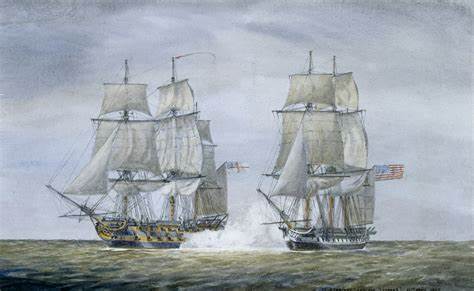
Undergoing a refit in Boston Harbor in 1813, USS Chesapeake was challenged to single combat by Captain Philip Broke, commanding the British frigate HMS Shannon.

Chesapeake_Mill

United States Naval Captain James Lawrence was eager to comply, confident in the wake of a number of American victories in single-ship actions.

It was a Big mistake.

All of Boston turned out that June day, to watch the fight.  Cheers went out across the docks and from scores of private vessels across Boston Harbor, as Chesapeake slipped her moorings and glided out of the harbor.

Boston authorities reserved dock space in expectation of a prize.  The arrival of a captured British frigate, was a foregone conclusion. Rooftops, hills and trees from Lynn to Malden and Cohasset to Scituate were crowded with spectators, come to watch the show.

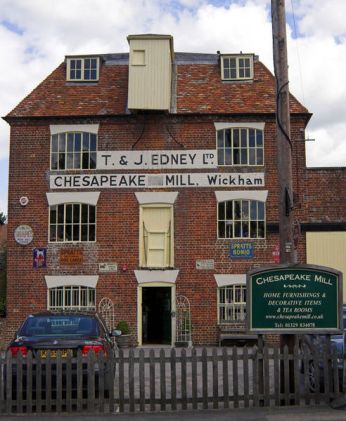
The tale of the Battle of Boston Harbor must be a story for another day.  Suffice it to say that USS Chesapeake ended her career as the British frigate HMS Chesapeake, before being sold for scrap, in 1819.  Two-hundred years later, the ship’s timbers live on.  Part of the Chesapeake Mill in the historic village of Wickham, in Hampshire, England.

A Trivial Matter: British manpower needs expanded exponentially following defeat at the battle of Saratoga and impending hostilities with Napoleonic France. Regular army enlistment swelled from 48,000 to 110,000. The Recruiting Acts of 1778 and 1779 alike reaffirmed the necessity of impressment. Some recruits went so far as to chop off their own thumb and forefinger of the right hand making it impossible to handle musket or sword, to avoid impressment.

June 19, 1864 Single Combat

Tales of single combat reach back to the mists of antiquity where history fades, into legend.  Homer’s Iliad tells of the great battle when Menelaus squared off against Paris and later Achilles, met  Hector. The Hebrew Bible brings us that most unlikely of tales where David, slew Goliath.  The Islamic chronicles are filled with such stories as are the native legends of the American plains, legends of European Knights and tales of the samurai, of the Japanese home islands.  On this day in 1864 the American Civil War took to the battle in a no-holds-barred fight to the finish off the coast of Cherbourg.


Tales of single combat reach back to the mists of antiquity where history fades, into legend.  Homer’s Iliad tells of the great battle when Menelaus squared off against Paris and later when Achilles, met  Hector. The Hebrew Bible brings us that most unlikely of tales where David, slew Goliath.  The Islamic chronicles are filled with such stories as are legends of European Knights, tales of Japanese samurai and the aerial dogfights of a later age.

On this day in 1864 the American Civil War took to the seas in a fight to the finish off the coast of Cherbourg, between the federal steam sloop-of-war USS Kearsarge and the Confederate commerce raider CSS Alabama. 

Only one would come out of this alive.

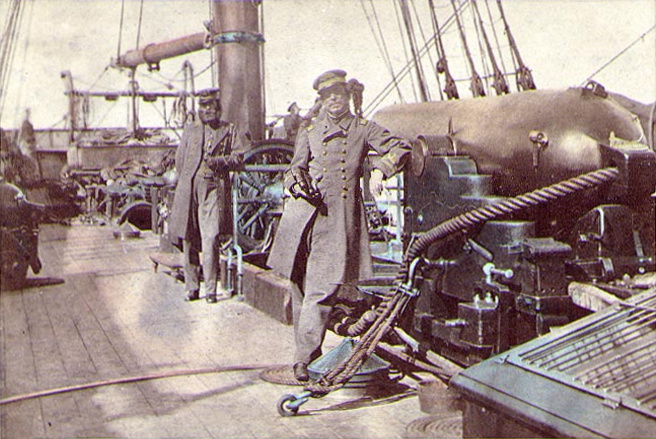
Hull #290 was launched from the John Laird & Sons shipyard in Birkenhead, Cheshire, England as the screw sloop HMS Enrica on May 15, 1862. She sailed in secret to the Terceira Island in the Azores, where she was met by Raphael Semmes, her new captain. Three days, 8 cannon and 350 tons of coal later, the Enrica was transformed into the 220′, 1,500-ton sloop of war and Confederate States of America commerce raider, CSS Alabama.

CSS Alabama
CSS Alabama

Alabama’s mission was to wage economic war on the Union, attacking commercial shipping from the Pacific to the Indian Ocean, from Newfoundland to Brazil. In her two-year career as commerce raider, Alabama claimed 65 prizes valued at nearly $123 million in today’s dollars.  She was the most successful, and most notorious, commerce raider of the Civil War.

portsmouth nh-uss kearsarge-civil war steam sloop
Civil War Steam Sloop USS Kearsarge

Alabama was in sore need of a refit when she put into Cherbourg France, on the 11th of June, 1864. The Mohican-class Union steam sloop-of-war USS Kearsarge, then on patrol near Gibralter hurried to Cherbourg, arriving on the 14th.

Captain_Raphael_Semmes_and_First_Lieutenant_John_Kell_aboard_CSS_Alabama_1863
Captain Raphael Semmes and 1st Lieutenant John Kell aboard CSS Alabama 1863

Seeing himself blockaded, Alabama’s Captain challenged Kearsarge Captain John Winslow to a ship-to-ship duel, saying “my intention is to fight the Kearsarge as soon as I can make the necessary arrangements. I hope these will not detain me more than until to-morrow or the morrow morning at farthest. I beg she will not depart until I am ready to go out. I have the honor to be your obedient servant, R. Semmes, Captain“.  That suited Winslow just fine, who took up station in international waters, and waited for Alabama to come out.

CSS Alabama steamed out of Cherbourg harbor on the morning of June 19, 1864, escorted by the French ironclad Couronne, which remained nearby to ensure that the combat remained in international waters. Kearsarge steamed further to sea as the Confederate vessel approached.  There would be no one returning to port until the issue was decided.

Captain Winslow put his ship around and headed for his adversary at 10:50am. Alabama fired first from a distance of a mile, and continued to fire as the range decreased.

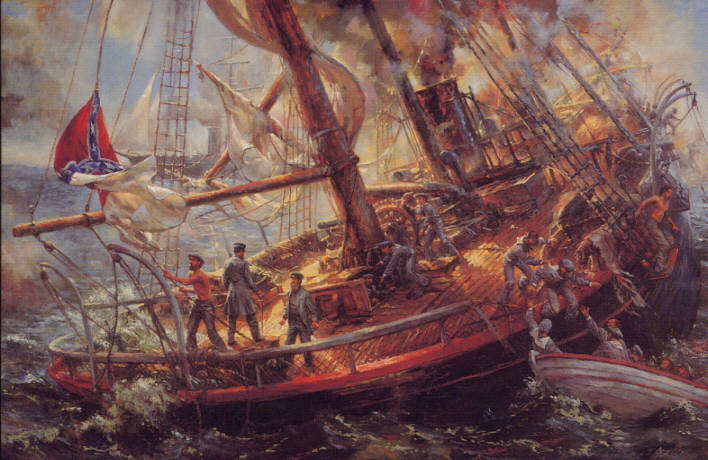
Sinking_of_the_CSS_Alabama, by Andy Thomas
Sinking of the CSS Alabama, by Andy Thomas

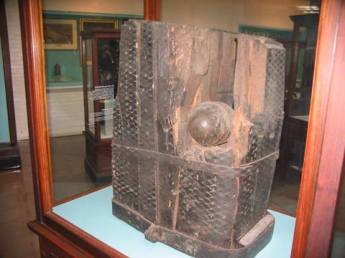
The engagement followed a circular course at a range of a half mile; the ships steaming in opposite directions and firing at will.  One ball from Alabama lodged in Kearsarge’s sternpost, but failed to explode.  Within an hour, Kearsarge’s 11″ Dahlgren smooth bore pivot cannons reduced the most successful commerce raider in history to a sinking wreck. Alabama turned and tried to run back to port, but Kearsarge headed her off as rising water stopped her engines.

Kearsarge Stern Post
USS Kearsarge Sternpost

Semmes struck his colors and sent a boat to Kearsarge with a message of surrender and an appeal for help.

For those rescued by Kearsarge, the Civil War was over. These would spend the rest of the war as prisoners of the Federal government.  Captain Semmes escaped along with 41 others, being plucked from the water and taken to neutral ports by the British steam yacht Deerhound, and the private sail yacht Hornet.

June 17, 1775 Act Worthy of Yourselves

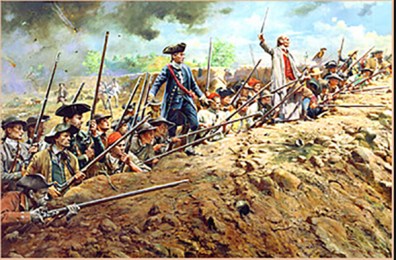
Two months before the battle, Dr. Warren spoke to his men. “On you depend the fortunes of America”, he said. “You are to decide the important question, on which rest the happiness and liberty of millions yet unborn. Act worthy of yourselves.”

Charlestown, Massachusetts occupies a hilly peninsula to the north of Boston, at the point where the Mystic River meets the Charles. Like Boston itself, much of what is now Charlestown was once Boston Harbor.  In 1775 the town was a virtual island, joined to the mainland only by a thin “neck” of land.

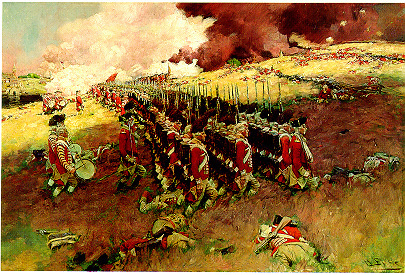
Bunker Hill, 2

Thousands of Patriot Militia poured into the area following the April battles of Lexington and Concord, hemming in the British who controlled Boston and its surrounding waterways.

Reinforced and provisioned from the sea over which the Crown held undisputed control, British forces under General Sir Thomas Gage could theoretically remained in Boston, indefinitely.

The elevation of Breed’s and Bunker’s Hill across the river, changed that calculation.  Should colonial forces obtain artillery of their own, they would be able to rain down hell on British forces bottled up in Boston.  It was just this scenario that led Henry Knox into a New England winter later that year, to retrieve the guns of Fort Ticonderoga.

The Massachusetts Provincial Congress received word on the 13th that the British planned to break out of Boston within the week, taking the high ground of Dorchester Heights to the south and Charlestown to the north. Major General Israel Putnam was directed to set up defenses on Bunker Hill, on the northwest end of the Charlestown peninsula.

Bunker_Hill_by_Pyle

Colonel William Prescott led about 1,200 men onto the peninsula on the night of the 16th. Some work was performed on the hill which gives the battle its name, but it was farmer Ephraim Breed’s land to the southeast, which offered the more defensible hill from which to defend the peninsula.

Shovels could be heard throughout the night.  The sun rose on June 17 to reveal a 130′ defensive breastwork across Breed’s hill. Major General William Howe was astonished. “The rebels,” he said, “have done more work in one night than my whole army would have done in one month.”

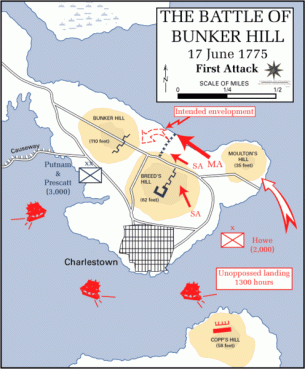
The warship HMS Lively opened fire on the redoubt shortly after 4am, with little effect on the earthworks. 128 guns joined in as the morning bore on, including incendiary shot which set fire to the town. Militia continued to reinforce the high ground throughout the morning hours, as Regulars commanded by General Howe and Brigadier General Robert Pigot crossed the Charles River and assembled for the assault.

Bunker_hill_first_attack
First Assault

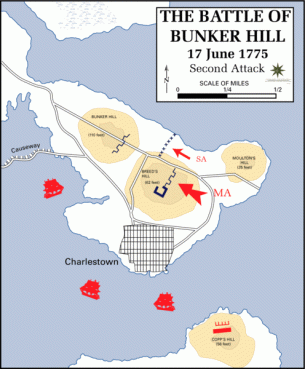
The British line advanced up Breed’s Hill twice that afternoon, Patriot fire decimating their number and driving survivors back down the hill to reform and try again. Militia supplies of powder and shot began to give out as the British advanced up the hill for the third assault.

“Don’t fire until you see the whites of their eyes”. The quote is attributed to Prescott, but the order seems to have originated with General Putnam and passed along by Prescott, Seth Pomeroy, John Stark, and others, in a desperate attempt to conserve ammunition.

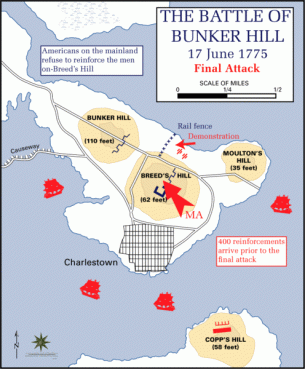
Finally, there was nothing left with which to oppose the British bayonets.  The Militia was forced to retreat.

Bunker_hill_second_attack
Second Assault

Most of the colonists’ casualties occurred at this time, including Boston physician and President of Massachusetts’ Provincial Congress, Dr. Joseph Warren.  Dr. Warren had been appointed Major General on June 14, but the commission had not arrived as of yet.  On this day, he fought as a private soldier. He had been  but the commission had not yet taken effect.

Two months before the battle, Dr. Warren spoke to his men. “On you depend the fortunes of America”, he said. “You are to decide the important question, on which rest the happiness and liberty of millions yet unborn. Act worthy of yourselves.”

“Act worthy of yourselves”. 

That they did.

Bunker_hill_final_attack
Final Attack

The Battle of Bunker Hill ended in victory for the British, in that they held the ground when the fighting was over. It was a Pyrrhic victory. Howe lost 226 killed and 828 wounded, over a third of their number and more than twice those of the Militia.

One Eighth of all the British officers killed in the Revolution, died on Ephraim Breed’s Hill. General Henry Clinton wrote afterward, of the battle:  “A few more such victories” he said, “would have shortly put an end to British dominion in America”.

June 14, 1775 The United States Army

President Woodrow Wilson marked the 1777 declaration in 1916 by declaring June 14 as national Flag Day. So it is we observe Flag Day and the birth of the United States Army alike, on June 14.

On May 10, 1775, twelve colonies convened the second Continental Congress in Philadelphia, Pennsylvania.  One colony was absent at the time, Georgia would come later, arriving on July 20 following their own Provincial Congress.

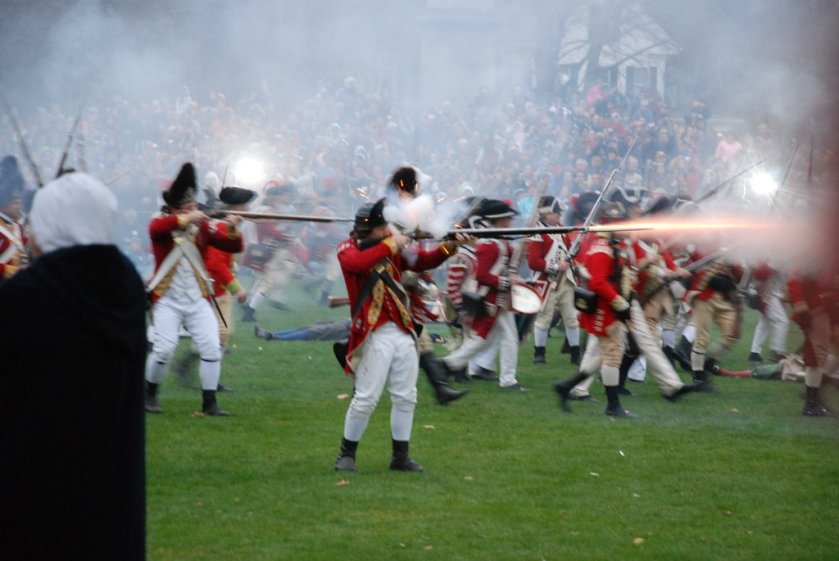
The Revolution had begun in April that year, with the battles of Lexington and Concord.  A primary focus of the Second Continental Congress was to manage the war effort.Regulars

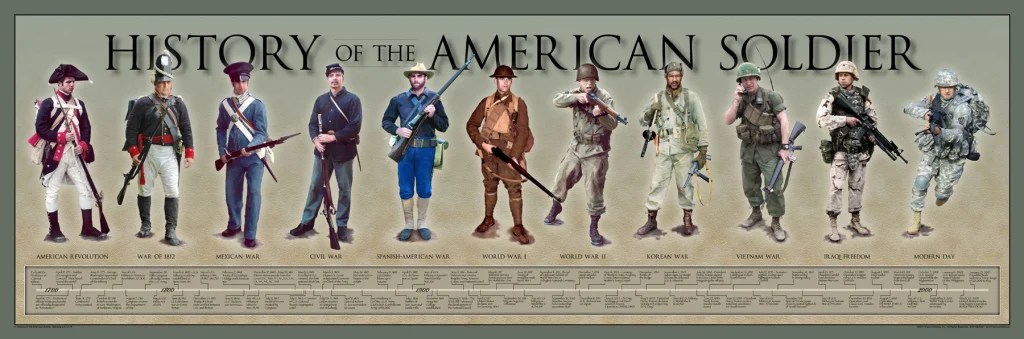
The fledgling United States had no Army at this time, relying instead on ad hoc militia units organized by the colonies themselves. At this time there were approximately 22,000 such troops surrounding British forces occupying Boston, with another 5,000 or so in New York.

Continental

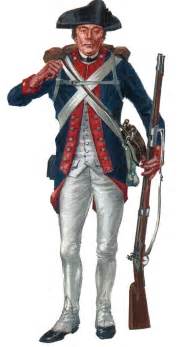
The Continental Congress established the ‘American Continental Army’ on June 14, 1775, authorizing 10 companies of ‘expert riflemen,’ to serve as light infantry in the siege of Boston. The next day the Congress unanimously selected George Washington to be General and Commander in Chief of all continental forces.

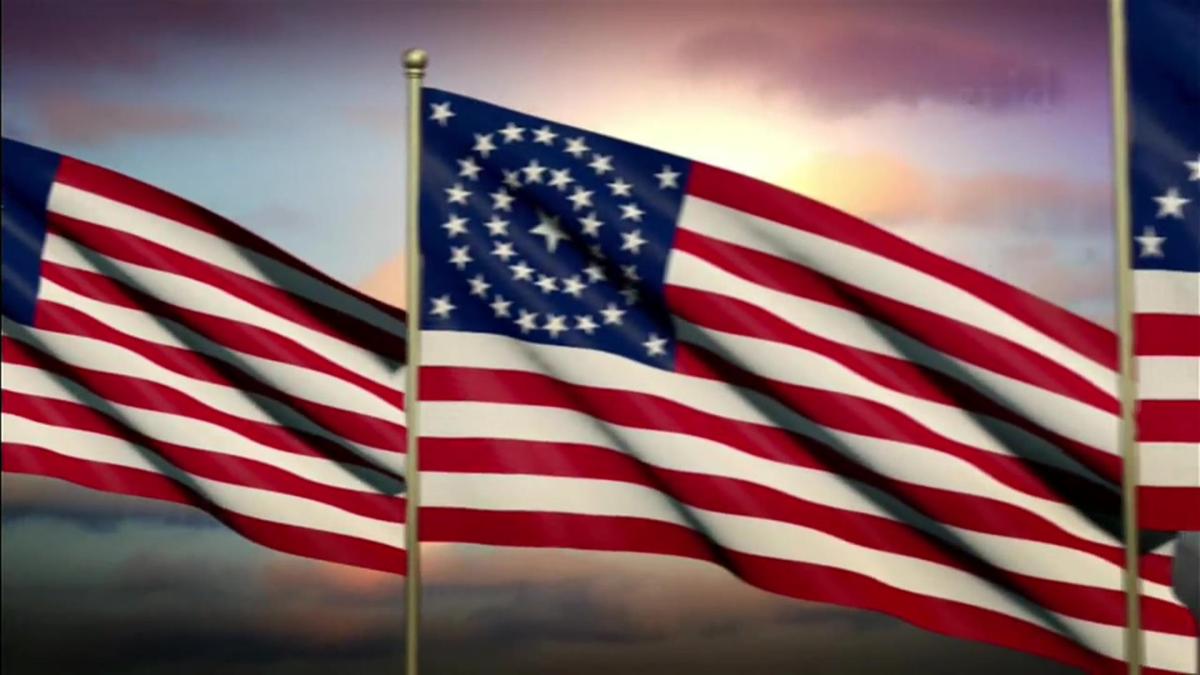
Two years later and also on this day the 2nd Continental Congress passed a resolution, stating that “the flag of the United States be 13 stripes, alternate red and white,” and that “the union be 13 stars, white in a blue field, representing a new constellation.”

President Woodrow Wilson marked the day in 1916 by declaring June 14 as national Flag Day. So it is we observe Flag Day and the birth of the United States Army alike, on June 14.

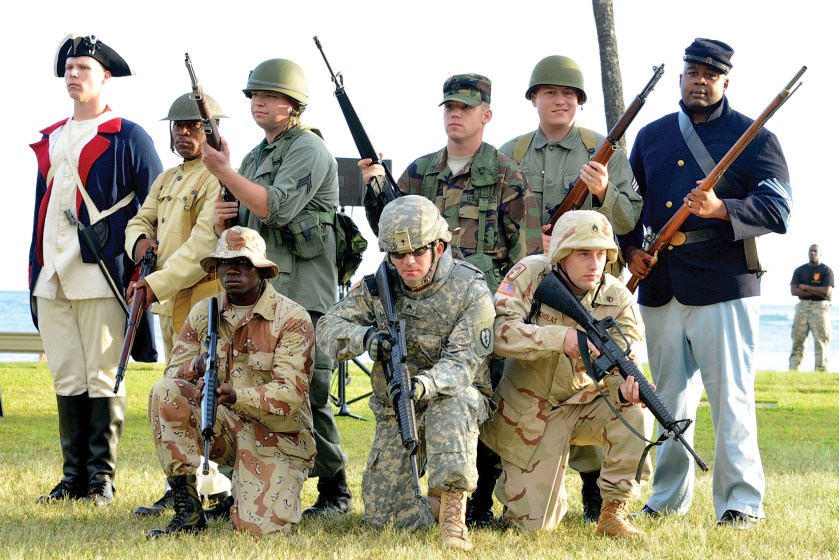
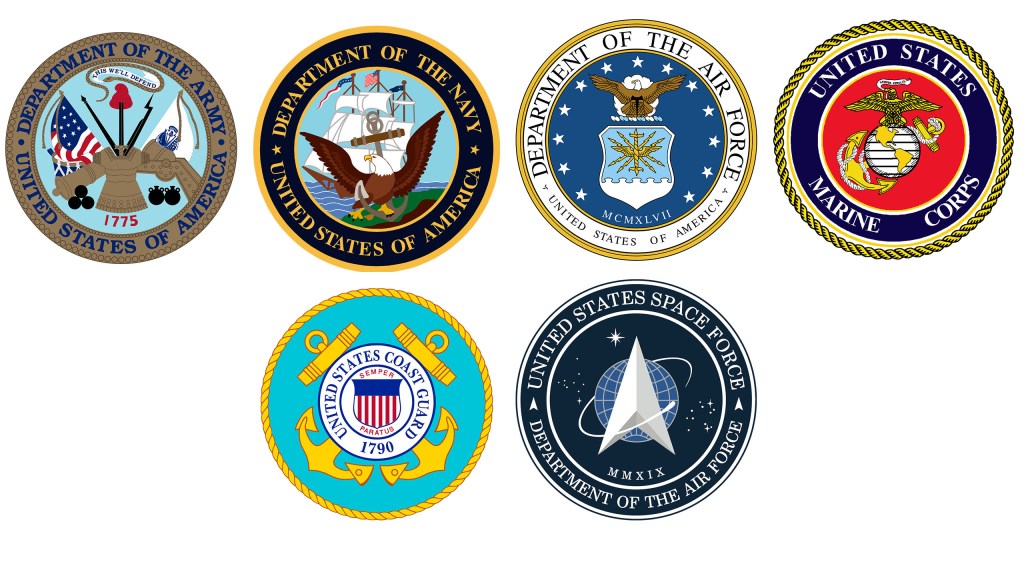
Other branches of the Armed services were quick to follow the establi9shment, of the Continental Army. The Navy was formed in October 1775, the Marine Corps in November. 18th century revenue cutter and rescue operations led to the formation of the United States Coast Guard in January 1915.  The Air Force spun off of the Army Air Corps in September 1947.

A3_USARPAC_Army-Birthday-Commemoration_003_w

Discussions for a Space force, the last of eight uniformed services and six co-equal branches of US Armed Forces began as early as 1958. The idea gained new impetus with a June 2018 order from then President Donald Trump, directing the Department of Defense begin the necessary steps to establish such an agency as a part of the US Armed Forces.

Formally established in December 2019 the Space Force was mocked in some corners. It is difficult to understand why. A dull child could easily see the strategic importance of such an organization, national defense leaning as it does on space in the modern era for navigation, intelligence, missile warning, communications, weather and precision-guided munitions, and more. This is to say nothing of the many uses we all find for satellites in our day-to-day lives.

Most of the Continental Army was disbanded following the Treaty of Paris ended the war in 1783. The 1st and 2nd Regiments remained to become the basis of the Legion of the United States in 1792, under General Anthony Wayne. These two became the foundation of the United States Army, in 1796.

Speaking on Armed Services Day in 1953, President Dwight David Eisenhower said: “It is fitting and proper that we devote one day each year to paying special tribute to those whose constancy and courage constitute one of the bulwarks guarding the freedom of this nation and the peace of the free world.”

On the other days of the year, you might well say you can thank a teacher that you can read this essay.  Today, you can thank a soldier that you can read it in English.  Happy birthday, United States Army.

June 11, 1775 The Battle of Machias

Called by some the “Lexington of the Sea”, the little-known episode was the first naval battle of the American Revolution.

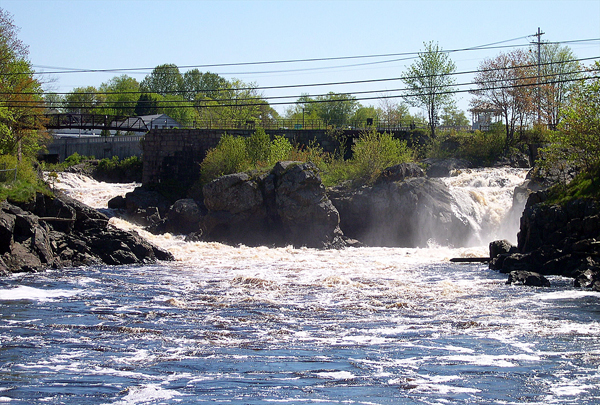
In the Passamaquoddy tongue, “Machias” roughly translates into “bad little falls”, after the river that runs through the place. Five hours and 15 minutes drive-time from Boston, Machias Maine sports a campus for the University of Maine, a municipal airport and, even today, a year-round population barely exceeding 2,000.

BAD LITTLE FALLS KC.JPG
Machias-area residents who discussed downtown revitalization Tuesday evening said the Bad Little falls was the town’s most distinctive element. (KATHERINE CASSIDY PHOTO)

Not necessarily a place where you’d expect the first naval combat of the American Revolution.

In 1775, the modern state of Maine was still part of Massachusetts. Machias itself, a small fishing village on the “Down East” New England coast, was a thorn in the British side since the earliest days of the Revolution.   A local pilot intentionally grounded the coastal patrol schooner HMS Halifax that February, in Machias Bay.  The place also served as a base from which privateers preyed on British merchant shipping.

In April, a British foray from the occupied city of Boston had culminated in the Battle at Lexington Green.  While the King’s troops held the ground in the wake of the early morning skirmish, the decision of the afternoon’s battle at nearby Concord was quite different.  The colonial’s response to the column of “Regulars” was that of a swarming beehive, resulting in a Patriot victory and a British retreat under fire, all the way back to Boston.
Siege-of-Boston-1-AB

Boston was all but an island in those days, connected to the mainland only be a narrow “neck” of land.  A Patriot force some 20,000 strong took positions in the days and weeks that followed, blocking the city and trapping four regiments of British troops (about 4,000 men) inside of the city.
For General Thomas Gage, in charge of all those troops, the best hope for resupply was by water.

British Royal Navy Admiral Samuel Graves wanted the guns from the wreck of the Halifax, concerned they would otherwise fall into rebel hands.  Gage wanted lumber, with which to build barracks.  So it was that the wealthy merchant and Tory loyalist Ichabod Jones was enlisted to help, blissfully unaware of the dim view in which his activities were held by fellow colonials.

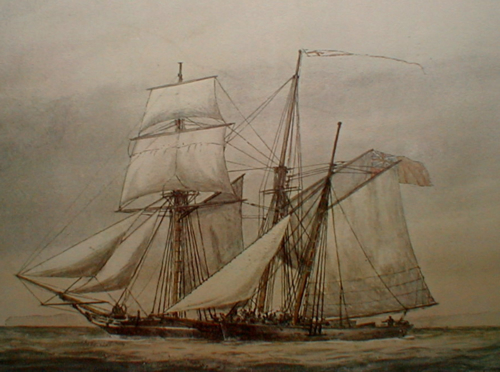
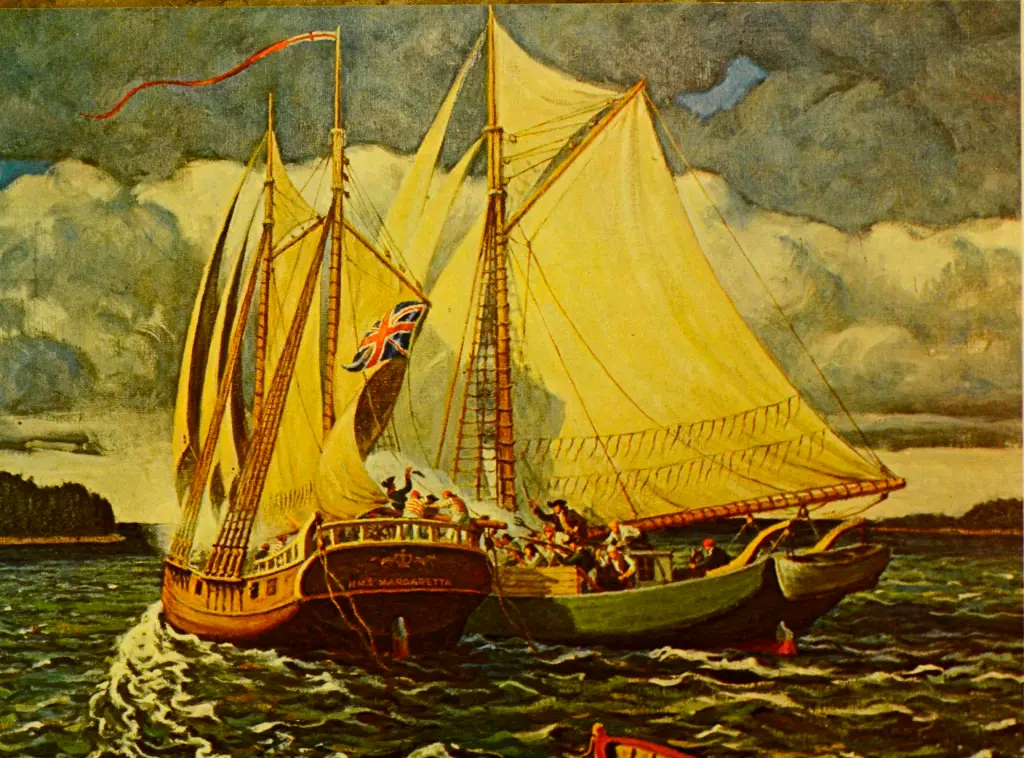
Jones arrived at Machias on June 2 aboard the merchant ships Unity and Polly, under guard of the armed schooner HMS Margaretta, commanded by Midshipman James Moore.  They had come to trade food for lumber but the townspeople were split, and voted against doing business with Jones.  This provoked a threat from the Margaretta, which moved into range to bombard the town.  The action resulted in a second vote and the trade was approved, but Jones’ response was ham-fisted.   The merchant would only do business, with those who had voted with him in the first place.

margaretta
HMS Margaretta

Local militia leader Colonel Benjamin Foster conceived a plan to seize the merchant, and saw his opportunity on June 11, when Jones and Moore were in church.  They almost had the pair too, but Jones saw some twenty men approaching, and fled for the woods.  Moore was able to get back to the Margaretta, but events soon spun out of control.

Colonel Foster and his brother, a man with the delightful name of Wooden Foster, seized the Unity.  A group of thirty began to construct breastworks to serve as protection, while others commandeered the coastal packet Falmouth.   There was gong to be a fight.

machias_me

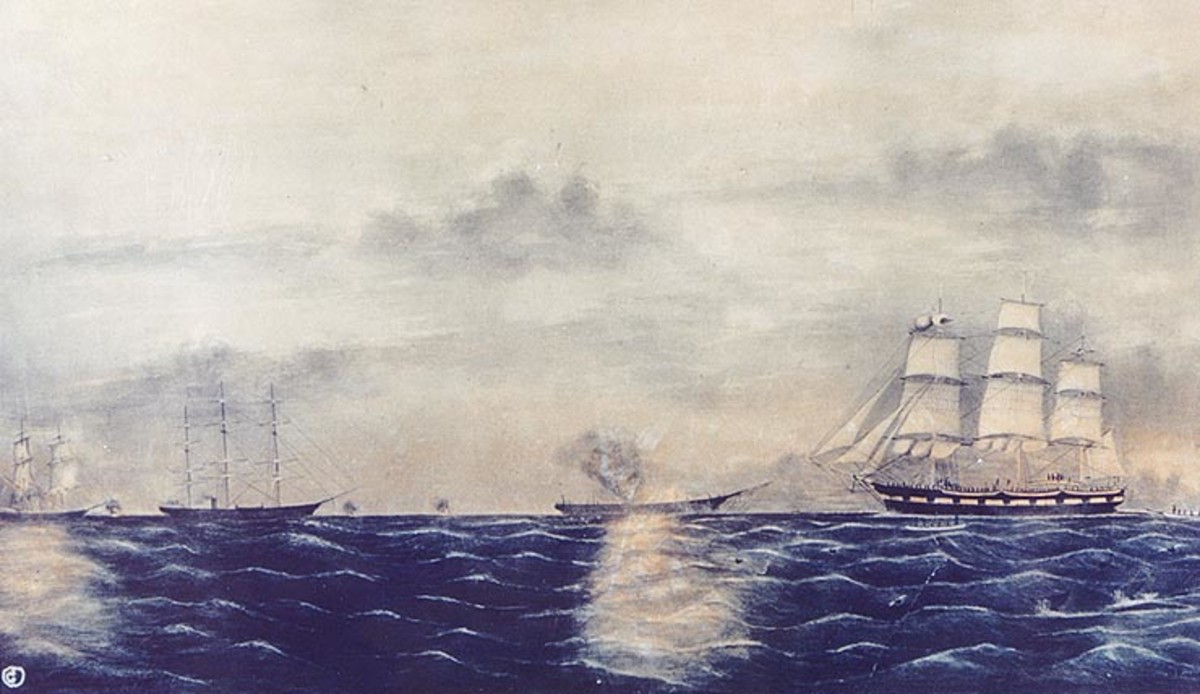
A group of Machias men approached Margaretta from the land and demanded her surrender, but Moore lifted anchor and sailed off in attempt to recover the Polly.  A turn of his stern through a brisk wind resulted in a boom and gaff breaking away from the mainsail, crippling the vessel’s navigability. Unity gave chase followed by Falmouth.

Musket fire was exchanged from both sides and hand grenades were thrown onto the decks of the Unity.   Soon, the Margaretta was boarded from both sides, the fighting hand to hand.

Called by some the “Lexington of the Sea”, the little-known episode was the first naval battle of the American Revolution and ended in victory for the Patriot side.  Four Royal Navy seamen were killed outright and another ten wounded including Moore himself, who received a musket ball to the chest and died the following day.

Patriot losses amounted to ten killed and another three wounded.

HMS Margaretta served out the remainder of the Revolution as the renamed Machias Liberty.  British payback came on October 18 when Falmouth Massachusetts, the modern-site of Falmouth Maine and not to be confused with either of the modern-day towns of  Falmouth Massachusetts, or Falmouth Maine, was burned to the ground.

British forces attempted a second assault on Machias, with an amphibious landing of 1,000 troops over the 13th – 14th of August, 1777.  The attempt was beaten back by local militia and their Passamaquoddy and Penobscot allies, with both sides claiming victory.  The nearby village of Castine would be occupied in 1779 as would Machias itself during the War of 1812.  On both occasions, captured territories were re-dubbed the Crown Colony of “New Ireland”, a refuge for Loyalists and a base for future military operations.

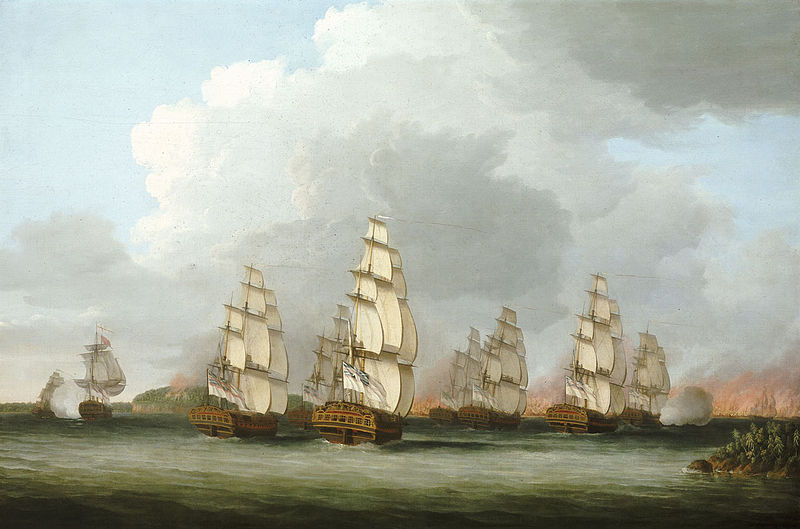
The Crown Colonies of New Ireland survived for four years in the first instance and eight months in the second.  The failed Penobscot expedition of 1779 to retake the colony would result in the most catastrophic defeat suffered by American Naval forces until the Japanese attack on Pearl Harbor 162 years later, but that must be a story for another day.

800px-PenobscotExpeditionBySerres
Britain defending New Ireland from the Penobscot Expedition by Dominic Serres

June 7, 1942 To Alaska

Construction began in March as trains moved hundreds of pieces of construction equipment to Dawson Creek, the last stop on the Northern Alberta Railway. At the other end, 10,670 American troops arrived in Alaska that spring to begin what officers called “the biggest and hardest job since the Panama Canal.”

In 1865, Western Union contemplated plans to install telegraph wires from the US to Siberia, sparking discussions of an road to the Alaskan interior. The proliferation of automobiles in the 1920s caused the idea to pick up steam but the project was a hard sell, for Canadian authorities. Such a road would necessarily pass through Canadian territory while the government believed the project would have little impact, benefiting no more than a few thousand people in the Yukon.

In the days following the surprise attack on Pearl Harbor, Guam and Wake Island fell to Imperial Japanese forces , making it clear that parts of the Pacific coast were vulnerable.

Priorities were changing for both the United States, and Canada.

The Alaska Territory was particularly exposed. Situated only 750 miles from the nearest Japanese base, the Aleutian Island chain had but 12 medium bombers, 20 pursuit planes, and fewer than 22,000 troops in the entire territory, an area four times the size of Texas.

Surviving-AK-blog-1

Colonel Simon Bolivar Buckner Jr., son of the Confederate commander who famously received Ulysses S. Grant’s “Unconditional Surrender” ultimatum at Fort Donelson (“I propose to move immediately, upon your works”), was in charge of the Alaska Defense Command.  Buckner made his made point, succinctly. “If the Japanese come here, I can’t defend Alaska. I don’t have the resources.”

The Army approved construction of the Alaska Highway in February 1942, the project receiving the blessings of Congress and President Roosevelt within the week. Canada agreed to allow the project, provided that the United States pay the full cost, and the roadway and other facilities be turned over to Canadian authorities at the end of the war.

Construction began in March as trains moved hundreds of pieces of construction equipment to Dawson Creek, the last stop on the Northern Alberta Railway. At the other end, 10,670 American troops arrived in Alaska that spring to begin what officers called “the biggest and hardest job since the Panama Canal.”

4517139905_887f3c484a_b
Dawson Creek, 1942

In-between lay over 1,500 miles of unmapped, hostile, wilderness.

The project received a new sense of urgency on June 7, when a Japanese force of 1,140 took control of Attu Island and murdering Charles Jones, a ham radio operator and weather reporter from Ohio. Japanese forces took 45 Aleuts into captivity along with Jones’ wife, Etta.  Adding to the urgency was the fact that the Alaskan winter permits no more than an eight-month construction window.  That period was already well underway.

Construction began at both ends and the middle at once, with nothing but the most rudimentary engineering sketches. A route through the Rocky Mountains had yet to be identified.

06162017_HighwayRadios of the age didn’t work across the Rockies, and the mail was erratic.  The only passenger service available was run by the Yukon Southern airline, a run which locals called the “Yukon Seldom”.  For construction battalions at Dawson Creek, Delta Junction and Whitehorse, it was faster to talk to each other through military officials in Washington, DC.

Moving men to assigned locations was one thing.  Transporting 11,000 pieces of heavy equipment, to say nothing of supplies needed by man and machine, was quite another.

alcan-hwyTent pegs were useless in the permafrost, while the body heat of sleeping soldiers meant waking up in mud. Partially thawed lakes meant that supply planes could use neither pontoon nor ski, as Black flies swarmed the troops by day.  Hungry bears raided camps at night, looking for food.

Engines had to run around the clock, as it was impossible to restart them in the cold. Engineers waded up to their chests building pontoons across freezing lakes, battling mosquitoes in the mud and the moss laden arctic bog. Ground which had been frozen for thousands of years was scraped bare and exposed to sunlight, creating a deadly layer of muddy quicksand in which bulldozers sank in what seemed like stable roadbed.

Alaska Highway Black Soldiers

That October, Refines Sims Jr. of Philadelphia, with the all-black 97th Engineers, was driving a bulldozer 20 miles east of the Alaska-Yukon line when the trees in front of him toppled to the ground. Sims slammed his machine into reverse as a second bulldozer came into view, driven by Kennedy, Texas Private Alfred Jalufka. North had met south, and the two men jumped off their machines, grinning. Their triumphant handshake was photographed by a fellow soldier and published in newspapers across the country, becoming an unintended first step toward desegregating the US military.

24SOLD-popup

A gathering at Soldier’s Summit on November 21, 1942 celebrated “completion” of the route, though the “highway” remained impassable for most vehicles, until 1943.

Alaska-Hwy-historyNPR ran an interview about this story back in the eighties, in which an Inupiaq elder was recounting his memories. He had grown up in a world as it existed for hundreds of years, without so much as an idea of internal combustion. He spoke of the day that he first heard the sound of an engine, and went out to see a giant bulldozer making its way over the permafrost. The bulldozer was being driven by a black operator, probably one of the 97th Engineers Battalion soldiers.  The old man’s comment, as best I can remember it, was a classic. “It turned out”, he said, “that the first white person I ever saw, was a black man”.

REBRANDSD2997_THC_MDRN_3703_HVG_000_2997_60_20160202_00_HD

A Trivial Matter: “There were many timber bridges built by civilian workers on the Alaska Highway, the Kiskatinaw Bridge is the only one still in use. It is also one of the most unusual, curving nine degrees along its 162.5 metre (534 foot) length”. Hat Tip http://www.alcanhighway.org