February 9, 1945 An Underwater Chernobyl

Only 4kg of mercury are estimated to have leaked so far, about nine pounds, and surrounding waters are already off limits, to fishing. The Nazi submarine sank this day in 1945 carrying 67 tons.

A light rain fell on Heston Aerodrome in London, as thousands thronged the tarmac awaiting the return of British Prime Minister Neville Chamberlain. Searing memories of the Great War only 20 years in the past, hung over London like some black and malevolent cloud.

Emerging from the door of the aircraft that evening in September, 1938, the Prime minister began to speak.  The piece of paper Chamberlain held in his hand annexed that bit of the Czechoslovak Republic known as the “Sudetenland”, to Nazi Germany. Germany’s territorial ambitions to her east, were sated. It was peace in our time.

With the March invasion of Czecho-Slovakia, Hitler demonstrated even to Neville Chamberlain that the so-called Munich agreement, meant nothing. That Poland was next was an open secret.  Polish-British mutual aid talks began that April. Two days after Nazi Germany and Stalin’s Soviet Union signed the Molotov-Ribbentrop non-aggression pact, the Polish-British Common Defense Pact was added to the Franco-Polish Military Alliance.  Should Poland be invaded by a foreign power, England and France were now committed to intervene. That same month the first fourteen “Unterseeboots” (U-boats) left their bases, fanning out across the North Atlantic. 

The German invasion of Poland began on September 1, the same day the British passenger liner SS Athenia departed Glasgow for Montreal with 1,418 passengers and crew.  Two days later Great Britain and France declared war, on Germany. With the declaration only hours old, Athenia was seating her second round of dinner guests, for the evening.

At 19:40, U-30 Oberleutnant Fritz Julius Lemp fired two torpedos, one striking the liner’s port side engine room.   14 hours later, Athenia sank stern first with the loss of 98 passengers and 19 crew. The Battle of the Atlantic, had begun.
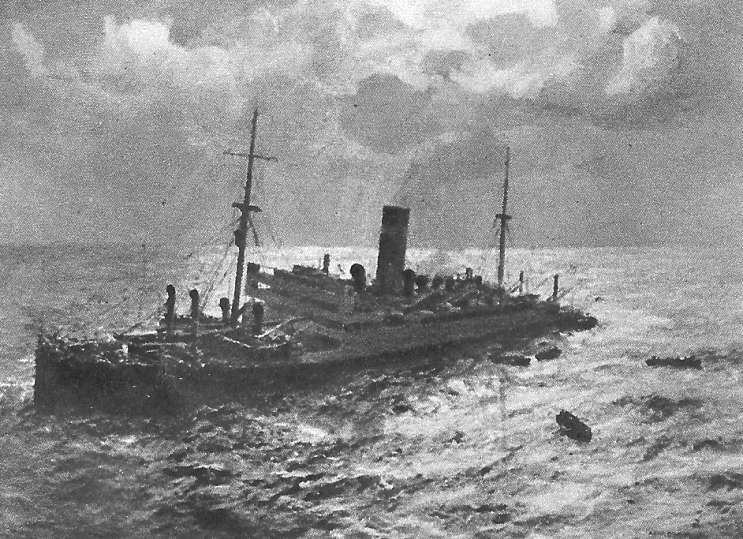
In a repeat of WWI, both England and Germany implemented blockades on one another.   And for good reason.  At the height of the war England alone required over a million tons a week of imported goods, to survive and to stay in the fight.

The “Battle of the Atlantic” lasted 5 years, 8 months and 5 days ranging from the Irish Sea to the Gulf of Mexico, from the Caribbean to the Arctic Ocean. 

New weapons and tactics would shift the balance first in favor of one side, and then to the other.  Before it was over 3,500 merchant ships and 175 warships were sunk to the bottom. 500,000 tons of allied shipping was sunk in June 1941, alone.

Nazi Germany lost 783 U-boats.

Submarines operate in 3-dimensional space but their most effective weapon, does not.  The torpedo is a surface weapon operating in two-dimensional space:  left, right and forward.  Firing at a submerged target requires that the torpedo be converted to neutral buoyancy. The complexity of firing calculations are all but insurmountable.

The most unusual underwater action of the war occurred on February 9, 1945 in the form of a combat between two submerged submarines. 
u-864
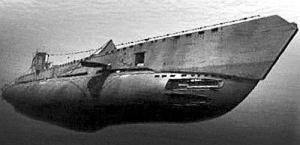
U-864

The war was going badly for the Axis Powers in 1945, the allies enjoying near-uncontested supremacy over the world’s shipping lanes.  Any surface delivery between Nazi Germany and Imperial Japan was sure to be detected and destroyed.  The maiden voyage of the 287-foot, 1,799 ton German submarine U-864 departed on “Operation Caesar” on December 5, delivering Messerschmitt jet engine parts, V-2 missile guidance systems and 67 tons of mercury to the Imperial Japanese war production industry.
u-864-location

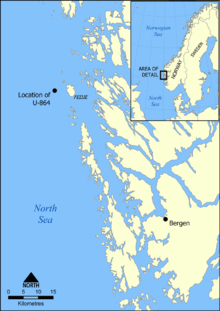
The mission was a failure, from the start. U-864 ran aground in the Kiel Canal and had to retreat to Bergen, Norway, for repairs. The submarine was able to clear the island of Fedje off the Norway coast undetected on February 6.  By this time British MI6 had broken the German Enigma code and were well aware, of Operation Caesar.

The British submarine Venturer, commanded by 25-year-old Lieutenant Jimmy Launders, was dispatched from the Shetland Islands to intercept and destroy U-864.

ASDIC, an early name for sonar, would have been helpful in locating U-864, but at a price.  That familiar “ping” would have been heard by both sides, alerting the German commander he was being hunted.  Launders opted for hydrophones, a passive listening device which could alert him to external noises.  Calculating his adversary’s direction, depth and speed was vastly more complicated without ASDIC but the need for stealth, won out.

U-864 developed an engine noise and commander Ralf-Reimar Wolfram feared it might give him away. The submarine returned to Bergen for repairs.  German submarines of the age were equipped with “snorkels”, heavy tubes which broke the surface, enabling diesel engines and crews to breathe while running submerged.  Venturer was on batteries when those first sounds were detected.

The British sub had the advantage in stealth but only a short time frame, in which act.
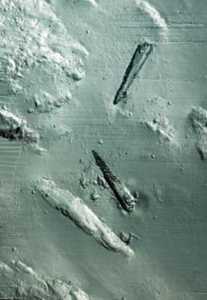
u-864-wreck

A four dimensional firing solution accounting for time, distance, bearing and target depth was theoretically possible but had rarely been attempted under combat conditions.  Unknown factors could only be guessed at.

A fast attack sub Venturer only carried four torpedo tubes, far fewer than her much larger adversary.  Launders calculated his firing solution, ordering all four tubes and firing with a 17½ second delay between each pair.  With four incoming at different depths, the German sub didn’t have time to react.  Wolfram was only just retrieving his snorkel and converting to electric, when the #4 torpedo struck.  U-864 imploded and sank, instantly killing all 73 aboard.

So, what about all that mercury?

In our time, authorities recommend consumption limits of certain fish species. Sharp limitations are recommended for pregnant women and nursing mothers.

Fish and shellfish have a natural tendency to concentrate or bioaccumulate mercury in body tissues in the form of methylmercury, a highly toxic organic compound of mercury. Concentrations increase as you move up the underwater food chain. In a process called biomagnification, apex predators such as tuna, swordfish and king mackerel may develop mercury concentrations up to ten times higher than prey species.

The toxic effects of mercury include damage to the brain, kidneys and lungs and long term neurological damage, particularly in children.

Exposures lead to disorders ranging from numbness in the hands and feet, muscle weakness, loss of peripheral vision and damage to hearing and speech.

In extreme cases, symptoms include insanity, paralysis, coma, and death. The range of symptoms was first identified in the city of Minamata, Japan in 1956 and results from high concentrations of methylmercury.

In the case of Minamata, methylmercury originated in industrial wastewater from a chemical factory, bioaccumulated and biomagnified in shellfish and fish in Minamata Bay and the Shiranui Sea. Deaths from Minamata disease continued some 36 years among humans, dogs and pigs. The problem was so severe among cats as to spawn a feline veterinary condition known as “dancing cat fever”.

Today, 67 tons of mercury lie under 490-feet of water at the bottom of the north sea, in the broken hull of Adolf Hitler’s last best chance. Rusting containers have already begun to leach toxic mercury into surrounding waters.

The wreck has been called an “underwater Chernobyl”.

Only 4kg are estimated to have leaked so far, about nine pounds, and surrounding waters are already off limits, to fishing. Pregnant and breastfeeding women and young children are advised not to eat fish caught near the wreck.

The wreck was located in 2003. Discussions began almost immediately to retrieve the deadly cargo from what Oslo’s newspaper Dagbladet called, “Hitler’s secret poison bomb.”

Now, 76 years to the day from the last dive of the U-864, the submarine’s hull and mercury containment vessels are believed too fragile to be brought to the surface.

In the fall of 2018, the Norwegian government decided to bury the thing under a great sarcophagus, of concrete and sand. Much the same technique as that used in Chernobyl to sea off contaminated reactors. The work was projected to cost $32 million (US) with completion date, of late 2020. The work was was delayed and once again, the government is now examining the possibility of retrieving the cargo.

February 8, 1587 Mary, Queen of Scots

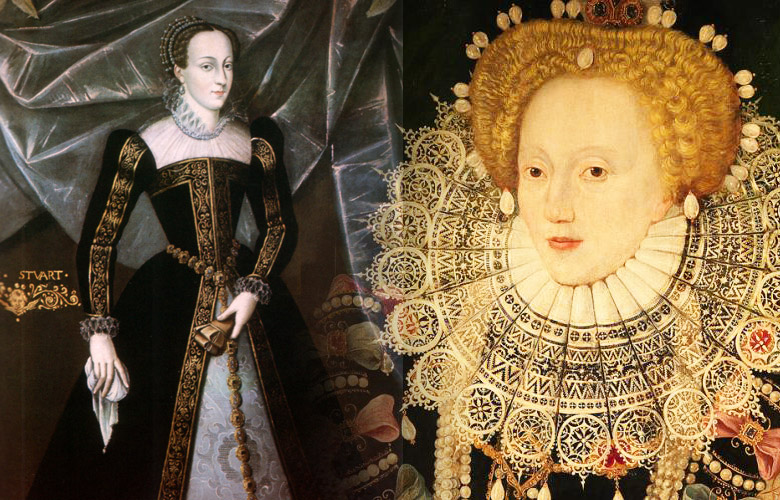
To her detractors, Mary Queen of Scots was an adulteress if not a murderess. To her supporters she was a romantic figure not given to evil but the tragic victim, of evil times.

In 1509, the daughter of Isabella I of Castile and Ferdinand II of Aragon (yeah, That Ferdinand and Isabella), married the newly ascended King of England, Henry VIII. Six times over the next nine years, Catherine of Aragon became pregnant. Three boys, three girls.

Only one lived through the second month, Mary Tudor, destined to become Mary I, Queen of England and hated by her Protestant opponents as “Bloody Mary”.

With no surviving male heir, Henry began an affair with the daughter of the 1st Earl of Wiltshire, Mary Boleyn. Mary bore two children around this time but Henry acknowledged paternity, of neither. Instead, the King became obsessed with Mary’s sister, Anne.

Henry wanted this woman but he was caught in a pickle, between a Pope who refused to grant an annulment and a love interest who refused to become a mistress, as her sister had done. Anne Boleyn was going to be the King’s wife, or nothing.

Thus began a series of events which would culminate in schism with the Catholic church with Henry ascending to the head, of the Church of England. This was no small thing. What seems to the modern mind as mere doctrinal differences, were life and death matters in the late middle and early modern ages. The Peasant’s War of 1524-’25 alone killed more Europeans than any conflict in history, prior to the French Revolution.

While court and public alike adored Catherine, Anne was reviled. “The King’s concubine”. The woman who had bewitched a Monarch and usurped a beloved Queen consort was held personally responsible, for Henry’s break with the Church. The union produced one surviving child, Elizabeth Tudor, derided by many as the “bastard child of a whore.”

Whip smart even at the age of three, Elizabeth noticed her own change of station following the death of her mother. Anne was executed by decapitation in 1536 and replaced by Jane Seymour, 11 days later. “How haps it Governor,” she asked a year later, “yesterday my Lady Princess, and today but my Lady Elizabeth?”

Seymour gave birth to the long awaited male heir who took the throne at age 9, following the death of his father. He was Edward VI, the first English monarch brought up, as a Protestant. Jane herself died shortly after giving birth.

Wife #4, a German princess called Anne of Cleaves, was displeasing to the King. The pair was divorced, in 6 months.

Elizabeth, now nine, was given the best of education while her father remained cold. Distant. The girl would occasionally appear in court and impressed all with her intelligence but it was her teenage stepmother, Catherine Howard, with whom Elizabeth developed any kind of relationship. That all changed when the headsman’s axe came down yet again on February 13, 1542. Catherine Howard, the 5th wife of King Henry VIII, was dead. Then and there the future Queen is said to have vowed, not to marry.

That same year a ginger-haired princess was born in Scotland, Mary Stuart, the only surviving child of King James V of Scotland and his imposing second wife the French noblewoman, Mary of Guise.

The childhood of those two girls, cousins who would never meet, could not have been more different. Mary became Queen of Scots as an infant, following the death of her father. Her mother ruled as Regent for the rest of her life, trying in vain to keep the Protestant reformation, out of Scotland.

The brilliant Elizabeth must have feared at times, for her own survival. With her future anything but certain, her very legitimacy an open question, Elizabeth learned to hold her cards close and to hold others, in suspicion.

Even with her title of “Princess” restored Elizabeth was still mostly alone, outside of court life with her books, her thoughts and the occasional visitor. Mary’s life “…from the age of six was lived at the very center of the most glamorous court in Christendom”, surrounded by pets, tutors, and adoring cousins and occupied by singing lessons, dancing and horseback riding.

Biographer Jane Dunn writes in Elizabeth and Mary: Cousins, Rival, Queens: “Mary’s sense of herself as queen had been with her from the dawning of her consciousness. It was never disputed or tested, as was Elizabeth’s. This awareness of her pre-eminence was her companion through life, something taken for granted, the responsibilities to which she did not apply much profound thought nor, in the end, much value.

Henry died in 1547 leaving Katherine Parr a widow, and the “Child King” Edward VI King of England, at the age of nine.

Henry’s long-awaited heir died at the age of fifteen to be replaced by his half sister, Mary Tudor.

Best remembered for her attempts to reassert Catholicism in England, “Bloody Mary” ruled for not-quite three years, her “Marian persecutions” responsible for hundreds of Protestant martyrs and “heretics” being burned, at the stake.

At first moved about to avoid the danger of warring clans, Mary was sent to her mother’s native France at age 5 where she was worshipped by the royal family. “The little Queen of Scots is the most perfect child that I have ever seen” gushed the French King Henry II.

As a child Queen, Mary literally walked before the King’s on children.

Royal marriages were often arranged at this time, to cement political alliances. Mary, age 5, was betrothed to Henry’s son and heir Francis, the Dauphin of France. The two could not have been more different: She, pretty and vivacious, dedicated to her studies and exceptionally tall as an adult reaching 5’11”. He was short and sickly, prone to stutter and more interested in falconry, than studying.

The couple was wed, in 1559. Francis II became the teenage King of France and after his father was killed in a joust, but the marriage didn’t last long. An ear infection turned into a brain abscess the following year.

Mary Tudor detested her half sister and, in 1554, threw her in the Tower of London where her mother Anne Boleyn, had died. “Oh Lorde!” she said. “I never thought to have come in here as prisoner!” There followed a year in exile and then a Royal Pardon. Mary I, suffering from abdominal pain which may have been uterine cancer, recognized Elizabeth on November 6, 1555. Mary Tudor, the first Queen to rule over Britain in her own right, died on November 17. Elizabeth I became Queen the same day.

Historian’s debate the new Elizabeth’s religious convictions but doubts about her own legitimacy left little doubt, she would rule as a Protestant. One day, Protestant England would go to war with itself over issues of Religious expression but, for now, Protestant England agreed. Current arrangements were better than “Popery”.

To English Catholics, the Scottish queen was the rightful heir to English throne. The 3rd succession act of 1543 said otherwise and Henry VIII’s own last will & testament precluded a Stuart from becoming sovereign, but still. Mary was the senior surviving legitimate descendant of Henry VII through her grandmother, Margaret Tudor and therefore, according to English Catholics, the rightful Queen of England.

Mary returned to Scotland in 1561. Having grown up in France she was ill prepared for the political situation in Scotland, or the Protestant reformation her mother had failed to hold off, as regent.

There followed a series of bad decisions, on Mary’s part. First her own political isolation resulting from the appointment of mostly Protestant ministers. Perhaps she had an eye toward the English throne. Next came a catastrophic error in judgement in the six-foot + form of her English-born half-cousin Henry Stuart, Lord Darnley. Mary fell hard for the man.

The marriage hardened differences in internal Scottish politics and infuriated Elizabeth. How could she marry an English subject without Her permission? Darnley became arrogant, demanding. King consort wasn’t good enough. He wanted the Crown Matrimonial, the full right of co-rule. Mary became pregnant at this time, a fact Darnley blamed on Mary’s Italian secretary, David Rizzio.

Months later, Mary would present her newborn baby boy, the future King of Scotland, to her husband. “My Lord, here I protest to God”, she said, “and as I shall answer to Him at the great day of judgment, this is your son, and no other man’s son…
It didn’t matter. Darnley and a group of Protestant Lords stabbed Rizzio to death in front of Mary, that March. Darnley himself was murdered in 1567 and Mary married James Hepburn, Earl of Bothwell, believed by many to be responsible for her husband’s murder.

Pushback was immediate, and vehement. 26 Scottish peers known as the confederate lords raised an army. Mary and Bothwell raised their own and met the lords at Carberry Hill, that June. No fighting took place but Mary’s forces dwindled through desertion, as negotiations dragged on. Bothwell himself was granted safe passage from the field while Mary was imprisoned in Loch Leven Castle, denounced as an adulteress, and murderer.

Mary escaped and this time there Was a battle. Her side lost and the Queen, now deposed, fled south to England. Mary seems to have thought Elizabeth would help regain her crown but instead, she ordered an inquiry.

Unsigned letters purported to be written by Mary were “found” in a small silver casket, seeming to establish Mary’s guilt. Three biographers later declared these “casket letters” to be outright forgeries but, no matter. The majority of commissioners accepted the letters, as valid.

Biographer Antonia Fraser describes the proceeding as one of the strangest “trials” in legal history. In the end there was no finding of guilt or innocence of either side. Perhaps that’s what Elizabeth wanted, all along. Moray was allowed to return home to Scotland. Mary remained in custody. For nineteen years.

Hers was a gilded cage to be sure with with servants, bedlinens changed daily and chefs to prepare her meals but a cage it was.

Lack of exercise and close confinement led to a host of medical problems including porphyria, and rheumatism so severe as to render her lame.

Elizabeth attempted at one point to mediate her cousin’s return to the throne but an uprising of Catholic earls convinced the Queen that Mary was where she belonged.

In 1586 there was a plot to assassinate Elizabeth and place Mary, on the English throne. Mary, betrayed by her own son in favor of Elizabeth, appears to have corresponded with the plotters. The names of so-called “Babington plot” co-conspirators were extracted by torture, participants convicted of treason, hanged, drawn and quartered. Mary herself was tried without benefit of legal counsel, evidence or witnesses, on her behalf. The Queen of Scotland was convicted of treason. Her cousin Elizabeth signed the death warrant.

100 years later, executioner James Ketch would so butcher the execution of Lord Russell (pun unintended), the axeman wrote a public letter of apology. James Scott, on ascending the scaffold for his own execution “bid the fellow to do his office better than to the late Lord Russell, and gave him gold; but the wretch made five chops before he had his head off; which so incensed the people, that had he not been guarded and got away, they would have torn him to pieces“.

You’d have to be some kind of screwup, to so incense a crowd come to gawk at a 17th century execution. On this day in 1587 Mary’s killer, wasn’t much better.

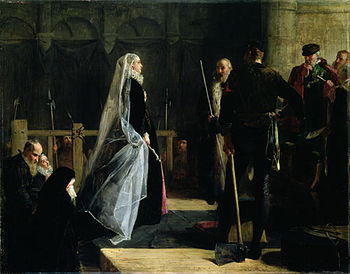
The slender neck was placed on the chopping block as Mary prayed. Seven words, over and over. “In manus tuas, Domine, commendo spiritum meum” (Into thy hands, O Lord, I commend my spirit)…A man who comes down to us only by the name of “Bull”, hacked down with the axe.

He missed, the blade glancing off the back of her skull as Mary, continued to pray. In manus tuas, Domine, commendo spiritum meum. A second swing came down and hit the mark, sort of, but the headsman’s axe yet had work to do. Now as a meat cleaver, to separate thee last bits of flesh and sinew. As Bull lifted the severed head with the words “God save the Queen”, the auburn locks by which he grasped it turned out to be a wig. The head tumbled to the floor revealing close cropped gray hair and rolled off the stage, “like a football”.

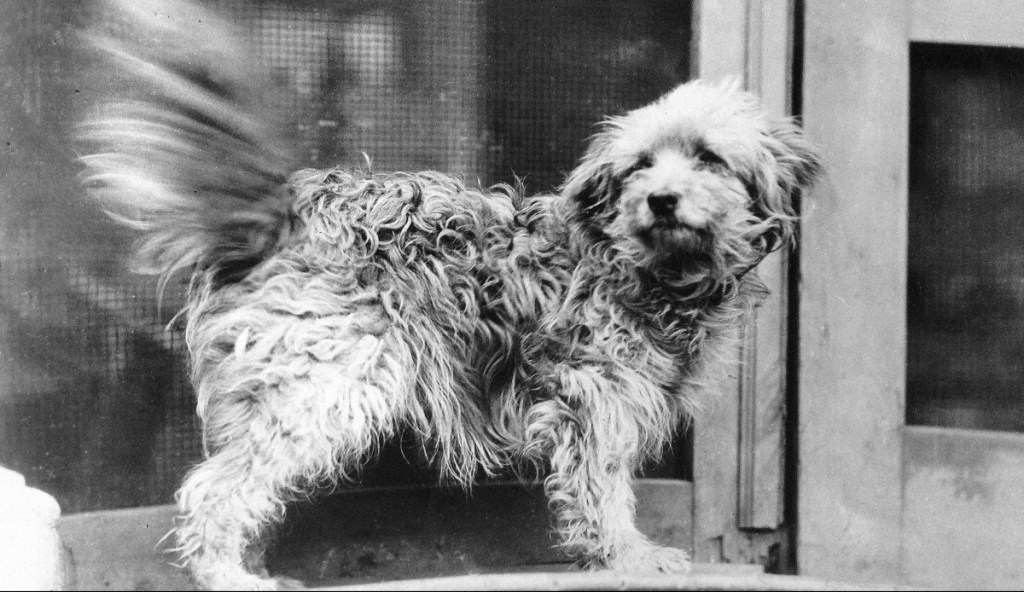
To make matters worse, Mary’s small dog, a terrier who had sneaked onto the scaffold and hidden in her petticoats now came forth, running about and wailing pitifully until lying down in the spreading pool of blood, where her head used to be.

In the end, there there is no proof of Mary’s complicity in Darnley’s murder nor of any conspiracy, involving Bothwell. Such accusations rest on nothing more than assumptions. To her detractors, Mary Queen of Scots was an adulteress if not a murderess. To her supporters she was a romantic figure not given to evil but the tragic victim, of evil times. To her rival, the cousin she would never meet, the Queen who signed her death warrant she was simply, “The daughter of debate”.

February 7, 1917 The Road to War

In the United States, the political tide was turning. Unrestricted submarine warfare…the Housatonic…the California…the Zimmermann telegram…the combination of events became the last straw. The United States entered the Great War about a month later.

On June 28, 1914, the assassination of Archduke Franz Ferdinand  began a cascade of events which would change the course of the 20th century.  Entangling alliances and mutual suspicion led to the mobilization and counter-mobilization of armies.  No one wanted to show up late in the event of war.  And so there was war.  By October, the “Great War” had devolved into the trench-bound hell which would characterize the next four years.

The German and British economies were heavily dependent on imports to feed their populations and prosecute the war effort. By February 1915, both powers were attempting to throttle the other through naval blockade.

Great Britain’s Royal Navy had superior numbers, while the Imperial German Navy’s surface fleet was restricted to an area of the North Sea called the German Bight. In other theaters, Germans augmented their small navy with commerce raiders and “unterseeboots”.  More than any other cause it was the German policy of unrestricted submarine warfare which would bring the United States into the war, two years later.

wwi-submarine

On February 4, 1915, Imperial Germany declared a naval blockade against shipping to Britain, stating that “On and after February 18th every enemy merchant vessel found in this region will be destroyed, without its always being possible to warn the crews or passengers of the dangers threatening”. “Neutral ships” it continued, “will also incur danger in the war region”.

lusitania-sinking

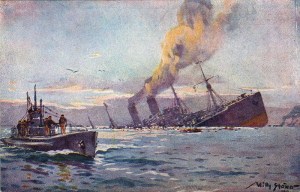
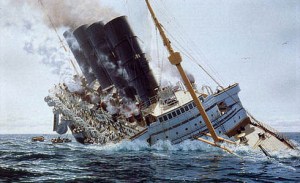
As the war unfolded, German U-boats sank nearly 5,000 ships, close to 13 million gross register ton including the Cunard Liner Lusitania, torpedoed and sunk off Kinsale, Ireland, on May 7, 1915. 1,198 were drowned, including 128 Americans.  100 of the dead, were children. .

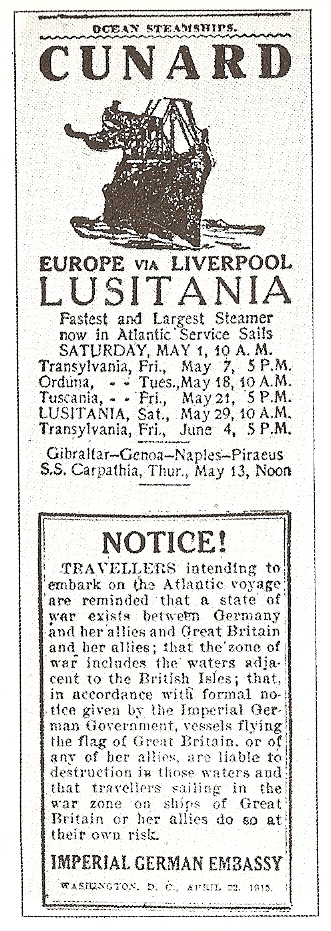
The reaction in the US and UK was immediate and vehement. The sinking was portrayed as the act of barbarians and Huns. Imperial Germany maintained that Lusitania was illegally transporting munitions intended to kill German boys on European battlefields. Furthermore, the embassy pointed out that ads had been taken out in the New York Times and other newspapers, specifically warning that the liner was subject to attack.

lusitania-warning
Warnings from the German embassy often ran directly opposite ads for the sailing. Many dismissed such warnings believing such an attack, unlikely.

Unrestricted submarine warfare was suspended for a time, for fear of bringing the US into the war.  The policy was reinstated in January 1917 prompting then-Chancellor Theobald von Bethmann Hollweg to say, “Germany is finished”.  He was right.

SS Housatonic was stopped off the southwest coast of England and boarded by German submarine U-53.  American Captain Thomas Ensor was interviewed by Kapitänleutnant Hans Rose, who said he was sorry.  Housatonic was “carrying food supplies to the enemy of my country”, and would be destroyed.  The American Captain and crew were allowed to launch lifeboats and abandon ship, while German sailors raided the American submarine, for soap supplies.  

Apparently, WWI vintage German subs were short on soap.

Housatonic was sunk with a single torpedo, U-53 towing the now-stranded Americans toward the English coast.  Sighting the trawler Salvator, Rose fired his deck guns to be sure they’d been seen, and then slipped away.  It was February 3, 1917.

President Woodrow Wilson retaliated, breaking off diplomatic relations with Germany the following day. Three days later, on February 7, a German U-boat fired two torpedoes at the SS California, off the Irish coast. One missed but the second tore into the port side of the 470-foot, 9,000-ton steamer. California sank in nine minutes, killing 43 of her 205 passengers and crew.

zimmerman-note

Two weeks later, British Intelligence divulged the Zimmermann note to Edward Bell, secretary to the United States Embassy in Britain.  This was an overture from German Foreign Minister Arthur Zimmermann to the Mexican government, promising American territories in exchange for a Mexican declaration of war against the US.

Zimmermann’s note read, in part, as follows:

“We intend to begin on the first of February unrestricted submarine warfare. We shall endeavor in spite of this to keep the United States of America neutral. In the event of this not succeeding, we make Mexico a proposal of alliance on the following basis: make war together, make peace together, generous financial support and an understanding on our part that Mexico is to reconquer the lost territory in Texas, New Mexico, and Arizona…”

In the United States, the political tide was turning. Unrestricted submarine warfare…the Housatonic…the California…the Zimmermann telegram…the combination of events became the last straw.  The United States entered the Great War about a month later.

At the time, the German claim that Lusitania carried contraband munitions seemed to be supported by survivors’ reports of secondary explosions within the stricken liner’s hull. In 2008, the UK Daily Mail reported that dive teams had reached the wreck, lying at a depth of 300′. Divers reported finding tons of US manufactured Remington .303 ammunition, about 4 million rounds, stored in unrefrigerated cargo holds in cases marked “Cheese”, “Butter”, and “Oysters”.

February 6, 2007 When Animals went to War

Handler Beval Austin Stapleton was on-hand to receive Lucky’s award. “Every minute of every day in the jungle” he said, “we trusted our lives to those four dogs, and they never let us down. Lucky was the only one of the team to survive our time in the Malayan jungle and I’m so proud of the old dog today. I owe my life to him.”

Mitochondrial DNA analysis of Felis silvestris catus, the common house cat, suggests two great waves of expansion. First came the dawn of agriculture, when grain stores attracted vermin. Genetic examination suggests all cats descend from one of five feline ancestors: the Sardinian, European, Central Asian, Subsaharan African or the Chinese desert cat.

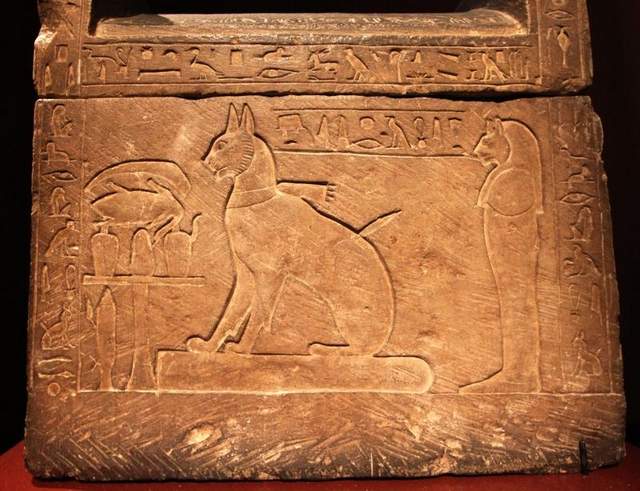
ta-mit

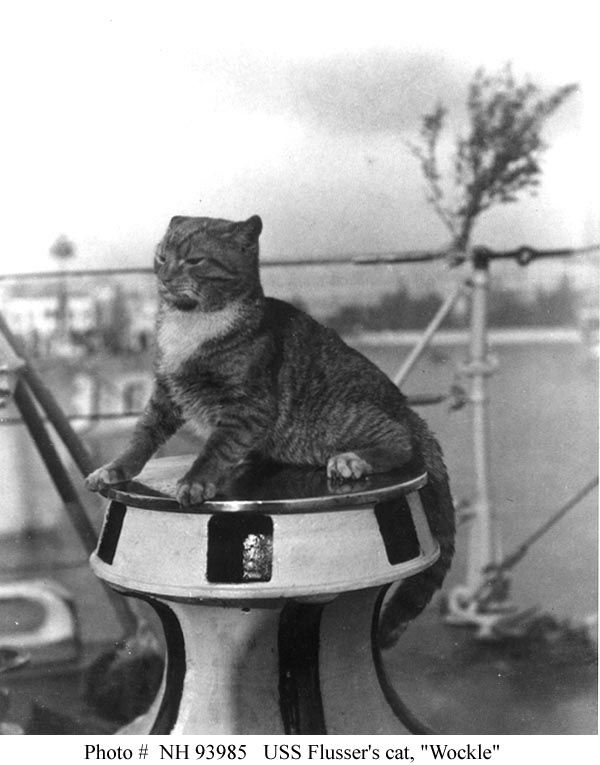
The second “cat-spansion” occurred later, as man took to water. From trade routes to diplomatic missions and military raids, men on ships needed food, and that meant rodents. The “ship’s cat” was a feature of life at sea from that day to this, first helping to control damage to food stores, ropes and woodwork and, in modern times, electrical wiring.

Norskskogkatt_Evita_3

A Viking site in North Germany dating ca 700-1000AD, contains the remains of one cat with Egyptian mitochondrial DNA.  Once driven nearly to extinction, the Norwegian Forest cat (Norwegian: Norsk skogkatt) descends from Viking-era ship’s cats, brought to Norway from Great Britain sometime around 1000AD.

Who knew? Vikings had cats!

Not without reason, were cats seen as good luck.  The power of cats to land upright is due to extraordinarily sensitive inner ears, capable of detecting even minor changes in barometric pressure.  Sailors paid careful attention to the ship’s cat, often the harbinger of foul weather ahead.

Clockwise:  1. Ship’s cat, HMS Queen Elizabeth, Gallipoli Peninsula, 1915, 2. USS Flusser’s cat, “Wockle” 3. Ship’s cats “inspect” the breech of a 4-inch gun aboard an unidentified US ship. 4. Togo, ships cat aboard the HMS Dreadnought,

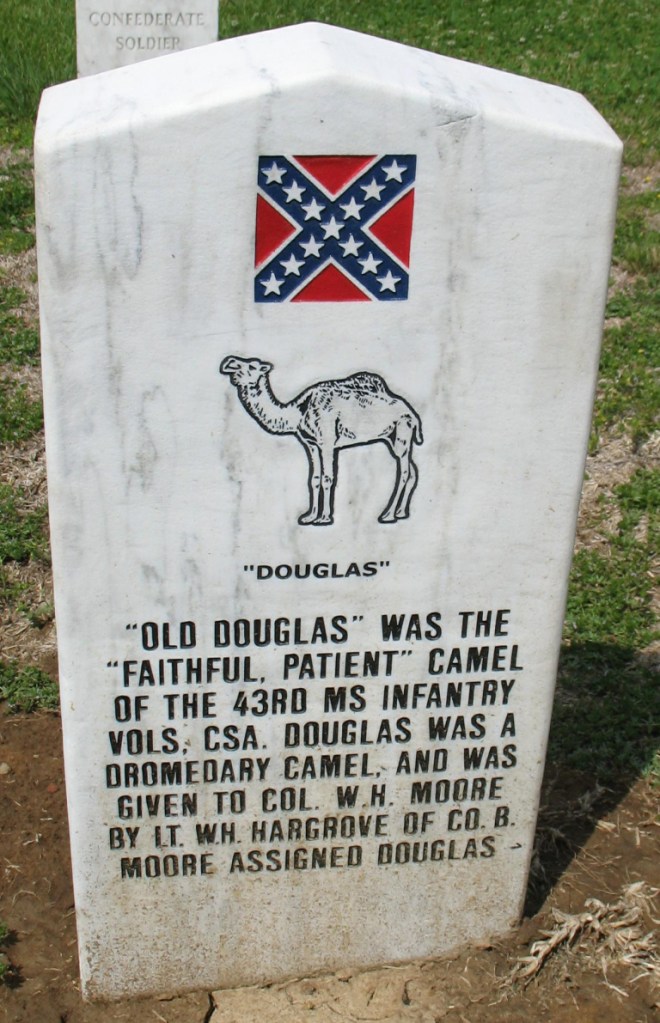
And if you’re ever in Vicksburg, you can stop and visit the grave site of Douglas, the Confederate camel.

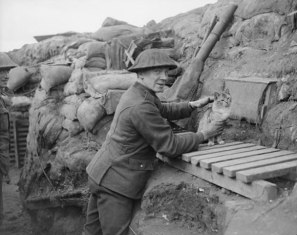
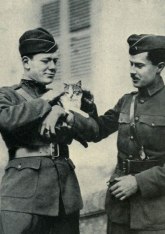
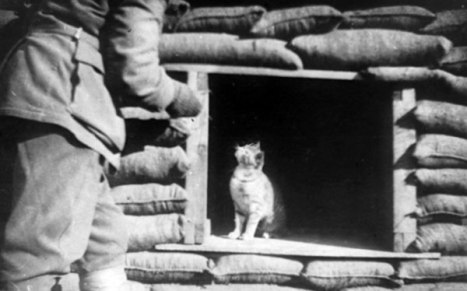
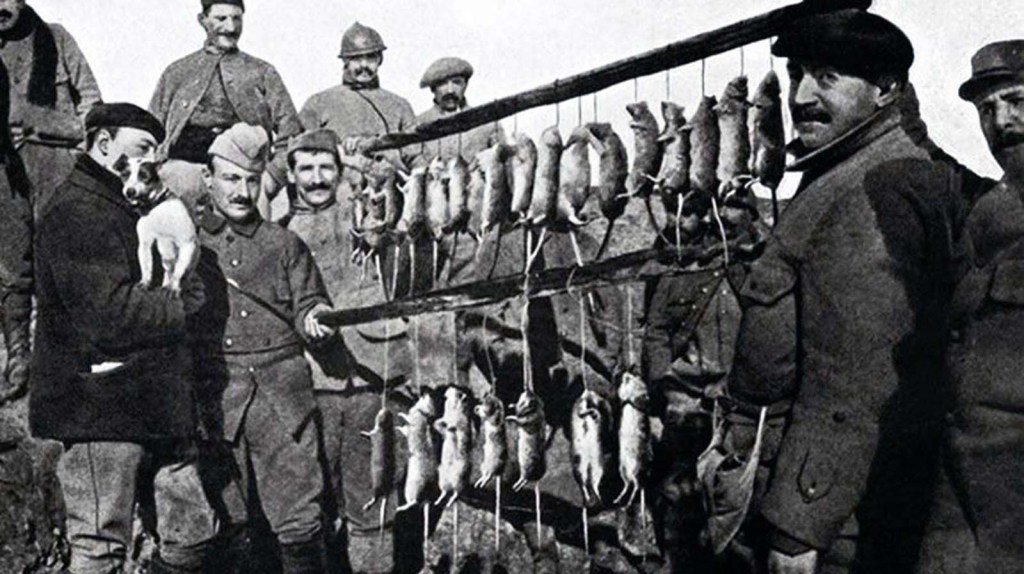
When the “Great War” arrived in 1914, animals of all kinds were dragged along.  Cats performed the same functions in vermin infested trenches, as those at sea.

1. Gunner with the regimental cat in a trench in Cambrin, France, February 6th, 1918.  2. Officers of the U.S. 2nd Army Corps with a cat discovered in the ruins of Le Cateau-Cambrésis 3. Trench cat, Gallipoli Peninsula, 1915

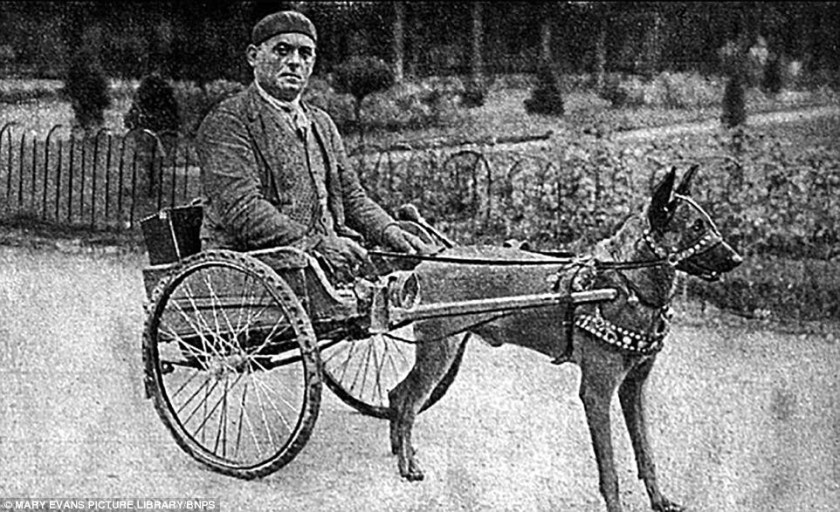
Tens of thousands of dogs performed a variety of roles, from ratters to sentries, scouts and runners.

“Mercy” dogs were trained to seek out the wounded on battlefields, carrying medical supplies with which the stricken could treat themselves.

3F0CB7F500000578-4359902-image-a-15_1491812396284
“A dog pulling the wheelchair of a wounded French soldier in the remarkable series of images featured in new book Images of War, Animals in the Great War” H/T Daily Mail

The French trained specialized “chiens sanitaire” to seek out the dead and wounded, and bring back bits of uniform.  Often, dogs simply provided the comfort of another living soul so the gravely wounded, should not die alone.

3F0CB81C00000578-4359902-image-a-31_1491812576844
“Messenger dogs pictured running the gauntlet of rifle fire during their training during the First World War” H/T Daily Mail

With the hell of no mans land all but impassable for human runners, dogs stepped in, as messengers. “First Division Rags” ran through a cataract of falling bombs and chemical weapons. Gassed and partially blinded with shrapnel injuries to a paw, eye and ear, the little guy still got his message where it needed to be.

1st Division Rags

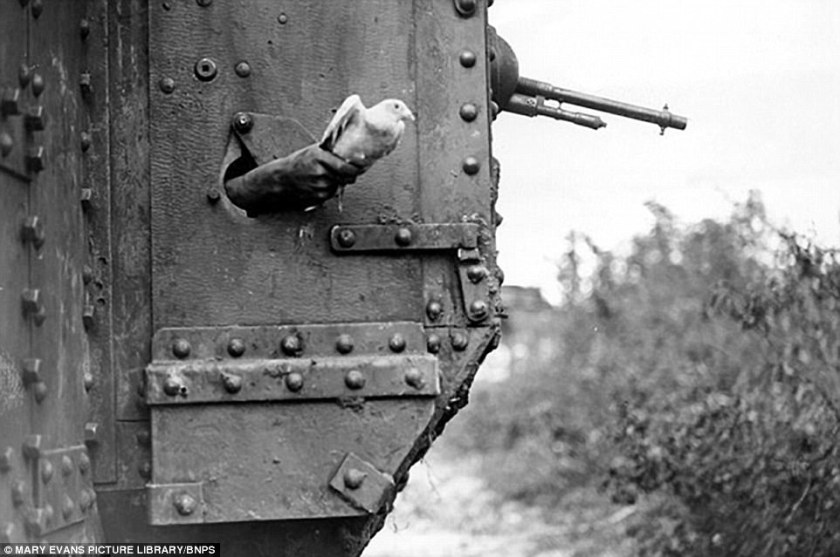
Other times, birds were the most effective means of communication. Carrier pigeons by the tens of thousands flew messages of life and death importance for Allied and Central Powers, alike.

3F0CB81400000578-4359902-image-a-25_1491812524663
“A carrier pigeon held tight before release from the belly of a tank in 1918. Birds were often used to pass messages between troops” H/T Daily Mail
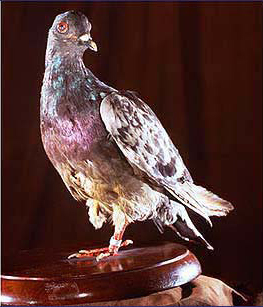
Cher Ami
Cher Ami

During the Meuse-Argonne offensive of 1918, Cher Ami saved 200 men of the “Lost Battalion”, arriving in her coop with a bullet through the breast, one eye shot out and a leg all but torn off, hanging by a single tendon.

Even the lowly garden slug pitched in.  Extraordinarily sensitive to mustard gas, “slug brigades” provided the first gas warnings, allowing precious moments in which to “suit up”.

The keen senses of animals were often the only warning of impending attack.

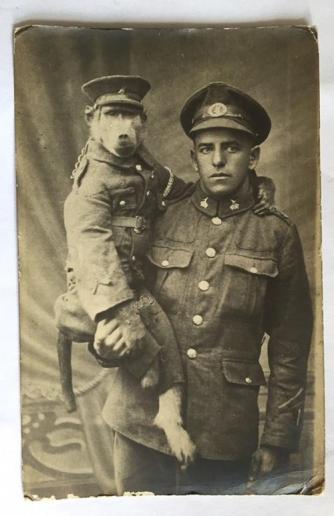
Albert Marr, Jackie

Private Albert Marr’s Chacma baboon Jackie would give early warning of enemy movement or impending attack with a series of sharp barks, or by pulling on Marr’s tunic.

One of many gut wrenching episodes of the Great war took place in April, 1918.  The South African Brigade withdrew under heavy shelling through the West Flanders region of Belgium.

Jackie was seen, frantically building a stone wall around himself as jagged splinters wounded his arm and all but tore off the animal’s leg. 

Even with all that Jackie refused to be carried off by stretcher-bearers, instead hobbling about on his shattered limb, trying to finish his wall

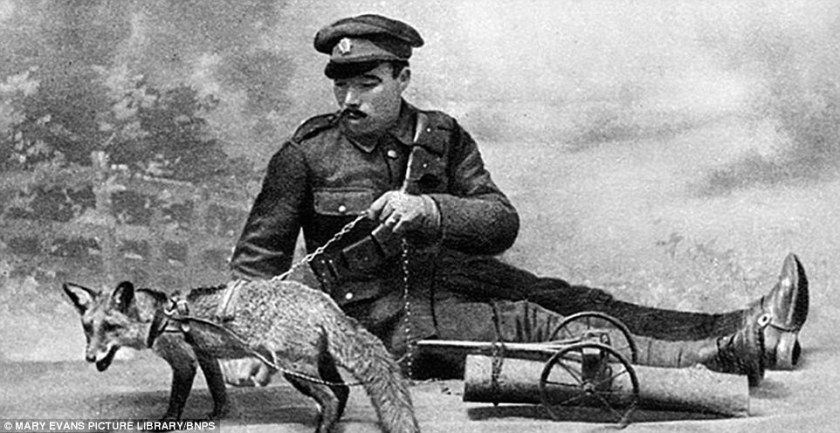
Constituted on June 13, 1917, British Aero Squadron #32 kept a red fox, as unit mascot.

3F0CB7E800000578-4359902-image-a-11_1491812343121.jpg
H/T Daily Mail

The famous Lafayette Escadrille kept a pair of lion cubs, called Whiskey and Soda.

Escadrille 124_Whiskey Soda_zpsaljbdve0

German soldiers in Hamburg, enlisted the labor of circus elephants in 1915.

3F0CB7E400000578-4359902-image-a-8_1491812296139
H/T Daily Mail

The light cruiser Dresden was scuttled and sinking fast in 1914, leaving the only creature on board to swim for it.  An hour later an Ensign aboard HMS Glasgow spotted a head, struggling in the waves.  Two sailors dove in and saved the animal, a pig they called “Tirpitz”, after the German Admiral.  Tirpitz the pig served out the rest of the war not in a frying pan but as ship’s mascot, aboard the HMS Glasgow.

3F0CB7DC00000578-4359902-image-a-4_1491812234452
“Tirpitz” the pig

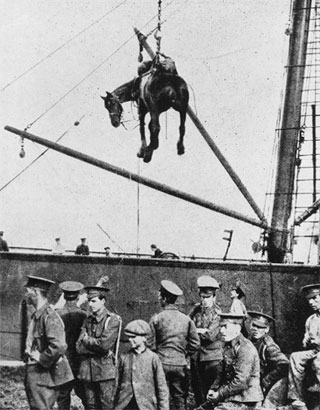
No beast who served in the Great war was as plentiful nor as ill used as the beast of burden and none so much, as the horse.   Horses were called up by the millions, along with 80,000 donkeys and mules, 50,000 camels and 11,000 oxen. The United States alone shipped a thousand horses a day “over there” between 1914, and 1917.

thIA31MUJ1

Horsepower was indispensable throughout the war from cavalry and mounted infantry to reconnaissance and messenger service, as well as pulling artillery, ambulances, and supply wagons.  With the great value horses contributed to the war effort and their difficulty in replacement,  the loss of a horse was a greater tactical problem in some areas, than the loss of a man.

horses-ww1-b

Few ever returned.  An estimated three  quarters died of wretched working conditions:  Exhaustion.  The frozen, sucking mud of the western front.  The mud-borne and respiratory diseases.  The gas, artillery and small arms fire.  An estimated eight million horses were killed on all sides, enough to start a line in Boston and make it all the way to London and back, twice, if such a thing was possible.

The United Kingdom entered the war with only eighty motorized vehicles, conscripting a million horses and mules, over the course of the war.  Only one in sixteen, lived to come home.

War5 (1)

Neither knowing nor caring why they were there, the animals of the Great War suffered at prodigious rates.  Humane organizations stepped up, the British Royal Society for the Prevention of Cruelty to Animals (RSPCA) processing some 2.5 million animals through veterinary hospitals.  1,850,000 were horses and mules.  85% were treated and returned to the front.

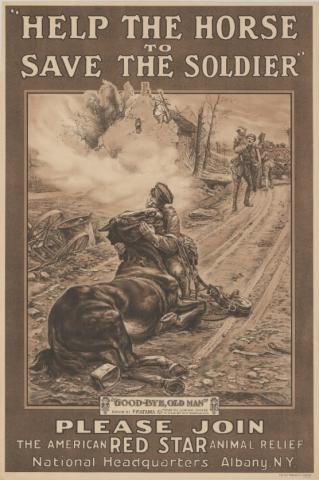
Downsize_Help Save the Horse to Save the Soldier

The American Red Star Animal Relief Program sent medical supplies, bandages, and ambulances to the front lines in 1916, to care for horses injured at a rate of 68,000 per month.

The century before the Great War was a Golden age, mushrooming populations enjoying the greatest rise in living standards, in human history. The economy at home would be dashed to rags and atoms by the Great War. Trade and capital as a proportion of the global economy would not recover to 1913 levels, until 1993.

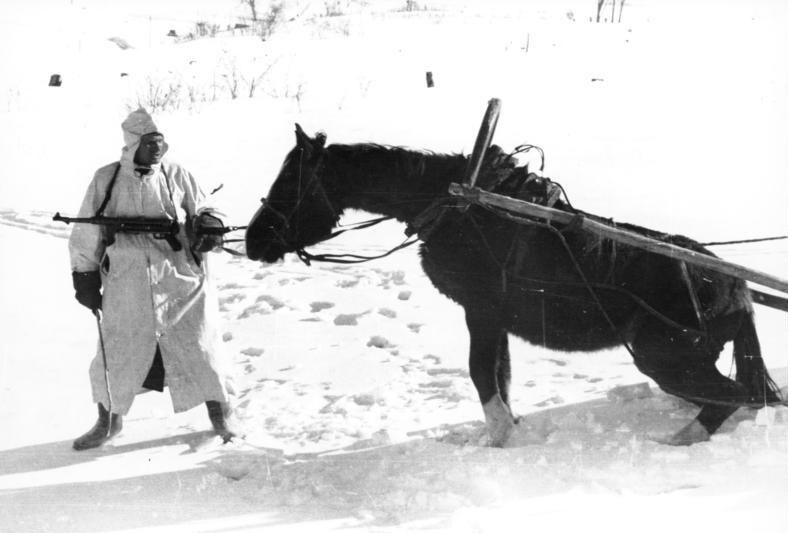
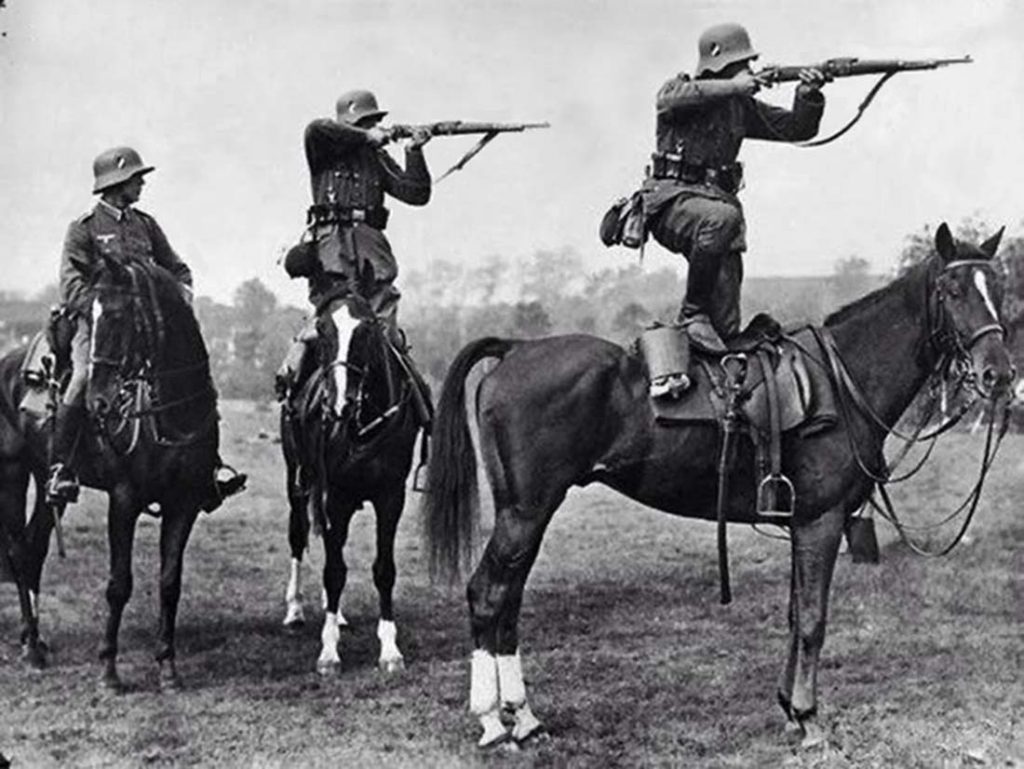
World War 2 wasn’t quite as ‘motorized’ as you might imagine. Nazi Germany and the Soviet Union alone deployed no fewer than six million horses.

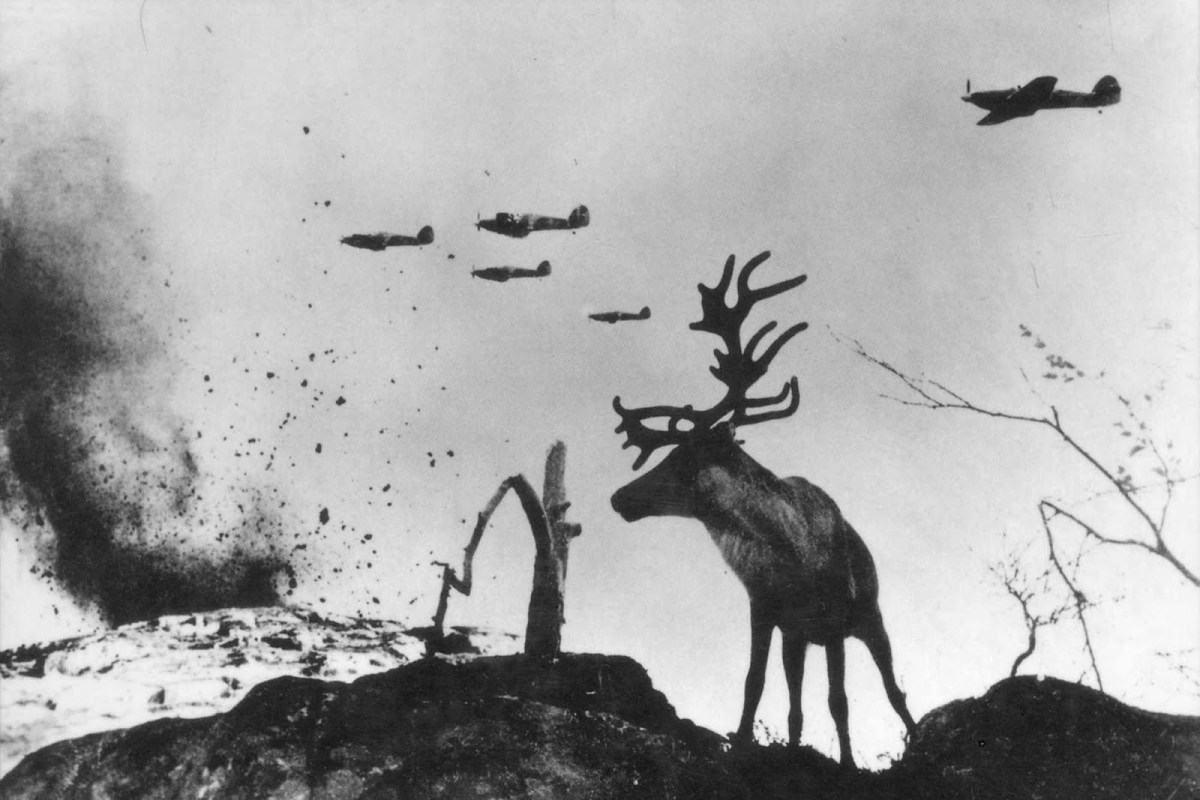
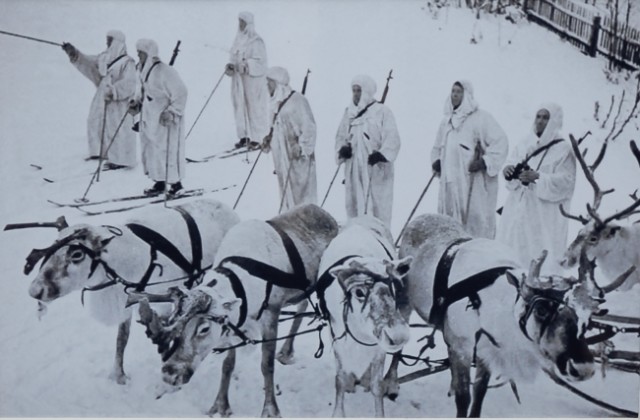
In the north, Reindeer proved far more successful than either horses or motorized transport.

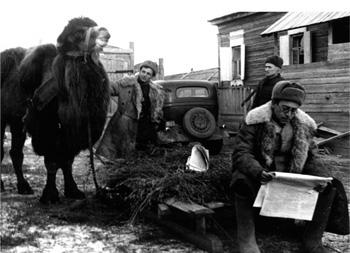
Camels were extensively used in WW2 and not just in north Africa. Following the battle of Stalingrad, the Red army took to using camels in the southern theater. One thousand-animal “camel battalion” carried some twelve thousand tons of cargo across the primitive Kalmyk Steppes, a job which would have required 134 trucks.

The 308th Rifle Division used a Bactrian camel called “Kuznechik”, Russian for “grasshopper”, for transport of food and other equipment. Kuznechik followed this mostly Siberian unit all the way to Berlin, where his handler taught him to spit on the ruins of the Reichstag building.

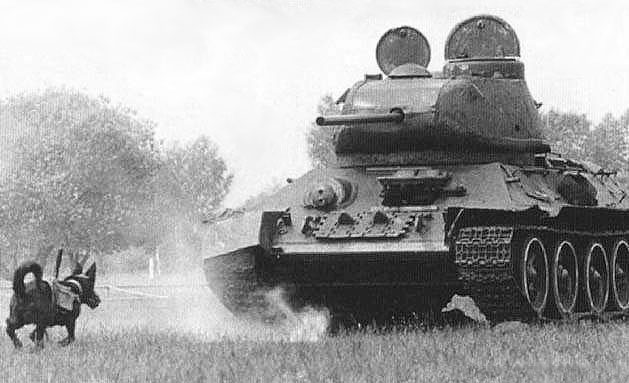
Animals were even combatants during WW2 though hardly, by their own choice. The Soviet Red Army used dogs as suicide bombers, trained to seek out and destroy enemy tanks. The problem was that dogs were trained using Soviet diesel-powered tanks and not the gas-fueled tanks of the Wehrmacht. It didn’t take long to figure out. Dogs were going after the wrong tanks.

The US even experimented with “bat bombs” and pigeon-guided munitions. Both projects were scrapped without ever going into use as the weapon system’s lethality, was limited to taxpayer dollars.

Not so with the Soviet’s use of Tularemia-infected rats. Following General von Paulus’ surrender after the Battle of Stalingrad, some fifty percent of German soldiers were found to be sick with the disease.

Unseen amidst the economic devastation of the home front, was the desperate plight of animals.  Turn-of-the-century social reformer Maria Elizabeth “Mia” Dickin founded the People’s Dispensary for Sick Animals in 1917, working to lighten the dreadful state of animal health in Whitechapel, London.  To this day, the PDSA is one of the largest veterinary charities in the United Kingdom, carrying out over a million free veterinary visits, every year.

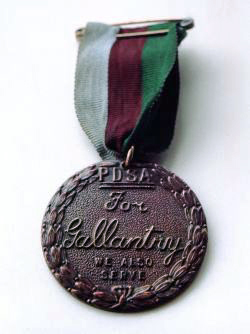
Dickin_Medal

The “Dickin Medal” was instituted on December 2, 1943, honoring the work performed by animals, in WW2. 

The “animal’s Victoria Cross”, the highest British military honor equivalent to the American Medal of honor, is awarded in recognition of “conspicuous gallantry or devotion to duty while serving or associated with any branch of the Armed Forces or Civil Defence Units.”

The Dickin Medal has been awarded 71 times, recipients including 34 dogs, 32 pigeons, 4 horses and a cat. An honorary Dickin was awarded in 2014, in honor of All animals serving in the Great War.

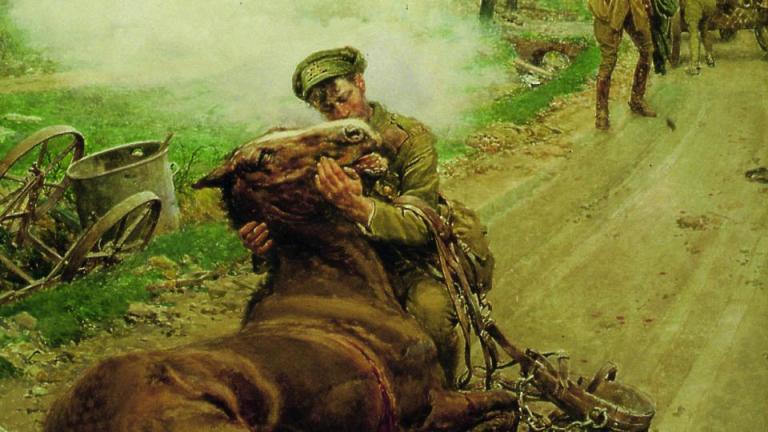
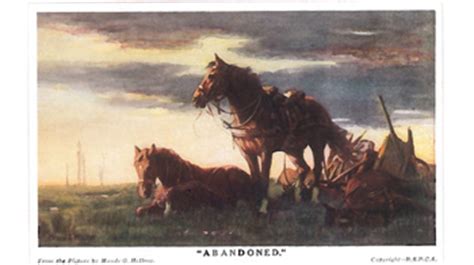
“Goodbye Old Man”, watercolour, painted by Fortunino Matania (Italian, 1881-1963), showing a British soldier saying farewell to his dying horse. The painting was commissioned by The Blue Cross Fund in 1916 to raise money to help relieve the suffering of horses on active service in Europe. Over one million horses saw service with the British Army during World War I and The Blue Cross treated thousands.

Two Dickins were awarded on this day in 2007, the first to Royal Army Veterinary Corps explosives detection dog “Sadie”, a Labrador Retriever whose bomb detection skills saved the lives of untold soldiers and civilians in Kabul, in 2005. The second went to “Lucky”, a German Shepherd and RAF anti-terrorist tracker serving during the Malaya Emergency of 1949 – ’52. Part of a four-dog team including “Bobbie”, “Jasper” and “Lassie”, Lucky alone survived the “unrelenting heat [of] an almost impregnable jungle“.

Handler Beval Austin Stapleton was on-hand to receive Lucky’s award. “Every minute of every day in the jungle” he said, “we trusted our lives to those four dogs, and they never let us down. Lucky was the only one of the team to survive our time in the Malayan jungle and I’m so proud of the old dog today. I owe my life to him.

1024px-A_cat_on_HMAS_Encounter

Ship’s cat, Her Majesty’s Australian Ship (HMAS) Encounter, World War I

February 5, 62AD End of the World

There were other signs of what was to come. Tremors. Springs dried up. Fish died and floated on the river Sarno, victims of increased acidification of the water.


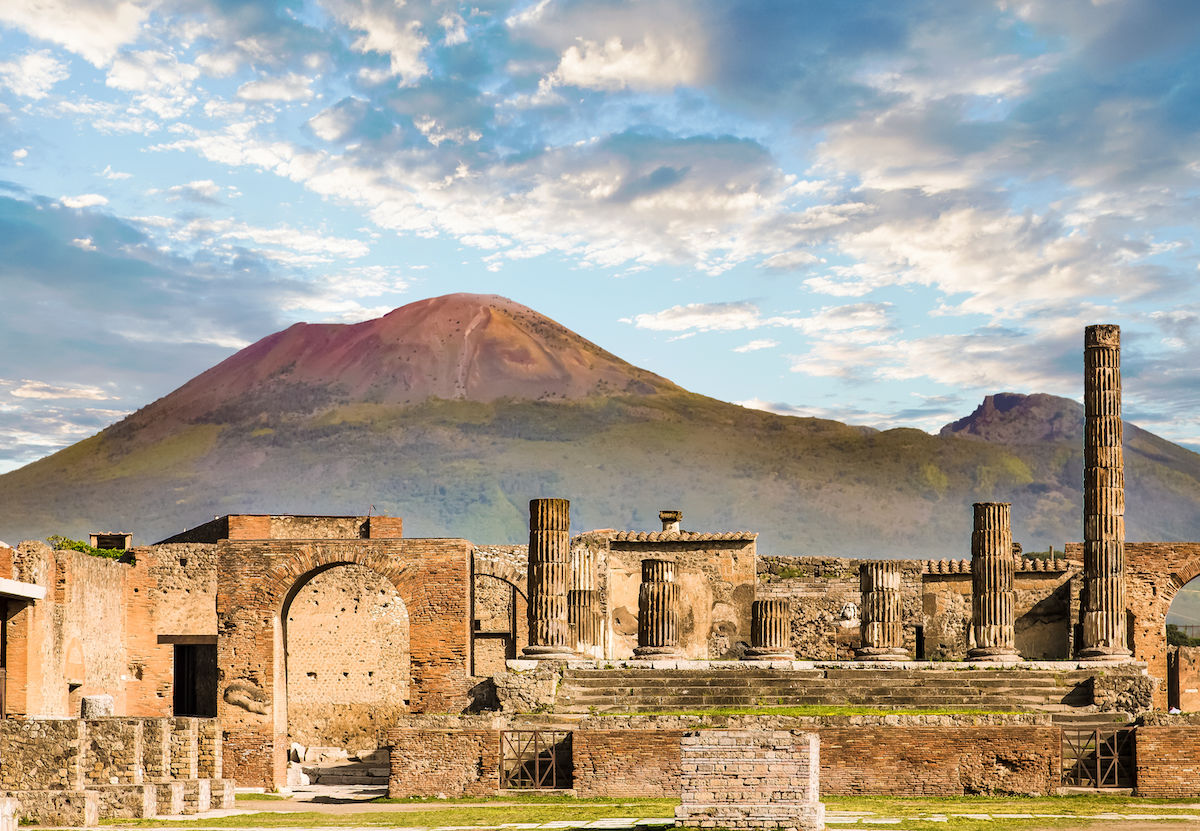
On February 5 in the year AD 62, an earthquake estimated at 7.5 on the Richter scale shook the Bay of Naples, spawning a tsunami and leveling much of the coastal Italian towns of Pompeii, Herculaneum and surrounding communities.

pompeii-2

Massive though the damage had been, the region around Mt. Vesuvius and the Bay of Naples had long been a favorite vacation destination for the upper crust of Roman society. Crowds of tourists and slaves bustled in and out of the city’s bath houses, artisans’ shops, taverns and brothels, adding their number to some ten to twenty thousand townspeople.

There were other signs of what was to come. Tremors. Springs dried up. Fish died and floated on the river Sarno, victims of increased acidification of the water.

And yet, these are only “signs”, in hindsight. Pompeiians of 62AD didn’t even have a word for Volcano. That would come much later with the eruption of Mt. Etna. The word is derived from “Vulcan”. The Roman God of fire.

So it was reconstruction began and continued, for the next seventeen years.  Until that day the world, came to an end.

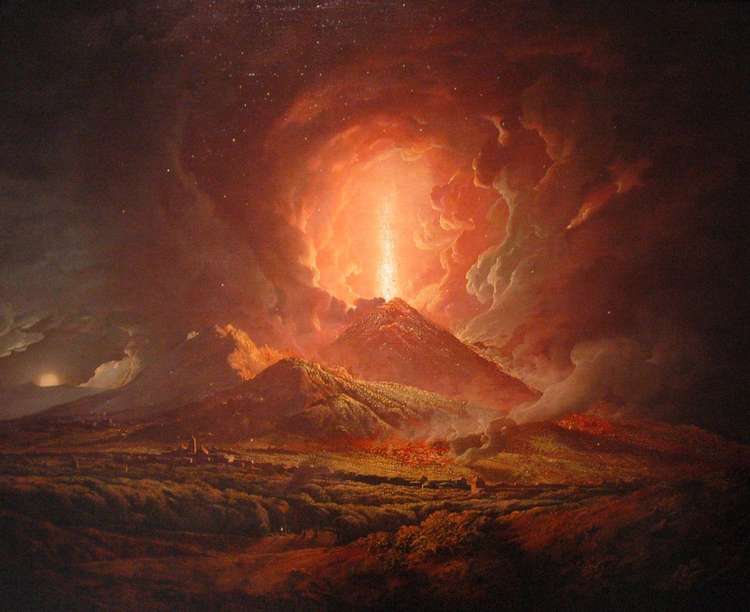
Long dormant and thought to be extinct, nearby Mount Vesuvius had been quiet for hundreds of years.  Historians have long believed Vesuvius erupted on August 24, 79AD but recently discovered graffiti referring to the calends of November more likely put the date, at October 17. 

The day dawned as any other, the first plumes of white smoke appearing, sometime around breakfast. By that afternoon the 4,203-foot stratovolcano was belching fire, propelling a scorching plume of ash, pumice and super-heated volcanic gases so high as to be seen for hundreds of miles.

The Melbourne Museum has created a stunning, eight-minute animation, of the event.

For the next eighteen hours the air was thick with hot, poisonous gases, as volcanic ash rained down with pumice stones the size of baseballs.  No one who stayed behind stood a chance, nor did countless animals, both wild and domestic.

Citizens tried to save themselves using tunics, as makeshift masks. Then came the pyroclastic surge, that ground-hugging pressure wave seen in test films of nuclear explosions.  Gasses and pulverized stone dust raced outward at 400 miles-per-hour in the “base surge” phase carrying gases super-heated to 1000° Fahrenheit. The bodily fluids of anyone left alive at this time burst instantly, into steam.

Pompeii 2
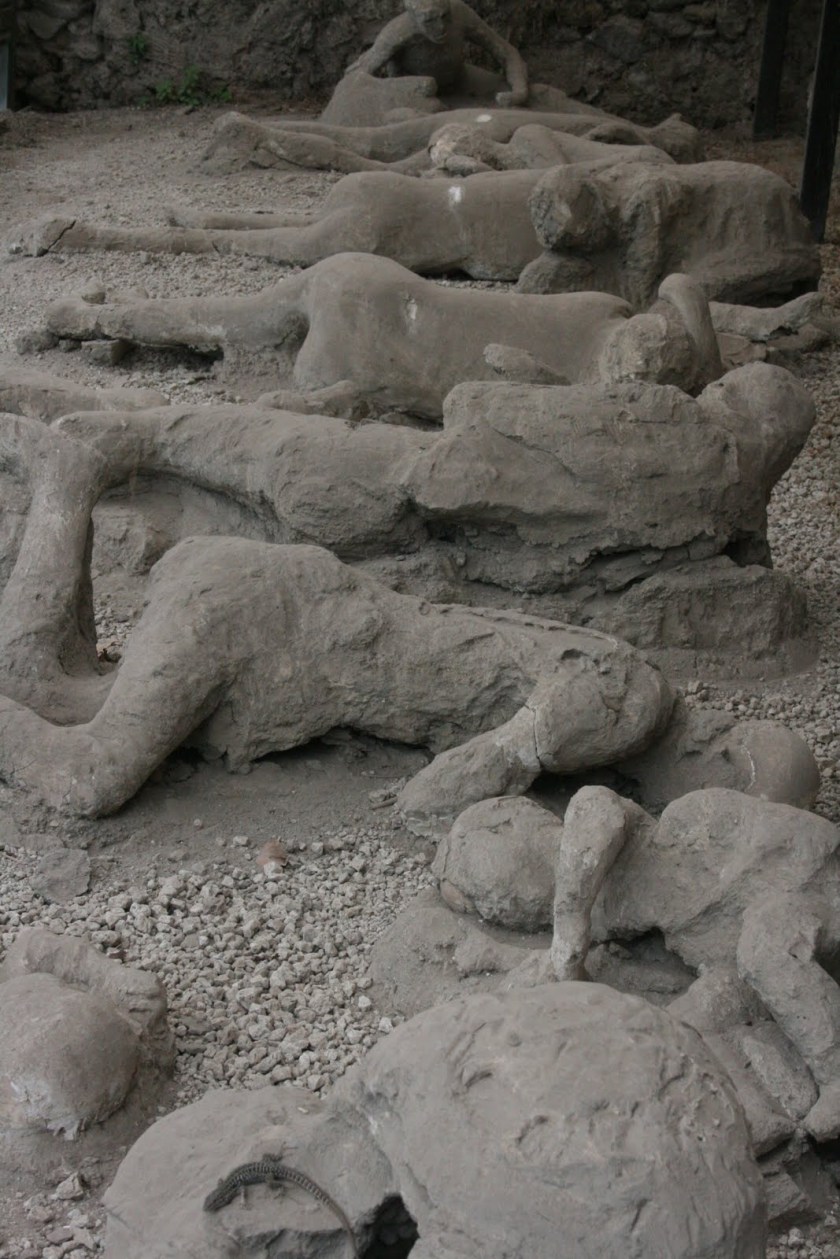
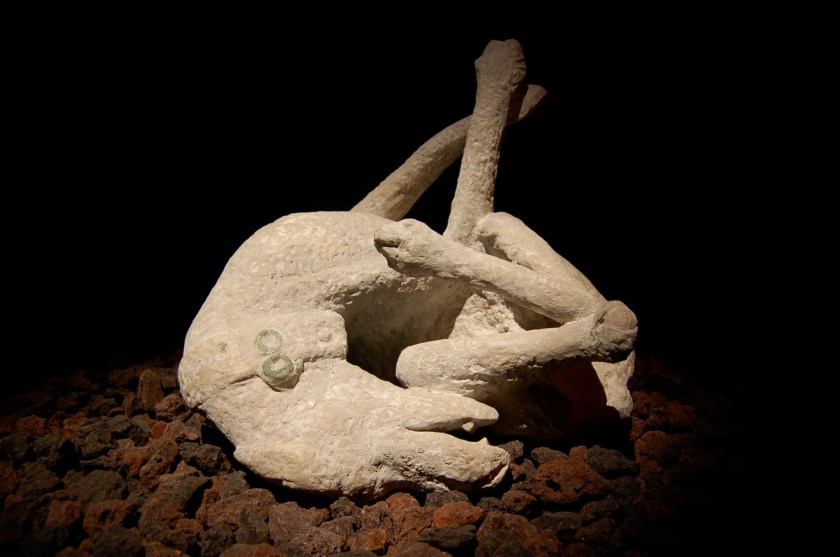
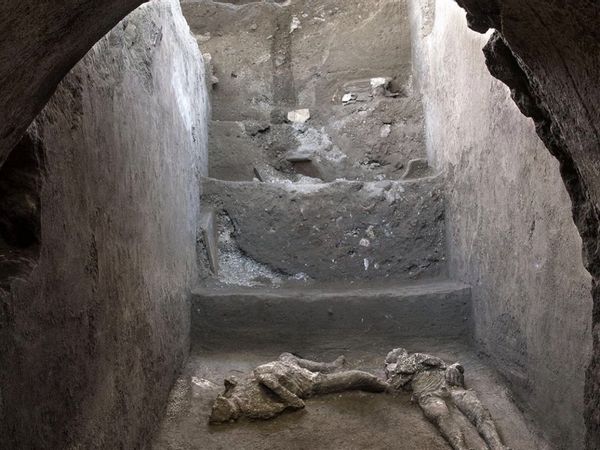
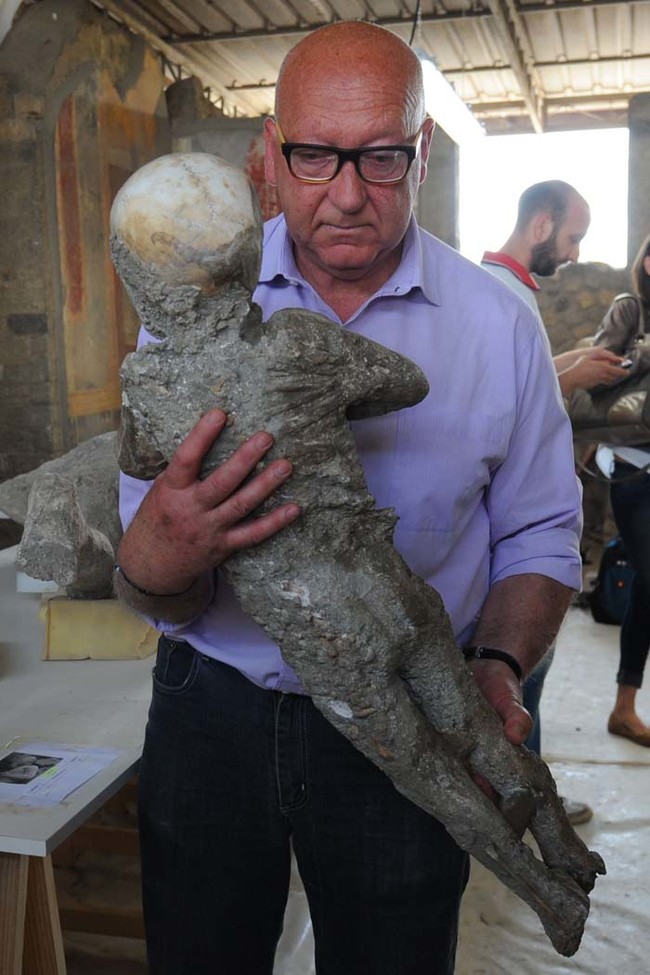
The victims of Mt. Vesuvius’ wrath left their imprints in the ash and rock which would be their tomb.  2,000 years later, remarkably life-like plaster casts, depict the final moments of these unfortunate men, women and children.

The suffocating, poisonous clouds of vapor and rock dust pouring into the city, soon  put and end to all that remained.  Imagine putting your head in a bag of cement, with someone pounding the sides.  Walls collapsed and roofs caved in, burying the dead under fourteen feet or more of ash, rock and dust. Neither Herculaneum, Pompeii nor their surrounding communities would see the light of day, for nearly two thousand years.

dsc_0128

Today we remember the Roman author, naturalist and military commander Gaius Plinius “Pliny’ Secundus for his work Naturalis Historia (Natural History). We see his work in the editorial model of the modern encyclopedia.

With the cities of Pompeii and Herculaneum already destroyed, Pliny raced to the port of Stabiae some 4½km to the southwest, to rescue a friend and his family. The sixth and largest pyroclastic surge trapped Pliny’s ship in port, killing the author and everyone in the vicinity. That we have an eyewitness to the event is thanks to two letters written by Gaius Plinius Caecilius Secundus (Pliny the Younger), Pliny’s nephew and a man he had helped to raise, from boyhood.

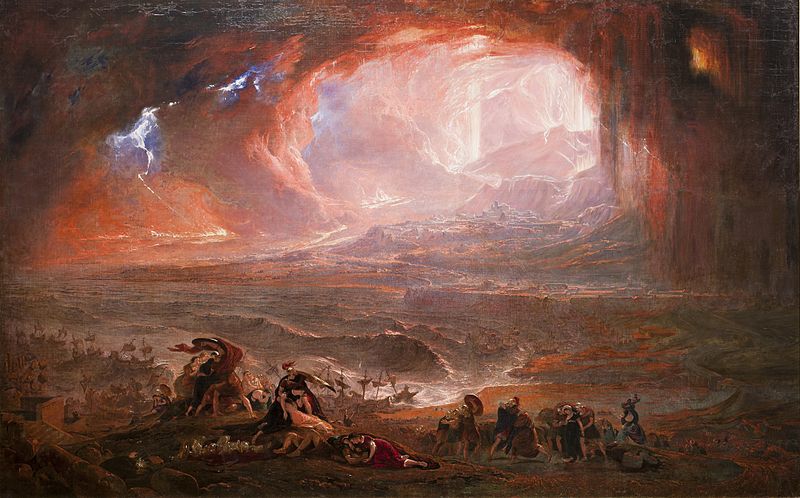
800px-Destruction_of_Pompeii_and_Herculaneum
Destruction of Pompeii and Herculaneum

Property owners and thieves returned over time to retrieve such valuables as statues. The words “house dug” can still be found, scrawled on the walls.  And then the place was forgotten, for fifteen hundred years.

15

An underground channel was dug in 1562 to redirect waters from the river Samo, when workers ran into city walls.  The architect Domenico Fontana was called in and further excavation revealed any number of paintings and frescoes, but there was a problem.

This stuff was downright pornographic.

According to the Annus Mirabilis written by English poet Philip Larkin, sex wasn’t even until 1963, in the British Isles.

“…So life was never better than
In nineteen sixty-three
(Though just too late for me) –
Between the end of the Chatterley ban
And the Beatles’ first LP…”

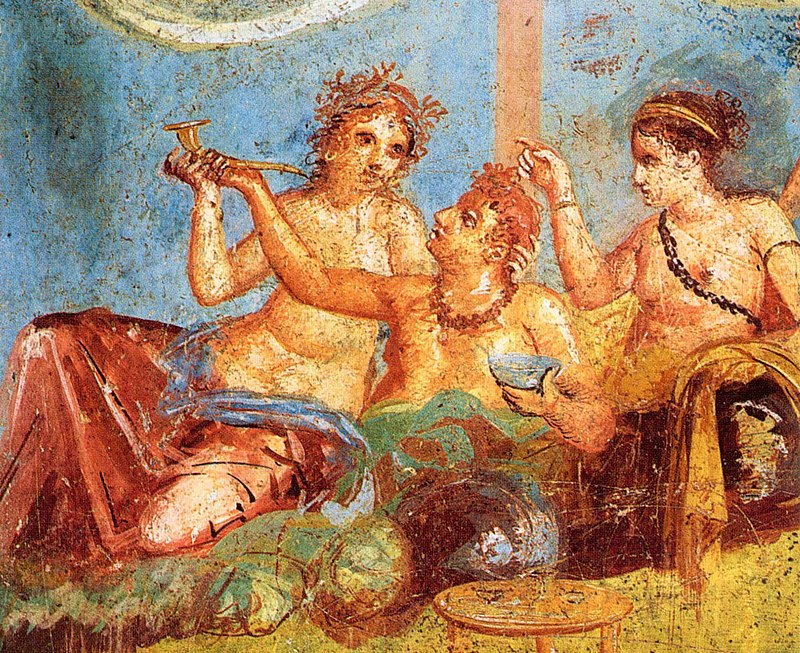
800px-Pompeii_-_Casa_dei_Casti_Amanti_-_Banquet
Pompeian artwork ranges from the merely hedonistic, to the pornographic

The ancients seem to have been rather more uninhibited.   In fact, life in some quarters was nothing if not hedonistic.  Pompeii itself has been described by some, as the “red-light district” of antiquity.  I’m not sure about that, but the erotic art of Pompeii and Herculaneum were WAY too much for counter reformation-era sensibilities. 

The place was quietly covered up and forgotten. For another two hundred years.

Pompeii was first excavated in earnest in 1748 but it took another hundred years for archaeologists’ findings to be organized, cataloged and brought to museums.  In 1863, archaeologist Giuseppe Fiorelli realized that occasional voids in the ash layer were in fact the long since decomposed bodies of the doomed victims, of Vesuvius.

A technique was developed of injecting plaster.  Today we can see them in excruciating detail, exactly where they fell.  Men, women and children, the dogs, even the fresh-baked bread, left out on the counter to cool.

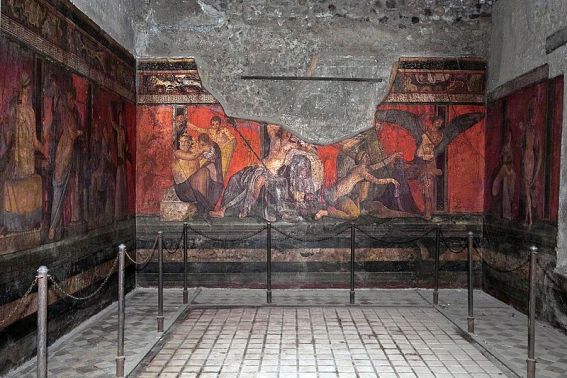
Roman_fresco_Villa_dei_Misteri_Pompeii_006

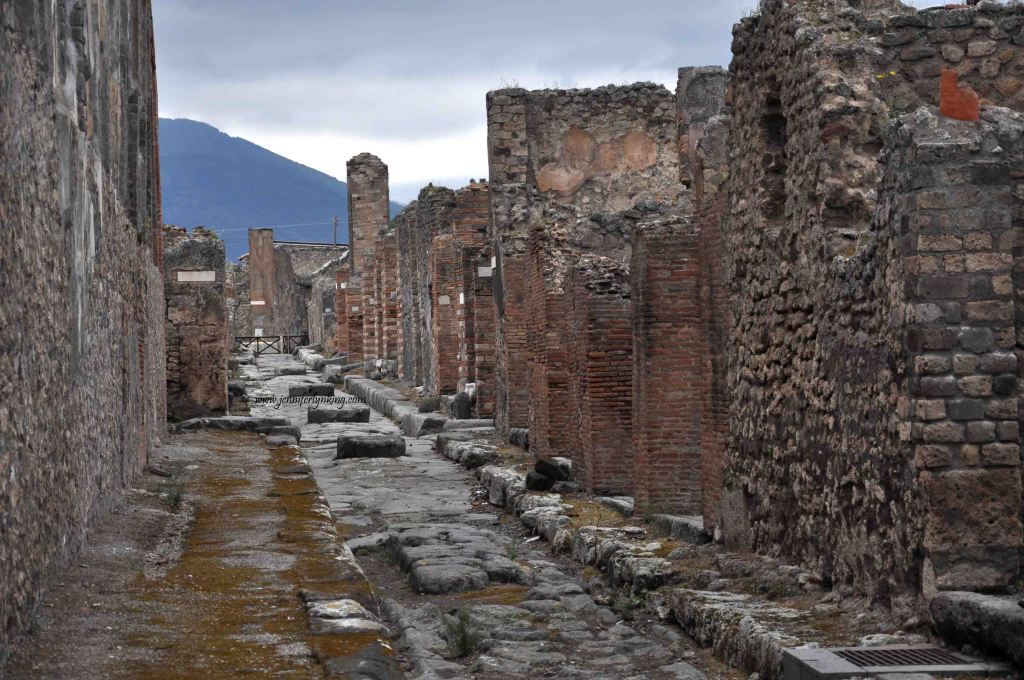
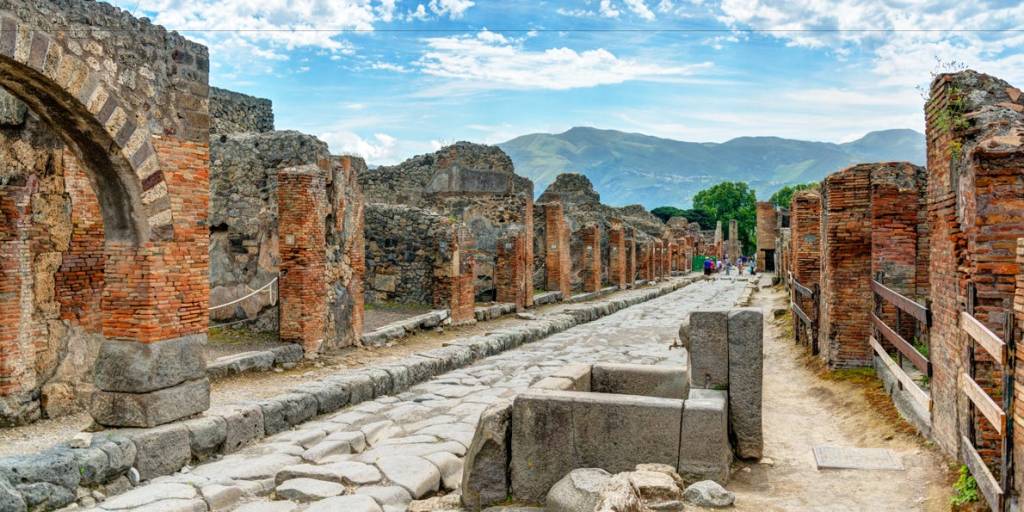
Today you can tour the lost city of Pompeii, from the baths to the forum, to the Lupanar Grande, where the prostitutes of Pompeii once “entertained” clients.  Ongoing excavation is all but a race with time, between uncovering what remains, and preserving what is.  Walls surrounding the “House of the Moralist” collapsed in 2010, so-called because its wealthy wine merchant owners posted rules of behavior, for guests to follow: “Do not have lustful expressions and flirtatious eyes for another man’s wife“.

Fun fact: A majority of Ancient Pompeiians had near-perfect teeth due to naturally occurring fluorine and a diet rich in fruits and vegetables.

There were other signs of what was to come. Tremors. Springs dried up. Fish died and floated on the river Sarno, victims of increased acidification of the water. Heavy rains were blamed for the collapse of the Schola Armatorium in 2010, the House of the Gladiators.  Fierce recriminations have followed and doubt has been cast on local authorities’ abilities, to properly preserve what has become a UNESCO World Heritage site.

Be that as it may, 2,000-year-old buildings do not come along every day.  There is no replacement for antiquity.

February 1, 1790 A Republic, if you can Keep it

Good judgement it’s been said, comes from experience. And experience? That comes from bad judgement.

Article III of the United States Constitution establishes the Supreme Court of the United States (SCOTUS), and “such inferior Courts as the Congress may from time to time ordain and establish”. There is no mention of the number of justices.

The first Congress passed the Federal Judiciary Act on September 24, 1789, specifying a six-justice Supreme Court. That same day President George Washington appointed John Jay of New York as chief justice along with associate justices John Rutledge of South Carolina, William Cushing of Massachusetts, John Blair of Virginia, Robert Harrison of Maryland and James Wilson of Pennsylvania.

Two days later the Senate confirmed all six. The Supreme Court of the United States sat for the first time in the Royal Exchange Building on New York City’s Broad Street on February 1, 1790.

Twelve years later, the presidency of John Adams was coming to an end. As a Federalist, Adams was pleased to throw a speed bump in the path of incoming Democratic-Republican, Thomas Jefferson. To that end, Adams appointed the infamous “midnight judges” in the last hours of his administration: 16 Federalist Circuit Court judges and 42 Federalist Justices of the Peace.

The incoming Jefferson administration sought to block the appointments. Jefferson ordered then-Secretary of State James Madison to hold those commissions as yet undelivered, thus invalidating the appointments. One appointee, William Marbury, sued.

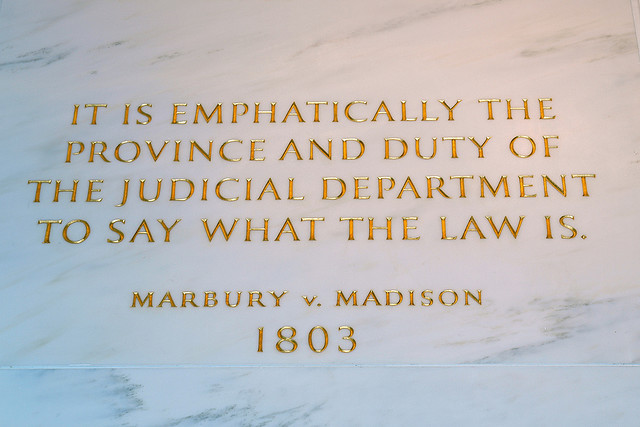
The case advanced all the way to the Supreme Court which ruled in Marbury v. Madison, the provision of the Judiciary Act enabling Marbury to bring his claim, was unconstitutional.  Marbury lost his case but the principle of judicial review, the idea that the court would preside God-like over laws passed by their co-equal branch, remains the law of the land from that day to this.

marbury-v-madison

Over time, SCOTUS has proven itself to be as imperfect as any other institution.

In the early days of the Great Depression, Federal agricultural officials conceived the hare brained idea that artificially introducing scarcity would increase prices and therefore wages, in the agricultural sector. Six million hogs were destroyed in 1933. Not harvested, just destroyed and burned or plowed into the ground. 470,000 cattle were shot in Nebraska alone. Vast quantities of milk were poured down sewers, all at a time of national depression and widespread malnutrition.

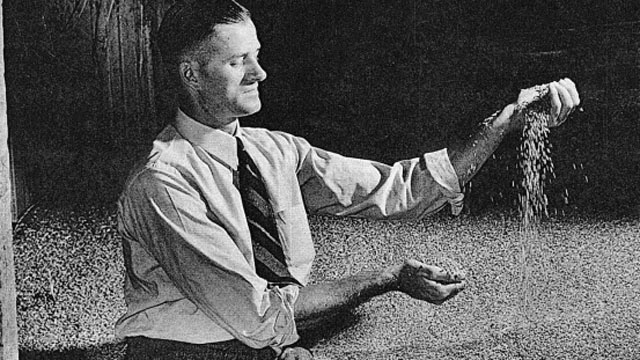
With the Agricultural Adjustment Act of 1938, Washington began to impose production quotas on the nation’s farmers. Ohio farmer Roscoe Filburne was ordered to grow 223 bushels of wheat during the 1941 season. He grew 462.

ht_roscoe_filburn_nt_120130_wmain

Article 1, Section 8 of the Constitution permits Congress “To regulate Commerce with foreign Nations, and among the several States, and with the Indian Tribes”. That’s it but, on this flimsy basis, the Federal Government took Roscoe Filburne to court.

The farmer argued the federal government had nothing to say as any “surplus” stayed on his farm, feeding the Filburne family and their chickens. Lower Courts sided with the farmer. The government appealed all the way to the Supreme Court arguing that, by withholding his surplus from the market, Filburne was effecting interstate market conditions, thereby putting him under federal government jurisdiction.

Intimidated by the Roosevelt administration’s aggressive and illegal “court packing scheme“, SCOTUS decided the Wickard v. Filburne case, against the farmer. Ever since that time, what you don’t do can be held against you by the government, in a court of law. Get it? Neither do I.

Kelo v. City of New London ruled one private party’s judicial theft of another’s was a valid use of the takings clause. Two dozen Connecticut families were evicted and forced out of their homes. Their houses were bulldozed, neatly kept yards overgrown with weeds and left a dumping ground and home, for feral cats. Small matter to those homeowners the proposed “redevelopment” of their neighborhood, never happened.

In the entire history of the court there have only been 115 justices. 

Some among those 115 have been magnificent human beings. Some of them were cranks. There have been instances of diminished capacity ranging from confusion to outright insanity. One justice spent part of his term in a debtor’s prison. Another killed a man. There have been open racists and anti-Semites.

There is no official portrait of the 1924 court because Justice James C. McReynolds wouldn’t stand next to Louis Brandeis, the court’s first Jewish Justice. One Justice was known to chase flight attendants around his quarters while another spent his time in chambers, watching soap operas.

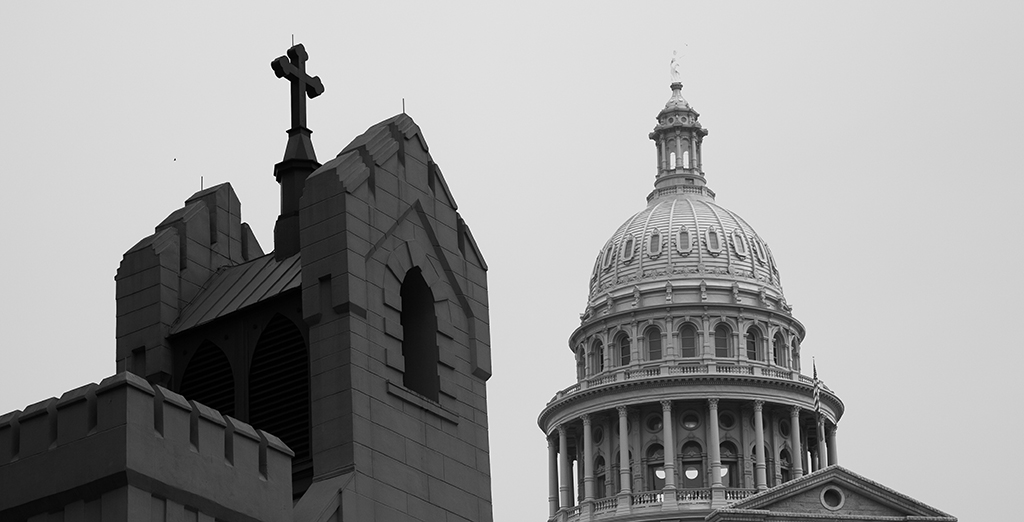
There’s the former Klan lawyer turned Justice who took a single phrase from a private letter of Thomas Jefferson, “separation of church and state”, and transformed the constitutional freedom OF religion into an entirely made up freedom FROM religion.

Separation-of-Church-and-State

The Supreme Court reinforced chattel slavery with the Dred Scott decision. The Korematsu ruling gave us the forced incarceration of Americans of Japanese descent. Buck v. Bell gave Americans the “gift” of forced sterilization and Stenberg v. Carhartt enshrined the constitutional “right” to the unthinkable “procedure” known as partial birth abortion. Hammer v. Dagenhart supported the practice of children, put to work in the nation’s mines and factories.

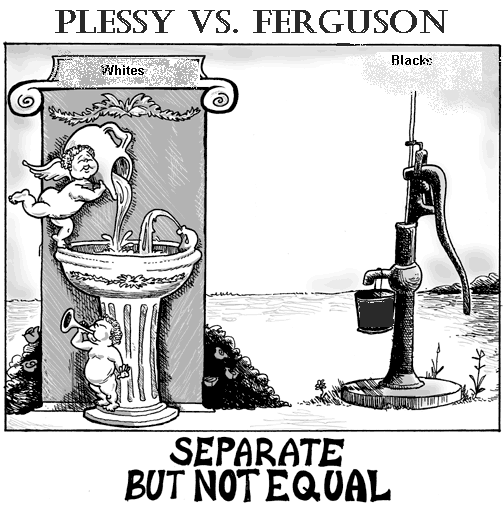
From “Separate but Equal” to the “rights” of terrorists, SCOTUS’ rulings are final, infallible and sometimes, imbecilic.

Chief Justice John Roberts once said “remember that it’s my job to call balls and strikes, and not to pitch or bat.”

He who invented a new definition of taxation enshrining the “Affordable Care Act” as the law of the land.

The constitution invests state legislatures with sole authority to determine state voting regulations. Yet recently, we had election officials and state courts changing key states’ voting rules while SCOTUS declined to intervene. Is there any wonder why half a nation questions the validity of that election?

Just don’t say it out loud or you’ll be de-platformed, or worse.

Today a man barely a week in office convenes a commission to recommend Supreme Court “reforms”, up to and including exhuming Roosevelt’s court packing scheme. It’s not hard to guess how that will turn out. Because it never really was about transparency, fairness or even democracy, was it. Just the raw exercise of power.